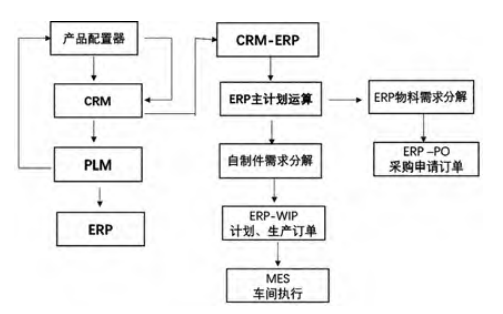
随着企业规模的不断扩大,部门之间信息壁垒,各环节反复确认,变更信息传递不及时,产品零件组装不匹配,产品下线不合格,需要投入更多的管理资源来处理各类数据问题,导致企业运营成本虚高,严重制约了企业的发展。制造业企业的订单数字化管理应用流程如图 1 所示,从执行层往上均为数字化管理,消除了大量的纸质文件与沟通阻力。
PLM 作为将企业产品数据与变更过程进行流程化、系统化集成的信息化管理平台,其发展至今已具有强大的数据连接整合能力,贯穿了产品全生命周期的数据管理,在众多大型制造业企业得到应用,是应对信息技术不断更新发展,市场对产品迭代速度要求不断提高,实现企业数字化转型的重要管理工具。企业数字化管理是集中高效的线上业务处理模式,基于标准化的数据基础,构建从产品数据、工艺文档、项目管理等各大环节资源数字化集成的一种企业管理模式。
一、数字化管理的标准化基础
数字化管理应在企业标准化的基础上实施,企业严格实施国家标准体系,使企业经营活动符合社会法规要求和对外相关业务的拓展更加有利。企业标准化源于国家颁发的《企业标准体系 要求》GB/T 15496-2017,企业标准化的过程就是将符合客户需求与质量要求的重复活动进行规范化、流程化,并赋予具体的指标参数,以企业经营管理的最佳秩序与活动效益作为管理目标,将工作方式与方法科学化、具体化,能实现工作流程与结构的快速参照复制,保障相关工作人员操作规范、系统运行效率更高。企业标准化可分为事与物两大类别,“物”指的是具体的人员、产品、材料、设备以及工具等;“事”则是在企业中开展工作的具体方法、参考示例、流程限定等能够提升企业运行效率的操作或管理。标准化是企业信息化建设的前提,如 PLM 系统就要求立项必须包括项目名称、业务板块、产品类别、部门领导、实施流程等标准内容。 数字化转型网(www.szhzxw.cn)
数字化基于标准化,企业运行过程中庞大的数据量需要标准化的管理基础,混乱的数据需要做好分类,按照既定的规则进行数据整理,最后上传到 PLM系统对应的数据库,形成具有极高参考价值的历史数据,为新产品的开发提供依据和保障,倘若原始数据与操作流程未能形成标准化的分类管理,即使上传到了 PLM 系统,也只是一堆毫无价值的数据垃圾,导致企业数据管理混乱,系统运作与实际工作格格不入。
PLM 系统的成功推行需要标准化数据,研发设计团队在此基础上进行协同化的产品模块组合设计。否则,PLM 系统的项目无法集成优势资源,系统管理失去其意义。
企业标准化建设与 PLM系统管理是相辅相成的,通过系统的高效管理,能够使企业标准化的文件体系不断更新完善,形成一个符合企业发展需求的标准文件结构及其管理体系。企业标准一般通过企管部进行审定与统一管理下发,通过使用 PLM 系统管理,将产品研发标准体系、产品制造标准体系、业务保障标准体系、岗位职责标准体系整合起来。此外,PLM 系统导出功能同样也方便了企业标准模板修订、标准文件分级受控打印等工作,实现研发与标准化工作同步,不仅有效提升产品全生命周期管理能力,而且促进产品质量的提高与企业技术的进步。
二、PLM系统工艺管理数字化
应对零部件工艺规程管理,通过构建企业标准工艺规程要求的工艺资源体系,按照分类定义工艺系统中的工艺资源类别,实现工艺资源的集中管理,并采用结构化的数据框架将产品涉及的工艺标准、设备选型、模具、工装容器、工艺参数、原材料等有序地关联管理起来,形成能直接指导生产的完整工艺规程数据,同时将常规的工艺术语在 PLM 系统中进行嵌入式语言管理,方便设计员直接引用这些常用术语,提升工艺规程编制效率与规范度。 数字化转型网(www.szhzxw.cn)
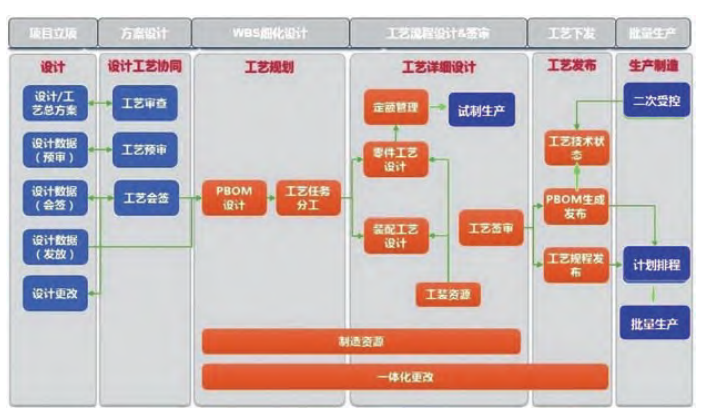
工艺变更与签审管理,基于 PLM 系统强化设计工艺一体化变更管理,提升工艺变更管理可控性,增加设计工艺一体化变更中设计更改的工艺会签环节,通过协同编辑程序实现 MBOM 数据的同步变更,建立对工艺资源数据的创建、审核、更改功能,限制不同账号的更改权限与设置生产管理人员签审环节,只有经过各环节签审的工艺规程才能投入到批量生产,同时系统以历史数据标识设计变更信息,保障设计工艺信息的一致性。设计更改归档后,下发工艺更改任务,整个流程在历史数据栏进行显示,方便管理人员查看变更过程信息,实现设计工艺一体化更改数字化闭环管理,并在生产车间配置 PC 端,方便生产班组直接查看电子工艺规程,消除纸质图形文档的打印与流转,实现工艺规程与图文数字化管理,从设计到生产的全过程产品工艺数字化管理流程如图 2 所示,各个环节设置的工艺签审与历史变更记录,减少了产品工艺过程管理的复杂度,大大降低了产品升级改进后数据管理的难度。
三、PLM系统产品管理数字化
ERP 中的订单确认后,即可形成对应的生产计划需求,计划下发到对应的生产系统,生产部根据MBOM 清单,安排物料的采购与自制生产,PLM 系统则按照既定的规则将 EBOM 转成 MBOM,构建EBOM 与 MBOM 之间的实时数据关联,并对零部件BOM 涉及的工艺规程进行管理。
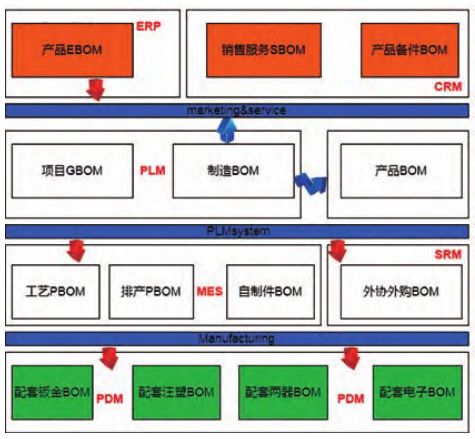
通过 PLM 系统对 BOM 的生成进行标准化管理,减少企业资源的浪费。为满足市场对产品定制化、多样化的需求,同一规格的空调产品需设计多款型号,搭载不同的外观与功能,应对不同的使用场景,这就导致配套的冲压零件种类繁多,图文设计变更频繁,生产切换频繁,大量的时间与加工资源浪费在不增值的校准、编程、工装、模具切换步骤。为提升不同型号产品配套冲压零件的兼容性,需依据 PLM 系统的连接规则对产品进行精益设计及标准化管理,同时采用仿真设计与模拟生产等先进技术,优化设计结构,减少生产辅料的使用,并从源头确定各型号产品对应的 X 系列冲压零件结构通用化特征及同系列零件模块化的 BOM 电子清单管理,以 PLM 系统为基础,对应产品的物料信息采用数字化管理,图 3 为产品各环节 BOM 清单数字化管理过程。 数字化转型网(www.szhzxw.cn)
采用标准化、模块化的 BOM 电子清单管理,消除因设计员或设计理念的变化对成熟产品的结构特征变化,其对应的物料编号都进行分类分族,严格进行设计图文下发签审。实际生产过程中,零件的外形设计应与设备的加工范围相匹配,有些零件在满足尺寸装配要求的情况下,却无法在现有的设备进行加工或加工的质量不符合控制要求,因此零件的设计审核者应当熟悉应用设备,确定零件的各项要求能够正常保障,保障加工工艺符合现有生产条件,并形成该系列精益设计标准文件,减少因加工浪费造成的交期延后问题。通过产品模块化精益设计,能够大大缩短设计周期,提升设计面向生产的保障能力,有利于建立新员工标准化培养体系,缩短培训周期。
四、PLM系统项目管理数字化
PLM 系统具有产品结构管理、工作流程管理、工艺图文管理、数据变更管理、零部件管理、集成与协同管理等功能,项目周期与产品生命周期 (PLM) 类似,通过 PLM 进行系统化、数字化的管理方式,将所有与产品相关的数据在其整个生命周期内进行集成管理,能够实现数据跨企业、跨空间、跨时间的管理,能够集成与产品相关的管理资源、标准流程、应用系统和数据信息。
PLM 系统生成项目报表:不同层级的管理人员所关心的报表内容不同,公司领导者最关心公司整体的发展支撑项目概况、整体项目分布、整体投入成本、整体效益、回收周期,中层领导最关心的是本部门参与项目的概况、承接公司重大项目概况、部门异常项目,项目负责人则具体关注项目进度、资源分配、节点周期等,通过 PLM 系统进行管理的项目则可根据权限层级进行报表的生成与打印,进一步优化了项目管理结构。
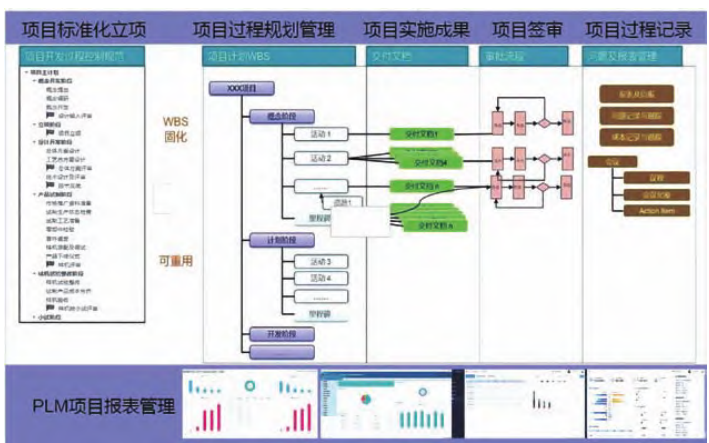
PLM 系统与规范流程:产品从概念到投产需要经历一个又一个的优化及筛选流程,产品的开发过程按照项目的方式进行管理,不同的产品需求对应不同的项目类型,如拓展产品开发、系列化产品开发、创新研究型课题等。对按照项目的不同路线进行标准化整理,对应到系统上相应的产品开发流程,包括项目资源、研发签审、工艺签审、技术签审等,从而形成标准的工程分解 WBS,这样可以做到分工明确,环节可控,任务清晰,方便整个过程的管理,图 4 为项目 4 大过程的数字化管理,各环节均形成了过程记录,方便项目管理人员对项目周期的管控。 数字化转型网(www.szhzxw.cn)
PLM 项目管理模板:PLM 系统一项重要的功能是项目管理模板建设,使用不同项目类型对应不同的细分模板,可减少不必要的资源投入,如研发型项目立项时对应到研发部门的资源配置与成果量化标准,按照项目的重要度与紧急程度参与的人员职级也可进行对应。项目管理过程在系统对应了标准处理模块,如评审看板 : 提供各单位评审整改问题相应信息和各单位关键技术图文相应信息;待办任务 : 可处理所有 PLM 任务,在任务区中集成签审需查看对应状态内容,如打开主要内容,更改单内容,实现快速签审;批量编制:实现同类型的升级流程或变更流程,同文档细类的标准流程可集中维护并批量启动;批量签审:实现同文档细类且同签审节点批量签审;重新分配任务:实现将已收到不属于自己的任务重新分配给他人。
项目计划 WBS 分解:完整的项目可细化分解到具体的实施步骤,如对项目开发的周期进行分解,可分为项目立项、项目方案、实施计划、交付计划、控制计划等。工程分解结构 (WBS) 分解的实施步骤需切实可行,且能支撑项目落地的各个环节,系统可用关键路线图 CPM 进行事件与活动的可视化表述,对应到项目成员时可在立项阶段进行节点负责人维护,项目成员进行节点签审,并在工作看板中了解自身的工作任务,按照周期提交对应成果,保障项目整体交付。分解实施后的项目,随着各个环节的交付,最终在系统形成完整的过程文档,实现整个项目周期数字化管理。
五、PLM 在冲压车间数字化管理的应用
以冲压生产车间的数字化管理应用为例,冲压生产车间的建设基于各大项目的集成应用,通过 PLM与生产车间 MES 信息化系统的数据连接共享实现对相关落地项目的全生命周期管理,可以有效地监控项目在生产车间的应用状况,MES 信息化系统通过运用数据采集技术、网络技术和数据库技术等将线体设备状态、工艺图文信息、生产决策管理、实时进度数据等进行数字化集成,通过配置汇集 Creo 助手及 Creo参数化工具,应用冲压 Creo 参数化工具查看三维图纸,配置系统个人看板管理,提供个人实时的系统信息,极大方便了车间班组长的日常管理工作,实现了车间资源的数字化管理与内外部信息联通利用,进一步改善车间生产过程的资源组织和管理,优化各类资源的柔性化配置,有利于提高车间的制造质量、效率和过程可控性。 数字化转型网(www.szhzxw.cn)
结束语
制造业企业实施 PLM 系统管理首先应建立各项数据的标准化,并对各层级管理人员进行认知与操作培训,构建系统实施基础。制造业企业通过应用 PLM系统,从点到面实现企业产品全生命周期的数字化管理,改善了企业内部管理结构,使企业从研发到生产流程更加规范合理,进一步发挥了企业各项资源优势,有效避免了各类数据的混乱与管理资源的浪费,极大提升了企业运营效率,是企业规模化发展的重要管理工具。

翻译:
The application of |PLM system in the digital management of manufacturing enterprises
With the continuous expansion of enterprise scale, information barriers between departments, repeated confirmation of each link, untimely transfer of change information, mismatch of product parts assembly, and unqualified products, more management resources need to be invested to deal with various data problems, resulting in high operating costs of enterprises and seriously restricting the development of enterprises. The application process of digital order management in manufacturing enterprises is shown in Figure 1. From the executive level up, it is all digital management, eliminating a lot of paper documents and communication resistance. 数字化转型网(www.szhzxw.cn)
Figure 1 Application flow of enterprise order digital management
As an information management platform that processes and systematically integrates enterprise product data and change process, PLM has developed so far with strong data connection and integration capabilities, and has run through the data management of the whole product life cycle. It has been applied in many large manufacturing enterprises in response to the continuous update and development of information technology and the increasing market requirements for product iteration speed. An important management tool for digital transformation of enterprises. Enterprise digital management is a centralized and efficient online business processing mode, based on standardized data basis, to build a digital integration of product data, process documents, project management and other major links of resources.
First, the standardization basis of digital management
Digital management should be implemented on the basis of enterprise standardization, and enterprises should strictly implement the national standard system, so that the business activities of enterprises can meet the requirements of social regulations and the expansion of foreign related businesses is more favorable. Enterprise standardization originated from the “enterprise standard system Requirements” GB/T 15496-2017 issued by the state, the process of enterprise standardization is to standardize and process repeated activities that meet customer needs and quality requirements, and give specific indicators and parameters, and take the best order and activity efficiency of enterprise management as the management goal. The scientific and specific working methods and methods can realize the rapid reference and replication of work processes and structures, ensure the operation standards of relevant staff and higher efficiency of system operation. Enterprise standardization can be divided into two categories: things and things, “things” refers to specific personnel, products, materials, equipment and tools; The “thing” is the operation or management that can improve the operation efficiency of the enterprise, such as the specific methods, reference examples, and process limits of the work in the enterprise. Standardization is the premise of enterprise information construction, such as PLM system requires that the project must include project name, business segment, product category, department leader, implementation process and other standard content. 数字化转型网(www.szhzxw.cn)
Digitalization is based on standardization. The huge amount of data in the process of enterprise operation needs a standardized management basis. The chaotic data needs to be classified, sorted according to established rules, and finally uploaded to the corresponding database of PLM system to form historical data with high reference value and provide basis and guarantee for the development of new products. If the original data and operation process do not form a standardized classification management, even if uploaded to the PLM system, it is only a pile of worthless data garbage, resulting in confusion of enterprise data management, system operation and actual work.
The successful implementation of the PLM system requires standardized data, on which the R & D design team collaboratively designs the product module combination. Otherwise, the project of PLM system cannot integrate superior resources, and system management loses its significance.
Enterprise standardization construction and PLM system management are complementary to each other, through the efficient management of the system, can make the enterprise standardized document system constantly updated and improved, forming a standard document structure and its management system in line with the needs of enterprise development. Enterprise standards are generally approved by the Department of Business Management and issued under unified management. Through the use of PLM system management, the product research and development standard system, product manufacturing standard system, business security standard system, and job responsibility standard system are integrated. In addition, the PLM system export function also facilitates the revision of enterprise standard templates and the grading and controlled printing of standard documents, realizing the synchronization of R & D and standardization work, which not only effectively improves the product life cycle management ability, but also promotes the improvement of product quality and the progress of enterprise technology.
Second, PLM system process management digitization
Parts process regulation management should be implemented by building the process resource system required by the enterprise standard process regulation, defining the process resource categories in the process system according to the classification, achieving centralized management of process resources, and using structured data framework to orderly associate management of process standards, equipment selection, molds, tooling containers, process parameters, raw materials, etc., involved in the product. Form a complete process data that can directly guide the production, and at the same time, the conventional process terms are managed in the embedded language in the PLM system, which is convenient for designers to directly reference these common terms, and improve the process preparation efficiency and standardization. 数字化转型网(www.szhzxw.cn)
Process change and approval management: strengthen the integrated change management of design process based on the PLM system, improve the controllability of process change management, increase the process countersign of design changes in the integrated change of design process, realize the synchronous change of MBOM data through collaborative editing program, and establish the creation, review and change functions of process resource data. Limit the change rights of different accounts and set the production management personnel signing process, only the process regulations that have been signed in each process can be put into mass production, and the system marks the design change information with historical data to ensure the consistency of the design process information. After the design changes are filed, the process change task is issued, and the whole process is displayed in the historical data bar, which is convenient for managers to view the change process information, realize the digital closed-loop management of the integrated design process changes, and configure the PC terminal in the production workshop, which is convenient for production teams to directly view the electronic process procedures, and eliminate the printing and circulation of paper graphic documents. Digital management of process procedures and graphics is realized. The whole process digital management process of products from design to production is shown in Figure 2. Process approval and historical change records set in each link reduce the complexity of product process management and greatly reduce the difficulty of data management after product upgrading and improvement.
Third, PLM system product management digitization
After the order in ERP is confirmed, the corresponding production plan needs can be formed, and the plan is sent to the corresponding production system. The production department arranges the material purchase and self-made production according to the MBOM list. The PLM system converts EBOM into MBOM according to the established rules, and constructs the real-time data association between EBOM and MBOM. And the BOM of parts involved in the process of management.
The generation of BOM is standardized and managed by PLM system to reduce the waste of enterprise resources. In order to meet the market’s demand for product customization and diversification, air conditioning products of the same specification need to be designed with multiple models, equipped with different appearance and functions, and cope with different use scenarios, which leads to a wide variety of supporting stamping parts, frequent graphic design changes, and frequent production switching. A lot of time and processing resources are wasted on calibration, programming, tooling, and tooling switching steps that do not add value. In order to improve the compatibility of stamping parts for different types of products, lean design and standardized management of products should be carried out according to the connection rules of the PLM system, and advanced technologies such as simulation design and simulation production should be adopted to optimize the design structure and reduce the use of production accessories. And from the source to determine the structure of the X-series stamping parts corresponding to each type of product universal characteristics and the same series of parts modular BOM electronic list management, based on the PLM system, the material information of the corresponding product adopts digital management, Figure 3 shows the product BOM list digital management process.
Figure 3 Digitization of product BOM material information management
Adopt standardized and modular BOM electronic list management to eliminate the structural characteristics changes of mature products due to the changes of designers or design concepts, and the corresponding material numbers are classified and classified, and the design text and text are strictly issued and signed. In the actual production process, the shape design of the parts should match the processing range of the equipment, some parts in the case of meeting the size assembly requirements, but can not be processed in the existing equipment or the quality of processing does not meet the control requirements, so the design auditor of the parts should be familiar with the application equipment, to determine the requirements of the parts can be normally guaranteed. Ensure that the processing technology meets the existing production conditions, and form the series of lean design standard documents to reduce the delivery delay caused by processing waste. Through the modular lean design of products, the design cycle can be greatly shortened, the guarantee ability of design for production can be improved, and the standardized training system for new employees can be established to shorten the training cycle. 数字化转型网(www.szhzxw.cn)
Fourth, PLM system project management digitization
PLM system has the functions of product structure management, workflow management, process graphics management, data change management, parts management, integration and collaborative management, etc. The project cycle is similar to the product life cycle (PLM), and systematic and digital management is carried out through PLM. The integrated management of all product-related data throughout its life cycle enables data to be managed across enterprises, across Spaces, and across time, and integrates product-related management resources, standard processes, application systems, and data information.
PLM system generates project reports: Managers at different levels are concerned about different report contents. Company leaders are most concerned about the company’s overall development support project overview, overall project distribution, overall input cost, overall benefit, and recovery cycle, while middle-level leaders are most concerned about the department’s participation in the project overview, the company’s major project overview, and the department’s abnormal project. The project leader pays specific attention to the project schedule, resource allocation, node cycle, etc., and the project managed by the PLM system can generate and print reports according to the authority level, further optimizing the project management structure. 数字化转型网(www.szhzxw.cn)
PLM system and standard process: The product needs to go through one optimization and screening process after another from concept to production. The product development process is managed according to the way of project. Different product requirements correspond to different project types, such as expanded product development, serialized product development, innovative research topics, etc. Standardize and organize the different routes of the project, corresponding to the corresponding product development process on the system, including project resources, R & D approval, process approval, technical approval, etc., so as to form a standard engineering decomposition WBS, which can achieve a clear division of labor, controllable links, clear tasks, and convenient management of the whole process. Figure 4 shows the digital management of the four major processes of the project. Process records are formed in each link, which is convenient for project managers to control the project cycle.
Figure 4 Digitization of project process management based on PLM system
PLM project management template: An important function of the PLM system is the construction of project management templates. The use of different project types corresponding to different subdivision templates can reduce unnecessary resource investment, such as the resource allocation and quantitative standards of the research and development department when the project is set up, and the ranks of the personnel involved can also be corresponding according to the importance and urgency of the project. The project management process corresponds to the standard processing modules in the system, such as the review Kanban: provides the corresponding information of each unit’s review and rectification problems and the corresponding information of each unit’s key technical graphics; To-do tasks: can handle all PLM tasks, integrated in the task area to check the corresponding status content, such as open the main content, change the content of the order, to achieve quick signing; Batch preparation: realize the same type of upgrade process or change process, and the standard process of the same type of document can be centralized maintenance and batch start; Batch signing: to implement batch signing of the same document and the same node; Reassign tasks: The implementation reassigns tasks that have been received that do not belong to it to others.
Project plan WBS decomposition: a complete project can be broken down into specific implementation steps, such as the decomposition of the project development cycle, which can be divided into project initiation, project plan, implementation plan, delivery plan, control plan, etc. The implementation steps of engineering decomposition structure (WBS) decomposition should be feasible and able to support all aspects of the project landing. The system can use key roadmap CPM for visual representation of events and activities. When corresponding to project members, node leader maintenance can be carried out in the project initiation stage, and project members can sign node approval and understand their work tasks in the work Kanban. Submit the corresponding results according to the cycle to ensure the overall delivery of the project. After the decomposition of the implementation of the project, with the delivery of each link, the final system to form a complete process document, to achieve the entire project cycle digital management. 数字化转型网(www.szhzxw.cn)
Five, PLM in the stamping shop digital management application
Taking the digital management application of stamping production workshop as an example, the construction of stamping production workshop is based on the integrated application of major projects. Through the data connection and sharing of PLM and MES information system of the production workshop, the whole life cycle management of related projects can be realized, and the application status of projects in the production workshop can be effectively monitored. MES information system through the use of data acquisition technology, network technology and database technology to the line equipment status, process graphic information, production decision management, real-time progress data and other digital integration, through the configuration of Creo assistant and Creo parameter chemical tools, the application of stamping Creo parameter chemical tools to view three-dimensional drawings. Configuring the system’s personal Kanban management, providing personal real-time system information, greatly facilitates the daily management of workshop team leaders, realizes the digital management of workshop resources and the interconnection and utilization of internal and external information, further improves the resource organization and management of the workshop’s production process, optimizes the flexible allocation of various resources, and is conducive to improving the manufacturing quality, efficiency and process controllability of the workshop.
Closing remarks
The implementation of PLM system management in manufacturing enterprises should first establish the standardization of various data, and conduct cognitive and operational training for managers at all levels to build the foundation of system implementation. Through the application of PLM system, manufacturing enterprises can realize the digital management of the whole life cycle of enterprise products from point to point, improve the internal management structure of enterprises, make enterprises more standardized and reasonable from research and development to production processes, further exert the advantages of various resources of enterprises, effectively avoid the confusion of various data and waste of management resources, and greatly improve the operation efficiency of enterprises. It is an important management tool for the large-scale development of enterprises.
本文由数字化转型网(www.szhzxw.cn)转载而成,来源于《锻造与冲压》2024年第4期;编辑/翻译:数字化转型网宁檬树。
免责声明: 本网站(http://www.szhzxw.cn/)内容主要来自原创、合作媒体供稿和第三方投稿,凡在本网站出现的信息,均仅供参考。本网站将尽力确保所提供信息的准确性及可靠性,但不保证有关资料的准确性及可靠性,读者在使用前请进一步核实,并对任何自主决定的行为负责。本网站对有关资料所引致的错误、不确或遗漏,概不负任何法律责任。
本网站刊载的所有内容(包括但不仅限文字、图片、LOGO、音频、视频、软件、程序等) 版权归原作者所有。任何单位或个人认为本网站中的内容可能涉嫌侵犯其知识产权或存在不实内容时,请及时通知本站,予以删除。