
【摘要】
2023年,我国经济运行回升向好,同比增速呈现出“前低、中高、后稳”的特征,全年经济增长5.2%。随着鼓励民营经济发展、扩大消费、优化房地产政策、化解地方政府债务、增发一万亿国债支持灾后重建和防灾减灾等政策措施的陆续出台,叠加2024年的政策措施有利于经济继续恢复增长。预计2024年,我国经济长期向好的基本面没有变化,经济增长速度在5%左右。
2023年,我国经济运行回升向好,经济社会发展预期目标基本实现。但疫情的疤痕效应和国际经济环境变化会继续影响我国经济,国内有效需求不足,部分行业产能过剩,市场预期不稳,风险隐患较多,外部环境复杂性、严峻性、不确定性上升。我国将坚持稳中求进、以进促稳、先立后破的原则,继续实施积极的财政政策和稳健的货币政策,不断深化改革、扩大开放,切实增强经济活力、防范化解风险、改善社会预期,巩固和增强经济回升向好态势,持续推动经济实现质的有效提升和量的合理增长,预计2024年我国经济增长5%左右。 数字化转型网(www.szhzxw.cn)
一、我国经济运行面临的问题和挑战
2023年是三年新冠肺炎疫情防控转段后经济恢复发展的一年,经济同比增速呈现出“前低、中高、后稳”的特征,全年经济增长5.2%,就业达到1244万人,物价低位运行;新兴产业增长较快,产业结构继续转型升级;科技创新实现新的突破,涌现出一批科技创新成果;金融、科技等机构改革取得进展;粮食、能源供给充足,地方债风险得到化解,安全发展基础巩固夯实;居民收入增长快于经济增长,农村居民人均可支配收入高于城镇居民,民生保障有力有效。但我国经济发展过程中仍面临一些突出矛盾和问题,需引起高度关注。 数字化转型网(www.szhzxw.cn)
(一)外部环境风险挑战仍然较多,我国的机遇大于挑战
2022年以来,为了应对数十年来处于高位的通胀水平,各国前所未有地收紧了货币政策,但全球经济持续从新冠疫情、俄乌冲突等冲击中复苏,世界经济放缓但并未停滞。按照国际货币基金组织2024年1月份的最新预测,2024年全球经济增速和2023年持平,增长3%,世界平均消费价格从2023年的5.9%降至4.8%。全球贸易量增长速度有所加快。世界贸易组织预测,2024年世界贸易量增长3.5%左右,高于2023年0.8%的水平。为防止经济继续回落,美国、欧元区会停止加息步伐,美国有可能在2024年年中前后开始降息,欧元区会先于美国进行降息。与此同时,美国继续对我国进行遏制围堵,主导启动“印太经济框架”“芯片四方联盟”,联合一些国家限制对我国芯片和相关生产设备出口,推动产业链转出中国,迟滞我国产业链提升和科技创新步伐。我国仍面临着资本外流、产业外迁、出口转移的巨大压力。中美博弈也会导致我国比较优势和竞争优势难以充分和有效发挥,科技创新成本上升,产业链、供应链稳定受到威胁。但世界贸易增速加快,有利于我国的出口增长和对外投资,中美、中欧利差缩小会减小人民币贬值压力,增加外资流入,为我国实施稳健货币政策增加了空间。
(二)国内有效需求不足
2022—2023年,我国经济平均增长4.1%,和我国5.3%左右的潜在经济增速相比,存在较大的供求缺口,需求不足成为当前我国经济运行最主要的矛盾。疫情的疤痕效应还会继续影响居民的收入和消费信心,中低收入群体担心就业、房贷、育幼、上学、医疗、养老等问题,不断增加储蓄,减小支出;中高收入居民,财富收入减少,消费顾虑增多,消费意愿不足。房地产销售和开发投资持续下滑,新开工面积和土地购置面积大幅萎缩,一些企业的流动性风险和信用风险持续暴露,“销售弱—回款难—融资难—拿地意愿不足—新开工降速—房地产投资回落”的循环打破尚需时日,房地产能否稳定发展成为我国经济的最大不确定因素。工业企业产能过剩,利润下降,近三年来的高制造业投资增速难以持续。地方财政困难,债务负担加大,基础设施建设受到地方财力的严重制约。 数字化转型网(www.szhzxw.cn)
(三)经营主体预期较弱
需求不足,产能过剩,工业品价格负增长,实际利息负担加重,企业经营困难,不少个体工商户和中小微企业仍面临关停风险。近年来,社会上不断出现质疑民营企业的声音,企业产权保护仍不到位,对企业信心的影响难以在短时间恢复。政策变化多,给企业生产经营带来不利影响,市场预期不稳。国际政治经济环境恶化,美国等通过友岸外包、近岸外包、小院高墙等打压遏制我国,地缘政治风险加大,影响一些企业特别是外商投资企业的信心。
(四)财政金融风险较大
房地产风险是财政金融风险的最大隐患。土地出让金在2022年下降23%左右的基础上,2023年又下降13.2%。由于基础设施和公共服务项目盈利能力差,现金流不足,在地方财力不足、债务还本付息压力加大的情况下,地方平台的隐形债务风险开始显现,一些平台公司过度依赖新融资偿债,一些平台公司债务不得不展期,债务风险开始向银行等金融机构转移。许多民营房地产企业出现信用风险,违约难以避免。中小银行在资产质量、资本充足水平、公司治理等方面面临突出问题,其风险暴露不仅影响金融稳定,还会给居民带来财富损失,影响社会稳定。 数字化转型网(www.szhzxw.cn)
二、多措并举巩固和增强经济回升向好态势
要解决我国经济存在的矛盾和问题,需要综合施策,抓主要矛盾,突破关键瓶颈。为此,2023年中央经济工作会议和2024年全两会提出了一揽子政策措施。
(一)积极的财政政策适度加力,提质增效
2024年,财政赤字率按3%安排,赤字规模达到4.06万亿元,比上年年初预算增加1800亿,全年一般公共预算支出规模28.5万亿元,比上年增长4%。地方政府专项债券3.9万亿元,比上年增加1000亿元。从今年开始连续几年发行超长期特别国债,专项用于国家重大战略实施和重点领域安全能力建设,今年先发行1万亿元。专项债、特别国债、加上土地出让收入等基金预算收入达到12万亿元以上,比上年增长18.2%。优化支出结构,强化国家重大战略任务和基本民生财力保障,严控一般性支出。落实好结构性减税降费政策,重点支持科技创新和制造业发展。
(二)稳健的货币政策要灵活适度精准有效
保持流动性合理充裕,社会融资规模、货币供应量同经济增长和价格水平预期目标相匹配。加强总量和结构双重调节,盘活存量、提升效能,加大对重大战略、重点领域和薄弱环节的支持力度。促进社会综合融资成本稳中有降。畅通货币政策传导机制,避免资金沉淀空转。大力发展科技金融、绿色金融、普惠金融、养老金融、数字金融。优化融资增信、风险分担、信息共享等配套措施,更好满足中小微企业融资需求。 数字化转型网(www.szhzxw.cn)
(三)扩大有效需求,推动房地产市场平稳发展
以提高技术、能耗、排放等标准为牵引,推动各类生产设备、服务设备更新、技术改造和消费品以旧换新。发挥好政府投资的带动放大效应,重点支持科技创新、新型基础设施、节能减排降碳,加强民生等经济社会薄弱领域补短板,推进防洪排涝抗灾基础设施建设。今年中央预算内投资拟安排7000亿元。合理扩大地方政府专项债券投向领域和用作资本金范围,额度分配向项目准备充分、投资效率较高的地区倾斜。确保房地产市场平稳发展,扎实做好保交楼、保民生、保稳定各项工作;切实支持房地产行业合理融资需求,有效防范化解优质头部企业的金融风险,对问题较为严重的头部房企,可按照行政接管、专业托管、司法保护、银团贷款、封闭运转原则,通过追加授信、贷款展期、利息减免、债转股、股票增发等途径提供融资支持。
(四)以科技创新引领现代化产业体系建设
以科技创新推动产业创新,特别是以颠覆性技术和前沿技术催生新产业、新模式、新动能,发展新质生产力。完善新型举国体制,实施制造业重点产业链高质量发展行动,提升产业链供应链韧性和安全水平。大力推进新型工业化,发展数字经济,加快推动人工智能发展。打造生物制造、商业航天、低空经济等若干战略性新兴产业,开辟量子、生命科学等未来产业新赛道,广泛应用数智技术、绿色技术,加快传统产业转型升级。 数字化转型网(www.szhzxw.cn)
(五)深化改革开放,激发微观主体活力
国有企业、民营企业、外资企业都是现代化建设的重要力量。要不断完善落实“两个毫不动摇”的体制机制,为各类所有制企业创造公平竞争、竞相发展的良好环境。实施降低物流成本行动,健全防范化解拖欠企业账款长效机制。加快全国统一大市场建设,制定全国统一大市场建设标准指引,着力推动产权保护、市场准入、公平竞争、社会信用等方面制度规则统一。专项治理地方保护、市场分割、招商引资不当竞争等突出问题,加强对招投标市场的规范和管理。谋划新一轮财税体制改革,落实金融体制改革部署,加大对高质量发展的财税金融支持。深化电力、油气、铁路和综合运输体系等改革,健全自然垄断环节监管体制机制。深化收入分配、社会保障、医药卫生、养老服等民生领域改革。
三、2024年我国经济走势判断
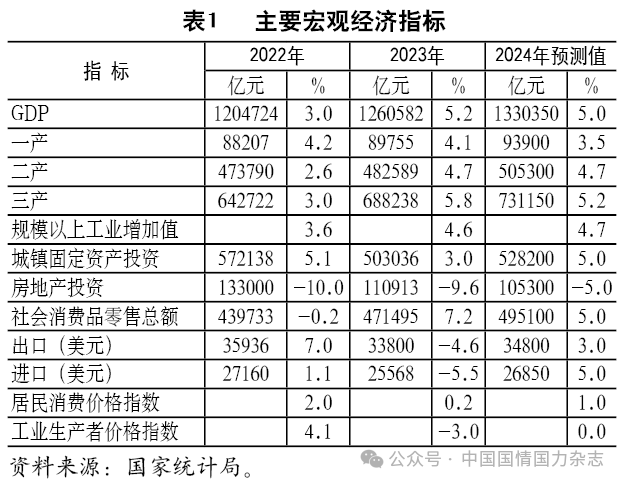
我国经济长期向好的基本面没有变化,突出表现在产业链、供应链完整齐全;科技创新能力持续提升,产业结构不断升级,数字经济、绿色产业、高技术产业和装备制造业迅速发展,新经济增长动能不断增强。2023年以来,我国陆续出台了鼓励民营经济发展、扩大消费、优化房地产政策、化解地方政府债务、增发一万亿国债支持灾后重建和防灾减灾等政策措施,这些政策叠加2024年的政策措施有利于经济继续恢复增长。预计2024年,我国经济增长速度在5%左右(见表1)。
(一)消费增速回落
经过2023年消费恢复特别是服务性消费快速反弹后,2024年,纺织服装等部分实物性消费和服务性消费将有所放缓,全年社会消费品零售额预计增长5%左右,服务消费零售额降至6%左右。消费市场将呈现高档消费增长较好、中低档消费修复偏慢、服务消费回落的局面。
(二)投资增速略有回升
依靠房地产拉动我国经济的时代到2021年已经过去,但要摆脱房地产对经济影响将是一个中长期、痛苦的过程。从国际经验看,世界上22个国家出现房地产下跌后,一般需要7年左右的时间进行调整。2022年以来,房地产从供需两端持续发力,前期央行等部门的保交楼资金支持和金融16条政策,近期的认房不认贷、降首付、降利率、保交楼、改善融资环境,这些措施会提振房地产需求,房地产市场投资降幅会有所收窄。虽然,地方政府财力不足和债务约束对基建投资形成一定拖累,但2024年基金预算支出增长较快,2023年增发一万亿国债支持灾后重建和防灾减灾会对水利等基础设施投资将在2024年发挥效应,预计基建投资增速会继续保持较高增速。2023年,我国工业企业产能利用率为75.1%,低于2022年0.5个百分点,也大大低于78%左右的合意水平;企业盈利水平下降,科技创新能力总体不足,关键零部件和关键技术存在卡脖子问题,制造业企业总体投资增速会有所下降。预计2024年,城镇固定资产投资增长5%左右。
(三)出口有所好转,净出口对经济拉动作用增强或将成为2024年经济的亮点
部分国内外资企业产能向海外转移,跨国公司调整企业国际产业链、供应链分布,美加墨、日韩、东盟等区域已对我国部分产业形成替代,对我国出口产生一定的压力。2024年,我国出口增长机遇大于挑战,世界贸易量有所回升,会增加我国产品出口。我国强大的产业基础和供应能力也有利于稳定我国的竞争优势。在2023年我国低出口基数效应下,2024年,我国出口量有望和世界贸易量持平。我国进口也会随着经济增长而相应有所增加,但由于内需不足,国际大宗商品价格基本稳定,进口增速恢复不会太快。与此同时,2023年居民跨境旅行需求快速恢复后,2024年服务进口增速会减缓,服务贸易逆差会减少。综合考虑服务和商品进出口情况,2024年,净出口对我国经济增长的贡献会有所改善。
(四)物价存在下行压力
从全球经济发展看,世界主要经济体的通货膨胀是成本推动、需求拉动、结构性通胀的混合型通货膨胀,难以靠紧缩政策得到快速治理,全球通胀还会维持一段时间。但2022年年初以来美联储、欧元区等主要国家采取的紧缩货币政策的滞后影响,会继续稳定全球通胀预期,我国的输入性通胀压力不大。我国货币政策仍处于常态化,基本管住了物价上涨的货币基础,总供给大于总需求的态势尚未改变。2023年消费品价格翘尾影响2024年下降0.2个百分点,工业品价格翘尾影响2024年下降1个百分点。即使服务消费恢复带动服务价格有所上升,我国工业品价格仍将存在下行压力。预计2024年,居民消费价格涨幅在1%左右,工业品出厂价格上涨幅度在零左右。 数字化转型网(www.szhzxw.cn)
(五)就业基本稳定
经济增长和就业之间有较强的相关关系,根据我国目前的产业结构和劳动生产率水平,近几年平均来看,我国经济每增长一个百分点,城镇新增就业可增加约250万人左右。经济增长5%左右,城镇新增就业可增长1200万人左右。我国将继续强化就业优先政策,大力援企稳岗,保持就业形势总体稳定,预计2024年城镇新增就业能实现1200万人以上的目标,全年城镇调查失业率均值为5.5%左右。

翻译:
Zhu Baoliang: Judging the trend of China’s economy in 2024
【 Abstract 】
In 2023, China’s economic operation picked up and improved, and the year-on-year growth rate showed the characteristics of “low before, high in the middle and stable after”, and the annual economic growth was 5.2%. With the introduction of policy measures such as encouraging the development of the private economy, expanding consumption, optimizing real estate policies, resolving local government debt, and issuing an additional one trillion national bonds to support post-disaster reconstruction and disaster prevention and mitigation, the policy measures in 2024 will be conducive to the continued recovery of economic growth. It is expected that in 2024, the long-term fundamentals of China’s economy will remain unchanged, and the economic growth rate will be around 5%.
In 2023, China’s economic performance will pick up and improve, and the expected goals of economic and social development will be basically achieved. However, the scarring effect of the epidemic and changes in the international economic environment will continue to affect China’s economy, with insufficient effective domestic demand, overcapacity in some industries, unstable market expectations, many hidden risks, and increasing complexity, severity, and uncertainty in the external environment. We will continue to implement a proactive fiscal policy and a prudent monetary policy. We will continue to deepen reform and open wider to the outside world. We will enhance economic vitality, forestall and defuse risks, improve social expectations, consolidate and strengthen the momentum of economic recovery, and continue to promote qualitative and effective economic improvement and reasonable quantitative growth. China’s economy is expected to grow by about 5% in 2024.
First, the problems and challenges faced by China’s economic operation
The year 2023 will be a year of economic recovery after the three-year turnaround in the prevention and control of the COVID-19 epidemic. The year-on-year growth rate will be “low at the beginning, medium to high and stable”. The annual economic growth will reach 5.2%, the number of jobs will reach 12.44 million, and prices will remain low. Emerging industries grew rapidly, and the industrial structure continued to be transformed and upgraded. New breakthroughs have been made in scientific and technological innovation, and a number of scientific and technological innovation achievements have emerged. Progress was made in the reform of financial, scientific and technological institutions; Food and energy supplies are sufficient, local debt risks have been mitigated, and the foundation for safe development has been consolidated. Personal income grew faster than economic growth, and the per capita disposable income of rural residents was higher than that of urban residents. However, China still faces some outstanding contradictions and problems in the process of economic development, which require great attention. 数字化转型网(www.szhzxw.cn)
(1) There are still many risks and challenges in the external environment, and China has more opportunities than challenges
Since 2022, countries have tightened monetary policy unprecedentedly in response to decades of high inflation, but the global economy has continued to recover from shocks such as the COVID-19 pandemic and the Russia-Ukraine conflict, and the world economy has slowed but not stalled. According to the latest forecast of the International Monetary Fund in January 2024, the global economic growth in 2024 will be the same as that in 2023, increasing by 3%, and the average world consumer price will fall from 5.9% in 2023 to 4.8%. The growth rate of global trade volume has accelerated. The WTO forecasts that the volume of world trade will grow by around 3.5% in 2024, up from 0.8% in 2023. In order to prevent the economy from continuing to fall, the United States and the euro zone will stop the pace of interest rate hikes, and the United States may start to cut interest rates around mid-2024, and the euro zone will cut interest rates before the United States. At the same time, the United States continues to contain China, led the launch of the “Indo-Pacific Economic Framework” and “chip Quartet alliance”, united some countries to restrict the export of chips and related production equipment to China, promote the industrial chain out of China, and slow the pace of China’s industrial chain upgrading and scientific and technological innovation. China is still facing the great pressure of capital outflow, industry relocation and export transfer. The game between China and the United States will also cause China’s comparative and competitive advantages to be difficult to fully and effectively play, the cost of scientific and technological innovation will rise, and the stability of the industrial chain and supply chain will be threatened. However, the acceleration of world trade growth is conducive to China’s export growth and foreign investment. The narrowing of interest rate between China, the United States and Central Europe will reduce the pressure of RMB depreciation and increase the inflow of foreign capital, which will increase the space for China to implement prudent monetary policy. 数字化转型网(www.szhzxw.cn)
(2) Insufficient effective domestic demand
From 2022 to 2023, China’s economy will grow by 4.1% on average, compared with China’s potential economic growth rate of about 5.3%, there is a large gap between supply and demand, and the lack of demand has become the most important contradiction in China’s current economic operation. The scarring effect of the epidemic will continue to affect people’s income and consumer confidence. The low – and middle-income groups are worried about employment, housing, childcare, schooling, medical care and elderly care, and are constantly increasing their savings and reducing their expenditures. Middle and high income residents, wealth income decreased, consumption concerns increased, consumption willingness is insufficient. Real estate sales and development investment continue to decline, the newly started area and land purchase area shrink sharply, some enterprises liquidity risks and credit risks continue to be exposed, “weak sales – difficult to collect money – financing difficulties – lack of willingness to take land – new construction slowed down – real estate investment fall back” cycle still needs time to break, the stable development of real estate has become the biggest uncertainty factor in China’s economy. Industrial enterprises have overcapacity, profits are falling, and the high growth rate of manufacturing investment in the past three years is difficult to sustain. Local governments are in financial difficulties, the debt burden has increased, and infrastructure construction has been severely constrained by local financial resources. 数字化转型网(www.szhzxw.cn)
(3) The expectations of business entities are weak
Insufficient demand, overcapacity, negative growth in prices of industrial products, increased real interest burden, enterprises operating difficulties, many individual industrial and commercial businesses and micro, small and medium-sized enterprises still face the risk of closure. In recent years, the voice of questioning private enterprises has constantly appeared in society, and the protection of enterprise property rights is still not in place, and the impact on enterprise confidence is difficult to recover in a short time. Many policy changes have adversely affected the production and operation of enterprises, and market expectations are unstable. The international political and economic environment has deteriorated, and the United States and other countries have suppressed China through friend-shore outsourcing, nearshore outsourcing, and small courtyard walls. Geopolitical risks have increased, affecting the confidence of some enterprises, especially foreign-invested enterprises.
(4) Greater fiscal and financial risks
Real estate risk is the biggest hidden danger of financial risk. On the basis of a decline of about 23% in 2022, the land transfer fee will decrease by 13.2% in 2023. Due to the poor profitability of infrastructure and public service projects and insufficient cash flow, under the circumstances of insufficient local financial resources and increasing pressure on debt repayment, the hidden debt risk of local platforms began to appear, some platform companies relied excessively on new financing to repay debt, some platform companies had to roll over their debts, and debt risks began to transfer to banks and other financial institutions. Many private real estate enterprises appear credit risk, default is difficult to avoid. Small and medium-sized banks face prominent problems in asset quality, capital adequacy, corporate governance and other aspects, and their risk exposure will not only affect financial stability, but also bring wealth loss to residents and affect social stability. 数字化转型网(www.szhzxw.cn)
Second, we took a combination of measures to consolidate and strengthen the momentum of economic recovery
In order to solve the contradictions and problems existing in China’s economy, we need to take comprehensive measures to grasp the main contradictions and break through the key bottlenecks. To this end, a package of policy measures was proposed at the Central Economic Work Conference in 2023 and the two Sessions in 2024.
(1) A proactive fiscal policy was appropriately strengthened to improve quality and efficiency
In 2024, the deficit will reach 4.06 trillion yuan, an increase of 180 billion yuan over the figure set at the beginning of last year. General public budget expenditure for the year will reach 28.5 trillion yuan, an increase of 4% over the previous year. Local government special bonds reached 3.9 trillion yuan, an increase of 100 billion yuan over the previous year. Starting from this year, we will issue super long-term special Treasury bonds for several years in a row, specifically for the implementation of major national strategies and security capacity building in key areas. We will issue 1 trillion yuan first this year. Budgetary revenue of funds such as special bonds, special government bonds, and land transfer revenue reached over 12 trillion yuan, an increase of 18.2 percent over the previous year. We will improve the structure of spending, strengthen financial support for major national strategic tasks and the basic livelihood of the people, and strictly control general spending. We will implement structural tax and fee reduction policies and focus on supporting scientific and technological innovation and the development of the manufacturing industry. 数字化转型网(www.szhzxw.cn)
(2) Prudent monetary policy should be flexible, appropriate, precise and effective
We will maintain reasonable and sufficient liquidity, and ensure that the scale of social financing and money supply are in line with the expected targets for economic growth and price levels. We will strengthen both aggregate and structural adjustment, put stock to good use, improve efficiency, and increase support for major strategies, key areas, and weak links. We will ensure that the overall cost of financing in society remains stable while falling. We will smooth the transmission mechanism of monetary policy and avoid the idling of funds. We will vigorously develop technology finance, green finance, inclusive finance, pension finance, and digital finance. We will improve supporting measures such as credit enhancement, risk sharing, and information sharing to better meet the financing needs of micro, small and medium-sized enterprises. 数字化转型网(www.szhzxw.cn)
(3) Expand effective demand and promote steady development of the real estate market
Driven by the improvement of technology, energy consumption and emissions standards, we will promote the upgrading of various production equipment and service equipment, technological upgrading and the replacement of old consumer goods with new ones. We will give full play to the driving and amplifying effect of government investment, focus on supporting scientific and technological innovation, new infrastructure, energy conservation, emission reduction and carbon reduction, strengthen people’s wellbeing and other weak economic and social areas to strengthen weaknesses, and promote the development of infrastructure for flood control, drainage and disaster relief. This year, 700 billion yuan will be allocated for investment from the central government budget. We will appropriately expand the areas where local government special bonds can be invested and used as capital, and the quota allocation will be tilted toward areas with adequate project preparation and high investment efficiency. To ensure the steady development of the real estate market, and do a solid job in ensuring the delivery of housing, ensuring people’s livelihood and ensuring stability; Effectively support the reasonable financing needs of the real estate industry, effectively prevent and resolve the financial risks of high-quality head enterprises, and provide financing support through additional credit, loan extension, interest reduction, debt-to-equity swap, and additional stock issuance in accordance with the principle of administrative takeover, professional custody, judicial protection, syndicated loans, and closed operation for head real estate enterprises with more serious problems.
(4) Leading the development of a modern industrial system through scientific and technological innovation
We will use scientific and technological innovation to promote industrial innovation, especially disruptive and cutting-edge technologies to generate new industries, new models and new drivers of growth, and develop new quality productivity. We will improve the new nationwide system, implement high-quality development actions for key industrial chains in the manufacturing industry, and improve the resilience and safety of industrial chains and supply chains. We will vigorously promote new industrialization, develop the digital economy, and accelerate the development of artificial intelligence. We will develop a number of strategic emerging industries such as bio-manufacturing, commercial aerospace, and low-altitude economy, open up new racetracks for future industries such as quantum and life sciences, and make extensive use of digital intelligence and green technologies to accelerate the transformation and upgrading of traditional industries. 数字化转型网(www.szhzxw.cn)
(5) Deepening reform and opening up and energizing micro entities
State-owned enterprises, private enterprises and foreign-funded enterprises are all important forces in the modernization drive. We must constantly improve the implementation of the “two unwavering” systems and mechanisms to create a good environment for fair competition and competitive development for enterprises of all types of ownership. We will implement actions to reduce logistics costs and improve the long-term mechanism for preventing and resolving delinquent enterprise accounts. We will accelerate the development of a unified large market across the country, formulate standards and guidelines for the development of a unified large market across the country, and strive to unify rules and regulations on property rights protection, market access, fair competition, and social credit. We will specifically address prominent problems such as local protection, market segmentation, and improper competition in attracting investment, and strengthen the regulation and management of the bidding market. We will plan a new round of reform of the fiscal and taxation systems, implement plans for reform of the financial system, and increase fiscal, taxation and financial support for high-quality development. We will deepen reforms of the electricity, oil and gas, railway, and comprehensive transport systems, and improve the regulatory mechanisms for natural monopolies. We will deepen reforms in income distribution, social security, medicine, health care, elderly care and other areas related to people’s livelihood. 数字化转型网(www.szhzxw.cn)
Third, China’s economic trend in 2024
The fundamentals of China’s long-term economic growth have not changed, and the outstanding performance is that the industrial chain and supply chain are complete. The capacity for scientific and technological innovation has continued to improve, the industrial structure has been upgraded, the digital economy, green industries, high-tech industries and equipment manufacturing have developed rapidly, and the growth momentum of the new economy has been strengthened. Since 2023, China has successively introduced policy measures to encourage the development of the private economy, expand consumption, optimize real estate policies, resolve local government debt, issue an additional trillion national bonds to support post-disaster reconstruction and disaster prevention and mitigation, and these policies and measures in 2024 are conducive to the continued recovery of economic growth. In 2024, China’s economic growth rate is expected to be around 5% (see Table 1).
(1) Consumption growth slowed down
After the recovery of consumption in 2023, especially the rapid rebound of service consumption, in 2024, some material consumption and service consumption such as textiles and clothing will slow down, and the annual retail sales of social consumer goods are expected to grow by about 5%, and the retail sales of service consumption will fall to about 6%. The consumer market will show a better growth of high-end consumption, slow repair of middle and low consumption, and a decline in service consumption.
(2) Investment growth picked up slightly
The era of relying on real estate to pull China’s economy has passed by 2021, but it will be a long and painful process to get rid of the economic impact of real estate. From the international experience, after the real estate decline in 22 countries in the world, it generally takes about seven years to adjust. Since 2022, real estate has continued to force from both ends of supply and demand, the early stage of the central bank and other departments to ensure the financial support and 16 financial policies, the recent housing not to recognize loans, lower down payments, lower interest rates, guarantee the delivery of buildings, improve the financing environment, these measures will boost the demand for real estate, real estate market investment decline will be narrowed. Although the lack of local governments’ financial resources and debt constraints have caused a certain drag on infrastructure investment, the fund budget expenditure in 2024 will grow rapidly, and the issuance of an additional one trillion government bonds in 2023 to support post-disaster reconstruction and disaster prevention and reduction will have an effect on infrastructure investment such as water conservancy in 2024, and the growth rate of infrastructure investment is expected to continue to maintain a high growth rate. In 2023, the capacity utilization rate of China’s industrial enterprises will be 75.1%, 0.5 percentage points lower than in 2022, but also much lower than the agreed level of about 78%; Corporate profitability has declined, scientific and technological innovation capacity is generally insufficient, key components and key technologies have problems, and the overall investment growth rate of manufacturing enterprises will decline. It is expected that urban fixed asset investment will grow by about 5% in 2024.
(3) Exports have improved, and the enhanced role of net exports in driving the economy may become the highlight of the economy in 2024
Some domestic and foreign-funded enterprises have transferred their production capacity overseas, multinational companies have adjusted the distribution of their international industrial chain and supply chain, and the United States, Canada, Mexico, Japan and South Korea, ASEAN and other regions have replaced some of China’s industries, which has generated certain pressure on China’s exports. In 2024, China’s export growth opportunities are greater than challenges, and the world trade volume has rebounded, which will increase China’s product exports. China’s strong industrial base and supply capacity are also conducive to stabilizing China’s competitive advantage. Under the effect of China’s low export base in 2023, China’s export volume is expected to be equal to the world trade volume in 2024. China’s imports will also increase with economic growth, but due to insufficient domestic demand, international commodity prices are basically stable, import growth will not recover too fast. At the same time, after the rapid recovery of residents’ cross-border travel demand in 2023, the growth rate of service imports will slow down in 2024, and the service trade deficit will decrease. Taking into account the import and export of services and goods, the contribution of net exports to China’s economic growth will improve in 2024.
(4) Downward pressure on prices
From the perspective of global economic development, inflation in the world’s major economies is a combination of cost-driven, demand-driven and structural inflation, which is difficult to be quickly controlled by tightening policies, and global inflation will remain for some time. However, the delayed impact of the tightening monetary policy adopted by the Federal Reserve, the eurozone and other major countries since the beginning of 2022 will continue to stabilize global inflation expectations, and China’s imported inflation pressure is not large. China’s monetary policy is still in a normal state, basically controlling the monetary base of rising prices, and the trend of total supply exceeding total demand has not changed. The carry-over effect of consumer prices in 2023 is 0.2 percentage points lower in 2024, and the carry-over effect of industrial prices is 1 percentage point lower in 2024. Even if the recovery of service consumption leads to a rise in service prices, there will still be downward pressure on the prices of industrial products in China. It is expected that in 2024, the increase of consumer prices will be around 1%, and the increase of factory gate prices will be around zero.
(5) Employment was basically stable
There is a strong correlation between economic growth and employment, according to China’s current industrial structure and labor productivity level, in recent years, on average, China’s economic growth of one percentage point, urban new employment can increase about 2.5 million people. With economic growth of around 5%, about 12 million new urban jobs could be created. China will continue to strengthen the policy of giving priority to employment, vigorously support the stabilization of employment, and maintain the overall stability of the employment situation. It is expected that more than 12 million new urban jobs will be created in 2024, and the average surveyed urban unemployment rate will be about 5.5%. 数字化转型网(www.szhzxw.cn)
本文由数字化转型网(www.szhzxw.cn)转载而成,来源于中国国情国力杂志,作者祝宝良;编辑/翻译:数字化转型网宁檬树。
免责声明: 本网站(http://www.szhzxw.cn/)内容主要来自原创、合作媒体供稿和第三方投稿,凡在本网站出现的信息,均仅供参考。本网站将尽力确保所提供信息的准确性及可靠性,但不保证有关资料的准确性及可靠性,读者在使用前请进一步核实,并对任何自主决定的行为负责。本网站对有关资料所引致的错误、不确或遗漏,概不负任何法律责任。
本网站刊载的所有内容(包括但不仅限文字、图片、LOGO、音频、视频、软件、程序等) 版权归原作者所有。任何单位或个人认为本网站中的内容可能涉嫌侵犯其知识产权或存在不实内容时,请及时通知本站,予以删除。