
2020年七、八月份,Gartner对1847名CIO进行了调研,并把这1847位CIO所处的公司分为三组:
一组是300多家数字化做得比较好的企业;
第二组是1300多家数字化做得一般的企业;
而最后一组是200多家数字化做得比较落后的企业。
调研后,Gartner生成了一份名为《The 2021 CIO Agenda: Seize This Opportunity for Digital Business Acceleration(2021年CIO议程:把握机遇,加速发展数字业务)》的报告。
该报告大概输出了几个主要信息:
1.新冠疫情也许对于CIO的整个职业生涯是一个最重要的,甚至有可能是唯一的一个机遇;
2.2020年疫情期间的CIO的数字化决策会在2021年持续推行;
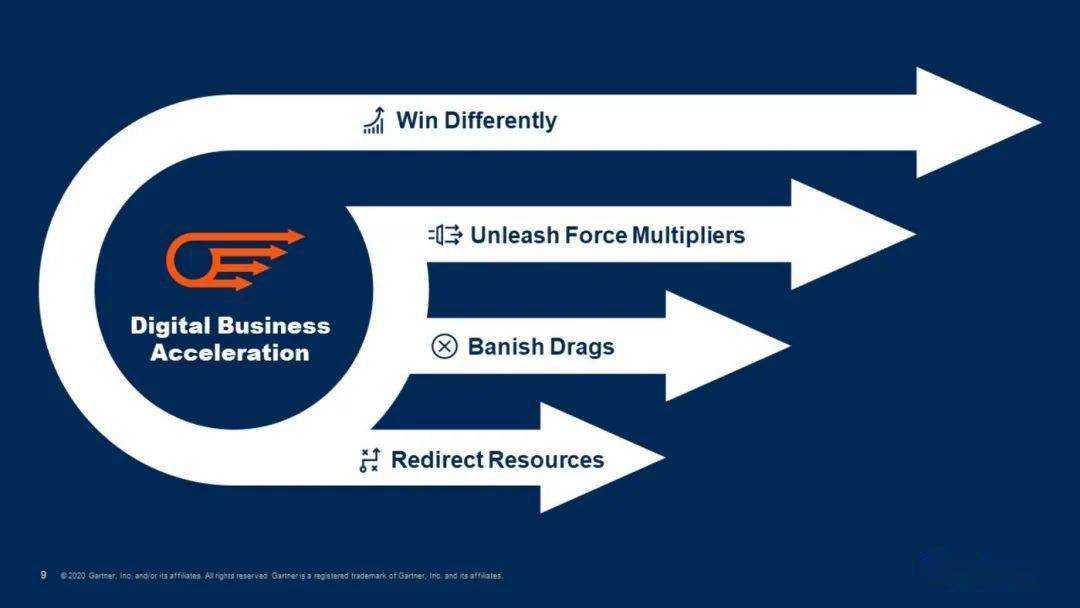
3.对CIO的四个建议:Win Differently(另辟蹊径)、Unleash Force Multipliers(释放更多潜能)Banish Drags(抛弃障碍物)、Redirect Resources(重新分配你的资源)。
一、疫情对企业最大的影响是什么?
疫情阻断了产业链上下游之间的物理联系,供应链的断裂成为新冠对企业产生的最大影响。Gartner研究副总裁陈勇(Owen Chen)表示,通过研究发现,18%的企业供应商的可信赖程度在下降,而有51%的企业对客户的响应速度正在下降。
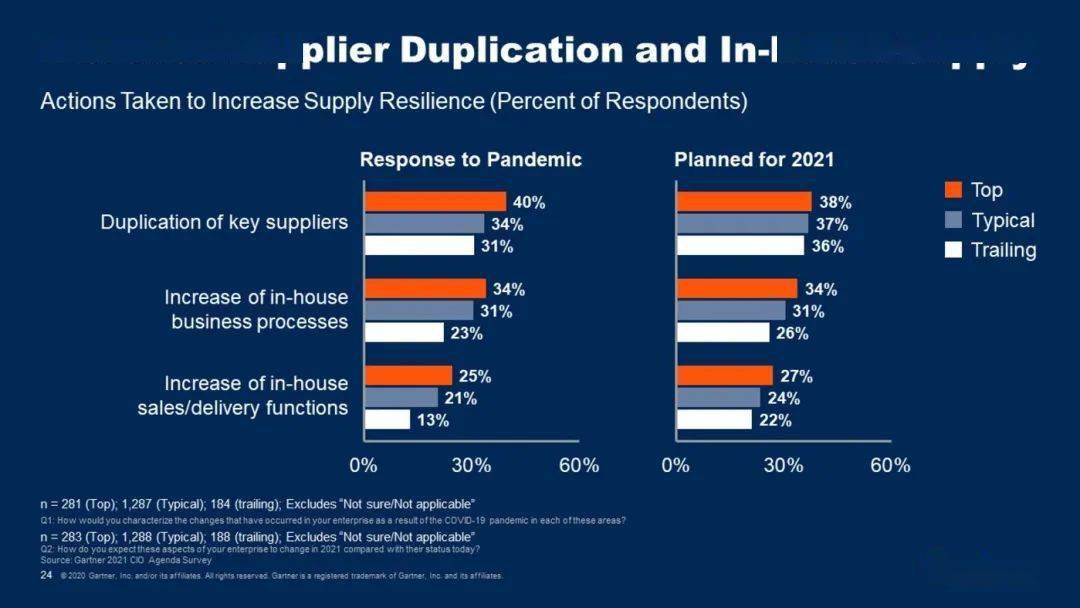
为了应对这些情况,企业为了自救采取了一些措施,比如对关键供应商进行备份,即不依赖一个供应链。第二个比较普遍的措施是企业会把原本交给其他厂商的事情拿回来自己做。同时,企业也会自己做渠道。
1、企业在触达客户上做出的改变
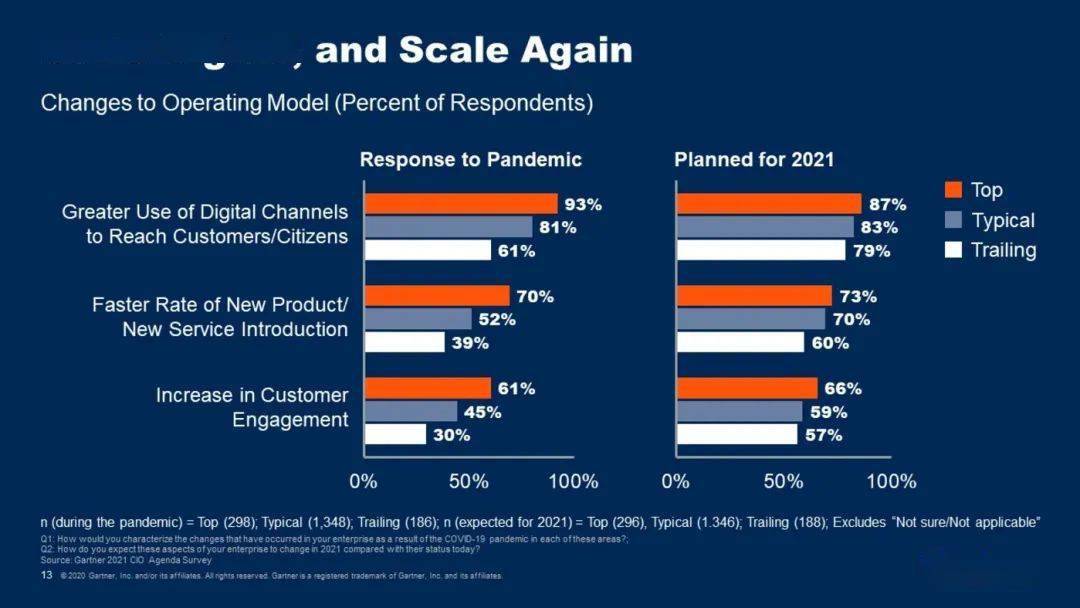
研究发现,在渠道上,一些应对新冠做得比较好得组织和机构会更多利用数字化渠道 触达他们的客户。或者他们也会另辟蹊径,加快新产品和新服务的引入。增加与客户的 交互。
比如先前的交互可能是单点的交易型的交互,新型的交互是即使没有交易也会通过新媒体的手段,做一些更多互动,增加客户粘性。
2、企业应对供应链断裂做出的改变
这其中,大部分企业表示,他们认为自己应对疫情所做出的这些改变是正确的,2021年他们会继续践行这些决策。“上面这张图,左边的数据显示的是疫情期间企业做了一些变化,右边这个数据是他们的预估2021年会不会继续这一变化。我们可以看到,几乎左边的数据跟右边的数据是一样的。”陈勇说。
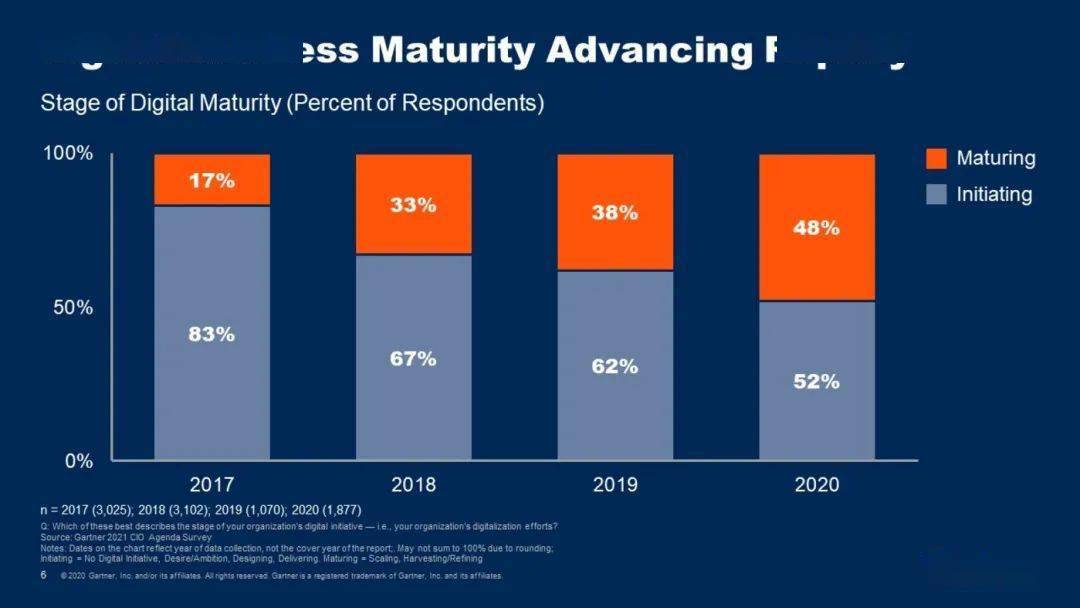
另一方面,数字化的进程可能还在加快,陈勇说:“新冠疫情这个机遇也许对于CIO的整个职业生涯是一个最重要的,甚至有可能是唯一的一个机遇,所以我们会建议CIO把握住这样的机遇。”
二、CIO的角色发生了哪些变化?
新冠大流行以及疫情防控这个过程,让企业看到了IT的重要性。CIO的角色也逐渐发生了一些 变化。
从Gartner的报告可以看出,80%的CIO通过这个机会来教育CEO以及业务同事;70%的CIO引导了对整个企业影响较大的项目;69%的CIO能够让更多的业务领导来参与到“IT项目”当中。这个时候业务人员也意识到IT项目的最终的目的是为了业务的产出。这相较之前有了一个很大的改观。
而伴随着CIO的角色变化,CEO与CIO关系也发生了变化。
陈勇表示,CEO与CIO关系的角度,Gartner将CIO分为四类:
第一类是At Risk,处境危险的CIO,这类CIO没办法满足业务的需求。甚至于CIO工作不保;去年At Risk的CIO的比例达到17%,今年降到了3%;
第二种叫做Transactional,这类CIO是事务型CIO,即业务给CIO提一些需求,CIO能够满足业务的需求,而且能够保持IT的正常运行,这个比例从16%降到了13%;
第三种为Partnering,即伙伴型CIO,这类CIO与业务部门是伙伴关系,可以为了共同的利益而奋斗,分担共同的风险。从43%上升到54%。
最后一种为Trusted Ally,即可信任的伙伴,这类CIO可以成为业务发展的动力,引领业务往前跑。
Gartner的一系列数据表明,今年和去年相比,CEO对CIO的满意程度在提高,陈勇说:“我们把2020年说成是CIO在整个职业生涯当中最关键的一年,他们一定要抓住这样的一个机会”。
三、2020年数字化成熟度水平正在加速发展
上述角色的转变,也给CIO带来了新挑战。陈勇表示,一个转变是企业的CIO会承担一些能力输出方面的工作,也就是说做出来的数字化的产品不光是给企业自己用的,而且要卖到外面去,这个叫能力输出。这个职责我们看到很多企业的IT正在承担。针对这方面的职责改变,CIO需要具备更多的能力,包括市场化的能力、管理投资收益的能力,把自己作为一个企业家来看待。
还有一个职责的改变叫做企业文化转变。企业文化是阻碍企业数字化的一个很大的挑战,CIO前几年的调研也显示企业文化在全球范围内是排名第一的阻力,在中国是仅次于人才的第二阻力,所以CIO也要承担起改变企业文化的职责。
“这个职责是一个非常具有挑战度的职责,因为要改掉整个企业的文化是一个非常难的事情,所以我们给CIO的建议是别一下子全改、而是慢慢的改,英文叫做‘crack’,就是一点一点改掉。”陈勇强调。
所谓的企业文化就是这个企业传统的做事情的方式,这种做事方式会对数字化转型不利。比如说数字化要求敏捷,而传统的层层汇报、层层审批的流程跟“敏捷”是相悖的,CIO在这个过程中要看能做什么事情来加快审批的流程,通过改变文化来加快做事进程。
四、给CIO的四点建议
正如文章开头所言,透过这份报告,经过一系列分析,Gartner向CIO给出了四点建议,分别是Win Differently(另辟蹊径)、Unleash Force Multipliers(释放更多潜能)Banish Drags(抛弃障碍物)、Redirect Resources(重新分配你的资源)。
五、Gartner对CIO的一些建议
首先, Win Differently(另辟蹊径)就是通过新的方式来赢得业务方面的成功。CIO要把握住客户的变化趋势,特别是因为新冠疫情造成客户行为改变的趋势,首先在前端做相应的改变,同时后端的体系架构也要配合前端的改变。
以一家领先企业为例,在疫情期间这些另辟蹊径的企业,他们会更多利用数字化渠道触达他们的客户。在开辟新的渠道之外,领先企业也会加快新产品和新服务的引入。并且他们也会增加和客户的交互。比如先前的交互可能是单点的交易型的交互,新型的交互是即使没有交易也会通过新媒体的手段,做一些更多互动,增加客户粘性。
同时,在IT技术投入上,41%的企业会增加用户体验相关的投入,比如多媒体、虚拟现实、增加现实等等;32%的企业会增加客户关系管理解决方案的投入;27%的企业会增加电商或者是门户网站相应的投入。这三类都是相对前端的面向客户IT投入。但像虚拟化、容器化这些体系架构的投入有29%的企业会选择。因为前端要有更多的敏捷性的要求,所以对后端的架构方面,也会有相应的改变。
第二个建议是 Unleash Force Multipliers(释放更多的潜能)。原先企业可能有一些潜力没有发挥出来,可能包括人才、组织架构、工作方式等,甚至也可能是企业文化的潜力。
以NHS Digital(英国的卫生服务部门)为例,因为是政府机关,NHS Digital在IT投入上相对保守。新冠疫情期间,这种方式的弊端就暴露了出来,传统的IT软件在统计情况的过程中,漏掉好多数据。如果不改变可能就没办法推动疫情管控。于是他们对IT提出了新的要求,他们从企业文化开始着手改变工作的作风。比如远程的诊断,通过物联网来监控病床,以及医疗病例的流转等等这些方面
第三个建议是 Banish Drags(抛弃障碍物),哪些是数字化的障碍物呢?CIO可以把企业的投资和工作分为三大类,第一大类是能够给企业创造价值的部分,对于这一类的工作CIO需要价值最大化。第二类的工作是不得不做的部分,也就是说如果这部分工作不做,就可能会出问题,但产生不了价值。对于这一类的工作,CIO要尽可能减少投资。第三就是其他,这类工作建议CIO都不要做。虽然抛弃“其他工作”看起来简单,但实际上,很多CIO都做不到。
比如,从技术的角度来讲,61%的企业会增加安全方面的投入,58%的企业会增加数据分析方面的投入,53%的企业会增加云方面的投入。形成鲜明对照的就是基础设施。虽然有21%的企业表示在基础设施方面仍然会增加投入,但是接近1/3的企业表示他们会在数据中心和基础设施方面减少投入。所以陈勇建议:“CIO要按照事情的分类来决定自己的工作,即创造价值的事情、不得不做的事情以及其他事情。”
第四个建议是 Redirect Resources(新分配你的资源),这个建议指的是CIO要把有限的资金用到关键的地方,让资金产生价值。例如,疫情应对比较成功的佛罗里达大学,在疫情之前他们就有至少98%的学生曾上过一门远程的课程,所以疫情之后,他们能够在几天之内把所有的课程都搬到线上。这跟之前学校在远程课程上的资金、资源分配有很大关系,
在企业的IT预算方面,Gartner预计2021年全球的IT预算平均增长2.0%。陈勇评价:“这个数据相较前几年略低了一点,但在疫情情况下,这个数据已经非常难得。”
翻译:
Gartner surveyed 1,847 CIOs in July and August and divided the companies of the 1,847 CIOs into three groups:
One group is more than 300 companies that have done well in digital;
The second group consists of more than 1,300 companies that have done a so-so job digitally;
The last group is made up of more than 200 companies that have lagged behind in digitization.
In response, Gartner produced a report called The 2021 CIO Agenda: Seize This Opportunity for Digital Business Acceleration (2021 CIO Agenda: Seize This Opportunity for Digital Business Acceleration: Seize the Opportunity to Accelerate the Development of Digital Business).
There are a few main messages from the report:
- The COVID-19 pandemic may be the single most important, perhaps even the only, opportunity for a CIO’s entire career;
- CIO’s digital decision making during the 2020 pandemic will continue in 2021;
- Four suggestions for CIO Differently: Win Differently, Unleash Force Multipliers, Banish Drags, and Redirect Resources.
First, what is the biggest impact of the epidemic on enterprises?
The epidemic has blocked the physical links between the upstream and downstream of the industrial chain, and the disruption of the supply chain has become the biggest impact of COVID-19 on enterprises. Owen Chen, research vice president at Gartner, said the research found that 18% of enterprise suppliers were becoming less trustworthy, while 51% were becoming less responsive to customers.
In response, companies have taken steps to help themselves, such as backing up key suppliers, or not relying on one supply chain. A second, more common, step is for firms to take over tasks that have been given to other firms. At the same time, enterprises will also do their own channels.
Changes made by enterprises in reaching customers
In terms of channels, the study found that some organizations and institutions that are doing better in response to COVID-19 are making greater use of digital channels to reach their customers. Or they will find a way to accelerate the introduction of new products and services. Increase customer interaction.
For example, the previous interaction may be a single point of transactional interaction, while the new interaction means that even if there is no transaction, more interactions will be made through new media to increase customer stickiness.
Changes made by enterprises to cope with supply chain disruption
Of those, most said they believed they had made the right changes in response to the pandemic and would continue to implement those decisions in 2021. “On the graph above, the data on the left shows the changes companies have made during the pandemic, and the data on the right shows their projections for whether that change will continue in 2021. We can see that the data on the left is almost identical to the data on the right.” “Chen Yong said.
On the other hand, digitization may be accelerating, Chen said: “The COVID-19 opportunity may be the most important, maybe even the only, opportunity for the entire career of CIOs, so we would advise CIOs to seize it.”
How has the role of the CIO changed?
The COVID-19 pandemic and the process of controlling IT have made companies see the importance of IT. The role of the CIO has also gradually changed.
Gartner reports that 80% of CIOs use this opportunity to educate ceos and business colleagues; 70% of CIOs lead projects that have a high impact on the entire enterprise; Sixty-nine percent of CIOs were able to get more business leaders involved in “IT projects.” At this time, business people also realize that the ultimate goal of IT projects is for business output. That’s a big change from before.
With the change of CIO’s role, the relationship between CEO and CIO has also changed.
Chen Yong said that from the perspective of the relationship between CEO and CIO, Gartner divides CIO into four categories:
The first category is the At Risk CIO, who is unable to meet the needs of the business. Even the CIO’s job is at risk; Last year, the percentage of CIOs At Risk was 17 percent, but this year it fell to 3 percent.
The second category is Transactional CIOs, which are transactional CIOs, where the business makes demands on the CIO, and the CIO is able to meet the needs of the business and keep IT up and running, and that’s down from 16% to 13%.
The third is Partnering CIO, that is, partner CIO. This kind of CIO is partnering with the business department, and can struggle for common interests and share common risks. From 43% to 54%.
Finally, there is the Trusted Ally, the trusted partner, who can be the driving force of the business and lead the business forward.
Gartner’s series of data shows that ceos are more satisfied with CIOs this year than last. “We talk about 2020 as the most critical year in the entire career of CIOs,” Chen said. “They must seize this opportunity.”
Digital maturity levels are accelerating in 2020
The above role change, also brings new challenges to the CIO. Chen Yong said that a change is that the CIO of the enterprise will undertake some capacity output work, that is to say to make the digital product is not only for the enterprise’s own use, and to sell to the outside, this is called capacity output. This is a responsibility we are seeing a lot of enterprise IT taking on. For this aspect of the responsibility change, CIO needs to have more capabilities, including the ability to market, the ability to manage investment returns, to see themselves as an entrepreneur.
There is also a change in responsibility called a corporate culture shift. Corporate culture is a big challenge that hinders enterprise digitalization. CIO’s research in the past few years also shows that corporate culture is the first resistance in the world, and second only to talent in China. Therefore, CIO should also assume the responsibility of changing corporate culture.
“This is a very challenging responsibility, because it is very difficult to change the whole corporate culture, so our advice to CIOs is not to change all at once, but to change slowly, English called ‘crack’, is to change little by little.” Chen Yong stressed.
The so-called corporate culture is the traditional way of doing things, which is not conducive to digital transformation. For example, digitalization requires agility, while the traditional process of layer upon layer reporting and examination and approval is contrary to “agility”. CIO should see what can be done to speed up the examination and approval process and speed up the work process by changing the culture in this process.
Four suggestions for CIOs
As stated at the beginning of this article, Gartner made four recommendations to CIOs through this report and a series of analyses, The differences are Win Differently, Unleash Force Multipliers, Banish Drags, and Redirect Resources (redistributing your resources).
Some advice from Gartner for CIOs
First of all, Win Differently is a new approach to win differently in the business.
CIO should grasp the changing trend of customers, especially the changing trend of customers’ behavior caused by the novel coronavirus epidemic, first make corresponding changes in the front end, and at the same time, the backend architecture should also cooperate with the changes in the front end.
One leading company, for example, is taking a different approach during the pandemic. They are using more digital channels to reach their customers. In addition to opening up new channels, leading companies will also accelerate the introduction of new products and services. And they will also increase their interaction with customers. For example, the previous interaction may be a single point of transactional interaction, while the new interaction means that even if there is no transaction, more interactions will be made through new media to increase customer stickiness.
At the same time, 41% of enterprises will increase the investment in IT technology, such as multimedia, virtual reality, augmented reality and so on; 32% will increase investment in CRM solutions; Twenty-seven percent of enterprises will increase their investment in e-commerce or portal sites. These three categories are relatively front-end customer-facing IT investments. But architectures such as virtualization and containerization were chosen by 29% of enterprises. As the front end requires more agility, the architecture of the back end will change accordingly.
The second suggestion is to Unleash Force Multipliers.
There may be potential in the original organization that has not been realized. This may include talent, organizational structure, working style, etc., or even the potential of the corporate culture.
Take NHS Digital (the UK’s health service) for example. Because IT is a government agency, NHS Digital is relatively conservative in its IT spending. The drawbacks of this approach have been exposed during the COVID-19 pandemic, as traditional IT software misses a lot of data in the process of statistics. If we don’t change, we may not be able to move forward with epidemic control. So they’re putting new demands on IT, and they’re starting with corporate culture to change the way they work. Such as remote diagnosis, monitoring of hospital beds through the Internet of things, and the flow of medical cases
The third suggestion is Banish Drags, which are digital obstacles?
CIO can divide the investment and work of the enterprise into three categories. The first category is the part that can create value for the enterprise. For this kind of work, CIO needs to maximize the value. The second type of work is the “must do” part, which, if left undone, could cause problems but adds no value. For this type of work, the CIO wants to reduce investment as much as possible. The third is other, this kind of work is recommended that the CIO do not do. While it may seem simple to ditch “other work,” in reality, many CIOs fail to do so.
For example, from a technology perspective, 61 percent will increase investment in security, 58 percent will increase investment in data analytics, and 53 percent will increase investment in cloud. In stark contrast, infrastructure. While 21 percent said they would still spend more on infrastructure, nearly a third said they would spend less on data centers and infrastructure. So, Chen suggested, “CIOs should decide their jobs according to the categories of things: things that create value, things that they have to do, and other things.”
The fourth suggestion is Redirect Resources, which means that the CIO should redirect the limited funds to the most important places where the money can generate value.
For example, at the University of Florida, which has had a successful response to the pandemic, at least 98 percent of its students had taken a course remotely before the pandemic, so after the pandemic they were able to move all of their courses online in a matter of days. This has a lot to do with how schools have allocated money and resources for distance learning,
In terms of enterprise IT budgets, Gartner expects global IT budgets to grow by an average of 2.0 percent in 2021. “This figure is a little lower than that of previous years, but it is very rare under the epidemic situation,” said Chen.
本文由数字化转型网(www.szhzxw.cn)转载而成,来源:网络,作者: 秦聪慧;编辑/翻译:数字化转型网宁檬树。

免责声明: 本网站(http://www.szhzxw.cn/)内容主要来自原创、合作媒体供稿和第三方投稿,凡在本网站出现的信息,均仅供参考。本网站将尽力确保所提供信息的准确性及可靠性,但不保证有关资料的准确性及可靠性,读者在使用前请进一步核实,并对任何自主决定的行为负责。本网站对有关资料所引致的错误、不确或遗漏,概不负任何法律责任。
本网站刊载的所有内容(包括但不仅限文字、图片、LOGO、音频、视频、软件、程序等) 版权归原作者所有。任何单位或个人认为本网站中的内容可能涉嫌侵犯其知识产权或存在不实内容时,请及时通知本站,予以删除。