摘要
企业数字化转型的成功与否关键之一取决于如何制定战略路线图。
首先,理解数字化趋势至关重要,以便发现新商业模式、避免被颠覆和更好地了解用户行为。
其次,企业需要衡量自身的数字化能力与数据成熟度,以确定起点和优势。建议在数字化转型过程中设立由CDO专门负责的领导和执行团队,鼓励可视化展示战略,保持社会化互动,同时应采用动态、易访问的方式维护数字化路线图。
最终,数字化转型战略要容易理解,并与业务和技术路线图协调一致,保持对齐。
这些原则和操作建议将有助于企业在数字化转型中取得成功。
实践数字化转型的企业,如何制定适合的战略路线图并寻找新的商业机会和模式,是一个不容回避的关键问题。数字化转型网www.szhzxw.cn
在切入讨论这个关键问题前,我们先来谈一下企业为什么需要观察和追踪数字化趋势。
一、认清大势
企业数字化转型有两种类型:被动性的反应型数字化和主动性的变革型数字化。
其中,企业要避免“反应型的数字化”企业要避免“反应型的数字化”就需要主动地追踪数字化趋势,才能掌握战略主动权,识别机会和迭代改进商业模式,而不是坐等新竞争者出现再被动响应。
对数字化趋势的前瞻性了解可以在以下几点帮助公司:数字化转型网www.szhzxw.cn
- 发现新的商业模式
- 抵御被颠覆(防止被跨界打劫)
- 更好地了解用户行为
- 预测企业发展的未来
- 提升企业的数据成熟度,还能
- 尽快将数字化趋势应用到实践
而在产业中,常用的追踪科技生命周期的趋势分析模型是Gartner 公司的新兴技术成熟度曲线(Hype Cycle for Emerging Technologies)。
我放了三张图:
- 第一张是用来解释Gartner 新兴科技生命周期曲线的用法,数字化转型网www.szhzxw.cn
- 第二张是Gartner 发布的2022年新兴技术成熟度曲线图,
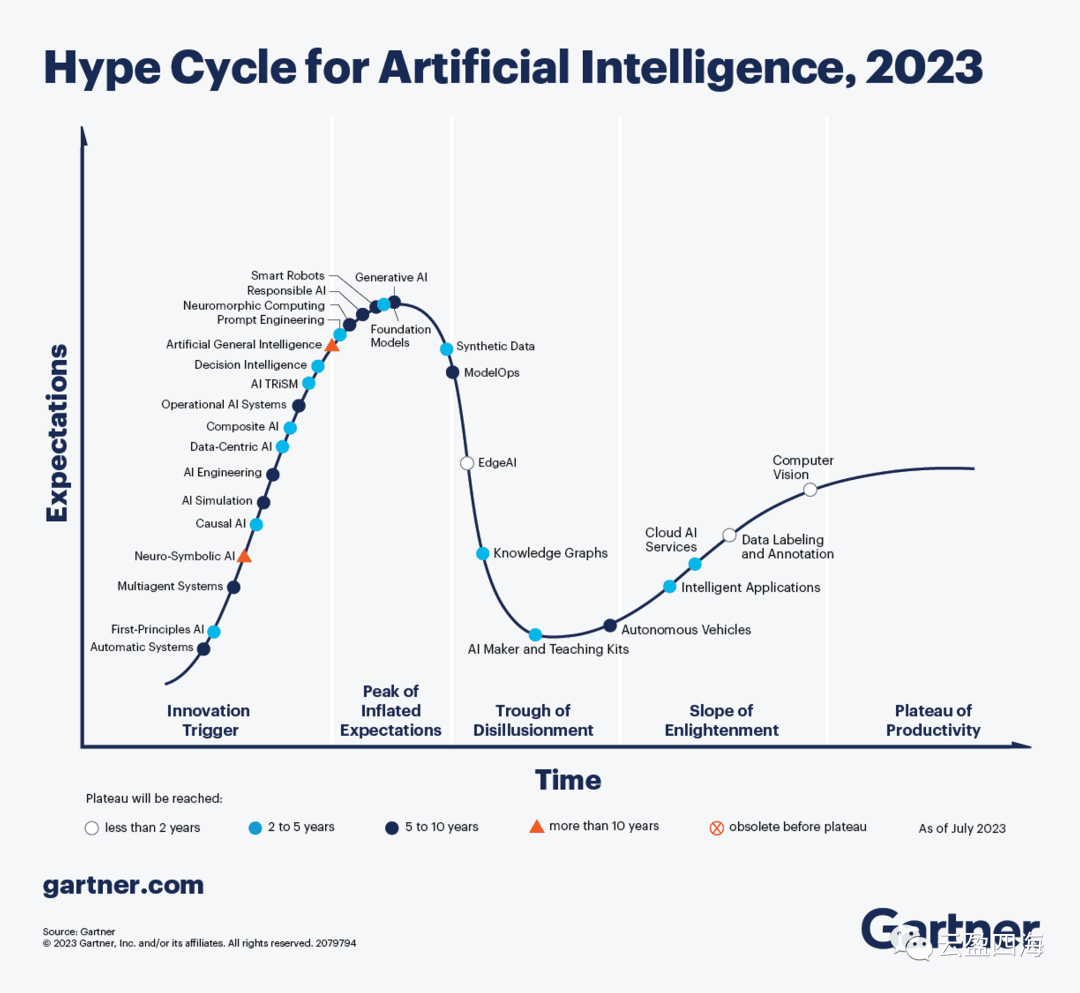
- 而第三张是Gartner 2023年发布的专门针对人工智能技术成熟度的Hype 曲线图,供你参考。
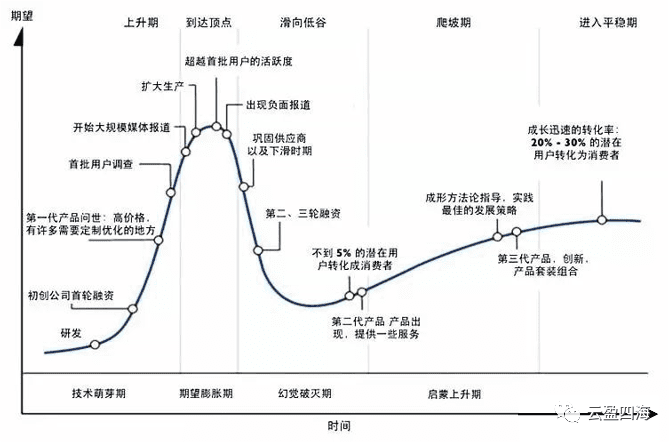
新兴技术成熟度曲线是是对Gartner所研究的1500多项技术进行精选,生成一个“必须了解”的新兴技术和趋势的技术集,而这些技术有望在未来五至十年内提供较大的竞争优势。

这个“2022年新兴技术成熟度曲线”揭示了数字化转型的3大主要趋势,分别是建立信任,加速增长以及塑造变革,更具体的建议则指向企业机构去探索诸如基础大模型、Web 3、去中心化身份管理、行业云和超级App 等新兴技术和应用场景,从而确保竞争优势。数字化转型网www.szhzxw.cn
由于ChatGPT 为代表的生成式AI 的崛起,人工智能的侧枝进化将迎来新的AI 应用大爆发和各种AI 基础模型和领域模型的军备竞赛,并将深度影响更多行业和企业。
我再来给你放一张最新的Gartner 关于人工智能技术成熟度的曲线供你参考。
目前生成式AI 正盘桓于“期望膨胀”之巅,提升工程、大模型驱动的新一代智能机器人、脑机融合计算,等也在升温,这其中有些技术和应用场景会遭受泡沫破裂,但目前来看,想在未来保持领先优势以及借此机会想弯道超车的企业都不能不拥抱这些具有颠覆性前景的技术趋势。这些趋势都是对未来3-5年企业在制定数字化转型和创新战略时所需要了解和考虑的选项和路径。数字化转型网www.szhzxw.cn
本质上来说,所有经历数字化转型的企业都将成为软件企业(所谓的“软件吃掉世界”),因此,技术创新永远是数字经济时代,企业实现竞争差异化的一个关键因素。
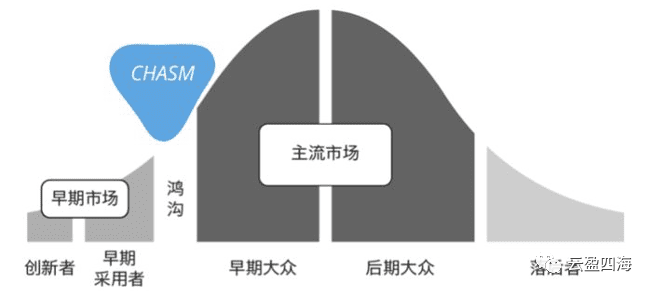
随着突破性的技术不断出现,即使是最具创新力的企业机构想要紧跟这一速度也极具挑战。从杰弗里.摩尔经典的《跨越鸿沟》这本书中给我们介绍的“技术采纳周期”图中,我们可以看到,只有一小部分企业会是技术的“创新者”和“早期采用者”,这意味着在新技术被证明之前,很少企业愿意坚持下来,尝试新技术。
在采纳新技术的循环中,一般的企业落在中间至后期部分。其实,对于传统企业来说,其数字化转型的关键并不在于急于采用新技术,而是要通过监控数字化趋势找到合适的时机和切入点,更主动的同时,也能更有效地做对未来发展有利的事情。Timing 时机很重要!数字化转型网www.szhzxw.cn
因此,利用这些技术趋势分析工具,企业可以更好地判断几个问题:
01 数字化趋势如何与企业现在的业务、商业模式或者所在的产业领域相关;
02 数字化趋势的哪些部分能够或不能现在被应用,为什么?
03 企业在商业模式创新和行业拓展方面能够利用技术创新发掘什么新机会?
此外,企业通过对数字化趋势的监控,还能确定什么是企业未来最重要的资源,哪些是企业发展的关键客户和生态成员,以及什么是最能连接企业与客户的数字化触点,等等…数字化转型网www.szhzxw.cn
但企业在开始着手数字化变革之前,还必须了解自身的数字化程度,做个数字资产和能力的盘点, 包括对于自身优劣势的衡量。
接下来,我们就来谈一下企业如何衡量自身的数字化能力与数据成熟度。
二、认识自己
传统企业需要对自身整体的数字化能力进行衡量,并设定标杆。数字化转型网www.szhzxw.cn
数字化标杆为企业提供了参照点,企业可以利用这些参照点将自身的数字化转型实践与其他企业的变革行动、企业目标与行业标准进行比照。
同样,数字化标杆也帮助企业确定绩效衡量、目标确定、战略决策与建立商业模型可以使用的标准线。它反映了企业数字化转型过程中的绩效,企业可以根据这些指标作出需要的调整。
你可以参考下图这张数字化成熟度量表,来更清晰地了解企业逐步达成行业内领先的数字化成熟度,所需要经历的5个阶段:
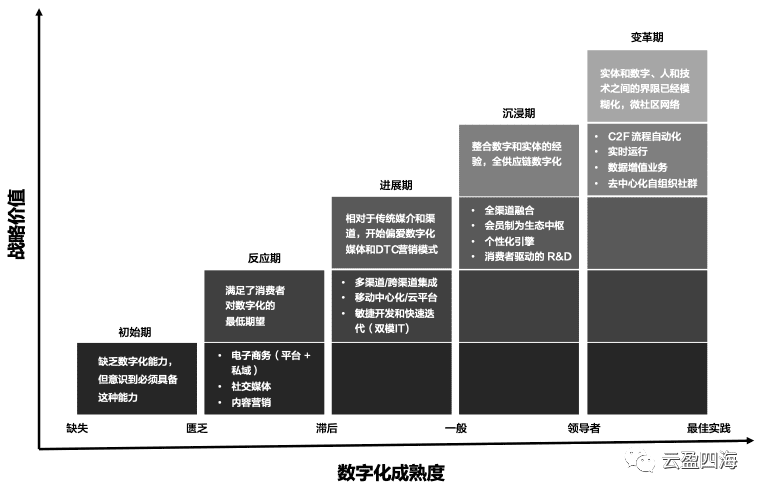
初始期
这一阶段的企业如果没有能与最终用户互动的社交媒体账号或网站、小程序等,那对于大部分当今的用户而言,这些企业即使不是完全不可见的,也是基本无关。
反应期(或交互期)
这一阶段的企业可能已经有了初步的数字化能力,如在电商平台上开店,甚至有自己的微商,私域运营等,但相互之间并没有围绕用户进行数据和流程打通,不同线上渠道的体验也不一致,用户界面也不太友好。数字化转型网www.szhzxw.cn
交互期的企业显示了部分的数字化成熟度,而离真正满足用户需求还差之甚远,但对于目前的大部分企业来说,这却是一个正常状态,只是看行业内竞争对手做了什么就也做什么,自身作为一个追赶者持续对领先者的行动做反应而已。
进展期
处于进展期的企业在数字化成熟度方面开始上了正轨,但相对于行业领先的企业仍然有很多落后之处。
不过这一阶段的企业,已经开始主动涉及数字化变革的投入,主要包括对企业已有的客户相关的数据进行累积和利用,还将数字化元素纳入企业的优先战略制定,并开始实施可以推动组织彻底完成数字化变革的举措。
企业的主营业务可能仍然维持原状,但在新产品、新渠道和新模式的探索方面已经变得更加敏捷和主动,能够通过快速试错和迭代来找到新的价值增长点。数字化转型网www.szhzxw.cn
企业开始关注数字化资产的价值创造能力!
沉浸期
在这一阶段,企业基本实现了成熟的数字化应用,沉浸期的企业已经开始将线上和线下所有的客户触点进行了全渠道融合,并利用数字化工具尽可能为客户提供个性化的体验。
企业数字化资产的价值创造、传递和提升开始有了一定的“飞轮效应”,企业的估值主要是由更有增长前景的数字化业务所定义。
变革期
这一阶段的企业不仅达到了成熟的数字化应用,而且是行业内的领导者和创新者,此时企业的全供应链流程通常已经完全自动化,人机之间的边界也完全模糊,企业的增长更多靠数据增值业务来实现。
同时,最终用户和生态伙伴能够充分分享网络效应和数据资产增值带来的价值,商业模式向维度更高的、去中心化的分布式商业演化。数字化转型网www.szhzxw.cn
企业成为生态化的组织形态,创新在生态上可以自发涌现。
当然,企业不能只在自身的企业边界内去实践数字化成熟度的这5个阶段,还需要观察行业内的领先者是如何完成数字化这个过程的。拓宽视野,不能仅仅把目标放在竞争者或行业内部。
根据《哈佛商业评论》的研究,对企业所在行业最优的想法往往不是来自行业内部。
事实上从相邻领域引入的理念可能是激发创新的潜在来源,如果企业需要激进式创新,更应该对外部创新进行广泛搜索,而不是在行业内部比谁更卷。
根据以上“数字化成熟度”的模型,我们看到企业数字化转型从进展期开始就需要摆脱“反应式数字化”的模式束缚,更为主动地将数字化元素纳入企业的战略规划,当然这也需要企业在内部建立一种更敏捷、在数字化转型方面更具有变革性的文化来支持企业数字化战略的制定和实施。数字化转型网www.szhzxw.cn
在经历过多个传统行业的企业数字化转型的咨询项目之后,我总结了几条可用来帮助企业制定数字化转型战略的操作建议,如:
在商业战略规划过程中,要有负责数字化变革领导的高管的持续参与和支持;
要在组织内设立有独立预算权的团队(如采用命题孵化模式的与外部创新服务机构合作的企业创新办公室,Corporate Venture Builder)以保障可以持续和按需调集资源,通过快速原型来实验新模式;
为企业的主要用户体验建立变革旅程地图,并为企业的客户细分建立与品牌关联的数据化层级;
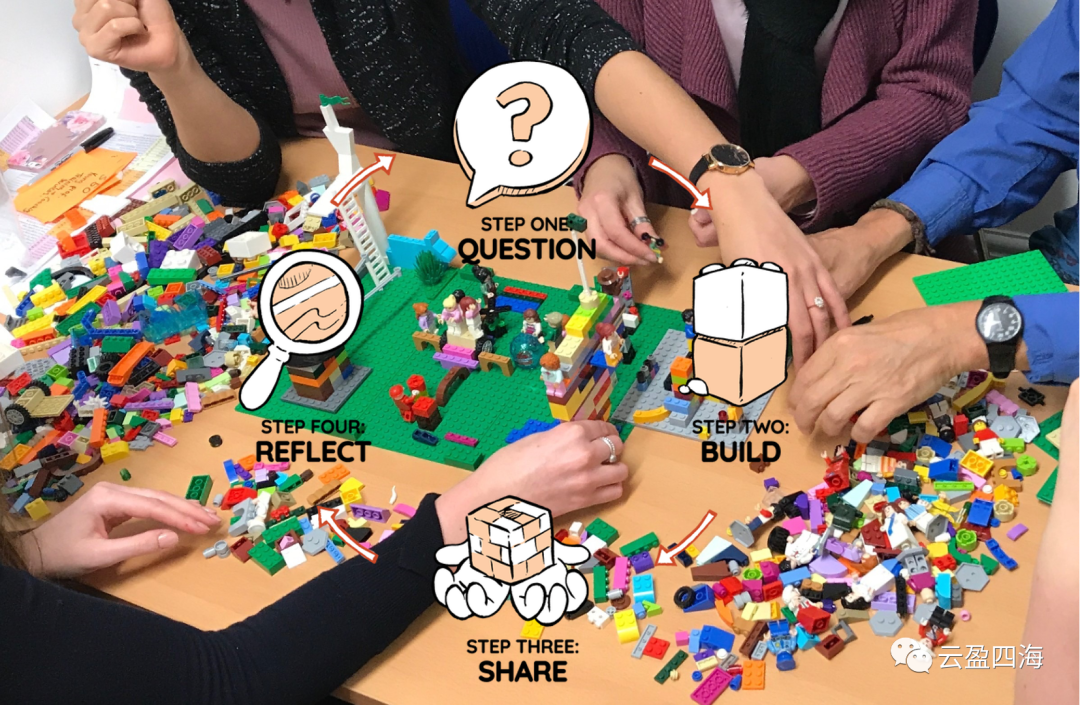
还有就是鼓励团队尽可能用可视化的方式来展示战略,而不是用PPT (我建议用乐高LSP 模型搭建,并结合亚马逊的“6页纸项目发布新闻稿”形式), 同时要在内外部协作平台上让员工、合作伙伴甚至客户参与战略共创,进行投票、评论和建议,等等。数字化转型网www.szhzxw.cn
这里面尤为重要的是,企业不仅需要有高管支持的数字化战略决策委员会,来负责战略规划、组织变革和资源协调,还要有专门的执行团队来负责如何将愿景分解为具体的阶段性目标和实验定义。
领导者的任务是在战略上拉齐认知,达成高层共识,并定义愿景目标,而数字化变革团队的目标是将这个定义转化为特定的数字化体验,如直接触达消费者的私域电商,线上/线下融合的全渠道营销,端到端的产品溯源,C2F 的反向定制与柔性生产,消费者反馈驱动的产品研发,以及个性化的产品和服务推荐,会员参与的社群运营等等…
领导者接下来的任务就是对以上这些数字化体验的变革结果进行评估,确定是否达到了战略目标,然后确定可进一步执行的行动以达到与总体目标一致的可能的最优结果。数字化转型网www.szhzxw.cn
最后,我们来谈一下如何设定企业的数字化转型的探索路线图。
三、认真探索
首先,企业要成立有最高层领导支持的数字化战略委员会,有了数字化转型的远景目标后,接下来的问题就是如何出发,找到通往目标方向的路径。
数字化转型如同一场在未知地界的旅行,因此,要想在目标确定的已知地界旅行,有一张清晰的地图是非常必要的,但如果你只有一个大致的方向,而目标和路径都是模糊的,这时候你所需要的不是一张详细的地图(可能也没有现成的)而是一个指南针,一个罗盘,你可以边走边调整目标,并在身后留下可供参考的路线规划。数字化转型网www.szhzxw.cn
这就是企业为什么需要用一个“沙盒”或“创新特区”机制来授权有最高领导层支持的,但独立运行的数字化转型创新实验团队,其背后的原因,也就是说企业在从“反应型数字化”向“主动性变革型数字化”转型过程中,需要通过独立小团队的不断迭代试错和反馈学习,来摸索出一张给大部队的“数字化转型路线图”。
而这种“摸着石头过河”来实践数字化转型路线图的模式,有以下几个关键设计原则很重要,我在这里简单和你介绍一下:
1. 易访问
数字化路线图一开始可以不完善,但要容易访问。路线图不是一个代待办事务列表,或是一套每半年才更新一次的数据报表,优秀的路线图必须是有活力的生命体,能够不断吸纳反馈并及时调整和优化。企业绝不能允许将数字化路线图退化为一份僵化的、只是偶尔被检查的文件。
2. 动态化
数字化路线图要与组织保持密切的互动。随着企业对数字化转型进程的不断了解,数字化路线图对组织的变革也有正面积极的影响,每当数字化战略有所更新,路线图应及时变更以做出业务流程和组织形态上的变革反应,需要面向组织全员发布并确保所有人都能评论和分享。数字化转型网www.szhzxw.cn
在这场数字化转型的征途中,组织中任何人,无论是高层管理者,还是最新的员工,甚至是企业的合作伙伴以及外部咨询顾问,都不应该有“我不清楚我们当前在哪,将去何方”这样的心态。
3. 社会化
一个成功的数字化路线图将企业的目标、战略和战术清晰地以可视化的方式展示出来,并鼓励所有的员工参与共创和讨论。
公司每个员工都应该有对路线图进行评论、建议和批评等互动的权限。如此则可以通过众包发掘好的创意,而组织所有成员都有机会主动参与和接受数字化进程,他们将会更加重视和投入。
对组织的人和一个项目而言,仅仅制定最终目标是不够的,关键在于全体成员要根据组织愿景和路线图参与转型的进程。数字化转型网www.szhzxw.cn
4. 可视化
数字化路线图应该具备多种强有力的可视化工具。可视化工具能够让员工以多样化的视角来了解现状,从而促使他们积极参与到数字化转型中,并将转型在整个企业内部社会化的特质中,有助于人们可以更快速地与数字化路线协调一致。
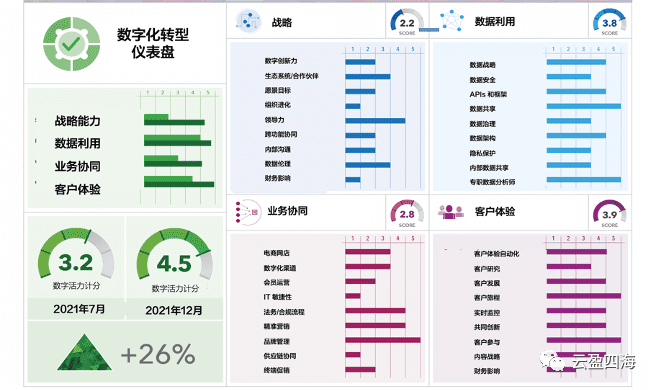
在数字化路线图上,转型终点目标可能包括数字化能力、最终产品的发布、阶段性工作的完成、成熟度的达成,以及实施流程等,这些都应当可以转化为各种可视化的方式,如仪表盘、图片、照片、视频和信息图表等展示出来,人们可以很轻松直观地了解公司当前在数字化转型各个维度上的进度。
我放了一张我给一家企业设计的数字化转型仪表盘供你参考。
5. 易于理解
战略不能过于复杂,要与业务和技术路线图协调一致。制定路线图应试图避免多任务并行,而应该是一次专注解决一件事,关注点可随转型进程更新,但关键在于确保路线图的一致性。
很多公司可能同时有客户战略和数字化战略,相互联系却难以彼此配合。数字化转型网www.szhzxw.cn
企业的商业战略规划和路线应当让这两个战略的基石重合,因为数字化战略的核心也是客户战略的核心,并安排人员统筹领导转型,基于此构建起由适应了数字化转型的组织内外部人员共同组成的合作网络。
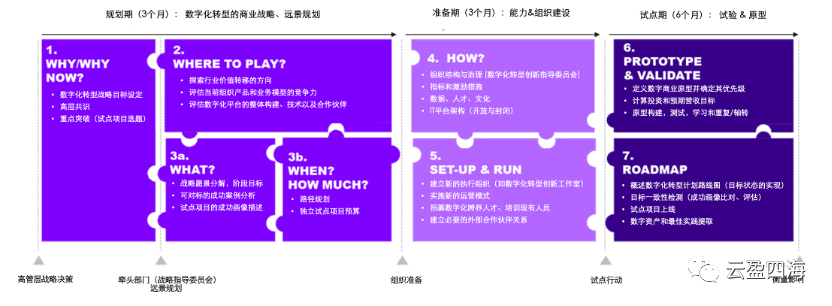
我也放了一张我在给企业做数字化战略路线规划的路线图的示例,供你参考。
关于企业数字化转型战略规划和路径图的讨论就到这里,明天,我再来和大家讨论一下驱动企业数字化转型的另一个关键能力打造—数据驱动的组织变革。数字化转型网www.szhzxw.cn
好,我们下次见!
翻译:
Abstract
One of the keys to the success of an enterprise’s digital transformation depends on how the strategic roadmap is developed.
First, it is critical to understand digital trends in order to discover new business models, avoid disruption, and better understand user behavior.
Second, companies need to measure their digital capabilities and data maturity to identify starting points and advantages. It is recommended to have a dedicated CDO leadership and execution team during the digital transformation process, encourage visual presentation of the strategy, maintain social interaction, and maintain the digital roadmap in a dynamic and accessible way.
Ultimately, the digital transformation strategy needs to be easy to understand and aligned with the business and technology roadmap.数字化转型网www.szhzxw.cn
These principles and operational recommendations will help businesses succeed in their digital transformation.
How to develop a suitable strategic roadmap and find new business opportunities and models is a key issue that cannot be avoided for enterprises practicing digital transformation.
Before we get to this critical issue, let’s talk about why companies need to observe and track digital trends.
First, recognize the general trend
There are two types of enterprise digital transformation: reactive digitalization and proactive transformational digitalization.
Among them, to avoid “reactive digitalization”, enterprises need to actively track digital trends in order to grasp the strategic initiative, identify opportunities and iterate to improve business models, rather than wait for the emergence of new competitors and then respond passively.数字化转型网www.szhzxw.cn
A proactive understanding of digital trends can help companies in the following ways:
Discover new business models
Resist subversion (prevent cross-border looting)
Better understanding of user behavior
Predict the future of business development
Improve the enterprise’s data maturity, but also
Put digital trends into practice as soon as possible
In the industry, the most commonly used trend analysis model to track the technology lifecycle is Gartner’s Hype Cycle for Emerging Technologies.
I put in three pictures:
The first one is used to explain Gartner’s emerging technology lifecycle curve,
The second is Gartner’s emerging technology Maturity graph for 2022.
The third is Gartner’s Hype graph for AI technology maturity released in 2023 for your reference.
Gartner emerging Technology lifecycle curve数字化转型网www.szhzxw.cn
The Emerging Technology Maturity Curve is a curation of more than 1,500 technologies studied by Gartner to produce a “must know” set of emerging technologies and trends that are expected to provide a significant competitive advantage over the next five to ten years.
Gartner’s “Emerging Technology Maturity Curve 2022”
The “Emerging Technology Maturity Curve 2022” reveals three key trends in digital transformation: building trust, accelerating growth, and shaping change, with more specific recommendations for organizations to explore emerging technologies and application scenarios such as Fundamental Big Models, Web 3, decentralized identity management, industry cloud, and super apps. Thus ensuring competitive advantage.数字化转型网www.szhzxw.cn
Due to the rise of generative AI represented by ChatGPT, the side-branch evolution of artificial intelligence will usher in a new explosion of AI applications and an arms race of various AI basic models and domain models, and will deeply affect more industries and enterprises.
Let me show you the latest Gartner curve on AI technology maturity for your reference.
At present, generative AI is staying at the top of the “expectation inflation”, upgrading engineering, a new generation of intelligent robots driven by large models, brain-computer integration computing, etc., are also heating up, and some of these technologies and application scenarios will suffer a bubble burst, but at present, Companies that want to stay ahead of the curve and take advantage of the opportunity to overtake in the future cannot afford not to embrace these disruptive technology trends. These trends are all options and pathways that businesses need to understand and consider as they develop their digital transformation and innovation strategies over the next 3-5 years.
Gartner’s “2023 AI Technology Maturity Curve”
In essence, all companies undergoing digital transformation will become software companies (so-called “software eats the world”), so technological innovation will always be a key factor in achieving competitive differentiation in the digital economy.数字化转型网www.szhzxw.cn
As breakthrough technologies continue to emerge, it is challenging for even the most innovative organizations to keep up with this pace. As we can see from Jeffrey Moore’s classic “Technology adoption cycle” chart in Crossing the Chasm, only a small percentage of businesses are “innovators” and “early adopters,” meaning that few are willing to stick around and try a new technology until it’s proven.
In the cycle of adopting new technologies, the average company falls in the middle to late part. In fact, for traditional enterprises, the key to their digital transformation is not to rush to adopt new technologies, but to find the right time and entry point by monitoring digital trends, and to be more active at the same time, but also more effective to do things favorable to future development. Timing is important!
Graph of the technology adoption cycle in the book Crossing the Chasm
Therefore, with these technology trend analysis tools, enterprises can better judge several questions:
01 How the digital trend is related to the company’s current business, business model or industry sector;
02 Which parts of the digital trend can or cannot be applied now, and why?数字化转型网www.szhzxw.cn
03 What new opportunities can enterprises explore with technological innovation in terms of business model innovation and industry expansion?
In addition, through the monitoring of digital trends, enterprises can also determine what is the most important resource of the enterprise in the future, which is the key customer and ecological member of the enterprise development, and what is the most able to connect the digital touchpoint between the enterprise and the customer, and so on.
However, before starting to embark on digital transformation, enterprises must also understand their digital degree, do an inventory of digital assets and capabilities, including the measurement of their strengths and weaknesses.数字化转型网www.szhzxw.cn
Next, let’s talk about how enterprises measure their digital capabilities and data maturity.
Second, know yourself
Traditional enterprises need to measure their overall digital capabilities and set benchmarks.
Digital benchmarking provides reference points that companies can use to compare their digital transformation practices with the change actions of other companies, corporate goals and industry standards.
In the same way, digital benchmarking helps companies define benchmarks that can be used to measure performance, set goals, make strategic decisions, and build business models. It reflects the performance of enterprises in the process of digital transformation, and enterprises can make necessary adjustments according to these indicators.
You can refer to the Digital Maturity scale below to get a clearer picture of the five stages that companies need to go through to achieve industry-leading digital maturity:数字化转型网www.szhzxw.cn
Digital Capability Maturity Scale
Initial period
Businesses at this stage that do not have social media accounts or websites, aparets, etc. that interact with end users are largely irrelevant, if not completely invisible, to most of today’s users.
Reaction (or interaction) period
At this stage, enterprises may already have preliminary digital capabilities, such as opening stores on e-commerce platforms, or even having their own wechat business, private domain operations, etc., but they do not open data and processes around users, and the experience of different online channels is inconsistent, and the user interface is not very friendly.
The enterprises in the interaction period show part of the digital maturity, and are far from really meeting the needs of users, but for most of the current enterprises, this is a normal state, just look at what the competitors in the industry do, and themselves as a catch-up continue to react to the actions of the leaders.数字化转型网www.szhzxw.cn
Progressive stage
Progressive companies are starting to get on the right track in terms of digital maturity, but still have a lot of ground to fall behind the industry leaders.
However, at this stage, enterprises have begun to actively involve investment in digital change, mainly including the accumulation and utilization of the customer-related data that the enterprise already has, but also the digital elements into the enterprise’s priority strategy development, and began to implement initiatives that can promote the organization to complete the digital transformation.
The main business may remain the same, but the company has become more agile and proactive in the exploration of new products, new channels and new models, and is able to find new value growth points through rapid trial and error and iteration.数字化转型网www.szhzxw.cn
Businesses are starting to focus on the value creation capabilities of digital assets!
Immersion period
In this stage, enterprises have basically realized mature digital applications, and enterprises in the immersion stage have begun to integrate all customer touch points online and offline for omni-channel integration, and use digital tools to provide customers with personalized experiences as much as possible.
The value creation, delivery and enhancement of enterprise digital assets began to have a certain “flywheel effect”, and the valuation of enterprises was mainly defined by the digital business with more growth prospects.数字化转型网www.szhzxw.cn
Transformative period
At this stage, enterprises have not only reached mature digital applications, but also become leaders and innovators in the industry. At this time, the whole supply chain process of enterprises is usually fully automated, the boundary between human and machine is completely blurred, and the growth of enterprises depends more on data value-added services to achieve.
At the same time, end users and ecological partners can fully share the value brought by network effects and data asset appreciation, and the business model is evolving to a higher-dimensional, decentralized distributed business.
Enterprises become ecological organizational forms, and innovation can spontaneously emerge in ecology.
Of course, companies can’t just practice these five stages of digital maturity within their own corporate boundaries, but also need to observe how industry leaders approach the digital process. Broaden your horizons and don’t just target competitors or industry insiders.数字化转型网www.szhzxw.cn
According to Harvard Business Review research, the best ideas for a company’s industry often don’t come from within the industry.
In fact, ideas imported from adjacent fields can be a potential source of innovation, and if companies need radical innovation, they should conduct a broad search for external innovation, rather than competing with others within the industry.
According to the above model of “digital maturity”, we can see that enterprise digital transformation needs to get rid of the mode of “reactive digitalization” from the beginning of the development stage, and more actively incorporate digital elements into the strategic planning of enterprises. Of course, this also requires a more agile and transformational culture within the organization to support the development and implementation of digital strategy.数字化转型网www.szhzxw.cn
After consulting with companies on digital transformation in traditional industries, I have come up with several operational recommendations to help companies develop digital transformation strategies, such as:
The ongoing involvement and support of executives responsible for digital change leadership in the business strategy planning process;
A team with independent budget authority should be set up within the organization (such as a Corporate innovation office that adopts the proposition incubation model and cooperates with external innovation service institutions, Corporate Venture Builder) to ensure that resources can be continuously mobilized and on-demand, and new models can be tested through rapid prototyping;
Establish a change journey map for the main user experience of the enterprise, and establish a data-related level for the customer segmentation of the enterprise;数字化转型网www.szhzxw.cn
It also encourages the team to present the strategy in a visual way as much as possible, rather than using powerpoint (I recommend using a LEGO LSP model, combined with Amazon’s “6-page project press release” form), and to engage employees, partners and even customers on internal and external collaboration platforms to co-create the strategy, vote, comment, and suggest, etc.
Lego Serious Play innovation strategy model building
In particular,
In particular, companies need not only executive-backed digital strategy decision-making committees responsible for strategic planning, organizational change, and resource coordination, but also dedicated executive teams responsible for how to break down the vision into specific milestones and experimental definitions.数字化转型网www.szhzxw.cn
The leader’s task is to build strategic awareness, reach high-level consensus, and define vision goals, and the goal of the digital change team is to translate this definition into specific digital experiences, such as direct consumer access to private e-commerce, online/offline integration of omnichannel marketing, end-to-end product traceability, C2F reverse customization and flexible production. Product development driven by consumer feedback, as well as personalized product and service recommendations, community operations with member participation, and more…
The leader’s next task is to evaluate the results of these digital experience transformations, determine if strategic objectives are being met, and then identify further actions that can be taken to achieve the best possible outcome consistent with the overall objectives.
Finally, let’s talk about how to set the exploration roadmap for the digital transformation of the enterprise.数字化转型网www.szhzxw.cn
Third, explore carefully
The first step is to establish a digital strategy committee supported by the top leadership. Once you have a vision for digital transformation, the next question is how to start and find a path to the target direction.
Digital transformation is like a journey through unknown territory, so to travel through known territory with defined goals, a clear map is necessary, but if you only have a general direction, and the goals and paths are vague, then what you need is not a detailed map (which may not be readily available) but a compass, a compass, You can adjust your goals as you go, and leave a trail plan behind you for reference.
This is the reason behind why enterprises need to use a “sandbox” or “innovation special zone” mechanism to authorize the digital transformation innovation experimental team supported by the top leadership but operating independently. That is to say, in the process of transformation from “reactive digitalization” to “proactive transformational digitalization”, enterprises need to learn through continuous iteration, trial and error and feedback of independent small teams. To develop a “digital transformation roadmap” for large forces.
In this mode of “crossing the river by feeling the stones” to implement the digital transformation roadmap, there are several key design principles that are important, and I will briefly introduce them to you here:数字化转型网www.szhzxw.cn
1. Easy access
The digital roadmap can be incomplete at first, but it should be easily accessible. A roadmap is not a todo list or a set of data reports that are updated every six months. A good roadmap must be a living entity that constantly absorbs feedback and adjusts and optimizes in time. Companies must not allow their digital roadmap to degenerate into a rigid document that is only occasionally checked.
2. Dynamic
The digital roadmap is a close interaction with the organization. With the continuous understanding of the process of digital transformation, the digital roadmap also has a positive impact on the transformation of the organization. Whenever the digital strategy is updated, the roadmap should be changed in time to reflect the change in business process and organizational form, and it needs to be released to the entire organization and ensure that everyone can comment and share.
In this journey of digital transformation, no one in the organization, whether it is senior management, the newest employees, or even corporate partners and external consultants, should have the mentality that “I don’t know where we are and where we are going.”数字化转型网www.szhzxw.cn
3. Socialize
A successful digital roadmap clearly visualizes the company’s goals, strategies, and tactics and encourages all employees to participate in co-creation and discussion.
Every employee in the company should have the right to interact with the roadmap with comments, suggestions, and criticisms. In this way, good ideas can be discovered through crowdsourcing, and all members of the organization have the opportunity to actively participate in and accept the digital process, and they will be more valued and invested.数字化转型网www.szhzxw.cn
It is not enough for an organization’s people and a project to set the end goal; it is crucial that all members participate in the transformation process according to the organization’s vision and roadmap.
4. Visualize
A digital roadmap should have multiple powerful visualization tools. Visualization tools enable employees to see the current situation from a variety of perspectives, thereby encouraging them to actively participate in the digital transformation, and to integrate transformation into the social nature of the entire enterprise, helping people to more quickly align with the digital path.
In the digital roadmap, the transformation end goals may include digital capabilities, final product release, completion of phased work, maturity, and implementation processes, which should be translated into various visualizations such as dashboards, images, photos, videos, and infographics. People can easily and intuitively understand the current progress of the company in the various dimensions of digital transformation.数字化转型网www.szhzxw.cn
I’ve included a digital transformation dashboard I designed for a company for your reference.
Digital Transformation Visual dashboard
5. Easy to understand
The strategy should not be overly complex and should be aligned with the business and technology roadmap. The roadmap should try to avoid multitasking and instead focus on one thing at a time, with a focus that can be updated as the transformation progresses, but the key is to ensure consistency.
Many companies may have a customer strategy and a digital strategy at the same time, but they are not compatible with each other.数字化转型网www.szhzxw.cn
Business strategic planning and alignment should align the two cornerstones, because the core of the digital strategy is also the core of the customer strategy, and assign people to lead the transformation, based on which to build a collaborative network of people inside and outside the organization who are adapted to the digital transformation.
I’ve also included an example of a roadmap that I’m working on for a company’s digital strategic roadmap for your reference.
An example of a digital transformation strategic roadmap that can be used as a planning and testing tool for project iteration and strategic alignment
So much for strategic planning and roadmap for enterprise digital transformation. Tomorrow, I’ll talk to you about another key capability building that drives enterprise digital transformation – data-driven organizational change.数字化转型网www.szhzxw.cn
Ok, see you next time!
数字化转型网(www.szhzxw.cn)转载而成,来源于云盈四海檀林;编辑/翻译:数字化转型网宁檬树。

免责声明: 本网站(http://www.szhzxw.cn/)内容主要来自原创、合作媒体供稿和第三方投稿,凡在本网站出现的信息,均仅供参考。本网站将尽力确保所提供信息的准确性及可靠性,但不保证有关资料的准确性及可靠性,读者在使用前请进一步核实,并对任何自主决定的行为负责。本网站对有关资料所引致的错误、不确或遗漏,概不负任何法律责任。
本网站刊载的所有内容(包括但不仅限文字、图片、LOGO、音频、视频、软件、程序等) 版权归原作者所有。任何单位或个人认为本网站中的内容可能涉嫌侵犯其知识产权或存在不实内容时,请及时通知本站,予以删除。