
根据全球权威的IT研究咨询公司的统计,成功的数字化转型能让企业效率提升20-25倍,但这个过程中仅不到20%的企业转型成功。
尽管5G、云计算、物联网盛行,但对于企业而言,数字化转型并非一次简单的“治疗”,而是一场复杂的“手术”,企业数字化转型过程中面临“战略缺位”“能力难建”“价值难现”的难题。
数字化转型,究竟难在哪儿?做好数字化转型升级必须得先对自身企业做一个分析,今天我们一起先来探讨交流一下企业数字化转型都有哪些阶段,对应自身企业目前属于什么阶段?

一、传统企业数字化转型的六阶段
传统企业数字化转型大致分为六个阶段:业务数据化、数据资产化、资产价值化、价值服务化、服务生态化。
这六阶段并非瀑布式依次递进,各个阶段间也不一定有清晰的跃迁标志,这些阶段很可能会同时存在 ,只不过在某一特定时期某个阶段会占主导,因为数据资产是持续累积、完善和优化的过程。
例如某些集团性企业可能某些业态数字化进程已经很深入,而有些业态还没有开始或才起步;有些企业只是在相关业态开始了数字化升级,但集团层面还没开始或刚起步,或者集团层面已经开始,相关业态还没有跟上;同时企业跟生态的合作在之前也一直存在,只是合作的模式和深度各有不同。
01 业务数据化阶段
在信息化时代,也逐步搭建了业务经营需要的不同的业务系统,IT系统围绕业务服务,在服务的过程中沉淀了众多数据,再在数据的基础上做一些分析,如ERP、CRM 、供应链、线上商城、线下POS 、主数据等系统。
02 数据资产化阶段
基于移动互联、物联网、云计算、大数据技术,通过数字化手段采集消费者信息(粉丝、潜客、新客、老客、忠诚客等),给客户打上各种标签,如人口属性标签、行为属性标签、交易属性标签、偏好属性标签、消费趋势标签,建立数据资产目录,形成群体画像(如高购买力、中购买力、低购买力)。
孤岛式分散以及没有清洗和整合的数据没有太多价值,只有具备完整性、唯一性、一致性、准确性、合法性、及时性的数据才是数据资产,才能真正创造业务价值。
数据资产化需要把分散在企业内部和外部、线上和线下的各个平台中碎片化的数据聚集起来,互相打通和增强,推动企业变得更加智能,企业都在尝试利用各种技术来处理超大数据量级、不同类型、不同格式的海量数据,以积累和提升企业数据资产的价值。
03 资产价值化阶段
数据必须结合业务场景、人工智能和数据运营,才能真正呈现价值,改变过去系统辅助决策的方式,逐步以数据决策作为核心驱动力,通过数据复用、安全共享来达到沉淀经验、提效减负、业务赋能和创新的目的。在建立和完善数据资产化的基础上,对消费者做精细化运营,通过数据驱动场景应用,场景应用带来价值。
数据的积累和人工智能(AI)的发展,互相促进,相辅相成。企业通过智能化的手段进行预测、预警、推荐,实现千人千面、千店千面运营、更精准更高效的触达和营销,如最优人群推荐、最优SKU推荐、关联商品购买预测,并最终实现业务增长的目标。
04 价值服务化阶段
企业需要梳理内部和外部的服务能力,将业务能力标准化,封装成服务,通过平台化思维来规划和搭建可复用的价值服务平台,打通企业内部前后台、对接外部生态平台。数字化时代需要以数据驱动为出发点,把数据资产作为企业的战略资产来经营,让数据资产增值和变成业务价值。
价值输出平台也是最近几年比较火热的中台,如业务中台、数据中台、技术中台、组织中台等。企业通过中台赋能,互相调用、互相赋能,调用别人的长板来弥补自身的短板的同时,也要开放自身的长板供别人调用,并依据新的价值链条获取相应的价值回报。
05 服务生态化阶段
未来企业要转型升级就要开放,与产业形成链接,需要有共生、共存、共建、共赢的思维,纵向服务企业内部前端和后端,横向服务各业务单元和整个产业链的上下游。
对于产业中的龙头企业或拥有核心数据的企业,除了对企业内部各业态进行服务和赋能外,还可以将服务体系延伸到产业生态,将内部平台延伸为c2S2b2c (或c2B2b2c),S是指供应平台,小 b 借助供应平台 S 的赋能对 c 进行服务。
06 生态产业化阶段
数字化核心要点就是产业链上下游企业借助同一个数字化平台、企业赋能各自的核心能力和资源,来实现高效的分工和更合理的价值分配,改变过去“麻雀虽小、五脏俱全”的企业组织形式,把企业的边界和组织扩展到产业链层面,同时也规避了企业各自的短板。
企业边界模糊、产业边界模糊,将会直接导致垂直分工则更加明显,由于产业间横向整合使得横向链条变宽,产业内链条网状化使得产业内纵向链条平缩。这些都将会加剧产业间重新融合,并进化和演变成新的产业生态或产业联盟,甚至有可能,未来的产业形态,可能跟我们当前的产业形态完全不同。

二、诊断企业在数字化转型中所处的阶段
企业到底该如何判断自己处在哪个阶段呢?企业可以按照以下步骤判断自身处在向数字化转型的哪个阶段:
1、确认企业当前数字能力成熟度:企业可以通过自我评估或聘请第三方机构,对自身数字能力进行全面诊断,了解企业在向数字化转型过程中的现状和存在的问题。
2、分析企业数字化转型的落地领域:企业需要从业务、技术、组织等多个角度综合分析,找出数字化转型的重点领域,例如企业信息化、数字化、智能化、业务转型等。
3、对比行业最佳实践案例:通过比较同行业先进企业的数字化转型实践,可以帮助企业更准确地判断自己的位置。可以参考行业内的最佳实践和成功案例,了解其他企业在数字化转型过程中的先进经验和做法。
4、评估企业数字化转型的进展:企业需要定期对数字化转型的进展进行评估,了解数字化转型的成效,并根据评估结果进行调整和优化。
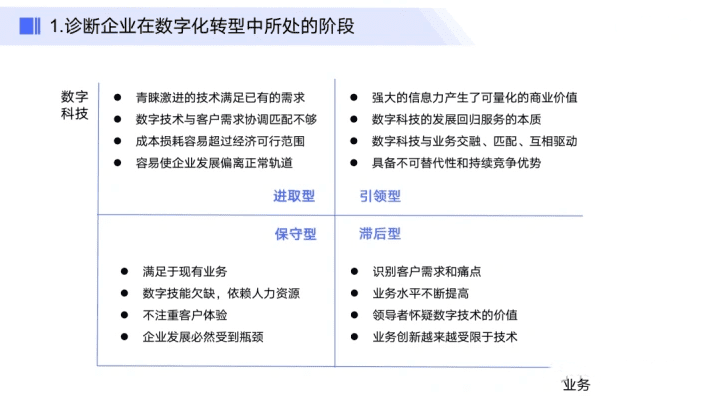
根据数字科技的应用程度和业务转型的进展情况,我们以数字科技的应用为纵坐标、业务为横坐标,可以将企业分为引领型、进取型、保守型、滞后型,按照数字化转型的广度和深度,将企业数字化转型对应三个阶段。
第一阶段,是信息化或系统化阶段,重点在硬件建设和数据能力,例如ERP软件系统已成为企业的“标配”,极大地推动了企业信息化进程。这个阶段的内容包括数据的标准化、规范化,以及数据的打通和整合。
第二阶段,是数字化或智能化阶段,这个阶段重点在于业务、产品和服务优化以及协同共享,同时数据价值在企业管理决策、提升客户洞察、改善运营效率等诸多方面会发挥重要作用。
第三阶段,是转型与与升级阶段,企业需要打造持续创新能力,包括产品与服务创新、商业和管理模式创新。从根本上打破烟囱式的业务和组织架构,构建横向、纵向体系,探索新赛道,逐渐向平台化与与生态化发展。
根据以上步骤,企业可以判断自己处在数字化转型的哪个阶段,从而针对性地制定数字化转型策略和计划,数字化转型升级是一个长期的过程,企业需要持续推进。
翻译:
Six stages of digital transformation of traditional enterprises, self-test!
According to Gartner, a global authoritative IT research and consulting company, successful digital transformation can make enterprises 20-25 times more efficient, but less than 20% of enterprises successfully transform in this process.
Despite the prevalence of 5G, cloud computing, and the Internet of Things, for enterprises, digital transformation is not a simple “treatment”, but a complex “surgery”, and enterprises are faced with the problem of “strategic absence”, “capacity is difficult to build” and “value is difficult to emerge” in the process of digital transformation.
What’s so hard about digital transformation? To do a good job of digital transformation and upgrading, we must first do an analysis of our own enterprises. Today, we will discuss and exchange what stages are there in the digital transformation of enterprises, and what stage is corresponding to their own enterprises at present?
First, six stages of digital transformation of traditional enterprises
The digital transformation of traditional enterprises can be roughly divided into six stages: business data, data assets, asset value, value service, and service ecology.
These six stages are not cascades in sequence, and there is not necessarily a clear transition mark between each stage, these stages are likely to exist at the same time, but a certain stage will dominate at a certain time, because data assets are a continuous accumulation, improvement and optimization process.
For example, some group enterprises may have a deep digitization process in some business forms, while some business forms have not started or just started. Some enterprises have only started digital upgrading in relevant formats, but the group level has not started or just started, or the group level has started, and the relevant formats have not caught up; At the same time, the cooperation between enterprises and ecology has always existed before, but the mode and depth of cooperation are different.
01 Service data phase
In the information age, different business systems have been gradually built for business operation. The IT system focuses on business services, depositing a lot of data in the process of service, and then doing some analysis on the basis of the data, such as ERP, CRM, supply chain, online mall, offline POS, master data and other systems.
02 Data asset stage
Based on mobile Internet, Internet of Things, cloud computing and big data technology, collect consumer information (fans, potential customers, new customers, old customers, loyal customers, etc.) by digital means, label customers with various labels, such as population attribute label, behavior attribute label, transaction attribute label, preference attribute label, consumption trend label, and establish data asset catalog. Form a group portrait (e.g., high purchasing power, medium purchasing power, low purchasing power).
Isolated and dispersed data without cleaning and integration does not have much value. Only data with integrity, uniqueness, consistency, accuracy, legitimacy and timeliness are data assets, which can truly create business value.
Data assets need to gather the fragmented data scattered in the internal and external, online and offline platforms, connect and enhance each other, and promote enterprises to become more intelligent. Enterprises are trying to use various technologies to deal with massive data of large data magnitude, different types and different formats, in order to accumulate and enhance the value of enterprise data assets.
03 Asset valuation stage
Data must be combined with business scenarios, artificial intelligence and data operations to truly present value, change the way the system assisted decision-making in the past, gradually take data decision-making as the core driving force, and achieve the purpose of accumulating experience, improving efficiency and reducing burden, business empowering and innovation through data reuse and safe sharing. On the basis of the establishment and improvement of data assets, to do fine operations for consumers, through the data to drive scene application, scene application to bring value.
The accumulation of data and the development of artificial intelligence (AI) promote each other and complement each other. Enterprises through intelligent means to forecast, early warning, recommendation, to achieve thousands of thousands of faces, thousands of stores, more accurate and efficient reach and marketing, such as the best crowd recommendation, the best SKU recommendation, related goods purchase forecast, and ultimately achieve the goal of business growth.
04 Stage of value service
Enterprises need to sort out internal and external service capabilities, standardize business capabilities and encapsulate them into services, plan and build reusable value service platforms through platform-based thinking, and open up the internal front and back office of enterprises and connect with external ecological platforms. The digital era needs to be data-driven as a starting point, and data assets should be operated as strategic assets of enterprises, so that data assets can be added value and become business value.
The value output platform is also a hot middle platform in recent years, such as business middle platform, data middle platform, technology middle platform, and organization middle platform. Enterprises through the middle empower, call each other, empower each other, call others’ longboard to make up for their own shortcomings, but also open their own longboard for others to call, and according to the new value chain to obtain the corresponding value return.
05 Service ecological stage
In the future, enterprises must be open to transformation and upgrading, form links with the industry, and need to have symbiosis, coexistence, co-construction, and win-win thinking, vertical service of the internal front end and back end of the enterprise, horizontal service of each business unit and the upstream and downstream of the entire industrial chain.
For leading enterprises in the industry or enterprises with core data, in addition to serving and empowering various business forms within the enterprise, the service system can also be extended to the industrial ecology, and the internal platform can be extended to c2S2b2c (or c2B2b2c), S refers to the supply platform, and Small b can serve c with the help of the empowerment of supply platform S.
06 Ecological industrialization stage
The core point of digitalization is that upstream and downstream enterprises in the industrial chain use the same digital platform to empower their respective core capabilities and resources to achieve efficient division of labor and more reasonable value distribution, change the past “small, complete” enterprise organization form, extend the boundaries of enterprises and organizations to the industrial chain level, and avoid their respective shortcomings.
Blurring enterprise boundaries and blurring industry boundaries will directly lead to more obvious vertical division of labor. Horizontal chain widens due to horizontal integration between industries, and vertical chain flattens due to the network of intra-industry chains. These will intensify the re-integration of industries, and evolve and evolve into a new industrial ecology or industrial alliance. And it is even possible that the future industrial form may be completely different from our current industrial form.
Second, diagnose the stage of the enterprise in the digital transformation
How can a business tell what stage it is in? Companies can determine where they are in their digital transformation by following these steps:
1. Confirm the maturity of the enterprise’s current digital capabilities: Enterprises can conduct a comprehensive diagnosis of their own digital capabilities through self-assessment or hiring a third-party organization to understand the status quo and existing problems in the process of digital transformation.
2. Analyze the landing areas of enterprise digital transformation: enterprises need to comprehensively analyze from the perspectives of business, technology, organization, etc., to find out the key areas of digital transformation, such as enterprise informatization, digitalization, intelligence, and business transformation.
3, Compare industry best practice cases: By comparing the digital transformation practices of advanced enterprises in the same industry. You can help enterprises more accurately judge their own position. You can refer to the best practices and success stories in the industry to learn about the advanced experiences and practices of other companies in the digital transformation process.
4, Evaluate the progress of digital transformation: enterprises need to regularly evaluate the progress of digital transformation, understand the effectiveness of digital transformation, and adjust and optimize according to the evaluation results.
According to the application degree of digital technology and the progress of business transformation. We take the application of digital technology as the vertical coordinate and the business as the horizontal coordinate. And can divide enterprises into leading, aggressive, conservative and lagging types. According to the breadth and depth of digital transformation, the digital transformation of enterprises corresponds to three stages.
The corresponding three stages of enterprise digital transformation
The first stage is the informationization or systemization stage, focusing on hardware construction and data capabilities. Such as ERP software system has become the “standard” of enterprises, which has greatly promoted the process of enterprise informatization. The content of this stage includes the standardization and normalization of data. As well as the opening and integration of data.
The second stage is the digital or intelligent stage. Which focuses on business, product and service optimization and collaborative sharing. While the value of data plays an important role in enterprise management decisions, enhance customer insight, improve operational efficiency and many other aspects.
The third stage, is the transformation and upgrading stage, enterprises need to build continuous innovation capabilities. Including product and service innovation, business and management model innovation. Fundamentally break the smokestack business and organizational structure, build a horizontal and vertical system, explore a new track. And gradually develop towards platform and ecology.
According to the above steps, enterprises can judge which stage of digital transformation they are in. So as to formulate targeted digital transformation strategies and plans, digital transformation and upgrading is a long-term process, enterprises need to continue to promote.
本文由数字化转型网(www.szhzxw.cn)转载而成,来源于中国新闻网;编辑/翻译:数字化转型网宁檬树。

免责声明: 本网站(http://www.szhzxw.cn/)内容主要来自原创、合作媒体供稿和第三方投稿,凡在本网站出现的信息,均仅供参考。本网站将尽力确保所提供信息的准确性及可靠性,但不保证有关资料的准确性及可靠性,读者在使用前请进一步核实,并对任何自主决定的行为负责。本网站对有关资料所引致的错误、不确或遗漏,概不负任何法律责任。
本网站刊载的所有内容(包括但不仅限文字、图片、LOGO、音频、视频、软件、程序等) 版权归原作者所有。任何单位或个人认为本网站中的内容可能涉嫌侵犯其知识产权或存在不实内容时,请及时通知本站,予以删除。