
2023年11月,美国防部发布《数据、分析和人工智能采用战略》,该战略整合了2018年的《国防部人工智能战略》和2020年的《国防部数据战略》,在分析美国防部当前的战略环境和目标后,提出了六项具体战略。
一、战略环境
2018《国防部人工智能战略》强调为人工智能开发集中建立基础设施,为美国防部研究和工程界人工智能技术的发展牵线搭桥,并在军事道德和人工智能安全方面发挥国际领导作用。2020《国防部数据战略》将美国防部设想为一个以数据为中心的组织,以VAULTIS目标框架为方向开展数据管理活动,利用数据提高技术能力,获得作战优势,提高部署效率。 数字化转型网(www.szhzxw.cn)
这两个战略为美国防部的数字化转型起到了关键推动作用。《数据、分析和人工智能采用战略》(后称《战略》)吸收并取代了这两个战略,重点关注数据、分析和人工智能技术的采用,以期将数据、分析和人工智能技术集成在更广泛的美国政府政策、促进创新的私营部门和合作伙伴关系以及全球生态系统中。
二、主要成果
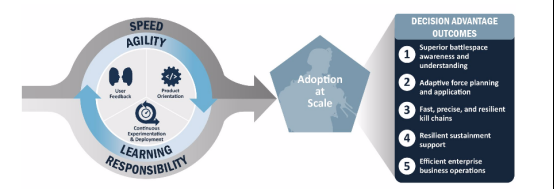
实施《战略》,美国防部领导人和作战人员将能够通过专业地利用高质量数据、先进分析和人工智能技术,推动持续性结果驱动的开发、部署和反馈,作出快速、明智的决策。
《战略》提出采用灵活方法来扩大决策优势。灵活的采用方法,即在开发人员、用户、专家之间创建有效的迭代反馈循环,提升反馈效率,强调交付速度和持续改进。
三、战略目标
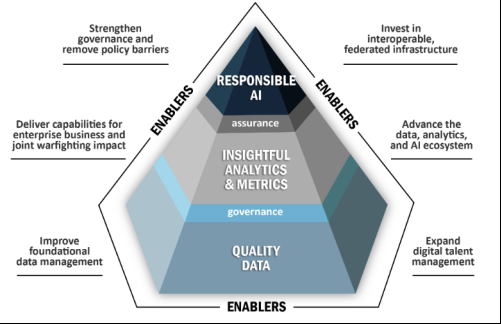
美国防部将战略工作重点放在支持美国防部人工智能需求层次结构的几个相互依赖的目标上。
人工智能需求层级是一个以高质量数据为基础的金字塔,因为所有分析和人工智能能力都需要可靠的高质量数据来支持决策者。金字塔的下面是分析和数据,美国防部领导人了解其领域所需的基础模型和可视化技术,以及影响这些领域的关键变量。金字塔顶端是可靠的人工智能。金字塔之外则是有助于维持需求层次的推动者,即六项具体战略。 数字化转型网(www.szhzxw.cn)
(一)改进基础数据管理
《战略》继续肯定数据的重要性,指出美国防部的所有数据都是资源。为提高数据质量,《战略》提出了“将数据视为产品”的路径。美国防部将继续提高数据的可视性、可访问性、可理解性、关联性、可信赖性、可互操作性和安全性(VAULTIS)。通过将数据视为一种产品,美国防部各部门可以在适当的情况下激发数据共享和再利用,从而打破数据孤岛,促进跨职能协作。以产品为导向确保了数据获得正确的管理与支配,以及明确的问责制、质量和接口标准以及访问控制。虽然这种数据管理方法不会改变美国防部组织的复杂性特征,但随着时间的推移,它将提高作战与分析数据质量,减少数据积压,降低数据存储成本,并减少数据冗余。这些改进将使美国防部能够更好地利用其数据产品,并做出更有效、数据驱动的决策。
(二)提供技术支持,改善决策优势成果
美国防部将继续专注于推进数据分析技术,通过不断提高数据质量,为美国防部人员提供更全面的信息,以更好地进行反应和作出主动决策。美国防部将与利益相关者、企业和作战人员一起设计和测试分析和人工智能解决方案,以应对不同的作战环境。美国防部将持续进行实验,并进行综合多边演习。倡导各部门加大数据、分析和人工智能投入,以提升技术能力。这些经过严格测试后的能力将获得更多支持,并被大规模采用。 数字化转型网(www.szhzxw.cn)
(三)加强共识和合作
《战略》指出,当前政策环境复杂,达成共识和合作对于消除政策障碍、调整技术接口、加快可靠性采用至关重要。一是确定领导者,明确优先关键领域,包括数据管理、网络安全等,加强问责制。针对既有政策,提高灵活性、部署速度和可扩展性。二是减少体制障碍,铲除不必要的集体研发、规划、互用、情报和信息共享障碍,为技术和信息发布流程提供信息,促进交流。
(四)投资建设可互操作的联合基础设施
数据、分析和人工智能能力的发展需要巨大的计算能力,而且计算需求将随着使用规模的扩大而呈指数级增长。在适当的情况下,该基础设施将实现自动化,包括实施美国防部技术政策的措施(如持续授权操作)、状态报告,以及关键的用户访问任务相关数据、分析以及人工智能平台。尽管由政府主导和设计,但美国防部基础设施将采用面向行业和值得信赖合作伙伴的开放合作架构,美国防部集中研究部分决策和服务,而其他决策和服务任务则继续分散,解决独特的任务需求。
(五)加强政府间、学界、产业界和国际合作
《战略》指出,美国防部不可能独自取得成功,需要推动建立强大的国家和国际生态系统,改善政府间、学界、产业界和国际在数据、分析和人工智能技术方面的合作,继续出口关键技术,并共享数据,以确保同盟国和合作伙伴保持敏锐度,能够快速采用先进分析技术和进行人工智能创新。
(六)扩大数字人才管理
美国防部将尽力识别和雇用人才,将资源集中在吸引、招聘、培训和留住数字人才工作岗位上真正创新的员工队伍,发掘和培训非技术人员,他们将领导和监督创新文化,促进数据、分析和人工智能能力被负责任地使用和应用。一方面通过提高技能和再培训来增强现有劳动力的技术能力,一方面扩大渠道,灵活吸引、招聘和雇佣数字人才。
《战略》附件部分译文
附件A:
本附件为改进美国防部的基础数据管理提供了额外的指南,以提高美国防部数据的质量及可用性。用户需求和位置要求是数据质量的基础。因此,各组成部分和下属组织将制定数据质量实施指南和相关指标。由于本附件保留了VAULTIS框架,基于2020年数据战略的现有部门级实施计划仍然健全。但随着时间的推移,各部门将改进其数据管理计划,更紧密地与本战略保持一致。
随着各部门制定并实施其数据质量计划,需改进的数据集将建立在元数据之上,以便进行数据检索与分析;优先考虑相关性及任务价值;采取行动,以便为改进工作提供适当的资源;对优先数据集进行监测,以衡量和报告其生命周期数据的质量水平;并通过循环过程进行校正,从而能持续解决数据质量的下降问题。 数字化转型网(www.szhzxw.cn)
数据质量维度、VAULTIS框架是用于数据管理规划的两项工具。这些工具代表了相互关联和相互支持的概念,适用于从创建到清除的整个数据生命周期。低质量数据将不可避免地破坏数据的可信度,引发安全问题,并破坏VAULTIS框架的实用性。另一方面,不符合VAULTIS框架的高质量数据,对分析和人工智能工作进程的价值也十分有限。
1、数据质量维度
随着时间的推移,数据所有者可能会依据寿命、优先级、初始条件和其他因素对不同质量水平的数据集进行分类。因此,数据质量维度是相对的,所有者将在数据的生命周期中进行评估。下表提供了每个维度的评估问题示例。
| 维度 | 评估问题 |
| 准确性:正确反映已证实的真实数据值或特定行动、个人、实体的数据。准确性包括数据结构、内容和可变性。 | 数据值与指定格式不一致的频率有多高?数据值与基本事实匹配的频率有多高?误差是如何测量的?对于制定的目的来说,它是可容忍的吗? |
| 完整性:在指定时间出现的数据包含在数据集、行或列级别测量的预期信息或统计信息。 | 是否有已知的数据可以使数据集更加完整?数据集是否包含足够的信息广度,以使数据达到其目的?数据中的哪些字段需要一些空值?空值多久出现一次? |
| 合格性:数据集遵循商定的内部政策、标准、程序和体系结构需求。 | 数据的格式是否符合适用的标准?数据集架构是否已发布并可用?是否根据内部政策、标准和程序实施了数据库约束,以防止错误输入? |
| 一致性:一个值在数据集中和数据集之间统一表示的程度。 | 是否有其他数据集引用此数据集中的值?是否存在差异? |
| 唯一性:确保每个观察到的事件与描述该事件的记录之间存在一对一的一致性。 | 是否有其他具有相同功能的权威数据源?这个数据集中是否有重复的记录? |
| 集成度:数据集的系谱、来源和谱系是已知的,并与相关的业务规则保持一致。 | 在收集、存储、处理或传输过程中,是否存在数据被篡改、误报、降级、损坏、中毒或其他被更改的可能?为解决数据质量差的问题,多久进行一次数据质量检查?数据清理过程是否会导致数据被篡改? |
| 及时性:衡量事件发生与数据可用性之间的时间。 | 受支持的数据使用者要求更新的频率有多高?数据用途是否需要减少延迟? |
2、VAULTIS框架
2020年美国防部《数据战略》讨论的VAULTIS框架仍然是各部门组织、监控其数据管理计划的有用工具。关键维度和相关评估问题包括: 数字化转型网(www.szhzxw.cn)
| 维度 | 评估问题 |
| 可见性:用户可以找到所需的数据。 | 授权用户是否能够发现具有特定利益或价值的数据?数据管理员、数据保管人和功能数据管理者是否被分配了识别、注册、公开数据的责任,使整个企业以及适当的外部合作伙伴能够轻松检索数据?用户是否能够检索并快速确定谁负责特定的数据产品、数据产品的位置、可用数据产品的类型以及访问数据产品的方式? |
| 可访问性:用户可以检索数据。 | 授权用户是否能够在需要时获得所需的数据?授权用户是否可以访问数据,包括作战、情报和业务数据? |
| 可解释性:用户可以找到数据描述来识别内容、上下文和适用性。 | 是否允许用户安全地使用数据聚合、比较和分析的工具?数据的标签和格式是否适当,以支持大规模分析?与数据相关联的元数据是否包含上下文关系和业务规则? |
| 关联性:用户可以通过固定的关联关系进一步利用互补的数据元素。 | 数据是否链接,以便可以发现并维护关联关系、依赖关系?组织机构是否使用开放数据标准、数据目录和元数据标记的行业最佳实践?数据是否不必要地被孤立,或者它们是否支持跨数据源的连接? |
| 信赖度:用户可以对他们使用数据进行决策的各个方面充满信心。 | 这些数据代表了事实来源吗?数据是否必须经过额外的审查,以确保其能够支持决策?在解释和分析数据时,用户是否需要考虑可能导致致命结果的错误情况?数据是否反映了必要的元数据或上下文,以使用户能够对数据是否存储或如何存储做出适当判断? |
| 互操作性:用户和生产者对数据有共同的认识和理解。 | 数据能否在系统和用户之间进行交换,同时保持其质量和可用性?数据是否具有基于通用数据格式和机器间通信的语义、语法互操作性? |
| 安全性:用户了解数据保护责任,遵循分类管理程序,并知道数据受到保护,需经授权使用、操作。 | 数据在静止、传输和使用时(应用程序中、分析中等等)是否受到保护?组织是否在整个企业范围内使用规范的数据保护方法,例如:基于属性的访问控制?是否有保护机制(例如,安全控制)来确保根据适用的法律、法规和政策允许用户访问?是否有分类管理程序,以确保数据(无论是否汇总)得到保护,并符合法律、法规和政策? |
这些准则为组织以有效并高效的方式提升高优先级数据集数据质量提供了基础指导。若缺乏基于测试标准的有序方法,各部门将在提升数据质量水平以满足分析和人工智能开发需求时面临重大挑战。因此,组织将通过协作论坛,如CDAO委员会及其支持论坛,进行平面化通信,增强可见性,并确保数据质量改进和维护的方法之间的一致性。 数字化转型网(www.szhzxw.cn)

翻译:
Us Department of Defense releases Data, Analytics and AI Adoption Strategy
In November 2023, the Department of Defense released the Data, Analytics, and Artificial Intelligence Adoption Strategy, which integrates the 2018 Department of Defense Artificial Intelligence Strategy and the 2020 Department of Defense Data Strategy, and proposes six specific strategies after analyzing the Department of Defense’s current strategic environment and objectives.
First, strategic environment
The 2018 dod Artificial Intelligence Strategy emphasizes building a centralized infrastructure for AI development, bridging the development of AI technologies in dod research and engineering communities, and providing international leadership in military ethics and AI security. The 2020 Department of Defense Data Strategy envisions the Department of Defense as a data-centric organization that conducts data management activities guided by the VAULTIS Objectives framework to leverage data to improve technical capabilities, gain operational advantage, and improve deployment efficiency.
These two strategies play a key role in promoting the digital transformation of the Department of Defense. The Data, Analytics, and AI Adoption Strategy (later called the Strategy) absorbs and replaces both strategies, focusing on the adoption of data, analytics, and AI technologies with a view to integrating data, analytics, and AI technologies into broader U.S. government policy, private sector and partnerships that foster innovation, and the global ecosystem.
Ii. Main Achievements
By implementing the Strategy, DOD leaders and warfighters will be able to make fast, informed decisions through the expert use of high-quality data, advanced analytics, and artificial intelligence to drive continuous results-driven development, deployment, and feedback.
The Strategy proposes a flexible approach to maximizing decision-making advantage. A flexible approach to adoption that creates effective iterative feedback loops between developers, users, and experts to improve feedback efficiency, emphasizing speed of delivery and continuous improvement.
Figure 1: Using a flexible approach to maximize decision-making advantage (Image: US Department of Defense) 数字化转型网(www.szhzxw.cn)
Third, strategic objectives
The Department of Defense has focused its strategic efforts on several interdependent objectives that support the Department’s AI requirements hierarchy.
The AI demand hierarchy is a pyramid based on high-quality data, as all analytics and AI capabilities require reliable high-quality data to support decision makers. Below the pyramid are analytics and data, the underlying models and visualization techniques that DOD leaders need to understand their fields, and the key variables that affect them. At the top of the pyramid is reliable AI. Beyond the pyramid are the movers that help maintain the hierarchy of needs, namely six specific strategies.
Figure 2: Strategic Objectives and AI requirements Hierarchy (Image: US Department of Defense)
(1) Improving basic data management
The Strategy continues to affirm the importance of data, noting that all DOD data is a resource. To improve data quality, the Strategy sets out a path to “treat data as a product.” The Department of Defense will continue to improve data visibility, accessibility, understandability, relevance, trustworthiness, interoperability, and security (VAULTIS). By treating data as a product, dod departments can stimulate data sharing and reuse where appropriate, breaking down data silos and facilitating cross-functional collaboration. Being product-oriented ensures that data is properly managed and controlled, with clear accountability, quality and interface standards, and access controls. While this approach to data management will not change the complexity of the dod organization, over time it will improve operational and analytical data quality, reduce data backlogs, reduce data storage costs, and reduce data redundancy. These improvements will enable the Department of Defense to better leverage its data products and make more effective, data-driven decisions.
(2) Provide technical support to improve the results of decision-making advantages
The Department of Defense will continue to focus on advancing data analytics technology to provide DOD personnel with more comprehensive information to better react and make proactive decisions by continuously improving the quality of data. The Department of Defense will work with stakeholders, enterprises, and warfighters to design and test analytics and AI solutions for different operational environments. The US Department of Defense will continue to conduct experiments and conduct comprehensive multilateral exercises. Advocate for greater investment in data, analytics and artificial intelligence across all sectors to enhance technical capabilities. These rigorously tested capabilities will gain support and be adopted at scale. 数字化转型网(www.szhzxw.cn)
(3)Strengthen consensus and cooperation
The Strategy notes that in the current complex policy environment, consensus and cooperation are essential to remove policy barriers, align technology interfaces, and accelerate reliable adoption. First, identify leaders and prioritize key areas, including data management and cybersecurity, to enhance accountability. Improve flexibility, deployment speed, and scalability for existing policies. The second is to reduce institutional barriers, remove unnecessary barriers to collective research and development, planning, interoperability, intelligence and information sharing, inform technology and information dissemination processes, and facilitate exchanges.
(4) Invest in building interoperable joint infrastructure
The development of data, analytics, and AI capabilities requires tremendous computing power, and the computing needs will grow exponentially with the scale of use. Where appropriate, this infrastructure will be automated, including measures to implement DOD technology policies (such as continuous authorization operations), status reporting, and critical user access to mission-relevant data, analytics, and artificial intelligence platforms. Although government-led and designed, dod infrastructure will adopt an open collaborative architecture for industry and trusted partners, with DOD focusing research on some decisions and services while others continue to be decentralized to address unique mission requirements.
(5)Strengthening inter-governmental, academic, industrial and international cooperation
The Strategy states that dod cannot succeed alone and needs to promote a strong national and international ecosystem, improve intergovernmental, academic, industry, and international collaboration on data, analytics, and artificial intelligence technologies, continue to export critical technologies, and share data to ensure that Allies and partners remain vigilant. Ability to quickly adopt advanced analytics and AI innovation. 数字化转型网(www.szhzxw.cn)
(6)Expanding digital talent management
The Department of Defense will strive to identify and hire talent, focus resources on attracting, recruiting, training, and retaining a truly innovative workforce for digital talent jobs, and identify and train non-technical personnel who will lead and oversee a culture of innovation that promotes the responsible use and application of data, analytics, and AI capabilities. On the one hand, through upskilling and retraining
本文由数字化转型网(www.szhzxw.cn)转载而成,来源于CAICT互联网法律研究中心;编辑/翻译:数字化转型网宁檬树。
免责声明: 本网站(http://www.szhzxw.cn/)内容主要来自原创、合作媒体供稿和第三方投稿,凡在本网站出现的信息,均仅供参考。本网站将尽力确保所提供信息的准确性及可靠性,但不保证有关资料的准确性及可靠性,读者在使用前请进一步核实,并对任何自主决定的行为负责。本网站对有关资料所引致的错误、不确或遗漏,概不负任何法律责任。
本网站刊载的所有内容(包括但不仅限文字、图片、LOGO、音频、视频、软件、程序等) 版权归原作者所有。任何单位或个人认为本网站中的内容可能涉嫌侵犯其知识产权或存在不实内容时,请及时通知本站,予以删除。