

近期,有报道指出,OpenAI计划从今年7月9日起,对非支持国家和地区的API(应用程序接口)服务实施限制。目前,该公司的API服务覆盖了161个国家和地区,但中国内地和中国香港并未包含在内。
尽管有使用了OpenAI的API接口服务的中国技术人员透露,他们尚未收到任何停止使用的通知,但这一消息无疑引起了业界的广泛关注。 数字化转型网(www.szhzxw.cn)
实际上,OpenAI从未向中国市场开放服务,中国用户大多都是通过代理服务或微软云来间接使用OpenAI的技术与服务。对于这种使用方式,此前,OpenAI官方并未明确表态是否可行。
自今年2月以来,OpenAI开始发布一系列关于AI安全性的报告和声明,表示有部分国家和地区的个别用户利用其OpenAI的AI工具生成不实内容,对网络安全造成了一定的影响。
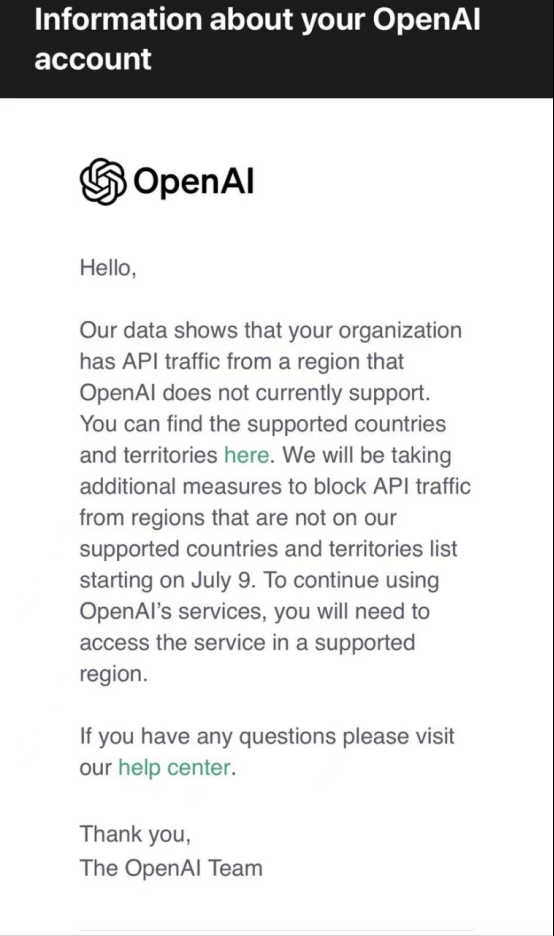
OpenAI推送的邮件通知中指出,自7月9日起,OpenAI将开始阻止来自非支持国家和地区的API流量。受影响组织若希望继续使用OpenAI的服务,必须在其支持的国家和地区内访问。(图片来源:Twitter,OpenAI用户发布) 数字化转型网(www.szhzxw.cn)
2月14日,OpenAI发文表示,已通过与微软安全部门的合作,封锁了五个涉嫌网络钓鱼和生成恶意代码的账号,这些账号分别来自中国、俄罗斯、伊朗和朝鲜。
同日,微软也发表声明,强调公司已制定相关原则以降低安全风险,包括封锁恶意用户账号,且也通知了其他AI服务商,与企业利益相关者定期交换安全信息并持续向公众通报。同时微软还表示,将与OpenAI合作监控攻击行为,并不断改进和提升防御机制和技术。
5月30日,OpenAI发布了一份39页的调查报告,揭露了过去三个月内发现的五个新的不安全行为案例,涉及俄罗斯、中国、伊朗和以色列的用户。这些行为包括使用OpenAI模型在社交平台上发布虚假内容、生成虚假回复和发送垃圾邮件等。报告指出,虽然这些账号在多个社交平台上活动,但目前并未产生实际影响。 数字化转型网(www.szhzxw.cn)
OpenAI在声明中还提到,公司已经开发了AI工具,以提高检测和分析危险行为的效率。这些工具在短时间内就识别出了上述不安全行为,并计划进一步优化以提升调查能力和效率。
目前,中国公司和开发者主要通过两种方式使用OpenAI的API:一是通过购买微软Azure云服务;二是通过海外服务器进行API调用。如果OpenAI加强地区限制,中国开发者可能面临使用成本上升的问题。
值得注意的是,OpenAI的服务并不完全符合中国市场的法律规范。2023年7月13日,中国相关部门发布了《生成式人工智能服务管理暂行办法》,要求提供具有舆论属性或社会动员能力的生成式人工智能服务必须进行安全评估,并按照规定进行算法备案和变更、注销备案手续。截至今年3月,已有117家大模型完成了备案,但OpenAI并未在列。 数字化转型网(www.szhzxw.cn)
本文素材来源于网络,不代表数字化转型网观点。
更多人工智能相关观点可扫码加入数字化转型网人工智能研习社





翻译:
OpenAI strengthens regional restrictions on API services, How do Chinese developers respond?
Recently, it was reported that OpenAI plans to implement restrictions on API (application programming interface) services in non-supported countries and regions from July 9 this year.Although some Chinese technicians who have used OpenAI’s API interface service revealed that they have not received any notice to stop using it, the news undoubtedly caused widespread concern in the industry.
In fact, OpenAI has never opened its services to the Chinese market, and Chinese users mostly use OpenAI’s technology and services indirectly through proxy services or Microsoft cloud. For this use, previously, OpenAI official did not make clear whether it is feasible.
Since February this year, OpenAI has begun to release a series of reports and statements on AI security, indicating that individual users in some countries and regions have used their OpenAI tools to generate false content, which has a certain impact on network security.
As of July 9, OpenAI will begin blocking API traffic from non-supported countries and regions. Affected organizations that wish to continue using OpenAI’s services must access them within the countries and territories they support. (Image credit: Twitter, posted by OpenAI user)
On February 14, OpenAI said it had worked with Microsoft security to block five accounts suspected of phishing and generating malicious code from China, Russia, Iran and North Korea.
On the same day, Microsoft also issued a statement, emphasizing that the company has established relevant principles to reduce security risks, including blocking malicious user accounts, and has also notified other AI service providers, regularly exchange security information with enterprise stakeholders, and continue to inform the public. At the same time, Microsoft also said that it will work with OpenAI to monitor attacks and continuously improve and enhance defense mechanisms and technologies.
On May 30, OpenAI released a 39-page investigative report revealing five new cases of unsafe behavior found in the past three months, involving users in Russia, China, Iran, and Israel. These include using OpenAI models to post fake content on social platforms, generate fake responses, and send spam. According to the report, although these accounts are active on multiple social platforms, there is no real impact at present. 数字化转型网(www.szhzxw.cn)
In its statement, OpenAI also mentioned that the company has developed AI tools to improve the efficiency of detecting and analyzing dangerous behavior. The tools identified these unsafe behaviors within a short period of time and are planned to be further optimized to improve investigation capabilities and efficiency.
Currently, Chinese companies and developers use OpenAI’s apis in two main ways: by purchasing Microsoft Azure cloud services; The second is to make API calls through overseas servers. If OpenAI strengthens regional restrictions, Chinese developers may face higher usage costs.
It is worth noting that OpenAI’s services do not fully comply with the legal norms of the Chinese market. On July 13, 2023, the relevant departments of China issued the Interim Measures for the Management of Generative Artificial Intelligence Services, requiring that generative artificial intelligence services that provide public opinion attributes or social mobilization capabilities must conduct security assessments, and carry out algorithm filing and change and cancellation filing procedures in accordance with regulations. As of March this year, 117 large models have completed the filing, but OpenAI is not listed.
The material of this article comes from the Internet, and does not represent the view of digital transformation network. 数字化转型网(www.szhzxw.cn)
本文由数字化转型网(www.szhzxw.cn)转载而成,来源于中国经营报;编辑/翻译:数字化转型网宁檬树。