
一、媒体发声
在数字乡村建设中,分级分类既是成效考核评价的重要抓手,又是充分调动基层积极性的重要手段。构建精准识别、分级分类的数字乡村建设评价标准,有助于总结地方数字乡村建设进程中的特色经验,促进同类地区的学习和借鉴。
9月6日,浙江数字化发展与治理研究中心研究员陈川在《中国社会科学报》发表《打造分级分类数字乡村评价标准》一文,为当前加快推进我国数字乡村建设,打造分级分类评价标准提出五个发力点。
全文如下。数字化转型网www.szhzxw.cn
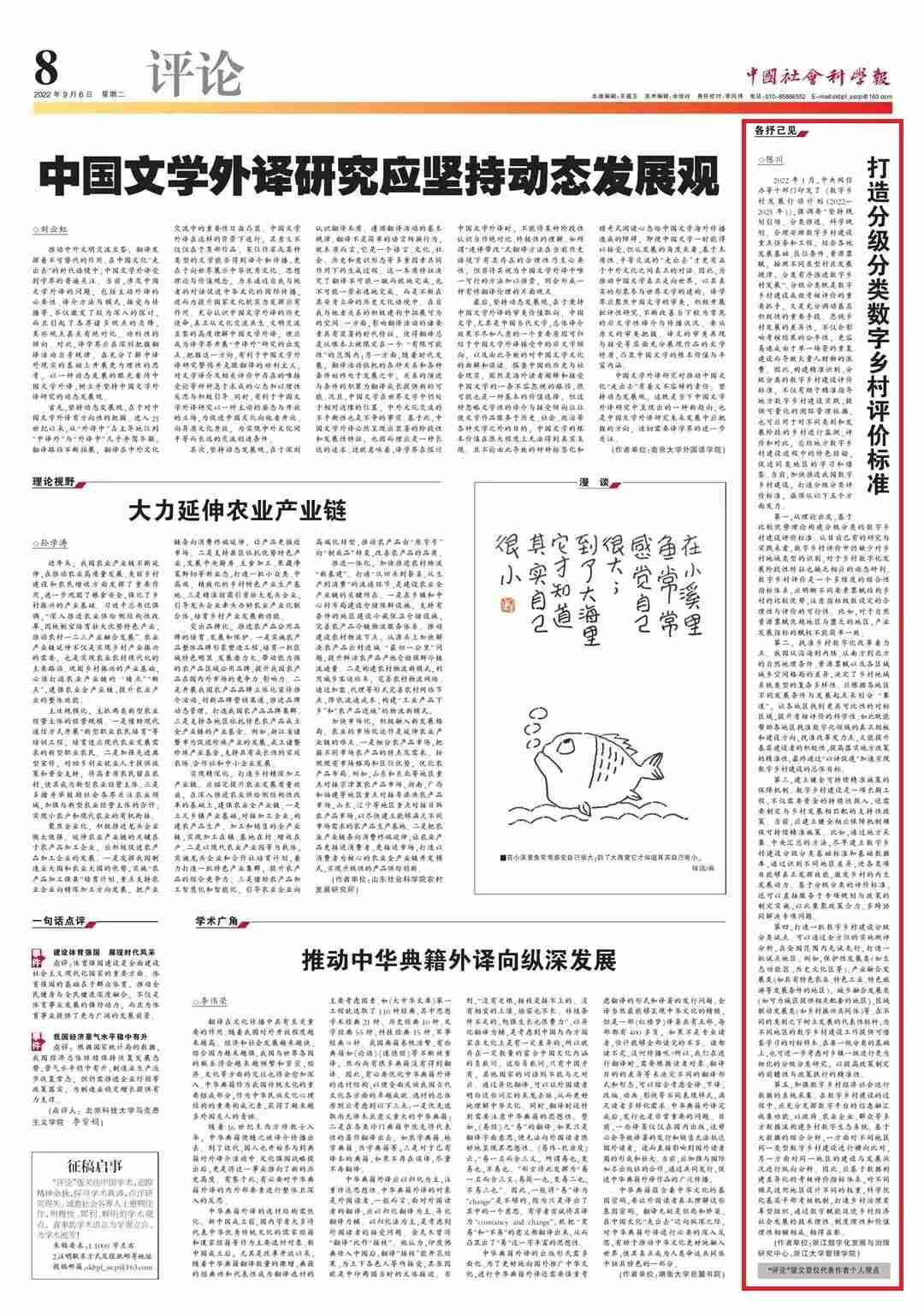
二、打造分级分类数字乡村评价标准 陈川
2022年1月,中央网信办等十部门印发了《数字乡村发展行动计划(2022—2025年)》,强调要“坚持规划引领、分类推进。科学规划、合理安排数字乡村建设重点任务和工程,结合各地发展基础、区位条件、资源禀赋,按照不同类型村庄发展规律,分类有序推进数字乡村发展”。分级分类既是数字乡村建设成效考核评价的重要抓手,又是充分调动基层积极性的重要手段。忽视乡村发展的差异性,不仅会影响考核结果的公平性,更容易造成由于单一场景的重复建设而导致大量人财物的浪费。因此,构建精准识别、分级分类的数字乡村建设评价标准,不仅有助于精准指导地方数字乡村建设实践,提供可量化的闭环管理依据,也可应用于对不同类别和发展阶段的乡村进行监测、评价和对比,总结地方数字乡村建设进程中的特色经验,促进同类地区的学习和借鉴。当前,加快推进我国数字乡村建设,打造分级分类评价标准,亟须从以下五个方面发力。
第一,从理论出发,基于比较优势理论构建分级分类的数字乡村建设评价标准。从目前已有的研究与实践来看,数字乡村评价中仍缺少对乡村地域类型的识别,对于乡村数字化发展阶段性特征也缺乏相应的动态研判。数字乡村评价是一个多维度的综合性指标体系,应明晰不同要素禀赋结构乡村的比较优势,注意指标权数设定的合理性与评价的可行性。比如,对于自然资源禀赋优越地区与匮乏的地区,产业发展指标的赋权不能简单一致。数字化转型网www.szhzxw.cn
第二,找准乡村数字化改革着力点。我国从沿海到内陆、从南方到北方的自然地理条件、资源禀赋以及各区域城乡空间格局的差异,决定了乡村地域系统类型的复杂多样性。应根据各地区不同发展条件与发展起点来划分“赛道”,让各地区找到更具可比性的对标区域,提升考核评价的科学性。如此既能帮助各地区找准数字化领域的真正短板和建设方向,找准改革发力点,又能提升基层建设者的积极性,提高落实地方政策的精准性,最终通过“以评促建”加速实现数字乡村建设的总体目标。
第三,建立健全可持续精准施策的保障机制。数字乡村建设是一项长期工程,不仅需要资金的持续性投入,还需要制定与乡村发展相匹配的支持性政策。当前,应建立健全相应保障机制确保可持续精准施策。比如,通过地方采集、中央汇总的方法,尽早建立数字乡村建设分级分类基础标准和基础数据库,通过识别不同地区差异,使各类项目能够真正发挥效能,激发乡村的内生发展动力。基于分级分类的评价标准,还可以直接服务于专项规划与政策的制定实施,以此集聚政策合力、多跨协同解决专项问题。
第四,打造一批数字乡村建设分级分类试点。可以通过全方位的实地测评分析,在全国范围内先试先行,打造一批试点地区。例如,保护性发展类(如生态功能区、历史文化区等)、产业融合发展类(如具有特色农业、特色工业、特色旅游等发展条件的地区)、城乡融合发展类(如可为城区提供相关配套的地区)、区域联动发展类(如乡村振兴共同体)等。在不同的类别之下树立发展的代表性标杆,为不同地区的数字乡村建设工作提供可借鉴学习的对标样本。在县一级分类的基础上,也可进一步考虑对乡镇一级进行更为细化的分级分类研究,以提高政策制定的前瞻性与政策执行的精准性。
第五,加强数字乡村经济社会运行数据的系统采集。在数字乡村建设的过程中,应充分发挥数字平台的信息融汇收集功能,以政府、农业企业、群众等多方数据流构建乡村数字生态系统。基于大数据的综合分析,一方面对不同地区同一类型数字乡村建设进行横向比对,另一方面对同一地区的建设与发展状况进行纵向分析。因此,应基于数据构建差异化的考核评价指标体系,对不同模式适用地区设计不同的权重,科学优化基层干部考核机制,打造乡村治理变革型组织,通过数字赋能促使乡村经济社会发展的技术理性、制度理性和价值理性相辅相成、相得益彰。

数字化转型网www.szhzxw.cn
翻译:
The media voice
In the construction of digital countryside, classification is not only an important starting point of effectiveness assessment and evaluation, but also an important means to fully mobilize grassroots enthusiasm. The construction of accurate identification, classification and evaluation standards for digital rural construction is helpful to sum up the characteristic experience in the process of local digital rural construction, and promote the learning and reference of similar regions.
On September 6th, Chen Chuan, a researcher of Zhejiang Digital Development and Governance Research Center, published an article titled “Building Evaluation Standards for Graded and Classified Digital Villages” in the Chinese Journal of Social Science, putting forward five power points for accelerating the construction of China’s digital villages and building evaluation standards for graded and classified.
The full text is as follows.数字化转型网www.szhzxw.cn
Create Graded and classified digital rural evaluation standard Chen Chuan
In January 2022, the Cyberspace Administration of the CPC Central Committee and ten other departments issued the Action Plan for Digital Rural Development (2022-2025), emphasizing that “adhere to the guidance of planning and promote by classification. Scientific planning and reasonable arrangement of key tasks and projects for the construction of digital countryside, combined with local development basis, location conditions, resource endowment, according to the development law of different types of villages, classified and orderly promote the development of digital countryside. Classification is not only an important way to evaluate the effectiveness of digital rural construction. But also an important means to fully mobilize the grassroots enthusiasm.
Ignoring the differences of rural development will not only affect the fairness of the assessment results. But also easily lead to the waste of a large number of people and property due to the repeated construction of a single scene. Therefore, the construction of accurate identification, classification and evaluation standards for digital rural construction not only helps to accurately guide local digital rural construction practices and provide quantifiable closed-loop management basis, but also can be applied to the monitoring, evaluation and comparison of villages in different categories and development stages, sum up the characteristic experience in the process of local digital rural construction, and promote the learning and reference of similar regions. At present, it is necessary to accelerate the construction of digital villages and make classification and evaluation standards from the following five aspects.
Firstly, from the theoretical point of view, based on the theory of comparative advantage, the evaluation standard of digital rural construction is constructed.
Judging from the existing research and practice, the digital rural evaluation still lacks the identification of rural regional types. And the corresponding dynamic research and judgment on the phased characteristics of rural digital development. As a multi-dimensional comprehensive index system, digital rural evaluation should clarify the comparative advantages of villages with different factor endowment structures and pay attention to the rationality of index weight setting and the feasibility of evaluation. For example, for regions with superior natural resource endowment and regions with poor natural resources. The empowerment of industrial development indicators cannot be simply consistent.
Second, identify the focus of rural digital reform. 数字化转型网www.szhzxw.cn
The natural geographical conditions, resource endowments and the differences of spatial pattern between urban and rural areas from coastal to inland and from southern to northern regions determine the complex diversity of rural regional system types. The “track” should be divided according to different development conditions and starting points of each region. So that each region can find a more comparable benchmark area, and improve the scientific nature of assessment and evaluation. In this way, it can not only help each region to identify the real weaknesses and construction direction in the digital field, but also identify the reform strength point, enhance the enthusiasm of grassroots builders, improve the precision of the implementation of local policies. And finally accelerate the realization of the overall goal of digital rural construction through “evaluation to promote construction”.
Third, we need to establish a sound guarantee mechanism for implementing sustainable and targeted policies.
The construction of digital countryside is a long-term project, which requires not only the continuous investment of funds. But also the formulation of supportive policies that match the development of rural areas. At present, we need to establish and improve the relevant guarantee mechanism to ensure sustainable and precise policies. For example, through the methods of local collection and central summary. The basic standards and database of digital rural construction classification and classification should be established as soon as possible. By identifying regional differences, various projects can really play their role and stimulate the endogenous development power of rural areas. The evaluation criteria based on classification and classification can also directly serve the formulation and implementation of special planning and policies. So as to gather policy synergy and solve special problems through multi-cross coordination.
Fourth, we will launch a batch of graded and classified pilot projects for building digital villages.
We can build a batch of pilot areas nationwide through comprehensive field evaluation and analysis. For example, protected development. (Such as ecological functional areas, historical and cultural areas, etc.), integrated industrial development. (Such as areas with characteristic agriculture, industry, tourism and other development conditions), integrated urban-rural development. (Such as areas that can provide relevant supporting facilities for urban areas). And interconnected regional development (such as rural revitalization community). The representative benchmark of development should be set up under different categories to provide reference samples for the construction of digital villages in different areas. On the basis of the classification at the county level. A more detailed classification study at the township level can also be further considered in order to improve the foresight of policy formulation and the precision of policy implementation.数字化转型网www.szhzxw.cn
Fifth, strengthen the digital rural economic and social operation data system collection.
In the process of the construction of digital countryside. We should give full play to the function of information integration and collection of digital platforms. And build rural digital ecosystem with the data flow of government, agricultural enterprises, people and other parties. Based on the comprehensive analysis of big data. The horizontal comparison of the same type of digital rural construction in different regions is made on the one hand. And the longitudinal analysis of the construction and development status of the same region is made on the other hand.
Therefore, it is necessary to build a differentiated assessment and evaluation index system based on data. Design different weights for the regions where different models are applicable. Scientifically optimize the assessment mechanism of grassroots cadres, build a transformational organization of rural governance. And promote the technical rationality, institutional rationality and value rationality of rural economic and social development to complement and complement each other through digital empowerment.
本文由数字化转型网(www.szhzxw.cn)转载而成,来源:中国社会科学报;编辑/翻译:数字化转型网宁檬树。
免责声明: 本网站(http://www.szhzxw.cn/)内容主要来自原创、合作媒体供稿和第三方投稿,凡在本网站出现的信息,均仅供参考。本网站将尽力确保所提供信息的准确性及可靠性,但不保证有关资料的准确性及可靠性,读者在使用前请进一步核实,并对任何自主决定的行为负责。本网站对有关资料所引致的错误、不确或遗漏,概不负任何法律责任。
本网站刊载的所有内容(包括但不仅限文字、图片、LOGO、音频、视频、软件、程序等) 版权归原作者所有。任何单位或个人认为本网站中的内容可能涉嫌侵犯其知识产权或存在不实内容时,请及时通知本站,予以删除。