
2014年,大数据首次写入政府工作报告,大数据逐渐成为各级政府关注的热点;2019年10月,十九届四中全会首次将数据纳入生产要素范畴;2023年2月,中共中央、国务院印发的《数字中国建设整体布局规划》,将数据要素放到一个更为宏大的“数字中国”图景中;3月7日,十四届全国人大会议上,根据国务院关于提请审议国务院机构改革方案的议案,我国将组建国家数据局。随着国家政策的密集发布,数据作为关键生产要素的地位进一步明确。
一、数据成为数字经济的关键生产要素
数据并非从诞生起就是生产要素。近二十年来,人类采集数据、处理数据的能力有了质的跃升,经济活动数字化转型加快,数据才逐渐具备成为生产要素的性质,对提高生产效率的乘数作用凸现。激活数据要素的根本目的是以多样、创新的方式投入生产,为经济社会生产创造更大的价值。
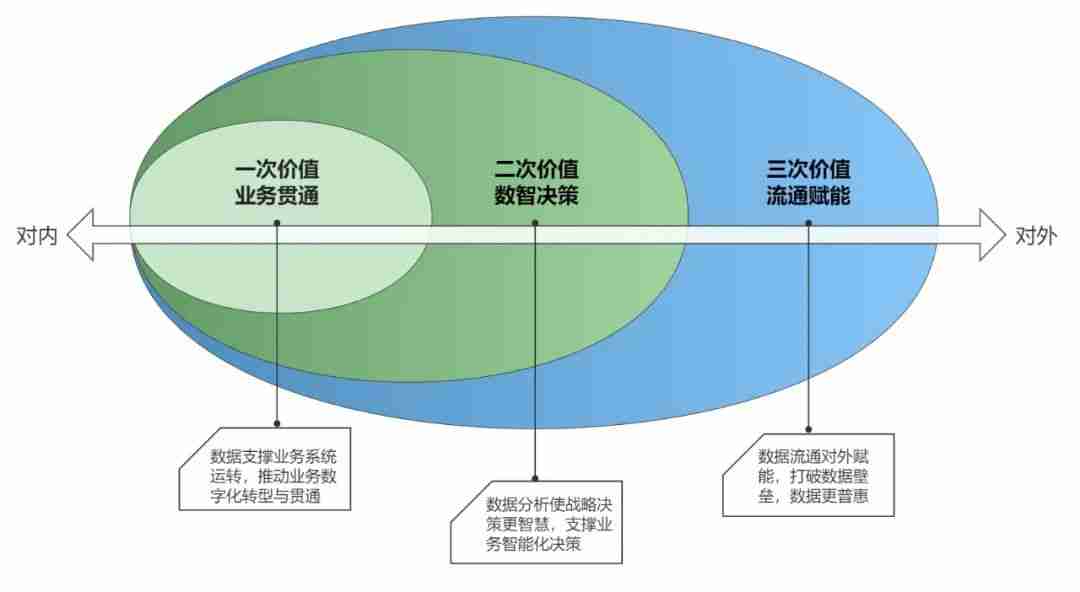
数据要素究竟如何发挥其作为生产要素的价值,需要进一步分析厘清。随着信息技术的发展和产业应用的演化,数据要素投入生产的途径可分为三次价值释放过程,即数据支撑业务贯通、数据推动数智决策、数据流通对外赋能,如上图所示。需要注意的是,之所以说这三次价值是数据要素价值释放的三条途径,是因为一方面这三次价值之间存在一种递进关系,后者往往以前者为基础;另一方面,这三条途径存在一种并列关系,这些价值可以且有必要同时予以关注、同时充分释放。
二、一次价值:数据支撑业务贯通
数据投入生产的一次价值体现在支撑政府、企业等组织的业务系统运转,实现业务间的贯通。首先,数据经由各个业务系统的设计而产生,经过业务系统的规范,在特定范围内实现标准化的数据得以不断积累,逐渐汇聚成可利用的资源。其次,这些数据也支撑着业务系统的正常运转,通过计算机对数据的读写,实现业务初步的标准化、自动化管理和运营。最后,一定程度标准化的数据具备了通用性,数据得以贯通了线下与线上的界限,贯通业务流程间的界限,甚至有贯通组织内部业务领域间的界限的能力。总之,业务系统搭建起来、数据在系统中运转起来时,就已经在生产活动中释放出价值。
从投入生产的执行环节看,数据支撑业务贯通直观表现为提高劳动等生产要素的利用率。技术要素与之类似,通过将技术投入生产环节,实现业务流程中对部分劳动、岗位的替代,发挥其乘数作用。在这个意义上,就像将技术投入生产释放价值一样,发挥数据要素作用的首要工作是充分认识数据要素的作用,真正在业务中用到数据、贯通业务。
此时,数据以业务系统为单元集中产生、单一存储,相应的治理工作也以增、删、改、查、对齐、合并等常规的数据库管理为主,多集中于局部业务领域的流程改善和相关业务数据的贯通。虽然此阶段数据并未得到深度整合与分析,但无论是开发系统积累数据,还是操作数据规范业务流程,还是利用数据贯通业务,它们都是数据世界内的生产活动,创造出相应的价值。因此,数据的一次价值是是实现数字化转型、提高组织内部经营管理效率的第一步。
为推动数据的一次价值释放,政府、企业等组织的主要工作重心是业务数据化及各类业务信息系统建设。例如,二十年前,我国以“两网、一站、四库、十二金”工程为代表的电子政务建设全面开展,经过多年推进,各级政府业务信息系统建设和应用成效显著,通过业务数据化的方式实现了数据在系统中的有效运转和贯通,公共服务水平得到全面提升,为当今的数字政府建设奠定了基础。这一阶段,组织内部所持有的数据种类相对单一、计算的要求简单,技术门槛较低,关键是深入挖掘业务需求,明确业务数据化方向。当前仍有大量行业、大量企业未能有效实现数字化转型,“流程靠跑、查询靠问”的传统工作模式拖累了生产效率的提升。总之,数据要素的一次价值如同寻找矿洞、积累矿藏,是数据要素流通的基础工作。在众多行业和企业尚不具备业务数据化能力的背景下,对这些行业和企业谈论数据要素市场还为时过早。更好发挥数据要素作用,需要帮助这些行业和企业释放数据要素的一次价值,用数据支撑起业务贯通。随着业务需求的挖掘和业务信息系统的建设,大量宝贵的业务数据不断积累,组织内业务系统数据独立存储、共享壁垒高筑的情形不再适应生产经营发展的需要,数据统一管理、贯通使用的场景不断涌现,为进一步挖掘数据的生产要素价值奠定了重要基础。
三、二次价值:数据推动智能决策
数据要素投入生产的二次价值释放体现在,通过数据的加工、分析、建模,可以揭示出更深层次的关系和规律,使生产、经营、服务、治理等环节的决策更智慧、更智能、更精准。一方面,通过对大量数据的管理和分析,组织内部的决策者可以实现“用数据说话、用数据决策”,运用数据呈现出的关键指标与信息评估发展态势,即时有效防范化解风险,创新行动方略;另一方面,数据分析也直接嵌入到系统中,与业务紧密融合,即时的数据挖掘、分类、预测、聚类等直接向业务赋予智能化的价值。
这两方面中,数据都是通过带来新信息、实现认知层面的升级来创造生产价值。从控制论的角度看,物质、能量和信息是构成世界的三大基石,信息不是物质也不是能量。如同土地要素是所有生产经营活动的物质基础,资本要素提高了物质交换的效率,劳动要素和技术要素促进了能量的转移与转换,数据要素可以支撑起对信息这一基石的创造与转换。与其他要素相比,对信息的把握与运用是数据要素价值释放的独特所在。数据要素的二次价值中,“决策”一词是广义的含义,既包括人的抉择与决策,又包括业界所说的机器“智能化决策”。
人和机器都可以根据各种信息、规律、规则做出选择,人可以用数据更好地认识形势和规律,人的能力难以认知到的业务规则可以交给机器认知。从根本上讲,数据二次价值释放是深层关系与规律的挖掘带来的认知突破,提供了独特的观察视角,由此构建出理解、预测乃至控制事物运行的新体系,从而摆脱了经验和人工的局限。
当前,一些头部制造业企业已建立起针对业务管理和经营决策的完整数据链,部分关键的经营管理决策动作可以被数据替代,从而实现通过业务智能化优化管理岗位用工结构;各大银行充分整合中小企业的经营数据,挖掘更准确的企业客户画像与信用评分,由此决定中小企业贷款风险评估结果,为中小企业低成本融资提供可能。
可以看到,数据要素不仅可以投入于自有业务支撑分析决策,还能够与其他生产要素的交融,形成新的要素组合和要素结构。数据驱动的智慧化、智能化决策通过与传统要素的业务化结合,可以实现更少的要素资源投入创造更多的物质财富和服务,从而优化传统生产要素的经营与配置,使传统要素价值倍增,提升全要素生产效率,实现生产率跃升、产业链优化和竞争力重塑。
(数联产服作为一家专业的产业大数据服务商、数字经济研究智库,依托团队在大规模数据处理分析领域的技术沉淀和业务实践,具备了全流程的大数据治理-分析-决策支撑服务能力,可面向政府和产业运营机构提供数字化的产业服务解决方案——编者注)总之,数据要素的二次价值具有其他生产要素不具备的独特性,是数据要素价值释放的核心所在。数据要素流通的重要目标也是回馈二次价值的释放,使数据在认知决策层的价值惠及广大主体,因此数据要素二次价值的基础也必须筑牢。为推动数据要素二次价值的释放,各组织需主动提升数据意识和数据挖掘能力,在数据分析、人工智能等技术的辅助下,构建数据自动化、智能化采集、处理、执行的新生产体系,消除人的认知误区和主观偏见,发挥数据要素在生产力竞争中的关键作用。战略决策者可以结合对业务目标的深刻理解,利用大量数据挖掘呈现的结果做出更具智慧的决策,执行层可以充分利用数据分析结果,让人通过智能的关联、图谱等做出更有效的选择,让机器寻找关键的函数、标签、画像,实现自动化的预测、分析,使数据的二次价值回馈一次价值,业务运转变得更加智能。
四、三次价值:数据流通对外赋能
数据要素投入生产的三次价值释放让数据流通到更需要的地方,让不同来源的优质数据在新的业务需求和场景中汇聚融合,实现双赢、多赢的价值利用。流通赋能是数据要素价值飞跃的一个关键。一方面,数据具有规模报酬递增效应,越大规模、越多维度的数据融合汇聚创造的价值倍增,金融、物流、通信、汽车等等经济活动中的各类事项均可被多方来源的数据赋能,企业自有数据与外部数据的充分融合可以实现数据应用价值的最大化。因此,随着各组织对数据一次价值、二次价值的释放,各组织对于数据的渴求已经超越了自身产生的数据。
另一方面,现阶段大量数据集中于少数主体,数据要素分布不均、结构失衡的问题较为突出。数据具有的低成本复制性可以改变要素投入生产的结构,更大规模、更广范围的数据要素利用不会增加过多额外成本,但可以产生超额利润,带来社会福利增加。“数据二十条”强调促进全体人民共享数字经济发展红利,数据要素流通可以激发数据的正外部性,使数据价值惠及广大市场主体和全体人民。
历史经验表明,生产要素并不必然需要流通,但流通有助于进一步释放生产要素价值。农业领域,土地要素自古释放着生产粮食的价值。土地流转政策的改革与落地,让土地在供方和需方间有效流转,进一步促进了农民获得财产性增收,激活了农业剩余劳动力的转移。
参考土地要素流转经验,结合数据要素自身属性,数据要素的三次价值释放需要各组织有效管理自有数据,提升高质量数据供给能力,挖掘外部数据引入需求。需求与供给间存在对立统一的关系,各组织及相关服务商需要关注多元化能力的提升。一次数据流通过程中,数据供给方和需求方虽然不是同一主体,但一个主体可以兼具数据供给者和需求者的身份,在不同业务场景中进行转换。在追求利益的市场自发手段调节下,需求能够牵引供给,供给也能创造需求。供给方与需求方的数据框架在相互对齐的过程中,不断扩大相应的市场规模,增加新的经济增长点,从而实现在多元场景中持续释放数据要素的业务价值、经济价值和社会价值。为实现数据供需双方高效规范匹配,数据要素市场培育逐渐成为行业关注焦点。市场的基本含义是各方在共识规约下自由参与交换的场所。数据要素市场就是以数据供方、需方为主体,以各种形态的数据为对象,以流通为手段,从而实现参与方各自诉求的场所,是一系列制度和技术支撑的复杂系统,数据供给、业务需求、流通模式、权利关系、价格机制、技术条件、配套设施等都是数据要素市场的构成要件。因此,数据要素市场的培育应在保障安全和隐私的前提下,本着自由流动、普惠发展的原则进行鼓励和规范,使各项工作有力支撑起数据要素价值的充分释放。
五、结论
推动数据要素发展,是对当今技术与产业背景的深刻把握,是抢抓数字经济时代国际竞争制高点的关键举措。发展数据要素应聚焦于数据要素价值的释放。数据要素三次价值释放规律突出了数据要素本身的作用机理,在一定程度上连接起政府、企业等组织的业务数据化、数据业务化、数据资产化具体操作与整体经济社会增长、全要素生产率提升。
关于数据要素及其价值释放的基本规律还需要持续深入挖掘和阐释,但数据要素的三次价值提示我们:数据要素发展是一项系统工程,既涉及组织内部的数据应用,又涉及全社会的普惠发展;既涉及数据资源的配置,又涉及数据对配置其他资源的作用。
需要强调的是,我们今天说数据在流通中可以实现价值增值和飞跃,并不意味着我们已经完全进入第三次价值的阶段。部分组织对数据应用的感知仍然模糊,又受限于资金、人才、技术水平不足,覆盖生产活动全流程、全产业链的数据链仍不完善,尚不具备业务数据电子化或分析决策智能化的能力。这种条件下,这类组织即使引入外部数据也无法有效利用,无法形成回馈业务发展的价值回路。因此,数据要素发展需要统筹推进,一次价值和二次价值仍需要持续释放,在更广泛实现业务贯通和数智决策的基础上,全面发挥数据流通对外赋能的价值。
翻译:
In 2014, big data was written into the government work report for the first time, and it has gradually become a hot topic for governments at all levels. In October 2019, the Fourth Plenary Session of the 19th Central Committee included data as a factor of production for the first time. In February 2023, the CPC Central Committee and The State Council issued the Overall Layout Plan for the Construction of Digital China, which put data elements into a more grand picture of “digital China”. A National data bureau will be established at the 14th National People’s Congress on March 7, according to a proposal submitted by The State Council to reform The State Council. With the intensive release of national policies, the status of data as a key factor of production is further clarified.
Data has become a key factor of production in the digital economy
Data is not a factor of production from birth. In the past two decades, human beings’ ability to collect and process data has made a qualitative improvement, and the digital transformation of economic activities has been accelerated. Data gradually has the nature of becoming a factor of production, and its multiplier effect on improving production efficiency is prominent. The fundamental purpose of activating data elements is to put them into production in various and innovative ways and create greater value for economic and social production.
How data factors play their value as production factors needs to be further analyzed and clarified. With the development of information technology and the evolution of industrial application, data elements put into production can be divided into three value release processes, that is, data support business integration, data promote data intelligence decision-making, and data circulation external empowerment, as shown in the figure above. It should be noted that the reason why these three values are the three ways to release the value of data elements is that on the one hand, there is a progressive relationship between these three values, the latter is often based on the former; On the other hand, there is a juxtaposition between these three approaches, and these values can and need to be paid attention to and fully released at the same time.
Primary value: data support business integration
The value of data put into production is reflected in supporting the operation of the business system of the government. Enterprises and other organizations, and realizing the interconnection between businesses. First of all, the data is generated through the design of various business systems. Through the specification of business systems. The standardized data in a specific scope can be continuously accumulated and gradually converged into available resources. Secondly, these data also support the normal operation of the business system. Through the computer to read and write data, realize the initial standardization of business, automatic management and operation. Finally, standardized data has the ability to penetrate the boundaries between offline and online. Between business processes, and even between business areas within the organization. In short, when business systems are set up and data is moved through them, value is released in production activities.
From the point of view of the implementation of put into production, data support through the business is directly manifested in improving the utilization rate of labor and other production factors.
Technology elements are similar. By putting technology into production, it can replace part of labor and posts in business processes and play its multiplier role. In this sense, just like putting technology into production to release value. The first job to play the role of data elements is to fully understand the role of data elements. And really use data in the business, through the business.
At this time, data is centrally generated and stored in a single unit of the business system. The corresponding governance work also focuses on the routine database management. Such as adding, deleting, modifying, checking, aligning and merging,. Which mainly focuses on the process improvement of local business fields and the integration of relevant business data. Although the data has not been deeply integrated and analyzed at this stage. They are all production activities in the world of data, creating corresponding values. Whether it is to develop systems to accumulate data, operate data to standardize business processes, or use data to connect business. Therefore, the first value of data is the first step to realize digital transformation and improve the efficiency of internal management.
In order to promote the release of value of data, the main work focus of the government, enterprises and other organizations is business data and various business information system construction.
For example, twenty years ago, the construction of e-government, represented by the project of “two networks, one station, four Repositories and twelve gold Funds”, was carried out in an all-round way. After years of progress, the construction and application of business information systems at all levels of governments have achieved remarkable results. Through the way of business data, the effective operation and integration of data in the system have been realized. And the level of public services has been comprehensively improved. It has laid the foundation for the construction of today’s digital government. At this stage, the types of data held within the organization are relatively single. The requirements for calculation are simple, and the technical threshold is low. The key is to dig deep into the business needs and clarify the direction of business data.
At present, there are still a large number of industries and enterprises fail to realize digital transformation effectively.
The traditional working mode of “process depends on running and inquiry depends on asking” has dragged down the improvement of production efficiency. In short, the primary value of data elements is the basic work of the circulation of data elements. Just like looking for ore holes and accumulating mineral deposits. It is premature to talk about the data factor market for many industries and enterprises when they are not yet equipped with business data capabilities. To better play the role of data elements, we need to help these industries and enterprises release the primary value of data elements and use data to support business connectivity.
With the mining of business needs and the construction of business information system. A large amount of valuable business data has been accumulated continuously. And the situation of independent storage and sharing of business system data within organizations no longer meets the needs of production and operation development. Scenes of unified data management and through use keep emerging, which lays an important foundation for further mining the value of production factors of data.
Secondary value: data drives intelligent decision-making
The release of secondary value when data elements are put into production is reflected in that deeper relationships and rules can be revealed through data processing, analysis and modeling. So as to make decisions in production, operation, service and governance more intelligent, intelligent and accurate. On the one hand, through the management and analysis of large amounts of data, decision-makers within the organization can realize “speaking and making decisions with data”, use the key indicators and information presented by the data to evaluate the development situation, promptly and effectively prevent and defuse risks, and innovate action strategies. On the other hand, data analysis is also directly embedded in the system and closely integrated with business. Real-time data mining, classification, prediction, clustering, etc., directly endows intelligent value to business.
In both cases, data creates productive value by bringing new information and upgrading cognition. From the perspective of cybernetics, matter, energy and information are the three building blocks of the world. Information is neither matter nor energy. As the land element is the material basis of all production and management activities. Capital element improves the efficiency of material exchange, labor element and technology element promote the transfer and conversion of energy. And data element can support the creation and conversion of information, the cornerstone. Compared with other elements, the grasp and application of information is unique in the release of value of data elements. In the secondary value of data elements, the word “decision” has a broad meaning. Including both human choice and decision, and the industry said that the machine “intelligent decision”.
Both human and machine can make choices according to various information, laws and rules.
Human can use data to better understand the situation and rules. Business rules that are difficult for human to recognize can be handed over to machines. Fundamentally speaking, the release of secondary value of data is a cognitive breakthrough brought about by the mining of deep relationships and laws. It provides a unique perspective of observation. Thus constructing a new system to understand, predict and even control the operation of things. Thus getting rid of the limitations of experience and artificial.
At present, some leading manufacturing enterprises have established a complete data link for business management and operational decision-making. And some key operational management decision-making actions can be replaced by data. So as to optimize the employment structure of management posts through business intelligence. All major banks fully integrate the operation data of smes, mining more accurate corporate customer portraits and credit scores. Thus determining the risk assessment results of SME loans, and providing the possibility of low-cost financing for smes.
It can be seen that data elements can not only be invested in their own business support analysis and decision-making. But also integrate with other production factors to form new factor combinations and structure. Through the combination of data-driven intelligence and intelligent decision making with traditional factors. Less input of factor resources can be used to create more material wealth and services. So as to optimize the management and allocation of traditional factors of production, multiply the value of traditional factors, improve the total factor production efficiency. And realize productivity improvement, industrial chain optimization and competitiveness remodeling.
(As a professional industrial big data service provider and digital economy research think tank
(As a professional industrial big data service provider and digital economy research think tank. Relying on the technical precipitation and business practice of the team in the field of large-scale data processing and analysis. We have the whole-process big data governance, analysis and decision support service capability. And can provide digital industrial service solutions for the government and industrial operating institutions. The secondary value of data elements has the uniqueness that other production factors do not have. Which is the core of data element value release.
The important goal of data element circulation is to release the secondary value in return. So that the value of data in the cognitive decision-making level can benefit the majority of subjects. Therefore, the foundation of the secondary value of data elements must be firmly established. In order to promote the release of secondary value of data elements, organizations need to take the initiative to enhance data awareness and data mining ability, with the assistance of data analysis, artificial intelligence and other technologies, to build a new production system of data automation, intelligent collection, processing and execution, eliminate people’s cognitive misunderstandings and subjective biases. And give play to the key role of data elements in productivity competition.
Strategic decision makers can make more intelligent decisions based on the results presented by massive data mining based on their deep understanding of business objectives. The executive level can make full use of data analysis results to enable people to make more effective choices through intelligent correlation and mapping. And enable machines to search for key functions, labels and portraits to realize automatic prediction and analysis. Make the second value of data back to the first value, business operations become more intelligent.
Third value: data flow external enabling
Three times of value release when data elements are put into production let data flow to places where it is more needed. And let high-quality data from different sources converge and integrate in new business needs and scenarios. So as to realize win-win and multi-win value utilization. Circulation enablement is a key to the value leap of data elements. On the one hand, data has the effect of increasing returns to scale. The larger scale and more dimensions of data fusion and convergence will multiply the value. All kinds of matters in economic activities such as finance, logistics, communication, automobile and so on can be empowered by data from multiple sources. Therefore, with the release of primary value and secondary value of data. Organizations’ thirst for data has exceeded the data generated by themselves.
On the other hand, at the present stage, a large amount of data is concentrated in a few subjects, and the problem of uneven distribution of data elements and unbalanced structure is more prominent.
The low cost replication of data can change the structure of factor input into production. Larger scale and wider use of data factors will not increase too much extra cost. But it can generate super profits and increase social welfare. “Article 20 of Data” emphasizes the promotion of all people to share the dividends of the development of digital economy. The circulation of data elements can stimulate the positive externality of data. So that the value of data benefits the vast majority of market players and all people.
Historical experience shows that factors of production do not necessarily need circulation. But circulation helps to further release the value of factors of production. In the field of agriculture, land elements have released the value of food production since ancient times. The reform and implementation of land transfer policy made land transfer effectively between suppliers and demanders. Further promoted farmers to gain property income and activated the transfer of agricultural surplus labor force.
Based on the land factor circulation experience and combined with the attributes of data factors
Based on the land factor circulation experience and combined with the attributes of data factors. The three times of value release of data factors requires organizations to effectively manage their own data. Improve the supply capacity of high-quality data, and tap the demand for external data introduction. There is a unity of opposition between demand and supply. So organizations and relevant service providers need to pay attention to the improvement of diversified capabilities. In the process of a data flow, although the data supplier and the demand side are not the same subject. A subject can have both the identity of the data supplier and the demand side. And carry out transformation in different business scenarios.
Under the adjustment of the self-regulated means of the market in pursuit of interests. Demand can pull supply, and supply can create demand. In the process of the mutual alignment of the data framework of the supply side and the demand side. The corresponding market scale is constantly expanded and new economic growth points are added. So as to realize the continuous release of the business value, economic value and social value of data elements in multiple scenarios.
In order to realize efficient standard matching between data supply and demand, data factor market cultivation has gradually become the focus of the industry.
The basic meaning of a market is a place where all parties freely participate in exchange under a common agreement. Data factor market is a place that takes data suppliers and demanders as the main body, takes various forms of data as the object. And takes circulation as the means to realize the respective demands of participants. It is a complex system supported by a series of institutions and technologies. Data supply, business demand, circulation mode, rights relationship, price mechanism, technical conditions and supporting facilities are all components of data factor market. Therefore, the cultivation of data factor market should be encouraged and regulated under the premise of guaranteeing security and privacy, in line with the principle of free flow and inclusive development, so that all work can effectively support the full release of data factor value.
Conclusion
Promoting the development of data elements is a profound grasp of the current technological and industrial background, and a key measure to seize the commanding heights of international competition in the era of digital economy. The development of data elements should focus on releasing the value of data elements. The three-time value release law of data elements highlights the action mechanism of data elements themselves, and connects the specific operation of business digitization, data business and data assets of organizations such as governments and enterprises with the overall economic and social growth and the improvement of total factor productivity to some extent.
The basic rules of data elements and their release of value still need to be explored and explained continuously.
However, the three values of data elements suggest that the development of data elements is a systematic project, which involves not only the application of data within the organization, but also the development of the whole society. It involves the configuration of data resources and the role of data in the configuration of other resources.
It needs to be emphasized that today we say that data in circulation can realize value increment and leap, does not mean that we have completely entered the stage of the third value. Some organizations still have vague perception of data application, and are limited by insufficient capital, talents and technical level. The data link covering the whole process of production activities and the whole industrial chain is still not perfect, and they do not have the ability to digitize business data or intellectualize analysis and decision making.
Under these conditions, such organizations, even if they introduce external data, will not be able to effectively use it and form a value loop that will contribute to the development of the business. Therefore, the development of data elements needs to be promoted as a whole, and the primary and secondary values need to be released continuously. On the basis of more extensive business integration and data-wise decision-making, the external enabling value of data circulation should be fully brought into play.
本文由数字化转型网(www.szhzxw.cn)转载而成,来源:大数据;编辑/翻译:数字化转型网宁檬树。

免责声明: 本网站(http://www.szhzxw.cn/)内容主要来自原创、合作媒体供稿和第三方投稿,凡在本网站出现的信息,均仅供参考。本网站将尽力确保所提供信息的准确性及可靠性,但不保证有关资料的准确性及可靠性,读者在使用前请进一步核实,并对任何自主决定的行为负责。本网站对有关资料所引致的错误、不确或遗漏,概不负任何法律责任。
本网站刊载的所有内容(包括但不仅限文字、图片、LOGO、音频、视频、软件、程序等) 版权归原作者所有。任何单位或个人认为本网站中的内容可能涉嫌侵犯其知识产权或存在不实内容时,请及时通知本站,予以删除。