领先的企业已经开始启动数字化采购转型的工作,为数字化转型制定实施路线图;领先的解决方案提供商正投入大量资源开发数字化采购产品和解决方案。
一、如何有个整体思考,从战略高度有个顶层设计呢?
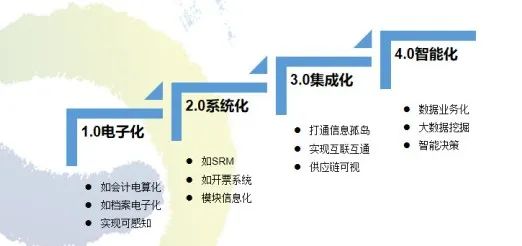
我们把企业数字化采购转型路径图分成四步,把它叫做“数字化采购转型4.0路径图”(见下图)。期待这个图能给大家带些思考,找到方向,踏实迈好每一步。
二、1.0 电子化:记录下来,呈现出来,让管理“看见”
这个阶段追求的目标是每个过程、每个零件都能被记录、被感知、可视化,将来做到可统计、可追溯。
老牌汽车零部件企业博世说,让“每个零件都有身份证”;物流企业G7说“数字化每一辆货车”。我在第4期“CPO首席采购官工作坊”上讲“一切皆数字、一切皆可控”。
这个阶段就像早些年轰轰烈烈的“会计电算化”,将手工记账转为电脑记账;就像现在很多公司正在开展的“档案电子化”、“无纸化办公”。会计再也不要算盘了,查找信息、传递信息,一般也不用翻资料、发传真了。当然不止如此,将来可实现一物一码,发展跟踪经济。
当然,数字化追求的目标,不仅是无纸化,记录下来,还要追求把它电子化呈现出来,让管理者“看见”,以便实时监控,发现异常,及时采取措施,寻求改善。比如数字化绩效管理工具的应用,该工具分为对外的供应商绩效评分卡和对内的采购组织绩效评分卡。
供应商绩效评分卡系统可实时提供对供应商绩效、差距以及预期成本、质量或者交付时间等问题的洞察。与系统监控的自动化范围和服务水平相关联时,还能提供经过整合的索赔管理功能。
当拥有了这些数字化信息后,品类经理就能够第一时间发现供应商出现的问题,更快采取行动并做出决策,同时系统还能提供相应工具帮助、鼓励或促使供应商做出改进。
采购组织绩效评分卡记录并衡量整个采购部门或单个采购品类的绩效。系统将记录战略采购团队的全部活动,并同时跟踪成本节省措施的落地实施。
首席采购官可以通过这个系统,非常简洁且全面地监督和管理工作的进度和结果,也可以细致到审阅每位品类经理的绩效完成情况与业务水平。
绩效管理工具还可以植入到其他工具中,比如品类战略采购工作流工具,从而实现对团队、品类以及个人绩效的实时管理。
三、2.0 系统化:流动起来,串联起来,让管理更有效率
这个阶段追求的目标是把1.0记录的信息流动起来,通过IT系统去实现某一个流程、某一个功能,如采购管理系统、供应商寻源系统、电子招标系统、合同管理系统、发票管理系统等等。
比较典型的是SRM供应商关系管理系统。SRM系统对供应商进行全生命周期管理。比方说,引进新的供应商,建立优秀供应商数据库;通过与供应商的信息共享,加快产品开发进度;提高供应商满意度,保留和吸引优秀供应商;改进供应链商业流程,降低采购和储存成本等。
以前是流程,未来是“流程+数据”。系统除了解决一个流程、一个功能的问题外,还会记录数据,为后续智能化做准备。
四、3.0 集成化:并联起来,互联互通,让管理协同
这个阶段的目标是打通信息孤岛,实现互联互通,链接供应链各个节点,最后形成整条供应链透明可视,实现网络协同。所谓通则不痛,痛则不通,供应链一定要打通。
信息孤岛是指相互之间在功能上不关联互助、信息不共享互换以及信息与业务流程和应用相互脱节的计算机应用系统。
应当看到,在整个信息技术产业飞速发展过程中,企业的IT应用也伴随着技术的发展而前进。但与企业的其它变革明显不同的是,IT应用的变化速度更快,也就是说,企业进行的每一次局部的IT应用改进都可能与以前的应用不配套,也可能与以后的“更高级”的应用不兼容。
因此,从产业发展的角度来看,信息孤岛的产生有着一定的必然性。
信息孤岛是一个普遍的问题,不是什么人的问题,也不是中国信息化特有的情况,全球每年的应用集成有近3000亿美元之巨。
信息孤岛的类型有很多,不仅企业内各环节存在着信息孤岛,企业间也存在信息孤岛,所以供应链管理和B2B电子商务应运而生。
甚至政府机关之间也存在信息孤岛,在很多地方,有多少个委、办、局就有多少个信息系统,每个信息系统都由自己的信息中心管着,有自己的数据库、自己选择的操作系统、自己开发的应用软件和用户界面,完全是独立的体系。
要消除供应链中的信息孤岛(如下图所示),不仅是消除企业内部孤岛,而且要消除企业外部孤岛,最终形成闭环。这需要供应链成员间信息互联互通、资源共享,最终实现网络协同。
我们从一个角度看一下“互联互通”的重要性,很多企业都有战略供应商,并且签署了“战略合作协议”。
但真正战略了吗?
我觉得战略供应商就是要能够“同甘苦共患难”的供应商,就是要能团结一致应对市场的供应商,战略关系要能风险共担、信息共享。注意,我这里说的是“信息共享”,不是“利益共享”,因为风险共担就是利益共享,不仅仅是损失共享。
比方说汽车厂,一旦供应商选定后,实际上与供应商就形成了战略供应商关系,因为一个车型量产以后是不可能随便更换供应商的。
此时,汽车厂一定要与供应商“互联互通”信息共享。这样供应商可以实时知道买方的生产情况、市场情况,以便及时做出调整,甚至是自动进行调整。
现在已经有一些汽车厂,把自己的ERP与供应商ERP打通,或者自己搞一个SRM供应商关系系统与供应商的CRM整合打通。
有很多中小企业,也在尝试着用某种软件,把买卖双方信息打通,实现供应链可视化,买方随时知道生产交付库存情况,卖方随时知道生产库存市场变化情况,这极大地提升了买卖双方沟通的效率和准确性。
五、4.0 智能化:数据洞察,挖掘规律,让决策智能
这个阶段的目标是,一切业务数据化,一切数据业务化,通过数据挖掘、数据洞察,继而实现智能决策。数据化管理=数据分析+服务业务+改善管理。
信息化是一种管理手段,它将企业的生产过程、物料移动、事务处理、现金流动等业务过程数字化,通过各种信息系统、网络加工生成新的信息资源,给各层次业务人员了解“现在是什么情况”,“流程进行到哪儿了”等一切业务信息。
数字化是推动信息化最好的方法,数字化就是将许许多多复杂的事情变成计算机处理的 0和1二进制代码,让管理人员实时了解情况、甚至实现流程自动化、决策智能化。
是数字化带来了数据化,在数据基础上推动了智能化。
数字化采购体系的核心是数据,而且是海量数据。企业运营的方方面面都离不开数据,包括预测客户需求,了解哪些产品或服务可以更好地满足这些需求,确定合适的供应商,并确定合理价格。企业应当有意识地获取比现在多得多的内部和外部数据。
未来的世界将是一个万物互联、人工智能无所不在的世界,商业智能化是未来最重要的一个趋势。
所谓的智能化就是,未来商业的决策会越来越多地依赖于机器学习、依赖于人工智能。如《今日头条》就是采用了同传统媒体不一样的推送方式才迅速崛起的,抢了传统媒体的读者。它会根据读者的阅读习惯、所在地理位置、关注内容等来推送内容,也就是给你想看的,传统媒体是不管你想不想,都给你看。
六、如何用智能化改造自己的采购流程和业务呢?
首先,采购的业务流程必须在线化、软件化,也就是将所有核心流程构建在互联网上,然后由软件自行驱动,这样才有智能化演进的可能。
其次,要让企业的决策数字化,它包含三个方面:
1)所有采购过程被实时记录,比方谁,什么时候买了什么、买了多少,以便做支出分析。
2)根据用户反馈和绩效让算法帮你自动调整采购策略,比方自动选择最合适的供应商。
3)依靠人的洞察将数据、算法和客户体验结合起来,让绩效每时每刻都得到改进。
翻译:
Leading companies have started work on digital procurement transformation to develop implementation roadmap for digital transformation; Leading solution providers are devoting significant resources to developing digitally sourced products and solutions.
How to have a holistic thinking, a top-level design from a strategic perspective?
We divide the enterprise digital procurement transformation path map into four steps and call it “digital Procurement Transformation 4.0 Path Map” (see the figure below). I hope this figure can give you some thoughts, find the direction, and take every step steadily.
1.0 Electronic: Record it, present it, and let management “see” it
The goal of this stage is that every process and every part can be recorded, perceived and visualized, so as to be statistical and traceable in the future.
Bosch, a veteran auto-parts company, says “every part has an ID”; G7, a logistics firm, says it digitizes every truck. I talked about “Everything is digital, everything is controllable” at the 4th CPO Chief Purchasing Officer Workshop.
This stage is like the early years of vigorous “computerized accounting”, manual bookkeeping into computer bookkeeping; Just like many companies are now carrying out the “electronic archives”, “paperless office”. Accountants don’t use an abacus anymore. They don’t need to turn over materials or send faxes to find and transmit information. Of course, more than that, the future can achieve one size, development tracking economy.
Of course, the goal of digitization is not only to be paperless and recorded, but also to present it electronically, so that managers can “see” it, so that they can monitor it in real time, detect abnormalities, take measures in time and seek improvement. For example, the application of digital performance management tools is divided into external supplier performance score card and internal purchasing organization performance score card.
The supplier Performance Scorecard system provides real-time insight into supplier performance, gaps and issues such as expected cost, quality or delivery time. Integrated claims management capabilities can also be provided in relation to the automation scope and service level of system monitoring.
With this digital information, category managers can find the problems of suppliers in the first time
With this digital information, category managers can find the problems of suppliers in the first time, take action and make decisions faster, and the system can also provide tools to help, encourage or motivate suppliers to make improvements.
The purchasing organization Performance Scorecard records and measures the performance of an entire purchasing department or a single purchasing category. The system will record all the activities of the strategic procurement team and track the implementation of cost saving measures.
Through this system, the chief Purchasing Officer can monitor and manage the progress and results of the work very succinctly and comprehensively, as well as review the performance and performance of each category manager.
Performance management tools can also be embedded in other tools, such as category strategic procurement workflow tools, to enable real-time management of team, category, and individual performance.
2.0 Systematize: Flow, connect, make management more efficient
The goal of this stage is to flow the information recorded in 1.0 and realize a certain process and function through IT systems, such as procurement management system, supplier sourcing system, electronic bidding system, contract management system, invoice management system and so on.
A typical example is the SRM vendor relationship management system. The SRM system provides supplier lifecycle management. For example, introducing new suppliers and building a database of excellent suppliers; Accelerate product development by sharing information with suppliers; Improve supplier satisfaction, retain and attract excellent suppliers; Improve supply chain business processes, reduce procurement and storage costs, etc.
In the past, it was process. In the future, it’s Process + data. In addition to solving the problem of a process and a function, the system will also record data to prepare for the subsequent intellectualization.
3.0 Integration: parallel, interconnection, let management coordination
The goal of this stage is to break through information islands, realize interconnection, link each node of the supply chain, and finally form a transparent and visible whole supply chain to realize network collaboration. The so-called general rule is not pain, pain is impassable, the supply chain must get through.
Information island refers to the computer application system which is not related to each other in function, information is not shared and exchanged, and information is disconnected from business process and application.
IT should be noted that in the process of the rapid development of the whole information technology industry, the enterprise’s IT application is also advancing with the development of technology. But unlike other changes in the enterprise, the speed of change in IT applications is much faster, which means that every partial IT application improvement made by the enterprise may not be compatible with the previous application, or it may not be compatible with the “more advanced” application in the future.
The emergence of information island has a certain inevitability.
Therefore, from the perspective of industrial development, the emergence of information island has a certain inevitability.
Information silos are a common problem, not a problem of anyone, nor is it unique to Chinese informationization. The annual global application integration is nearly $300 billion.
There are many types of information islands. Information islands exist not only in each link of enterprises, but also among enterprises. Therefore, supply chain management and B2B e-commerce emerge at the historic moment.
There are even information islands among government agencies. In many places, there are as many information systems as there are committees, offices and bureaus. Each information system is managed by its own information center, with its own database, operating system of its own choice, application software and user interface developed by itself, making it a completely independent system.
To eliminate the information island in the supply chain (as shown in the figure below), it is not only to eliminate the internal island of the enterprise, but also to eliminate the external island, and finally form a closed loop. This requires information interconnection and resource sharing among supply chain members, and finally network collaboration.
Information silos in supply chains
Let’s look at the importance of “connectivity” from one perspective. Many companies have strategic suppliers and have signed “strategic cooperation agreements”.
But is there a real strategy?
In my opinion, strategic suppliers should be able to “share weal and woe”, that is, to cope with the market in a united way, and the strategic relationship should be risk-sharing and information sharing. Note that I say “information sharing,” not “benefit sharing,” because risk sharing is benefit sharing, not just loss sharing.
For example, an automobile factory, once the supplier is selected, actually forms a strategic supplier relationship with the supplier, because it is impossible to change the supplier randomly after the mass production of a model.
At this point, car factories must “interconnect” with suppliers to share information. In this way, the supplier can know the buyer’s production situation and market situation in real time, so as to make timely adjustment, or even automatic adjustment.
At present, some automobile factories have connected their own ERP with the supplier’s ERP, or built an SRM supplier relationship system and integrated the supplier’s CRM.
Many small and medium-sized enterprises are also trying to use some software to connect the information of buyers and sellers and realize the visualization of supply chain. The buyer can know the production and delivery of inventory at any time, and the seller can know the changes in the production and inventory market at any time, which greatly improves the efficiency and accuracy of the communication between the buyer and the seller.
4.0 Intelligence: data insight, mining rules, so that intelligent decision
The goal of this stage is to digitize all business and business all data, and realize intelligent decision-making through data mining and data insight. Data management = data analysis + service business + improvement management.
Informatization is a kind of management means, which digitizes the production process, material movement, transaction processing, cash flow and other business processes of the enterprise, generates new information resources through various information systems and network processing, and gives all levels of business personnel to understand the “what is the situation now”, “where the process is going” and other business information.
Digitization is the best way to promote informationization. Digitization is to turn many complex things into 0 and 1 binary code processed by computer, so that managers can understand the situation in real time, and even realize process automation and intelligent decision-making.
It is digitization that brings digitization and promotes intelligentization on the basis of data.
The core of the digital procurement system is data, and a lot of data. Every aspect of business operations depends on data, including predicting customer needs, knowing which products or services can better meet those needs, identifying the right suppliers, and determining the right prices. Companies should consciously acquire far more internal and external data than they do now.
The future world will be a world where everything is connected and artificial intelligence is ubiquitous. Business intelligence is the most important trend in the future.
The so-called intelligence is that future business decisions will increasingly rely on machine learning and artificial intelligence. For example, Toutiao has risen rapidly by adopting a push method different from that of traditional media, which has robbed the readers of traditional media. It will give you what you want to see based on your reading habits, where you are, what you follow, etc. Traditional media will give you what you want to see whether you want it or not.
How to use intelligence to transform their own procurement process and business?
First of all, the business process of procurement must be online and software-based. That is, all core processes should be built on the Internet. And then driven by the software itself, so as to have the possibility of intelligent evolution.
Second, digitizing corporate decisions involves three aspects:
1) All purchasing processes are recorded in real time. Such as who bought what when and how much, so as to make expenditure analysis.
2) Based on user feedback and performance. Let the algorithm help you automatically adjust the purchasing strategy, for example, automatically select the most suitable supplier.
3) Rely on human insight to combine data, algorithms, and customer experience to improve performance every moment.
本文由数字化转型网(www.szhzxw.cn)转载而成,来源:宫迅伟采购频道;;作者:宫采;编辑/翻译:数字化转型网默然。
免责声明: 本网站(http://www.szhzxw.cn/)内容主要来自原创、合作媒体供稿和第三方投稿,凡在本网站出现的信息,均仅供参考。本网站将尽力确保所提供信息的准确性及可靠性,但不保证有关资料的准确性及可靠性,读者在使用前请进一步核实,并对任何自主决定的行为负责。本网站对有关资料所引致的错误、不确或遗漏,概不负任何法律责任。
本网站刊载的所有内容(包括但不仅限文字、图片、LOGO、音频、视频、软件、程序等) 版权归原作者所有。任何单位或个人认为本网站中的内容可能涉嫌侵犯其知识产权或存在不实内容时,请及时通知本站,予以删除。