随着数字技术5G、大数据、边缘计算、云计算、人工智能、物联网等技术快速发展,以及工业4.0、中国制造2025、数字中国建设规划的深度推进,打造“数字化工厂”成为了很多企业的重要战略目标。
什么是“”数字化工厂”?面对数字化转型带来的机遇与挑战,传统制造企业该如何跟上时代的步伐打造数字化工厂?数字化工厂建设对传统PLM、ERP、MES、WMS等业务系统带来哪些挑战和变化?
一、什么是数字化工厂
数字化工厂DF(Digital Factory,DF)是运用数字技术、大数据、人工智能、物联网等先进技术,将生产线和生产设备连接起来,实现高效、自动化、智能化、自适应的一种先进的制造模式。
这种制造模式以数字化工厂为核心,在设计、生产、质量、物流、环保等领域,实现数据的实时感知、存储、分析、决策和控制,提高生产效率、降低生产成本、提高产品质量、提升客户满意度和创造核心价值。、智能化工厂是智能制造的核心,是未来工业生产的一种新趋势和新模式。
数字化工厂提供了全面的制造过程管理,在实际产品生产前,在计算机模拟的环境中完成虚拟生产全部过程,生成经过“数字化工厂”验证过的、实际生产所需的各种工艺数据和文档。
从应用层面看,数字化工厂核心,即是PLM、ERP、MOM、WMS、DCS五大系统的全面集成、打通和融合,并以MOM/MES(制造运营系统)为中枢核心,形成智能制造创新平台。
1、PLM系统
PLM系统(Product Lifecycle Management)是一种用于整个产品生命周期管理的软件系统。PLM系统包括设计、开发、制造、销售和维护等各个阶段,用于协调和管理整个生命周期的所有过程。
2、ERP系统
ERP系统是一个企业资源计划系统(Enterprise Resource Planning),是一种综合性的企业管理软件,旨在协调和整合企业各个方面的业务流程。ERP系统可以集成销售、采购、生产、物流、财务等多个业务领域,使各个部门之间的信息流和业务流更加协调和高效。
3、MOM系统
MOM系统(Manufacturing Operations Management)是一种用于制造业的管理系统,旨在协调和管理整个生产过程。MOM系统主要包括五个部分:生产管理、过程控制、设备管理、人机交互和数据分析。
4、WMS系统
WMS系统(Warehouse Management System)是一种仓库管理系统,旨在帮助企业有效地管理仓库,实现对供应链的优化。WMS系统可以管理仓库中的货物流动,跟踪每一件货物的位置、状态和数量,支持物流管理中的各个环节,包括收货、质检、入库、存储、拣选、装运等。
5、DCS系统
SCADA+PLC的生产现场控制系统。DCS系统(Distributed Control System)是一种分布式控制系统,主要用于工业自动化和过程控制。DCS系统通过分布在系统各个节点的控制器和传感器等装置,实现对生产过程的实时监控和控制。
二、智能制造本质的理解
智能制造本质应用最新工业工程及数字网络技术(移动互联网、边缘计算、大数据、人工智能、物联网等),重新审视企业现有流程与生产组织方式,实现企业在供应、营销、设计及制造等领域的经营创新,全面推动企业向生产智能、管理智能化、运营智能方向转型,以满足客户敏捷 、个性、服务化需求。
企业的数字化和智能化改造大体分为4个阶段:自动化产线与生产设备,设备互联与数据采集,数据的打通与直接应用、数据智能决策与控制执行。这4个阶段并不是严格按顺序进行的,各阶段不是孤立且可能跨越多个阶段。
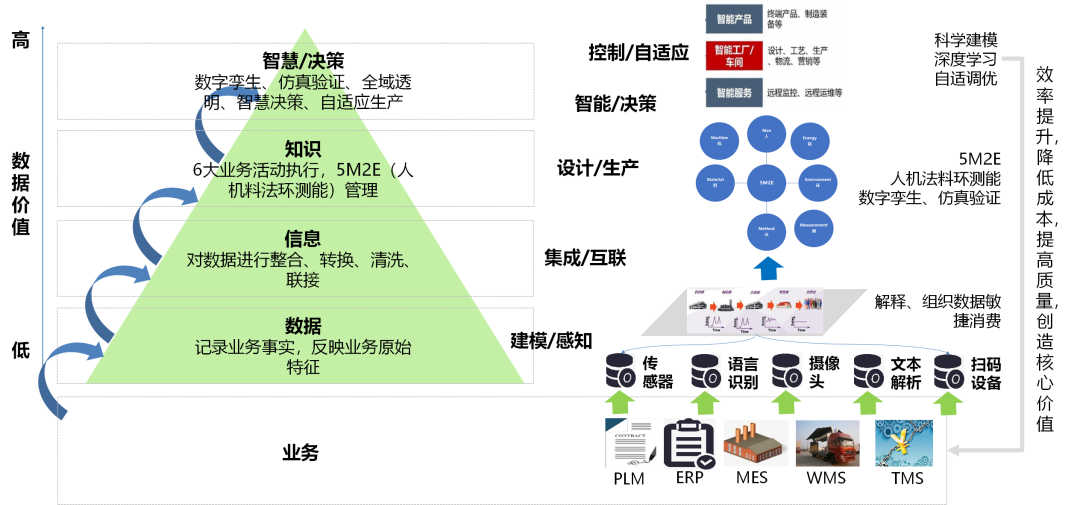
数字化工厂的主要环节包括:设计、生产、物流、售后等环节。关键技术包括:人工智能、大数据、物联网、边缘计算、智能制造系统等。其中,数字化建模、虚拟仿真、虚拟现实/加强现实(VR/AR)等技术包含其中。
产品设计环节
在产品研发设计环节利用数字化建模技术为产品构建三维模型,利用数值仿真、虚拟现实等技术,对产品在各种条件下的性能进行模拟和测试。产品设计环节可以大大缩短设计周期、提高设计质量、快速响应市场需求和定制化生产。
生产规划环节
利用虚拟仿真技术对生产执行进行预规划和验证是数字化工厂生产流程中的一个重要环节。通过数字化建模和仿真技术,对生产环节进行虚拟仿真,既可以提前预测生产执行过程中可能出现的问题,也可以优化和验证生产方案的可行性。
生产执行环节
数字化工厂的生产执行环节是指公司采用数字化技术和工具实现生产计划和任务的执行过程,帮助企业实现生产计划与实际情况的一致性,实时监测生产设备和生产过程中的参数和指标,并提供实时反馈,帮助企业及时调整、优化生产过程。
仓储物流环节
数字化工厂仓储环节是指利用数字化技术和设备,对仓储管理进行优化升级的过程。通过数字化技术,仓储环节可以实现更精准的库存管理、更高效的物流运输和更快速的订单处理,同时可以有效降低仓储成本和提高工作效率。
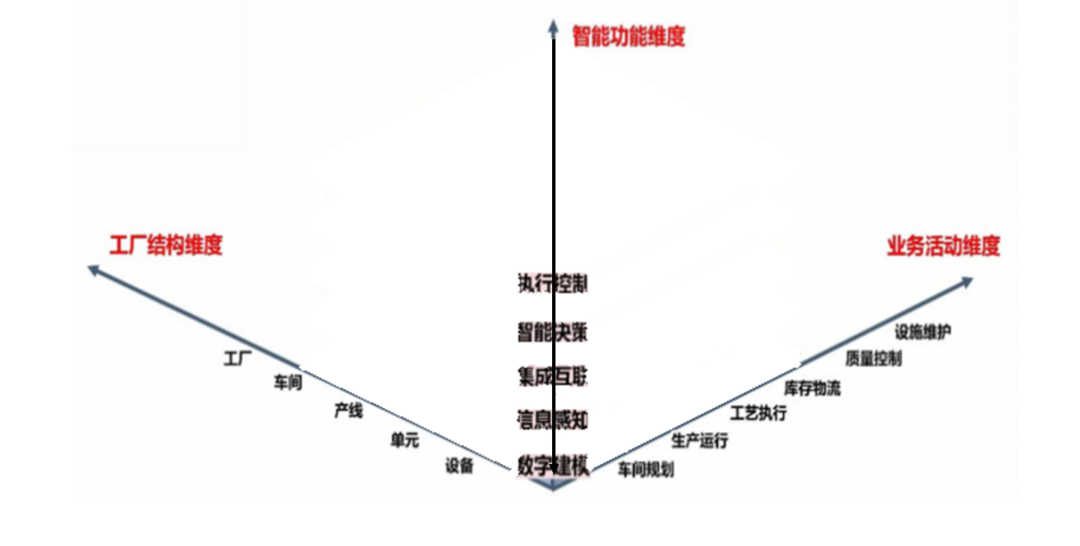
将数字化建模、数字化控制、数字化管理等技术应用于车间规划与改善、生产运行、工艺执行、库存物流、质量控制、设施维护等六大主要业务活动。
结合5M2E(人员Man,设备Machine,物料Material,方法Method,测量Measurement,能源Energy和环保Environment)对生产过程中这六个元素进行监控和管理,提高生产效率和产品品质,并降低生产成本和资源浪费。
工厂数字化、智能化到一定程度,就能通过智能决策来做执行控制和自适应。自适应则指的是系统或设备能够根据外部环境的变化、自动调整参数以及工作模式的能力。
就像人体就是天然的自组织,手指破了皮肤会自动修复,运动疲劳了身体会自动恢复,长跑久了在没有大脑指令的情况下双脚也能维持和谐的跑姿,走路遇到水沟大脑还没反应过来双腿不由自主地跨越过去了。
三、数字化工厂驱使PLM、ERP、MES、WMS等系统解构和重构
通常认为,数字化工厂就是将PLM、ERP、MES、WMS业务系统组合并实现数据集成,然后结合物联网(IoT)、大数据、人工智能等技术,以及基于云计算、边缘计算等构建的数字化生产平台,实现生产过程的自动化、数字化和智能化。
但实际情况是否真的如此?在大规模批量生产的流程制造也许问题还不明显,但对于小批量、需要较高柔性和可定制性,以及对市场需求反应快的离散型制造就会有较大的问题。
传统的PLM、ERP、MES、WMS等系统,主要还是基于流程和管理的业务驱动模式。过去工厂缺少很多一线生产环节数据,或信息传递较原始,效率较低,而且ERP、CRM、MES等各种信息系统互相独立,存在很多数据孤岛。这些产品通常流程重且死板,适用性差,改造难;系统间多套主数据运营,仅面向企业内部经营管理,无外部资源整合的能力。
现在开始有一些公司通过新型的管理软件,对工厂的数据进行整合打通,并在此基础上提供更高效的信息传递、生产管理和协同,用以适应C2M和OTD。详见之前文章《从OTD到ATS,数字化重塑制造型企业尤其是面向终端消费市场的制造型企业》。
以C2M场景为例,如果用户在下单及提出定制化需求后,在这之后取消订单、修改订单、追加订单,或者修改了产品的属性。这些改变除了在产品数量有变化之外,还会涉及BOM、工艺、设备的变化,然后引起采购需求、生产主计划、生产计划、库存、成本、工序等一系列的变化。
这些变化会首先从PLM系统引发跟ERP、MES、WMS等系统交互,然后再是各系统的交互和协同,整个协同链路长,甚至存在链路有断点、信息孤岛和数据不一致的问题。
由于企业自身情况以及厂家各自擅长产品和领域的不同,PLM、ERP、MES、WMS等业务系统往往是在企业发展不同阶段,由不同厂家实施和搭建的,然后通过流程和管理来打通和协同,导致各系统间的关系是串行关系。
但实际上业务运行的实质是牵一发而动全身,他们之间是互为网状关系,但由于信息化时代数字技术还没发展起来,还不具备运行网状关系的条件和基础。当数字技术充分发展后,这个网状协同关系是可以很好地运作起来,并可事先通过数字孪生、仿真的技术手段在数字世界模拟和验证。
比如无论是PLM系统,还是ERP、MES、WMS系统,它们中某一个环节发生了变化,作为出发点均需要同时跟其它几个系统协同和交互。
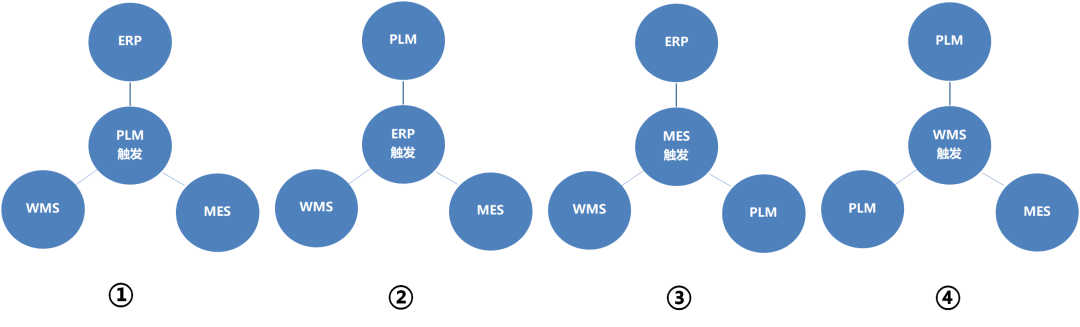
就像在小水沟里丢一块石头后,石头激起的波纹会延着水沟的某个方向延伸,可以看成是串联的波动。水沟里的水基本上往一个方向波动,波动结束后水才会整体回流,只是力道减弱了。
如果往水塘中间丢一块石头,那么激起的波浪就会向四面八方扩散和迭代。池塘里的水在荡漾出去后,这个波动自触发以后就是连续的,看起来向外扩散又像是向内回流,已经分不清哪里是开始哪里是结束。水塘这种波浪扩散、延伸和迭代的模式和效果,类似端到端的实时计算和响应,才是数字化工厂和智能制造真正需要的。
以C2M为例,可能一开始用户需求的变化从PLM开始触发后,系统就开始不间断地运行。但当运行到某个环节,这个环境可能是PLM、也可能是ERP、MES、WMS甚至是DCS发现异常,然后从异常点开始往四面八方扩散和延伸。这个时候已经说不清谁是开始谁是结束,因为互为因果关系。
也就是说,当数字化、智能化工厂开始运行后,业务和数据角度看,已经不清楚谁来影响谁,因为它们是你中有我,我中有你,无始无终。就像平时谈论到底是先有鸡还是先有蛋,永远都说不清楚,其实也已经不重要了,因为任何事物开始的时候可能就是以终为始,然后结束的时候就是以终为始。
因此,对于C2M和柔性制造的数字化工厂,还需要对PLM、ERP、MES、WMS等系统进行解构和重构。详见之前文章《数字化时代,包含ERP、CRM在内的所有业务系统终将被解构和重构》。
要解决数据孤岛、协同链路长、以及依赖串行流程控制这些问题,就需要这些业务系统的数据都要采集、存储到同一个统一的数据平台里(数据中台)。然后在此基础上解构原有的PLM、ERP、MES、WMS等业务,将共性、关联性和协同性很强的部分融合,原有独立性较强的核心的模块继续保留,同时也会增加一些新数字孪生、仿真验证等应用场景。从纵横向两个维度对原有的业务系统进行解构和重构,然后在低代码平台进行承载和落地(类似技术中台+业务中台)。
解构和重构等PLM、ERP、MES、WMS系统后,可以实现端到端的数据源统一,实现一体化敏捷运营、智能决策,精确排产、自适应生产管理,全域透明、智慧拉动式生产物流,进而提高生产效率、降低生产成本、提高产品质量、提升客户满意度。
这种直接在数据中台上架构和实现业务系统功能的做法,可以看成是数据中台智能的延伸,类似直营店和加盟店的关系。“直营店”的数据直接通过低代码平台将数据存储到数据中台,“加盟店”是先将业务系统数据存储到自己的数据库,然后再将数据库的数据汇聚到数据中台。
也许数据中台的终极目的地就是所有的业务系统是直接架挂在数据中台之上,但那个时候也许已经不叫数据中台了,但是不管它叫什么其实不重要,它出现的时机和使命决定了它的任务和价值所在。
将PLM、ERP、MES、WMS系统解构和重构实施起来会有不小的难度,首先要充分考虑好架构,然后考虑到ERP的功能模块多且很复杂。但有难度并不代表不可行,比如可以用代码平台减少开发工作量,使用具备丰富ERP产品设计团队参与和主导。
四、结语
未来,随着数字化、智能化工厂的规划和实现,将会个人就业、企业定位以及产业的布局都会带来较大的冲击和影响。
比如未来有实力的制造型企业可以建设数字化、智能化工厂,没有实力建设数字化、智能化工厂的企业,可能需要将企业核心竞争力聚焦在品牌打造、市场营销和渠道关系维系等方面,产品设计、制造和物流方面就需要外包出去,逐渐形成营销型企业、产品型企业、生产型企业、物流型企业等。详见之前文章《数字化转型之生态篇:企业数字能力资产交易和共享形成数据价值域,价值域又形成数字生态价值圈 》。
建设数字化、智能化工厂也会对行业和产业带来冲击,并最终会驱动产业的分化、融合和重组,形成以“数字产业+基础资源产业“的新产业体系。详见之前文章《数字化转型之重组篇:数字化驱动传统产业的分化、融合和重组》。
翻译:
With the rapid development of digital technologies such as 5G, big data, edge computing, cloud computing, artificial intelligence and the Internet of Things, as well as the in-depth promotion of Industry 4.0, Made in China 2025 and the construction plan of Digital China, building a “digital factory” has become an important strategic goal for many enterprises.
What is a “digital factory”? Facing the opportunities and challenges brought by digital transformation, how should traditional manufacturing enterprises keep up with the pace of The Times to build digital factories? What challenges and changes does digital factory construction bring to traditional PLM, ERP, MES, WMS and other business systems?
First, what is the digital factory
DF (Digital Factory) is an advanced manufacturing mode that uses digital technology, big data, artificial intelligence, Internet of things and other advanced technologies to connect production lines and production equipment to achieve high efficiency, automation, intelligence, and self-adaptation.
This manufacturing mode takes the digital factory as the core. In the fields of design, production, quality, logistics and environmental protection, it realizes real-time perception, storage, analysis, decision and control of data, improves production efficiency, reduces production cost, improves product quality, enhances customer satisfaction and creates core value. Intelligent factory is the core of intelligent manufacturing, is a new trend and new mode of industrial production in the future.
The digital factory provides comprehensive manufacturing process management. Before the actual product production, the virtual production process is completed in the computer simulation environment, and various process data and documents verified by the “digital factory” are generated for the actual production.
From the perspective of application, the core of the digital factory is the comprehensive integration, opening up and integration of the five systems of PLM, ERP, MOM, WMS and DCS, and takes MOM/MES (manufacturing operation system) as the central core to form an intelligent manufacturing innovation platform.
PLM、ERP、MOM、WMS、DCS
- PLM system
PLM system (Product Lifecycle Management) is a software system used to manage the entire product lifecycle. The PLM system consists of design, development, manufacturing, sales, and maintenance phases to coordinate and manage all processes throughout the lifecycle.
- ERP system
ERP system is an Enterprise Resource Planning system (Enterprise Resource Planning), is a comprehensive enterprise management software, designed to coordinate and integrate business processes in all aspects of the enterprise. ERP system can integrate sales, procurement, production, logistics, finance and other business fields, making the information flow and business flow between various departments more coordinated and efficient.
- MOM system
The MOM system (Manufacturing Operations Management) is a management system used in the manufacturing industry to coordinate and manage the entire production process. MOM systems consist of five main components: production management, process control, equipment management, human-computer interaction, and data analysis.
- WMS system
Warehouse Management System (WMS) is a kind of warehouse management system, which aims to help enterprises effectively manage the warehouse and realize the optimization of supply chain. The WMS system can manage the flow of goods in the warehouse, track the location, status and quantity of each piece of goods, and support all aspects of logistics management, including receiving goods, quality inspection, warehousing, storage, selection, shipment, etc.
- DCS system
SCADA+PLC production site control system. DCS (Distributed Control System) is a distributed control system, mainly used in industrial automation and process control. DCS system through distributed in each node of the system controller and sensor devices, to achieve real-time monitoring and control of the production process.
Second, the understanding of the nature of intelligent manufacturing
The essence of intelligent manufacturing applies the latest industrial engineering and digital network technologies (mobile Internet, edge computing, big data, artificial intelligence, Internet of Things, etc.), re-examines the existing process and production organization mode of the enterprise, realizes the operation innovation of the enterprise in the fields of supply, marketing, design and manufacturing, and comprehensively promotes the transformation of the enterprise to the direction of intelligent production, intelligent management and intelligent operation. To meet customer agile, personality, service requirements.
The digital and intelligent transformation of enterprises can be roughly divided into four stages: automatic production line and production equipment, equipment interconnection and data collection, data opening and direct application, and data intelligent decision and control execution. The four phases are not strictly sequential; they are not isolated and may span multiple phases.
The main links of digital factory include: design, production, logistics, after-sales and so on. Key technologies include: artificial intelligence, big data, Internet of Things, edge computing, intelligent manufacturing systems, etc. Among them, digital modeling, virtual simulation, virtual reality/augmented reality (VR/AR) and other technologies are included.
Design, production, logistics, after-sales
Product design process
In the process of product development and design, digital modeling technology is used to build three-dimensional models for products, and numerical simulation, virtual reality and other technologies are used to simulate and test the performance of products under various conditions. Product design can greatly shorten the design cycle, improve the design quality, rapid response to market demand and customized production.
Production planning link
Using virtual simulation technology to pre-plan and verify production execution is an important step in the production process of digital factory. Through digital modeling and simulation technology, virtual simulation of the production link can not only predict the problems that may occur in the process of production execution in advance, but also optimize and verify the feasibility of the production plan.
Production execution link
The production execution link of digital factory refers to the implementation process of production plan and task by the company using digital technology and tools, helping enterprises to realize the consistency of production plan and actual situation, real-time monitoring of production equipment and parameters and indicators in the production process, and providing real-time feedback to help enterprises timely adjust and optimize the production process.
Warehousing and logistics link
The digital warehouse link refers to the process of optimizing and upgrading the warehouse management by using digital technology and equipment. Through digital technology, warehousing can achieve more accurate inventory management, more efficient logistics transportation and faster order processing, and can effectively reduce storage costs and improve work efficiency.
The technology of digital modeling, digital control and digital management is applied to six major business activities
The technology of digital modeling, digital control and digital management is applied to six major business activities, including workshop planning and improvement, production operation, process execution, inventory logistics, quality control and facility maintenance.
Monitor and manage these six elements in the production process by combining 5M2E (Man, Machine, Material, Method, Measurement, Energy and energy, and environmental protection) to improve production efficiency and product quality. And reduce production costs and waste of resources.
When a factory is digitized and intelligent to a certain extent, it can make executive control and self-adaptation through intelligent decision-making. Self-adaptation refers to the ability of a system or device to automatically adjust parameters and working modes according to changes in the external environment.
Just like the human body is natural self-organization, finger broken skin will automatically repair, exercise fatigue body will automatically recover, long distance running in the absence of brain instructions feet can also maintain a harmonious running posture, walking encountered ditch brain has not responded to legs involuntarily across the past.
Third, digital factory drives the deconstruction and reconstruction of PLM, ERP, MES, WMS and other systems
It is generally believed that digital factory is to combine PLM, ERP, MES and WMS business systems and realize data integration, and then combine the Internet of Things (IoT), big data, artificial intelligence and other technologies, as well as the digital production platform based on cloud computing and edge computing to realize the automation, digitalization and intelligence of the production process.
But is this really the case? Manufacturing may not be obvious in the process of mass production, but it will be a bigger problem for discrete manufacturing in small batches, which requires high flexibility and customizability, and responds quickly to market demands.
The traditional PLM, ERP, MES, WMS and other systems are mainly business-driven models based on process and management. In the past, factories lacked data of many first-line production links, or the information transmission was primitive, with low efficiency. Moreover, various information systems such as ERP, CRM and MES were independent of each other, and there were many data islands. These products are usually heavy and rigid process, poor applicability, difficult to transform; The operation of multiple sets of master data between systems is only for internal enterprise operation and management, without the ability to integrate external resources.
Now some companies are using new management software to integrate factory data and provide more efficient information transfer, production management and collaboration to accommodate C2M and OTDs. See the previous article “From OTDs to ATS: Digitally reshaping Manufacturing Firms, Especially for end-consumer Markets”.
Take the C2M scenario as an example.
After placing an order and putting forward customized requirements, the user cancels the order, modifies the order, adds the order, or modifies the product attributes. In addition to changes in the quantity of products, these changes will also involve changes in BOM, process and equipment, and then cause a series of changes in purchasing demand, production master plan, production plan, inventory, cost and process.
These changes will first trigger the interaction between PLM system and ERP, MES, WMS and other systems, and then the interaction and collaboration of various systems. The whole collaborative link is long, and there are even problems such as link breakpoints, information islands and data inconsistency.
Due to the different situation of enterprises and the different products and fields that manufacturers are good at, PLM, ERP, MES, WMS and other business systems are often implemented and built by different manufacturers at different stages of enterprise development. And then through the process and management to open up and cooperate, resulting in a serial relationship between the systems.
But in fact, the essence of business operation is connected with the whole body. And they are each other’s network relationship. But because of the development of digital technology in the information age. There is no condition and foundation for the operation of network relationship. When digital technology is fully developed. This network collaboration can be well operated and can be simulated and verified in the digital world through digital twin and simulation technology.
For example
For example, no matter PLM system, or ERP, MES, or WMS system. The changes in one link of them all need to cooperate and interact with several other systems at the same time as the starting point.
Like dropping a stone in a small ditch. The ripples created by the stone will extend in one direction of the ditch, and can be regarded as a series of waves. The water in the gutter fluctuates in almost one direction, and only when the fluctuation is over does the water return as a whole, but with less force.
If you drop a stone into the middle of the pool, the waves will spread and iterate in all directions. After the water in the pond ripples out, the wave has been continuous ever since it was triggered. It seems to spread out and flow in. And it is no longer clear where it begins and where it ends. The pattern and effect of wave diffusion, extension and iteration in the pond, similar to end-to-end real-time calculation and response, is what digital factories and intelligent manufacturing really need.
In the case of C2M, it is possible that the system will start running uninterrupted once changes in user requirements are triggered from the beginning of PLM.
But at some point, the environment may be PLM, ERP, MES, WMS or even DCS finds an exception. And then spreads and extends in all directions from the exception point. At this time has been unable to say who is the beginning and who is the end, because each other causal relationship.
That is to say, when digital and intelligent factories start to operate. It is no longer clear who will influence who from the business and data perspective. Because they are interlinked with each other and each of us has no beginning and no end. Just like when we talk about whether the chicken or the egg comes first, we can never say clearly. In fact, it is not important anymore, because anything may start with the end, and then end with the end.
Therefore, for digital factories of C2M and flexible manufacturing. It is also necessary to deconstruct and reconstruct PLM, ERP, MES, WMS and other systems. See the previous article “In the Digital Age. All business systems including ERP and CRM will eventually be deconstructed and reconstructed”.
To solve the problems of data isolation, long cooperative link, and dependent serial process control. It is necessary that the data of these business systems should be collected and stored in the same unified data platform (data center). Then on this basis, deconstruct the original PLM, ERP, MES, WMS and other businesses, integrate the parts with strong commonness, relevance and synergy, and retain the original core modules with strong independence. At the same time, some new digital twin, simulation verification and other application scenarios will be added. Deconstruct and reconstruct the original business system from both vertical and horizontal dimensions. And then carry and land on the low code platform (similar to technology center + business center).
After deconstructing and reconstructing PLM, ERP, MES and WMS systems
After deconstructing and reconstructing PLM, ERP, MES and WMS systems, end-to-end data sources can be unified, integrated agile operation, intelligent decision making, accurate production scheduling, adaptive production management, all-area transparent and intelligent production logistics can be achieved, thus improving production efficiency, reducing production costs, improving product quality and enhancing customer satisfaction.
This approach of building and realizing business system functions directly in the data platform can be regarded as the extension of Taiwan intelligence in the data, similar to the relationship between direct stores and franchise stores. The data of the “direct store” is stored to the data center through the low code platform. While the “franchise store” first stores the data of the business system to its own database. And then gathers the data of the database to the data center.
Perhaps the ultimate destination of the data center is that all business systems are directly mounted on the data center. But at that time it may not be called the data center anymore. But whatever it is called is not important. The timing and mission of its emergence determine its mission and value.
It will be quite difficult to deconstruct and reconstruct PLM, ERP, MES and WMS systems. First of all, it is necessary to fully consider the architecture. And then take into account the many and complex functional modules of ERP. However, the difficulty does not mean that it is not feasible. For example, the code platform can be used to reduce the development workload. And the rich ERP product design team can be involved and led.
Fourth, conclusion
In the future, with the planning and implementation of digital and intelligent factories, individual employment, enterprise positioning and industrial layout will bring great impact and influence.
For example, in the future, manufacturing enterprises with strength can build digital and intelligent factories. While enterprises without strength in building digital and intelligent factories may need to focus their core competitiveness on brand building, marketing and channel relationship maintenance. While product design, manufacturing and logistics need to be outsourced. Gradually formed marketing enterprises, product enterprises, production enterprises, logistics enterprises and so on. See the previous article “The Ecology of Digital Transformation:. Transactions and Sharing of enterprise Digital Capability Assets form the data value domain. Which in turn forms the digital ecological value Circle”.
The construction of digital and intelligent factories will also have an impact on industries and industries. And will eventually drive the differentiation, integration and reorganization of industries. Forming a new industrial system of “digital industry + basic resource industry”. See the previous article “Digital Transformation Restructuring: Digital-Driven Differentiation, Convergence, and Restructuring of Traditional Industries”.
本文由数字化转型网(www.szhzxw.cn)转载而成,来源于广东省工业和信息化厅 ;编辑/翻译:数字化转型网宁檬树。

免责声明: 本网站(http://www.szhzxw.cn/)内容主要来自原创、合作媒体供稿和第三方投稿,凡在本网站出现的信息,均仅供参考。本网站将尽力确保所提供信息的准确性及可靠性,但不保证有关资料的准确性及可靠性,读者在使用前请进一步核实,并对任何自主决定的行为负责。本网站对有关资料所引致的错误、不确或遗漏,概不负任何法律责任。
本网站刊载的所有内容(包括但不仅限文字、图片、LOGO、音频、视频、软件、程序等) 版权归原作者所有。任何单位或个人认为本网站中的内容可能涉嫌侵犯其知识产权或存在不实内容时,请及时通知本站,予以删除。