This year, the sudden epidemic has brought a huge impact on the entire market, but it has also created new opportunities and challenges.
On September 12, at the 2020 P&G Alumni Annual event, Ding Jie, senior global partner of Bain & Company, described the new trend of brand digital transformation from the five perspectives of “internal and external cycle, two-wheel drive”, “Product + content, multi-dimensional competition”, “all-channel, extreme experience”, “full link, data with energy”, “Open data, organizational change”. The following is the speech record:数字化转型网szhzxw.cn
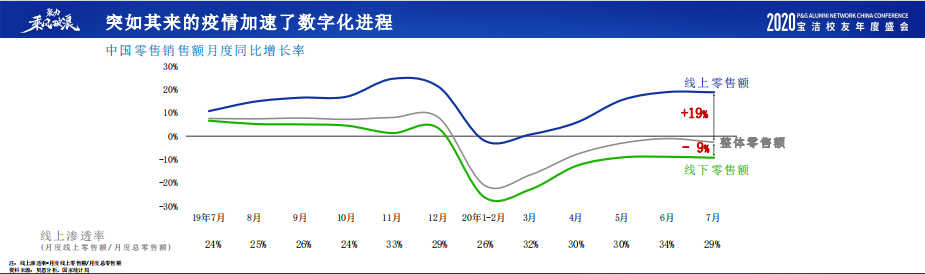
Now everyone is talking about what kind of recovery curve the epidemic has brought to the market. Some think it is a “V” shape, some think it is a “U” shape, and some think it is a “W” shape. But now there is a growing view that the influence recovery curve has formed a new letter – the “K” shape.
After a sharp decline, the market’s recovery has diverged. For consumer brands, the rising and falling lines represent a widening gap between online and offline. The pandemic has dramatically accelerated the migration of brands online.
The reason, above all, lies with consumers. Under the epidemic, there are more scenes of home consumption: working from home, holding parties, and buying much-needed health and hygiene supplies. In the home environment, consumers also have more time to pay attention to online content; The second is online media, which increasingly use online tools to facilitate consumer behavior and improve the relevant experience.数字化转型网szhzxw.cn
China is already the world’s most powerful digital consumer nation, and new changes during the pandemic have taken it to a new level.
Under this impetus, a large number of excellent brands have further increased and accelerated to stand out on the basis of years of digital investment and transformation. In the first half of this year, the beauty and daily cosmetics industry as a whole fell slightly, but L ‘Oreal still achieved 18% growth; In the field of milk powder, Flying Crane broke through the difficulties and achieved a growth of 48%. In the digital native brand, such growth is more incisively and vividly reflected, perfect diary, flower Xizi respectively achieved 10 times and 17.7 times of growth.
What have these successful brands done right? What new revelation does it bring to us?
Here are my top 5 emerging trends:数字化转型网szhzxw.cn
First, internal and external circulation, two-wheel drive
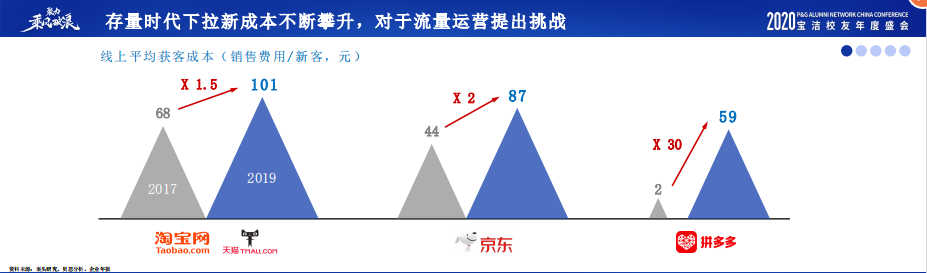
Before this concept was applied, the vast majority of enterprises’ digital transformation came from public domain platforms and public domain traffic. But after years of rapid development, the stock has been depleted. From the public domain to the platform, and then precipitation to the platform, the cost is getting higher and higher, and this model is not sustainable.
In this case, first of all, the public domain platform has to transform and respond, and the most critical thing is to dig deeply into its existing data and provide a variety of methods, tools and means to show the potential power of the data to the brand. For brands, the challenge is how to make good use of the tools provided by the platform, better precision marketing, accurate customer acquisition, and improve marketing efficiency.数字化转型网szhzxw.cn
Bain has assisted Tmall to jointly develop FAST Growth 2.0, which includes eight strategic groups and Outlines a series of most representative groups such as small town youth and exquisite mothers. Through this data, the interaction between the brand and the crowd can be measured more accurately and serve as an overall compass for the future development of the brand.
Tencent has also further optimized the structure of its massive data from many aspects: through basic labels, that is, gender, attribute, region and mobile phone brand model. Then to the first-level label, for example, in which field the user consumes, what APP has been used, location information, etc., after data desensitization, it is more systematically output to the brand in an all-round way to improve its marketing efficiency.数字化转型网szhzxw.cn
In general, the public domain has always been improving the brand’s precision strike ability to cope with rising costs. The private domain traffic is now a new track built by all brands with heavy bets.
The private domain is divided into three levels: membership system, customized benefits and membership subscription.
Membership system
Self-controlled member system, with the ability to manage member data, can push content and provide rights based on consumption amount.
Customize entitlements
On the basis of the membership system, more accurate matching between people and rights and interests is achieved, and customized rights and interests are placed for different types of customers.
Membership subscription
Deep binding mode, users can use the service after paying an annual fee or a monthly fee, high user stickiness, can obtain a large number of user data.数字化转型网szhzxw.cn
For example, Adidas and Luckin have greatly increased customer loyalty through the operation of the membership system and the rights and interests of personalization and customization. The highest level is the member subscription model, using the subscription system to fix the relationship between the two sides, on the one hand to improve the level of service to consumers, on the other hand to better affect the operation of the entire back-end supply chain, improve efficiency.
Whether it’s a monthly box of magic cats, or a weekly delivery of flowers and flowers, I think more and more brands will move to this model in the future. Private domain is definitely more than a simple consumer traffic operation, but really deepen the overall relationship with consumers.
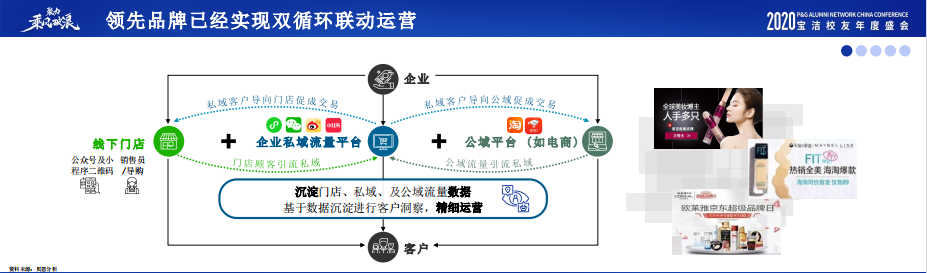
Of course, if you combine public and private traffic, you get a two-loop model:
Store customers to private domain – Through the enterprise private domain traffic platform – private domain customers guide stores to facilitate transactions数字化转型网szhzxw.cn
Public domain traffic diversion private domain – Through the public domain platform – private domain customers guide public domain to facilitate transactions
After the formation of the dual-cycle model, brands can establish a more efficient foundation for consumers to unify labels and information. Through this foundation, various touch points can be opened up, and personalized touch interactive services can be formed between brands and consumers. We call it the new two-wheel drive growth model, and it’s the latest development we’re seeing across all companies right now.数字化转型网szhzxw.cn
With two-wheel drive, brands need to understand what they’re driving. The traditional view is that brand companies do products, and behind the brand is the product. But now more and more brands are realizing that it’s actually a content company, a creative company. In addition to providing consumers with the use value of the product, the brand also provides a lot of social value and entertainment value.
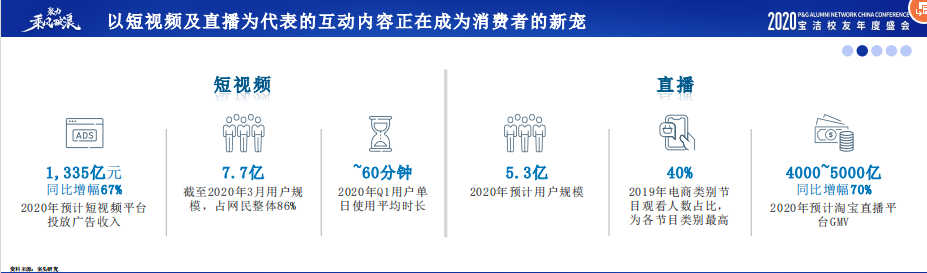
The driving force behind these changes also comes from consumers. Consumers are embracing new content, embracing live streaming, embracing short videos at an unprecedented rate. This change has created countless new opportunities for brands to explore new battlegrounds – super content is increasingly the focus of competition for all brands.
Last month, Bain and Ali released the “Three super” white paper, the core of which I think is “super content.”数字化转型网szhzxw.cn
“Super content” is not a simple communication with marketing, but permeates every aspect of the brand. For example, Perfect Diary has embedded the IP of Li Jiaqi into product development; L ‘Oreal breaks down each content to the pixel level to match consumer needs, so as to achieve “thousands of faces”; OPPO has done the live broadcast to the extreme, and the live broadcast picture that everyone sees has different elements, so that “thousands of people broadcast”.
Deep application content creates extreme super content, which is becoming a new core competitiveness of consumer brands.
This core competence largely depends on technical means. For example, the information mined through big data shows that 0-6 months of mothers are concerned about the baby vomiting milk, pregnant mothers are concerned about the nutritional response, the information and the corresponding product attributes of the brand into the system, marketing long text can be automatically generated.
Maybe the social sharing and brand sharing we see on Facebook in the future will all be controlled by machines. But in any case, the extreme penetration of future technologies is rapidly changing the entire chain of branded content production and distribution.数字化转型网szhzxw.cn
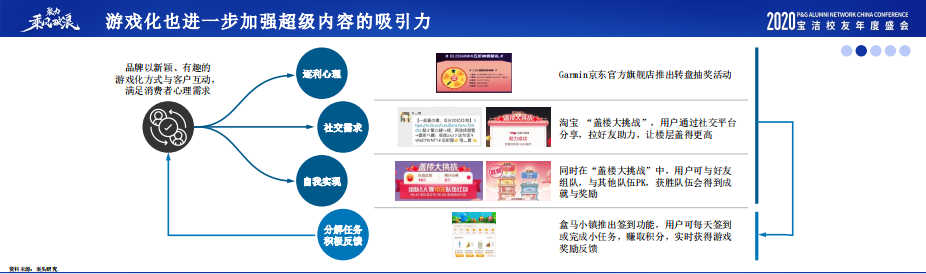
The ultimate application of content is games. Game is already one of the largest content industries in the world. And the application of game elements is becoming a very important core competitiveness of brand companies. Games give consumers instant gratification, satisfying their voracious appetite for upgrades and latent demand for novelty, all of which can be closed loop feedback in a rapidly iterating data. General consumers usually buy daily necessities once a few weeks, or even once a few months, and the brand rarely interacts with them. However, games can now be used to greatly enhance the relationship between consumers and brand companies, deepen their all-round understanding of consumers, penetrate various rights and interests in the process of game interaction, and refine and polish the concept of new products.数字化转型网szhzxw.cn
Third, omni-channel, the ultimate experience
The main battlefield of traditional digital transformation is online. But countless data prove that if you can interact, touch and transact with consumers online and offline. The value of consumers is far greater than only online transactions. Data shows that in the full life cycle of consumers, omnichannel reach will generate 5-7 times more transaction amounts.
But the challenge of omnichannel access is how to digitize the offline world. The development of modern technology has allowed us to digitize a large number of offline elements of people, goods and fields. But in the process of digitization, privacy issues have to be considered. For example, the sensitivity switch of crowd portraits, most of the time, can not identify each individual person, can only stay in the age, gender and other vague concepts.数字化转型网szhzxw.cn
However, if the consumer is open to permission, the brand can communicate the identified information to the store staff. So that they can predict in advance the arrival of a customer or what kind of products are in the store. And even the length of time in front of different products. By analyzing this information and online behavior, brands can continue to provide consumers with seamless services in all aspects.
Now there are many brands with relatively strong offline retail genes, retail experience, and retail touch points that have done a lot of work in this field, and the most important thing is to open up the process between the above different systems.
When each system is designed, it is often only for a specific scenario, there is a specific solution, and it involves the production of specific data.
In the complex system, how to find the largest common divisor. How to use a single User ID to connect all the points together. And in turn use this unified view to re-drive the personalized solution on different touch points. This is the problem that all brands are trying to solve.数字化转型网szhzxw.cn
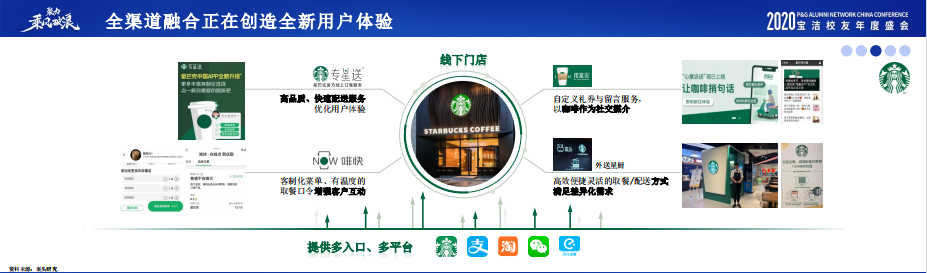
Starbucks is a good example, it not only provides traditional service. But also in the process of service, further enhance the brand value. Starbucks launched “fast coffee”, users can order online, offline pick up. Many consumers who order offline don’t really understand how this cup of coffee can be different. However, “fast” provides users with a lot of different new choices, and even when users pick up food offline. They can also “joint password” with the clerk. And the ubiquitous product elements and game elements provide consumers with a better shopping experience.
‘Starbucks is a Connecting people & human company,’ said Belinda Wong, president of Starbucks China. ‘Coffee and offline stores are just tools.’ These contacts serve a larger vision for the company.
The integration of online and offline gives the brand another tool to realize the company’s vision and great ideals.数字化转型网szhzxw.cn
Four, full link, digital empowerment
How to use extremely rich front-end data to improve the agility efficiency of the middle and back office is also what many leading brands are doing.
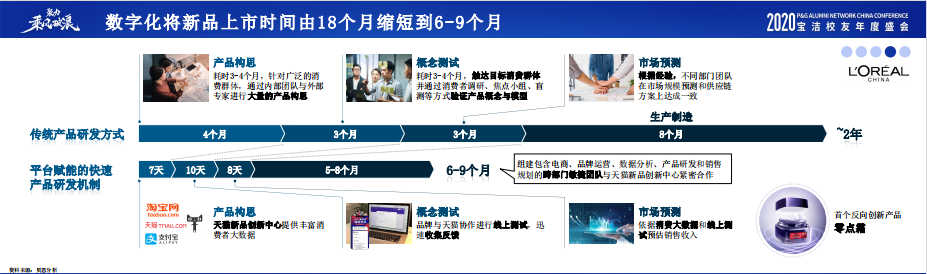
L ‘Oreal is a good example. It is keen to capture the opportunity of “late night cream” through the vast amount of information obtained in the public ecosystem platform. On this basis, the brand quickly developed the relevant formula, conducted AB Test. And finally launched the new product “zero cream” in only 6 months, and finally this product has achieved very good results.数字化转型网szhzxw.cn
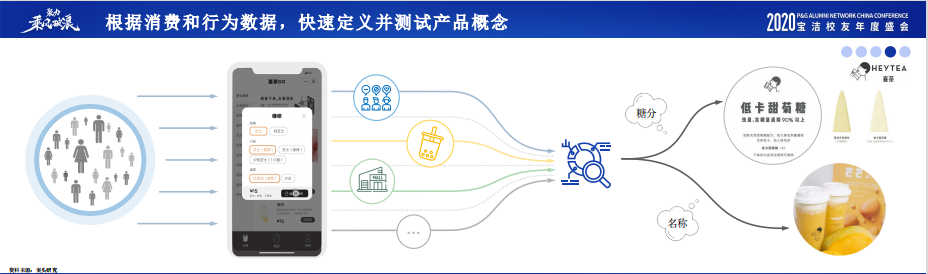
Happy tea is a hot enterprise in recent years. It also found in a large number of data analysis that low-calorie, stevia and other ingredients are very popular among middle-aged consumers. Immediately after the launch of related products. A large number of AB tests were conducted, and the name of the product was finally determined.
Libai mainly optimizes the digital capability of the supply chain. And accurately plans the distribution route through the vehicle routing algorithm. Through digital technology fine sales forecast, efficient warehouse replenishment, more in line with market demand.
Fifth, open up data, organizational change
Here I see three very interesting trends:
After CRM and DMP, there is CDP. CDP is to integrate the original internal consumer transaction data and the DMP data that is biased to the external media delivery results to form a complete user perspective data. CDP’s data is more standardized, more modular, and more flexible output, which can adapt to the use needs of different scenarios, truly driving the digital transformation of every link in the entire chain.
In terms of organization, the digital department of the brand has changed from the e-commerce department to an empowering department, and now it further carries the business profit target of new business growth, which is a new direction for the future digital transformation organization support.
The third trend is for brands to turn themselves into an open public domain platform. For example, Unilever plans to open up its research and development capabilities, marketing capabilities, channel capabilities and supply chain capabilities to the outside world, forming a true platform itself. Previously, Unilever’s research and development, production, sales and other links were only suitable for vertical integration and integration within its system. Which was a tight coupling, and in order to transform into a public domain platform. It must become a loose coupling. Although the difficulty can be imagined, there is no doubt that they have taken gratifying steps. And we expect more companies to find a new way in this area.数字化转型网szhzxw.cn
These are five emerging trends for brands in digital transformation. But as a brand leader, how do you think about the digital transformation of your brand. And what can you learn from these five trends?
Six, Bain’s three transformation recommendations for brands
Redefine the relationship between brands and consumers with simple metrics like NPS. The core of NPS is not customer satisfaction, but referral possibilities. When it comes to referrals, the customer is in the driving seat. Put customers in the situation, ask them the possibility of recommending products and let them simply passive answer whether they are satisfied with the product is a completely different context, recommendation is the bottom foundation behind word-of-mouth, social, pyramid marketing and so on.
The number is ever-changing, consumers are difficult to tune, no matter how many good tools are useless, in order to truly breakthrough innovation, the key is the founder’s spirit. The founder has three major spirits, one is to have lofty ideals, the second is extremely close to the line, and the third is a strong spirit of ownership.数字化转型网szhzxw.cn
The next step is how to start. It is necessary to use the method of “micro war” to find several key nodes that can best support the future strategy and condense them into a micro war. Micro-warfare is not a pilot, and the pilot is often something that must be done at any cost, but micro-warfare allows failure, and failure is also a gain. Micro-warfare should become replicable and scalable, and become the future business model of the brand. The effect of micro-warfare is to continue to impact the existing organization, stimulate it to grow new muscles, and continue to expand, which is the only way for enterprises to truly land digital transformation.