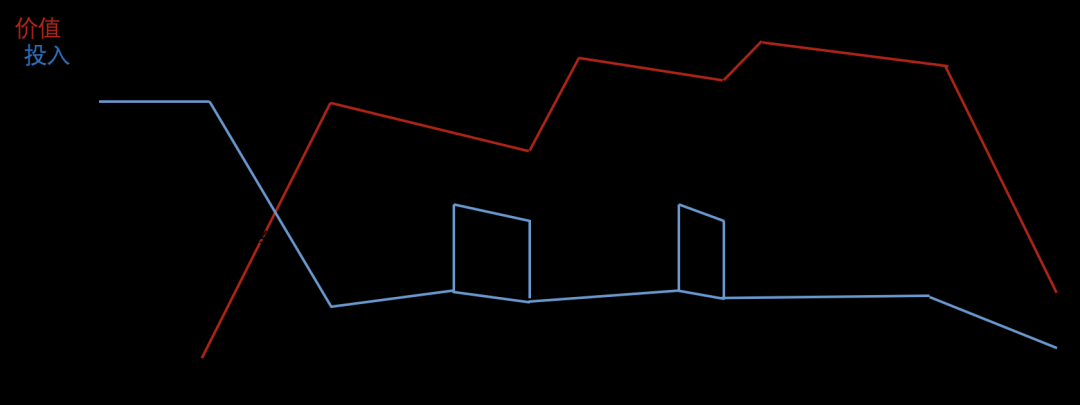
用工业时代的度量体系驱动数字时代的管理/改进,这是当前数字化面临的主要困难。基于数字服务经济学,构建价值-体验-进化的数字化度量体系,以更好理解数字时代的各种现象,更好进行数字时代的价值创造。
一、数字时代的度量难题
没有度量就没有管理,没有度量就没有改进。
度量的重要性毋庸置疑,但度量在数字时代成了难题。
1. 数字时代的度量难题
迈入数字时代后,度量突然就不灵了。反度量浪潮出现,其标志性事件是2007年索尼前董事的《绩效主义毁了索尼》,引发了饱受绩效考核折磨的打工人的共鸣和老板们对绩效考核的反思,一时间KPI人人喊打。出现这种情况的一个时代大背景是,从互联网转型开始,敏捷转型、DevOps转型、中台转型、数字化转型以及各种组织转型,似乎这些2000年后出现的热潮都没办法用度量去管理、改进,原有的绩效目标、考核指标不灵了。它们都是反直觉的,看起来容易做起来难,持续做下去持续改进更难。不灵带来另一个结果就是频繁更换度量指标,特别是绩效考核指标,导致了打工人的极大抱怨,“TMD,怎么又变了”,这进一步助涨了反度量浪潮。 数字化转型网www.szhzxw.cn
既然度量是不好的,既然我们认为好的东西难以度量,要不我们干脆就反度量,或者另辟蹊径,干脆放下度量,于是在2000年后的20年中放弃度量,追逐各种方法实践工具成为了主流。既然无法度量,那干脆就玩感受,别问,问就是组织文化价值观,方法实践工具无法落地使用是组织文化价值观不匹配,方法实践工具没产生效果是组织文化价值观不到位。敏捷就是这样,我只是方法实践,我是好的,用不起来是我的问题吗,你为什么不考虑考虑是不是组织文化价值观不匹配呢,DevOps、中台、数字化、合弄制等都这样玩。但没有度量是万万不行的,于是人们开始用维度拼凑来代替度量,创造出了各种雷达图、成熟度的所谓度量工具雷达图、成熟度中有着各种过程度量指标,用这些过程度量指标驱动过程改进,做好这些过程,肯定能带来更好的结果,这种工具实在是太多了,这里就不一一列举。
2. 时代已经变了,度量还在工业时代
时间已经来到数字时代,但我们的度量还停留在工业时代,这才是问题。
人们经常感叹,在这个VUCA时代,因果不确定性打破了结果与过程之间的逻辑关系,给管理带来了更多挑战,可嘴里一边这么说,一边继续推动过程改进,继续追求可预测、可管控的确定性度量管理。如果留心的话就会发现,我们现有的度量管理/改进工作方式大多是2000年前形成的,即便是2000年后的CMMI、在敏捷领域占据主流的精益价值流等,其思维体系方法也基本成型于2000年前,其中CMM一直遵循的过程决定结果这一过程改进的基本思想就成型于2000年前,精益价值流源于丰田的精益制造,而雷达图则大多参考了平衡记分卡。然而,2000年后才流行起来的度量指标例如GMV、MAU等,很少有组织能够玩转。
既然原有的因果逻辑被打破,那么继续沿用原有的因果逻辑去度量、去管理/改进,那不就是刻舟求剑、缘木求鱼吗,为什么不重新梳理因果逻辑,重建与数字时代匹配的度量体系来指导数字时代的管理/改进。
二、数字化度量体系
如果不是为了更有效的价值创造,则度量毫无意义。——大卫张33
数字化度量体系是应用于数字服务的度量体系,它源自于数字服务经济学。
1. 价值度量
(1)价值度量
数字服务的价值分为客户价值和商业价值,客户价值=服务次数*次均价值,商业价值=次数*(次均收入-次均成本)。次数成为数字服务价值最大化的核心指标,要做大客户价值需要次数最大化和次均价值最大化,而做大商业价值的手段则是次数最大化、次均收入最大化和次均成本最小化。(详情请参考上一章《数字化价值:数字服务吞噬世界的经济学基础》)
这是数字时代常用度量指标的底层逻辑。GMV商品交易总额和MAU月活跃用户数是两个常用的综合指标,它们相对综合的反映了客户价值和商业价值,GMV=订单数*订单均价,其中订单数就是服务次数,订单均价在一定程度上反映了次均价值(用户愿意用这个价格来换取本次服务),而GMV*收入转化率/订单数=次均收入,因此在转化率相对稳定的情况下,GMV也意味着商业价值,而MAU*月均次数=月度服务次数,是价值中最重要的服务次数指标,MAU*留存率*月均次数=下月保底服务次数,代表了价值创造的持续性。 数字化转型网www.szhzxw.cn
那么客户价值优先还是商业价值优先呢?没有客户价值就没有商业价值,大多数情况下,我们会以客户价值优先,兼顾商业价值,只有少数情况下会进行破坏客户价值的商业价值收割。
(2)客户价值度量
次数是核心,次数来自客户,客户是数字时代次数经营的主体,客户经营成为数字时代数字服务经营的主旋律,这是“以客户为中心”、“客户第一”背后的底层逻辑。
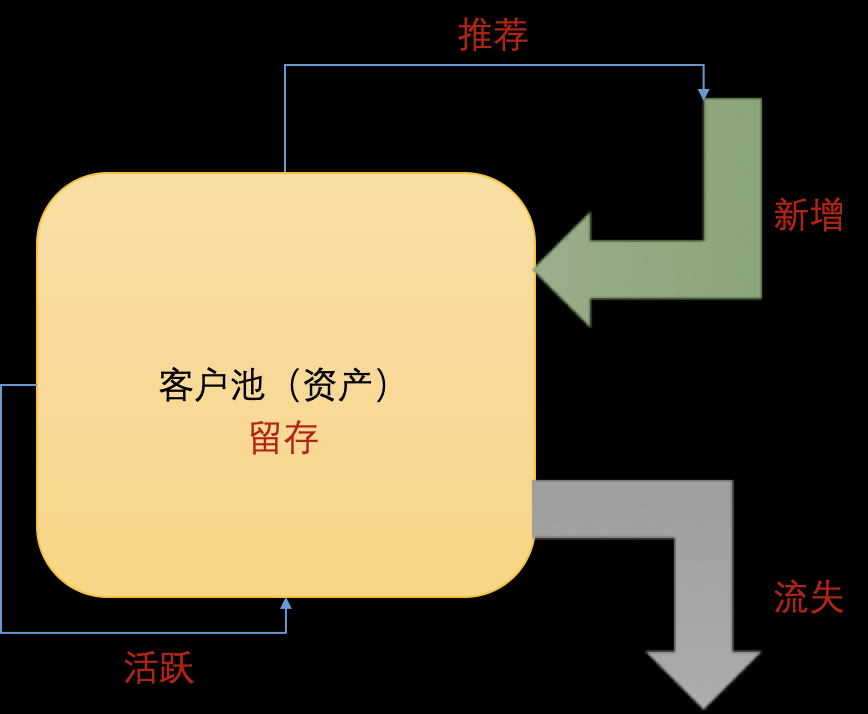
客户池(MAU)是核心,是能够源源不断带来次数的资产。客户池运营变成了中学常见的抽放水问题,新增是进水,带来了次数的增量;流失是出水,导致了次数的减少;活跃是激活,减少流失、留住次数;推荐是引得活水来的有力措施。流行的AAARR海盗模型是这一基本模型的变形。
2. 体验度量
客户价值=服务次数*次均价值,次均价值带来次均收入,客户价值决定商业价值。次均价值就是客户的服务体验,是数字服务价值创造中的核心要素之一,这是“体验为王”的底层逻辑,一切都是为了价值创造。
时长成功率是体验度量的统一指标,它是由(服务)时长、(客户)成功、(服务)成功率三者构成的综合指标。成功是服务体验的基础,客户之所以使用服务是为了取得某种成功。时长决定了体验,在同样成功的情况下,时间越短体验越好。成功率或者失败率是客户使用服务中获得所需结果的确定性或遭遇麻烦的失败率,它将影响客户对服务的信心、信任。
常见的指标诸如效率、质量、成本、性能、安全/风险、能力/专业、竞争力其实都是时长成功率指标,需要根据服务所处的上下文进行指标选择。同等成功更短时长或者同等时长更多成功,我们称之为效率。质量是次数基数下的成功率。性能是指在特定次数压力下的时长成功率,例如在200并发的情况下能够让80%业务在1分钟内成功完成,90%业务在2分钟内成功完成。 数字化转型网www.szhzxw.cn
时长在服务度量中是一个非常重要的指标,一方面来说,时长带来体验,能创造更高的次均价值进而带来更高的客户价值;另一方面来讲,时长直接关系到服务的次均成本,能够提升商业价值。
3. 进化度量
要创造更大价值,服务间存在次数竞争,体验是客户选择服务的依据,这让持续提升服务体验成为了数字服务重要的竞争手段,我们把服务体验的不断改变称为服务的进化。
服务的进化度量指标也是时长成功率,能够在多短时间内成功让服务进化,带来更好的服务体验。
4. 数字化度量体系
由此,我们得到了价值-体验-进化三个维度构成的数字化度量体系。
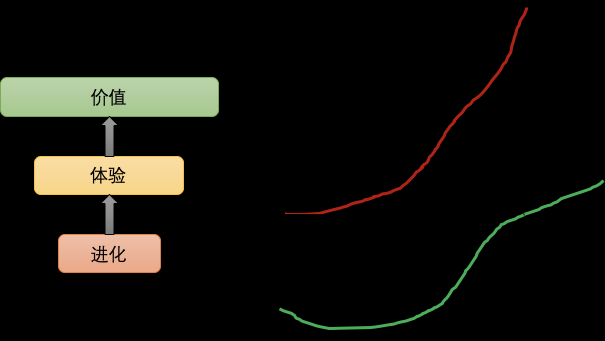
价值是结果,体验是竞争力,进化是适应性。价值是结果,先有客户价值才有商业价值,次数是价值的核心,客户是次数的主体。体验是竞争力,服务间通过服务体验竞争客户服务次数,是价值创造的核心。进化是适应性,它决定了服务能否在外部环境变化时快速适应,能否快速进化提升体验竞争力。
价值的指数型增长、爆炸性增长是数字时代的常见现象,这是服务次数爆炸式增长带来的结果。这种现象往往是服务进化的结果,由于服务进化带来服务体验的快速/跨越式上升,从而吸引了更多客户的更多次数。
三、理解数字化度量体系
1. 工业时代的度量体系 vs. 数字时代的度量体系
工业时代度量体系建立在传统经济学基础上,其商业价值=商品数*(商品价格-商品成本),商品是价值创造的主体,劳动生产率是降低商品成本、在更短时间内创造更多商品数的核心竞争力。
- 商品 vs. 客户
工业时代的价值创造主体是商品,数字时代的价值创造主体是客户,价值创造主体是基石,基石不同带来巨大差异。
- 自己 vs. 外部
工业时代价值来自于自己,自己通过劳动创造价值,努力带来结果,大投入大产出,关注努力、关注投入。数字时代价值来自于外部客户的认可,客户通过次数创造价值,不是说不努力、不投入,而是做好努力、投入,然后期待客户的认可。 数字化转型网www.szhzxw.cn
- 线性 vs. 非线性
依靠自身努力,也受自身限制,商品数在劳动生产率变化不大的情况下,随着自身的努力、投入呈线性增长。而数字服务的客户次数来自客户认可,当体验有了竞争优势,进化给体验带来持续竞争优势,客户次数可以非线性(爆炸性、指数型、跨越式)增长,当然,做不好就会遭遇非线性的另一面是大投入0产出或断崖式下跌。
- 确定性 vs. 不确定性
工业时代的度量体系表现出确定性,过程决定结果,努力决定产出,从而可以通过度量过程来预测结果,实现可预测、可管控。数字时代的度量体系表现出不确定性,结果来自于外部客户,来自于外部客户体验,所以需要不断进化,提升竞争力,竞争客户次数,这导致数字时代需要新的思维逻辑来预测和管控,需要不断根据外部反馈来调整适应。
- 稳定重复 vs. 不断进化
工业时代推动过程稳定重复,标准化、规范化,以便重复创造价值,重复成功。数字时代推动体验不断进化,以便为客户创造更多价值,以创造指数型增长的机会,以避免出现客户次数的断崖式下跌。
2. 用数字化度量体系进行案例解读
- 听说大众软件要裁员2000人?
工业时代企业数字化转型失败案例非常多,大众只是其中之一。大众的数字化转型是典型的大投入大产出思维,为了显示数字化转型的决心,提现一把手工程的重要性,把生产线上的工人都换成软件工程师,大众启动了庞大的招募计划,这次裁员的2000人只占10%,也就是说整个数字团队有20000人。但大众遭遇了非线性,其软件平台频繁跳票,已经影响到了新车的投产进度,直接影响商业价值。可即便其软件平台按时发布,其实也没有什么用,缺乏用户参与的体验打磨,缺乏快速进化的适应能力,该软件平台注定在市场上缺乏竞争力。 数字化转型网www.szhzxw.cn
- 阿里的张勇下课了,怎么看?
更注重商业价值,弱化了客户价值,仅此而已。财务出身的张勇接棒时正值阿里风光上市后,上市带来的一个后果就是更加重视商业价值,于是有了后续的一系列举措:天猫品牌化、客单价上升、商家费用上涨等等,这是典型的商业价值收割,在经历了多年的平稳发展后,一不小心让拼多多偷了家,等到阿里开始重视应对时,为时已晚。拼多多是破坏式创新,从边缘市场入手,成为低价破坏者,大肆亏钱,最后凭借拿到的足够多的客户次数翻身上岸,原来的成功企业因其心态、利益机制毫无还手之力,这是典型的商学院教程。近期拼多多旗下的TEMU以类似的策略出海大杀四方。
主流企业往往会陷入客户池幻觉,认为是自己拥有了客户,并且扩大客户池的边际成本愈发高昂,这种幻觉让许多主流企业都更关注客户变现,而减弱了对新增客户新增次数的关心,却不知你拥有的只是客户曾经发生的次数,你从来都不拥有客户,客户今天可以把次数给你,明天就能把次数给他。于是乎,主流企业的客户体验往往会处于保持甚至下降状态,破坏式创新的新企业在获得了新增客户新增次数后,因为更挑剔客户打磨出来的更好体验引发了主流客户的倒戈。
- 招行APP的北极星指标从MAU到AUM,而微信支付的北极星指标一直是支付笔数?
招行APP的案例是典型的移动互联网转型案例,转型中存在一个很大的挑战就是企业往往会照搬一个指标,但不知道指标从何而来。最初招行APP的指标是MAU,这个指标做着做着业务就变味了,因为达成指标最简单的方式就是做签到,花钱买用户,这种方式在移动APP的推广期非常流行,但它并不真正带来客户价值,也不会带来足够的商业价值。所以最后招行APP回到了AUM指标,跟电商的GMV指标类似,是金融类业务的综合指标,既能表现客户价值,又能有商业价值。而微信支付的指标就简单一点,一直是支付笔数,因为其业务比较单纯,并且有助于保持微信支付破坏式创新的竞争优势,支付笔数既是客户价值也是商业价值。 数字化转型网www.szhzxw.cn
绩效指标的一个重要问题是围绕指标进行思考,而不是围绕价值创造进行。前面阿里的案例也类似,如果基于GMV思考的话,那么最高效的方式是找到大品牌商业、提高客单价,开发下沉客户、更低客单价是件费力不讨好的事。这也是银行普惠信贷做不好的原因,与其找100个中小企业,不如找1个大型国企,既不承担风险,又能快速做高信贷,何乐而不为。正是因为这个原因,银行们才坐视支付宝、微信支付通过支持广大人民的超小额支付把中国变成无现金社会,在这个过程中顺便把银行的支付挤出了下沉市场,要知道,支付宝开始推线下支付的当年,宇宙第一大行可是有2000多亿的年利润。
- 高并发技术为何会成为互联网公司的技术能力?
许多人都不知道高并发技术为什么会成为互联网公司最认可的专业能力。高并发它首先不是一个技术指标,是业务指标,能够并发支持多大规模的客户服务次数,是互联网公司最为看重的客户体验指标,是互联网公司的价值之源。正是因为如此,互联网公司才如此看重高并发技术。
但传开来后,人们忘记了为什么,高并发成为了每个技术人心中的圣地,不管自己在从事什么行业,不管自己面对的真正业务问题是什么。
- 怎么看高铁对长途汽车、飞机的竞争?
数字化度量体系可用于解读数字时代的各种现象,不限于数字化,以高铁对长途汽车、飞机的竞争为例。高铁是铁路的里程碑式进化,让高铁成为了运输工具中强有力的竞争者。首先谈高铁跟长途汽车的竞争,高铁具备压倒式的客户体验,时长更短,乘坐过程体验更好,价格差距不大,因此各地纷纷在减少长途车线路,关闭长途汽车站。高铁也对飞机形成了明显的竞争压力,如果加上通勤,高铁跟飞机的时长类似,但高铁更准点,价格更便宜。 数字化转型网www.szhzxw.cn

翻译:
Digital measurement: Build a digital measurement system
TDriving management/improvement in the digital age with an industrial-age measurement system is the main difficulty facing today’s digitalization. Based on digital service economics, a value-experience-evolution digital measurement system is constructed to better understand various phenomena in the digital age and better create value in the digital age.
Measurement challenges in the digital age
Without measurement there is no management, without measurement there is no improvement.
The importance of measurement is undeniable, but measurement is a problem in the digital age.
Measurement Conundrums in the digital age
As we enter the digital age, metrics suddenly fail. The anti-measurement wave appeared, and its landmark event was the “performance-ism ruined SONY” by the former director of SONY in 2007, which triggered the resonance of the workers who were tortured by performance appraisal and the bosses’ reflection on performance appraisal, and everyone shouted about KPI for a time. The background of this era is that from the beginning of the Internet transformation, agile transformation, DevOps transformation, middle desk transformation, digital transformation and various organizational transformation, it seems that these post-2000 upsurge can not be managed and improved with metrics, and the original performance objectives and evaluation indicators are not working. They are counter-intuitive, easier to look at than to do, and harder to keep doing and improving. Another result of the failure is the frequent replacement of metrics, especially performance appraisal indicators, which leads to great complaints from workers, “TMD, how have you changed again”, which further helps to increase the tide of counter-metrics.
Since measurement is bad, since we think that good things are hard to measure, we should just reverse measurement, or we should take a different approach and just drop measurement, so in the 20 years after 2000, giving up measurement, chasing various methods and practical tools became the mainstream. Since it can not be measured, it is simply to play with the feeling, don’t ask, ask is the organizational cultural values, the method of practice tools can not be used is the organizational cultural values do not match, the method of practice tools have no effect is the organizational cultural values are not in place. Agile is like this, I just method practice, I am good, it doesn’t work is my problem, why don’t you consider whether the organizational culture values mismatch, DevOps, middle, digital, collaborative, etc. All play like this. But no measurement is absolutely not possible, so people began to use a patchwork of dimensions instead of measurement, to create a variety of radar charts, maturity of the so-called measurement tools radar charts, maturity has a variety of process metrics, with these process metrics to drive process improvement, do these processes, can certainly bring better results, this tool is too much, I won’t list them here. 数字化转型网www.szhzxw.cn
Times have changed, and measurement is still in the industrial age
Time has come to the digital age, but our measurement is still stuck in the industrial age, and that is the problem.
People often lament that in this era of VUCA, causal uncertainty breaks the logical relationship between results and processes, bringing more challenges to management, but while saying this, they continue to promote process improvement and continue to pursue predictable and manageable deterministic measurement management. If you pay attention, you will find that most of our current measurement management/improvement ways of working were formed before 2000, and even the post-2000 CMMI, the Lean value stream that dominates the agile field, and other systems of thinking methods were basically formed before 2000. Among them, the process that CMM has been following determines the result. The basic idea of process improvement was formed 2000 years ago. The lean value stream originated from Toyota’s lean manufacturing, and the radar map mostly references the balanced Scorecard. However, metrics that became popular after 2000, such as GMV, MAUs, etc., are something that few organizations can play with.
Since the original causal logic has been broken, then continue to use the original causal logic to measure, manage/improve, it is not burning the boat to seek sword, fish, why not re-sort the causal logic, rebuild the measurement system that matches the digital age to guide the management/improvement of the digital age.
Second, digital measurement system
Measurement is meaningless if it is not for more effective value creation. — David Chang 33
Digital measurement system is a measurement system applied to digital services, which originates from the economics of digital services. 数字化转型网www.szhzxw.cn
Measurement of value
(1) Value measurement
The value of digital services is divided into customer value and business value, customer value = number of services * average value, business value = number of times * (average revenue – average cost). The number of times has become the core index to maximize the value of digital services. To maximize the value of customers, it is necessary to maximize the number of times and the average value of times, and the means to maximize the business value is to maximize the number of times, maximize the average income and minimize the average cost. (For details, please refer to the previous chapter “Digital Value: The Economic Foundation of Digital Services Eating the World”)
This is the underlying logic of metrics commonly used in the digital age. GMV Gross merchandise volume and MAU monthly active users are two commonly used comprehensive indicators, which relatively comprehensively reflect customer value and business value. GMV= number of orders * average price of orders, where the number of orders is the number of services, average price of orders reflects the average value of times to a certain extent (users are willing to use this price in exchange for this service). And GMV* revenue conversion rate/order number = average revenue, so in the case of relatively stable conversion rate, GMV also means business value, and MAU* average monthly number = monthly service number, is the most important service number indicator of value, MAU* retention rate * average monthly number = minimum service number of the next month, representing the continuity of value creation.
What about customer value or business value? There is no business value without customer value, in most cases, we will give priority to customer value, taking into account business value, only a few cases will destroy customer value of business value harvesting. 数字化转型网www.szhzxw.cn
(2) Customer value measurement
The number is the core, the number comes from the customer, the customer is the main body of the number of operations in the digital era, and the customer management has become the main theme of the digital service management in the digital era, which is the underlying logic behind “customer-centric” and “customer first”.
The customer pool (MAUs) is the core, the asset that generates the number of times. The operation of customer pool has become a common problem of pumping water in middle schools, and the new addition is water intake, which brings the increment of the number of times; Runoff is water, resulting in a decrease in frequency; Active is to activate, reduce the number of loss, retention; Recommendation is a powerful measure to draw fresh water. The popular AAARR pirate model is a variation of this basic model.
Experience measurement
Customer value = service times * average value, average value brings average revenue, customer value determines business value. Secondary average value is the customer service experience, is one of the core elements of digital service value creation, which is the underlying logic of “experience is king”, everything is for value creation. 数字化转型网www.szhzxw.cn
Duration success rate is a unified index of experience measurement, which is a comprehensive index composed of (service) duration, (customer) success rate and (service) success rate. Success is the foundation of the service experience, and customers use the service to achieve some kind of success. Time determines the experience, and with equal success, the shorter the experience, the better. The success rate or failure rate is the failure rate of customers to obtain the desired result or encounter trouble in using the service, which will affect the customer’s confidence and trust in the service.
Common indicators such as efficiency, quality, cost, performance, safety/risk, capability/professionalism, and competitiveness are actually indicators of the success rate of the time, which need to be selected according to the context of the service. Equal success is shorter and longer or equal success is more, we call it efficiency. Mass is the success rate in the number base. Performance refers to the success rate of the time under certain times of pressure, for example, 80% of the services can be successfully completed in 1 minute and 90% of the services can be successfully completed in 2 minutes under 200 concurrent conditions. 数字化转型网www.szhzxw.cn
Time is a very important indicator in service measurement. On the one hand, time brings experience, which can create higher sub-average value and thus bring higher customer value. On the other hand, time is directly related to the average sub-cost of services, which can enhance business value.
Evolutionary metrics
In order to create greater value, there is competition among services, and experience is the basis for customers to choose services, which makes continuous improvement of service experience an important means of competition for digital services. We call the continuous change of service experience the evolution of services.
The measure of service evolution is also the long-term success rate, how short a time can successfully evolve the service to bring a better service experience.
Digital measurement system
Thus, we get a digital measurement system composed of three dimensions: value, experience and evolution. 数字化转型网www.szhzxw.cn
Value is the result, experience is competitiveness, evolution is adaptability. Value is the result, there is customer value before there is commercial value, the number is the core of value, the customer is the main body of the number. Experience is competitiveness, and competition between services for customer service times through service experience is the core of value creation. Evolution is adaptability, which determines whether the service can adapt quickly when the external environment changes, and whether it can evolve quickly to improve the experience competitiveness.
Exponential and explosive growth in value is a common phenomenon in the digital age, which is the result of the explosion in the number of services. This phenomenon is often the result of service evolution, which leads to a rapid/leapfrog rise in the service experience, thus attracting more customers more times.
Understand digital measurement systems
Metrics in the Industrial Age vs. metrics in the digital Age
The industrial age measurement system is based on traditional economics, where business value = number of commodities * (commodity price – commodity cost), commodity is the main body of value creation, and labor productivity is the core competitiveness to reduce commodity cost and create more commodities in a shorter period of time.
Goods vs. customers
The main body of value creation in the industrial age is the commodity, the main body of value creation in the digital age is the customer, and the main body of value creation is the cornerstone, and the difference in the cornerstone brings great differences.
Self vs. external
Value in the industrial age comes from oneself, oneself creates value through labor, efforts bring results, big input big output, attention to effort, attention to input. The value of the digital era comes from the recognition of external customers, and customers create value through the number of times, not to say that they do not work hard and do not invest, but to make efforts and invest, and then look forward to customer recognition. 数字化转型网www.szhzxw.cn
Linearity vs. nonlinearity
Depending on their own efforts, but also subject to their own limitations, the number of goods in the labor productivity change is little, with their own efforts, investment in linear growth. The number of customers of digital services comes from customer recognition, when the experience has a competitive advantage, evolution brings continuous competitive advantage to the experience, the number of customers can be non-linear (explosive, exponential, leap-forward) growth, of course, do not do well will encounter the other side of nonlinear is a large input 0 output or cliff drop.
Certainty vs. uncertainty
The measurement system of the industrial age shows certainty, the process determines the result, and the effort determines the output, so that the result can be predicted through the measurement process, and the result can be predicted and controlled. The measurement system in the digital age shows uncertainty, and the results come from external customers and from external customer experience, so it needs to constantly evolve, improve competitiveness, and compete for the number of customers. As a result, the digital age needs new thinking logic to predict and control, and needs to constantly adjust and adapt according to external feedback. 数字化转型网www.szhzxw.cn
Steady repetition vs. constant evolution
The industrial age promotes the process of stable repetition, standardization and standardization in order to create value repeatedly and repeat success. The digital age is driving the evolution of experiences to create more value for customers to create opportunities for exponential growth to avoid a cliff drop in customer count.
Use digital measurement system to interpret cases
I heard that Volkswagen Software is cutting 2,000 jobs?
Volkswagen is just one of many examples of digital transformation failures in the industrial age. Volkswagen’s digital transformation is a typical big input big output thinking, in order to show the determination of digital transformation, the importance of the project, the production line workers are replaced by software engineers, Volkswagen launched a huge recruitment plan, the layoffs of 2000 people accounted for only 10%, that is to say, the entire digital team has 20,000 people. However, Volkswagen has encountered nonlinearity, and its software platform has frequently skipped tickets, which has affected the production schedule of new cars and directly affected the commercial value. But even if its software platform is released on time, it is actually useless, lack of user participation in the experience of grinding, lack of rapid evolution of adaptability, the software platform is doomed to lack of competitiveness in the market. 数字化转型网www.szhzxw.cn
Ali’s Zhang Yong is out of class. What do you think?
More business value, less customer value, that’s all. Zhang Yong, who was born in finance, took over when Ali Scenery was listed, and one of the consequences of listing was to pay more attention to commercial value, so there were a series of follow-up measures: Tmall branding, customer unit price rise, business costs rise, etc., this is a typical commercial value harvest, after years of stable development, accidentally let Pin more stolen home, until Ali began to pay attention to the response, it is too late. Pinomany is destructive innovation, starting from the marginal market, becoming a low-price destroyer, losing money, and finally turning over with enough customers, the original successful enterprise has no power to fight back because of its mentality and interest mechanism, which is a typical business school tutorial. Recently, Pinduoduo’s TEMU went out to sea with a similar strategy.
Mainstream enterprises often fall into the illusion of customer pool, thinking that they have customers, and the marginal cost of expanding the customer pool is getting higher and higher. This illusion makes many mainstream enterprises pay more attention to customer realization, and weaken the concern about the number of new customers. The client can give you the count today and give him the count tomorrow. As a result, the customer experience of mainstream enterprises is often in a state of maintenance or even decline. After the new enterprises with disruptive innovation gain new customers, the better experience polished by more picky customers leads to the defection of mainstream customers.
The North star indicator of CMB APP ranges from MAU to AUM, while the North star indicator of wechat Pay has always been the number of payments.
The case of CMB APP is a typical case of mobile Internet transformation, and a big challenge in the transformation is that enterprises often copy an indicator, but do not know where the indicator comes from. The initial indicator of the APP is MAU, this indicator is doing business on the change, because the easiest way to achieve the indicator is to sign in, spend money to buy users, this way in the promotion period of mobile APP is very popular, but it does not really bring customer value, will not bring enough business value. Therefore, in the end, CMB APP returned to the AUM index, which is similar to the GMV index of e-commerce, and is a comprehensive indicator of financial business, which can not only show customer value, but also have commercial value. The index of wechat Pay is a little simpler, which has always been the number of payments, because its business is relatively simple, and helps maintain the competitive advantage of wechat Pay’s disruptive innovation. The number of payments is both customer value and commercial value. 数字化转型网www.szhzxw.cn
An important problem with performance metrics is to think around metrics rather than value creation. The previous Ali case is similar, if based on GMV thinking, then the most efficient way is to find big brand business, increase customer unit price, the development of sinking customers, lower customer unit price is a thankless thing. This is also the reason why the bank does not do well in inclusive credit, instead of finding 100 small and medium-sized enterprises, it is better to find a large state-owned enterprise, which does not take risks and can quickly do high credit, why not? It is precisely for this reason that banks sit by and watch Alipay and wechat Pay turn China into a cashless society by supporting the ultra-small payments of the vast majority of people, and in the process, by the way, bank payments have squeezed out the sinking market, you know, when Alipay began to push offline payments, the largest bank in the universe had more than 200 billion annual profits. 数字化转型网www.szhzxw.cn
Why will high concurrency technology become the technical capability of Internet companies?
Many people do not know why high concurrency technology has become the most recognized professional competence of Internet companies. High concurrency is first of all not a technical indicator, is a business indicator, can concurrently support the number of large-scale customer service, is the most important customer experience indicator of Internet companies, is the source of value of Internet companies. That’s why Internet companies value high concurrency so much.
But as word spread, people forgot why high concurrency became sacred ground for every techie, no matter what industry they were in, no matter what the real business problem they faced.
How do you see the competition between high-speed rail and long-distance buses and planes?
Digital measurement systems can be used to interpret various phenomena in the digital age, not limited to digitalization, such as the competition between high-speed rail and long-distance buses and airplanes. High-speed rail is a milestone in the evolution of railways, making high-speed rail a strong competitor in transportation. First of all, let’s talk about the competition between high-speed rail and long-distance buses. High-speed rail has an overwhelming customer experience, shorter time, better ride experience, and little price difference. Therefore, various places are reducing long-distance bus lines and closing long-distance bus stations. High-speed trains also put significant competitive pressure on planes, which take a similar amount of time when commuting is included, but are more punctual and cheaper.
本文由数字化转型网(www.szhzxw.cn)转载而成,来源于大卫谈;编辑/翻译:数字化转型网宁檬树。
免责声明: 本网站(http://www.szhzxw.cn/)内容主要来自原创、合作媒体供稿和第三方投稿,凡在本网站出现的信息,均仅供参考。本网站将尽力确保所提供信息的准确性及可靠性,但不保证有关资料的准确性及可靠性,读者在使用前请进一步核实,并对任何自主决定的行为负责。本网站对有关资料所引致的错误、不确或遗漏,概不负任何法律责任。
本网站刊载的所有内容(包括但不仅限文字、图片、LOGO、音频、视频、软件、程序等) 版权归原作者所有。任何单位或个人认为本网站中的内容可能涉嫌侵犯其知识产权或存在不实内容时,请及时通知本站,予以删除。