
近日,国际机器人联合会(IFR)发布了《2023世界机器人报告》,包含工业机器人和服务机器人两份报告。《报告》记录了全球工厂安装的工业机器人数量为553,052台,同比增长5%。按地区划分,新部署的机器人中有73%安装在亚洲,15%在欧洲,10%在美洲。
完整报告下载方式见文末!
一、5大趋势
《报告》对机器人行业的发展做出了跟踪预测。
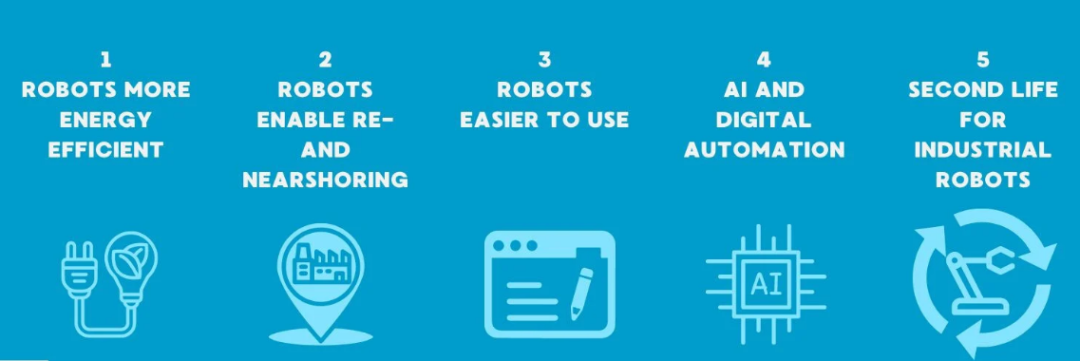
1. 能源效率
在能源成本不断上升的情况下,能源效率是提高企业竞争力的关键。机器人技术的采用在许多方面有助于降低制造业的能源消耗,与传统装配线相比,通过减少热量可以节省大量能源,同时,机器人高速工作,从而提高生产率,使制造变得更加省时和节能。
今天的机器人旨在消耗更少的能源,从而降低运营成本。为了实现生产的可持续性目标,公司使用配备节能技术的工业机器人。
例如,机器人控制能够将动能转化为电能,并将其反馈回电网,该技术显著降低了运行机器人所需的能量,另一个特点是智能节电模式,可以在整个工作日按需控制机器人的能源供应,由于即使在今天,工业设施也需要监控其能源消耗,因此这种连接的功率传感器很可能成为机器人解决方案的行业标准。
2. 回流
弹性已成为各个行业回流的重要驱动力,例如,汽车制造商大量投资于短供应线,以使流程更接近客户,这些制造商使用机器人自动化以经济高效的方式大批量生产强大的电池,以支持他们的电动汽车项目。这些投资使得重型电池的运输变得多余,这一点很重要,因为越来越多的物流公司出于安全原因拒绝运送电池。 数字化转型网www.szhzxw.cn
将微芯片生产重新转移到美国和欧洲是另一个回流趋势。由于当今大多数工业产品都需要半导体芯片才能发挥作用,因此靠近客户的供应至关重要。
机器人在芯片制造中发挥着至关重要的作用,因为它们能够满足极端的精度要求,专门设计的机器人使硅晶圆制造自动化,接管清洁和清洁任务或测试集成电路。最近的回流例子是英特尔在俄亥俄州的新芯片工厂,或最近宣布由芯片制造商 Wolfspeed 和汽车供应商采埃孚在德国萨尔地区运营的芯片工厂。
3. 机器人变得更容易使用
机器人编程变得更容易,非专家也更容易上手。软件驱动的自动化平台供应商为公司提供支持,让用户在没有编程经验的情况下管理工业机器人。原始设备制造商与低代码甚至无代码技术合作伙伴携手合作,让各种技能水平的用户都能对机器人进行编程。
易于使用的软件与直观的用户体验相结合,取代了广泛的机器人编程,并开辟了新的机器人自动化机会,软件初创公司正在进入这个市场,提供满足中小企业需求的专业解决方案。例如,传统的重型工业机器人可以配备传感器和允许协作设置操作的新软件,这使工人可以轻松调整重型机械以完成不同的任务。
因此,公司将两全其美,强大而精确的工业机器人硬件和最先进的协作机器人软件,易于使用的编程界面,允许客户自己设置机器人,也推动了低成本机器人技术的新兴领域。许多新客户通过尝试机器人解决方案来应对 2020 年的大流行病。 数字化转型网www.szhzxw.cn
机器人供应商承认了这一需求,易于设置和安装,例如,使用预配置的软件来处理夹具、传感器或控制器,支持低成本的机器人部署。此类机器人通常通过网上商店出售,各种应用程序的程序例程可从应用程序商店下载。
4. 人工智能(AI)和数字自动化
在数字技术进步的推动下,机器人供应商和系统集成商提供新的应用程序并改进现有应用程序的速度和质量,互联机器人正在改变制造业,机器人将越来越多地作为互联数字生态系统的一部分运行,云计算、大数据分析或 5G 移动网络为优化性能提供技术基础,5G 标准将实现完全数字化生产,让车间的电缆变得过时。
人工智能 (AI) 在机器人技术方面具有巨大潜力,可为制造业带来一系列好处,在机器人技术中使用 AI 的主要目的,是更好地实时或离线管理外部环境中的可变性和不可预测性,这使得支持 AI 的机器学习在软件产品中发挥越来越大的作用,使运行的系统受益,例如优化流程、预测性维护或基于视觉的抓取。
该技术帮助制造商、物流供应商和零售商处理频繁变化的产品、订单和库存,环境的可变性和不可预测性越大,人工智能算法就越有可能提供具有成本效益和快速的解决方案,例如,对于处理数百万种定期变化的不同产品的制造商或批发商,人工智能在移动机器人需要区分遇到的物体或人并做出不同反应的环境中也很有用。 数字化转型网www.szhzxw.cn
5. 工业机器人的第二次生命
工业机器人的使用寿命可达三十年,新技术装备是让旧机器人获得“第二次生命”的绝佳机会。工业机器人制造商在其客户附近设有专门的维修中心,以资源高效的方式翻新或升级二手设备,这种为机器人制造商及其客户准备维修的策略还可以节省成本和资源,为客户提供长期维修是对循环经济的重要贡献。
二、市场增长
1. 工业机器人
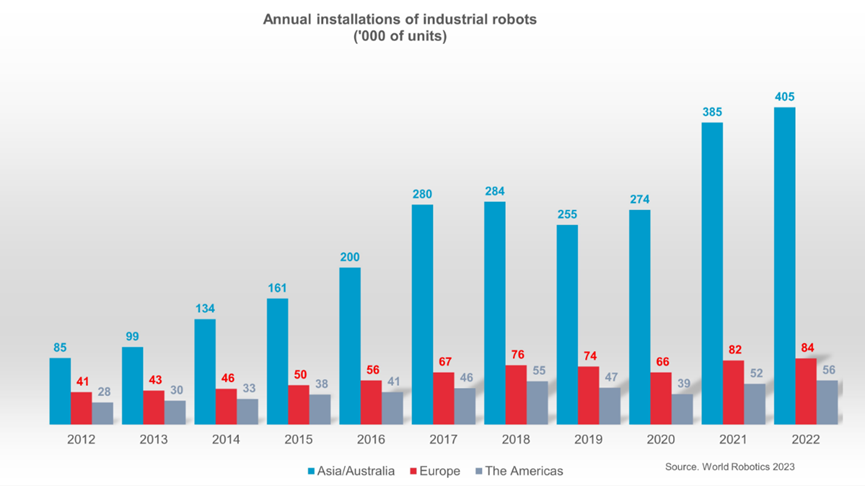
《世界机器人2023报告》报告记录了全球工厂安装的553052台工业机器人,到2022年同比增长率为5%。按地区划分,73%的新机器人安装在亚洲,15%安装在欧洲,10%安装在美洲。
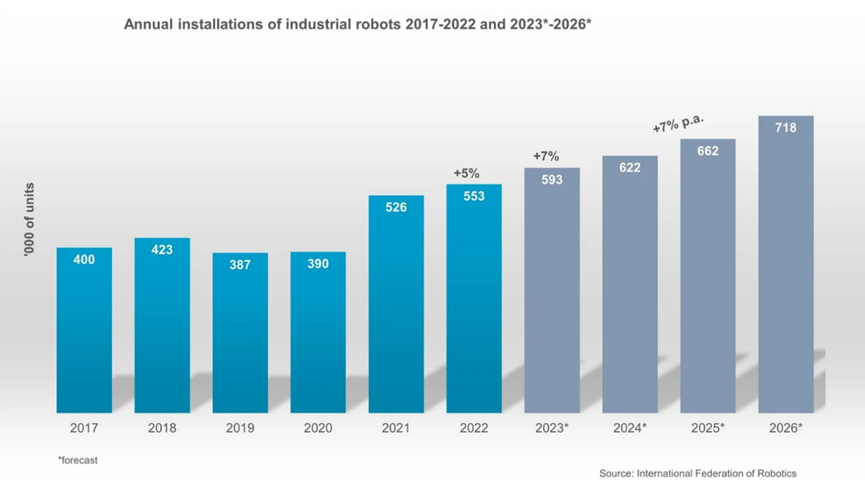
国际机器人联合会主席玛丽娜·比尔说:“50万台的世界纪录连续第二年被打破。”到2023年,全球工业机器人市场预计将增长7%,达到59万台以上。”
(1)亚洲
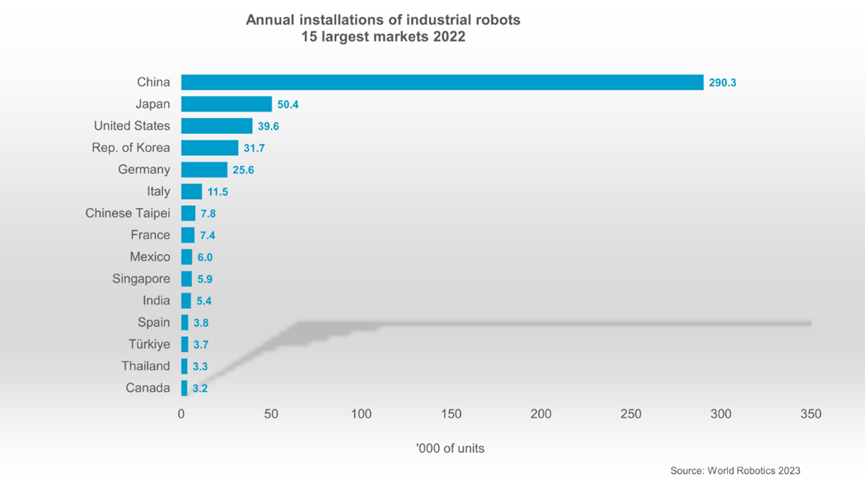
中国是迄今为止世界上最大的市场。2022年,290,258台的年安装量以5%的增长取代了2021年的前记录。这一最新增长非常引人注目,因为它甚至超过了2021年的结果,后者比2020年增长了57%。为了服务这个充满活力的市场,国内外的机器人供应商都在中国建立了生产工厂,并不断提高产能。平均每年机器人安装量以13%的速度增长(2017-2022年)。
日本的机器人安装量增长了9%,达到50,413台,超过了2019年大流行前49,908台的水平。2018年的峰值水平仍为55240套。该国的工业机器人市场规模仅次于中国。2017-2022年,年均安装量增长2%。日本是世界上主要的机器人制造国家,占全球机器人产量的46%。 数字化转型网www.szhzxw.cn
韩国市场增长了1%,2022年安装量达到31,716台。这是继连续四年安装数据下滑之后,该公司第二年实现了边际增长。韩国仍然是继美国、日本和中国之后的世界第四大机器人市场。
(2)欧洲
欧盟仍然是世界第二大市场(70,781台;+5%)。德国是全球五大采用者之一,在欧盟的市场份额为36%。德国的安装量下降了1%,至25,636台。意大利紧随其后,在欧盟的市场份额为16%,安装量增长了8%,达到11,475台。欧盟第三大市场法国的区域市场份额为10%,增长了13%,2022年安装了7380台。
在脱欧后的英国,工业机器人的安装量在2022年增长了3%,达到2534台,不到德国销售额的十分之一。
(3)美洲
在美洲,2022年的安装量增长了8%,达到56,053辆,超过了2018年的峰值水平(55,212辆)。美国是最大的区域市场,占2022年美洲安装量的71%。机器人安装量增长了10%,达到39,576台。这仅略低于2018年达到的40373辆的峰值水平。主要增长动力是汽车行业,新增装机量增加了47%(14472辆)。汽车行业的份额现在已经恢复到37%,其次是金属和机械行业(3900辆)和电气/电子行业(3732辆)。
另外的主要市场是墨西哥,安装量增长了13%(6000台),而加拿大的需求下降了24%(3223台)。这是汽车行业需求下降的结果,而汽车行业是最强劲的采用者。
巴西是汽车和汽车零部件的重要生产基地:国际汽车制造商组织(OICA)报告称,到2022年,巴西的汽车产量将达到240万辆,显示了该国自动化的巨大潜力。每年的安装数量增长相当缓慢,有周期性的起伏。2022年,安装了1858台机器人。这比前一年增加了4%。 数字化转型网www.szhzxw.cn
(4)聚焦中国市场
据最新的《世界机器人报告》显示,中国的机器人安装量增长了5%,并在2022年达到290,258台的新高峰。占全球安装量的52%。运行存量突破150万台的历史纪录。
国际机器人联合会主席Marina Bill说:“中国是迄今为止全球最大的市场。2022年的最新增幅为5%,甚至超过了2021年的增幅(当年与2020年相比,增幅为57%),因此这一增幅十分显著。为了服务这个活力四射的市场,国内外机器人供应商纷纷在中国建立生产工厂,并不断提高产能。”
2021年,中国的运营存量超过100万台,2022年突破150万台大关(1,501,535台;+22%)。这使中国成为第一个也是唯一一个拥有如此庞大机器人保有量的国家。欧洲的总量为728,391台,北美为452,217台。从2017年到2022年,中国的机器人存量平均每年增长25%,这说明了中国经济现代化正飞速发展。
电子电气行业是中国工业机器人的主要客户,占总安装量的35%,即2022年达到100,320台。比上一年增长7%。2022年,中国电子行业的安装量占全球该行业安装量的64%,中国生产商提供了其中41%的机器人。
汽车行业是第二大客户行业。年安装量增长强劲,2021年达到新的峰值,2022年继续保持这一增长势头(73363台;+26%)。全球汽车行业54%的安装量在中国。中国制造商提供的机器人占中国汽车工业的17%。 数字化转型网www.szhzxw.cn
2022年,金属和机械行业的机器人安装量减少了16%,为30,932台。占中国总安装量的11%。中国机器人供应商在这一领域的市场份额为77%。
前景展望:据报道,中国经济增速正在放缓,但根据IFR的《2023年第二季度季度调查》,主要由中国市场决定的亚洲营业额增长率仍然强劲。由于交货期延长,2022年的许多订单将在2023年交付。
(5)展望2023-2026
与新冠疫情之前相比,机器人需求仍处于较高水平。到2023年,全球机器人安装量预计将增长7%,达到59万台以上。预计全球经济放缓将在2024年体现在机器人安装上,但预计2025年增长率将略有加快,2026年将更加强劲。没有迹象表明,整体的长期增长趋势会在短期内结束。事实恰恰相反。预计2024年将达到60万台,2026年将突破70万台。考虑到通货膨胀和紧缩因素,北美市场预计每年平均增长7%。欧洲市场的中期前景大概率收到衰退的影响。亚洲市场将保持强劲。中国的机器人需求将继续从非常高的水平以高速度增长。日本的机器人安装将在2024年略有加速,并以高速度增长,预计韩国市场的增长率将达到中位数。 数字化转型网www.szhzxw.cn
2. 服务机器人
与工业机器人相比,服务机器人产业更加多样化。IFR统计部门目前了解到全球范围内975家服务机器人生产商全球范围内,不包括原型服务和系统集成商。许多公司仍处于融资或原型制作阶段,并打算推出市场产品。
2022年,全球专业服务机器人销量增长48%。近158000售出单位由IFR登记。RaaS的规模扩大50%,超过21000台。
移动机器人解决方案已经在运输和物流领域建立起来,到2022年,销售量增加44%。酒店机器人越来越受欢迎。2022年销售额增长了125%,RaaS规模正在迅速增长。医药销售机器人下跌4%。机器人技术是农业数字化的重要组成部分,到2022年销售额将增长18%。有很多的研究和发展使用机器人进行种植的植物和农作物数量和产品在增长。专业清洁机器人的需求增长了8%。搜救与安防机器人应用组销量上升18%。用于建筑或拆除任务的服务机器人构成了一个市场,几乎没有任何销售报告给IFR统计部门,仍有大量特定产品的机会有待开发。 数字化转型网www.szhzxw.cn
企业仍然有大量的特定服务机器人的产品机会,因此在全球范围内创造了一个有吸引力的商业市场。今天的服务机器人市场由许多专业服务的小众产品和一些专业和家庭使用的大批量应用组成。服务机器人领域的先驱者强调,新公司进入这一增长市场的重要机会是通过创新产品,而不是偶尔的机器人炒作。专业用途的服务机器人非常多样化,因为它们通常被设计用于执行特定的任务。从最终用户的角度考虑成本效益是投资此类系统的主要因素,此外还有助于提供合格和安全的工作。虽然服务机器人的用途和工业机器人用途一样多样化,但可以区分出三种设计类别:对工业机器人部件进行修改(例如自动化仓储和医疗机器人),使用先进的机器人技术对现有生产线的高端系统进行升级,并具有自动化功能(如清洁、检查),以及“从头”设计新的机器人(如窗户清洁工、保安机器人)。
美国是大多数服务机器人供应商的所在地。218家公司坐落于此。中国有106家公司生产服务型机器人,德国有85家公司生产服务型机器人。日本有72家服务机器人供应商,法国有53家。
服务机器人行业正在高速发展,并购活动频繁。许多公司将自己定位为“深度科技”,这意味着他们愿意在产品开发阶段接受技术挑战,以创造技术进步。虽然服务机器人行业是一个年轻且不断发展的行业,但91%的供应商都是老牌企业。这包括成熟的服务机器人供应商,以及其他行业将服务机器人添加到其产品组合中的公司。2010年代出现了一波新的服务机器人制造商。从那以后,新成立的公司数量急剧下降。IFR的市场观察表明,市场份额下降的原因是一些细分市场已经达到了成熟的水平,例如仓库物流的amr。多年来,amr的销售一直在强劲增长,公司不断发展壮大,成为老牌企业。许多服务应用程序都是基于从工业机器人生产商那里购买的协作工业机器人,因此,服务机器人供应商不被视为机器人生产商,机器人是从第三方购买的。这些公司就像一个系统集成商,将不同的组件组合在一起,开发软件来创建一个解决方案。 数字化转型网www.szhzxw.cn

翻译:
World Robotics 2023 Report released
Recently, the International Federation of Robotics (IFR) released the World Robotics Report 2023, which includes two reports on industrial robots and service robots. The report recorded 553,052 industrial robots installed in factories worldwide, an increase of 5% year-on-year. By region, 73% of newly deployed robots were installed in Asia, 15% in Europe and 10% in the Americas.
Download the full report at the end! 数字化转型网www.szhzxw.cn
5 Major trends
The report tracks the development of the robotics industry.
Energy efficiency
In the face of rising energy costs, energy efficiency is the key to improving business competitiveness. The adoption of robotics technology in many ways helps to reduce the energy consumption of the manufacturing industry, compared to the traditional assembly line, by reducing heat can save a lot of energy, at the same time, robots work at high speed, thus improving productivity, making manufacturing more time efficient and energy efficient.
Today’s robots are designed to consume less energy, thus reducing operating costs. In order to achieve the sustainability goals of production, the company uses industrial robots equipped with energy-saving technology.
For example, robot control is able to convert kinetic energy into electricity and feed it back to the grid, a technology that significantly reduces the amount of energy required to run the robot, and another feature is a smart power saving mode that can control the energy supply of the robot on demand throughout the working day, since even today, industrial facilities need to monitor their energy consumption. This connected power sensor is therefore likely to become the industry standard for robotic solutions. 数字化转型网www.szhzxw.cn
Reflux
Resilience has become an important driver of reshoring across various industries, with automakers, for example, investing heavily in short supply lines to bring processes closer to customers, using robotic automation to produce powerful batteries in high volumes in a cost-effective manner to support their electric vehicle projects. These investments make shipping heavy batteries redundant, which is important because more and more logistics companies refuse to ship batteries for safety reasons.
Relocating microchip production to the United States and Europe is another reshoring trend. Since most industrial products today require semiconductor chips to function, it is critical to have supplies close to customers.
Robots play a vital role in chip manufacturing because of their ability to meet extreme precision requirements, with specially designed robots automating silicon wafer manufacturing, taking over cleaning and cleaning tasks or testing integrated circuits. Recent examples of reshoring are Intel’s new chip plant in Ohio, or the recently announced chip plant operated by chipmaker Wolfspeed and automotive supplier ZF in Germany’s Saarland region. 数字化转型网www.szhzxw.cn
Robots are becoming easier to use
Robot programming has become easier and more accessible to non-experts. Software-driven automation platform vendors support companies that allow users to manage industrial robots without programming experience. Oems work with low-code or even no-code technology partners to enable users of all skill levels to program robots.
Easy-to-use software combined with an intuitive user experience has replaced extensive robot programming and opened up new opportunities for robot automation, and software startups are entering this market to provide specialized solutions that meet the needs of smes. For example, traditional heavy industrial robots can be equipped with sensors and new software that allows for collaborative setup operations, which allows workers to easily adjust heavy machinery to complete different tasks.
As a result, the company will have the best of both worlds, with powerful and precise industrial robot hardware and state-of-the-art collaborative robot software, an easy-to-use programming interface that allows customers to set up their own robots and also drives the emerging field of low-cost robotics. Many new customers are responding to the 2020 pandemic by trying out robotic solutions.
Robot vendors acknowledge this need and are easy to set up and install, for example, using pre-configured software to handle fixtures, sensors or controllers, enabling low-cost robot deployment. Such robots are usually sold through online stores, and the program routines for various applications can be downloaded from the app store. 数字化转型网www.szhzxw.cn
Artificial Intelligence (AI) and digital automation
Driven by advances in digital technology, where robot vendors and system integrators deliver new applications and improve the speed and quality of existing ones, connected robots are transforming manufacturing, where robots will increasingly operate as part of a connected digital ecosystem, with cloud computing, big data analytics or 5G mobile networks providing the technical foundation for optimizing performance. The 5G standard will enable fully digital production, making the cables in the workshop obsolete.
Artificial intelligence (AI) has great potential in robotics to bring a range of benefits to the manufacturing industry, and the main purpose of using AI in robotics is to better manage variability and unpredictability in the external environment in real time or offline, which makes AI-enabled machine learning play an increasing role in software products. Benefit the operating system, such as optimizing processes, predictive maintenance, or vision-based grasping.
The technology helps manufacturers, logistics providers, and retailers deal with frequently changing products, orders, and inventory, and the greater the variability and unpredictability of the environment, the more likely it is that an AI algorithm will provide a cost-effective and fast solution, for example, for a manufacturer or wholesaler dealing with millions of different products that change regularly. Ai is also useful in environments where mobile robots need to distinguish between objects or people they encounter and react differently. 数字化转型网www.szhzxw.cn
Second life of industrial robots
The service life of industrial robots can reach 30 years, and new technological equipment is a great opportunity for old robots to get a “second life”. Manufacturers of industrial robots have dedicated repair centers near their customers to refurbish or upgrade used equipment in a resource-efficient manner, this strategy of preparing the robot manufacturers and their customers for repairs can also save costs and resources, and providing customers with long-term repairs is an important contribution to the circular economy.
Second, market growth
Industrial robots
The World Robotics 2023 Report documents 553,052 industrial robots installed in factories worldwide, with a year-on-year growth rate of 5 percent through 2022. By region, 73% of new robots were installed in Asia, 15% in Europe and 10% in the Americas.
“The world record of 500,000 units has been broken for the second year in a row,” said Marina Beer, president of the International Federation of Robotics. By 2023, the global industrial robot market is expected to grow by 7% to more than 590,000 units.” 数字化转型网www.szhzxw.cn
(1) Asia
China is by far the largest market in the world. In 2022, 290,258 annual installations replaced the previous record for 2021 with a 5% increase. This latest increase is remarkable because it even exceeds the 2021 result, which was a 57% increase from 2020. In order to serve this dynamic market, both domestic and foreign robot suppliers have established production plants in China and are constantly increasing their capacity. Average annual robot installations are growing at a rate of 13% (2017-2022).
Robot installations in Japan increased by 9% to 50,413 units, surpassing the 2019 pre-pandemic level of 49,908 units. The peak in 2018 was still 55,240 units. The country’s industrial robot market is second only to China in size. From 2017 to 2022, the average annual installed volume will grow by 2%. Japan is the world’s leading robot manufacturing country, accounting for 46% of global robot production.
The South Korean market grew 1%, with installations reaching 31,716 units in 2022. This is the company’s second year of marginal growth after four consecutive years of declining installation figures. South Korea remains the world’s fourth-largest robot market after the United States, Japan and China.
(2) Europe
The EU remains the world’s second largest market (70,781 units; +5%). Germany is among the top five global adopters, with a market share of 36% in the EU. Installations in Germany fell 1% to 25,636 units. Italy is close behind, with a 16% market share in the EU and an 8% increase in installations to 11,475 units. France, the EU’s third largest market, had a regional market share of 10 percent, up 13 percent, with 7,380 installations in 2022.
In post-Brexit Britain, the installation of industrial robots rose 3 percent in 2022 to 2,534 units, less than a tenth of Germany’s sales. 数字化转型网www.szhzxw.cn
(3) America
In the Americas, installations grew 8% to 56,053 units in 2022, surpassing the peak level of 55,212 units in 2018. The United States is the largest regional market, accounting for 71% of installations in the Americas in 2022. Robot installations increased 10 percent to 39,576 units. This is only slightly below the peak of 40,373 vehicles reached in 2018. The main growth driver was the automotive sector, where new installations increased by 47%(14,472 units). The share of the automotive industry has now recovered to 37%, followed by the metal and machinery industry (3,900 units) and the electrical/electronics industry (3,732 units).
The other major market was Mexico, where installations grew by 13%(6,000 units), while demand in Canada declined by 24%(3,223 units). This is the result of falling demand from the automotive industry, which has been the strongest adopter.
Brazil is an important production base for cars and auto parts: The International Organization of Automobile Manufacturers (OICA) reports that vehicle production in Brazil will reach 2.4 million units by 2022, showing the country’s great potential for automation. The number of installations grows rather slowly each year, with periodic ups and downs. In 2022, 1,858 robots were installed. That’s a 4 percent increase from the previous year. 数字化转型网www.szhzxw.cn
(4) Focus on the Chinese market
According to the latest World Robotics Report, robot installations in China grew by 5% and reached a new peak of 290,258 units in 2022. That’s 52% of global installations. The number of units in operation exceeded a record 1.5 million.
Marina Bill, President of the International Federation of Robotics, said: “China is by far the largest market in the world. The latest increase in 2022 is 5%, which even exceeds the increase in 2021 (57% compared to 2020), so the increase is significant. In order to serve this dynamic market, domestic and foreign robot suppliers have set up production plants in China and continue to increase production capacity.”
In 2021, China’s operational stock exceeded 1 million units and in 2022 crossed the 1.5 million mark (1,501,535 units; +22%). This makes China the first and only country with such a large robot population. The total number of units in Europe was 728,391 and 452,217 in North America. From 2017 to 2022, China’s robot stock has increased by an average of 25% per year, which illustrates the rapid development of China’s economic modernization. 数字化转型网www.szhzxw.cn
The electronics and electrical industry is the main customer of industrial robots in China, accounting for 35% of total installations, or 100,320 units in 2022. An increase of 7% over the previous year. In 2022, China’s electronics industry accounted for 64 percent of global installations in the industry, with Chinese manufacturers supplying 41 percent of these robots.
The automotive industry is the second largest customer sector. Annual installations grew strongly, reaching a new peak in 2021 and continuing this momentum in 2022 (73,363 units; +26%). 54% of global automotive industry installations are in China. Robots supplied by Chinese manufacturers account for 17% of China’s automotive industry.
In 2022, robot installations in the metal and machinery industry decreased by 16% to 30,932 units. It accounts for 11% of total installations in China. Chinese robot suppliers have a 77% market share in this segment.
Outlook: China is reported to be slowing down, but turnover growth in Asia, largely determined by the Chinese market, remains strong, according to IFR’s Q2 2023 Quarterly Survey. Due to the extended lead time, many orders for 2022 will be delivered in 2023. 数字化转型网www.szhzxw.cn
(5) Looking forward to 2023-2026
Demand for robots is still at a high level compared to before the COVID-19 pandemic. By 2023, global robot installations are expected to grow 7% to more than 590,000 units. The global economic slowdown is expected to show up in robot installations in 2024, but the growth rate is expected to accelerate slightly in 2025 and be even stronger in 2026. There is no sign that the overall long-term growth trend will end anytime soon. Quite the opposite is true. It is expected to reach 600,000 units in 2024 and exceed 700,000 units in 2026. Taking into account inflation and deflation, the North American market is expected to grow by an average of 7% per year. The medium-term outlook for the European market is likely to be affected by a recession. Asian markets will remain strong. China’s robot demand will continue to grow at a high rate from a very high level. Robot installations in Japan will accelerate slightly and grow at a high rate in 2024, and the Korean market is expected to grow at a mid-single digit rate.
Service robots
Compared with industrial robots, the service robot industry is more diverse. IFR Statistics is currently aware of 975 service robot manufacturers worldwide, excluding prototype service and system integrators. Many companies are still in the financing or prototyping stage and intend to launch a market product.
In 2022, global sales of professional service robots will increase by 48%. Nearly 158,000 units sold were registered by IFR. The size of RaaS increased by 50% to more than 21,000 units.
Mobile robot solutions are already well established in the transport and logistics sector, with sales increasing by 44% by 2022. Hotel robots are becoming increasingly popular. With 125% sales growth in 2022, RaaS size is growing rapidly. Pharmaceutical sales robots fell 4 percent. Robotics is an important part of the digitalization of agriculture, with sales set to grow 18 percent by 2022. There is a lot of research and development using robots to grow plants and crops and the number of products is growing. Demand for specialized cleaning robots grew by 8 percent. Search and rescue and security robot application group sales rose 18%. Service robots for construction or demolition tasks constitute a market where almost no sales are reported to IFR statistics and there are still plenty of product-specific opportunities to be developed. 数字化转型网www.szhzxw.cn
Enterprises still have a large number of product opportunities for specific service robots, thus creating an attractive business market on a global scale. Today’s service robot market consists of many niche products for professional services and some high-volume applications for professional and home use. Pioneers in the service robotics space emphasize that the important opportunity for new companies to enter this growth market is through innovative products, rather than the occasional robot hype. Service robots for professional use are very diverse, as they are often designed to perform specific tasks. Cost-effectiveness from the end user’s point of view is a major factor in investing in such systems, in addition to contributing to the provision of qualified and safe work. While the uses of service robots are as diverse as those of industrial robots, three design categories can be distinguished: Modifications to industrial robot components (such as automated warehousing and medical robots), the use of advanced robotics to upgrade high-end systems in existing production lines with automated functions (such as cleaning, inspection), and the design of new robots “from scratch” (such as window cleaners, security robots).
The United States is home to most service robot suppliers. 218 companies are located here. There are 106 companies producing service robots in China and 85 companies producing service robots in Germany. Japan has 72 service robot suppliers, while France has 53.
The service robot industry is developing rapidly, and mergers and acquisitions are frequent. Many companies position themselves as “deep tech,” meaning they are willing to take on technical challenges during the product development phase to create technological advances. While the service robot industry is a young and growing industry, 91% of suppliers are established players. This includes established service robot providers, as well as companies in other industries that are adding service robots to their product portfolios. The 2010s saw the emergence of a new wave of service robot manufacturers. Since then, the number of new companies being formed has fallen sharply. IFR’s market watch shows that the reason for the decline in market share is that some segments have reached a level of maturity, such as amr for warehouse logistics. Over the years, amr’s sales have been growing strongly and the company has continued to grow and become an established player. Many service applications are based on collaborative industrial robots purchased from industrial robot manufacturers, so the service robot supplier is not considered a robot manufacturer, and the robot is purchased from a third party. These companies act like a system integrator, putting together different components and developing software to create a solution. 数字化转型网www.szhzxw.cn
本文由数字化转型网(www.szhzxw.cn)转载而成,来源 于智能制造:编辑/翻译:数字化转型网宁檬树。
免责声明: 本网站(http://www.szhzxw.cn/)内容主要来自原创、合作媒体供稿和第三方投稿,凡在本网站出现的信息,均仅供参考。本网站将尽力确保所提供信息的准确性及可靠性,但不保证有关资料的准确性及可靠性,读者在使用前请进一步核实,并对任何自主决定的行为负责。本网站对有关资料所引致的错误、不确或遗漏,概不负任何法律责任。
本网站刊载的所有内容(包括但不仅限文字、图片、LOGO、音频、视频、软件、程序等) 版权归原作者所有。任何单位或个人认为本网站中的内容可能涉嫌侵犯其知识产权或存在不实内容时,请及时通知本站,予以删除。