
一、中小企业数字化转型现状概述
《“十四五”数字经济发展规划》明确提出大力推进数字产业化转型,实施中小企业数字化赋能专项行动。如何抓住窗口,驶入数字经济快车道,加速实现转型成为中小企业的首要关注重点。
《中小企业数字化转型分析报告(2021)》数据显示,中小企业中79%的企业处于数字化转型的初级阶段,而大型企业超半数企业步入到了应用践行和深度应用阶段。大型企业资金、人才、技术资源丰富,具有一定的数字化转型先发优势,而中小企业囿于各类资源限制,整体呈现出的数字化转型水平较低。
(一)数字化转型意识思维。数字化转型的第一步就是意识形态的改变。企业数字化转型意识包括采用数字化技术意识、数字化认证意识和数字化创新意识三个方面。中国电子技术标准化研究院基于15000 余家中小型企业数据,编制形成了《中小企业数字化转型分析报告(2021)》,分析中小企业数字化转型整体态势,从业务转型、管理转型、产品转型的三重视角剖析转型发展、成效与不足。
相关统计数据分析结果显示,我国中小企业在快速实现产品和服务的业务模式数字化转型过程中,着重点主要集中在数字化技术对管理模式的创新方面,有近九成的中小企业现正处于产品与服务模式数字化转型的初期探索阶段,不足 10%的中小企业现正处于利用数字化技术实现管理模式数字化转型的初级实践阶段,仅有不足 5%的中小企业现正处于利用数字化技术实现战略管理与商业模式协同创新的深度应用阶段。
我国多数中小企业对于如何实现数字化转型技术管理实践意愿非常弱,对于如何实现数字化转型的认知狭隘,很大程度上增加当前我国中小企业如何实现数字化转型的技术管理实践难度。高层管理者是企业的重要决策者,其数字化变革意愿、前瞻性思维以及变革导向的心态对企业数字化转型至关重要。如果企业的数字化转型意愿不足,不仅会面临数字化转型后劲乏力,在成果转化上也会受到负面影响。
(二)数字化人才。数字技能人才短缺成为中小企业数字化转型的主要瓶颈。自 2012 年起,互联网平台经济爆发式增长大幅抬高了 IT 人员的薪资水平,传统制造业企业在待遇上缺乏竞争力。在 IT 人才看来,中小企业特别是制造业企业中的 IT 岗位并非公司主业,职业前景不明。在新业态冲击下,即使是位于一线城市的行业标杆企业都面临“招工难”困境。通过市场招聘引入的 IT 人员能否与企业内部 OT 人员有效融合、深度参与企业生产经营流程的数字化改造存在较大不确定性。
数字化技术专业人才大量短缺已成为制约当前我国中小企业实现数字化转型升级的一个重要因素。数字经济时代初期,我国各类企业数字化技术专业人才供不应求,企业之间对于各类数字化技术专业人才的竞争日益加剧。由于中小企业具有自主研发创新能力严重不足、经营规模小、缺乏市场整体综合实力和竞争力等劣势,导致其在企业人才资源的培养和管理过程中存在诸多不足。很多中小企业在各类专业人才招聘及培养等方面,缺乏一套完整的机制,从而导致高技能的专业人才向大中型企业快速聚集,中小企业内部人才资源大量匮乏的尴尬困境越来越严重。
(三)数字化基础与转化能力。数字技术是企业实施数字化转型的核心技术支撑。技术因素体现了现有市场技术水平及创新能力对企业未来数字化转型的赋能作用,是企业能否进行数字化转型以及如何进行数字化转型所需要考虑的技术基础,主要包括数字技术成熟度、技术转化能力和技术迭代周期。
一些学者开始认识到企业数字化转型不仅是技术的应用,更是一个组织变革的过程。数字经济时代背景下,数字信息技术无论是从技术层面还是管理层面,都是中小企业实现有效数字化转型的重要技术助推器,是提高中小企业在新的市场环境中实现可持续发展的关键推动力。
当前,我国大多数中小企业正处于数字技术转型的初级阶段,其对数字信息技术的应用仅限于企业内部,并没有真正涉及能覆盖中小企业的核心经营管理业务。此外,传统中小企业采用的基础生产设施设备老旧,缺乏配套进行数字化技术综合转型的信息技术配套设施,阻碍中小企业进行数字化转型发展。
(四)外部环境因素。环境因素体现在企业数字化转型所面临的外部机会和威胁力量,而驱动企业进行数字化转型的外部机会主要包括政策支持与政策红利、客户认知与市场溢价、市场竞争以及供应链协同四个方面。 数字化转型网(www.szhzxw.cn)
政策支持与政策红利反映企业数字化转型所能依靠的政策引导与资源支持情况,为企业数字化转型提供了法律保障和预期导向。客户认知与市场溢价直接衡量企业数字化转型的价值实现和价值传导过程,客户的异质性需求提升了数字产品和服务的市场容量,并愿意为高品质、高技术含量的产品及服务支付更高的溢价。
市场竞争反映了企业数字化转型的驱动力量,体现了企业在行业内的位置稳定性与突破可能性。行业对于数字化的认知越清晰,通过开展数字化转型参与市场竞争并实现业绩提升的企业越多,行业的整体数字化生态的改造越深入。供应链协同是指企业供应链网络中的各种力量在推动企业数字化转型的过程中形成的协同合力,既在资源上提供了企业数字化转型的有力支撑,又保障了企业数字化转型的收益。
二、中小企业数字化成熟度模型构建
能力成熟度模型是由卡内基梅隆大学软件工程研究院发布,它起源于计算机软件行业,主要用于指导软件开发组织不断完善软件的概念、量化、运行、测试以及升级等过程,使得软件开发管理逐步从混乱的、不成熟的过程走向规范的、成熟的开发过程,因此在软件企业的应用获得了巨大成功。由于它构建了具有动态性和持续演进性的标准,其适用范围逐渐扩大,应用领域也变得越来越广阔。企业数字化同样是为实现特定目标和能力的演进发展,不断优化资源以达成企业转型升级的动态过程。因此,借鉴能力成熟度模型,构建一个便利的自我评价工具,进行数字化水平评估和分析,是促进数字化转型的重要手段。
一方面有助于企业理解和构建清晰的数字化概念,使企业了解自身数字化建设水平,从而及时发现存在的问题,并获取相关的诊断建议;另一方面能够使政府部门客观、正确、科学地评价目前企业数字化建设中取得的成绩和存在的问题,进而为政府做好顶层设计、制定政策和建立数字化标准提供客观依据。
数字化成熟度模型研究、开发与应用,将有助于企业在数字化进程中获得具有可比性的评价结论和策略启示,对推动企业数字化转型有着积极的作用。本文在参考、借鉴国内外相关理论文献和实证研究的基础上,通过对扬州中小企业数字化转型过程中的企业活动深入分析,系统地研究了企业数字化成熟度评估指标体系。 数字化转型网(www.szhzxw.cn)
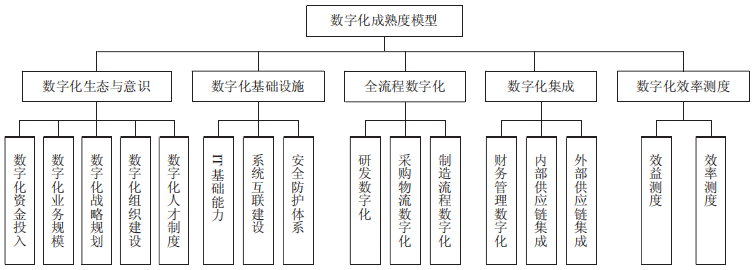
(一)数字化生态与意识。数字化生态与意识反映了企业的顶层设计概况,为数字化转型指明了方向。本文选取数字化资金投入、数字化业务规模、数字化战略规划、数字化组织建设和数字化人才制度作为评价指标。数字化资金投入反映企业对数字化转型的重视程度,投入占比越高,企业对数字化转型越重视,数字化转型效果越明显。数字化业务规模反映了企业数字化的进展程度。数字化战略规划反映了企业高层对数字化转型的重视程度。数字化组织在企业的地位越高,数字化的推进越明显。数字化人才制度是推动企业数字化转型的关键要素之一,企业数字化相关人才数与企业员工总数比反映企业数字化人才的比重,也反映了数字化转型在人力配比上的软实力。
(二)数字化基础设施。数字化基础设施是企业数字化转型的基石,选取 IT 基础能力、系统互联建设和安全防护体系作为数字化基础设施的主要评价指标。IT 基础能力涵盖 IT 基础通信设施水平、互联网平台构建能力/二次开发能力和系统计算能力。系统互联建设涵盖设备的数字化程度、设备的联网程度以及系统智慧互联程度。安全防护体系包括数字化安全建设投入力度和数字化安全维护程度。
(三)全流程数字化。中小企业需要打破信息孤岛,通过更优质、多元的数据,综合和协调地利用分析工具与先进技术了解自身运营的各个环节,加强人机协作,推动全流程转型,融入敏捷性和快速响应能力,打造卓越的客户体验,找到新的价值来源。全流程数字化主要包括研发数字化、采购物流数字化和制造流程数字化。研发数字化是企业转型升级的主要动力,可以从研发手段数字化、创新平台网络化、研发管理过程数字化和产品管理数字化进行衡量。采购与物流数字化可以从供应商管理数字化程度、采购与物流过程流程化监控、物流数字化优化程度进行评价。制造流程化可以从制造过程的数字化管理、数字化制造的协调水平以及数字化生产监控进行评价等。 数字化转型网(www.szhzxw.cn)
(四)数字化集成。数字化集成反映了企业数字化转型的综合能力,可以从内部供应链集成与外部供应链集成两个方面进行评价。内部供应链集成主要衡量企业产品设计与制造集成程度、内部管理与制度集成和内部财务与业务的集成。外部供应链集成包括企业间研产供销集成、经营管理与生产控制集成、业务与财务全流程的综合集成。
(五)数字化效率测度。数字化效率测度反映企业数字化转型的成果,是企业数字化成效的集中体现。效益测度主要从企业成本、产品质量、用户满意度、产品或服务创新和企业生态系统等方面进行评估。效率测度主要从市场响应速度、研发周期效率、生产效率、管理和决策效率、信息共享效率等方面进行评估。
三、中小企业数字化转型路径
数字化转型的时间跨度都非常大,而不同阶段的数字化转型具有不同的任务和关注点,起步建设阶段的主要任务为基础设施建设,而基础设施建设主要为政府行为,因此在李君等研究的基础上,构建由“单项覆盖、集成提升、创新突破”构成的数字化转型阶段性体系。
(一)企业层面
1、战略为先,覆盖核心业务。面对后疫情时代的新机遇和新挑战,中小企业首先要解决的是发展方向和路径问题。应当立足于自身的竞争优势,创新数字化商业模式,明确自身转型之路,并以企业定位与业务发展战略为先导,基于业务构想设计数字化转型的愿景和顶层战略。
数字化转型不能成为空中楼阁,顶层设计与愿景一定要形成端到端的规划蓝图和行动计划,并需获得全体业务部门的支持,以成熟完善的规划与深入人心的解读来增进集团各层级员工的参与。同时,企业还需要动态跟踪全局及各业务线、各职能部门的数字化进程,根据不同的业务特性,制定明确的、阶段性的考核评估体系,实现从战略、管理、执行、操作到评估的闭环管控和持续优化。不同类型企业数字化切入点略显不同,制造企业应以生产过程数字化作为切入点,物流或服务类企业应着手购买或研发数字化信息平台,实现供应链全流程一体化操作和管理,打造供应链生态系统,提升行业扩展能力和平台服务能力,赋能业务的不断创新升级。 数字化转型网(www.szhzxw.cn)
2、创新数字化转型思维,明确数字化转型方向。数字化时代背景下,中小企业实现数字化创新转型,要合理利用国家、省市数字化产业技术与创新平台,构建中小企业未来发展的新兴市场经济体和商业模式,以逐步提高中小企业的管理创新能力和可持续健康发展的战略创新能力。
从中小企业经营管理政策层面来说,相关政策明确要求中小企业的管理层应始终保有高度敏锐的国际市场经济洞察力,及时有效地应对市场经济环境复杂的变化,抓住行业发展先机,合理调整中小企业整体发展经营战略。鼓励中小企业全体员工积极参与到企业数字化转型中,提高中小企业全体员工对未来企业数字化发展趋势的充分认知。充分利用数字经济发展的历史契机,结合中小企业自身实际情况及发展形势,积极参与到转型中来,推动企业连接数字化全产业链的转型发展,从而达到振兴经济的目的。
在数字化转型中,企业要明确自身发展方向和路径,寻找适合自身发展的商业模式和竞争优势,根据企业的发展理念制定发展目标和数字化战略,组建专门的数字化建设团队负责相关转型设计的工作。同时,作为管理者要从整体上动态跟踪数字化工作进程,设立不同的考核体系,实现从战略规划、经营管理到评价的闭环控制和持续优化,帮助企业实现数字化的升级。对于制造企业来说,全流程的数字化管理是企业降本增效的主要手段。
3、构建系统数字化人才培养体系。在大力推进中小企业数字化转型过程中,最重要的内容就是需要培养一批综合型的推进中小企业数字化技术的人才。扬州中小企业应积极组织企业员工学习如何掌握数字化技术以及相关的专业技能。同时,政策上引导中小企业与高校、科研机构针对性地合作,系统性地建立健全企业数字化转型人才培养保障机制,培养一批适合中小企业自身发展需求的企业数字化技术人才,共同推进中小企业数字化技术转型升级。 数字化转型网(www.szhzxw.cn)
加强数字人才培养和人力资本积累,为制造业高质量发展提供持久内在动力。完善制造业人力资本积累顶层设计,从市场、教育、社会保障等多方面入手,切实提高制造业对人才的吸引力。对职业资格制度、职称制度、人才评价制度、劳动保障制度进行适应性改革和调整。大力提升工程制造学科职业教育水平,畅通工程职业教育向研究型高等教育的转换深造渠道。重视数字技能、先进制造技能等未来产业发展所需技能的开发和培养,推广终身学习、建设学习型社会。
4、提升中小企业数字化转型创新能力。新冠肺炎疫情对企业经营的打击让企业深刻意识到系统韧性、敏捷性、适应性和可扩展性的重要价值。2020 年,中国云计算整体市场规模达 2091 亿元,增速56.6%,其中公有云市场规模达 1277 亿元,同比增长 85.2%,私有云市场规模达 814 亿元,同比增长 26.1%。对于中国企业而言,上云不再是未来畅想与计划,而是迫在眉睫的要务,是数字化转型的关键。通过云与多种数字技术的融合应用,赋能新产品、新业务和新模式,加速企业各个职能的全面上云,并借助多种云服务提升敏捷度和可扩展性,积极尝试技术融合,以云促新。
企业数字化转型是一个优化生态集群,创造新的组织模式的过程。因此,中小企业要积极借助数字信息技术实现数据资源对经营能力的高质量提升。首先,中小企业可以专注于将产品链与服务模式有机结合,根据自身所在行业和产业特点整合资源,通过数字化技术实现动态管理。在我国,数字化转型的创新应用出现了从高信息化行业向低信息化行业渗透现象。
因此,中小企业的数字化转型创新要突破产品的传统定义,积极利用数字信息技术开发产品的内涵深度,从以实物为载体的基础型产品,向以服务提升产品性能纵深的内涵型产品创新发展,实现根据用户需求方向创造价值的数字化转型。其次,引入新型数字化信息技术,积极利用数据资源共享功能深度了解用户行为,利用大数据技术整合行业资源,缩短用户与企业之间的距离,开发新的用户需求,提高企业创新能力,以实现中小企业高质量可持续发展。 数字化转型网(www.szhzxw.cn)
(二)政府层面
1、加快城市数字化发展。城市数字化发展为所属地中小企业数字化转型提供了发展空间。“新华三”针对中国城市发展与治理的四大关键领域,依据国家各部委针对各领域的政策要求,构建“城市数字化指标体系”。针对城市数字化发展指数来看,在城市服务与产业融合两个方面评分较低,这两项指标直接关系到中小企业数字化转型的进度。需要在教育、医疗、民政、营商环境推进数字化进程,改善城市服务水平。数字产业化会影响到主体产业的发展,是其他行业的市场驱动力,信息通信技术行业的发展水平对于数字产业化至关重要,是其他行业数字化的供应商。
2、配套数字化转型相关政策。现阶段,我国中小企业的发展还是依靠地方政府的产业政策来提供支持。首先,政府应当支持并继续加大对中小企业应用数字化技术转型的投入,以保证在新时代背景下打好可持续发展的根基。其次,数字经济时代我国中小企业获得可持续发展能力的关键就在于从战略管理层面进行数字化转型,但是中小企业受限于内外部复杂多变的因素影响,政府应该适时性的重点结合中小企业普遍面临的各种财税补贴问题,给予中小企业一定的相关财税补贴优惠政策,鼓励当前中小企业积极主动投入,推进中小企业通过大力发展数字化产业服务推动经济项目实现快速转型,尤其是针对中小企业长期面临的融资困难问题,政府应当根据数字经济时代的发展需求,为中小企业的数字化转型提供融资政策保障,为中小企业的高质量可持续发展注入新动能,助力中小企业高效实现数字化转型升级。
立足于企业数字化水平差距较大的实际,从完善公共服务、基础设施等外部环境入手,循序渐进推动企业数字化改造。各级政府既要关注少数标杆企业所展示出的智能制造场景,又要客观认识企业建设水平多层次化并存的现实国情。在转型过程中,政府部门既要充分提升中小企业负责人对数字化转型的认知、增强企业的转型意愿,又要提升制造业整体信息化、数字化基础,将有限的政府资金集中到数字基础设施建设、数字化共性技术研发等准公共服务领域,降低中小企业数字化改造隐性成本。在此基础上,引导企业选择关键、典型的应用场景进行数字化改造,循序渐进地推进数字化转型。

翻译:
Key factors, maturity model construction and implementation path of smes’ digital transformation
I. Overview of the current situation of digital transformation of smes
The “14th Five-Year Plan” for the Development of Digital Economy clearly proposes to vigorously promote the transformation of digital industrialization and implement special actions to empower small and medium-sized enterprises. How to seize the window, enter the fast lane of digital economy, and accelerate the transformation has become the primary focus of small and medium-sized enterprises.
According to the Digital Transformation Analysis Report for smes (2021), 79% of smes are in the initial stage of digital transformation, while more than half of large enterprises have entered the application practice and deep application stage. Large enterprises are rich in capital, talent and technology resources and have certain advantages of being the first mover in digital transformation, while small and medium-sized enterprises are limited by various resources and have a low level of digital transformation on the whole. 数字化转型网(www.szhzxw.cn)
(1) Digital transformation awareness thinking. The first step in digital transformation is a change in ideology. The consciousness of enterprise digital transformation includes three aspects: the consciousness of adopting digital technology, the consciousness of digital certification and the consciousness of digital innovation. Based on the data of more than 15,000 small and medium-sized enterprises, the China Institute of Electronic Technology Standardization has compiled and formed the Digital Transformation Analysis Report of Small and medium-sized Enterprises (2021), which analyzes the overall situation of digital transformation of small and medium-sized enterprises, and analyzes the transformation development, effectiveness and shortcomings from the three perspectives of business transformation, management transformation and product transformation.
The analysis results of relevant statistical data show that in the process of rapidly realizing the digital transformation of the business model of products and services, the focus of China’s small and medium-sized enterprises is mainly focused on the innovation of the management model of digital technology, and nearly 90% of small and medium-sized enterprises are now in the initial stage of exploring the digital transformation of the product and service model. Less than 10% of smes are in the primary practice stage of using digital technology to achieve digital transformation of management mode, and only less than 5% of smes are in the deep application stage of using digital technology to achieve strategic management and business model collaborative innovation.
Most small and medium-sized enterprises in our country have very weak willingness on how to achieve digital transformation technology management practice, and narrow cognition on how to achieve digital transformation, which greatly increases the difficulty of technology management practice for small and medium-sized enterprises in our country to achieve digital transformation. Top managers are important decision makers of enterprises, and their willingness to digital change, forward-looking thinking and change-oriented mentality are crucial to enterprises’ digital transformation. If the enterprise’s willingness to digital transformation is insufficient, it will not only face the weakness of digital transformation, but also be negatively affected in the transformation of results.
(2) Digital talents. The shortage of digital skills has become a major bottleneck for the digital transformation of smes. Since 2012, the explosive growth of the Internet platform economy has greatly increased the salary level of IT personnel, and traditional manufacturing enterprises are not competitive in terms of treatment. In the view of IT talents, IT positions in small and medium-sized enterprises, especially manufacturing enterprises, are not the main business of the company, and the career prospects are unclear. Under the impact of new business forms, even the industry benchmark enterprises located in first-tier cities are facing the dilemma of “recruitment difficulties”. There is great uncertainty whether the IT personnel introduced through market recruitment can effectively integrate with the OT personnel inside the enterprise and deeply participate in the digital transformation of the production and operation process of the enterprise. 数字化转型网(www.szhzxw.cn)
The large shortage of digital technology professionals has become an important factor restricting the realization of digital transformation and upgrading of small and medium-sized enterprises in China. At the beginning of the digital economy era, the supply of digital technology professionals in various enterprises in China is in short supply, and the competition among enterprises for all kinds of digital technology professionals is intensifying. Due to the serious shortage of independent research and innovation ability, small scale of operation, lack of overall market strength and competitiveness, there are many deficiencies in the training and management of enterprise human resources. Many small and medium-sized enterprises lack a complete mechanism in the recruitment and training of various professional talents, which leads to the rapid accumulation of highly skilled professionals to large and medium-sized enterprises, and the embarrassment of large and medium-sized enterprises’ lack of internal talent resources is becoming more and more serious.
(3) Digital foundation and transformation capability. Digital technology is the core technical support for enterprises to implement digital transformation. Technical factors reflect the enabling effect of existing market technology level and innovation ability on the future digital transformation of enterprises, and are the technical basis for enterprises to consider whether and how to carry out digital transformation, mainly including digital technology maturity, technology transformation ability and technology iteration cycle.
Some scholars begin to realize that enterprise digital transformation is not only the application of technology, but also a process of organizational change. Under the background of the digital economy era, digital information technology is an important technology booster for smes to achieve effective digital transformation, both from the technical level and management level, and a key driving force to improve the sustainable development of smes in the new market environment.
At present, most small and medium-sized enterprises in our country are in the initial stage of digital technology transformation, and their application of digital information technology is limited to their internal enterprises, and they do not really involve the core management business that can cover small and medium-sized enterprises. In addition, the basic production facilities and equipment used by traditional small and medium-sized enterprises are old, and the lack of supporting information technology facilities for comprehensive transformation of digital technology hinders the development of digital transformation of small and medium-sized enterprises.
(4) External environmental factors. Environmental factors are reflected in the external opportunities and threats faced by enterprises in digital transformation, and the external opportunities that drive enterprises to carry out digital transformation mainly include four aspects: policy support and policy dividend, customer awareness and market premium, market competition and supply chain collaboration.
Policy support and policy dividend reflect the policy guidance and resource support that enterprises can rely on for digital transformation, and provide legal protection and expected guidance for enterprises’ digital transformation. Customer perception and market premium directly measure the value realization and value transmission process of an enterprise’s digital transformation. The heterogeneous needs of customers increase the market capacity of digital products and services, and they are willing to pay a higher premium for high-quality and high-tech products and services.
Market competition reflects the driving force of enterprises’ digital transformation, and reflects the position stability and breakthrough possibility of enterprises in the industry. The clearer the industry’s awareness of digitalization, the more enterprises that participate in market competition and achieve performance improvement through digital transformation, the deeper the transformation of the overall digital ecology of the industry. Supply chain collaboration refers to the synergy formed by various forces in the enterprise supply chain network in the process of promoting enterprise digital transformation, which not only provides strong support for enterprise digital transformation in terms of resources, but also guarantees the benefits of enterprise digital transformation.
Construction of digital maturity model for smes
CMM is published by the Institute of Software Engineering of Carnegie Mellon University. Originating from the computer software industry, CMM is mainly used to guide software development organizations to constantly improve the process of software concept, quantification, operation, testing and upgrade, so that software development management gradually moves from a chaotic and immature process to a standardized and mature development process. Therefore, the application in software enterprises has achieved great success. Because it has built a dynamic and continuous evolution of the standard, its scope of application gradually expanded, the application field has become more and more broad. Enterprise digitalization is also a dynamic process of continuous optimization of resources to achieve enterprise transformation and upgrading in order to achieve the evolution and development of specific goals and capabilities. Therefore, it is an important means to promote digital transformation to build a convenient self-evaluation tool for digital level assessment and analysis by drawing on the capability maturity model.
On the one hand, it helps enterprises to understand and build clear digital concepts, so that enterprises can understand their own digital construction level, so as to timely discover existing problems and obtain relevant diagnostic suggestions; On the other hand, it can enable the government departments to objectively, correctly and scientifically evaluate the achievements and existing problems in the current enterprise digital construction, and then provide an objective basis for the government to do a good job in top-level design, formulate policies and establish digital standards.
The research, development and application of digital maturity model will help enterprises to obtain comparable evaluation conclusions and strategic enlightenment in the digital process, and play a positive role in promoting the digital transformation of enterprises. Based on the reference of relevant theoretical literature and empirical research at home and abroad, this paper systematically studies the evaluation index system of enterprise digital maturity through the in-depth analysis of enterprise activities in the process of digital transformation of small and medium-sized enterprises in Yangzhou.
Figure 1. Evaluation index system of enterprise digital maturity
(1) Digital ecology and consciousness. Digital Ecology and Awareness reflects the top design profile of the enterprise and points the way for digital transformation. This paper selects digital capital investment, digital business scale, digital strategic planning, digital organization construction and digital talent system as evaluation indicators. Digital capital investment reflects enterprises’ attention to digital transformation. The higher the proportion of investment, the more enterprises pay attention to digital transformation, and the more obvious the effect of digital transformation. The size of the digital business reflects the progress of the digital enterprise. Digital strategic planning reflects the importance of digital transformation at the top of the enterprise. The higher the position of the digital organization in the enterprise, the more obvious the promotion of digitalization. The digital talent system is one of the key factors to promote the digital transformation of enterprises. The ratio of the number of digital-related talents to the total number of employees reflects the proportion of digital talents in enterprises, and also reflects the soft power of digital transformation in manpower matching.
(2) Digital infrastructure. Digital infrastructure is the cornerstone of enterprise digital transformation. IT basic capability, system interconnection construction and security protection system are selected as the main evaluation indicators of digital infrastructure. IT basic capabilities cover the level of IT basic communication facilities, Internet platform construction capabilities/secondary development capabilities and system computing capabilities. System interconnection construction covers the digitization degree of equipment, the networking degree of equipment and the intelligent interconnection degree of the system. Security protection system includes digital security construction investment and digital security maintenance degree.
(3) Digitalization of the whole process. Smes need to break down information silos, use better, diverse data, integrated and coordinated use of analytics tools and advanced technologies to understand every part of their operations, enhance human-machine collaboration, drive whole-process transformation, incorporate agility and rapid response capabilities, create superior customer experiences, and find new sources of value. The digitalization of the whole process mainly includes the digitalization of research and development, procurement logistics and manufacturing process. Digitization of R&D is the main driving force for enterprise transformation and upgrading, which can be measured from digitization of R&D means, networking of innovation platform, digitization of R&D management process and digitization of product management. Procurement and logistics digitization can be evaluated from the digitalization degree of supplier management, procurement and logistics process monitoring, and logistics digitalization optimization degree. Manufacturing process can be evaluated from the digital management of manufacturing process, the coordination level of digital manufacturing and digital production monitoring. 数字化转型网(www.szhzxw.cn)
(4) Digital integration. Digital integration reflects the comprehensive ability of enterprise digital transformation, which can be evaluated from two aspects: internal supply chain integration and external supply chain integration. Internal supply chain integration mainly measures the integration degree of product design and manufacturing, internal management and system integration, and internal finance and business integration. External supply chain integration includes research, production, supply and marketing integration, management and production control integration, business and financial integration of the whole process.
(5) Digital efficiency measurement. The measurement of digital efficiency reflects the results of enterprise digital transformation and is the concentrated embodiment of enterprise digital effectiveness. Benefit measurement is mainly evaluated from the aspects of enterprise cost, product quality, user satisfaction, product or service innovation and enterprise ecosystem. Efficiency measurement is mainly evaluated from the aspects of market response speed, research and development cycle efficiency, production efficiency, management and decision efficiency, information sharing efficiency, etc.
Digital transformation path for smes
The time span of digital transformation is very large, and different stages of digital transformation have different tasks and concerns. The main task of the initial construction stage is infrastructure construction, which is mainly government behavior. Therefore, based on the research of Li Jun et al., a phased system of digital transformation composed of “single coverage, integrated improvement and innovative breakthrough” is built. 数字化转型网(www.szhzxw.cn)
(1) Enterprise level
1. Strategy first, covering the core business. In the face of new opportunities and challenges in the post-COVID-19 era, the first thing for smes to address is the direction and path of development. It should be based on its own competitive advantages, innovate digital business models, clarify its own transformation path, and design the vision and top-level strategy of digital transformation based on the business concept, guided by the enterprise positioning and business development strategy.
Digital transformation can not become a castle in the air, the top-level design and vision must form an end-to-end planning blueprint and action plan, and need to obtain the support of all business departments, with mature planning and in-depth interpretation to enhance the participation of employees at all levels of the group. At the same time, enterprises also need to dynamically track the digital process of the global and various business lines and functional departments, formulate a clear and phased assessment and evaluation system according to different business characteristics, and achieve closed-loop control and continuous optimization from strategy, management, implementation, operation to evaluation. The digitalization entry point of different types of enterprises is slightly different. Manufacturing enterprises should take the digitalization of production process as the entry point, and logistics or service enterprises should purchase or develop digital information platforms to realize the integrated operation and management of the whole process of the supply chain, build supply chain ecosystem, improve the industry expansion ability and platform service ability, and enable continuous innovation and upgrading of business.
2. Innovate digital transformation thinking and clarify the direction of digital transformation. In the context of the digital era, to achieve digital innovation transformation for smes, it is necessary to make reasonable use of national, provincial and municipal digital industry technology and innovation platforms to build emerging market economies and business models for the future development of smes, so as to gradually improve their management innovation capabilities and strategic innovation capabilities for sustainable and healthy development. 数字化转型网(www.szhzxw.cn)
At the level of SME operation and management policies, relevant policies clearly require that the management of smes should always maintain a highly sensitive insight into the international market economy, timely and effectively respond to complex changes in the market economic environment, seize the opportunity for industry development, and reasonably adjust the overall development and management strategy of smes. Encourage all employees of smes to actively participate in the digital transformation of enterprises, and improve the full awareness of all employees of smes on the future digital development trend of enterprises. Make full use of the historical opportunity of the development of the digital economy, combined with the actual situation and development situation of small and medium-sized enterprises, actively participate in the transformation, promote the transformation and development of enterprises to connect the digital whole industrial chain, so as to achieve the purpose of revitalizing the economy.
In the process of digital transformation, enterprises should clarify their own development direction and path, find business models and competitive advantages suitable for their own development, formulate development goals and digital strategies according to the development concept of the enterprise, and set up a dedicated digital construction team to be responsible for related transformation design. At the same time, as a manager, it is necessary to dynamically track the digital work process as a whole, set up different assessment systems, achieve closed-loop control and continuous optimization from strategic planning, operation management to evaluation, and help enterprises achieve digital upgrading. For manufacturing enterprises, the digital management of the whole process is the main means to reduce costs and increase efficiency.
3. Build a systematic digital talent training system. In the process of vigorously promoting the digital transformation of smes, the most important content is to cultivate a group of comprehensive talents to promote the digital technology of smes. Small and medium-sized enterprises in Yangzhou should actively organize their employees to learn how to master digital technology and related professional skills. At the same time, policies guide smes to cooperate with universities and scientific research institutions in a targeted manner, systematically establish and improve the training guarantee mechanism for enterprise digital transformation talents, train a group of enterprise digital technical talents suitable for the development needs of smes, and jointly promote the transformation and upgrading of digital technology of smes. 数字化转型网(www.szhzxw.cn)
Strengthen the training of digital talents and the accumulation of human capital to provide lasting internal impetus for the high-quality development of the manufacturing industry. Improve the top-level design of human capital accumulation in the manufacturing industry, start from the market, education, social security and other aspects, and effectively improve the attractiveness of the manufacturing industry to talents. We will carry out adaptive reforms and adjustments to the vocational qualification system, the title system, the talent evaluation system, and the labor security system. Vigorously improve the level of engineering and manufacturing vocational education, smooth the conversion of engineering vocational education to research-oriented higher education channels. Pay attention to the development and cultivation of skills needed for future industrial development such as digital skills and advanced manufacturing skills, promote lifelong learning, and build a learning society.
4. Enhance the digital transformation and innovation capability of smes. The impact of the COVID-19 pandemic on business operations has made companies deeply aware of the important value of system resilience, agility, adaptability and scalability. In 2020, the overall market size of China’s cloud computing will reach 209.1 billion yuan, with a growth rate of 56.6%, of which the public cloud market size will reach 127.7 billion yuan, an increase of 85.2%, and the private cloud market size will reach 81.4 billion yuan, an increase of 26.1%. For Chinese enterprises, the cloud is no longer a future vision and plan, but an urgent priority, is the key to digital transformation. Through the integration of the cloud and a variety of digital technologies, new products, new businesses and new models are enabled to accelerate the comprehensive cloud of various functions of the enterprise, and with the help of a variety of cloud services to enhance agility and scalability, and actively try to integrate technologies to promote new cloud. 数字化转型网(www.szhzxw.cn)
Enterprise digital transformation is a process of optimizing ecological clusters and creating new organizational models. Therefore, small and medium-sized enterprises should actively use digital information technology to achieve the high-quality improvement of data resources to business capabilities. First of all, smes can focus on the organic combination of product chain and service model, integrate resources according to their own industry and industry characteristics, and achieve dynamic management through digital technology. In China, the innovative application of digital transformation has penetrated from high information industry to low information industry.
Therefore, the digital transformation and innovation of smes should break through the traditional definition of products, and actively use digital information technology to develop the connotation of products, from the basic product with physical objects as the carrier to the connotation product innovation and development with service to improve product performance, and realize the digital transformation of creating value according to the direction of user needs. Secondly, the introduction of new digital information technology, the active use of data resource sharing function to deeply understand user behavior, the use of big data technology to integrate industry resources, shorten the distance between users and enterprises, develop new user needs, improve enterprise innovation ability, in order to achieve high-quality sustainable development of small and medium-sized enterprises.
(2) The government level
1. Accelerate urban digital development. The digital development of cities provides development space for the digital transformation of local small and medium-sized enterprises. “H3c” aims at the four key areas of urban development and governance in China, and builds an “urban digitalization indicator system” according to the policy requirements of various ministries and commissions in various fields. In terms of the urban digital Development Index, the score is low in the two aspects of urban services and industrial integration, which are directly related to the progress of digital transformation of smes. It is necessary to promote the digitalization process in education, medical care, civil affairs and business environment, and improve the level of urban services. Digital industrialization will affect the development of the main industry and is the market driving force for other industries. The development level of the information and communication technology industry is crucial for digital industrialization and is the supplier of digitalization in other industries.
2. Supporting digital transformation related policies. At present, the development of small and medium-sized enterprises in our country still relies on the industrial policy of local government to provide support. First, the government should support and continue to increase investment in the application of digital technology transformation in small and medium-sized enterprises, so as to ensure the foundation of sustainable development in the new era. Secondly, in the era of digital economy, the key to the sustainable development ability of smes in China lies in the digital transformation from the strategic management level. However, smes are limited by complex and changeable internal and external factors. Therefore, the government should focus on the various fiscal and tax subsidies commonly faced by smes in a timely manner, and give smes certain preferential policies on fiscal and tax subsidies. Encourage the current small and medium-sized enterprises to actively invest in promoting the rapid transformation of economic projects by vigorously developing digital industrial services, especially for the long-term financing difficulties faced by small and medium-sized enterprises, the government should provide financing policy guarantees for the digital transformation of small and medium-sized enterprises according to the development needs of the digital economy era. Inject new momentum into the high-quality sustainable development of small and medium-sized enterprises, and help small and medium-sized enterprises efficiently achieve digital transformation and upgrading.
Based on the fact that there is a large gap in the level of digitalization of enterprises, we will start with improving the external environment such as public services and infrastructure, and gradually promote the digital transformation of enterprises. Governments at all levels should not only pay attention to the intelligent manufacturing scenes displayed by a few benchmarking enterprises, but also objectively understand the actual national conditions of the coexistence of multiple levels of enterprise construction. In the process of transformation, government departments should not only fully enhance the awareness of small and medium-sized enterprise leaders on digital transformation, enhance the willingness of enterprises to transform, but also improve the overall information and digital foundation of the manufacturing industry, concentrate limited government funds on digital infrastructure construction, digital common technology research and development and other quasi-public service areas, reduce the hidden costs of digital transformation of small and medium-sized enterprises. On this basis, enterprises are guided to select key and typical application scenarios for digital transformation and promote digital transformation step by step. 数字化转型网(www.szhzxw.cn)
本文由数字化转型网(www.szhzxw.cn)转载而成,来源于新工业网;编辑/翻译:数字化转型网宁檬树。
免责声明: 本网站(http://www.szhzxw.cn/)内容主要来自原创、合作媒体供稿和第三方投稿,凡在本网站出现的信息,均仅供参考。本网站将尽力确保所提供信息的准确性及可靠性,但不保证有关资料的准确性及可靠性,读者在使用前请进一步核实,并对任何自主决定的行为负责。本网站对有关资料所引致的错误、不确或遗漏,概不负任何法律责任。
本网站刊载的所有内容(包括但不仅限文字、图片、LOGO、音频、视频、软件、程序等) 版权归原作者所有。任何单位或个人认为本网站中的内容可能涉嫌侵犯其知识产权或存在不实内容时,请及时通知本站,予以删除。