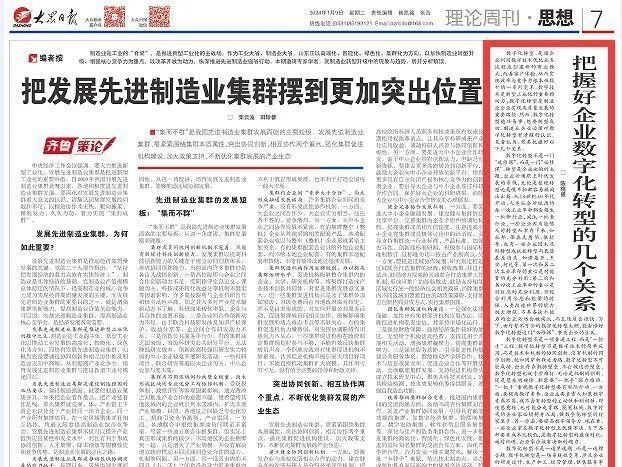
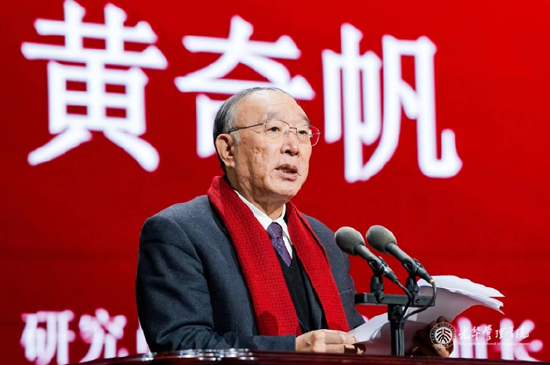
2024年1月7日,第二十五届北大光华新年论坛在北京大学百周年纪念讲堂举行,本届论坛的主题为“增长动能中国探索”。研究员、重庆市原市长黄奇帆出席论坛并发表了题为《围绕新制造、新服务、新业态推动新质生产力发展》的演讲。
黄奇帆表示,他理解的新质生产力大致由新制造、新服务、新业态这三个“新”构成的。以战略性新兴产业和未来产业为代表的新制造,以高附加值生产性服务业为代表的新服务以及以全球化和数字化为代表的新业态形成的聚合体就是新质生产力。我国在制造业板块、服务业板块和新业态板块这三大板块都有巨大潜力,要通过培育新质生产力,推动中国制造业克服短板,让新质生产力成为未来中国发展的新增长极。
以下为部分发言实录:
很高兴受邀参加今年的新年论坛,今年发言的主题是《围绕新制造、新服务、新业态推动新质生产力发展》。我想就新质生产力谈一点我的理解。
我认为新质生产力大致有三个“新”构成:
第一个新是“新制造”。
我个人理解“新制造”涉及新能源、新材料、新的医药、新的制造装备和新的信息技术五个领域,但要称得上是“新质生产力”的概念,不是那些普通的科技进步、不是边际上的改进,而是要有颠覆性的科技创新。所谓颠覆性科技创新,我认为以下五个新的标准至少要满足一个:
一是新的科学发现。这是“0到1”、从无到有的,对我们这个世界有新理解的重大发现。比如量子科学、脑科学的研究,可能会将人类对世界的认知、对自身的认知往前推进一大步。
二是新的制造技术。也就是在原理、路径等方面完全不同于现有的技术路线,却能够对原有的工艺、技术方案进行替代的制造技术,比如未来的生物制造,通过生物反应器的方式制造人类需要的各种蛋白、食品、材料、能源等等。 数字化转型网(www.szhzxw.cn)
三是新的生产工具。工具变革在人类发展史上始终处于重要地位,因为工具的革新带来了效率提升和成本下降,这样的例子有很多,比如EUV光刻机的出现让7纳米、5纳米芯片制造成为可能,新能源汽车制造中的一体化压铸成型技术,让新车的制造成本大幅下降等等。
四是新的生产要素。过去的制造靠劳动力、资本、能源等要素,未来的制造中除了这些传统要素外,还会有数据这一新的要素。新的要素介入让生产函数发生了新的变化,规模经济、范围经济、学习效应会产生新的交叉组合和融合裂变。
五是新的产品和用途。每一个时代都有属于那个时代进入千家万户的“四大件”“五大件”,近几十年是家电、手机、汽车等等,未来可能是家用机器人、头戴式VR/AR设备、柔性显示、3D打印设备和智能汽车等等。
回到当下,我们发展新制造需要以发展战略性新兴产业和培育未来产业为重点,“十四五”规划提出要聚焦新一代信息技术、生物技术、新能源、新材料、高端装备、新能源汽车、绿色环保以及航空航天、海洋装备等战略性新兴产业,加快关键核心技术创新应用,增强要素保障能力、培育壮大产业发展新动能。在类脑智能、量子信息、基因技术、未来网络、深海空天开发、氢能与储能等前沿科技和产业变革领域组织实施未来产业孵化与加速计划,谋划布局一批未来产业。
如今,我们看到全世界在这些领域的进展很快,人类正以前所未有的速度在推进科技进步,一批颠覆性的产品和科技将改变人们的生产生活方式,推动生产可能性曲线实现新的拓展和跃迁。这是我讲的第一点,就是“新制造”。 数字化转型网(www.szhzxw.cn)
第二个新是“新服务”。
服务成为生产力的重要构成是社会分工深化的结果。新生产力需要有新服务,这个服务的重点在于镶嵌在全球产业链、供应链当中,对全球产业链具有重大控制性影响的生产性服务业。
关于服务业,世界经济版图里现在有三个特征:
第一个特征是在各种高端装备里面,服务业的价值往往占这个装备或者是这个终端的50%—60%的附加值。比如,一部手机有一千多个零部件,这些硬件形成的附加值占产品价值比例约45%,其余55%是操作系统、各种应用软件、各种芯片的设计专利等等,就是各种服务。这些服务看不见摸不着,但代表这个手机55%的价值所在。其他如核磁共振,或者是各种各样的高端装备、终端都差不多有这样的特征。
第二个特征,整个世界的服务贸易占全球贸易比重越来越大。三十年以前,服务贸易占全球贸易总量的5%左右,现在已经达到了30%,服务贸易与货物贸易相比,货物贸易比重在收缩,服务贸易在扩张。
第三个特征,世界各国尤其是发达国家,在他们GDP的总量中,生产性服务业比重越来越大。我们经常说美国的服务业占美国GDP的80%,似乎有些“脱实就虚”,是不是有泡沫?需要注意的是美国80%的服务业里面有70%是生产性服务业,这70%×80%就是56%,也就是美国25万亿美元的GDP里面差不多有13万亿美元是生产性服务业,是和制造业强相关的高科技服务业。欧盟27个国家服务业增加值占GDP比重是78%,这78%里面有50%是生产性服务业,也就是欧盟GDP的39%是生产性服务业。美国生产性服务占GDP的50%以上,欧盟占40%左右,其他发达国家、G20国家的生产性服务业增加值占GDP的比重也大体在40%—50%之间。 数字化转型网(www.szhzxw.cn)
对比之下,这三个服务的指标恰恰是我们国家现在生产力的短板,我们2022年GDP当中制造业增加值占27%,服务业增加值是52.8%,但这52.8%里面有2/3是生活性服务业,生产性服务业不到1/3,也就是说我们的生产性服务业占GDP比重约为17%—18%,跟欧洲(40%)、美国(50%)相比差距是比较大的。
换言之,我们实现中国式现代化要加快发展生产性服务业,要实现高质量的中国制造,必须把跟制造业强相关的高附加值的生产性服务业增加值搞上去。
按照国家统计局的《生产性服务业统计分类(2019)》,生产性服务业包括为生产活动提供的研发设计和其他技术服务,货物运输,通用航空生产,仓储和邮政快递服务,信息服务,金融服务,节能和环保服务,生产性租赁服务,商务服务,人力资源管理和职业教育培训服务,批发与贸易经济代理服务,生产性支持服务,共十大类。这十个板块和制造业是强相关的,制造业的各种附加值,服务性的附加值都是由它来代表,如果不到位则制造产品就不会高端化。目前我国虽然制造业的增加值占全球比重接近30%,但与制造业强相关的生产性服务业却相对滞后,我国在全球产业链、供应链中位置不高的根源就在于这个方面。
此外,中国的服务贸易也存在结构比例与世界不同步的问题,根据联合国贸发会议的数据,2019年全球服务贸易占全球贸易总额大体上在30%左右,中国的服务贸易占贸易总额比重去年仅仅是12%。我国服务贸易出口去年是2.85万亿元人民币,一半以上是生活性服务业的出口。我们有3万多亿元人民币的服务贸易进口,进口的基本上都是生产性服务业,可惜进口的生产性服务业大部分不是中国贸易公司做的生产性服务业进口,而是外国服务贸易公司做的生产性服务业对中国的输出。
在这个意义上讲,培育新质生产力实际上就是要使中国服务业的50%是生产性服务业,整个GDP板块中生产性服务业要力争达到30%。如果我们的服务业占GDP的60%,60%里面有50%是生产性服务业,整个GDP板块当中生产性服务业就能够占到GDP的30%。尽管还达不到欧洲(40%)、美国(50%)的比例,但是由现在的不到20%增加到30%,这增加的10个百分点,对现在120多万亿的GDP来说就是12万亿。如果服务贸易也增加,从现在12%的比重增加到全部贸易总量的30%,使我们的高端制造中服务价值能达到终端制造产品总体附加值的50%左右,这是新质生产力制造业的方向。生产性服务业上去了,新质生产力的制造也上去了。这是我要讲的第二个“新”。 数字化转型网(www.szhzxw.cn)
第三个新是新业态。
培育新业态的核心是推动产业变革,是产业组织的深刻调整。我认为有两个关键推力:
第一个关键推力是全球化,新业态的形成要与全球潮流连在一起,形成国内国际双循环相互促进的新格局,我们要坚定不移推进制度型开放,促进形成新发展格局。这就是一个新的业态,是世界潮流,我们要培育新业态、新模式,需要内外贸一体化,换言之我们的市场体制必须从规则、规制、标准、管理等方面进行改革,形成内外循环一体化、市场化、法治化、国际化的营商环境。
为此,去年12月1日,国务院常务会议研究通过了《关于加快内外贸一体化发展的若干措施》,提出了要对标国际先进水平,加快调整完善国内相关规则、规制、管理、标准等,促进内外贸标准衔接、检验认证衔接、监管衔接,推进内外贸产品同线同标同则,国务院的这些措施正是这个改革的内在目标所在。
第二个关键推力是数字化,形成产业互联网,现在我们消费互联网做得风生水起,而产业互联网基本上刚刚开始。产业互联网不仅是国内产业的互联网,还包括国际国内的产业互联网,这种产业互联网有两种,一种是一个企业集团、一个大型制造企业从设计、市场、信息、销售信息到开发、制造、物流的一体化的数字系统,这是在讲一个个企业的产业互联网,就跟我们90年代讲的SaaS、2000年以后讲的ERP一样,是一个企业制造业的工业自动化,从市场到销售、设计整个的自动化的产业互联网系统。
但是市场正在发展的是另一种产业互联网,是依托互联网平台和各种终端,将触角伸到全世界的消费者,根据消费者的偏好实现小批量定制、大规模生产、全产业链贯通、全球化配送,在这样的平台上集聚了几百家提供生产性服务业的研发设计、金融保险、物流运输等企业,几千家的制造业企业,以及上万家各种原材料供应商,这些企业之间用数字系统进行了全面贯通,依托这样一个产业互联网平台,这些企业形成了以客户为中心的全产业链紧密协作的产业集群,真正实现了以销定产、以新打旧、以快打慢。现在这样的产业互联网,中国有那么一批,这样的平台放在哪一个城市,哪一个城市就因此带来几千亿、上万亿的销售值,同时带来几千亿、上万亿的金融结算,还会带来物流和其他各种服务,就变成金融中心、贸易中心、服务中心。所以掌控未来产业互联网全球的平台,谁就是“三中心”莫属。
总之,以战略性新兴产业和未来产业为代表的新制造,以高附加值生产性服务业为代表的新服务,以及以全球化和数字化为代表的新业态,形成的聚合体就是新质生产力,我们国家在制造业板块、服务业板块、新业态板块都有巨大的潜力,现在的短板就是未来巨大的增长极,我们希望通过培育新质生产力推动中国制造业克服短板,成为未来发展的新的增长极。

翻译:
Huang Qifan New Year speech: New quality productivity is the new growth pole
On January 7, 2024, the 25th Guanghua New Year Forum of Peking University was held in the Centennial Lecture Hall of Peking University. The theme of the forum was “China’s Exploration of Growth Drivers”. Huang Qifan, a researcher and former mayor of Chongqing, attended the forum and delivered a speech entitled “Promoting the Development of New quality Productivity around New manufacturing, New services and New business Forms”. 数字化转型网(www.szhzxw.cn)
Huang Qifan, researcher and former mayor of Chongqing
Huang Qifan said that the new quality productivity he understands is roughly composed of three “new” : new manufacturing, new services and new business forms. The aggregation of new manufacturing represented by strategic emerging industries and future industries, new services represented by high value-added producer services and new business forms represented by globalization and digitalization is the new quality productivity. China has great potential in the manufacturing sector, the service sector and the new business sector, the three major sectors, we should foster new quality productivity, promote China’s manufacturing industry to overcome shortcomings, and make new quality productivity become the new growth pole of China’s development in the future.
The following is part of the transcript:
It is my great pleasure to be invited to this year’s New Year Forum. The theme of this year’s speech is “Promoting the development of New quality Productivity around New Manufacturing, New Services and New Business Forms”. I would like to talk about my understanding of new quality productivity.
I think there are roughly three “new” components of new quality productivity:
The first new is “new manufacturing”.
I personally understand that “new manufacturing” involves the five fields of new energy, new materials, new medicine, new manufacturing equipment and new information technology, but the concept of “new quality productivity” is not those ordinary scientific and technological progress, not marginal improvement, but subversive scientific and technological innovation. In terms of disruptive technological innovation, I believe that at least one of the following five new criteria must be met:
First, new scientific discoveries. This is a “0 to 1”, from nothing, a major discovery of a new understanding of our world. For example, the research of quantum science and brain science may advance human cognition of the world and their cognition.
The second is new manufacturing technology. That is, completely different from the existing technical route in terms of principle, path, etc., but can replace the original process and technical solutions of manufacturing technology, such as the future of biological manufacturing, through the bioreactor to produce a variety of proteins, food, materials, energy and so on.
Third, new tools of production. Tool change has always been in an important position in the history of human development, because the innovation of tools has brought efficiency improvement and cost reduction, there are many such examples, such as the emergence of EUV lithography machine to make 7 nm, 5 nm chip manufacturing possible, new energy vehicle manufacturing in the integration of die casting technology, so that the manufacturing cost of new cars has dropped significantly.
Fourth, new factors of production. In the past, manufacturing relied on labor, capital, energy and other elements, and in the future, in addition to these traditional elements, there will be a new element of data. The intervention of new factors makes the production function undergo new changes, and the economies of scale, scope economy and learning effect will produce new cross-combination and fusion fission.
Fifth, new products and uses. In every era, there are “four big pieces” and “five big pieces” that belong to the era and enter millions of households. In recent decades, it has been home appliances, mobile phones, cars, etc., and the future may be home robots, head-mounted VR/AR devices, flexible displays, 3D printing equipment and smart cars. 数字化转型网(www.szhzxw.cn)
Back to the present, the development of new manufacturing needs to focus on the development of strategic emerging industries and the cultivation of future industries. The 14th Five-Year Plan proposes to focus on the new generation of information technology, biotechnology, new energy, new materials, high-end equipment, new energy vehicles, green environmental protection, aerospace, Marine equipment and other strategic emerging industries, and accelerate the innovation and application of key core technologies. We will strengthen our ability to provide factors of production and foster new driving forces for industrial development. Organize the implementation of future industry incubation and acceleration plans in the fields of brain-like intelligence, quantum information, gene technology, future network, deep sea, space and space development, hydrogen energy and energy storage and other cutting-edge technologies and industrial changes, and plan the layout of a number of future industries.
Today, we see rapid progress in these fields around the world, human beings are advancing scientific and technological progress at an unprecedented speed, a number of subversive products and technologies will change people’s production and life style, and promote the production possibility curve to achieve new expansion and transition. This is the first point I talked about, that is, “new manufacturing”.
The second new is “new services”.
Service becomes an important component of productive forces is the result of deepening social division of labor. New productivity requires new services, which focus on producer services embedded in the global industrial chain and supply chain and have a significant controlling influence on the global industrial chain. 数字化转型网(www.szhzxw.cn)
With regard to services, there are now three features in the world economic landscape:
The first feature is that in various high-end equipment, the value of the service industry often accounts for 50%-60% of the added value of this equipment or this terminal. For example, a mobile phone has more than one thousand parts, and the added value of these hardware accounts for about 45% of the value of the product, and the remaining 55% is the operating system, various application software, various chip design patents, etc., which is a variety of services. These services can’t be seen or touched, but they represent 55% of the value of the phone. Others such as nuclear magnetic resonance, or a variety of high-end equipment, terminals almost have such characteristics.
The second feature is that the world’s service trade accounts for an increasing proportion of global trade. Thirty years ago, trade in services accounted for about 5% of total global trade, and now it has reached 30%. Compared with trade in goods, the proportion of trade in services is shrinking, while trade in services is expanding. 数字化转型网(www.szhzxw.cn)
The third feature is that all countries, especially developed countries, have an increasing proportion of producer services in their total GDP. We often say that the service industry in the United States accounts for 80% of the U.S. GDP, which seems to be somewhat “unreal”. It should be noted that 70% of the 80% service industry in the United States is producer service industry, which is 70%×80% is 56%, that is, almost 13 trillion dollars of the US $25 trillion GDP is producer service industry, which is strongly related to the manufacturing industry. The added value of the service industry in 27 EU countries accounts for 78% of GDP, of which 50% is producer services, that is, 39% of EU GDP is producer services. Productive services account for more than 50% of GDP in the United States, about 40% in the European Union, and the value added of productive services in other developed countries and G20 countries also accounts for roughly 40%-50% of GDP. 数字化转型网(www.szhzxw.cn)
In contrast, these three service indicators are exactly the shortcomings of our country’s current productivity. In our 2022 GDP, the added value of manufacturing industry accounts for 27%, and that of service industry is 52.8%, but two-thirds of this 52.8% is life service industry, and less than 1/3 is producer service industry. In other words, China’s producer services account for about 17%-18% of GDP, which is quite a big gap compared with Europe (40%) and the United States (50%).
In other words, to achieve Chinese-style modernization, we must accelerate the development of producer services, and to achieve high-quality made in China, we must increase the added value of high value-added producer services that are strongly related to manufacturing.
According to the Statistical Classification of Producer Services (2019) of the National Bureau of Statistics, producer services include R&D, design and other technical services provided for production activities, cargo transportation, general aviation production, warehousing and postal and Courier services, information services, financial services, energy saving and environmental protection services, production leasing services, business services, and other services. Human resource management and vocational education and training services, wholesale and trade economic agency services, production support services, a total of ten categories. These ten sectors are strongly related to the manufacturing industry, and the various added value of the manufacturing industry and the added value of services are represented by it, if it is not in place, the manufacturing product will not be high-end. At present, although the added value of China’s manufacturing industry accounts for nearly 30% of the world’s total, the producer services strongly related to manufacturing industry are relatively lagging behind, and the root cause of China’s low position in the global industrial chain and supply chain lies in this aspect.
In addition, China’s service trade also has a structural proportion that is not synchronized with the world. According to the data of the United Nations Conference on Trade and Development (UNCTAD), the global service trade accounted for about 30% of the total global trade in 2019, while China’s service trade accounted for only 12% of the total trade last year. China’s export of service trade was 2.85 trillion yuan last year, more than half of which is the export of life service industry. We import more than 3 trillion yuan worth of services, which are basically producer services. Unfortunately, most of the producer services imported are not imports of producer services made by Chinese trading companies, but exports of producer services made by foreign service trading companies.
In this sense, cultivating new quality productivity is actually to make 50% of China’s service industry producer services, and strive to reach 30% of the entire GDP producer services. If our service sector accounts for 60% of GDP, and 50% of the 60% is producer services, producer services in the entire GDP sector can account for 30% of GDP. Although it is still less than the proportion of Europe (40%) and the United States (50%), the increase of 10 percentage points from the current less than 20% to 30% is 12 trillion yuan for the current GDP of more than 120 trillion yuan. If trade in services also increases, from the current proportion of 12% to 30% of the total trade, so that the value of services in our high-end manufacturing can reach about 50% of the total added value of terminal manufacturing products, which is the direction of new quality productivity manufacturing. Producer services have gone up, and so has the production of new quality productive forces. This is the second “new” I want to talk about.
The third new is the new business format.
The core of cultivating new business forms is to promote industrial reform, and it is a profound adjustment of industrial organization. I think there are two key thrusts:
The first key driving force is globalization. The emergence of new forms of business should be linked to the global trend and create a new pattern in which domestic and international cycles reinforce each other. We need to unswervingly promote institutional opening-up and foster a new pattern of development. In other words, our market system must be reformed in terms of rules, regulations, standards and management, so as to form a business environment featuring integrated internal and external circulation, marketization, rule of law and internationalization.
To this end, on December 1 last year, the executive meeting of The State Council studied and passed the “Several measures on accelerating the integration of domestic and foreign trade development”, proposing to standard the international advanced level, accelerate the adjustment and improvement of domestic and foreign trade standards, regulations, management, standards, etc., promote the connection of domestic and foreign trade standards, inspection and certification, regulatory connection, and promote the same line of domestic and foreign trade products with the same standard. These measures by The State Council are the intrinsic goal of this reform.
The second key thrust is digitalization, forming the industrial Internet, and now we are doing well on the consumer Internet, while the industrial Internet is basically just beginning. The industrial Internet is not only the Internet of the domestic industry, but also includes the international and domestic industrial Internet. There are two kinds of such industrial Internet. One is the digital system integrating design, market, information, sales information, development, manufacturing and logistics of an enterprise group or a large manufacturing enterprise. Just like the SaaS we talked about in the 1990s and the ERP after 2000, it is an industrial automation of the enterprise manufacturing industry, from marketing to sales, and the design of the entire automated industrial Internet system.
However, the market is developing another kind of industrial Internet, which relies on the Internet platform and various terminals to extend its tentacles to consumers around the world, and realizes small-batch customization, large-scale production, the whole industrial chain, and global distribution according to consumers’ preferences. On such a platform, hundreds of enterprises that provide R&D, design, finance and insurance, logistics and transportation for producer services, thousands of manufacturing enterprises, and tens of thousands of suppliers of various raw materials are gathered, and these enterprises are fully connected with digital systems. Relying on such an industrial Internet platform, These enterprises have formed an industrial cluster with close cooperation of the whole industrial chain with customers as the center, and truly realized the determination of production by sales, the new to fight the old, and the fast to fight the slow. Now such an industrial Internet, China has a number of such a platform in which city, which city will therefore bring hundreds of billions, trillions of sales value, while bringing hundreds of billions, trillions of financial settlement, will also bring logistics and other various services, become a financial center, trade center, service center. Therefore, who controls the global platform of the future industrial Internet is the “three centers”.
In short, new manufacturing represented by strategic emerging industries and future industries, new services represented by high value-added producer services, and new business forms represented by globalization and digitalization form an aggregate of new quality productivity. Our country has huge potential in the manufacturing sector, the service sector and the new business form. The current short board is the huge growth pole in the future, we hope to promote China’s manufacturing industry to overcome the short board by cultivating new quality productivity and become a new growth pole for future development. 数字化转型网(www.szhzxw.cn)
本文由数字化转型网(www.szhzxw.cn)转载而成,来源于智能制造,作者黄奇帆;编辑/翻译:数字化转型网宁檬树。
免责声明: 本网站(http://www.szhzxw.cn/)内容主要来自原创、合作媒体供稿和第三方投稿,凡在本网站出现的信息,均仅供参考。本网站将尽力确保所提供信息的准确性及可靠性,但不保证有关资料的准确性及可靠性,读者在使用前请进一步核实,并对任何自主决定的行为负责。本网站对有关资料所引致的错误、不确或遗漏,概不负任何法律责任。
本网站刊载的所有内容(包括但不仅限文字、图片、LOGO、音频、视频、软件、程序等) 版权归原作者所有。任何单位或个人认为本网站中的内容可能涉嫌侵犯其知识产权或存在不实内容时,请及时通知本站,予以删除。