近两年,生态战略非常流行,被认为是面向未来具有重要价值的新兴战略。然而,人们也常常提出疑问:生态战略跟以往流行的多元化战略有何区别?两者看起来很像,都涉足多个业务,生态战略是不是多元化战略的某种变形?
这两个战略有交叉,但更多是不同,体现在作用场域、战略目标、资源运用、价值创造、成功关键等多个方面。简言之,生态战略将战略思考带入一个新的层次,大幅超越了多元化战略的思考范畴,并且拥有不同的目标与逻辑,是当今所有企业都需重视和研究的新战略。
一、作用场域:公司层vs.生态层
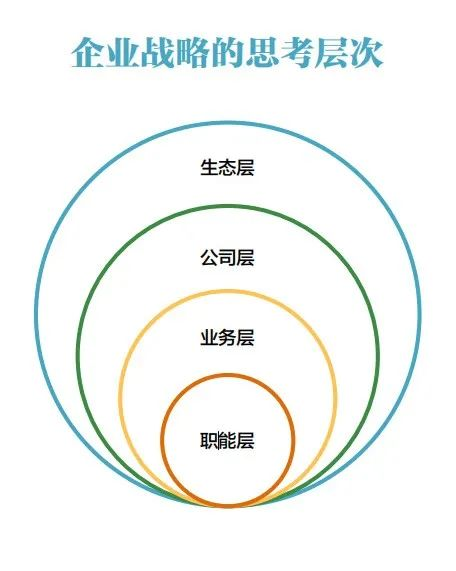
一般认为,企业的战略思考在三个层次上展开:公司战略、业务层的竞争战略和职能战略,因职能战略从属和服务于竞争战略,所以主要是前两个层次。
公司战略和竞争战略的关系是,前者划定经营范围,后者在划定的范围内寻求建立竞争优势、推动企业成长的模式和路径。多元化战略属于公司战略的一种,是指企业通过自建、并购、合资合作的方式进入与原有产品/业务不同的新业务领域。 数字化转型网(www.szhzxw.cn)
就拿飞鹤乳业来说,它的竞争战略非常成功,短短六七年时间从行业第七逆袭成为行业第一,婴幼儿奶粉市场占有率达到20%。随着市占率越来越高,人们越来越担心它未来的成长空间。
飞鹤早就认识到这个问题,从2018年开始布局,意图打造从出生到成长、从成年到长寿的全年龄周期功能化产品,包含孕婴奶粉、儿童及学生奶粉、健康食品、营养健康等四大业务。越到年龄周期的后半段,飞鹤提供的产品离奶粉就越远,这也意味着它的业务布局在走向多元化。
生态战略的独特性在于,它引入一个新的、更高的战略思考层次,即生态层。它关注的是企业如何处理与商业生态系统的关系,包括嵌入、利用、发展和控制等。
这一层次的战略思考在以往是很少研究的。如果向前追溯,哈佛商学院教授迈克尔·波特在《国家竞争优势》一书中构建的“钻石模型”是重要的源头,揭示了商业生态系统的价值。引入生态层,对于我们理解企业的生存和成长带来一些新的视角,并为企业的战略思考与行动带来新的机会。
首先,企业发展的好坏不仅取决于自身的努力,也离不开所在商业生态系统的支撑。一个行业的优秀企业总是集聚产生,原因是共享了相同的商业生态系统,包括方便的信息和资源获取、充分的供应商和合作伙伴备选、低交易成本、高协作效率等收益。
其次,敏锐的企业会选择合适的生态系统进行嵌入与依托,借生态之力来支撑企业的快速发展。希音(SHEIN)创立于南京,但2014年将供应链总部搬到广州,目的就是更靠近广州发达的服装商业生态系统。希音将欧美的互联网社交媒体与中国的低成本、高效率的服装商业生态系统联结起来,通过大数据驱动的运营系统,将生产周期压缩至最短7天。 数字化转型网(www.szhzxw.cn)
两相对比,可以明显看出差别:多元化战略是在行业层次上思考,是横向的扩张,而生态战略则是在生态层次上思考,其覆盖的疆域和机构广泛得多,思考的是如何主动利用生态为企业的生存和发展服务。典型的生态战略不仅考虑供应链上的布局,还有合作伙伴、科研院所、投资机构、当地社区与政府等。
二、战略目标:规模成长vs.客户价值
大多数情况下,多元化战略是一种乐观的战略、资金推动的战略、企业家激情燃烧的战略,或者可以如此表述:多元化战略是在企业家激情推动下,运用充裕的资本来追逐和捕捉商业机会的一种战略,而相应地,它所基于的理性、行业边界感等比较薄弱。
我们认为最能够直观生动地体现这个特点——也因此最大程度地显示多元化战略缺点的,就是恒大许家印决定进军新能源汽车行业时发表的观点:“买买买、大大大、合合合”。
当然,企业的多元化还可能有其他的考虑,比如防御角度的风险分散,因为“鸡蛋不放在一个篮子里”,所以可能会“东边不亮西边亮”,或者为了满足其他强有力利益相关者的要求而开展多元化。但是,总的来说,多元化战略的主要目的就是为了规模成长,通过进入新的行业来扩大规模,并且对于规模的追求要高于对利润的关注。 数字化转型网(www.szhzxw.cn)
生态战略颇有不同,其主要出发点是为客户创造更大价值,方法是跟其他企业、机构合作,包括供应商、经销商、软件开发商、科研机构等,各自发挥不同作用,承担不同角色。
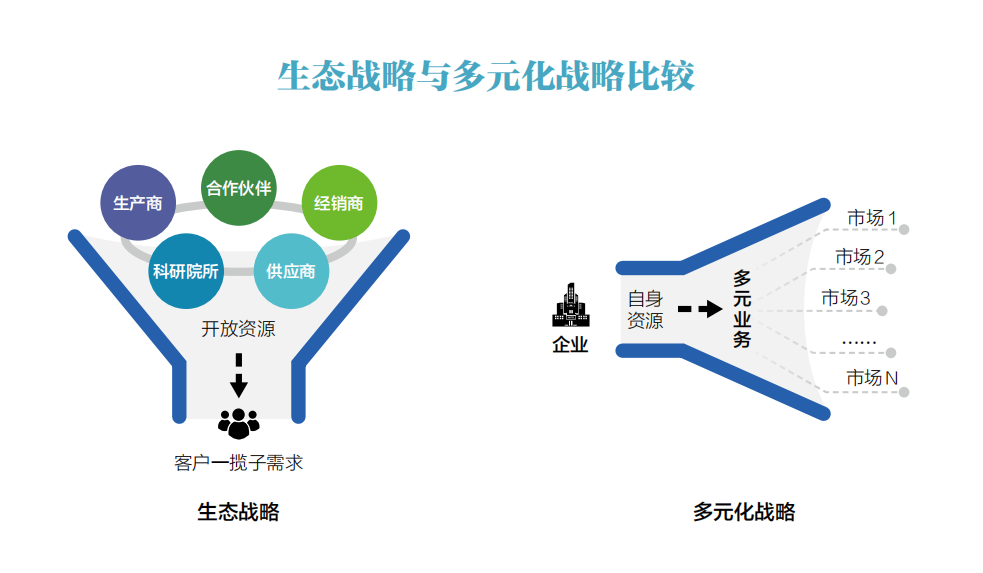
因此,生态战略就像一个漏斗,在资源端是开放的、合作的,在市场端反倒是收敛的,紧紧围绕着客户;与之相反,多元化战略更像是一个喇叭,运用自身的资源,面向更广泛的市场,尝试抓住更多机会。
其实在这里,我们恰好可以识别出生态战略与多元化战略最像的部分:当一个企业基于客户需求进行多元化时,它在市场端和生态战略是一致的,但在资源端依然不同,这是根本性差异。
汇总起来,多元化战略关注更多的是规模和利润,而生态战略更关注客户价值、客户一揽子需求的满足,至于规模,是客户价值主张得到客户认可的逻辑结果。由此,我们也可以说,从多元化战略到生态战略意味着企业越来越重视客户了。
三、资源运用:老资源+新资源vs.内部资源+外部资源
众所周知,新业务的失败率很高,特别在早期阶段存在一个伴随现金流流出的“死亡之谷”,很多创业企业无法实现收支平衡而倒在“死亡之谷”。因此,企业开展多元化时,会很自然地将一些老资源投入进来,再加上新资源,助其跨越“死亡之谷”。 数字化转型网(www.szhzxw.cn)
如果老资源足够强,可称之为核心能力,且新业务与传统业务关联性较高,成功概率就会比较高,这也正是相关多元化越来越受欢迎的原因。
事实上,核心能力的概念于1990年提出,就是因为两位战略管理学者普拉哈拉德和加里·哈梅尔赞赏日本企业在这方面的卓越表现。
然而,此后十几年里,情况发生了很大变化——美国涌现出一大批互联网企业、高科技企业,而日本并没有,很多以核心能力著称的企业也衰落了。
表现最出色的美国企业相当一部分来自硅谷,可以说是硅谷独特的商业生态系统“孕育”了一批又一批开创性企业。这样的活力与资源流动性、广泛连接、灵活的重新组合,有着非常直接的关系,在这些互动关系网络上,创意流淌、相互激发,很容易涌现出创新的思维、技术、商业模式等。
与之对应的,战略管理领域非常重要的企业资源观理论发生了重要的转变。传统资源观形成于1980和1990年代,关注企业内部发展的、自主控制的资源和能力,并认为越是塑造组织独特性的能力越有价值。
然而,在动态能力理论和开放式创新观点提出后,人们开始注意到核心能力的局限性。随着环境的乌卡化(VUCA),执迷于既有的核心能力,反倒可能导致能力的刚性,进而因不适应环境的变化而被淘汰,此时企业需要更灵活、更开放——根据环境变化在企业内重新配置和组合资源,也包括引入和利用外部的资源来更新企业的竞争力。
生态战略就是顺应这样的资源观的转变。也因此,评判一个企业生态战略的成功,就看它吸引了多少合作伙伴参与其中。今天的苹果跟以往有很大不同,它不再仅是一个伟大的产品公司,而是以硬软一体为基础、服务为平台的复杂的生态系统。 数字化转型网(www.szhzxw.cn)
在一端,苹果将研发、设计紧紧掌握在自己手里,同时将全世界最优秀的电子零部件厂商、OEM厂商集成在一起,形成了全世界最优秀的供应链。在另一端,它集合了几百万个高水平的应用软件、全世界最优秀的音乐和内容提供商,为全球20亿台苹果设备的使用者提供无缝切换的苹果式沉浸体验。
四、价值创造:协同效应vs.生态效应
有学者曾经断言:多元化的唯一理由是协同效应。协同效应的公式是“1+1>2”,它有多种类型,包括采购、运营、销售、管理、财务等方面的协同。从经济学角度看,协同效应的理论基础主要是范围经济和市场权力,最终体现为成本节约或价格控制。而从战略管理角度看,除了降低成本之外,还有其他几种协同效应。
1. 通过共享企业拥有的优势资源和能力,无论是资本、技术还是分销网络、品牌影响力,提升新业务的成功概率。
2. 企业在某些领域发展到一定规模,积累了资本、人才和管理经验,往往采用多元化的战略行为来复制成功。
3. 通过业务组合而强化企业在某一方面的市场地位。
4. 与转型升级相关,即通过新业务带动旧业务,或者将公司整体带入一个更好的市场地位。
对于一个生态来说,它最核心的价值是否也能用协同效应来概括呢?我们认为,生态中所涉及的互动关系远超“1+1”的关系。物理学有一个“自由度”的概念,生态与“1+1”相比带来了量级大得多的自由度,而由此带来的创造价值的方式也会远超多元化战略,而不止于成本节约、资源和能力共享。
为此,我们提出了“生态效应”的概念。这是一个具有丰富内涵并且持续开放的概念,就已有的认知来说,它包括三种主要效应,如果一个企业能够恰当地处理与生态之间的关系,必将从这三种效应中获益。
第一种是资源的互补和联结机制,即通过各种资源的连接和整合高效率地完成工作。这一机制伴随市场分工而自然发展,并随着市场不断扩大而将分工和协调推向更高水平。而当市场边界扩展至全世界时,全球化就发生了。 数字化转型网(www.szhzxw.cn)
我们认为全球化是目前人类创造的发挥资源互补和连接机制最有效的方式,它充分发挥各个国家、区域和企业的自然禀赋、资源禀赋、科技禀赋,优势互补,强强联合。
在中观层面上,这样的资源互补机制是通过产业集群发挥作用的,比如美国硅谷(IT硬件、互联网)、中国深圳(科技硬件)、中国台湾新竹(半导体设计与制造)、日本筑波(生物、土木)等。这些产业集群是数百乃至数千家企业互动关系的总和,它们各展所长,分工互助。如果一家企业能够很好地嵌入其中,就可以很方便地获得各种资源和能力的助力。
一些领先的企业可以吸引其他企业围绕在它们周围,以此建立形成产业生态。例如,台积电作为当今世界最重要的半导体制造企业,近年来不断深化在台湾的生产布局,涉及新竹科学园区、南部科学园区、中部科学园区等。与此同时,它的上游供应商也随之而动,在这些地方纷纷投资建设工厂和研发中心,包括日本的信越化学、美国的Entegris等。
第二种是创新涌现。创新来自多元的视角、自由的组合,而与企业自身的局限性相比,生态显然可以带来更多元的资源、视角,以及新组合的可能性。
一个富有活力的产业生态不仅仅是围绕生产的生态系统,还必然是一个创新的、创业的生态系统。在其中,技术、资本、人才、商业创意、市场机会等各种资源的拥有者相互联结,不断推出创新的产品、技术、服务、商业模式,催生一个又一个创业企业,并在激烈的大浪淘沙中筛选出一代又一代的杰出代表。
就拿美国硅谷来说,曾经的杰出代表是仙童、惠普、英特尔、思科、甲骨文,后来是苹果、谷歌、Facebook,现在则是OpenAI、特斯拉、英伟达等。这样的创新活力正是硅谷最让人羡慕的一点,也是OpenAI等会在硅谷产生的原因。
第三种主要体现为协同进化。与创新涌现强调的跳跃性不同,协同进化描述的是不同生态成员之间紧密互动合作所带来的持久价值。从那些伟大的硅谷科技公司的发展历史中,我们总能看到各种形式的纵向联系。 数字化转型网(www.szhzxw.cn)
比如,乔布斯年轻时曾参观施乐公司的图形用户界面,由此彻底改变了他对人机界面的理解。比尔·盖茨也有过这样的经历,同样对微软产生了巨大的推动作用。
五、成功关键:核心能力vs.生态能力
今天人们谈论多元化战略如何成功时,必然会提到核心能力。那么,对于一个企业的生态战略来说,核心能力是否足够呢?我们认为是不够的。一个企业的核心能力可能很强,但它的要点在于“竞争”,而对于生态来说,更重要的是“合作”,是如何吸引更多的组织、机构加入进来。对于这样的能力,我们将其定义为生态能力。
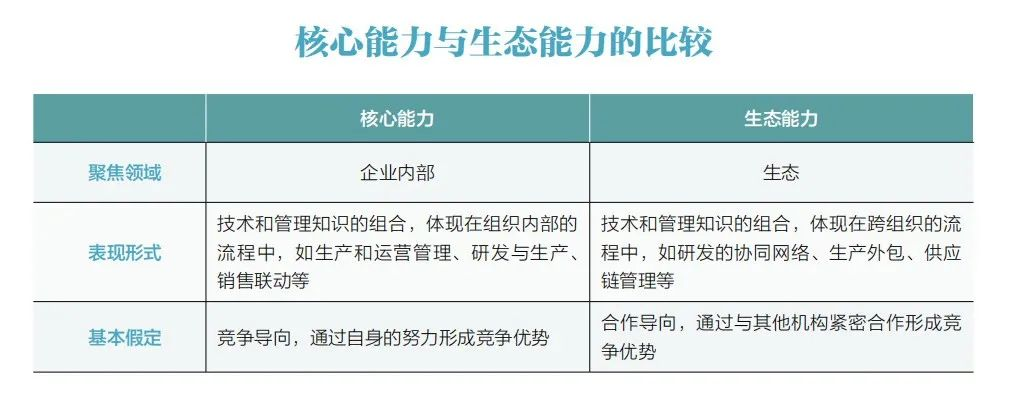
核心能力与生态能力有共同点:都是技术与管理知识的组合,并体现在流程中。
但是,也有很多不同,尤其是在基本假定上,一个强调自身的努力和控制,另一个则强调与他人的合作。在这里,并不是要比较“高低”,而是要突出“不同”。
实际上,我们认为,两者之间完全可以建立积极的互动关系。比如,当一家企业的核心能力不强的时候,可以通过与科研院所合作弥补不足,逐步形成自身的核心能力,后续则可以两者兼顾,在强化、更新核心能力的同时,扩大和提升生态合作的范围与质量,这样,一家企业就既有很强的核心能力,也拥有强大的生态能力。 数字化转型网(www.szhzxw.cn)
在我们看来,生态能力至少包括三个维度:生态合作力、生态创新力和生态进化力,分别对应前文提到的三种生态效应。这里可以结合阿里巴巴案例来说明。
阿里巴巴业务庞杂,但核心业务无疑是电商,而电商的真正起点是2003年推出的淘宝。最开始淘宝相对于易趣处于劣势,但通过一系列创新措施,包括卖家免费入驻、交易零抽成、买家卖家直接沟通(阿里旺旺)、信用保障(支付宝)、客户评分等,淘宝生态变得越来越繁荣,网络效应充分发挥,从而超越了易趣。这里就反映了阿里巴巴强大的生态合作力,即凝聚生态合作伙伴的能力。
要吸引别人参与,就要设计合理的利益共享机制,还有能够为生态参与者提供一个有吸引力的使命和愿景。阿里巴巴“让天下没有难做的生意”的使命,在很长时间里是颇有诱惑力的。生态合作力的最终体现在于合作伙伴的黏附度上,它们愿意留在生态中,贡献力量,分享利益。
生态创新力是指借助生态合作来实现创新的能力,对应的是创新涌现效应。淘宝就有很多成功例子。
一方面,淘宝作为一个平台不断完善其功能,孕育了支付宝、阿里云、菜鸟、聚划算、闲鱼等新业务,其中一些估值达到数百亿美元。
另一方面,在淘宝网大平台上形成了2,000多个特色市场,包括大码女装、二次元、儿童家具、国潮、男士彩妆等。与消费者的直接互动不仅给商家带来订单,还会激发创意和灵感,促使创新产品层出不穷,也因此涌现出大量的原创品牌、独立品牌。此外,淘宝也鼓励了一些商业模式创新,最典型的就是红人经济、直播电商。
生态进化力是指在核心企业的带动下,整个生态发生进化的能力。
阿里巴巴的电商业务就一直在进化,继淘宝之后最大的进化就是2008年推出淘宝商城,2012年改名天猫。这是一次重大的升级,吸引了大量品牌企业入驻天猫平台,丰富了阿里巴巴的电商业态。
在淘宝的流量倾斜支持下,天猫迅速发展,在阿里巴巴的GMV(商品交易总额)占比不断提升,2020年就与淘宝平分秋色。 数字化转型网(www.szhzxw.cn)
六、结语
“未来的企业只有两种命运——要么生态化,要么被生态化。”这是张瑞敏的一个判断,对此我们非常赞同。在今天,企业单打独斗、仅仅依靠自身的力量越来越难以生存和发展,在商业生态的层次上思考公司的战略定位变得日益重要。这正是生态战略得以流行的根本原因。
不过,实施生态战略并不容易,在很多方面与已有战略模式,包括这里重点讨论的多元化战略,颇有不同。企业需要明确自己的存在价值,围绕客户价值,以共赢思维来整合生态的力量,共生、共创、协同演化。

翻译:
There are two fates of future enterprises: either ecological or be ecological
In the past two years, ecological strategy has been very popular and is considered to be an emerging strategy with important value for the future. However, people often ask how ecological strategies differ from the diversification strategies that have been popular in the past. The two look similar, both involved in multiple businesses, is the ecological strategy some variant of the diversification strategy?
These two strategies have intersection, but more are different, reflected in the field of action, strategic objectives, resource utilization, value creation, the key to success and other aspects. In short, ecological strategy takes strategic thinking to a new level, greatly transcends the thinking scope of diversification strategy, and has different objectives and logic, which is a new strategy that all enterprises need to pay attention to and study. 数字化转型网(www.szhzxw.cn)
1. Field of action: corporate layer vs. ecological layer
It is generally believed that the strategic thinking of enterprises is carried out at three levels: corporate strategy, business level competitive strategy and functional strategy. Because functional strategy is subordinate to and serves competitive strategy, it is mainly the first two levels.
The relationship between corporate strategy and competitive strategy is that the former delimits the scope of business, while the latter seeks to establish competitive advantage and promote the model and path of enterprise growth within the delimit scope. Diversification strategy is a kind of corporate strategy, which means that enterprises enter new business areas different from the original products/businesses through self-establishment, mergers and acquisitions, joint ventures and cooperation.
Take Feihe Dairy for example, its competitive strategy is very successful, in just six or seven years from the industry’s seventh counterattack to become the industry’s first, infant milk powder market share reached 20%. As the market share is increasing, people are increasingly worried about its future growth space.
Feihe has long recognized this problem, and began to layout in 2018, with the intention of creating full-age cycle functional products from birth to growth, from adulthood to longevity, including four major businesses, such as pregnant and infant milk powder, children and student milk powder, health food, and nutrition and health. The more it reaches the second half of the age cycle, the farther away the products provided by Feihe are from milk powder, which also means that its business layout is diversifying.
The uniqueness of ecological strategy is that it introduces a new and higher level of strategic thinking, that is, the ecological layer. It focuses on how companies deal with the business ecosystem, including embedding, exploitation, development, and control.
This level of strategic thinking has rarely been studied in the past. If you look back, the “diamond model” developed by Harvard Business School professor Michael Porter in his book The Competitive Advantage of Nations is an important source that reveals the value of business ecosystems. The introduction of the ecological layer brings some new perspectives for our understanding of the survival and growth of enterprises, and brings new opportunities for strategic thinking and action of enterprises.
First of all, the development of enterprises depends not only on their own efforts, but also on the support of the business ecosystem. Excellent enterprises in an industry are always clustered, because they share the same business ecosystem, including convenient access to information and resources, adequate supplier and partner options, low transaction costs, high collaboration efficiency and other benefits.
Secondly, sensitive enterprises will choose the right ecosystem to embed and rely on, and use the ecological power to support the rapid development of enterprises. SHEIN was founded in Nanjing, but moved its supply chain headquarters to Guangzhou in 2014 to be closer to Guangzhou’s developed apparel business ecosystem. Xiyin connects the Internet social media in Europe and the United States with China’s low-cost and efficient clothing business ecosystem, and compresses the production cycle to as little as 7 days through a big data-driven operation system.
In comparison, the difference can be clearly seen: diversification strategy is thinking at the industry level and horizontal expansion, while ecological strategy is thinking at the ecological level, covering a much wider range of territories and institutions, and thinking about how to actively use ecology to serve the survival and development of enterprises. A typical ecological strategy considers not only the layout of the supply chain, but also partners, research institutes, investment institutions, local communities, and governments. 数字化转型网(www.szhzxw.cn)
2. Strategic goal: scale growth vs. customer value
In most cases, diversification strategy is an optimistic strategy, a capital-driven strategy, and a strategy of entrepreneurial passion, or it can be expressed as follows: Diversification strategy is a strategy of pursuing and capturing business opportunities with abundant capital driven by entrepreneurial passion, and correspondingly, it is based on a relatively weak sense of rationality and industry boundaries.
We believe that the most intuitive and vivid manifestation of this feature – and therefore the largest display of the shortcomings of the diversification strategy, is Evergrande Xu Jiayin’s decision to enter the new energy vehicle industry, expressed the view: “buy buy, big big, Hehehe.”
Of course, diversification may also have other considerations, such as risk diversification from a defensive perspective, because “eggs do not fit in one basket”, so it may be “bright in the east and bright in the west”, or diversification to meet the requirements of other powerful stakeholders. However, in general, the main purpose of diversification strategy is to grow scale, to expand scale by entering new industries, and to pursue scale over profit.
Ecological strategy is quite different, its main starting point is to create greater value for customers, the method is to cooperate with other enterprises and institutions, including suppliers, distributors, software developers, research institutions, etc., each play different roles and assume different roles.
Therefore, ecological strategy is like a funnel, which is open and cooperative in the resource side, but convergent in the market side, closely surrounding the customer; On the contrary, the diversification strategy is more like a trumpet, using its own resources, targeting a wider range of markets, and trying to seize more opportunities.
In fact, here we can just identify the most similar part of ecological strategy and diversification strategy: when an enterprise diversifies based on customer needs, it is consistent with the ecological strategy on the market side, but still different on the resource side, which is a fundamental difference.
In summary, diversification strategy pays more attention to scale and profit, while ecological strategy pays more attention to customer value and the satisfaction of customer’s package needs. As for scale, it is the logical result of customer value proposition being recognized by customers. Thus, we can also say that the shift from diversification strategy to ecological strategy means that enterprises are paying more and more attention to customers. 数字化转型网(www.szhzxw.cn)
3. Use of resources: old resources + new resources vs. internal resources + external resources
As we all know, the failure rate of new businesses is very high, especially in the early stage there is a “valley of death” with cash flow outflow, many start-ups can not achieve balance and fall in the “valley of death”. Therefore, when enterprises diversify, it is natural to put some old resources into it, plus new resources to help them cross the “valley of death”.
If the old resources are strong enough to be called core capabilities, and the new business has a high correlation with the traditional business, the probability of success will be relatively high, which is why related diversification is becoming more and more popular.
In fact, the concept of core competence was introduced in 1990, because two strategic management scholars, Prahalad and Gary Hummel, praised the excellence of Japanese companies in this area.
However, in the decade since then, the situation has changed a lot – a large number of Internet companies and high-tech companies have emerged in the United States, but Japan has not, and many companies known for their core capabilities have declined.
Many of the best-performing US companies come from Silicon Valley, whose unique business ecosystem has given birth to a succession of pioneering companies. Such vitality has a very direct relationship with the mobility of resources, extensive connectivity, and flexible recombination. On these interactive networks, creativity flows and inspires each other, and it is easy to emerge innovative thinking, technologies, and business models. 数字化转型网(www.szhzxw.cn)
Correspondingly, the very important enterprise resource view theory in the field of strategic management has undergone an important change. The traditional view of resources, formed in the 1980s and 1990s, focuses on the resources and capabilities developed internally and controlled independently by enterprises, and believes that the more the ability to shape the uniqueness of the organization, the more valuable it is.
However, after the dynamic capability theory and open innovation were put forward, people began to notice the limitations of core competence. With the VUCA of the environment, the obsession with the existing core capabilities may lead to the rigidity of the capabilities, and then due to the changes in the environment and be eliminated, at this time the enterprise needs to be more flexible and more open – according to the changes in the environment to reconfigure and combine resources within the enterprise, including the introduction and use of external resources to update the competitiveness of the enterprise.
Ecological strategy is to adapt to the change of resource view. Therefore, the success of an enterprise ecological strategy is judged by how many partners it attracts to participate. Today’s Apple is very different, it is no longer just a great product company, but a complex ecosystem based on hardware and software, services as a platform.
At one end, Apple tightly holds research and development and design in its own hands, while integrating the world’s best electronic parts manufacturers and Oems together to form the world’s best supply chain. At the other end of the spectrum, it brings together millions of high-level apps and the world’s best music and content providers to deliver a seamlessly switched, immersive Apple experience to users of 2 billion Apple devices worldwide. 数字化转型网(www.szhzxw.cn)
4. Value creation: Synergy vs. ecological effect
Some scholars have asserted that the only reason for diversification is synergy. The formula of synergy is “1+1>2”, which has various types, including procurement, operations, sales, management, finance and other aspects of synergy. From the perspective of economics, the theoretical basis of synergy is mainly the economy of scope and market power, which is ultimately embodied in cost saving or price control. From a strategic management perspective, there are several other synergies besides cost reduction.
- Enhance the success probability of new business by sharing the superior resources and capabilities owned by the enterprise, whether it is capital, technology, distribution network or brand influence.
- Enterprises develop to a certain scale in some fields, accumulate capital, talent and management experience, and often adopt diversified strategic behaviors to replicate success.
- Strengthen the enterprise’s market position in a certain aspect through business portfolio.
- Related to transformation and upgrading, that is, driving old business through new business, or bringing the company as a whole into a better market position.
For an ecology, can its core value also be summed up in synergy? We believe that the interactions involved in ecology go far beyond the “1+1” relationship. Physics has a concept of “freedom,” and ecology brings a much larger degree of freedom than “1+1,” and the resulting ways of creating value go far beyond diversification strategies, beyond cost savings and sharing resources and capabilities.
Therefore, we put forward the concept of “ecological effect”. This is a rich and open concept, and as far as we know, it includes three main effects, if a business can properly handle the relationship with the ecology, it will benefit from all three effects.
The first is the complementarity and connection mechanism of resources, that is, through the connection and integration of various resources to complete the work efficiently. This mechanism naturally develops with the market division of labor, and pushes the division and coordination to a higher level as the market continues to expand. Globalization occurs when market boundaries are extended worldwide.
We believe that globalization is the most effective way to give full play to the mechanism of resource complementarity and connectivity created by mankind. It gives full play to the natural endowments, resource endowments and scientific and technological endowments of various countries, regions and enterprises to complement each other’s advantages and unite strong countries.
At the middle level, such resource complementarism plays a role through industrial clusters, such as Silicon Valley (IT hardware, Internet), Shenzhen (technology hardware), Hsinchu (semiconductor design and manufacturing), and Tsukuba (biology, civil engineering). These industrial clusters are the sum of the interactions between hundreds or even thousands of enterprises, each of which develops its own strengths and helps each other. If a business is well embedded, it has easy access to a variety of resources and capabilities. 数字化转型网(www.szhzxw.cn)
Some leading enterprises can attract other enterprises to surround them, so as to establish an industrial ecosystem. For example, TSMC, as the world’s most important semiconductor manufacturing enterprise, has continuously deepened its production layout in Taiwan in recent years, involving Hsinchu Science Park, Southern Science Park, Central Science Park, and so on. At the same time, its upstream suppliers, including Japan’s Shin-etsu Chemical and Entegris of the United States, have followed suit, investing in factories and research and development centers in these places.
The second is the emergence of innovation. Innovation comes from multiple perspectives and free combinations, and compared with the limitations of the enterprise itself, ecology can obviously bring more diversified resources, perspectives, and the possibility of new combinations.
A vibrant industrial ecosystem is not only an ecosystem around production, but also an innovative and entrepreneurial ecosystem. Among them, the owners of various resources such as technology, capital, talent, business ideas, and market opportunities are connected with each other, constantly introducing innovative products, technologies, services, and business models, spawning one startup after another, and screening out generation after generation of outstanding representatives in the fierce wave.
Take Silicon Valley in the United States, the outstanding representatives were Fairchild, HP, Intel, Cisco, Oracle, later Apple, Google, Facebook, and now OpenAI, Tesla, Nvidia and so on. Such innovative vitality is the most enviable point of Silicon Valley, and it is also the reason why OpenAI is produced in Silicon Valley.
The third kind is mainly embodied in coevolution. Unlike the sprints emphasized by innovation emergence, coevolution describes the enduring value of close interaction and cooperation between members of different ecosystems. In the history of the great Silicon Valley tech companies, we can always see vertical connections in various forms.
As a young man, for example, Jobs visited Xerox’s graphical user interface, which revolutionized his understanding of human interfaces. Bill Gates also had such an experience, which also had a huge boost for Microsoft. 数字化转型网(www.szhzxw.cn)
5. Key to success: Core competence vs. ecological competence
When people talk about how successful diversification strategies are today, they inevitably mention core competencies. So, for an enterprise’s ecological strategy, is the core competence enough? We think it’s not enough. The core competence of an enterprise may be very strong, but its key point is “competition”, and for the ecology, it is more important to “cooperation”, how to attract more organizations and institutions to join. For such capability, we define it as ecological capability.
Core competencies and ecological competencies have something in common: they are a combination of technical and managerial knowledge and are reflected in processes.
However, there are many differences, especially in the basic assumptions, one emphasizing self-effort and control, and the other emphasizing cooperation with others. Here, it is not to compare the “high and low”, but to highlight the “difference”.
In fact, we believe that a positive interaction between the two is entirely possible. For example, when an enterprise’s core competence is not strong, it can make up for the deficiency by cooperating with scientific research institutes and gradually form its own core competence, and then it can take both into account. While strengthening and updating core competence, it can expand and improve the scope and quality of ecological cooperation. In this way, an enterprise has strong core competence and strong ecological competence. 数字化转型网(www.szhzxw.cn)
In our view, ecological capacity includes at least three dimensions: ecological cooperation, ecological innovation and ecological evolution, respectively corresponding to the three ecological effects mentioned above. Here can be combined with Alibaba case to illustrate.
Alibaba’s business is vast and complex, but the core business is undoubtedly e-commerce, and the real starting point of e-commerce is Taobao, launched in 2003. At the beginning, Taobao was at a disadvantage compared to ebay, but through a series of innovative measures, including free seller entry, zero percentage of transactions, direct communication between buyers and sellers (Aliwangwang), credit protection (Alipay), customer ratings, etc., Taobao ecology has become more and more prosperous, and network effects have been fully played, thus surpassing ebay. This reflects Alibaba’s strong ecological cooperation, that is, the ability to gather ecological partners.
To attract others to participate, it is necessary to design a reasonable benefit-sharing mechanism, and to provide an attractive mission and vision for ecological participants. Alibaba’s mission to “make it easy for the world to do business” was seductive for a long time. The ultimate embodiment of ecological cooperation lies in the degree of adhesion of partners, who are willing to stay in the ecology, contribute and share the benefits. 数字化转型网(www.szhzxw.cn)
Ecological innovation power refers to the ability to realize innovation with the help of ecological cooperation, corresponding to the emergence effect of innovation. Taobao has many successful examples.
On the one hand, Taobao as a platform has continuously improved its functions, giving birth to new businesses such as Alipay, Alibaba Cloud, Cainiao, Juhuasuan and Xianyu, some of which are valued in the tens of billions of dollars.
On the other hand, more than 2,000 characteristic markets have been formed on Taobao’s big platform, including plus-size women’s clothing, two yuan, children’s furniture, national tide, and men’s makeup. Direct interaction with consumers not only brings orders to merchants, but also inspires creativity and inspiration, prompting innovative products to emerge in an endless stream, and thus a large number of original brands and independent brands have emerged. In addition, Taobao has also encouraged some business model innovation, the most typical is the red person economy, live e-commerce.
Ecological evolutionary power refers to the ability of the whole ecology to evolve under the drive of the core enterprise. 数字化转型网(www.szhzxw.cn)
Alibaba’s e-commerce business has been evolving, and the biggest evolution after Taobao is the launch of Taobao Mall in 2008, which was renamed Tmall in 2012. This is a major upgrade, attracting a large number of brand enterprises to enter the Tmall platform, enriching Alibaba’s e-commerce.
With the support of Taobao’s traffic tilt, Tmall has developed rapidly, accounting for an increasing proportion of Alibaba’s GMV (gross merchandise volume), and will be equal with Taobao in 2020.
6. Conclusion
“The business of the future has only two destinies — to be ecological or to be ecological.” This is a judgment of Zhang Ruimin, which we very much agree with. Nowadays, it is more and more difficult for enterprises to survive and develop alone and only rely on their own strength, so it is increasingly important to think about the strategic positioning of the company at the level of business ecology. This is the fundamental reason for the popularity of ecological strategies.
However, the implementation of an ecological strategy is not easy and differs in many ways from existing strategic models, including the diversification strategy that is highlighted here. Enterprises need to clarify their own existence value, focus on customer value, and integrate the power of ecology with win-win thinking, symbiosis, co-creation, and collaborative evolution.
本文由数字化转型网(www.szhzxw.cn)转载而成,来源于商业评论 ,作者程兆谦;编辑/翻译:数字化转型网宁檬树。
免责声明: 本网站(http://www.szhzxw.cn/)内容主要来自原创、合作媒体供稿和第三方投稿,凡在本网站出现的信息,均仅供参考。本网站将尽力确保所提供信息的准确性及可靠性,但不保证有关资料的准确性及可靠性,读者在使用前请进一步核实,并对任何自主决定的行为负责。本网站对有关资料所引致的错误、不确或遗漏,概不负任何法律责任。
本网站刊载的所有内容(包括但不仅限文字、图片、LOGO、音频、视频、软件、程序等) 版权归原作者所有。任何单位或个人认为本网站中的内容可能涉嫌侵犯其知识产权或存在不实内容时,请及时通知本站,予以删除。