为什么要提生态?这是教育信息化发展到数字化阶段,亟需解决的深层问题。可以说,信息化已进入了深水区,其效果不再取决于信息化部门自身的努力,而是需要决策层深度参与以及学校其他部门的通力配合。

信息化发展进入新阶段,信息化工作也到了深水区。很多信息化的问题深层是机制和生态问题,教育数字化工作就是面向信息化的深层问题。那么如何打造教育数字化良好生态的工作模式?要基于教育数字化体系架构,做好构建“两梁五柱”的基础工作。“两梁”是在数据层、网络层融合数字空间的各类系统,形成统一的支撑;“五柱”是推动机制体系制度、师生数字素质、标准化、统一认证、网络安全等贯穿各个技术层面的工作,形成数字化工作的全方位、全链条升级。
一、数字化技术的突破影响教育生态
当前,我们提到数字化转型,就会提到“生态”。生态,指生物在一定的自然环境下生存和发展的状态,也指生物的生理特性和生活习性,强调环境对生物的影响,也强调环境和生物之间的相互作用,这其实也是数字化系统的状态,这就是我们今天提生态的原因。
为什么要提生态?这是因为教育信息化发展到数字化阶段,需面向信息化的深层问题。随着全球进入数字化时代,学校核心业务对信息化的依赖程度和期待也越来越高。信息化不单是新基建,而是从物理层至应用层贯穿到各个技术层面,需要数据融合和赋能,实现业务流程持续优化和快速迭代,满足师生对数字化校园工作和生活需求,支撑学校决策,推动学校办学变革,增加学校竞争力。同时需要信息化和网络安全双翼齐飞,并对标新技术应用(移动互联网、物联网、大数据、云计算、人工智能、网络安全)的系统工程。 数字化转型网(www.szhzxw.cn)
可以说,信息化已进入了深水区,其效果不再取决于信息化部门一个部门的努力,而是需要决策层深度参与或者全面授权,其他部门配合,并和全体师生的数字化素质相关。而信息化的问题深层正是机制和生态问题。但生态是个宏观的概念,面向良好生态的打造,如何落实到数字化转型的具体工作中,是当前高校面临的挑战。
为了展现教育系统生态的构成,知识图谱或思维导图是比较合适的方式,但为了将问题简单化,我们也可以按不同的维度画出数字化系统的结构图,再研究结构图中不同模块之间的数据流向,展示模块之间的数据流动和接口关系。
例如,我们可以从技术层次和数字空间两个维度画出教育数字化系统架构图(图1)。
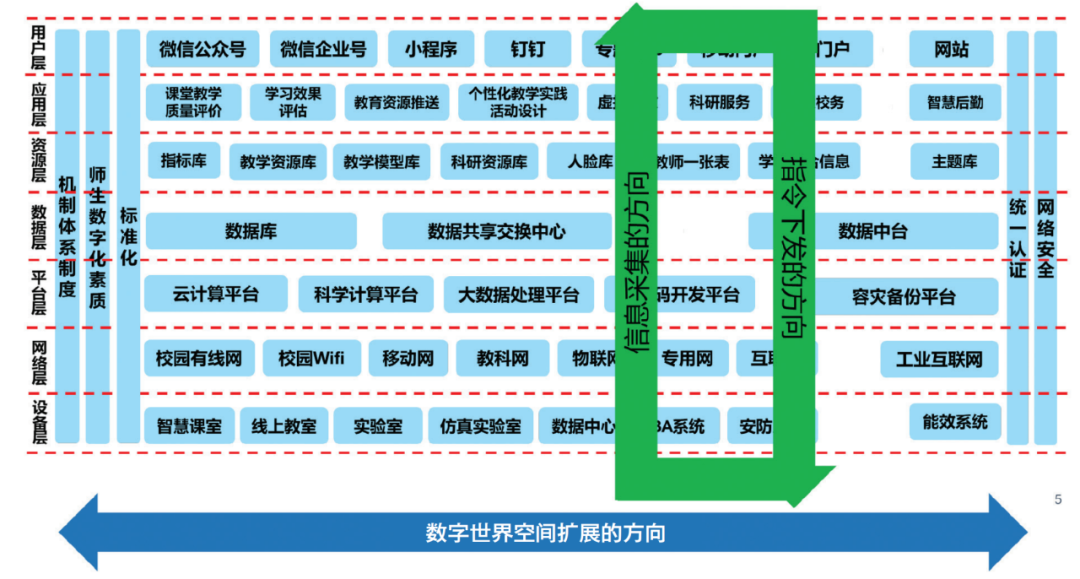
纵轴是技术层次维度,从下至上可以分为设备层、网络层、平台层、数据层,资源层、应用层、用户层;横轴是数字空间维度,是同一技术层面上沿数字空间分布不同的系统,例如网络层面,有校园有线网、校园Wifi、物联网、专用网、移动网、教科网、互联网等。从纵轴方向看,信息采集的方向是从下至上,而指令下发的方向是从上至下。一个好的生态是闭环系统,因此,上下流动的数据应该在数字空间连接成一个环,并且,这个环应该在数字空间维度展开,因为,如果系统在数字空间维度上不展开,数据就会在小系统内部流动形成“数据烟囱”,这是需要避免的现象。因此,我们也需要数据沿横轴方向流动,并沿横轴打通数据空间的各个模块。 数字化转型网(www.szhzxw.cn)
利用架构图,我们可以透视数字技术对教育的影响。以人工智能为例,人工智能在教育领域有广泛的应用,在个性化学习、自适应评估、智能辅助教学、开放教学资源等诸多方面有着广泛影响。人工智能的相关要素有算法(模型)、算据(数据)、算力,将这些要素添加到教育数字化系统架构中,作为强相关要素,再通过强相关的要素画出弱相关要素,如作为数字化新基座的网络层的各类网络和设备层的数据中心,以及和用户相关的网站、门户等。再以元宇宙为例,元宇宙是指一个虚拟的、模拟的世界,由数字化的现实和虚拟现实技术构建而成,在沉浸式学习体验、跨地域和跨文化交流、个性化学习和自主性、虚拟实践和模拟等方面有着一系列影响。也可以据此画出教育数字化系统架构图中的强相关和弱相关元素。
二、教育数字化架构的“两梁五柱”
以华南理工大学为例,打造良好的教育数字化生态的基础工作是统一架构的“两梁五柱”(图2)。
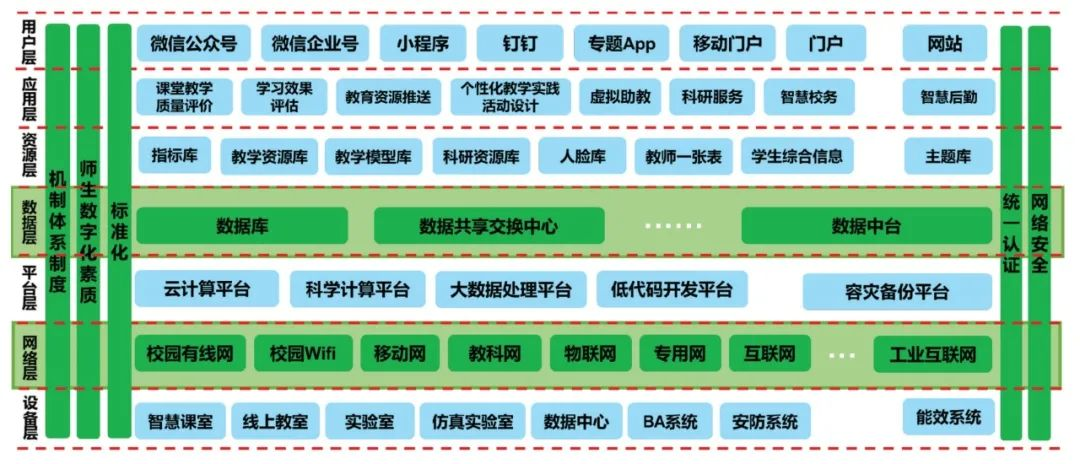
其中,“两梁”是数字化系统架构图中的网络和数据两个技术层面,“五柱”是机制体系制度、师生数字化素质、标准化、统一认证和网络安全五个贯穿各个技术层面的工作。
1. 两梁
网络是第一个“梁”。在信息化系统中,网络的结构可能非常复杂、异构的,但网络其实是可以融合的,例如,我们常说All over IP,业界也有著名的沙漏模型,前几年的三网融合就是在网络层统一到IP协议,让IP协议兼容并承载上下层的通讯协议和应用。此外,在数据链路层,也可以通过时间敏感网络TSN,统一通过以太网帧结构传送信息网和控制网信息。 数字化转型网(www.szhzxw.cn)
华南理工大学将数据中心内网、校园网、智能网、5G教育专网、软交换电话网融为一体,建成了融合式多网合一的校园网络系统,采用集中SDN控制器结合VxLAN技术,实现面向业务的弹性、智能、动态适应需求的校园网。
此外,华南理工大学牵头,联合省内高校建立了开放型的广东省5G教育专网,将校园网延伸到三大运营商移动网络覆盖的范围,实现全国漫游。广东省5G教育专网基于广东省教科网,共享5G设备,降低重复投资;通过下沉5G专网设备,分流访问校园网流量,降低流量费用,鼓励师生通过移动网络访问校园网;通过打通运营商和校园网的认证系统,实现通过移动网接入对校园资源的无障碍访问。
数据是第二个“梁”。数据是新型生产要素。2017年在十九届中央政治局第二次集体学习时,习近平总书记强调要加快建设数字中国,构建以数据为关键要素的数字经济,推动实体经济和数字经济融合发展。数据是政策驱动的要素,教育数字化转型是国家数字化转型在教育系统的贯彻落实,而数据赋能是数字化的基础,因此,数据赋能是高校数字化转型的重点之一。数字化的重点在数据价值挖掘和业务赋能及创新。数字化以数据为核心,使业务数据化、数据资产化、资产服务化、服务价值化。通过业务在线、数据智能,实现以数据说话、以数据管理、以数据决策、以数据创新。
在具体实践中,华南理工大学智慧校区建设的核心数据资产,不仅包括业务数据,还包括物联网海量物理节点产生的数据。例如,学校广州国际校区数字平台有93000多个设备监控点,8900多个视频监控点,100GB物联及业务数据。在数据处理中,数字平台,或者数据中台打通校内多个系统,实现数据标准化,并向应用层开放,提供数据接口,不断推动学校业务创新。通过数据赋能,构建智慧校园大脑,实现数据可视、事件可管、业务联动。 数字化转型网(www.szhzxw.cn)
2. 五柱
机制体系制度是数字化系统架构的重要支柱。信息化的组织架构影响生态。学校决策层、部门主要负责人、专家的参与程度,保障信息化部门参与全校信息化规划,是打造良好的机制制度的关键。
师生数字化素质是另一根重要的“柱”。提升师生数字化素质,要营造师生共同参与教育数字化建设的新生态,这需要强化系统思维,加强信息化和学校核心业务的融合,在进行系统规划设计时重点考虑全校师生这个最大群体的用户,在建设完成之后需要对这个用户群体提供针对性服务。
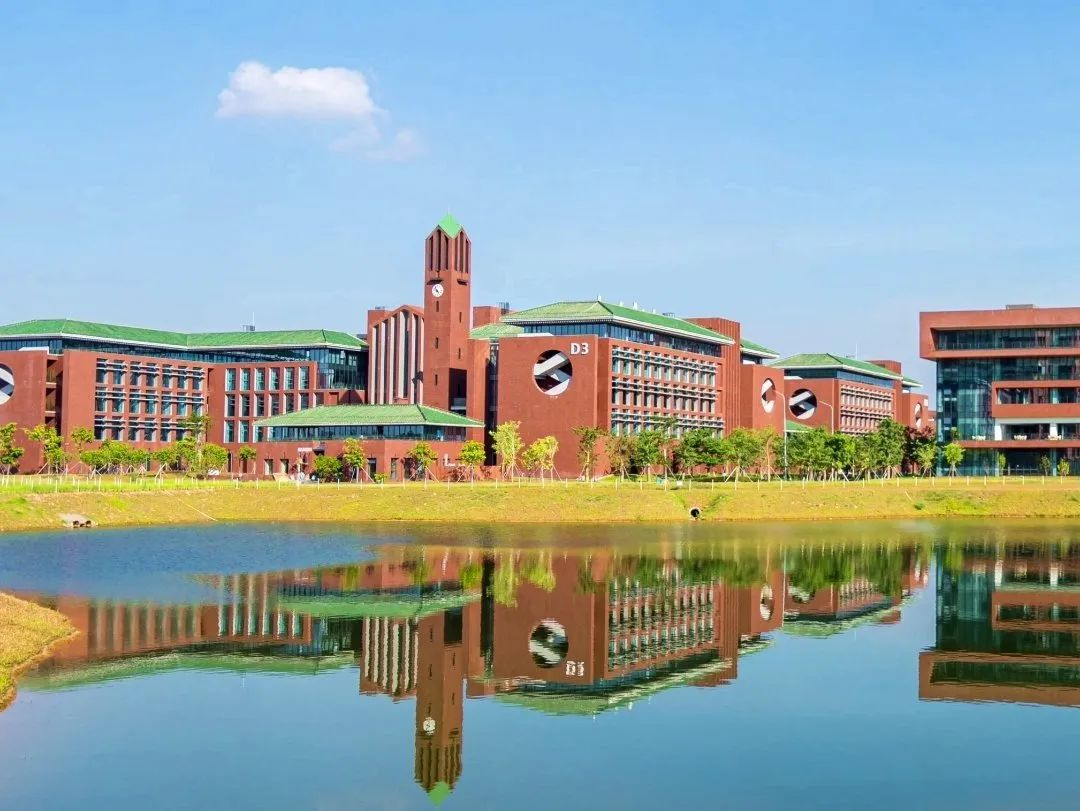
例如,华南理工大学建立教师教学能力提升长效机制,实施三年轮训计划,重点提升教师信息化教学能力、科研转化教学能力、工程教学能力等。更重要的是,让最广泛群体参与信息化规划与决策是IT治理结构改革的核心要义,华南理工通过加大智慧校园技术体系的开放性,开放低代码开发混合云平台,鼓励师生参与数字化建设,让师生觉得数字化是他们自己的事情,打造“信息化塔台,全校师生唱戏”的良好生态。 数字化转型网(www.szhzxw.cn)
此外,标准化、统一认证、网络安全也是数字化系统架构的“柱”。举个例子,人脸识别可以认为是统一认证的一种方式,但目前很多高校的人脸识别系统的运行过程和统一认证是不一样的,很多人脸识别系统把原始的人脸库下载到终端设备,在终端设备进行人脸特征比对,这相当于把统一认证的用户账号密码下载到前端,存在很大的安全风险。
为此,华南理工起草了团体标准《高校人脸识别基准库建设规范》,提出高校人脸识别基准库建设原则是统一采集、统一管理、采集最小化、安全保障、公开透明;如果学校要新建人脸识别应用系统,应该利用统一采集的人脸库,不应该再由这个应用系统来采集人脸库;前端的设备可以把采集的人脸照片生成特征值送到后台进行比对,如果为了提高效率最多也只能把后台人脸库的特征值下载到终端进行比对,而不能下载原始的人脸照片。
三、构建面向转型的数字化新生态
解决“两梁五柱”基础工作之后,我们可以关注更深层次的问题,将数据和应用结合起来,充分考量组织、流程、运营和技术深度结合,通过业务使能和IT使能,形成数据、业务处理的闭环系统。通过数据中台主题库把基础子系统关联起来,实现联动。
华南理工大学开展了多种实践,打造面向转型的数字化新生态。例如,学校面向不同用户、业务场景提供大屏、中屏、小屏三个作业界面,实现三屏业务联动,其中大屏战时决策指挥、中屏日常事件处理、小屏随时随地响应。 数字化转型网(www.szhzxw.cn)
探索基于AI的课堂教学。开展课程知识图谱建设,推动数字化教育的AI化并提升教学质量。在校内布局建设“智慧课栈”,推动教师运用“知识图谱”及AI课程工具。通过关联各业务系统数据,为学生的学习建模,有针对性地推送学习资源和学习活动设计,最大限度地实现个性化学习与成长。
变革课程修读模式,开设虚拟第三学期。虚拟第三学期利用每年寒暑假实施开设,以MOOC教学为载体,建立“循环开课、自主修读、统一考核”的修读模式。学生在完成所有网上学习环节并考核合格后,可获得相应学分。学校每年开出“材料与社会”“工程伦理学”等100门次课程,约12000个选课名额。
推进虚拟教研室建设。以现代信息技术为依托,围绕创新教研形态、加强教学研究、共建优质资源、开展教师培训等重点任务,推进虚拟教研室建设,打造教师教学发展共同体。
翻译:
Lu Yiqin: Education informatization ecological construction for digitization
Why mention ecology? This is a deep problem that needs to be solved in the development of education informatization to the digital stage. It can be said that informatization has entered the deep water zone, and its effect no longer depends on the efforts of the informatization department itself, but needs the deep participation of the decision-making level and the full cooperation of other departments of the school. 数字化转型网(www.szhzxw.cn)
Yiqin Lu, Deputy Chief Information Officer and Director of Internet Information Office of South China University of Technology
The development of information technology has entered a new stage, and the work of information technology has also reached the deep water zone. Many problems of informatization are deeply rooted in mechanism and ecology, and the digitization of education is a deep problem facing informatization. So how to create a good ecological working model of education digitization? It is necessary to do a good job in building the basic work of “two beams and five pillars” based on the educational digital system architecture. “Two beams” is the integration of various systems in the digital space in the data layer and the network layer to form a unified support; “Five pillars” is to promote the mechanism system system, teachers and students digital quality, standardization, unified certification, network security and other work through various technical levels, forming a comprehensive digital work, the whole chain upgrade.
First, the breakthrough of digital technology affects the education ecology
Nowadays, when we talk about digital transformation, we always talk about “ecology”. Ecology refers to the state of survival and development of organisms in a certain natural environment, and also refers to the physiological characteristics and living habits of organisms, emphasizing the impact of the environment on organisms, and also emphasizing the interaction between the environment and organisms, which is actually the state of the digital system, which is why we mention ecology today.
Why mention ecology? This is because the development of education informatization to the digital stage, need to face the deep problems of informatization. As the world enters the digital age, the school’s core business relies on and expects more and more information technology. Informatization is not only a new infrastructure, but also runs through all technical levels from the physical layer to the application layer. It requires data fusion and empowerment to achieve continuous optimization and rapid iteration of business processes, meet the needs of teachers and students for work and life in the digital campus, support school decision-making, promote school reform, and increase school competitiveness. At the same time, it is necessary to fly both wings of information and network security, and to apply new technologies (mobile Internet, Internet of things, big data, cloud computing, artificial intelligence, network security) system engineering. 数字化转型网(www.szhzxw.cn)
It can be said that informatization has entered the deep water zone, and its effect no longer depends on the efforts of one department of the informatization department, but needs the deep participation or comprehensive authorization of the decision-making level, and the cooperation of other departments, and is related to the digital quality of all teachers and students. The deep problem of informatization is the mechanism and ecology. However, ecology is a macro concept, and how to implement it into the specific work of digital transformation is the challenge facing universities at present.
In order to show the composition of the education system ecology, knowledge map or mind map is a more appropriate way, but in order to simplify the problem, we can also draw the structure diagram of the digital system according to different dimensions, then study the data flow between different modules in the structure diagram, and show the data flow and interface relationship between modules.
For example, we can draw the architecture diagram of education digitization system from two dimensions of technical level and digital space (Figure 1).
Figure 1. Architecture of education digitization system
The vertical axis is the dimension of technology level, which can be divided into equipment layer, network layer, platform layer, data layer, resource layer, application layer and user layer from bottom to top. The horizontal axis is the dimension of digital space, which is different systems distributed along the digital space on the same technical level. For example, at the network level, there are campus wired network, campus Wifi, Internet of Things, private network, mobile network, education network, Internet and so on. From the vertical axis, the direction of information collection is from the bottom up, while the direction of instruction delivery is from the top down. A good ecology is a closed loop system, so the data flowing up and down should be connected into a ring in the digital space, and this ring should be expanded in the digital space dimension, because if the system is not expanded in the digital space dimension, the data will flow inside the small system to form a “data chimney”, which is a phenomenon to be avoided. Therefore, we also need data to flow along the horizontal axis and open up the various modules of the data space along the horizontal axis.
Using architecture maps, we can put into perspective the impact of digital technology on education. Taking artificial intelligence as an example, artificial intelligence has a wide range of applications in the field of education, and has a wide impact on personalized learning, adaptive assessment, intelligent assisted teaching, open teaching resources and many other aspects. The relevant elements of artificial intelligence include algorithms (models), data (data), and computing power. These elements are added to the architecture of the educational digital system as strongly related elements, and then weakly related elements are drawn through the strongly related elements, such as the data center of various network and device layers as the network layer of the new digital base, as well as the websites and portals related to users. Metaverse, for example, is a virtual, simulated world built from digital reality and virtual reality technologies, with a range of impacts in terms of immersive learning experiences, cross-regional and cross-cultural communication, personalized learning and autonomy, virtual practice and simulation. It can also be used to draw strong correlation and weak correlation elements in the architecture diagram of education digital system.
Second, “Two Beams and Five Pillars” of Educational Digital Architecture
Taking South China University of Technology as an example, the basic work to build a good digital ecology of education is the “two beams and five pillars” of a unified framework (Figure 2).
Figure 2 Two beams and five pillars of the architecture of education digitization system
Among them, the “two beams” are the two technical levels of network and data in the digital system architecture diagram, and the “five pillars” are the five work that runs through all technical levels of mechanism system, digital quality of teachers and students, standardization, unified certification and network security. 数字化转型网(www.szhzxw.cn)
1. Two beams
The network is the first beam. In the information system, the structure of the network may be very complex and heterogeneous, but the network can actually be fused, for example, we often say All over IP, the industry also has a famous hourglass model, a few years ago, the triple network convergence is unified to the IP protocol at the network layer, so that the IP protocol is compatible with and carries the upper and lower communication protocols and applications. In addition, at the data link layer, the information network and control network can be transmitted through the Ethernet frame structure through the time-sensitive network TSN.
South China University of Technology integrates the data center Intranet, campus network, intelligent network, 5G education private network and softswitch telephone network, and has built a campus network system of integration and multi-network integration. The centralized SDN controller and VxLAN technology are used to achieve a business-oriented campus network that is flexible, intelligent and dynamically adaptable to needs.
In addition, South China University of Technology took the lead and jointly established an open 5G education private network in Guangdong Province with colleges and universities in the province, extending the campus network to the coverage of the mobile networks of the three major operators to achieve nationwide roaming. Guangdong 5G Education Private Network is based on Guangdong Education Science Network to share 5G equipment and reduce repeated investment; By sinking 5G private network equipment, diverting traffic to the campus network, reducing traffic costs, and encouraging teachers and students to access the campus network through mobile networks; Through opening up the certification system of operators and campus network, the barrier-free access to campus resources can be realized through mobile network access.
Data is the second “beam.” Data is the new factor of production. Data is a policy-driven element, education digital transformation is the implementation of national digital transformation in the education system, and data empowerment is the foundation of digitalization, therefore, data empowerment is one of the key points of digital transformation in universities. Digitalization focuses on data value mining and business empowerment and innovation. Digitalization takes data as the core, making business data, data assets, asset services and service value. Through business online, data intelligence, to achieve data speak, data management, data decision-making, data innovation.
In concrete practice, the core data assets of the smart campus construction of South China University of Technology include not only business data, but also data generated by massive physical nodes of the Internet of Things. For example, the digital platform of the school’s Guangzhou International Campus has more than 93,000 equipment monitoring points, more than 8,900 video monitoring points, and 100GB of iot and business data. In data processing, the digital platform or data center can open up multiple systems in the school, achieve data standardization, and open to the application layer to provide data interfaces, and constantly promote school business innovation. Through data empowerment, build a smart campus brain, and realize data visibility, event management, and business linkage.
2. Five pillars
Mechanism system system is an important pillar of digital system architecture. The organizational structure of informatization affects ecology. The degree of participation of the school’s decision-making level, the main person in charge of the department and the experts, and the guarantee of the information department’s participation in the informatization planning of the whole school are the key to creating a good mechanism and system. 数字化转型网(www.szhzxw.cn)
The digital quality of teachers and students is another important pillar. To improve the digital quality of teachers and students and create a new ecology in which teachers and students jointly participate in the digital construction of education, it is necessary to strengthen the system thinking, strengthen the integration of information technology and the core business of the school, and give priority to the users of the largest group of teachers and students in the system planning and design, and provide targeted services to this user group after the completion of the construction.
South China University of Technology (photo source School official)
For example, South China University of Technology has established a long-term mechanism to improve teachers’ teaching ability and implemented a three-year rotational training plan, focusing on improving teachers’ teaching ability in informatization, research transformation and engineering. More importantly, allowing the broadest group to participate in information planning and decision-making is the core of IT governance structure reform. South China Institute of Technology encourages teachers and students to participate in digital construction by increasing the openness of the smart campus technology system, opening up the low-code development of hybrid cloud platform, and making teachers and students feel that digitalization is their own thing. The whole school teachers and students singing “good ecology.”
In addition, standardization, unified certification, and network security are also the “pillars” of the digital system architecture. For example, face recognition can be considered as a way of unified authentication, but at present, the operation process of the face recognition system in many universities and unified authentication is not the same, many face recognition systems download the original face library to the terminal device, in the terminal device face features comparison, which is equivalent to the unified authentication of the user account password download to the front-end, There is a big security risk.
To this end, South China Institute of Technology drafted the group standard “College face recognition benchmark database construction standards”, proposed that the construction principles of college face recognition benchmark database are unified collection, unified management, collection minimization, security, openness and transparency; If the school wants to build a new face recognition application system, it should use the unified collection of face library, and should not be collected by this application system; The front-end device can collect the face photo generated feature values sent to the background for comparison, if in order to improve efficiency can only download the feature values of the background face library to the terminal for comparison, but can not download the original face photo.
Third, build a transformation-oriented digital ecology
After solving the basic work of “two beams and five pillars”, we can pay attention to deeper problems, combine data and application, fully consider the depth of organization, process, operation and technology, and form a closed-loop system of data and business processing through business enablement and IT enablement. Through the subject library of the data center, the basic subsystems are associated to achieve linkage. 数字化转型网(www.szhzxw.cn)
Ssouth China University of Technology has carried out a variety of practices to create a new digital ecology oriented to transformation. For example, the school provides three operation interfaces for different users and business scenarios, such as large screen, medium screen, and small screen, to achieve three-screen business linkage, in which the large screen wartime decision-making command, the medium screen daily event processing, and the small screen anytime and anywhere response.
Explore AI-based classroom teaching. Carry out the construction of curriculum knowledge map, promote the AI of digital education and improve the teaching quality. In the school layout, the construction of “wisdom course stack”, and promote teachers to use “knowledge graph” and AI course tools. By connecting data from various business systems, we can model students’ learning, push learning resources and design learning activities in a targeted way, and maximize personalized learning and growth.
Change the course model, open a virtual third semester. The virtual third semester will be launched every winter and summer vacation, and the MOOC teaching will be used as the carrier to establish a study mode of “circular course opening, independent study and unified assessment”. After completing all online learning links and passing the examination, students can obtain corresponding credits. Every year, the school offers 100 courses such as “Materials and Society” and “Engineering Ethics”, and about 12,000 courses are available.
We will promote the construction of virtual teaching and research rooms. Relying on modern information technology and focusing on key tasks such as innovating teaching and research forms, strengthening teaching and research, co-building high-quality resources, and carrying out teacher training, the construction of virtual teaching and research rooms is promoted to build a community of teacher teaching and development. 数字化转型网(www.szhzxw.cn)
本文由数字化转型网(www.szhzxw.cn)转载而成,来源于《中国教育网络》;编辑/翻译:数字化转型网宁檬树。

免责声明: 本网站(http://www.szhzxw.cn/)内容主要来自原创、合作媒体供稿和第三方投稿,凡在本网站出现的信息,均仅供参考。本网站将尽力确保所提供信息的准确性及可靠性,但不保证有关资料的准确性及可靠性,读者在使用前请进一步核实,并对任何自主决定的行为负责。本网站对有关资料所引致的错误、不确或遗漏,概不负任何法律责任。
本网站刊载的所有内容(包括但不仅限文字、图片、LOGO、音频、视频、软件、程序等) 版权归原作者所有。任何单位或个人认为本网站中的内容可能涉嫌侵犯其知识产权或存在不实内容时,请及时通知本站,予以删除。