业务和组织是一体两面的,从来没有离开组织成功的业务成功,也没有离开业务成功的组织成功。业务和组织是一体两面的,从来没有离开组织成功的业务成功,也没有离开业务成功的组织成功。
我从事的岗位是组织发展,组织发展其实就是陪伴业务在各个周期里持续赢得增长的工作。我们不仅关注当下的组织健康度,还要关注长期的组织适应性,去面对环境、条件的不断变化。
最近半年,我有一个项目是支持AI大模型时代的业务重构,在协助内部OTD探询重构的核心要素过程中,我发现在技术变革的背景下做业务变革,首先还是做业务的人,要先发生意识层面、状态层面的重构。数据引领创新,但根本还在人,人们如何理解用户、如何用好数据和技术?
回到人,我们也会看到虽然现在有更多创新的必要性和可能,但过去已经获得成功的企业带着的既有模式已经成为了组织惯性,这种巨大的惯性在制约着创新,阻碍我们打破过去、寻找新的增长曲线。
一、今天大多数组织的四大痛点
面向数智化时代,企业在组织方面面对的四大痛点。
痛点一:业务链路长,组织效率低
不同阶段、不同行业的组织,只要获得过成功,就一定有一个过去的业务链路已经在运行。尤其是那些已经有一定行业壁垒的公司,它们的业务链路长且稳定。过去的效率来自这个稳定或者说是固化,但是未来的效率可能恰要打破这个固化。
过去工业时代形成的效率是来自上游与下游的关系,大家并没有一张共同的图,每个人守好自己那一个环节即可。这意味着链路之间只是单向或者节点式的联动。
当链路的尾部因为直接接触市场,感受到了市场的变化,再传导到上游供应链的开发端,需要通过很多的环节、时间,甚至还会损耗整个组织的士气,出现想尝试变化而没有反馈的习得性无助。
屡次创新却不能拿到结果,渐渐的,组织的士气就越来越低迷,很多人对创新的信心、决心就慢慢损耗了。 数字化转型网(www.szhzxw.cn)
在这个过程当中,我们需要重构业务链路,新的业务链路要变得更网状、更集成,也就是我们也会期待的敏捷性组织、网状组织。无论是什么形态,重点是要提升业务链路的灵敏、速度或效率。
痛点二:边界固化,决策集中
不少组织已经有一个固化的边界,甚至叫地盘。如果从一个团队抽调多少人,这个团队的负责人可能会觉得你在削他的权,更别说要调整他的管理范围、部门职能。
当我们要创新的时候,又不得不打破边界,包括部门边界、职能边界、人的边界、关系边界。这里面会出现非常多的冲突。怎么管理这些冲突?
这当中有非常多软性的OD(组织发展)工作要做。调整组织结构只是硬OD,但所有成功的变革都是软硬兼施的,内在的意愿如何激发,要与外在的作用力共同发生。
还有一个很大的问题是过去的科层制组织:决策集中在顶层。今天,如果所有的决策还是回到顶层,那可能只能做大的结构性决策,但是不能做具体的产品决策或某个用户市场选择的决策,因为规模越大顶层离一线越远。 数字化转型网(www.szhzxw.cn)
尤其今天的发展重点不是在规模化上,而是在差异化、精益化上。那么差异化、精细化的业务增量,越需要贴近业务和贴近用户的人做决策。
所以,我们要重构一套组织的决策文化、决策机制,让更多的一号位长出来,而不是只有一个一号位。
痛点三:一线活力和动力不足
员工“躺平”是所有领导的痛点。用年轻人的话叫“45度人生”:躺不平,卷不动,最后停在45度。
今天为什么会有越来越多的企业希望我们帮它们做绩效考核、激励机制?因为在这些企业里,一线跑不起来,很难激发,没有斗志,没有动力。
没错,它们是需要有一套从战略拆解到策略、拆解到业务过程的目标管理、从组织绩效到个体绩效的管理方法,但还是要想想组织到底用什么才能真正激发员工的动力和创造力?
构建机制的同时也要有激发型的文化,由内而外激发年轻人、一线的同学,比方说可以邀请一线员工参与甚至主导产品共创。多年前,阿里就意识到,在骨干中,90后的比例必须提高,因为只有90后才知道90后用户要靠什么才能触达。 数字化转型网(www.szhzxw.cn)
痛点四:创新人才匮乏
但凡公司一号位、CEO、创始人,永远不会觉得创新人才充足。创新人才的匮乏跟前面几个痛点有关,正是因为企业过去的决策是集中的,这个过程就只是把人当工具、当执行者,就很难培养出真正能够在关键转折时刻打开新天地的人才。
反而言之,如果企业从外部引进人才,招空降的骨干或者高管进来,很快又会碰到另外一个问题:高管的落地和新老团队的融合。
创新人才不是简单的从外面引进还是从内部培养的问题,本质上还是看有没有一套长期的机制或者文化土壤,让创新人才真的能够从一线冒出来,能把他们的闪光点用到业务里,让决策过程能够涌现出更多值得期待和青睐的战役一号位。他从一个小战役到关键战役再到一盘生意,一点点成长起来,这样下一个领导班子或者真正的梯队才能建立起来。
这些组织的痛点,逼着我们今天要做一件事:不仅要看到机会,还要扫清障碍。那个障碍就是组织过去遗留的文化和模式,今天要慢慢地做一些转变和改革。
二、由内而外的系统性转变
这个转变和改革怎么做?我的观点是要真正由内而外去转变。
借用了一位整合学家的模型,从组织发展的角度做了一些改变。这个模型非常简单,纵轴是个体和集体,横轴是外在和内在。任何问题、任何现象都有个体和集体、外在和内在的因素。这四个象限代表了四个维度,所有的组织变革和组织升级,如果只是从单一维度入手,而没有从四个维度来综合考虑,是无法完成的。 数字化转型网(www.szhzxw.cn)
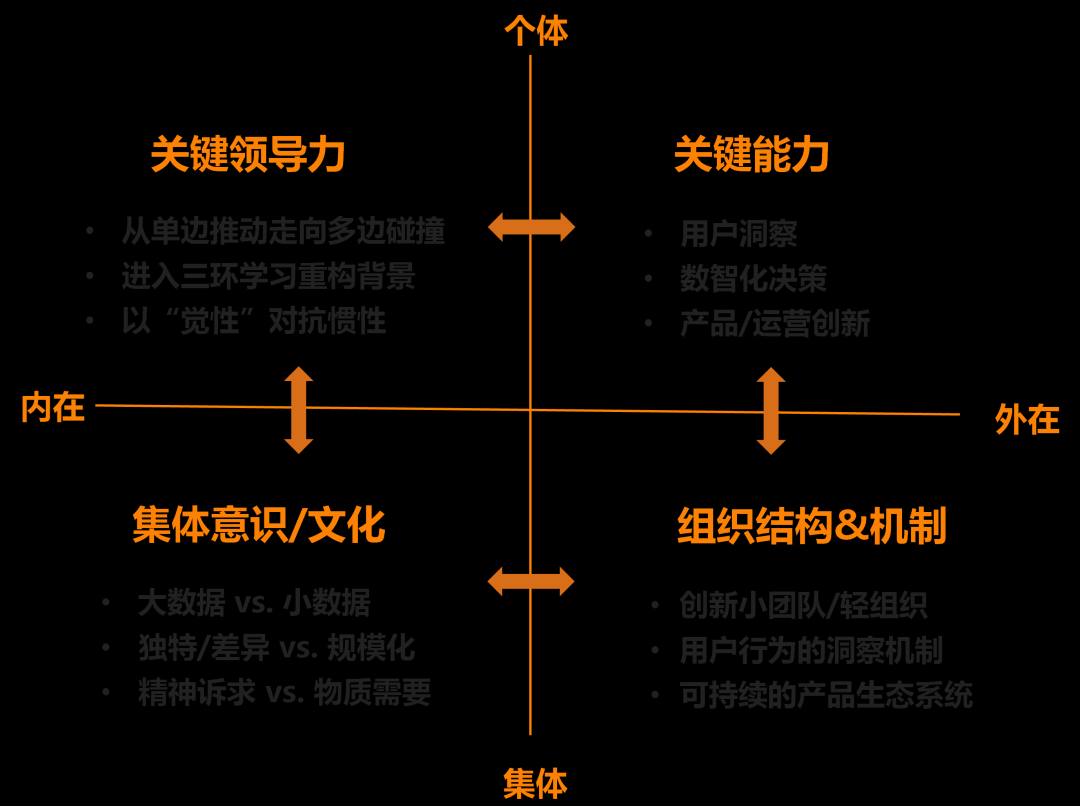
在这个坐标系中的右上角是偏个体的,可以直接看到或拿到结果的,这个部分叫关键能力。组织能力中一定有关键能力,但是如果关键能力只长在一两个部门上,它不足以给组织带来整体的结果。
关键能力下面是组织结构及机制。什么样的组织结构决定了什么样的能力更容易长出来,两者相互影响。组织到底是采取BU(事业部)制还是职能制?不同架构下能发挥出来的能力是不一样的。同样,决策机制、沟通机制、协同机制、考核机制等各种机制也会影响能力的发展和发挥。
坐标系的左半边就是由内而外的“内”,即通常说的软OD的范畴。首先是集体意识和文化。如果要在组织里推行新的绩效考核,但集体文化是大锅饭、老好人的文化,很难把绩效考核落实到每个人,因为集体意识和文化跟新的机制和结构是相违背的。这个时候,需要有配套的文化。
在集体意识和文化的上面是关键领导力。领导者当前的导向是什么,崇尚的是什么?如果我们今天以开放为导向,但领导的风格偏向控制,关注细节,这当中就会有拧巴。任何组织转变不是孤立的一步或者一招,而是四个方面的系统工程。 数字化转型网(www.szhzxw.cn)
例如,我们做产品创新,在关键能力上肯定要做用户洞察,做数智化决策。同时,还需要运营侧不同策略的创新。这些都是关键能力。
要具备这样的关键能力,需要什么样的组织?如果一个庞大的系统要创新,业务链路又很长,可能就很难迅速出结果。这时候就需要做创新小团队或者轻量化的组织:
成立一个小的BU,或组建一个作战小组,让各职能的人先聚集到一起,小闭环地试行起来。当然,这只适合0到1的产品阶段。
紧接着,组织需要有一套长期的用户洞察机制来保证长长的业务链路里面,不仅一线人员,而且后端人员也能够跟用户有更多交互和对话,整个组织系统的敏捷度得以提升。
如果创新产品成功上市,接下来要实现规模化并提高利润,就需要建立可持续的产品生态。
从集体内部来看,首先,我们既需要看大数据,又要看小数据,关注身边的用户行为,对目标人群做精细的研究。 数字化转型网(www.szhzxw.cn)
其次,要关注独特性和差异化。过去的经济周期中,规模化很有机会,但是在今天的经济周期,需要做差异化和独特性的东西。也许未来规模化的机会就是大量的精细化和差异化,形成新的集体规模。
第三,相比物质需求,也要关注精神需求。组织里越来越需要焕发人文气息,人文气息就是员工的精神需求也是用户未来的增量需求。
最后我们看关键领导力。第一,过去领导者是单边推动,一旦到了真正的创新,要与用户共创,就需要在组织内、跟组织外多边碰撞。第二,进入三环学习:第一层是行为的学习,第二层是行为假设的学习,第三层是背景和自体层面、包括人的潜意识和无意识;最后是觉性,即觉知力。如果没有觉性,惯性不会被打破。

三、组织变革的实现路径
最后,说说路径。组织变革的实现路径有A面也有B面。有的公司是从业务入手,组织在后面作为暗线做变革,有的公司直接从组织入手开始变革,业务在后面徐徐跟着变革。
我简单总结了两类陪伴项目的组织变革过程。 数字化转型网(www.szhzxw.cn)
路径A:从业务到组织
一个项目是从业务切入,明线做业务创新,暗线做组织变革。
这家公司从战略视角扫描市场,选定了一个业务方向,我们帮它搭建专题小组,将组织的高潜力人才放进这个小组,借事修人。他们自己经过快速的实验迭代,拿到一定成果之后,再跟大的组织系统、跟原有的业务做对话,逐步将其变成全系统的变革。
路径B:从组织到业务
还有一种方式是从业务复盘中直接加入组织诊断,帮助高管系统性地看到组织的问题,让他们想明白至今不能创新成功的原因是组织土壤的问题。
接下来我们就去调整组织结构,重新分地盘或者大家拧成一股绳,共同面对变化的环境,这样改革才能够发生。
无论从A到B还是B到A,都说明一个问题,业务和组织是一体两面的,从来没有离开组织成功的业务成功,也没有离开业务成功的组织成功。
在这里,我期许各位能成为一个雌雄同体的业务领导者、一号位,让业务带动组织、组织支撑业务,取得下一阶段的成功。 数字化转型网(www.szhzxw.cn)

翻译:
How can companies survive in times of great Change?
Business and organization are two sides of the same body, there is never a business success without organizational success, and there is no organizational success without business success. Business and organization are two sides of the same body, there is never a business success without organizational success, and there is no organizational success without business success.
My position is organizational development, which is actually the job of accompanying the business to continue to win growth in every cycle. We focus not only on the immediate health of the organization, but also on the long-term adaptability of the organization to face the constant changes in the environment and conditions.
In the past six months, I have a project to support business restructuring in the era of AI large models. In the process of assisting internal OTD to investigate the core elements of restructuring, I found that in the context of technological change, business people should first undergo restructuring at the level of consciousness and state. Data leads innovation, but it is still people, how do people understand users, how to use data and technology?
Going back to people, we will also see that although there is a need and possibility for more innovation now, the existing model that has been successful in the past has become organizational inertia, and this huge inertia is restricting innovation, preventing us from breaking the past and finding new growth curves. 数字化转型网(www.szhzxw.cn)
First, four major pain points for most organizations today
Facing the era of digital intelligence, the four major pain points faced by enterprises in organization.
Pain point 1: Long service links and low organizational efficiency
Organizations of different stages and industries, as long as they have achieved success, must have a past business link already in operation. Especially those companies that already have certain industry barriers, their business links are long and stable. Past efficiency came from this stabilization or solidification, but future efficiency may just break this solidification.
The efficiency formed in the past industrial era comes from the relationship between upstream and downstream, and we do not have a common map, and everyone can keep their own link. This means that there is only one-way or nodal linkage between links.
When the tail of the link is in direct contact with the market, feels the changes in the market, and then transmits to the development end of the upstream supply chain, it needs to go through a lot of links, time, and even the morale of the entire organization will be lost, and there will be learned helplessness when you want to try to change without feedback.
Repeated innovation but can not get results, gradually, the morale of the organization is more and more depressed, many people’s confidence in innovation, determination slowly wear out.
In this process, we need to restructure the business links, and the new business links need to become more mesh and integrated, which is what we also expect the agile organization, the network organization. Whatever the form, the focus is on improving the agility, speed, or efficiency of the service link.
Pain point 2: Rigid boundaries and centralized decision-making
Many organizations already have a fixed boundary, or even a territory. If you remove many people from a team, the head of the team may feel that you are cutting his authority, not to mention adjusting his management scope and departmental functions.
When we want to innovate, we have to break down boundaries, including departmental boundaries, functional boundaries, human boundaries, and relationship boundaries. There’s going to be a lot of conflict. How do you manage these conflicts?
There is a lot of soft OD (Organizational Development) work to be done. Adjusting organizational structure is only hard OD, but all successful change is a combination of soft and hard, how the internal will to stimulate, to occur together with external forces.
Another big problem is the bureaucratic organization of the past: decision-making is concentrated at the top. Today, if all the decisions are still back to the top, it may only be able to make large structural decisions, but can not make specific product decisions or decisions about the selection of a user market, because the larger the scale of the top layer is further away from the front line.
In particular, today’s development focus is not on scale, but on differentiation and lean. So differentiated, refined business increment, the more need to be close to the business and close to the user to make decisions. 数字化转型网(www.szhzxw.cn)
Therefore, we need to reconstruct a set of organizational decision-making culture and decision-making mechanism, so that more number one positions can grow out, rather than just one number one position.
Pain point 3: Lack of vitality and motivation in the first line
Employee “lying flat” is a pain point for all leaders. In the words of young people, it is called “45 degree life” : lying uneven, rolling motionless, and finally stopping at 45 degrees.
Today, why do more and more companies want us to help them with performance appraisal and incentive mechanism? Because in these enterprises, the first line can not run, it is difficult to motivate, there is no fighting spirit, there is no motivation.
Yes, they need to have a management approach from strategy disassembly to strategy, from disassembly to business process management by objectives, from organizational performance to individual performance management, but still need to think about what the organization really uses to motivate employees and creativity? 数字化转型网(www.szhzxw.cn)
While building the mechanism, there should also be an inspiring culture to stimulate young people and front-line students from the inside out. For example, front-line employees can be invited to participate in or even lead the co-creation of products. Many years ago, Ali realized that in the backbone, the proportion of the post-90s must be increased, because only the post-90s know what the post-90s users need to rely on to reach.
Pain point 4: Lack of innovative talent
No company leader, CEO, founder will ever feel that there is enough innovative talent. The lack of innovative talents is related to the first few pain points, precisely because the decision of the enterprise in the past is centralized, the process is just to treat people as tools, when the executioner, it is difficult to cultivate talents who can really open a new world at the key turning point.
In other words, if the enterprise introduces talents from the outside and recruits the airborne backbone or senior executives, it will soon encounter another problem: the landing of senior executives and the integration of the new and old teams.
Innovative talents are not simply introduced from the outside or cultivated from the inside, in essence, it depends on whether there is a long-term mechanism or cultural soil, so that innovative talents can really emerge from the front line, can use their shining points in the business, so that the decision-making process can emerge more worthy of expectation and favor. He goes from a small campaign to a key campaign to a business, growing little by little so that the next leadership team or real echelon can be established. 数字化转型网(www.szhzxw.cn)
These organizational pain points force us to do one thing today: not only to see the opportunity, but also to remove the obstacles. That obstacle is the culture and model of the organization’s past, which needs to be slowly transformed and reformed today.
Second, systemic transformation from the inside out
How will this transformation and reform be carried out? My point is to really transform from the inside out.
It borrows the model of an integrator and makes some changes from the perspective of organizational development. The model is very simple, the vertical axis is the individual and the collective, the horizontal axis is the external and internal. Any problem, any phenomenon has individual and collective, external and internal factors. These four quadrants represent four dimensions, and all organizational changes and upgrades cannot be completed if they only start from a single dimension without comprehensive consideration from the four dimensions.
In the upper right corner of this coordinate system are partial individuals, can directly see or get the result, this part is called the key capability. There must be key capabilities in the organizational capacity, but if the key capabilities are only grown in one or two departments, it is not enough to bring overall results to the organization. 数字化转型网(www.szhzxw.cn)
Below are the organizational structures and mechanisms. What kind of organizational structure determines what kind of ability is more likely to develop, and the two affect each other. Does the organization adopt the BU (Division) system or the functional system? The abilities that can be exerted under different structures are different. Similarly, decision-making mechanism, communication mechanism, coordination mechanism, assessment mechanism and other mechanisms will also affect the development and play of ability.
The left half of the coordinate system is the “inside” from the inside out, that is, the category of soft OD is usually said. The first is the collective consciousness and culture. If you want to implement a new performance appraisal in the organization, but the collective culture is a big pot, good guy culture, it is difficult to implement performance appraisal to everyone, because the collective consciousness and culture are against the new mechanism and structure. At this time, there needs to be a supporting culture.
At the top of the collective consciousness and culture is key leadership. What is the leader’s current orientation and what does he admire? If we are open oriented today, but the style of leadership is more control and attention to detail, there will be a twist. Any organizational transformation is not an isolated step or move, but a four-pronged systematic engineering.
For example, when we do product innovation, we must do user insight and make intelligent decisions in key capabilities. At the same time, it also needs the innovation of different strategies on the operational side. These are key competencies. 数字化转型网(www.szhzxw.cn)
What kind of organization does it take to have such critical capabilities? If a large system is to be innovated and the business links are long, it may be difficult to get results quickly. This is where you need to do small innovative teams or lightweight organizations:
Set up a small BU, or form a combat team, let the people of various functions get together first, and try out a small closed-loop. Of course, this is only suitable for the 0 to 1 product phase.
Next, organizations need a long-term user insight mechanism to ensure that not only front-line personnel, but also back-end personnel can have more interaction and dialogue with users in the long business link, and the agility of the entire organizational system can be improved.
If an innovative product is successfully launched, then to achieve scale and increase profits, a sustainable product ecosystem needs to be established.
From the perspective of the collective, first of all, we need to look at both big data and small data, pay attention to the user behavior around us, and do detailed research on the target population.
Second, focus on uniqueness and differentiation. In past cycles, there were opportunities for scale, but in today’s cycle, there is a need to do something different and unique. Perhaps the opportunity for future scale is a lot of refinement and differentiation, forming a new collective scale.
Third, focus on spiritual needs as well as material needs. The organization needs more and more humanistic atmosphere, which is the spiritual needs of employees and the incremental needs of users in the future. 数字化转型网(www.szhzxw.cn)
Finally, we look at key leadership. First, in the past, leaders were unilateral promotion, once it comes to real innovation, to create with users, you need to collide multilaterally within the organization and outside the organization. Second, enter the three-ring learning: the first layer is the learning of behavior, the second layer is the learning of behavior hypothesis, and the third layer is the background and self level, including people’s subconscious and unconscious; Finally, there is awareness, which is the power of awareness. Without awareness, inertia will not be broken.
Third, the realization path of organizational change
Finally, a word about the path. The realization path of organizational change has side A and side B. Some companies start with the business, and the organization makes changes as a dark line in the back, while some companies start with the change directly from the organization, and the business slowly follows the change.
I briefly summarized the organizational change process of two types of companion projects.
Path A: From business to organization
A project is cut from the business, the bright line to do business innovation, the dark line to do organizational change. 数字化转型网(www.szhzxw.cn)
The company scanned the market from a strategic perspective, chose a business direction, and we helped it set up a focus group, put the organization’s high potential talent into the group, and borrow people. After rapid experimental iteration, they get certain results, and then talk to the large organizational system and the original business, and gradually turn it into a system-wide change.
Path B: From organization to business
Another way is to directly join the organizational diagnosis from the business review, to help executives systematically see the problems of the organization, so that they can understand the reason for the failure of innovation so far is the problem of the organizational soil.
Then we will adjust the organizational structure, re-divide the territory or all of us together to face the changing environment, so that the reform can take place.
No matter from A to B or B to A, it shows a problem that business and organization are two sides of one body, and there is never a business success without organizational success, nor an organizational success without business success. 数字化转型网(www.szhzxw.cn)
Here, I hope you can become an androgynous business leader, the number one position, let the business drive the organization, the organization supports the business, and achieve the next stage of success.
本文由数字化转型网(www.szhzxw.cn)转载而成,来源于商业评论,作者:黄莺;编辑/翻译:数字化转型网宁檬树。
免责声明: 本网站(http://www.szhzxw.cn/)内容主要来自原创、合作媒体供稿和第三方投稿,凡在本网站出现的信息,均仅供参考。本网站将尽力确保所提供信息的准确性及可靠性,但不保证有关资料的准确性及可靠性,读者在使用前请进一步核实,并对任何自主决定的行为负责。本网站对有关资料所引致的错误、不确或遗漏,概不负任何法律责任。
本网站刊载的所有内容(包括但不仅限文字、图片、LOGO、音频、视频、软件、程序等) 版权归原作者所有。任何单位或个人认为本网站中的内容可能涉嫌侵犯其知识产权或存在不实内容时,请及时通知本站,予以删除。