
打通业务与应用系统建设壁垒是数据治理的关键。数据架构作为统一业务数字化所需数据语言及操作手段的重要方式,是业务与应用系统建设的桥梁。本文讲讲如何构建数据架构,来实现应用系统与业务深度融合。 数字化转型网(www.szhzxw.cn)
一、数据架构在企业架构中的位置
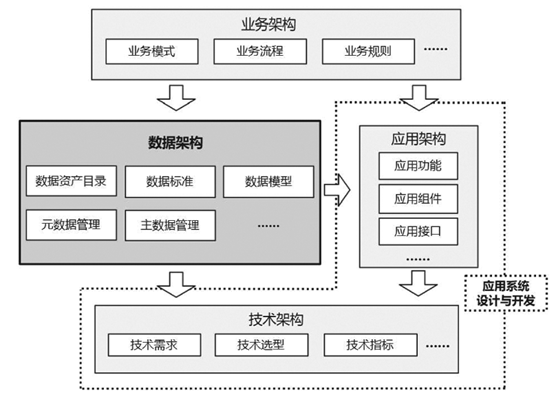
数据架构在整个企业的信息系统中扮演着重要角色。它位于业务架构和应用系统之间,作为桥梁连接二者。数据架构的建设需要识别业务流程中所依赖的数据及其流动情况,注重不同业务之间数据的复用与共享。同时,数据架构还需要统一业务数字化所需的数据语言和操作手段。
具体而言,数据架构基于业务架构,即业务模式、流程、规则等,来确定业务数据的需求。然后,通过统一的数据语言和操作手段,作为应用系统的应用架构(系统功能、组件、接口等)和技术架构(技术指标、技术选型等)的设计和开发依据。
数据架构建设的主要任务包括: 数字化转型网(www.szhzxw.cn)
1、确定业务流程中所需的数据,并定义数据的结构、属性和关系;
2、设计数据流动的路径和机制,确保数据能够在不同业务之间进行复用和共享;
3、统一数据的标准和规范,以确保不同系统之间的数据能够互通和兼容;
4、确定数据的安全和隐私策略,保护敏感数据的安全性;
5、监控和管理数据的整个生命周期,包括数据的采集、存储、处理、分析和清理等环节。
二、数据架构建设的核心内容
数据架构建设包括一系列核心内容,这些内容对于确保数据管理的有效性和系统间数据的一致性至关重要。以下是数据架构建设的核心内容:
1、数据资产目录编制:这一步骤旨在清晰识别和整理公司或组织中的数据信息资源,建立数据资产目录。这有助于支持数据标准、数据模型、元数据和主数据管理;
2、数据标准管理:数据标准管理旨在规范业务对象在信息系统中的定义和应用。通过确立数据标准,可以提升数据使用和交换的一致性和准确性; 数字化转型网(www.szhzxw.cn)
3、数据模型构建:数据模型构建阶段涉及对业务模式和业务规则的数据需求进行分析和重新组织。这有助于支持应用系统的设计和开发,并确保数据与业务需求相匹配;
4、元数据管理:元数据是描述数据的数据,规范元数据管理有助于定义数据业务属性、技术属性和操作属性。通过有效的元数据管理,可以支持业务在信息系统中的落地和实施;
5、主数据管理:主数据是组织中核心业务数据的集合,主数据管理旨在确保不同系统间核心业务数据的一致性。通过主数据管理,可以支持跨部门、跨系统的数据融合和应用,从而提高数据质量和决策的准确性。
三、数据架构建设的基本原则
数据架构建设需要遵循一些基本原则,来确保数据管理的可靠性、安全性、有效性和系统的可持续性,建立健壮的数据架构。具体如下:
1、业务导向:数据架构规划应当与企业或组织的业务战略相契合,基于业务对象进行设计和实施,确保数据架构能够支持业务的发展和需求。
2、持续优化:在数字化转型过程中,应当持续审视和优化数据架构,以满足不断变化的数据需求,并保持与业务发展的同步。 数字化转型网(www.szhzxw.cn)
3、行业实践和技术趋势:数据架构的设计应考虑所处行业的实践经验和主流软硬件技术,兼顾当前发展现状和未来趋势,确保数据架构具有前瞻性和可持续性。
4、数据一致性和标准化:应用系统数据库的设计和开发应当遵循统一的数据架构,减少数据冗余,实现接口的标准化,确保数据的一致性和质量。
5、数据治理责任:建立明确的数据责任人制度,业务数据责任人应与信息技术支撑组织共同进行业务数据架构的建设和维护。各级数据责任人应明确自身在数据治理中的责任和角色,推动数据治理工作的有效实施。其中,这里数据责任人是指基于数据的业务属性负责数据治理责任的个体,包括最高数据责任人、领域数据责任人、业务数据责任人;信息技术支撑组织是指企业或者组织中为数据治理工作提供信息技术支持的组织或部门。

翻译:
Data architecture for data governance
The key to data governance is to break down the barriers of business and application system construction. As an important way to unify the data language and operation means required for business digitization, data architecture is a bridge between business and application system construction. This article discusses how to build a data architecture to enable deep integration of application systems and business. 数字化转型网(www.szhzxw.cn)
First, the position of data architecture in the enterprise architecture
Data architecture plays an important role in the information system of the entire enterprise. It sits between the business architecture and the application and acts as a bridge between the two. The construction of data architecture needs to identify the data and its flow in the business process, and pay attention to the reuse and sharing of data between different businesses. At the same time, data architecture also needs to unify the data language and means of operation required for business digitization.
Specifically, data architecture is based on business architecture, that is, business models, processes, rules, etc., to determine the requirements for business data. Then, through a unified data language and means of operation, as the application architecture (system functions, components, interfaces, etc.) and technical architecture (technical indicators, technology selection, etc.) of the application system design and development basis. 数字化转型网(www.szhzxw.cn)
The main tasks of data architecture construction include:
1. determine the data required in the business process, and define the structure, attributes and relationships of the data;
2. Design the path and mechanism of data flow to ensure that data can be reused and shared between different businesses;
3. unified data standards and specifications to ensure that the data between different systems can be interoperable and compatible;
4. Determine data security and privacy policies to protect the security of sensitive data;
5. Monitor and manage the entire life cycle of data, including data collection, storage, processing, analysis and cleaning.
Second, the core content of data architecture construction
Data architecture includes a set of core elements that are essential to ensure the effectiveness of data management and the consistency of data across systems. The following are the core contents of data architecture construction: 数字化转型网(www.szhzxw.cn)
1. Data asset catalog compilation: This step aims to clearly identify and organize data information resources in the company or organization, and establish a data asset catalog. This helps support data standards, data models, metadata, and master data management;
2. Data standard management: Data standard management aims to standardize the definition and application of business objects in information systems. By establishing data standards, the consistency and accuracy of data use and exchange can be improved;
3. Data model construction: The data model construction stage involves the analysis and reorganization of the data requirements of business models and business rules. This helps support the design and development of the application system and ensures that the data matches the business requirements;
4. metadata management: Metadata is the data that describes the data, and standardized metadata management helps define data business attributes, technical attributes and operational attributes. Through effective metadata management, it can support the implementation of business in the information system.
5. master data management: Master data is the collection of core business data in the organization, master data management aims to ensure the consistency of core business data between different systems. Through master data management, data fusion and application across departments and systems can be supported, thereby improving data quality and decision-making accuracy.
Third, the basic principles of data architecture construction
Data architecture construction needs to follow some basic principles to ensure the reliability, security, effectiveness and system sustainability of data management, and establish a robust data architecture. The details are as follows: 数字化转型网(www.szhzxw.cn)
1. business orientation: Data architecture planning should be consistent with the business strategy of the enterprise or organization, based on the design and implementation of business objects, to ensure that the data architecture can support the development and needs of the business.
2. Continuous optimization: In the process of digital transformation, data architecture should be continuously reviewed and optimized to meet changing data needs and keep pace with business development.
3. Industry practices and technology trends: The design of data architecture should take into account the practical experience and mainstream hardware and software technologies of the industry in which it is located, taking into account the current development status and future trends, to ensure that the data architecture is forward-looking and sustainable.
4. data consistency and standardization: the design and development of the application system database should follow a unified data architecture, reduce data redundancy, achieve interface standardization, and ensure data consistency and quality. 数字化转型网(www.szhzxw.cn)
5. data governance responsibility: establish a clear system of data responsibility, business data responsibility should work with the information technology support organization to build and maintain business data architecture. Data managers at all levels should clarify their responsibilities and roles in data governance to promote the effective implementation of data governance. The data responsible person refers to the individual responsible for data governance based on the business attributes of the data, including the highest data responsible person, domain data responsible person, and business data responsible person. Information technology support organization refers to an organization or department in an enterprise or organization that provides information technology support for data governance.
本文由数字化转型网(www.szhzxw.cn)转载而成,来源于半山里人;编辑/翻译:数字化转型网宁檬树。
免责声明: 本网站(http://www.szhzxw.cn/)内容主要来自原创、合作媒体供稿和第三方投稿,凡在本网站出现的信息,均仅供参考。本网站将尽力确保所提供信息的准确性及可靠性,但不保证有关资料的准确性及可靠性,读者在使用前请进一步核实,并对任何自主决定的行为负责。本网站对有关资料所引致的错误、不确或遗漏,概不负任何法律责任。
本网站刊载的所有内容(包括但不仅限文字、图片、LOGO、音频、视频、软件、程序等) 版权归原作者所有。任何单位或个人认为本网站中的内容可能涉嫌侵犯其知识产权或存在不实内容时,请及时通知本站,予以删除。