在企业数字化转型的背景下,ERP/MES/PCS等信息系统已取得了阶段性成果,系统集成成为必然趋。其中MES是计划层和车间控制层的枢纽,同ERP都具有排产功能,而ASP是高级排产系统,相比较而言,具备更加强大和细致的算法。APS无论是作为一个独立系统还是作为MES或ERP的组成,都应去理顺其数据流程,因此本文对APS、MES和ERP的数据集成和实现方法进行了阐述。
一、MES与APS介绍
MES生产执行系统,是一套面向制造企业车间执行层的生产信息化管理系统,位于企业资源计划层ERP和PCS过程控制系统之间。作为ERP和PCS的中间桥梁,MES帮助企业实现纵向集成,打通了企业从设备、生产到计划层的信息流,在企业获得了广泛推广应用。
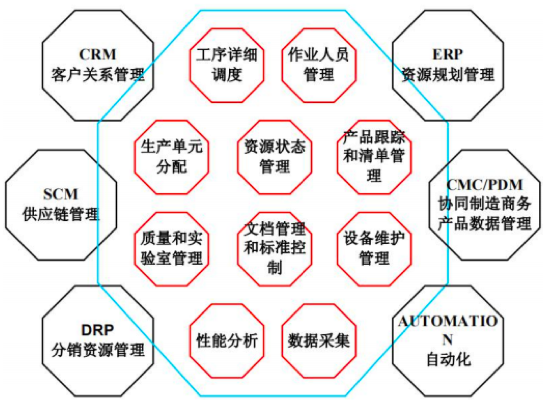
制造执行系统协会(MESA)归纳出MES涵盖的工序详细调度、资源分配和状态管理、生产单元分配、过程管理、人力资源管理、维护管理、质量管理、文档控制、产品跟踪和产品清单管理、性能分析和数据采集等十一个主要的功能模块。实际的MES产品通常是根据企业定制开发,结合业务模式和需求特点,选取其中几个模块形成支撑企业运行的MES系统。在MES的十一个功能模块中,工序详细调度、资源分配和状态管理和生产单元分配是与下面介绍的APS系统是息息相关的。
APS高级计划与排程系统是专业的企业排程管理软件。是对所有资源具有同步的,实时的,具有约束能力的模拟能力,不论是物料,机器设备,人员,供应,客户需求等影响计划因素。APS系统主要解决在有限产能条件下,交期产能精确预测、工序生产与物料供应最优详细计划的问题。解决复杂的生产计划排程问题必须借助于APS系统。APS系统除了能制定合理优化的详细生产计划还能够将实绩与计划结合,是企业实现精益生产、敏捷制造的有效工具。针对多约束条件下的复杂排产问题,APS的核心算法发挥了作用,其应用到的主要算法有启发式算法和智能优化算法两类。 数字化转型网(www.szhzxw.cn)
其中,启发式算法包括:启发式规则方法、专家系统法和拉格朗日松弛法;智能优化算法包括:神经网络(NN)、模拟退火(SA)、遗传算法(GA)禁忌搜索(TS)和粒子群算法(PSO)等。这些算法对一些特定的需求都有各自的特点,有些“算得快”,但结果不是最优解,有些收敛极慢不实用。针对APS数学求解问题,美国应用数学家EYUANSHI提出了分割嵌套(NP)算法,证明生成马克夫链,实现全局收敛,并可以给出离最优解的置信区间,被业界认可为解决复杂系统优化的有效算法。
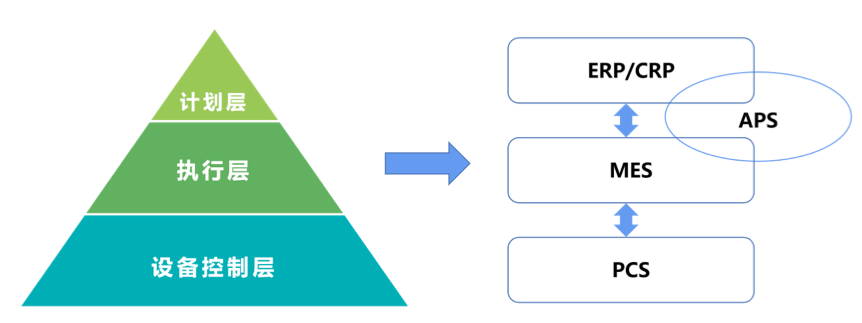
APS与MES、ERP关系如下图2所示,PCS系统以设备综合管理控制为目的,位于系统底层,MES位于ERP和PCS之间,APS与MES、ERP有交叉重合之处。APS如果作为一个独立的子系统,其功能的实现离不开ERP、MES数据的集成。在APS的发展过程中,曾一度被ERP厂商列入其中,现在逐渐向MES靠拢,某些MES厂商提供的MES产品是具备APS排产功能的,鉴于APS强大的算法,也被当做独立的一个信息系统产品在市面上销售。 数字化转型网(www.szhzxw.cn)
从这个过程中,我们也可以知晓APS与MES、ERP系统的紧密连接关系。因此有必要研究系统间涉及哪些数据交互,系统间如何实现集成。APS与MES集成的效益也是显而易见的,能够使车间资源效率最大化,及时处理变动的订单和变化的资源,快速解决插单难题,减少停机、等待时间,保障库存物料的合理配给,通过智能调度,实现柔性排产。
二、集成数据分析
(一)计划资源数据
计划资源数据主要是与企业经营相关的数据,如订货合同、销售合同、交货期、物流期等。对ERP、APS而言,计划资源数据是系统的业务源头,也是数据依据,是需求量化为数据、信息资料的第一部分,可供系统去使用。ERP中的MRP算法其实就是把平时手工的工作方式电子化,也是计划资源数据形成和流通的基础。APS通过集成计划资源数据,可形成主计划,从而再细化为车间计划、作业计划等。
(二)BOM数据
BOM可以分为设计BOM、工艺BOM、制造BOM三类。一般在企业内部由设计部门根据订单设计产品,形成设计BOM;工艺部门根据设计部门提供的设计BOM,完成工艺流程编制、材料定额、工艺流程审批等,通过ERP接口程序完成流转件拆分与工艺BOM输出;现场人员根据工艺BOM,完成工装配置、物料分配、工艺路线、工艺规程输出,通过ERP接口输出制造BOM。在这里ERP中的MRP可对BOM分解计算,APS系统计算性能更强,慢慢替代了MRP的计算工作,制定出更加细化的BOM。MES也是依靠制造BOM数据运行的。
(三)物料数据等
物料数据,包括库存数据和在制品流转数据,通常是MES通过条码系统、RFID、手工录入等方式对在制品和出入库进行管理,并且物料基础信息在MES数据库可进行提前录入和统一管理。MES集成了PCS层数据,为ERP和APS提供可靠的数据信息。 数字化转型网(www.szhzxw.cn)
三、集成技术实现方法
在技术上一般有3种方法数据集成:使用同样数据库表格;使用公共文件;数据库间程序或软件数据自动传递方式。
(一)公共部分使用同样数据库表格
使用同样数据库的系统,如Oracle、Sqlserver等。其中的BOM表可以考虑设置成为同一张表。但由于信息系统厂商的封闭性,这种方式往往受到限制。如果是同一厂家或者是开放性较好的系统之间可以采取此种集成办法。
(二)使用数据自动传递方式
数据自动传递,是通过数据库触发器传递数据,传输容易实现,成本较低。Sql server是APS、MES和ERP系统常用的数据库。Sql server数据库带有触发器的功能,利用触发器功能编写代码,代码是自动触发的。当对表中的数据做了任何修改之后立即被激活,然后程序运行,对其它数据表进行修改。基本的触发器包括一下3种类型:Ainsert触发器:向表中插入数据时被触发;Bupdate触发器:修改表中数据时被触发;Cdelete触发器:从表中删除数据时被触发。 数字化转型网(www.szhzxw.cn)
(三)使用中间件
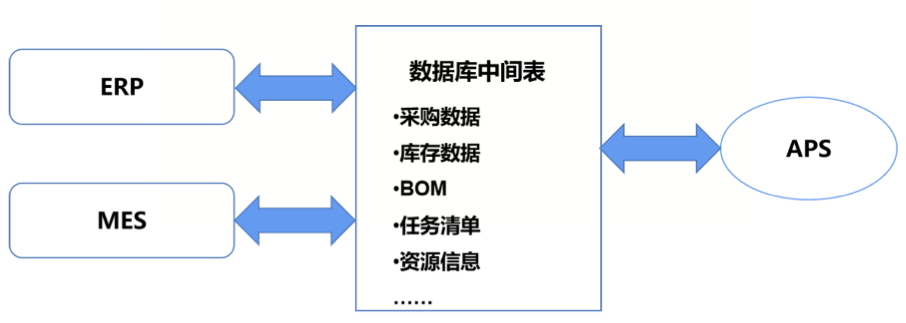
在数字制造集成环境中,为了解决异构系统集成,实现信息资源共享,提出了中间件MW的概念。中间件是一个软件,它通过规定一系列应用编程接口,转换客户端和服务器端之间的访问、通性来实现其屏蔽底层异构性的作用。数据库通讯指现场设备直接通过控制程序向MES开放的指定的数据库表格中存储当前工件的加工质量数据以及工艺数据。(如图3所示)
(四)使用XML
数据交换标准可扩展标记语言XML统一产品信息模型。ERP/PDM/MES/PCS的数据库体系是一个典型的分布式数据库。数据库分布在管理层、车间或生产单元,这给分布异构数据库系统的信息集成和共享带来了困难。
XML是一个简单灵活的标准格式,适用于网上发布和数据交换给跨平台跨地域异构应用间的协同工作,契合分布异构数据库系统的信息集成和共享需求。不同数据库间使用XML可以使用已定义的公共数据结构交换信息,也可自定义格式,收发方通过XML达到信息共享与数据交换的目的。主要用于MES与ERP等系统集成。 数字化转型网(www.szhzxw.cn)
四、总结
MES鉴于APS、MES、ERP系统集成可能涉及不同系统供应商,建议采取数据库中间表的方式,独立开发完成,在保障较高集成开发效率的同时,定义好数据库中间表格式,明确数据认责。
APS可以作为独立系统出售,也可集成在MES内,支撑MES的排产算法,研究MES与APS集成的数据流,包括与ERP交互的数据,能够帮助企业在信息系统集成工作中理解其集成数据来源及流动过程。针对具体企业流程应综合考虑数据集成,重视APS在业务中的应用,采取适宜的APS与MES系统集成实现方法,为企业数字化转型提供信息系统建设思路。

翻译:
APS and MES data integration method
In the context of enterprise digital transformation, ERP/MES/PCS and other information systems have achieved phased results, and system integration has become an inevitable trend. Among them, MES is the hub of the planning layer and the workshop control layer, which has the production scheduling function with ERP, while ASP is the advanced production scheduling system, which has a more powerful and detailed algorithm. APS, whether as an independent system or as a component of MES or ERP, should straighten out its data flow, so this paper expounds the data integration and implementation methods of APS, MES and ERP. 数字化转型网(www.szhzxw.cn)
First, introduction of MES and APS
MES production execution system is a set of production information management system for workshop execution level of manufacturing enterprises, located between ERP and PCS process control system of enterprise resource planning layer. As an intermediate bridge between ERP and PCS, MES helps enterprises realize vertical integration and opens up the information flow from equipment, production to planning layer, and has been widely promoted and applied in enterprises.
Figure 1 MES function module
The Manufacturing Execution Systems Association (MESA) has summarized 11 main functional modules covered by MES, such as detailed scheduling of processes, resource allocation and status management, production unit allocation, process management, human resource management, maintenance management, quality management, document control, product tracking and product inventory management, performance analysis and data collection. The actual MES products are usually customized according to the enterprise development, combined with the business model and demand characteristics, select several modules to form an MES system to support the operation of the enterprise. In the eleven functional modules of MES, detailed scheduling of processes, resource allocation and state management and production unit allocation are closely related to the APS system described below.
APS Advanced Planning and Scheduling System is a professional enterprise scheduling management software. It is a synchronous, real-time, constrained simulation capability for all resources, whether materials, machinery, equipment, personnel, supplies, customer demand, and other planning factors. APS system mainly solves the problem of accurate prediction of delivery capacity, detailed planning of process production and optimal material supply under the condition of limited capacity. APS system must be used to solve complex production planning and scheduling problems. APS system can not only make a reasonable and optimized detailed production plan, but also combine the performance with the plan. It is an effective tool for enterprises to realize lean production and agile manufacturing. For complex scheduling problems under multiple constraints, APS core algorithms play an important role, and the main algorithms applied to APS are heuristic algorithm and intelligent optimization algorithm.
Heuristic algorithms include: heuristic rule method, expert system method and Lagrange relaxation method; Intelligent optimization algorithms include neural network (NN), simulated annealing (SA), Genetic algorithm (GA) tabu search (TS) and particle swarm optimization (PSO). These algorithms have their own characteristics for some specific needs, some “calculate fast”, but the result is not the optimal solution, and some convergence is extremely slow and impractical. For APS mathematical solution problem, the American applied mathematician EYUANSHI proposed the segmentation nesting (NP) algorithm, proved to generate Markov chain, achieve global convergence, and can give the confidence interval from the optimal solution, which is recognized as an effective algorithm to solve the optimization of complex systems. 数字化转型网(www.szhzxw.cn)
Figure 2 Interaction between APS, MES and ERP
The relationship between APS and MES and ERP is shown in Figure 2 below. PCS system is located at the bottom of the system for the purpose of integrated management and control of equipment, MES is located between ERP and PCS, and APS overlaps with MES and ERP. If APS is an independent subsystem, its function can not be realized without the integration of ERP and MES data. In the development process of APS, it was once included in the ERP manufacturers, and now it is gradually closer to MES, some MES products provided by MES manufacturers are equipped with APS scheduling functions, in view of the powerful algorithm of APS, it is also sold as an independent information system product on the market.
From this process, we can also know the close connection between APS and MES, ERP system. Therefore, it is necessary to study what data interaction is involved between systems and how to achieve integration between systems. The benefits of APS and MES integration are also obvious, which can maximize the resource efficiency of the workshop, timely deal with changing orders and changing resources, quickly solve the problem of inserting orders, reduce downtime and waiting time, ensure the reasonable allocation of inventory materials, and realize flexible scheduling through intelligent scheduling.
Second, integrated data analysis
(1) Planned resource data
Planning resource data is mainly related to enterprise operation data, such as ordering contract, sales contract, delivery date, logistics period, etc. For ERP, APS, planning resource data is the source of the system’s business, but also the data basis, is the first part of the demand into data, information data, available for the system to use. In fact, the MRP algorithm in ERP is to electronize the usual manual work mode, and it is also the basis for the formation and circulation of planning resource data. By integrating planning resource data, APS can form a master plan, which can then be refined into workshop plans, operation plans, etc. 数字化转型网(www.szhzxw.cn)
(2)BOM data
BOM can be divided into three categories: design BOM, process BOM and manufacturing BOM. Generally, the design department in the enterprise designs products according to the order, forming the design BOM; According to the design BOM provided by the design department, the process department completes the process preparation, material quota, process approval, etc., and completes the flow parts splitting and process BOM output through the ERP interface program; According to the process BOM, the field personnel complete the tooling configuration, material distribution, process route, process regulation output, and output the manufacturing BOM through the ERP interface. In this ERP MRP can decompose the BOM calculation, APS system calculation performance is stronger, slowly replace the MRP calculation work, develop a more detailed BOM. MES also runs on manufacturing BOM data.
(3) Material data, etc
Material data, including inventory data and work-in-process flow data, are usually managed by MES through barcode system, RFID, manual entry, etc., and basic material information can be entered and unified management in advance in the MES database. MES integrates PCS layer data to provide reliable data information for ERP and APS.
Third, integration technology realization method
In technology, there are generally three methods of data integration: using the same database table; Use public documents; Automatic transfer of program or software data between databases.
(1) Use the same database form for the public part
Use the same database system, such as Oracle, Sqlserver, etc. The BOM table can be considered to be the same table. However, due to the closed nature of information system manufacturers, this approach is often limited. This integration approach can be taken if it is between the same manufacturer or a better open system. 数字化转型网(www.szhzxw.cn)
(2) Using automatic data transfer methods
Automatic data transfer, is to transfer data through the database trigger, transmission is easy to achieve, low cost. Sql server is a commonly used database in APS, MES and ERP systems. Sql server database with trigger function, the use of trigger function to write code, code is automatically triggered. It is activated immediately after any changes are made to the data in the table, and then the program runs to make changes to other data tables. There are three basic types of triggers :Ainsert trigger: Triggered when data is inserted into a table; Bupdate trigger: Triggered when modifying data in a table. Cdelete trigger: Triggered when data is deleted from a table.
(3) Use middleware
In order to integrate heterogeneous systems and share information resources in digital manufacturing integration environment, the concept of middleware MW is proposed. Middleware is a piece of software that shields underlying heterogeneity by specifying a series of application programming interfaces that transform access and connectivity between the client and the server. Database communication refers to the storage of the machining quality data and process data of the current workpiece in the specified database form opened to MES by the field equipment directly through the control program. (As shown in Figure 3) 数字化转型网(www.szhzxw.cn)
FIG. 3 Integration of APS, MES and ERP based on intermediate table
(4) Use XML
Data exchange Standard Extensible Markup Language XML Unified Product Information Model. ERP/PDM/MES/PCS database system is a typical distributed database. The database is distributed in management level, workshop or production unit, which makes it difficult to integrate and share information in distributed heterogeneous database system.
XML is a simple and flexible standard format, which is suitable for the collaborative work of online publishing and data exchange to cross-platform cross-region heterogeneous applications, and meets the information integration and sharing requirements of distributed heterogeneous database systems. Using XML between different databases can use the defined common data structure to exchange information, but also can customize the format, the receiver and receiver through XML to achieve the purpose of information sharing and data exchange. Mainly used for MES and ERP system integration.
Fourth, summary
In view of the APS, MES, ERP system integration may involve different system suppliers, it is recommended to take the database intermediate table method, independent development is completed, in order to ensure higher integration development efficiency at the same time, define the database intermediate table form, clear data recognition. 数字化转型网(www.szhzxw.cn)
APS can be sold as an independent system or integrated in MES to support the scheduling algorithm of MES. Studying the data flow integrated between MES and APS, including the data interacting with ERP, can help enterprises understand the source and flow process of their integrated data in the integration of information systems. According to the specific enterprise process, data integration should be comprehensively considered, APS should be attached importance to the application of APS in the business, and appropriate APS and MES system integration implementation methods should be adopted to provide information system construction ideas for the digital transformation of enterprises.
本文由数字化转型网(www.szhzxw.cn)转载而成,来源于新工业网;编辑/翻译:数字化转型网宁檬树。
免责声明: 本网站(http://www.szhzxw.cn/)内容主要来自原创、合作媒体供稿和第三方投稿,凡在本网站出现的信息,均仅供参考。本网站将尽力确保所提供信息的准确性及可靠性,但不保证有关资料的准确性及可靠性,读者在使用前请进一步核实,并对任何自主决定的行为负责。本网站对有关资料所引致的错误、不确或遗漏,概不负任何法律责任。
本网站刊载的所有内容(包括但不仅限文字、图片、LOGO、音频、视频、软件、程序等) 版权归原作者所有。任何单位或个人认为本网站中的内容可能涉嫌侵犯其知识产权或存在不实内容时,请及时通知本站,予以删除。