扫码加入数字化转型网数据要素X专题研习社:

摘要:在数字化时代,数据已成为企业最宝贵的资产之一。有效的数据治理不仅能够提升企业的决策质量,还能增强企业的竞争力。然而,实现成功的数据治理并非易事,它需要企业在多个方面进行深思熟虑和精心规划。目前根据McKinsey 的估计,一个中等规模的金融机构每年在数据治理上的投入大约在2000 万到5000 万美元之间。另一方面,在作出了诸多努力和尝试后,企业面临的数据问题和挑战似乎并没有减少,治理效果与预期之间似乎总是存在差距。据Gartner 的估算5,企业每年因为数据质量问题而需要付出平均约为1290 万美元的额外成本。
本文将从数据治理的基本现状出发,探讨数据治理的基本框架,并提出如何提升数据治理的投入产出比,以期为企业在数据管理领域提供指导和参考。
一、数据治理的现状
数据治理项目是一项复杂且比较难以成功的项目,如何说它难以成功,是目前的数据治理的项目的常见现象是:在经历多年的数据治理之后,相应的数据治理投入逐年增加,但是取得的治理效果或收益却不尽如人意。 数字化转型网(www.szhzxw.cn)
如下是常见的数据治理项目的情况:
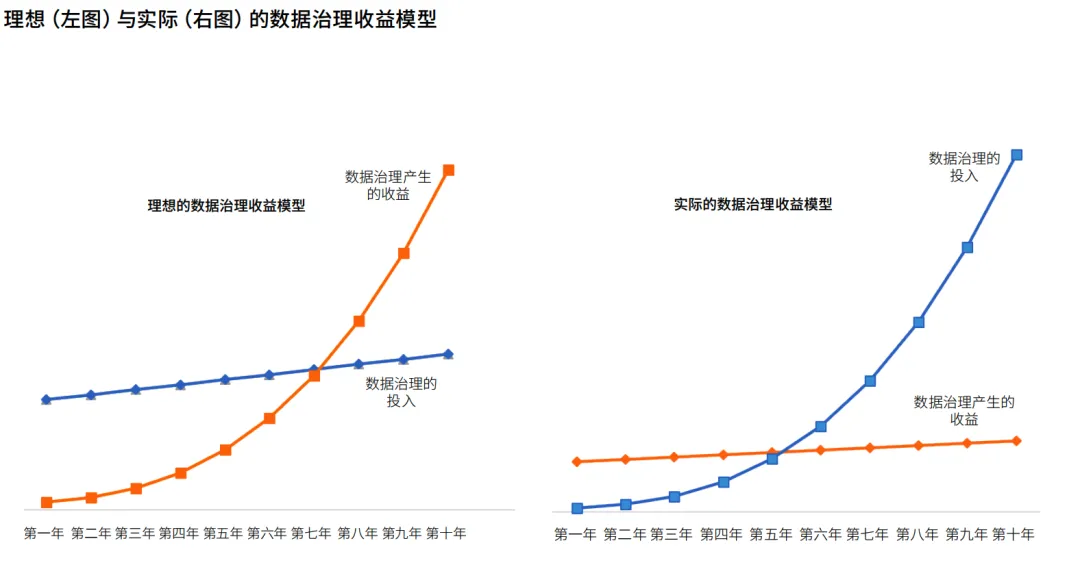
图来源:《【IBM】谋定后动,强化共识聚焦主数据,全面提升数据治理能力》
以上两张图说了数据治理项目的理想模型和实际模型收益模型上的差异。
(一)理想模型:
- 初始投入:在数据治理的初期,企业需要进行较大的投入来建立治理框架和基础。
- 持续优化:随着治理工作的不断推进,企业通过优化流程和技术,逐渐降低边际成本。
- 收益递增:在某个时间点之后,治理带来的边际收益开始超过边际成本,实现正向收益。
(二)现实模型:
- 持续增长的投入:在多年的数据治理实践中,企业发现需要持续增加投入,以应对不断变化的数据环境和技术需求。
- 收益增长缓慢:尽管投入不断增加,但治理效果的提升并不明显,导致收益增长缓慢。
- 成本效益不匹配:治理成本的增长速度超过了收益的增长,导致成本效益不匹配。
而导致现实模型的收益不明显的主要原因有如下几个原因:
1、技术更新迅速:数据治理技术快速发展,企业需要不断更新技术以保持竞争力,这导致成本的持续增加。例如企业在引入AIGC等项目时,同时需要对数据治理的相关技术进行更新,导致数据治理的项目也随着新项目和技术的引入而出现新的治理成本。 数字化转型网(www.szhzxw.cn)
2、治理策略不明确:缺乏清晰的治理策略和目标,使得投入无法有效转化为收益。企业在数字化转型的时候,没有将数据治理的目录和企业的数字化转型的业务目标挂勾,导致数据治理人员为了治理而治理,并且存在部分治理可能不能直接产生相关的效益和收益。
3、人员培训不足:员工对数据治理的认识和技能不足,导致治理效率低下。部分数据治理的人员对数据治理的整体框架认知不足,以及数据治理的相关行业标准了解不足,导致数据治理的项目出现反复的现象。
4、流程优化不足:治理流程可能存在冗余或低效环节,未能充分利用资源。
二、数据治理的基本框架
DAMA(数据管理协会)提供了一套全面的数据治理框架,旨在帮助组织有效地管理和利用其数据资产。参考DAMA数据治理的框架:
(一)数据治理的基本框架
数据架构(Data Architecture)
数据架构是数据治理的基础,它定义了数据存储、组织和流动的方式。这包括数据模型、数据库设计、数据仓库、数据湖等技术架构,以及数据集成和交换的策略。
元数据管理(Metadata Management)
元数据是描述数据的数据,它提供了数据的上下文和含义。有效的元数据管理有助于组织理解数据的来源、用途和关系,支持数据的发现、检索和分析。 数字化转型网(www.szhzxw.cn)
数据标准(Data Standards)
数据标准确保数据在整个组织中的一致性和准确性。这包括数据定义、数据类型、格式、编码规则和术语等。数据标准的制定和执行有助于减少数据错误和歧义。
数据模型(Data Modeling)
数据模型是数据结构的蓝图,它定义了数据实体之间的关系和属性。良好的数据模型支持业务需求,促进数据的整合和一致性,提高数据的可用性和灵活性。
数据质量管理(Data Quality Management)
数据质量管理关注数据的准确性、完整性、一致性、可靠性和时效性。通过监控、评估、清洗和改进数据质量,组织可以确保数据的可靠性,支持有效的业务决策。
三、企业内部数据治理成功的关键影响因素
数据治理有明确的框架和执行流程,那么在企业内部,影响企业数据治理成果的关键因素是什么?
1. 高层支持与领导力
数据治理的成功始于高层的支持。企业领导必须认识到数据治理的重要性,并将其作为企业战略的一部分。高层的积极参与和领导力能够确保数据治理计划得到必要的资源和关注。
2. 明确的数据治理策略
一个清晰的数据治理策略是成功的基石。企业需要制定一套全面的策略,包括数据的定义、分类、使用、保护和质量控制等方面。此外,策略还应包括数据治理的目标、原则和标准。
3. 组织结构与角色定义
数据治理需要一个明确的组织结构和角色分配。企业应该设立专门的数据治理委员会,负责监督和指导数据治理的实施。同时,明确各个角色的职责和权限,确保数据治理流程的顺畅执行。
4. 技术基础设施
强大的技术基础设施是数据治理的支撑。企业需要投资于数据管理工具和技术,如数据仓库、数据湖、数据质量管理工具等,以支持数据的收集、存储、处理和分析。
5. 员工培训与文化建设
员工是数据治理的执行者。企业应该对员工进行数据治理相关的培训,提高他们的数据意识和技能。同时,建立一种数据驱动的企业文化,鼓励员工积极参与数据治理活动。
6. 持续改进与反馈机制
数据治理是一个持续的过程,需要不断的评估和改进。企业应该建立反馈机制,收集员工和客户的意见和建议,不断优化数据治理流程。数据治理的成功需要企业在战略、组织、技术、人员和流程等多个方面进行综合考虑和投入。通过上述关键因素的实施,企业可以建立起一个健全的数据治理体系,从而在数据驱动的商业环境中获得竞争优势。
四、如何提升数据治理的投入产出比
提升数据治理的投入产出比是确保企业资源得到有效利用并实现数据治理价值最大化的关键。为提升数据治理投入产出比,以下是数据治理项目需要调整的关键策略:
1. 明确数据治理的目标和原则
与业务目标挂钩:确保数据治理的目标与企业的整体业务目标紧密相连。数据治理项目应该直接支持业务成果,如提高运营效率、增强客户满意度或增加收入。优先级管理:对于那些与业务目标关系不大的数据治理事项,应降低其优先级,避免资源浪费。 数字化转型网(www.szhzxw.cn)
2. 依据数字化转型的资产蓝图设定目标
范围限定:避免数据治理的范围无序扩展,专注于与数字化转型资产蓝图紧密相关的项目。明确产出:为每项数据治理活动设定清晰的产出目标,确保每项投入都能产生可量化的结果。
3. 获得业务方的支持
跨部门合作:确保数据治理项目得到业务部门的支持和参与,形成跨部门的合作机制。共同责任:将数据治理的责任和绩效指标纳入业务部门的考核体系,使数据治理成为组织内所有成员的共同责任。
4. 制定合理的数据治理策略
策略制定:基于业务需求和数据价值,制定合理的数据治理策略。持续评估:定期评估数据治理策略的有效性,并根据业务发展和市场变化进行调整。
5. 利用技术和自动化工具
技术投资:投资于先进的数据管理技术和工具,以提高数据治理的效率和准确性。自动化流程:自动化数据治理流程,减少人工干预,降低错误率和成本。
6. 强化数据治理的组织结构和流程
组织结构:建立清晰的数据治理组织结构,明确各个角色和职责。流程优化:优化数据治理流程,确保流程的高效和透明。
7. 培养数据文化
数据意识:提高全员的数据意识,培养数据驱动的企业文化。培训与发展:对员工进行数据治理相关培训,提升他们的数据管理和分析能力。 数字化转型网(www.szhzxw.cn)
8. 监控和评估数据治理绩效
绩效指标:建立数据治理绩效指标,监控数据治理活动的效果。持续改进:基于绩效评估结果,持续改进数据治理实践。
提升数据治理的投入产出比需要企业从战略层面到执行层面进行全面的规划和管理。通过明确目标、优化资源配置、强化技术和流程、培养数据文化以及持续监控和改进,企业可以有效地提升数据治理的效率和效果,实现数据资产的最大价值。希望这些策略能够为企业提供实际可行的方法来提升数据治理的投入产出比。
五、数字化转型网数据要素X专题包含哪些内容?
数字化转型网数据要素X专题将关注数据治理、数据质量管理、数据架构、主数据管理、数据仓库、元数据管理、数据备份、数据挖掘、数据分析、数据安全、大数据、数据合规、等数据相关全产业链相关环节。
数字化转型网数据要素X专题包含: 数字化转型网(www.szhzxw.cn)
1、数据相关外脑支持:100+数据相关专家、100+数据实践者、1000+相关资料
2、数据要素X研习社:与全球数据相关专家、实践者共同探讨相关问题,推动产业发展!
3、国际认证培训:目前已引进DAMA国际认证CDMP,其他国内外认证也在逐步引进中
4、典型案例参考:与数字化转型网数据要素X研习社社员一起学习典型案例,共探企业数据落地应用

翻译:
Data governance: Status quo, framework and improving input-output ratio
Scan code to join the Digital Transformation Network Data Elements X Project Learning Club:
Abstract: In the digital age, data has become one of the most valuable assets of enterprises. Effective data governance can not only improve the quality of decision-making, but also enhance the competitiveness of enterprises. However, achieving successful data governance is no easy task, and it requires thoughtful and careful planning on multiple fronts. McKinsey estimates that a mid-sized financial institution spends between $20 million and $50 million per year on data governance. On the other hand, after many efforts and attempts, the data problems and challenges faced by enterprises do not seem to decrease, and there always seems to be a gap between the governance effectiveness and expectations. Gartner estimates that data quality issues cost businesses an average of $12.9 million per year in additional costs.
This paper will start from the basic status of data governance, discuss the basic framework of data governance, and propose how to improve the input-output ratio of data governance, in order to provide guidance and reference for enterprises in the field of data management.
1. Current situation of data governance
Data governance project is a complex and relatively difficult to succeed project, how to say it is difficult to succeed, is the current data governance project common phenomenon is: after years of data governance, the corresponding data governance investment increases year by year, but the governance effect or benefits are not satisfactory.
The following is the case for common data governance projects:
Source: “[IBM] Plan to move, Strengthen consensus, Focus on master data, and comprehensively improve data governance capabilities”
The above two diagrams illustrate the difference between the ideal model and the actual model benefit model for a data governance project. 数字化转型网(www.szhzxw.cn)
(1) Ideal model:
Initial investment: In the early days of data governance, enterprises need to make large investments to establish the governance framework and foundation.
Continuous optimization: As governance efforts continue to advance, enterprises gradually reduce marginal costs by optimizing processes and technologies.
Increasing returns: After a certain point in time, the marginal benefits brought by governance begin to exceed the marginal costs and achieve positive returns.
(II) Reality model:
Growing Investment: Over the years of data governance practices, organizations have found that they need to continuously increase investment to respond to the changing data environment and technology requirements.
Slow revenue growth: Although investment continues to increase, the improvement of governance effect is not obvious, resulting in slow revenue growth.
Cost-benefit mismatch: Governance costs are growing faster than benefits, resulting in a cost-benefit mismatch. 数字化转型网(www.szhzxw.cn)
The main reasons leading to the non-obvious benefits of the realistic model are as follows:
1. Rapid technology update: the rapid development of data governance technology, enterprises need to constantly update technology to maintain competitiveness, which leads to continuous increase in costs. For example, when an enterprise introduces AIGC and other projects, it needs to update related technologies of data governance at the same time, resulting in new governance costs for data governance projects along with the introduction of new projects and technologies.
2. Unclear governance strategy: Lack of clear governance strategy and objectives, so that investment can not be effectively converted into benefits. In the process of digital transformation, enterprises do not link the catalog of data governance with the business objectives of digital transformation of enterprises, resulting in data governance personnel to govern for the sake of governance, and some governance may not directly generate related benefits and benefits.
3. Insufficient personnel training: employees have insufficient knowledge and skills of data governance, resulting in low governance efficiency. Some data governance personnel have insufficient understanding of the overall framework of data governance and the relevant industry standards of data governance, resulting in repeated data governance projects.
4. Insufficient process optimization: There may be redundant or inefficient links in the governance process, which fails to make full use of resources.
2. Basic framework of data governance
DAMA (Data Management Association) provides a comprehensive data governance framework designed to help organizations effectively manage and leverage their data assets. Refer to DAMA’s data governance framework: 数字化转型网(www.szhzxw.cn)
(I) The basic framework of data governance
Data Architecture (Data Architecture)
Data architecture is the foundation of data governance, which defines how data is stored, organized, and flowed. This includes technical architectures such as data models, database design, data warehouses, data lakes, and strategies for data integration and exchange.
Metadata Management
Metadata is the data that describes the data, which provides the context and meaning of the data. Effective metadata management helps organizations understand the source, use, and relationship of data, and supports data discovery, retrieval, and analysis.
Data Standards (Data Standards)
Data standards ensure consistency and accuracy of data throughout the organization. This includes data definitions, data types, formats, coding rules, and terminology. The development and enforcement of data standards helps reduce data errors and ambiguities.
Data Modeling
A data model is a blueprint of a data structure that defines the relationships and properties between data entities. A good data model supports business requirements, promotes data integration and consistency, and improves data availability and flexibility. 数字化转型网(www.szhzxw.cn)
Data Quality Management
Data quality management focuses on the accuracy, completeness, consistency, reliability and timeliness of data. By monitoring, evaluating, cleaning, and improving data quality, organizations can ensure the reliability of data to support effective business decisions.
3. Key factors affecting the success of internal data governance
With a clear framework and implementation process for data governance, what are the key factors within the enterprise that affect enterprise data governance outcomes?
- Senior support and leadership
Data governance success starts with support from the top. Business leaders must recognize the importance of data governance and make it part of their corporate strategy. Active involvement and leadership at the top ensures that data governance initiatives receive the necessary resources and attention. 数字化转型网(www.szhzxw.cn)
- Clear data governance policy
A clear data governance strategy is the cornerstone of success. Companies need to develop a comprehensive strategy that covers the definition, classification, use, protection, and quality control of data. In addition, the policy should include data governance goals, principles, and standards.
- Organizational structure and role definition
Data governance requires a clear organizational structure and role allocation. A dedicated Data governance committee should be established to oversee and guide the implementation of data governance. At the same time, clarify the responsibilities and authorities of each role to ensure the smooth execution of the data governance process.
- Technical infrastructure
A strong technical infrastructure underpins data governance. Enterprises need to invest in data management tools and technologies such as data warehouses, data lakes, data quality management tools, etc., to support the collection, storage, processing, and analysis of data.
- Staff training and cultural construction
Employees are the executors of data governance. Organizations should train their employees on data governance to improve their data awareness and skills. At the same time, establish a data-driven corporate culture that encourages employees to actively participate in data governance activities.
- Continuous improvement and feedback mechanism
Data governance is an ongoing process that requires constant evaluation and improvement. Companies should set up feedback mechanisms to collect opinions and suggestions from employees and customers to continuously optimize their data governance processes. The success of data governance requires a combination of strategic, organizational, technical, people and process considerations. Through the implementation of these key factors, enterprises can establish a robust data governance system to gain a competitive advantage in a data-driven business environment.
Fourth, how to improve the input-output ratio of data governance
Improving the input-output ratio of data governance is the key to ensuring the efficient use of enterprise resources and maximizing the value of data governance. To improve the data governance input-output ratio, here are the key strategies that data governance projects need to adjust:
- Define the objectives and principles of data governance
Alignment with Business goals: Ensure that the goals of data governance are closely aligned with the overall business goals of the enterprise. Data governance projects should directly support business outcomes such as improved operational efficiency, enhanced customer satisfaction, or increased revenue. Priority management: Data governance matters that have little to do with business goals should be de-prioritized to avoid wasting resources. 数字化转型网(www.szhzxw.cn)
- Set goals based on the asset blueprint for digital transformation
Limited scope: Avoid undisciplined expansion of the scope of data governance and focus on projects that are closely aligned with the digital transformation asset blueprint. Clear outputs: Set clear output goals for each data governance activity to ensure that each input produces quantifiable results.
- Obtain support from the business side
Cross-functional collaboration: Ensure that data governance projects have the support and participation of business units to form cross-functional cooperation mechanisms. Shared responsibility: Integrate data governance responsibilities and performance indicators into the business unit’s assessment system, making data governance a shared responsibility of all members of the organization.
- Develop reasonable data governance policies
Policy development: Develop reasonable data governance policies based on business needs and data value. Continuous assessment: Periodically assess the effectiveness of your data governance strategy and adjust it in response to business developments and market changes.
- Use technology and automated tools
Invest in advanced data management technologies and tools to improve the efficiency and accuracy of data governance. Automate processes: Automate data governance processes to reduce human intervention, error rates and costs. 数字化转型网(www.szhzxw.cn)
- Strengthen the organizational structure and process of data governance
Organizational structure: Establish a clear organizational structure for data governance with clear roles and responsibilities. Process Optimization: Optimize data governance processes to ensure they are efficient and transparent.
- Cultivate a data culture
Data awareness: improve the data awareness of all employees and cultivate a data-driven corporate culture. Training and Development: Conduct data governance training for employees to improve their data management and analysis skills. 数字化转型网(www.szhzxw.cn)
- Monitor and evaluate data governance performance
Performance indicators: Establish data governance performance indicators to monitor the effectiveness of data governance activities. Continuous improvement: Continuous improvement of data governance practices based on performance evaluation results.
Improving the input-output ratio of data governance requires comprehensive planning and management from the strategic level to the executive level. By clarifying goals, optimizing resource allocation, strengthening technologies and processes, cultivating a data culture, and continuously monitoring and improving, organizations can effectively improve the efficiency and effectiveness of data governance to maximize the value of their data assets. Hopefully, these strategies will provide enterprises with practical ways to improve the input-output ratio of data governance.
What does the Digital Transformation Network Data Elements X project contain?
The Digital Transformation Network Data Elements X topic will focus on data governance, data quality management, data architecture, master data management, data warehouse, metadata management, data backup, data mining, data analysis, data security, big data, data compliance, and other relevant links of the data-related whole industry chain.
Digital Transformation Network Data Elements X topics include:
1. Data related external brain support: 100+ data related experts, 100+ data practitioners, 1000+ related materials
2. Data Elements X Workshop: Discuss related issues with global data-related experts and practitioners to promote industrial development! 数字化转型网(www.szhzxw.cn)
3. International certification training: At present, DAMA international certification CDMP has been introduced, and other domestic and foreign certifications are gradually introduced
4. Reference of typical cases: Learn typical cases together with members of Digital Transformation Network Data Elements X Study Club to explore the application of enterprise data
本文由数字化转型网(www.szhzxw.cn)转载而成,来源于数字化转型网公众号;编辑/翻译:数字化转型网宁檬树。