省级大数据局是新一轮机构改革中许多省份的“自选动作”,对完善地方政府数据治理体系意义重大。研究发现,省级大数据局的机构设置多突出大数据发展和管理职能,主要有省政府直属机构、部门管理机构和挂牌机构三类,职能配置整合了大数据决策、执行与监督管理权,总体上呈现出相对集中大数据管理职能和从侧重行业管理、政务管理转向大数据综合治理的大趋势。
当前,省级大数据局运行中仍存在机构性质不明确、职能定位不清晰、职能配置不科学等挑战。优化地方大数据机构职能体系,亟需明确大数据行政管理职能的内涵外延,合理划分大数据局与相关部门职责分工,构建多元主体共建共享的数字政府体系。数字化转型网www.szhzxw.cn
党的十八大以来,地方政府设立大数据管理局是机构与行政体制改革一个值得关注的新动向。从宏观层面看,设立大数据局是各级政府贯彻落实党中央、国务院网络强国战略部署,加快建设“数字中国”“智慧社会”,充分利用信息化技术手段提高政府履职能力的重要举措。在中观层面,大数据局整合原分散于地方发改、经信等多个部门的相关职能,为构建统一高效的地方政府数据治理体系探索了有益经验。
省级大数据局在国家数字治理的宏观架构中处于承上启下的关键位置,对完善地方政府数据治理体系意义重大。2018年深化党和国家机构改革为各地组建省级大数据局提供了难得机遇。本轮机构改革提出,在确保中央集中统一领导的前提下赋予省级及以下机构更多自主权,允许地方因地制宜设置机构和配置职能。
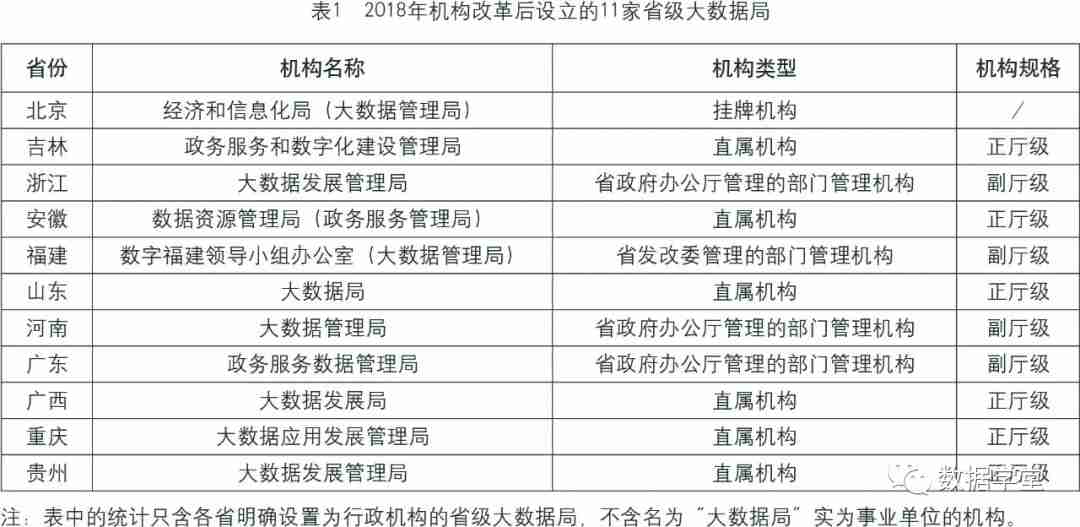
据不完全统计,北京、重庆、广东、浙江、贵州、山东、广西、吉林、福建、安徽、河南等地在省级机构改革方案中设立了专责大数据管理的行政机构。这些省级大数据局在省域内发挥顶层设计、总体布局、统筹协调和整体推进作用,有利于建立起标准统一、上下协同、运行高效的数字治理组织体系,加快建设集约化、一体化的数字政府。此外,省级大数据局的机构设置和职能配置模式将对后续开展的市县机构改革起示范作用,促进省域内各级大数据局优化机构、调整职能,健全省市县三级协同联动机制。
以各地公布的省级机构改革方案为线索,分析11个省级大数据局的机构设置与职能配置情况,为构建更加科学合理的地方政府数据治理机构职能体系提出优化建议。数字化转型网www.szhzxw.cn
中国地方大数据管理机构的数量
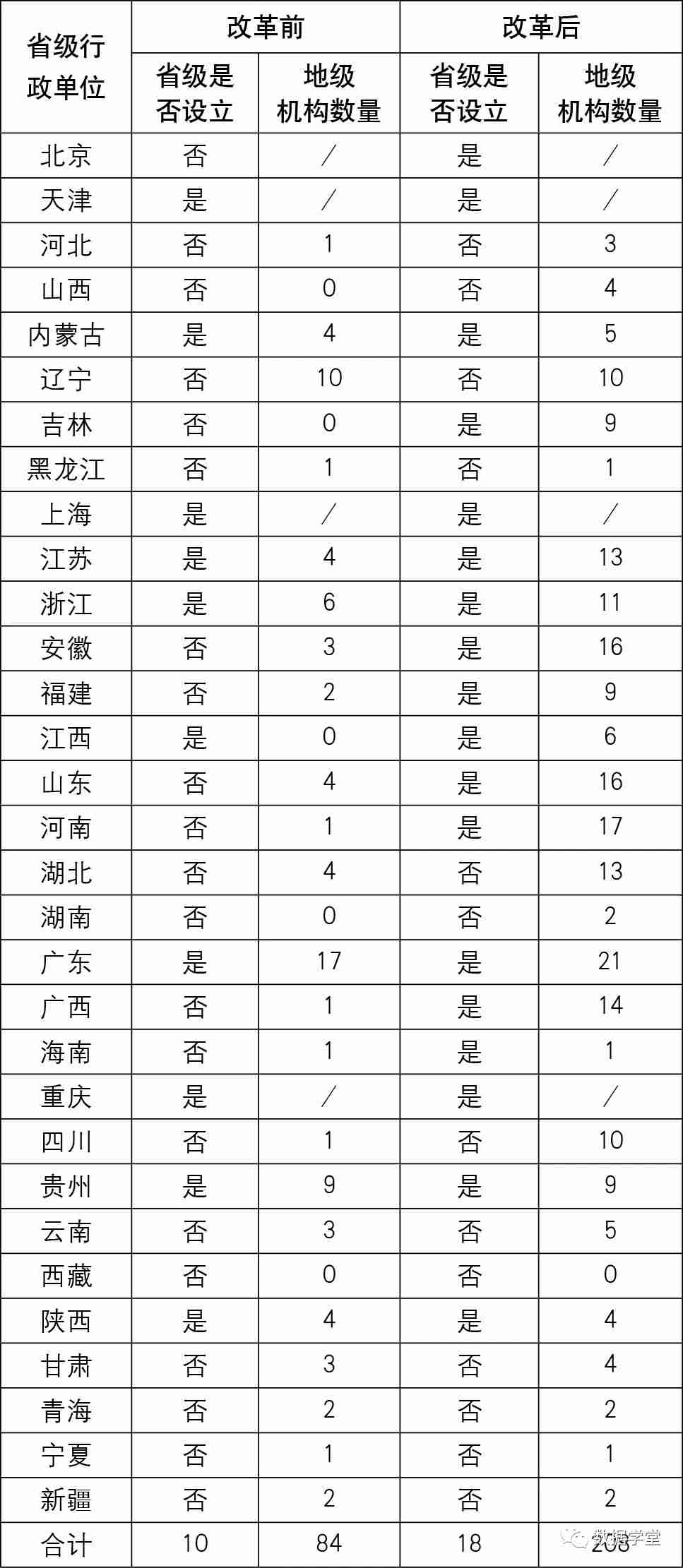
截至2019年6月,我国省级、地级地方政府已基本完成机构改革任务,在全国31个省级行政区中,共有18个省(直辖市、自治区)设有省级大数据管理机构,占比58%,它们分别是北京、天津、内蒙古、吉林、上海、江苏、浙江、安徽、福建、江西、山东、河南、广东、广西、重庆、贵州、陕西和海南。全国333个地级行政单位中共有208个地区设有大数据管理机构,占比62.5%。中国的22个省会城市、4个自治区首府(拉萨除外)以及5个非省会副省级城市,共计31个行政单位设立了大数据管理机构。
中国四大经济区地方政府大数据管理机构设置数量情况
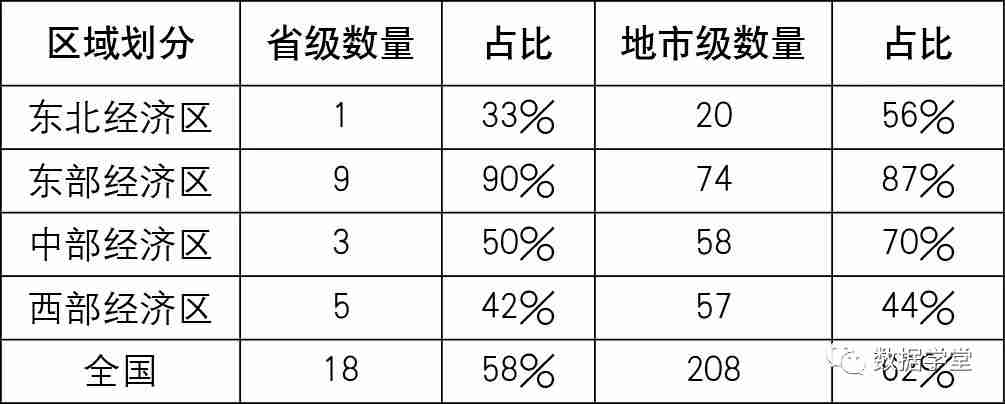
表1 第八次机构改革前后地方政府大数据管理机构设立情况
第八次机构改革前地方政府大数据管理机构职能特征
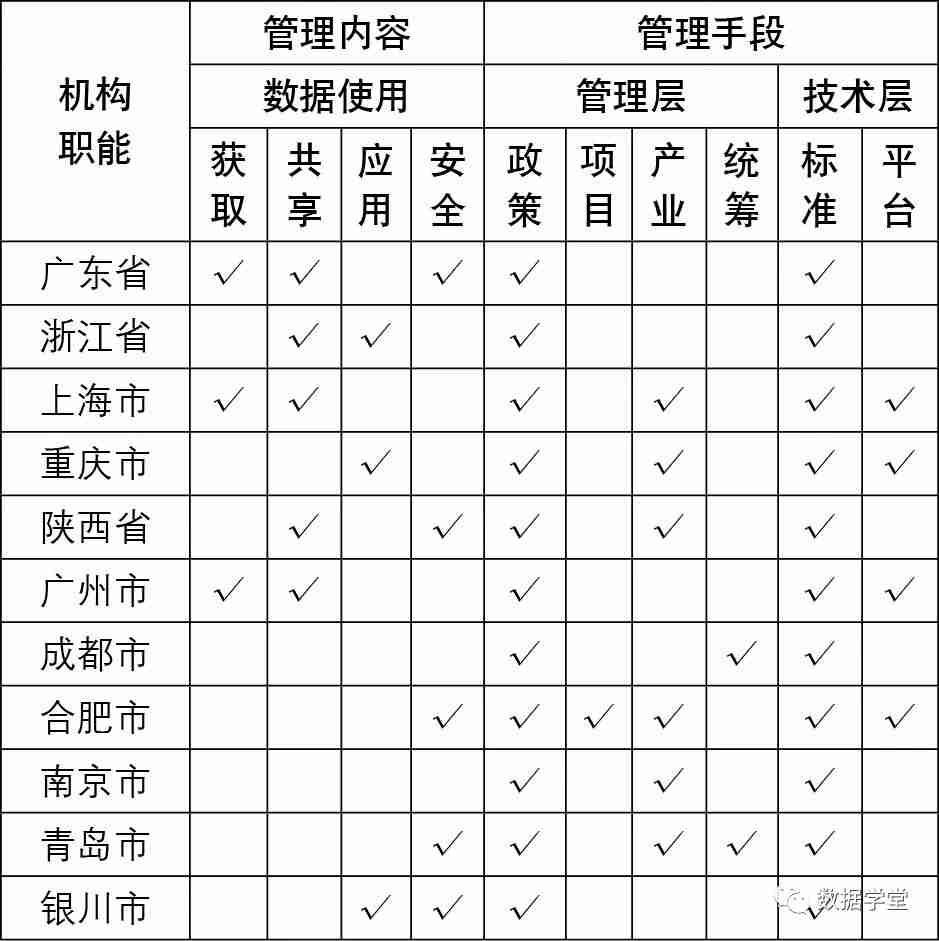
表6 第八次机构改革后地方政府大数据管理机构职能特征
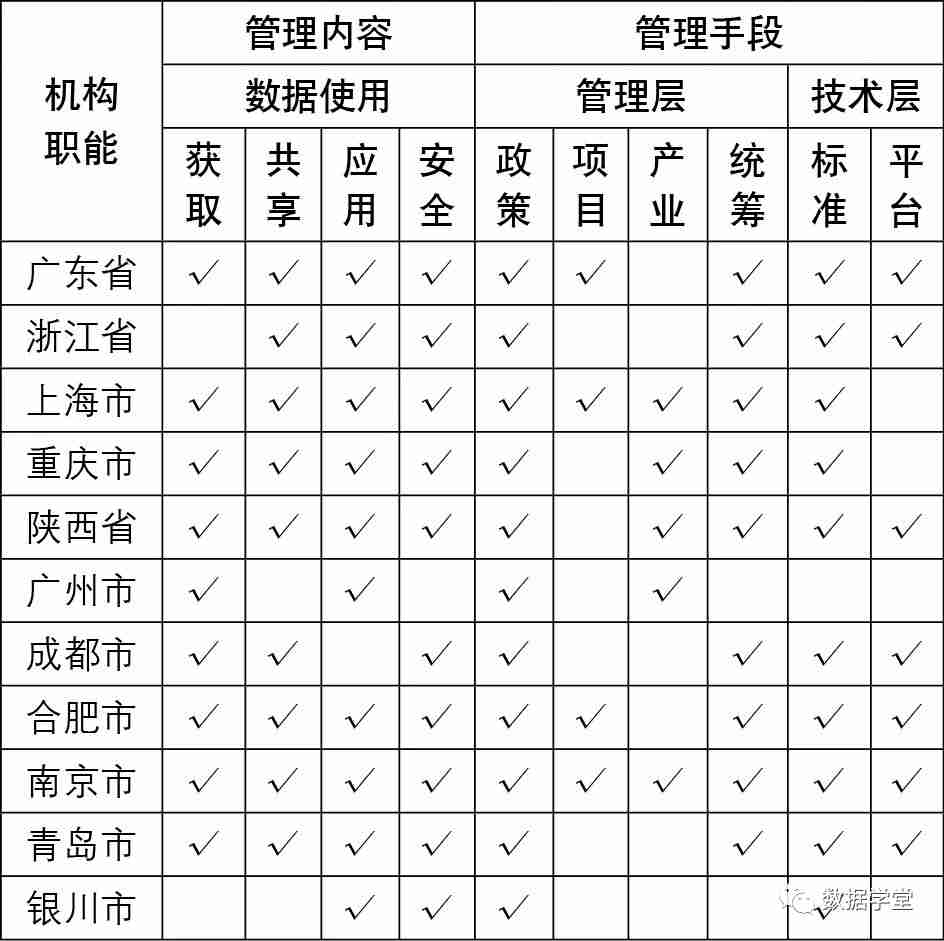
一、省级大数据局的机构设置和职能配置
梳理31个省、市、自治区公布的省级机构改革方案及有关公开报道,北京市和西藏自治区未公开机构改革方案,媒体报道披露了机构改革后北京市经济和信息化局挂大数据管理局牌子。可从机构名称、机构类型与规格、职能配置、内设机构等方面管窥省级大数据局的机构职能定位。
(一)机构名称:突出大数据发展和管理职能,有的省份合并设立大数据与政务服务管理机构
除山东直接冠名“大数据局”外,其他省份的机构名称多为“大数据管理局”或“大数据发展局”。这意味着对于多数地方政府而言,加强大数据领域行政管理职能和推动大数据产业发展是设置机构的主要目的。重庆市设立“大数据应用发展管理局”,将大数据的应用、发展和管理这三项核心职能直接写入机构名称。福建在政府机构序列设立数字福建领导小组办公室(大数据管理局),对议事协调机构办公室挂大数据局牌子,有利于打通大数据管理的决策执行链条。数字化转型网www.szhzxw.cn
一些省份因地制宜地将大数据与政务服务机构合并设立,如吉林组建政务服务和数字化建设管理局,安徽组建数据资源管理局加挂政务服务管理局牌子,广东组建政务服务数据管理局。合并设立大数据与政务服务管理机构主要有两个原因:一则这是在地方党政机构限额条件下的一种务实选择,通过设置一个机构履行两方面的新职能;另外,考虑到大数据和电子政务对提升政务服务水平具有重要支撑作用,合并设立机构的两大职能业务关联较为紧密。
(二)机构类型:省政府直属机构、部门管理机构和挂牌机构三类并存
本轮机构改革中设置的省级大数据局均列入政府机构序列,根据机构类型和规格可分为省政府直属机构、部门管理机构和挂牌机构三类。
⒈省政府直属机构
吉林、安徽、山东、广西、重庆、贵州六省(市)将大数据局设置为政府直属机构。省政府直属机构指省级人民政府为了管理某项专门或特定的事务而设置的一类机构,通常承担某项专门业务,具有独立的行政管理职能,机构规格一般为正厅级。在本轮机构改革中,没有省份将大数据设置为政府组成部门。这是因为政府组成部门是指履行政府基本行政管理职能依法设置的机构,省级政府组成部门要与国务院组成部门严格对应。一个新兴的大数据管理职能部门,能够在机构改革中独立跻身直属机构已然不易。作为直属机构的大数据局在省级机构中具有专业性、独立性、权威性,是根据法律法规规定和机构职责分工,对全省大数据领域各项工作负有主要管理责任的部门。数字化转型网www.szhzxw.cn
⒉部门管理机构
浙江、福建、广东、河南四省将大数据局设置为省政府部门管理机构。部门管理机构指由主管部门管理的,负责某方面工作的行政机构,具有相对独立性。例如,浙江、广东、河南三省大数据局均由省政府办公厅管理,福建省大数据局由省发展改革委员会管理。数字化转型网www.szhzxw.cn
部门管理机构与直属机构主要有三点区别:
一是机构规格。部门管理机构通常比其主管部门低半级,浙江等四省大数据局机构规格均为副厅级。
二是管理权限。直属机构可以在业务范围内单独向下级业务部门行文和向同级有关部门行文;部门管理机构对下级业务部门可以单独行文,但向有关部门行文或者与有关部门联合行文时原则上需报经主管部门同意。调研发现,在实践中一些地方部门管理的大数据局向有关部门行文或者与有关部门联合行文时不需报经主管部门同意。
三是请示报告方式。省以下部门管理机构原则上不直接向党委、政府请示工作,确需请示党委、政府的事项,由主管部门呈文;遇有紧急情况,需直接向党委、政府请示的,需同时报告主管部门。
值得特别注意的是,部门管理机构不是主管部门的内设机构,而是独立的法律主体,其职能履行和业务开展具有相对独立性。部门管理机构纳入党政机构限额管理,单独核定职能配置、内设机构和领导职数,具有一级独立预算权。主管部门主要通过行政首长召开会议等形式,对部门管理机构工作中的重大方针政策、工作部署等事项实施管理。
在机构改革中将省级大数据局设置为部门管理机构的主要目标是实现专业化治理与统筹协同治理的有机统一。一方面,大数据行政管理职能的独立性日益凸显,需要由一个专门行政机构履行职能;另一方面,大数据治理牵涉面广,又需要由具有统筹协调职能的强势部门加强对其他相关部门的政策协同。
出于对机构专业性和统筹性的双重考虑,由省政府办公厅或发改委等综合部门管理大数据局成为一种可行选择。但是,鉴于此前多轮机构改革经验与教训,主管部门与部门管理机构在实际运行过程中容易出现各类矛盾问题,大数据局作为部门管理机构是否能够充分履行职能仍值得进一步观察。
⒊挂牌机构
北京市在市政府组成部门经济和信息化局挂大数据管理局牌子。在机构编制管理实践中,挂牌机构是指一个机构承担多项职责,因工作需要加挂牌子,有两个或者两个以上名称,在不同场合以相应名称对外开展工作的机构。在实体机构挂牌的机构,一般不单独核定编制和领导职数,不是一级预算单位。挂牌机构原则上不得以挂牌机构名义对外制发行政规范性文件,确因工作需要制发行政规范性文件的,应当以实体机构名义或以实体机构与挂牌机构联合发文。数字化转型网www.szhzxw.cn
在2018年机构改革之前,省以下市县级政府多将大数据局设置为挂牌机构。相对于实体机构,挂牌机构的职能具有从属性。根据机构编制法规要求,挂牌机构在实践中不得实体化运作。以经济和信息化局挂大数据管理局牌子为例,大数据管理是经济和信息化局履行的部门职责之一,通常由经济和信息化局某些内设处室承担具体工作,有需要时对外以大数据管理局名义开展工作。
在本轮机构改革中,北京市经济和信息化局共加挂了三块牌子,分别为市无线电管理局、市大数据管理局和市国防科学技术工业办公室。经信局内设处室中的智慧城市建设处加挂大数据应用处牌子,实际承担推动大数据应用、电子政务考核、跨部门跨行业跨领域数据联通和共享等职责。
⒋地位、独立性和协调能力:三类机构设置的比较
在机构性质和地位方面,目前我国省级大数据局总体上处于省级党政机构序列的末端(参见表1)。大数据局的机构性质直接反映出同级党委政府对大数据相关事务的重视程度,相比而言在机构序列中直属机构地位较高,部门管理机构次之,挂牌机构最末。在机构独立性方面,直属机构大数据局拥有最为完整独立的管理权限,部门管理机构的重大政策要事先向主管部门汇报,机构自主权受到一定限制;挂牌机构基本上不具有日常管理的自主决定权。
在统筹协调方面,由省政府办公厅或发改委管理的大数据局优势较为明显,前提是能够处理好主管部门与部门管理机构之间的关系;直属机构对其他省级部门具备一定的统筹协调能力,需要在职能配置上加以明确;挂牌机构一般不具备统筹协调能力,其职能履行尚需要处理好实体机构内设处室之间的关系。
(三)职能配置:整合大数据决策、执行与监督管理权
本轮机构改革坚持优化协同高效原则,坚持一类事项原则上由一个部门统筹、一件事情原则上由一个部门负责,避免政出多门、责任不明、推诿扯皮。新组建的省级大数据局整合了原本分散于省级发改委、经信(委)厅、省政府办公厅等机构的多项职责,负责统筹协调大数据管理、信息化建设等相关工作。以省政府直属机构大数据局为例,可从行政管理过程视角下的决策权、执行权和监督管理权三个维度梳理其主要职责。数字化转型网www.szhzxw.cn
⒈决策权:制定大数据政策法规、发展规划和加强省内统筹协调
决策权是省级大数据局的核心职能,包括制定大数据相关政策法规、行业发展规划和加强省内统筹协调等职责。首先,省级大数据局负责拟定全省大数据相关政策、法规和标准,为省级人大及其常委会和省级人民政府起草相关地方性法规、规章草案,拟订大数据、信息化行业技术规范和标准并组织实施。
其次,大数据局负责制定全省大数据和信息化发展规划,提出大数据和信息化项目投资规模及方向、具体项目的审批备案核准等方面的建议。第三,大数据局负责统筹协调全省大数据资源开发管理使用,以及数字政府建设、政府网站、政务信息系统整合等工作。
⒉执行权:大数据资源管理、产业发展和推广应用
执行权是省级大数据局的关键职能,包括大数据基础设施建设运营管理、产业发展促进、大数据资源管理和推广应用等职责。
一是负责全省统一的大数据平台的建设管理利用,统筹大数据中心、政务云、政务网等电子政务基础设施规划建设管理。
二是负责大数据和信息化产业促进,支持和引导大数据、信息化等方面的新技术、新产品、新业态发展和应用,推动数字经济与产业发展深度融合。
三是负责公共数据资源的采集汇聚、登记管理、共享开放,推动社会数据汇聚融合、互联互通,推进大数据安全保障体系建设。数字化转型网www.szhzxw.cn
四是组织实施省级政务信息化建设、数字政府等项目,推动“互联网+政务服务”等大数据项目应用落地。
⒊监督管理权:大数据市场监管与政务监督
监督管理权是省级大数据局的基础职能,根据管理对象不同,主要可分为针对企业和政府两类。第一类是对大数据和信息化行业及企业合法合规经营进行日常监督管理,履行软件和互联网信息服务业行业管理职责。第二类是加强大数据局对省级部门和市县政府的业务指导,依据授权对省级部门及市县政府大数据建设管理使用状况进行监督考核评价,有效提升省市县协同联动发展水平。
二、省级大数据局的发展趋势与面临的主要挑战
省级大数据局是机构改革的新生事物,其机构设置和职能配置既有一定共性规律也存在较大差异性,在职能履行过程中仍然面临诸多挑战。总结国内此前各地大数据局运行规律,现阶段省级大数据局呈现出两大主要发展趋势。
(一)“一对多”:大数据管理职能相对集中,由一个机构承接多个上级机构的任务
长期以来,我国中央政府层面互联网和信息化职能相对分散,发改委、工信部、公安部、网信办根据职责分工各承担部分管理职能。这种“九龙治水”的管理格局固然有一定的合理性,但也容易造成职能交叉、权责脱节现象。在此前“上下一般粗”的机构设置模式下,地方政府根据中央部委设置和职能配置情况对应设置地方机构履行属地管理责任。
基于中央与地方政府职能异构特征,地方政府主要承担大数据和信息化政策执行、市场监管和项目应用等操作性事务,迫切需要整合分散于各部门的政策、资金和资源形成管理合力。在此背景下,一些市县率先探索设立大数据局整合分散于多部门的职责,由大数据局向上对接多个上级部门。
省级大数据局在省级层面相对集中大数据管理职能,向上对接发改委、工信部、国务院办公厅等多个部门,向下指导监督市县大数据局职能履行,构建起上下贯通、执行有力的体制机制,发挥了承上启下的关键性作用。
在省以下相对集中大数据管理职能有利于统筹调配资源,减少多头管理和职责分散交叉,充分发挥数字化政府转型的整体效应。特别是数字政府建设的整体性理念要求由一个超越原有部门利益格局的行政机构发挥牵头作用,省级大数据局能够以集约化、一体化建设优化资源配置、减少重复投资,构建统一规划、统一政策、统一标准、统一管理的数字政府业务体系。
(二)由单一到综合:大数据局职能配置重点从侧重行业管理、政务管理转变为大数据综合治理
目前,我国省级大数据局职能配置仍有较大差异,机构类型和设置方式直接影响大数据局的职责范围。在经济和信息化局挂牌的大数据局由于其职能从属性,通常侧重于大数据产业发展和行业管理。
合并设立的政务服务和大数据管理局通常牵头推进“放管服”改革,大数据管理方面侧重于电子政务、“互联网+”政务服务、政务信息系统整合等政务管理职能,其职责中一般不包括大数据产业发展和行业管理职能。此外,由省政府办公厅和发改委管理的大数据局也主要偏重于政务管理职能。
作为省政府直属机构的大数据局一般兼具行业管理和政务管理双重职能,在机构职能方面逐渐从大数据专项管理机构向大数据综合管理机构转型。此类大数据局职能配置呈现出四个“全”特征。
一是对象全覆盖。管理服务对象既包括大数据和信息化企业,也涵盖省级部门和市县政府,以及涉及大数据采集、储存、管理和使用的自然人等社会主体。数字化转型网www.szhzxw.cn
二是业务全流程。承担大数据管理的决策、执行和监督职能,具体行使大数据相关行政规划、行政审批、行政确认、行政奖励、行政检查等行政权力事项。
三是资源全配套。统筹法规政策、财政资金投入、基础设施建设、人才培养等促进大数据产业发展和数字政府建设的各类配套资源。
四是应用全打通。负责统筹大数据资源建设管理,促进大数据政用、民用、商用多管齐下、互联互通。
当然,大数据综合管理机构正在经历一个从无到有的过程,究竟大数据局的职能配置应当综合到何种程度,仍需在实践中检验。
(三)省级大数据局面临的主要挑战
⒈大数据局机构性质不明确
本文重点分析的省级大数据局是机构改革后明确列入省级党政机构序列的行政机构,实际上全国还有一些省份将大数据局设置为省政府直属事业单位或部门管理的事业单位。
例如,内蒙古自治区大数据管理局在本轮机构改革后仍作为省政府直属事业单位履行部分行政管理职能。这些机构性质为事业单位的大数据局多由省信息中心、大数据中心组建而成,但在实际运行中履行部分行政管理职能。事业单位的主业主责是公益服务,出于机构编制限额考虑由事业单位额外承担行政职能,容易造成政事不分、行政职能体外循环、管理不规范等现象。
《中共中央关于深化党和国家机构改革的决定》明确指出:“全面推进承担行政职能的事业单位改革,理顺政事关系,实现政事分开,不再设立承担行政职能的事业单位。”在本轮地方机构改革实施过程中,大部分省份全面清理省直事业单位承担的行政职能,将行政职能划归主管部门或职能相近的行政机构,除行政执法机构外,不再保留或新设承担行政职能的事业单位。
本轮机构改革后,全国共设立11个省级大数据局行政机构,尚有超过一半的省份由其他主管部门行政机构或事业单位履行大数据行政管理职能。应当承认,目前大数据局履行的职能中究竟有哪些必须由行政机构承担,哪些可以由事业单位承担,在实践中仍存在较大争议。
⒉大数据局职能定位不清晰
分析11家省级大数据局的机构设置和职能配置情况,可以发现一些省份对大数据局的职能定位不够清晰。例如,大数据局究竟应当是一个专项职能部门还是综合职能部门?不论是直属机构还是部门管理机构,单独设立大数据局的初衷就是要解决大数据管理职责交叉分散问题,让这一机构在省政府机构序列中承担专项职能部门责任。
与此同时,一些省级政府直属机构大数据局还承担了统筹推进信息化建设、数字经济发展、数字政府建设等原本由发改委、办公厅等综合职能部门履行的职责。
即使“三定”规定赋予了大数据局统筹协调职能,但是排序偏后的直属机构能否协调发改、财政、工信等排序靠前的省政府组成部门?可供参考的一个例子是,新组建的应急管理部整合国务院办公厅原国务院应急管理办公室职责后,就出现了综合协调力度反倒不如以前的情况。数字化转型网www.szhzxw.cn
⒊大数据局职能配置不科学
机构职能配置主要由“三定”规定和权力清单、责任清单确定,目前绝大部分新设立的省级大数据局已出台“三定”规定,但权责清单尚在编制过程中。经初步调研和梳理,省级大数据局职能配置还存在一些不够科学、不尽合理之处。在职责分工方面,省级大数据局与网信办、工信部门在统筹信息化建设、信息资源开发利用共享、指导信息安全等方面职能划分不够明确。
根据中央有关通知精神,省市两级网信机构主要职能要与中央网信办基本对应,统筹信息化工作职能实际上由网信部门负责。单独组建大数据局后,省级工业和信息化部门一般仍然负责工业领域信息化发展和信息化与工业化融合(两化融合)、软件和信息服务业管理等职责。
实际上,大数据局承担的产业促进政策的管理服务对象与软件和信息服务业企业多有重合。再以制定大数据(信息)安全监管的法规、标准体系为例,由于信息安全既涉及硬件也涉及软件,职责分散于网信、公安、大数据、工信等多个部门。网络安全执法更是存在不同执法部门对同一单位、同一事项重复检查且检查标准不一的问题。
另一方面,新设立的大数据局对外行业管理职权并不完整,大部分大数据局基本没有行政许可和行政执法处罚事项,是典型的行政审批、日常监管和执法职能相分离的行政机构。一旦大数据局与相关部门无法建立起行之有效的公务协作机制,那么很容易出现权责脱节、推诿扯皮现象。一些政务数据管理局只有对政府机构的内部审批管理权限和公共服务事项。
三、优化地方大数据机构职能体系的建议
省级大数据局是新一轮地方机构改革的新生事物,是地方政府完善数据治理体系、提升数据治理能力的重要探索。为解决大数据局在地方机构职能体系中面临的障碍和瓶颈,不断优化大数据局的机构设置和职能配置,当前亟需重点处理好四对关系。
(一)处理好政事关系,科学界定大数据行政管理职能的内涵和外延,加快推进政事分开
本轮机构改革后,省以下大数据局在机构性质上既有行政机构也有事业单位。按照深化党和国家机构改革根除“事业局”的具体要求,当前迫切需要科学界定大数据行政管理职能的内涵和外延,非此不足以论证将大数据局设置为行政机构的合法性。
从行政法原理分析,大数据行政管理职能应当包括制定大数据领域的法律法规和规范性文件的行政立法权等抽象行政行为,以及行政命令、行政许可、行政确认、行政监督检查、行政处罚、行政强制、行政奖励、行政裁决等具体行政行为。概言之,涉及大数据管理的抽象行政行为和具体行政行为均应由行政机构作出。此外,根据实践经验总结,统筹协调跨区域、跨领域、跨部门的数据聚通用和基础性、保障性的大数据公共服务应被视为大数据行政管理职能。
各地应当全面清理由大数据中心等事业单位承担的行政职能,根据机构改革精神因地制宜设立大数据局行政机构或将相关行政职能划归其他主管部门行使。已设置省以下大数据局的地方应当加快转变政府职能,落实简政放权、放管结合、优化服务等改革要求,按照“管办分离”的原则剥离行政机构的大数据运营维护职能,采取政府购买服务的方式由事业单位或企业具体承担大数据系统建设运营维护工作。充分发挥事业单位、互联网企业的专业技术和渠道服务优势,构建政企合作、多元主体共建共享共治的大数据治理生态体系。
(二)处理好党政关系,理顺和优化地方网信办与大数据局的职责关系
加强和优化党对网信工作的集中统一领导,是健全党对重大工作的领导体制机制的重要举措。在中央层面,由于网络安全和信息化职能分散于多个国务院机构,中央网信办成立以来有效统筹协调网络安全和信息化重大事项,承担党中央决策议事协调机构、办事机构的职能。本轮机构改革设立省级大数据局的地方要重视理顺和优化地方网信办与大数据局的职责关系,减少重复决策、多头管理,促进党政机构职能分工合理、责任明确、运转协调。
具体而言,一要明确党的议事协调机构、办事机构与政府职能部门职责的区别与联系。议事协调机构对相关领域重大工作发挥顶层设计、总体布局、统筹协调、整体推进作用,其办事机构的职能要紧紧围绕上述四个方面行使,做到既不越位也不缺位。政府职能部门是在党委、政府统一领导下,负责管理某一方面工作事务,并相对独立行使管理权的机构。
因此,网信办应重点提升领导力,大数据局应重点提升执行力。综合考虑机构属性和省级大数据局在政府机构序列中的排序,统筹协调全省网络安全和信息化建设的职责应由省级网信办承担更为合适。大数据局承担配合网信办指导推进信息化建设和跨行业、跨部门信息数据互联互通的职责。
二要把握好省以下不同层级党政机构的职责关系。省级党政机构承担全省顶层设计、统筹协调等职能,市县党政机构主要是落实中央和省级决策部署,越往基层越应当注重提升执行力。由于机构限额层层递减,许多市县党委机构中不单设网信办,而是将网信办设在宣传部门。根据基层事务特点和工作实际需要,一些市县将网信办承担的统筹推进信息化职责划转到大数据局也不失为可行之策。
此外,根据十九大报告和深化党和国家机构改革精神,市县网信部门和大数据管理局可以探索合并设立或合署办公,整合优化党政机构力量和资源,发挥统筹信息化建设和大数据管理应用的综合效益。
(三)处理好左右关系,明确大数据局与其他综合管理部门、行业管理部门的职责分工
本轮机构改革提出优化协同高效原则,坚持一类事项原则上由一个部门统筹、一件事情原则上由一个部门负责,改革机构设置与职能配置。根据管理服务对象可以将大数据管理涉及的“一类事情”“一件事情”分为行业管理和政务管理两大类。对大数据局而言,要重点明确与工信部门的行业管理职责分工,明确与发改委、政府办公厅的政务管理职责分工。
已设置为省政府直属机构的大数据局,应逐步划转大数据地方立法起草、行业产业发展规划编制、大数据和信息化项目投资规模及方向建议、软件和信息服务业行业管理等职责,提升综合管理协调能力。设置为部门管理机构的大数据局,要在确保职能相对独立完整的前提下与主管部门建立科学高效的决策执行业务流程,完善宏观、中观和微观管理决策分工,既要更好地发挥主管部门的统筹协调能力,也要充分履行部门管理机构的专业职责使命。设置为挂牌机构的大数据局,要准确把握、完整履行挂牌机构的职责权限,在机构编制管理法规框架内履行机构职能。
随着大数据相关法律法规不断健全和完善,大数据局需要与其他职能部门建立流程顺畅的公务协作机制。由于机构改革多采取由易到难分步骤进行的渐进改革策略,一些地方大数据管理领域可能出现了行政审批、日常监督管理、执法和技术支持辅助职能分别由不同部门行使的现象。为避免出现信息孤岛和职责推诿等问题,迫切需要加强业务全流程的跨部门衔接协同。地方政府应当加快完善大数据管理公务协作制度和监督约束机制,建立跨部门协作配合的信息共享机制,实现行政审批、监管、执法和支持辅助机构之间的信息互通、资源共享、行动协同。
(四)处理好统分关系,构建上下协同、政企合作、多元参与的共建共享数字政府体系
省级大数据局承担着加快推进数字政府建设的重要使命,首当其冲的任务就是确立“全省一盘棋”的理念,花大力气破解长期以来制约政府治理水平提升的信息资源碎片化、业务应用条块化、政务服务分割化等问题。数字化转型网www.szhzxw.cn
在推进数字政府建设过程中要特别注意处理好“统分结合”关系,破解难题固然需要统一规划、统一标准、统一上云、统一应用,但也不能由政府一家包打天下,省大数据局不宜过度集权。构建科学合理、运行高效的地方大数据治理体系,要充分调动各级政府、不同职能部门和市场社会主体的积极性,处理好政府与市场关系,发挥各类主体优势打造共建共享共治格局。
优化省对部门和市县大数据工作的领导管理体制,由省级大数据局承担业务指导、绩效管理、督促检查等职能,构建省级大数据局与省直部门、市县之间的高效协同机制。建立集中统一的全省政务“一朵云”“一张网”“一平台”,统筹管理政务大数据资源。省直部门信息化运行建设项目原则上应进行集中建设管理,由政府直接投资建设转变为向符合条件的运营企业购买服务。
信息化水平较高的市县要实现本地应用系统与省级平台的对接和数据共享,信息化欠发达地区由省级统一规划、建设基础设施和技术支撑平台,市县根据实际需要开展本地政务应用和服务。尤其要探索和完善政府购买大数据运营管理、应用开发、决策分析等服务的监管评价机制,确保网络和信息系统安全稳定。
翻译:
Provincial Big data Bureau is an “optional action” of many provinces in the new round of institutional reform, which is of great significance to the improvement of local government data governance system. It is found that the institutional Settings of provincial big data bureaus mainly highlight the development and management functions of big data, which mainly include the institutions directly under the provincial government, departmental management institutions and listed institutions. The functional allocation integrates the decision-making, implementation, supervision and management powers of big data. On the whole, it shows a trend of relatively centralized big data management functions and shifting from focusing on industry management and government management to comprehensive big data management.
At present, there are still challenges in the operation of provincial big data bureaus, such as unclear organizational nature, unclear functional positioning and unscientific functional allocation. To optimize the functional system of local big data organizations, it is urgent to clarify the connotation and extension of big data administrative functions, reasonably divide the responsibilities of big data bureaus and relevant departments, and build a digital government system featuring multi-subject co-construction and sharing.
Since the 18th CPC National Congress, the establishment of big data Bureau by local governments is a noteworthy new trend in institutional and administrative system reform.
From the macro level, the establishment of a big data bureau is an important measure for governments at all levels to implement the strategic deployment of the CPC Central Committee and The State Council to make China a cyber power, accelerate the construction of “digital China” and “smart society”, and make full use of information technology to improve the government’s ability to perform their duties. At the mid-level, the Big Data Bureau integrates related functions that were previously scattered in local development and reform departments, economy and information technology departments, etc., and explores useful experience for building a unified and efficient local government data governance system.
Provincial big data bureaus play a key role in the macro framework of national digital governance, which is of great significance to the improvement of local government data governance system. The deepening reform of Party and state institutions in 2018 has provided a rare opportunity for all regions to set up provincial big data bureaus. This round of institutional reform proposes to grant more autonomy to institutions at and below the provincial level while ensuring the centralized and unified leadership of the central government, and allow local governments to set up institutions and allocate functions in light of local conditions.
According to incomplete statistics
According to incomplete statistics, Beijing, Chongqing, Guangdong, Zhejiang, Guizhou, Shandong, Guangxi, Jilin, Fujian, Anhui, Henan and other provinces have set up administrative bodies dedicated to big data management in their provincial institutional reform plans. These provincial big data bureaus play a role in top-level design, overall layout, overall coordination and overall promotion within the province, which is conducive to the establishment of a digital governance organizational system with unified standards, coordination between the upper and lower levels and efficient operation, and accelerate the construction of an intensive and integrated digital government. In addition, the institutional setup and functional allocation mode of provincial big data bureaus will serve as a model for the subsequent reform of municipal and county institutions, promote the optimization of the institutions and adjustment of functions of provincial big data bureaus, and improve the coordination mechanism at the provincial and county levels.
Based on the provincial-level institutional reform plans published around the country, this paper analyzes the institutional setup and functional allocation of 11 provincial-level big data bureaus, and puts forward optimization suggestions for building a more scientific and reasonable functional system of local government data governance institutions.
The number of local big data management agencies in China
By June 2019, provincial-level and prefecture-level local governments had basically completed the task of institutional reform. Among the 31 provincial-level administrative regions, 18 provinces (municipalities directly under the Central Government and autonomous regions) had set up provincial-level big data management agencies, accounting for 58% of the total. They are Beijing, Tianjin, Inner Mongolia, Jilin, Shanghai, Jiangsu, Zhejiang, Anhui, Fujian, Jiangxi, Shandong, Henan, Guangdong, Guangxi, Chongqing, Guizhou, Shaanxi and Hainan. Out of 333 prefecture-level administrative units, 208 districts have big data management organizations, accounting for 62.5 percent of the total. Thirty-one administrative units in China, including 22 provincial capitals, four regional capitals (excluding Lhasa) and five non-provincial sub-provincial cities, have set up big data management agencies.
Institutional setup and functional configuration of provincial Big data bureaus
After sorting out the provincial institutional reform plans announced by 31 provinces, municipalities and autonomous regions and related public reports, Beijing and Tibet Autonomous Region did not make public institutional reform plans. Media reports revealed that the Beijing Municipal Bureau of Economy and Information Technology was named the Big Data Bureau after the institutional reform. The functional positioning of provincial big data bureaus can be explored from the aspects of organization name, organization type and specification, function configuration, internal organization, etc.
(1) Name of the institution: highlighting the development and management functions of big data, some provinces have merged to set up big data and government service management institutions
In addition to Shandong Province directly named “Big Data Bureau”, other provinces are mostly named “Big Data Bureau” or “Big Data Development Bureau”. This means that for most local governments, strengthening administrative functions in the field of big data and promoting the development of the big data industry are the main purpose of setting up institutions. Chongqing has set up a “Big Data Application Development Administration”, which directly writes the three core functions of big data application, development and management into its name. Fujian has set up the Digital Fujian Leading Group Office (Big Data Administration) in the sequence of government agencies, and hung the Big Data Bureau brand on the office of the discussion and coordination organization, which is conducive to opening up the decision-making and execution chain of big data management.
Some provinces have merged big data and government service organizations according to local conditions. For example, Jilin has established the Government Service and Digital Construction Administration Bureau, Anhui has established the Data Resources Administration Bureau under the brand of Government Service Administration, and Guangdong has established the Government Service Data Administration Bureau. There are two main reasons for the merger and establishment of the Big Data and government service management agency. First, it is a pragmatic choice under the quota of local party and government agencies, by setting up one agency to perform the two new functions; In addition, considering that big data and e-government play an important supporting role in improving government services, the two functions of the merged institutions are closely related to each other.
(2) Types of institutions: There are three types of institutions directly under the provincial government, departmental management institutions and listed institutions
The provincial big data bureaus set up in this round of institutional reform are all listed in the sequence of government institutions, which can be divided into three categories according to the types and specifications of institutions: directly under the provincial government, departmental management institutions and listed institutions.
Institutions directly under the provincial government
Six provinces (municipalities) — Jilin, Anhui, Shandong, Guangxi, Chongqing and Guizhou — have set their big data bureaus directly under the government. The directly affiliated institutions of the provincial government refer to the institutions set up by the provincial people’s government to manage a special or specific affairs. They usually undertake a special business and have independent administrative functions. The size of the institutions is generally at the department level. In this round of institutional reform, no province has set big data as a government department. This is because ministries and commissions of the government refer to the bodies set up by law to perform the basic administrative functions of the government.
Ministries and Commissions of the provincial-level governments must correspond strictly with Ministries and commissions of the State Council. For an emerging functional department of big data management. It is not easy for it to independently join its affiliated institutions in the institutional reform. As a direct agency, the Big Data Bureau is professional, independent and authoritative among provincial institutions. It is a department with major management responsibility for all the work in the field of big data in the province according to the provisions of laws and regulations and the division of institutional responsibilities.
The administrative body of the department
Zhejiang, Fujian, Guangdong and Henan provinces have set big data bureaus as administrative organs of provincial government departments. Departmental management organization refers to the administrative organization managed by the competent department and responsible for a certain aspect of the work, with relative independence. For example, the big data bureaus in Zhejiang, Guangdong and Henan are all managed by the General Office of the provincial government. While the big data bureau in Fujian province is managed by the provincial Development and Reform Commission.
There are three main differences between a department management organization and a directly affiliated organization:
One is the organization specification. The department management body is usually half a level lower than the competent department. The big data bureau of Zhejiang and other four provinces has the size of the deputy department.
The second is management authority. The directly affiliated institutions may, within the scope of their business, publish articles separately to the business departments at lower levels and to the relevant departments at the same level. The department management organ may write separately for the subordinate business departments. But in principle it shall obtain the approval of the competent department when writing to the relevant department or jointly with the relevant department. It is found that in practice. Some big data bureaus managed by local departments do not need the approval of the competent authorities when submitting documents to or jointly submitting documents with relevant departments.
The third is the request report. In principle, the administrative organs of departments below the provincial level shall not directly request instructions from the Party committee or the government. If it is necessary to request instructions from the Party committee or the government. They shall be submitted by the competent departments. In case of emergency, if it is necessary to directly request instructions from the Party Committee or the government. It shall report to the competent department at the same time.
It is worth noting that departmental management bodies are not internal organs of competent departments, but independent legal bodies with relatively independent functions and business development.
Departmental management organs are incorporated into the quota management of Party and government organs. And are independently verified for their functional allocation, internal organs and number of leading positions. With independent budgetary power at the first level. The competent departments manage major principles and policies. Work arrangements and other matters in the work of departmental management bodies mainly through meetings held by the heads of administration.
The main goal of setting provincial big data bureaus as departmental management organs in the institutional reform is to achieve the organic unity of professional governance and overall coordination and collaborative governance. On the one hand, the independence of the administrative function of big data is increasingly prominent. Which requires a special administrative organization to perform the function. On the other hand, big data governance involves a wide range of areas and requires strong departments with coordination functions to strengthen policy coordination with other relevant departments.
For the consideration of professionalism and coordination of the organization. It is a feasible choice for the general office of the provincial government or the National Development and Reform Commission to manage the Big data bureau. However, in view of the previous rounds of institutional reform experience and lessons. The competent departments and departmental management agencies are prone to various conflicts and problems in the actual operation process. Whether the Big Data Bureau can fully perform its functions as a departmental management organization is still worth further observation.
listing mechanism
Beijing has a Big Data Bureau in the Economic and Information Bureau of Ministries and commissions of the Municipal government. In the practice of institutional establishment management. A listed institution refers to an institution that undertakes multiple responsibilities. It has two or more names, and carries out external work with corresponding names on different occasions. Institutions listed in substantive institutions generally do not have separate approval for staffing and leadership positions and are not tier 1 budget units. In principle, a listed institution shall not produce and issue administrative normative documents in the name of a listed institution. If it is necessary to produce and issue administrative normative documents. It shall publish a document in the name of an entity institution or jointly with a listed institution.
Before the institutional reform in 2018, most city and county governments below the provincial level set big data bureaus as listed institutions.
Compared with the entity, the function of the listed institution is subordinate. According to the requirements of institutional establishment regulations, listed institutions are not allowed to materialize in practice. Take the Big Data Bureau as an example. Big data management is one of the responsibilities of the Bureau. Some internal offices of the Bureau are usually responsible for specific work. And work is carried out in the name of Big Data Bureau when necessary.
In this round of institutional reform, the Beijing Municipal Bureau of Economy and Information Technology has added three brands, namely. The Municipal Radio Administration Bureau, the Municipal Big Data Administration Bureau and the Municipal Defense Science, Technology and Industry Office. The Smart City Construction Department of the Bureau of Economy and Information Technology has been tagged with the Big Data Application Department, and actually undertakes the responsibilities of promoting big data application, e-government assessment, cross-departmental, cross-industry and cross-field data connectivity and sharing.
The status, independence and coordination of this class: A comparison of three types of institutional Settings
In terms of institutional nature and status. Chinese provincial big data bureaus are generally at the end of the sequence of provincial party and government institutions (see Table 1). The institutional nature of the Big Data Bureau directly reflects the importance of the Party committees and governments at the same level to the big data-related affairs. In comparison, the status of the directly affiliated institutions is higher in the institutional sequence. Followed by the department management institutions and the listed institutions. In terms of institutional independence. The Big Data Bureau directly under the agency has the most complete and independent management authority. Major policies of the department management agency should be reported to the competent department in advance. And the autonomy of the agency is limited to a certain extent. Listed institutions basically do not have the autonomy to make decisions in daily management.
In terms of coordination, the big data bureau managed by the provincial government office or the National Development and Reform Commission has obvious advantages, provided that it can handle the relationship between the competent department and the department management. The directly affiliated institutions have a certain ability to coordinate with other provincial departments. So it is necessary to clarify the function allocation. Generally, listed institutions do not have the ability to coordinate. And the performance of their functions still needs to deal with the relationship between the departments within the entity.
Functional allocation: integration of big data decision-making, implementation, supervision and management rights
This round of institutional reform adheres to the principle of optimization, coordination and high efficiency. And adheres to the principle that a single department should be in charge of a single matter and a single department should be in charge of a single matter. So as to avoid multiple political maneuvers, unclear responsibilities and buck-shifting. The newly established provincial Big data Bureau integrates a number of responsibilities previously scattered in the provincial Development and Reform Commission. The Economic and Information Technology (Commission) Department, the provincial government’s General office and other institutions. And is responsible for the overall coordination of big data management, information construction and other related work. Taking the Big Data Bureau directly under the provincial government as an example. Its main responsibilities can be sorted out from three dimensions of decision-making power, execution power and supervision power from the perspective of administrative process.
Decision-making power: formulate big data policies, regulations, development plans and strengthen overall coordination within the province
Decision-making power is the core function of provincial big data bureaus. Including the formulation of big data-related policies and regulations. Industry development planning and strengthening of provincial overall coordination. First of all, the provincial big data bureau is responsible for the formulation of provincial big data-related policies, regulations and standards, the drafting of relevant local regulations and rules for the provincial People’s Congress and its standing committee and the provincial people’s government. And the formulation and implementation of technical norms and standards for the big data and information industry.
Secondly, the Big Data Bureau is responsible for formulating the province’s big data and informatization development plan. And putting forward suggestions on the investment scale and direction of big data and informatization projects. As well as the approval, filing and approval of specific projects. Third, the Big Data Bureau is responsible for coordinating the development. Management and use of big data resources in the province. As well as the construction of digital government, the integration of government websites and government information systems.
Executive right: Big Data resource management, industry development and application
Executive power is a key function of provincial big data bureaus. Including big data infrastructure construction and operation management, industrial development promotion, big data resource management and promotion and application.
First, to be responsible for the construction, management and utilization of unified big data platforms in the province. And to coordinate the planning, construction and management of e-government infrastructure. Such as big data centers, government cloud and government network.
Second, it is responsible for promoting the big data and information technology industry. Supporting and guiding the development and application of new technologies, new products and new business forms in such fields. And promoting the deep integration of the digital economy and industrial development.
Third, it is responsible for the collection and aggregation, registration management. Sharing and opening of public data resources, promoting the convergence and integration of social data. And promoting the construction of big data security system.
Fourth, we will organize the implementation of provincial-level government informatization and digital government projects. And promote the implementation of big data projects such as “Internet plus government services”.
Power of supervision and management: big data market supervision and government supervision
The power of supervision and management is the basic function of provincial big data bureaus. Which can be divided into enterprises and governments according to different objects of management. The first category is the daily supervision and management of the big data and information industry and the legal compliance operation of enterprises. And the performance of the management responsibilities of the software and Internet information service industry. The second category is to strengthen the Big Data Bureau’s business guidance to provincial departments and city and county governments, to supervise, evaluate and evaluate the construction, management and use of big data of provincial departments and city and county governments according to the authorization. And to effectively improve the level of coordinated development of provinces and counties.
Development trend and main challenges of provincial Big data bureaus
Provincial big data bureaus are a new thing in institutional reform. Their institutional Settings and functional allocation have both certain common rules and great differences. And they still face many challenges in the process of functional implementation. By summarizing the operation rules of the previous big data bureaus in China. The provincial big data bureaus present two major development trends at the present stage.
(I) “one-to-many” : the functions of big data management are relatively centralized, with one institution undertaking the tasks of multiple superior institutions
For a long time, Internet and information technology functions at the central government level are relatively decentralized. According to the division of duties, Development and Reform Commission, Ministry of Industry and Information Technology. Ministry of Public Security, and Internet Information Office each undertake some management functions. Although the management pattern of “water control in Kowloon” is reasonable to some extent. It is also easy to cause the phenomenon of overlapping functions and disconnection between power and responsibility. Under the previous “top and bottom generally coarse” organization setting mode. Local governments set up local organizations to fulfill the territorial management responsibilities according to the central ministries and commissions setting and function allocation.
Due to the heterogeneity of functions of central and local governments, local governments mainly undertake operational affairs. Such as big data and informatization policy implementation, market supervision and project application. Therefore, it is urgent to integrate policies, funds and resources scattered among various departments to form joint management forces. In this context, some cities and counties have taken the lead in exploring the establishment of big data bureaus to integrate the responsibilities scattered among multiple departments. So that the big data bureaus can connect with multiple superior departments.
Provincial big data bureaus concentrate their big data management functions at the provincial level, link up with the National Development and Reform Commission
Provincial big data bureaus concentrate their big data management functions at the provincial level. Link up with the National Development and Reform Commission. The Ministry of Industry and Information Technology, The General Office of the State Council and other departments, guide and supervise the function performance of city and county big data bureaus at the provincial level, build a system and mechanism that connects the above and the next. And play a key role in connecting the above and the next.
The relatively centralized big data management functions at the provincial level are conducive to the overall allocation of resources. The reduction of multiple management and the decentralization of responsibilities. And the full play of the overall effect of digital government transformation. In particular, the holistic concept of the construction of digital government requires that an administrative agency beyond the original departmental interest pattern play a leading role. The provincial big data bureau can optimize the allocation of resources, reduce repeated investment through intensive and integrated construction. And build a digital government business system with unified planning, policies, standards and management.
(2) From single to comprehensive: The function allocation focus of the Big Data Bureau has changed from industry management and government management to comprehensive big data management
At present, there are still large differences in the functional allocation of provincial big data bureaus. And the types and Settings of institutions directly affect the scope of responsibilities of big data bureaus. Big data bureaus listed in the Bureau of Economy and Information Technology usually focus on big data industry development and industry management due to their functional subordination.
The merged government service and Big Data Administration Bureau usually takes the lead in promoting the reform of “delegating power, regulating and serving”. In terms of big data management, it focuses on e-government, “Internet +” government service. Government information system integration and other government management functions. Its responsibilities generally do not include big data industry development and industry management functions. In addition, the Big Data Bureau, which is managed by the provincial government General Office and the National Development and Reform Commission. Also focuses on government administration.
As an organization directly under the provincial government. The Big Data Bureau generally has dual functions of industry management and government administration. In terms of organizational functions. It has gradually transformed from a special big data management organization to a comprehensive big data management organization.
The functional configuration of such big data bureaus presents four “complete” characteristics.
One is full object coverage. Management service objects include not only big data and informatization enterprises. But also provincial departments, city and county governments. As well as natural persons involved in the collection, storage, management and use of big data and other social entities.
Second, the whole business process. To undertake decision-making, implementation and supervision functions of big data management. And specifically exercise administrative power matters related to big data. Such as administrative planning, administrative approval, administrative confirmation, administrative reward and administrative inspection.
Third, full complement of resources. We will coordinate various supporting resources. Such as regulations and policies, financial investment, infrastructure construction and personnel training to promote the development of big data industry and the construction of digital government.
Fourth, the application of all through. To be responsible for coordinating the construction and management of big data resources. And promoting the multi-pronged and interconnected use of big data for political, civil and commercial purposes.
Of course, the big data integrated management organization is going through a process of starting from scratch. It still needs to be tested in practice to what extent the functions of the big data bureau should be integrated.
(3) Major challenges faced by provincial big data bureaus
The institutional nature of the big data bureau is unclear
The provincial big data bureau analyzed in this paper is an administrative institution clearly listed in the sequence of provincial Party and government institutions after the institutional reform. In fact, some provinces in China set the big data bureau as a public institution directly under the provincial government or managed by a department.
For example, the Big Data Administration Bureau of the Inner Mongolia Autonomous Region still performs some administrative functions as a public institution directly under the provincial government after this round of institutional reform. These big data bureaus, which are public institutions in nature, are mostly formed by provincial information centers and big data centers. But they perform some administrative functions in actual operation. The main business responsibility of public institutions is public service. Due to the quota of institutional size, public institutions assume additional administrative functions. Which may easily lead to the separation of government and business. The extracorporeal circulation of administrative functions, and non-standard management.
The Decision of the CPC Central Committee on Deepening the Reform of Party and State Institutions clearly states:
The Decision of the CPC Central Committee on Deepening the Reform of Party and State Institutions clearly states:. “We will comprehensively advance the reform of public institutions that assume administrative functions. Straighten out the relationship between government and government affairs, separate government and government affairs. And stop establishing public institutions that assume administrative functions.” In the current round of local institutional reform, most provinces have completely cleared up the administrative functions undertaken by public institutions directly under the provincial government, transferring administrative functions to competent departments or administrative institutions with similar functions. Except for administrative law enforcement agencies, no public institutions with administrative functions will be retained or newly established.
After this round of institutional reform, a total of 11 provincial-level big data bureau administrative organs have been set up in China, and more than half of the provinces have other administrative organs or institutions in charge of big data administrative management functions. It should be admitted that there are still considerable disputes in practice as to which of the functions performed by big data bureaus must be undertaken by administrative agencies and which can be undertaken by public institutions.
The position of the big data bureau is not clear
By analyzing the institutional Settings and functional configuration of 11 provincial big data bureaus. It can be found that some provinces are not clear about the functional positioning of big data bureaus. For example, should the Big Data Bureau be a special functional department or a comprehensive functional department? The original intention of setting up a separate Big Data bureau is to solve the problem of cross-decentralization of big data management responsibilities. No matter it is a direct agency or a department management agency. And make this bureau assume the responsibility of a special functional department in the sequence of provincial government agencies.
At the same time, some Big data bureos directly under provincial governments have taken on the responsibility of coordinating and promoting informatization construction, digital economy development, digital government construction and other functions previously performed by comprehensive functional departments. Such as the National Development and Reform Commission and The General Office of the State Council.
Even if the “three definite” regulations give the Big Data Bureau the overall coordination function, can the subordinate organs with lower ranking coordinate the ministries and commissions of the provincial government with higher ranking. Such as development and reform, finance, industry and information technology? As an example, the new Ministry of Emergency Management integrated the responsibilities of the former Emergency Management Office of The State Council, leaving less coordination than before.
Unscientific functional allocation of the big data bureau
The functional allocation of an organization is mainly determined by “three sets” regulations and lists of powers and responsibilities. At present, most of the newly established provincial big data burets have issued “three sets” regulations. But the lists of powers and responsibilities are still in the process of preparation. After preliminary investigation and sorting out, there are still some unscientific and unreasonable function allocation of provincial big data bureaus. In terms of the division of responsibilities, the functions of provincial big data bureaus, cyberspace administration offices and industry and information technology departments are not clearly divided in terms of overall informatization construction, development, utilization and sharing of information resources, and guidance of information security.
According to the spirit of the central notice, the main functions of provincial and municipal network and information technology agencies should basically correspond to the central network and information Technology Office. And the network and information technology departments are actually responsible for the overall informatization function. After the establishment of a separate big data bureau. The provincial industrial and information departments are generally still responsible for the development of industrial informatization and the integration of informatization and industrialization. As well as the management of software and information services.
In fact, the management and service objects of industry promotion policies undertaken by the Big Data Bureau overlap with software and information service enterprises.
Take the formulation of laws and regulations and standard systems for big data (information) security supervision as an example. Since information security involves both hardware and software, the responsibilities are dispersed in multiple departments. Such as network information, public security, big data and industry information. Network security law enforcement is a problem that different law enforcement departments repeatedly inspect the same unit and the same matter and have different inspection standards.
On the other hand, the newly established Big data bureau’s foreign industry management powers are not complete. Most of the Big data bureaus basically have no administrative permits and penalties for administrative law enforcement. They are typical administrative agencies with separate functions of administrative approval, daily supervision and law enforcement. Once the big data bureau and relevant departments fail to establish an effective mechanism for official cooperation. It is easy to get out of line between power and responsibility, and buck-passing. Some government data administrations only have internal approval and management authority over government agencies and public service matters.
Suggestions on optimizing the functional system of local big data institutions
Provincial Big data bureau is a new thing in a new round of local institutional reform. And an important exploration for local governments to improve their data governance system and enhance their data governance ability. In order to solve the obstacles and bottlenecks faced by big data bureaus in the functional system of local institutions. And continuously optimize the institutional setup and functional allocation of big data bureaus. It is urgent to focus on the four pairs of relationships.
(1) Properly handle the relationship between government and public affairs, scientifically define the connotation and extension of big data administrative functions, and accelerate the separation of government and public affairs
After this round of institutional reform. The big data bureaus below the provincial level have both administrative and public institutions in terms of their institutional nature. According to the specific requirements of deepening the reform of Party and state institutions and eradicating “business bureaus”. It is urgent to scientifically define the connotation and extension of big data administrative functions. Otherwise, it is not enough to prove the legitimacy of setting big data bureaus as administrative institutions.
From the analysis of the principle of administrative law. The administrative management function of big data should include abstract administrative acts. Such as the administrative legislative power to formulate laws and regulations and normative documents in the field of big data, and specific administrative acts such as administrative orders, administrative licenses, administrative confirmation, administrative supervision and inspection, administrative penalties, administrative compulsions, administrative rewards and administrative rulings. In summary, both abstract and specific administrative actions related to big data management should be undertaken by administrative agencies. In addition, according to the summary of practical experience. The overall planning and coordination of cross-regional, cross-field and cross-department data aggregation and general, basic and secure big data public services should be regarded as the function of big data administrative management.
All localities should completely clean up the administrative functions undertaken by institutions
All localities should completely clean up the administrative functions undertaken by institutions such as big data centers and set up administrative organs of big data bureaus according to local conditions in the spirit of institutional reform or assign relevant administrative functions to other competent departments.
The local governments that have set up big data bureaus below the provincial level should speed up the transformation of government functions, implement the reform requirements of streamlining administration, delegating power, integrating regulation and optimizing services, and strip administrative agencies of their big data operation and maintenance functions in accordance with the principle of “separating management from office”, and let public institutions or enterprises specifically undertake the construction, operation and maintenance of big data systems in the way of government purchase of services. We should give full play to the expertise and channel service advantages of public institutions and Internet enterprises. And build a big data governance ecosystem featuring cooperation between government and enterprises and joint contribution, sharing and governance by multiple entities.
(2) We will properly handle the relationship between the Party and the government, rationalize and optimize the relationship between the responsibilities of local cyberspace administration offices and Big data bureaus
Strengthening and optimizing the Party’s centralized and unified leadership over Internet and information technology work is an important measure to improve the Party’s leadership system and mechanisms for major work. At the central level, the Cyberspace Administration of the CPC Central Committee has effectively coordinated major cybersecurity and informatization issues since its establishment, assuming the functions of the CPC Central Committee’s decision-making, deliberation, and coordination organs as well as administrative organs, since its functions are scattered among several State Council agencies. The local governments that set up provincial big data bureaus in this round of institutional reform should pay attention to rationalize and optimize the responsibility relationship between local network information offices and big data bureaus, reduce repeated decision-making and multiple management, and promote reasonable division of functions, clear responsibilities and coordinated operation of Party and government agencies.
To be specific, it is necessary to clarify the distinction and connection between the functions and responsibilities of the Party’s consultation and coordination organs, administrative organs and government functional departments.
Discussion and coordination bodies play a role in top-level design, overall layout, overall coordination and overall promotion of major work in relevant fields. The functions of its office bodies should be closely carried out around the above four aspects. So as to achieve neither offside nor absence. Government functional departments are the institutions responsible for the management of a certain aspect of work and affairs under the unified leadership of the Party committee and the government. And exercise the management power relatively independently.
Therefore, the Cyberspace Administration should focus on improving leadership and the Big Data Bureau should focus on improving execution. Considering the attributes of the institution and the ranking of the provincial big data bureau in the government organization sequence, it is more appropriate for the provincial network information Office to assume the responsibility of coordinating the provincial network security and informatization construction. The Big Data Bureau assumes the responsibility of cooperating with the Cyberspace Administration to guide and promote informatization construction and cross-industry and cross-department information and data connectivity.
Second, we should properly grasp the responsibilities of Party and government agencies at different levels below the provincial level.
Provincial Party and government organs are responsible for the top-level design, overall planning and coordination of the whole province. The party and government organs at the city and county level mainly implement the decisions and arrangements of the central and provincial levels. Due to the decreasing quota, many municipal and county Party committees not only set up Internet and information technology offices. But also set Internet and information technology offices in the propaganda department. According to the characteristics of grassroots affairs and the actual needs of the work. Some cities and counties transfer the responsibility of overall informatization to the big data bureau.
In addition, in accordance with the report of the 19th National Congress and the spirit of deepening the reform of Party and state institutions, municipal and county Internet and information departments and big data management bureaus can explore merging or establishing offices, integrating and optimizing the strength and resources of Party and government institutions. And bringing into play the comprehensive benefits of overall informatization construction and big data management application.
(3) Properly handle the left-right relationship, and clarify the division of responsibilities between the Big Data Bureau and other general management departments and industrial management departments
In this round of institutional reform, we have put forward the principle of optimizing, coordinating and being efficient. We have adhered to the principle that a single department should be responsible for a single matter and a single department should be responsible for a single matter. We have reformed institutional Settings and functional allocation. According to the management service object, “one kind of thing” and “one thing” involved in big data management can be divided into industry management and government management. For the Big Data Bureau, it should focus on clarifying the division of industry management responsibilities with the industry and information technology department, and the division of government management responsibilities with the National Development and Reform Commission and the General Office of the government.
The Big Data Bureau
The Big Data Bureau, which has been set up as an organization directly under the provincial government, should gradually transfer its responsibilities to drafting local big data legislation, compiling industrial development plans, proposing the investment scale and direction of big data and informatization projects. And managing the software and information service industry. So as to improve its comprehensive management and coordination ability. The Big data bureau, which is set as a department management organization, should establish a scientific and efficient decision-making and execution business process with the competent department on the premise of ensuring the relative independence and integrity of its function., And improve the division of labor in macro, meso and micro management decision-making.
It should not only give better play to the coordination ability of the competent department. But also fully fulfill the professional responsibilities and missions of the department management organization. The big data bureau set as a listed institution shall accurately grasp and fully perform the duties and authority of the listed institution. And perform the functions of the institution within the framework of the institution establishment management laws and regulations.
With the continuous improvement of laws and regulations related to big data, the Big Data Bureau needs to establish a smooth official cooperation mechanism with other functional departments.
Due to the gradual reform strategy from easy to difficult, the administrative approval, daily supervision and management, law enforcement and technical support functions may be exercised by different departments in some local big data management fields. In order to avoid the problem of information silos and blame shifting. It is urgent to strengthen the cross-department coordination of the whole business process. Local governments should speed up the improvement of the big data management official cooperation system and supervision and restraint mechanism. Establish an inter-departmental cooperation and information sharing mechanism. And realize the information exchange, resource sharing and action coordination among administrative approval, supervision, law enforcement and support agencies.
(4) Properly handle the relationship between government and division, and build a digital government system featuring coordination between the upper and lower levels, cooperation between government and enterprise, and diverse participation
Provincial big data bureaus undertake the important mission of accelerating the construction of digital government. The first task is to establish the concept of “the whole province is a chess game”, and make great efforts to solve the problems. Such as the fragmentation of information resources, the fragmentation of business applications and the fragmentation of government services. Which have been restricting the improvement of government governance for a long time.
In the process of promoting the construction of digital government, special attention should be paid to deal with the relationship of “unified planning, unified standards, unified cloud and unified application”. To solve the problems, it is necessary to unify planning, unified standards, unified cloud and unified application. But it can not be handled by the government alone, and the provincial big data bureau should not over-centralize. To build a scientific, rational and efficient local big data governance system. It is necessary to fully mobilize the initiative of governments at all levels. Different functional departments and market social entities, properly handle the relationship between the government and the market. And give full play to the advantages of various entities to build a pattern of joint contribution, sharing and co-governance.
The provincial leadership and management system for the big data work of departments and cities and counties should be optimized.
The provincial big data bureau should assume the functions of business guidance, performance management, supervision and inspection. And establish an efficient coordination mechanism between the provincial big data bureau and the provincial departments and cities and counties. To establish a centralized and unified “one cloud”, “one network” and “one platform” for provincial government affairs. And make overall management of big data resources for government affairs. In principle, the informatization operation and construction projects of provincial departments should be centralized,. And the government should invest directly in the construction and then purchase services from qualified operating enterprises.
Cities and counties with a high level of informationization should realize the docking and data sharing between local application systems and provincial platforms. In less informationized areas, the provincial level should plan and build infrastructure and technology support platforms in a unified manner, so that cities and counties can carry out local government application and services according to actual needs. In particular, we need to explore and improve the supervision and evaluation mechanism for government purchases of big data operation management, application development, decision analysis and other services to ensure the security and stability of networks and information systems.
本文由数字化转型网(www.szhzxw.cn)转载而成,来源:《电子政务》,作者:张克;编辑/翻译:数字化转型网宁檬树。

免责声明: 本网站(http://www.szhzxw.cn/)内容主要来自原创、合作媒体供稿和第三方投稿,凡在本网站出现的信息,均仅供参考。本网站将尽力确保所提供信息的准确性及可靠性,但不保证有关资料的准确性及可靠性,读者在使用前请进一步核实,并对任何自主决定的行为负责。本网站对有关资料所引致的错误、不确或遗漏,概不负任何法律责任。
本网站刊载的所有内容(包括但不仅限文字、图片、LOGO、音频、视频、软件、程序等) 版权归原作者所有。任何单位或个人认为本网站中的内容可能涉嫌侵犯其知识产权或存在不实内容时,请及时通知本站,予以删除。