中国要能在“十四五”期间继续保持全球数字化发展优势与树立标杆地位,必须要着眼于全球思维与顶层设计,重视系统、效能与均衡的原则。
数字化发展三部曲之一:“十四五”期间数字化发展路径思考
中央“十四五规划”与“二〇三五年远景目标”建议提出 “数字中国”概念。2021年3月11日的中央政府工作报告进一步提出了“加快数字化发展,打造数字化新优势,协同推进数字产业化和产业数字化转型,加快数字社会建设步伐,提高数字政府建设水平,营造良好数字生态,建设数字中国。”同时,一些数字化发达省份提出更为前瞻性与引领性的发展思路,如浙江强调通过大力推行数字化改革来确保浙江成为“全球数字变革高地”,上海提出要打造“国际数字之都”、福建设定要成为“数字应用第一省”的目标等等。
可以说,经过“十三五”期间的快速发展,中国的数字化发展全面进入快车道,在全球的领先优势进一步凸显,并将在“十四五”期间进一步加速。我们预计,到2025年,全球广义数字化增加值规模将增至45万亿美元,占全球GDP比重将增至45%,中国的数字化规模将达到全球的25%左右。
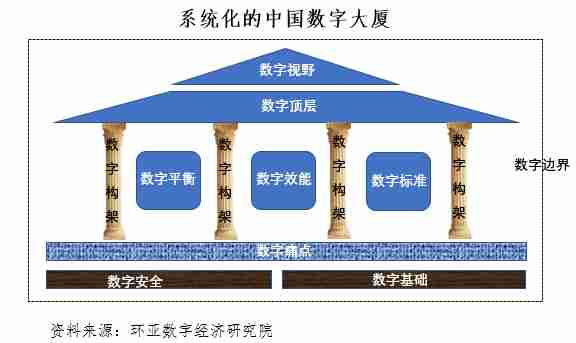
在经历了“十三五”期间数字化发展多点开花之后,中国要能在“十四五”期间继续保持全球数字化发展优势与树立标杆地位,必须要着眼于全球思维与顶层设计,重视系统、效能与均衡的原则。为此,我们提出了“十四五”期间数字化发展应重视的十条原则,其组成了系统化的中国数字大厦。
其中,“数字视野”决定数字大厦的高度;“数字顶层”决定大厦的主体设计;“数字构架”是大厦的四粱八柱;“数字痛点”解决了数字大厦的功能问题;“数字基础”与“数字安全”是数字大厦的根基;“数字效能”是对数字大厦能力的衡量;“数字边界”与“数字平衡”是数字大厦的社会属性要求;“数字标准”是数字大厦建立的标准与对外输出准则。
一、数字视野——把握数字化发展趋势与发展版图。
中国为了在未来能够继续引领全球数字化发展,首先要具备数字化发展的全球视野,掌握当前与预见未来数字化技术发展趋势以及数字经济与数字社会发展走向。形象的说,数字视野的宽广程度决定了中国数字大厦的高度。从数字技术看,人工智能势必将是数字化依托的基本工具,量子计算将是数字技术发展下一次飞跃,人机深度互动是数字应用的下一阶段突破方向。从数字经济发展来看,数字将成为经济的核心生产要素。另一方面,数字化对社会的渗透不是无限,对数字隐私的规范与重视将导致数字边界不断清晰与严格。
同时,需要重视分析与布局全球新的数字版图。全球传统经济模式具有三元特征,即欧美为全球主要消费中心,东亚为主要制造中心,其他地区为主要原料来源地。美欧日(G3)是全球三极。然而,数字化时代,经济向中美聚集,前者依赖巨大人口市场与应用创新推动数字化发展,后者依靠技术与算力保持数字化领先。未来全球数字化的中美两极(G2)特征将更加明显,因而也是中美冲突不断持续的大背景。在中美两极特征加深的情况下,现有传统的经济版图将不断调整,全球的数字经济、数字金融、数字贸易中心将加速向中美聚集,为中国的数字化发展带来巨大发展机遇。
二、数字顶层——解决数字化规划路径问题。
当前阶段的数字化发展,基本还处于分布式与条块分隔的状态,系统不通、数据分隔,导致数字化的效能远未发挥到最大潜能。
从本质上看,数字化发展是汇集、创造、运用数据进行优化决策与提升效益的系统工程。数据在社会经济全方面、多层次、上中下游链条的贯通与运用,使得社会经济的系统化特征更加清晰,数字信息传递的广度与深度也将更快渗透到各个环节。因此,数字化更适合运用全局性顶层设计。结合社会经济发展规划与功能需求,实施数字化的顶层设计,才能抓住数字化发展的大方向与长远发展节奏与目标。每一步、每个地区与每个部门的数字化应充分考虑顶层设计的任务分解,这样各地各部门合力才能凸显,避免各方无序制定、堆积数字化方案,缺乏战略协同与对接,导致冲突、浪费与无效现象。
三、数字构建——形成数字化发展的具体框架与发展路径。
数字构建包括数字理想布局、现实对比评估、构建改善方向与实施手段四个方面。首先是基于顶层框架,形成未来数字化发展需要的数字理想布局,包括构架全景图与路径发展图。其次,以数字理想布局为基础,对现有数字资源的范围进行对比,可以清晰看到当前数字资源面临的短板与不足;对现有数据资源质量的评估对比,可以发现现有数据质量的不足。第三,依据数据评估,为下一步的数据的改善与扩展方向制定更为精准与清晰的方向、目标以及发展阶段,解决无序数字化的弊端。最后,基于数据改善方向、目标以及发展阶段,设计改善与扩展数据的具体方式,包括通过感知设备采集新的必须数据、衍生计算新的数据、引入外部数据、开展调查生成数据等等。
四、数字痛点——解决为何要数字化与数字化驱动力的问题。
我们在对数字化的调查中发现,各地各地区都在竞相抓紧提出数字化方案与设想,“比学赶超“的风气浓厚。在当前形势大好的数字化进程中,更要防止“形式主义”抬头。从发达国家的数字化经验看,市场需求与效益驱动是主流,政府不是市场主体,作用较小。在中国,政府是数字化的主要推动者,更可以从全局与顶层设计推动数字化,但一些基层政府也有形式主义的倾向,不排除出现为了应付数字化而进行所谓“伪数字化”。因此,在大力倡导数字化过程中,应特别重视需求驱动,以解决实际痛点、提升效率与创新实效亮点为出发点,而不是以单纯建立大屏与可视化图表的“伪数字化”的形式主义。
五、数字设施——重视确保数字化优势的基础设施建设。
中国四十年来改革开放的成功离不开中国基础设施的快速发展。在全球数字化背景下,传统经济版图出现重新洗牌,加速向数字经济版图迈进。中国在全球数字化版图变化中面临重大的机遇,而抓住这一机遇的核心就是加速构建数字基础设施,以此才能确保成为全球数字经济真正的两极之一。
数据基础设施包括着围绕数据收集、存储、传输、清洗、处理、应用、交易与安全等一系列的软硬件的基础性软硬件。尤其是当前5G、未来6G以及卫星通讯技术决定了数据传输速度,这将成为全球各国经济竞争力与响应速度高低的关键基础,而算力基础则是数字化应用关键竞争力的核心。
六、数字安全——凸显数字化中的运行根基的重要性。
随着数字化程度的进一步提升,一个依托数字运行的社会经济体系将越来越清晰。在此基础上,数字安全的重要性也越来越凸显。而且,随着数字化程度的提升,数字安全的重要性不是线性增加,而是呈指数化增加。人类社会经济的集中度前所未有的集中在数字领域,相应的,风险也将前所未有的集中在数字安全领域。
极端情况下的外部人为攻击、太阳电磁冲击与数字化系统内部意外与蓄意破坏,都可能会社会经济运行带来系统性与灾难性的损失。有鉴于此,必须要从顶层设计角度加强数字安全,防止系统集中可能受到的冲击。集成与一体化的数字系统对提升效率十分重要,但备份与平行系统也是避免系统性风险冲击的必要数字安全措施。
七、数字效能——重视发展数字化的衡量效果。
衡量数字化成功的标准包括是否推动了效率变革,在效率、负担与成本方面是否有明显改善。因此,效能是检验数字化改革成果的主要标准,从数据的自动收集、填写、汇集与处理到切实减少人工负担,到提升政府工作能力与经济社会运行质量等。在数字化过程中,碎片化与不协同的数字化未必能够提升数字化整体效能,甚至可能形成“数字负担”。
我们在调研过程中发现了一些普遍问题:一些机关与企事业单位同时拥有多个数字化系统,系统内部实现了数字化,但系统之间没有打通,导致系统之间的数据交流回归人工操作。面对庞大高频的数据交换,对人工而言形成了典型的“数字负担”。除此之外,各类码识别信息的系统分隔,造成了大量重复数据填报的负担。因此,数字化不仅要重视消除存量“数字负担”,更要避免形成新的“数字负担”。
八、数字边界——数字化渗透不是无限的,需要尊重隐私的问题。
在国内数字化的推进过程中,压倒性的声音是加速全面推进数字化。不容置疑,数字化社会带来的便利与效能是显著的。但从辩证角度看,数字化渗透不是无限的。数字化之所以在中国可以加速推进,一方面是因为中国的市场与用户群体庞大,在数字化应用方面有相对其他国家无法比拟的优势,还有一个原因是国内在数据隐私方面意识相对淡薄与保护力度有限,数字边界模糊,从而客观上推进了数字化的飞速发展。从国外实践看,数字化推行相对缓慢的一个原因是个人与企业注重数据隐私,从而制约了数字化的推进速度。
面向未来,数据信息的重要程度将进一步提升,数据的资产特性也更加凸显,个人与企业的数据意识也会进一步加强,这些都将使得数据边界越来越清晰。因此,在数字化过程中,需要充分认识到数字边界的问题,把握好数字社会发展与数字边界之间的平衡。如果前期忽略这个问题,未来迟早要为此进行调整甚至会出现回撤的阵痛。
九、数字平衡——解决数字化发展过程中出现的“数字贫困”与“数字鸿沟”问题。
数字化的加速意味着经济结构、经济布局与财富的重新调整。发达国家的经验表明,拥有先发优势与垄断地位的企业已经在数字化转型中获取与掌握大量的社会财富。同时,部分小微企业面临营收减少与数字化转型挑战,庞大低学历人群也面对收入下降甚至工作转型的困境。在中国消除绝对贫困的情况下,需要重视弱势群体在数字化中可能出现的“数字贫困”问题,尤其是需要配套必要的扶持与培训。
另一方面,在制定数字化目标方面,追求便利是重要的一环。然而,当前数字化应用系统有越来越复杂的趋势,无形中把部分难以使用数字应用的群体排除在外,导致在共享数字福利与便利方面出现“数字鸿沟”。因此,设计与推广简便易用实用的数字化应用系统至关重要,唯此才能使得最广泛的群体享受数字化带来的福利与便利。
十、数字标准——确保数字化领先的制度性问题。
工业革命以来全球经济与社会体系的生产要素主要体现在技术、资金、土地与劳动力四个维度,具体的标准主要由欧美标准主导,体现在目前全球技术标准体系、经济框架、贸易体系、金融体系与国际规则等各个方面。在数字化加速发展与全球形成中美两极以后,全球的经济与社会格局出现明显的变化,数字经济的生产要素除了以上提到四方面外,还增加数据这一新的要素,而且由于数据是新加入的要素,其边际重要性还处于逐步增强的趋势。这为中国更多参与与影响全球规则与标准带来了难得的契机。中国积极参与数字要素标准的制定与实践,一旦在数字要素标准方面占领先机,则中国对全球数字化的影响将不仅体现在体量方面,而是在制度性领先方面形成优势。
数字化发展三部曲之二:数字化发展的八大趋势
在本文中,我们着重提出数字化发展的八大趋势,涉及数据形态、应用技术、应用方式、实现功能、决策领域、数字边界、数字变现与数字格局。
一、数据形态趋势——传统数据-大数据-定性信息量化
从本质上看,数字化是汇集、创造、运用数据进行优化决策与提升效益的过程。因此,信息的量化是数字化的前提与基础。传统的统计数据是数字化的起步,但无法支撑全面有效的数字化。大数据的出现极大扩展了数字化在企业、消费者等微观领域的应用,促进了数字化的大发展。未来,数字化分析的领域除了包含当前已量化的数据外,更重要的将会拓展到定性信息领域,将其量化或数字化,转变为计算机系统可以识别与处理的信息。因此,首先掌握定性信息数字化的技术与应用,将掌握着未来数字化的数据资源优势。
二、应用技术趋势——人工分析-人工智能
数字化应用的主要特征是对海量数据进行高效分析。数据海量体现在:频率从低转高、颗粒度从粗到精、维度从面到点等方面。数据的分析应用,集中在对数据进行系统化分析,其中不仅是数据的统计运算,更需要识别风险因素与智能化的响应。这些都对数据量与应用技术要求越来越高,传统的人工低效定性判断无法完成,必须要广泛采取智能逻辑判断、自然语言技术、机器学习与深度学习等技术来实现数字化应用技术的迭代与提升。率先从人工分析转向人工智能分析,则可以在数字化应用方面取得先机。
三、应用方式趋势——线上化-人机交互-融合
数字化的应用趋势包括三个阶段,线下工作线上化、人机交互与人机融合。当前的数字化仍主要处于初级阶段,即是线下工作与业务实现了部分线上化,尤其是新冠疫情加速了线上化的进程。线上化解决了工作流程、传输与存储等方面的系统化与电子化的问题,效率有了一定的提升。数字化应用方式下一个阶段是突破人机交互。目前,人工智能的运用,推动了人机交互的发展,包括简单的人机对话以及移动终端的人机信息交换。这个阶段的数字化特点是人机之间开展信息交互,系统可以更好更快了解人的意图与开展更精准的信息交流,进一步提升了数字化的效能。
第三阶段数字化是人机融合,即突破传统的视觉、声音与手触觉的人机交互模式,在脑神经、情绪、肢体形态甚至意念方面达成更快、更精准的信息传递与智能运算。这个阶段将推动大规模的生物植入芯片应用,“半数字人”与“数字人”将开始出现。当前时期,加速第二阶段数字化的应用推广以及提前布局第三节阶段数字化研发,将会极大加速推动数字化发展进程与水平并开发十分广阔的市场应用。
四、实现功能趋势——展示-风险分析-决策
数字化发展实现功能的初级阶段需要解决的是数据汇集与展示的问题,可视化是这一阶段的主要特征。但可视化只是加强了数据展现能力,并没有根本解决数字化赋能这一重要目标。实现功能趋势的第二阶段是数字化赋能,其中最为核心的识别风险与预警响应。通过数字化系统,可以精准实现预警,解决了过去人为无法及时识别与处置风险的痛点。第三阶段的实现功能是进入到决策阶段。随着算力的完善与数据的扩展,数字化系统将逐步具备决策功能,即实现真正意义的数据决策赋能,这是数字化的高阶阶段。
从当前的数字化实现功能看,主要集中展示这一阶段,数字化赋能的潜力远未被激发出来。率先在风险分析与决策方面实施突破,将能显著提升数字化赋能的水平与竞争力。
五、决策领域趋势——城市大脑-产业大脑-决策大脑
数字化决策能力是数字化最鲜明的特点。从当前的数字化实践来看,中国的数字化决策是首先在城市大脑方面取得突破,尤其是在交通与民生方面有一些创新应用。然而,未来的数字化决策领域远超城市大脑本身。从实体经济发展看,更为基础与关键的是如何利用数字化为实体经济赋能。因此,产业领域的大脑将是从经济社会角度最为重要的数字化发展应用。当前国内部分数字化新进省份,如浙江等提出“产业大脑”概念,正是在城市大脑基础上的领域突破。
在产业大脑方面,首先容易实现突破的是制造业大脑与产业链大脑,下一步将逐步向服务业大脑与商业大脑扩展,随着服务业在GDP比重的进一步上升,服务业大脑与商业大脑将成为产业大脑最核心的形式。产业大脑之后的下一阶段应用重点将体现在决策大脑层面,即基于风险预警与响应工具,建立决策大脑,开展数字化与智能化的决策分析。这体现在政府侧就是“政策大脑”,其将成为大幅提升数字政府的精准施政能力与国家治理能力的数字化基本工具。
六、数字边界趋势——模糊-清晰
数字化之所以在中国可以加速推进,一方面是因为中国的市场与用户群体庞大,在数字化应用方面有相对其他国家无法比拟的优势,还有一个原因是国内在数据隐私方面意识相对淡薄与保护力度有限。换句话说,中国数字化的初期阶段数字边界是模糊的,数字化发展享受了数据边界模糊的红利,从而客观上推进了数字化的飞速发展。从国外实践看,数字化推行相对缓慢的一个原因是个人与企业注重数据隐私,数字化界限相对清晰,从而制约了数字化的推进速度。
面向未来,数据信息的重要程度将进一步提升,数据的资产特性也更加凸显,个人与企业的数据保护意识也会进一步加强,这些都将使得数据边界从模糊逐步过渡到清晰。因此,在数字化过程中,需要充分认识到数字边界的问题,把握好数字社会发展与数字边界之间的平衡。如果前期忽略这个问题,未来迟早要为此进行调整甚至会出现回撤的阵痛。
七、数字变现趋势——数据“粗矿”-数据价值挖掘-数字化操作系统
数字化应用的持久性最终要体现在数字产品方面,即实现数字化的市场变现。数字经济时代中数字作为核心生产要素的重要性越来越明显,数据本身的资产特性与价值也将越来越明显。因此,数字化最基本的产品方式是数据本身或数据“粗矿”,即产生与提供特定的数据作为变现产品,这是数字产品的基本形态。随着数据分析专业化要求越来越高,数据“粗矿”越来越无法满足是数字经济时代的需求,专业的数据价值挖掘需要将逐步凸显,从而将催生出大量的数据价值挖掘供给产品,加速数字化GDP的增长。这就是数字变现趋势的第二个阶段。
第三阶段是数字化的操作系统,这种数字产品形态将是满足数据“粗矿”、数据价值挖掘、数据决策与定制化服务的集成。类似目前使用的办公软件系统,未来将出现专业化、智能化的数据分析管理与决策系统,其不仅体现在软件层面,也将拓展与带动硬件升级,从而推动数字变现价值进一步扩展。
八、数字格局趋势——传统经济版图-数字时代新中心
从全球格局来看,全球传统经济模式具有三元特征,即欧美为全球主要消费中心,东亚为主要制造中心,其他地区为主要原料来源地。美欧日(G3)是全球三极。然而,数字化时代,经济向中美聚集,前者依赖巨大人口市场与应用创新推动数字化发展,后者依靠技术与算力保持数字化领先。未来全球数字化的中美两极(G2)特征将更加明显。在中美两极特征加深的情况下,现有传统的经济版图将不断调整,全球的数字经济、数字金融、数字贸易中心将加速向中美聚集,为中国的数字化发展带来巨大发展机遇。
从地区经济格局看,长期以来,中国形成了以北京、上海、深圳为主体的经济与金融中心。这些中心的形成是长期以来政治因素、地理因素与国际环境综合形成的。在数字经济时代,国内经济面临洗牌与重新布局的可能。如数字化、能源结构与交通结构的变化打破了原有地理位置的约束,如贵州可以发展为中国的数据中心之一。对其他地区,借助数字经济的巨大机遇,同样也可能形成新的数字优势。如浙江利用自身在商业数字化与轻工制造业的优势,在数字版图调整背景下,有潜力发展为全球新的数字化制造与数字贸易中心,甚至基于数字技术与数据资产的汇集与应用,有潜力形成全球数据交易中心。
数字化发展三部曲之三:数字中国先行省浙江的实践与发展探讨
在数字中国加速推进的过程中,浙江无疑是数字中国的先行省与全球变革高地之一。从改革开放以来,浙江以私营经济作为先导,实现了向中国制造大省与外贸大省的转型,再以此为基础,构建了全球电商交易中心,奠定了浙江在数字经济的应用与技术全球领先优势。依托数字经济的领先优势,浙江率先在政府管理方面实现了“最多跑一次”改革和政府数字化转型的重大创新。
2021年,浙江又在全国率先提出了全方位数字化改革的目标,并提出了浙江数字化改革的重点任务是加快构建“1+5+2”工作体系,搭建好数字化改革“四梁八柱”。“1”即一体化智能化公共数据平台;“5”即五个综合应用;“2”即数字化改革的理论体系和制度规范体系。
预计到2025年,浙江的数字经济增加值占生产总值比重达到60%左右,超过全国10个百分点;浙江将在数字经济先行省、全球数字变革高地、全球数字贸易中心等方面进一步取得突破。
为更好推动浙江数字化改革有效、快速与扎实推进,始终引领全国与全球,我们基于近期开展的有关调研,从思维、趋势、目标、构架、导向、效能、社会、边界、安全九个方面提出深化推进数字中国先行省浙江的数字化改革有关发展思路。
一、在思维层面,重视数字化全局思维观与避免局部区域思维
浙江当前已经在全国乃至全球数字化发展方面取得领先地位,数字化发展进入无人区,很多领域无经验参考。下一步,浙江要能在数字经济先行省、全球数字变革高地、全球数字贸易中心建设等方面进一步取得突破,全局性的数字化思维是重中之重。也就是说,浙江更需要跳出自身的地区与局部思维观点,站在全国与全球数字经济发展潮流之上,充分监测、学习与展望全球数字经济与技术发展大势,在此基础上,制定适合浙江发展且能引领全国全球大趋势的数字化改革战略与行动措施。
二、在趋势层面,重视布局未来发展阶段与避免惯性思维
从数据形态趋势看,当前处于从传统数据、大数据应用阶段,未来数据形态将向定性信息量化拓展。从数字应用技术发展看,当前人工分析为主的趋势将被人工智能工具替代,越是重复性与可以量化的工作,被人工智能替代的速度越快。从数字应用方式趋势,从当前线上化进一步向人机交互再向融合方向发展。从数字化实现功能趋势看,展示与可视化的阶段已经不再具有先进性,未来将逐渐向风险管理与决策阶段升级。从数字决策领域趋势看,城市大脑将进一步延申到产业大脑与决策大脑。从数字变现趋势看,数据“粗矿”是最基本形态,之后是大规模的数据价值挖掘与专业化与智能化数字化操作系统产品。
三、在目标层面,重视打造全球数字中心与避免单纯围绕制造升级
数字化是超过国界与行业的生产方式的变革。基于传统经济的制造中心、能源中心、贸易中心、经济中心与金融中心将面临洗牌或被淘汰的危机。基于数字经济时代中美两极发展趋势,浙江下一步数字化不仅仅是帮助浙江传统制造基地的数字化升级,更应该在全球数字综合中心这个方面充分全面谋划,以服务业的数字化与相关数字化技术为中心,向数字技术创新中心、数据基础设施中心、数字技术与资产交易中心、算力中心、数字硬件中心延申与布局。
四、在架构层面,重视数字化改革顶层构架与避免无序堆积
“十三五”以来浙江地方政府数字化转型的主要发展特征是各地各部门建设形成了大量独立的数字化系统。基于“十四五“规划与2035远景目标,浙江应更加重视从顶层设计角度充分融合与配合社会经济发展目标与路径。在此基础上的数字化改革应是自上而下建立顶层设计,每一步、每个地区与每个部门的数字化改革应充分考虑顶层设计的改革分解,这样各地各部门合力才能凸显,避免各方无序制定、堆积数字化改革方案,缺乏战略协同与对接,导致冲突、浪费与无效现象。
五、在导向层面,重视痛点驱动与避免形式主义
我们在对数字化改革的调查中发现,各地各地区都在竞相抓紧提出数字化改革方案与设想,“比学赶超“的风气浓厚。在当前形势大好的数字化改革进程中,更要防止“形式主义”抬头。从发达国家的数字化经验看,市场需求与效益驱动是主流,政府不是市场主体,作用较小。在中国,政府是改革的主要推动者,更可以从全局与顶层设计推动数字化,但一些基层政府也有形式主义的倾向,不排除出现为了应付数字化改革而进行所谓“伪数字化”。因此,在大力倡导数字化改革过程中,应特别重视需求驱动,以解决实际痛点为出发点,而不是以单纯建立大屏与可视化图表的“伪数字化”。
六、在效能层面,重视数字效率与避免形成“数字负担”
衡量数字化改革成功的标准包括是否推动了效率变革,在效率、负担与成本方面是否有明显改善。因此,效能是检验数字化改革成果的主要标准,从数据的自动收集、填写、汇集与处理到切实减少人工负担,到提升政府工作能力与经济社会运行质量等。在改革过程中,碎片化与不协同的数字化未必能够提升数字化整体效能,甚至可能形成“数字负担”。
七、在社会层面,重视共享数字福利与避免造成数字贫困与鸿沟
数字经济的加速意味着经济结构、经济布局与财富的重新调整。发达国家的经验表明,拥有先发优势与垄断地位的企业已经在数字经济转型中获取与掌握大量的社会财富。同时,部分小微企业面临营收减少与数字化转型挑战,庞大低学历人群也面对收入下降甚至工作转型的困境。在中国消除绝对贫困的情况下,浙江作为数字先行省应更重视弱势群体在数字经济中可能出现的“数字贫困”问题,强调制度创新,探索出数字经济时代消除数字贫困的新思路。
另一方面,在制定数字化改革的目标方面,追求便利是重要的一环。然而,当前数字化应用系统有越来越复杂的趋势,无形中把部分难以使用数字应用的群体排除在外,导致在共享数字福利与便利方面出现“数字鸿沟”。因此,设计与推广简便易用实用的数字化应用系统至关重要,唯此才能使得最广泛的群体享受数字化带来的福利与便利。
八、在边界层面,重视数据使用边界的划分避免持续模糊化
数字化之所以在中国可以加速推进,一方面是因为中国的市场与用户群体庞大,在数字化应用方面有相对其他国家无法比拟的优势,还有一个原因是国内在数据隐私方面意识相对淡薄与保护力度有限。换句话说,中国数字化的初期阶段数字边界是模糊的,数字化发展享受了数据边界模糊的红利,从而客观上推进了数字化的飞速发展。从国外实践看,数字化推行相对缓慢的一个原因是个人与企业注重数据隐私,数字化界限相对清晰,从而制约了数字化的推进速度。
面向未来,数据信息的重要程度将进一步提升,数据的资产特性也更加凸显,个人与企业的数据保护意识也会进一步加强,这些都将使得数据边界从模糊逐步过渡到清晰。因此,在数字化过程中,需要充分认识到数字边界的问题,把握好数字社会发展与数字边界之间的平衡。
九、在安全层面,重视数字系统安全与避免风险集中
数字经济社会的基石是数字安全与网络安全。一旦基础性的数字系统与网络持续瘫痪,其影响甚至可能超过新冠肺炎疫情造成的损失,尤其是对浙江这样以数字经济发展为核心命脉的地区,数字化改革要格外重视数字安全与网络安全,防范极端情况下的外部冲击与内部意外的破坏性。有鉴于此,必须要从顶层设计角度及时部署备份与安全防护措施等,尤其是对高度集成化与整体性的数字化体系,更需要防止系统性风险导致的巨大冲击。
翻译:
In order to maintain the advantage of global digital development and establish the benchmark position during the 14th Five-Year Plan period, China must focus on global thinking and top-level design, and attach importance to the principles of system, efficiency and balance.
One of the digital development trilogy: Thinking about the digital development path during the “Fourteen Fifth Plan”
The “14th Five-Year Plan” and the “Vision Goals for 2035” of the CPC Central Committee put forward the concept of “digital China”. The central government Work Report on March 11, 2021 further proposed to “accelerate digital development, create new digital advantages, promote digital industrialization and industrial digital transformation, accelerate the pace of digital society construction, improve the level of digital government construction, create a good digital ecology, and build a digital China”. At the same time, some digitalized provinces put forward more forward-looking and leading development ideas. For example, Zhejiang emphasizes to ensure that Zhejiang becomes the “global digital revolution highland” by vigorously promoting digital reform, Shanghai proposes to build the “international digital capital”, and Fujian sets the goal of becoming the “first province of digital application”.
It can be said that after the rapid development of the 13th Five-Year Plan period, China’s digital development has entered the fast lane, and its leading advantage in the world has been further highlighted, and will be further accelerated during the 14th Five-Year Plan period. By 2025, we expect global broad digital value added to rise to $45tn, or 45 per cent of global GDP, with China accounting for about 25 per cent of global digital value added.
After experiencing multiple flowering of digital development during the 13th Five-Year Plan period, China must focus on global thinking and top-level design
After experiencing multiple flowering of digital development during the 13th Five-Year Plan period, China must focus on global thinking and top-level design, and pay attention to the principles of system, efficiency and balance in order to maintain the advantages of global digital development and establish a benchmark position during the 14th Five-Year Plan period. To this end, we put forward ten principles that should be emphasized in digital development during the 14th Five-Year Plan period, which constitute a systematic digital edifice in China.
“Digital Vision” determines the height of the digital tower; “Digital top floor” determines the main design of the building; The digital Framework is the four pillars of the building; The “Digital pain point” solves the functional problem of the digital building; “Digital infrastructure” and “digital security” are the foundation of the digital edifice; “Digital effectiveness” is a measure of the capabilities of the digital edifice; “Digital boundary” and “digital balance” are the social attributes of the digital building; “Digital standard” is the standard established by digital building and the export criterion.
Digital Vision — Grasp the development trend and territory of digitalization.
In order to continue to lead the global digital development in the future. China must first have a global vision of digital development, master the current and foresee the future development trend of digital technology. As well as the development trend of digital economy and digital society. Figuratively speaking, the breadth of digital vision determines the height of China’s digital edifice. From the perspective of digital technology. Artificial intelligence is bound to be the basic tool of digitization, quantum computing will be the next leap in the development of digital technology. And human-machine interaction is the next breakthrough direction of digital application. From the development of digital economy, digital will become the core factor of production. On the other hand, the penetration of digitalization into society is not infinite. And the regulation and emphasis on digital privacy will lead to the continuous clarity and strictness of digital boundaries.
At the same time, attention should be paid to the analysis and layout of the new digital map of the world.
The traditional global economic model has three characteristics, that is. Europe and the United States as the main global consumption centers, East Asia as the main manufacturing centers. And other regions as the main source of raw materials. The G3 is the world’s three poles. However, in the digital age, the economy is converging to China and the US. The former relies on the huge population market and application innovation to promote the digital development. While the latter relies on technology and computing power to maintain the digital lead.
In the future, the G2 characteristics of global digitalization will be more obvious. Which is also the background of the continuous conflict between China and the United States. In the case of the deepening of the bipolar characteristics of China and the United States. The existing traditional economic map will continue to adjust, the global digital economy, digital finance, digital trade centers will accelerate to converge to China and the United States, bringing huge development opportunities for China’s digital development.
Digital Top-level — Solving the problem of digital planning path.
The current stage of digital development is still in the state of distribution and block separation, system imconnectivity, data separation, resulting in the efficiency of digitalization far from the maximum potential.
In essence, digital development is a systematic engineering that collects,. Creates and uses data to make optimal decisions and improve benefits. The connection and application of data in all aspects, multi-level, upper, middle and downstream chains of social economy makes the systematic characteristics of social economy clearer. And the breadth and depth of digital information transmission will penetrate into every link faster. Therefore, digital is more suitable for the use of global top-level design.
Combined with social and economic development planning and functional requirements. The implementation of digital top-level design can grasp the general direction of digital development and long-term development rhythm and goals. The digitization of each step, each region and each department should give full consideration to the task decomposition of top-level design, so that the joint efforts of all regions and departments can be highlighted to avoid the disorderly development and accumulation of digitalization schemes. The lack of strategic coordination and connection, resulting in conflicts, waste and ineffectiveness.
Digital Construction — Forming a specific framework and development path for digital development.
Digital construction includes four aspects: digital ideal layout, realistic comparison evaluation, construction improvement direction and implementation means.
The first is based on the top-level framework to form the digital ideal layout needed for future digital development. Including the architectural panorama and path development map.
Secondly, based on the ideal layout of digital, comparing the range of existing digital resources, we can clearly see the shortcomings and deficiencies of current digital resources. By comparing and evaluating the quality of existing data resources, we can find the deficiency of existing data quality.
Thirdly, based on data evaluation, more precise and clear directions, objectives and development stages are formulated for the improvement and expansion direction of the next step of data. So as to solve the disadvantages of disordered digitalization.
Finally, based on the direction, goal and development stage of data improvement. Specific ways to improve and expand data are designed, including collecting new necessary data through sensing devices, deriving new data, introducing external data, conducting surveys and generating data, etc.
Digital pain points — Addressing the question of why we want to go digital and what drives it.
In our survey of digitalization. We found that all regions are racing to put forward digitalization schemes and ideas. And there is a strong trend of “catching up with learning”. In the current favorable digital process, we should prevent the rise of “formalism”. From the digital experience of developed countries, market demand and efficiency are the mainstream. While the government is not the main player of the market and plays a small role.
In China, the government is the main promoter of digitalization. And it can promote digitalization from the overall and top-level design. However, some grassroots governments also have the tendency of formalism. Which does not rule out the so-called “pseudo-digitalization” in order to cope with digitalization. Therefore, in the process of vigorously advocating digitalization, special attention should be paid to demand-driven.With solving actual pain points, improving efficiency and innovating actual highlights as the starting point. Rather than the “pseudo-digitalization” formalism of simply establishing large screens and visual charts.
Digital Infrastructure — Emphasis is placed on the construction of infrastructure to ensure the advantages of digital.
The success of China’s reform and opening up over the past four decades cannot be achieved without the rapid development of China’s infrastructure. Under the background of global digitization, the traditional economic map appears to be reshuffled, accelerating to the digital economic map. China faces great opportunities in the changing global digital landscape. And the core of seizing this opportunity is to accelerate the construction of digital infrastructure. So as to ensure that it becomes one of the true poles of the global digital economy.
Data infrastructure includes a series of basic hardware and software. Including data collection, storage, transmission, cleaning, processing, application, transaction and security. In particular, the current 5G, the future 6G and satellite communication technologies determine the data transmission speed. Which will become the key basis for the economic competitiveness and response speed of all countries in the world. While the basis of computing power is the core of the key competitiveness of digital application.
Digital Security — Highlighting the importance of operational fundamentals in digitization.
With the further development of digitization. It will become more and more clear that a social and economic system will be run on the basis of digital. On this basis, the importance of digital security is becoming more and more prominent. Moreover, as digitization increases, the importance of digital security increases not linearly, but exponentially. The concentration of human society and economy is unprecedented in the digital field, and correspondingly. The risk will be unprecedented in the digital security field.
In extreme cases, external man-made attacks, solar electromagnetic shocks. And internal accidents and sabotage of digital systems may lead to systematic and catastrophic losses in social and economic operations. In view of this, it is necessary to strengthen the digital security from the perspective of top-level design to prevent the possible impact of system centralization. Integrated and integrated digital systems are important to increase efficiency. But backup and parallel systems are also necessary digital security measures to avoid systemic risk shocks.
Digital Effectiveness – Pay attention to the development of digital measurement effect.
The criteria for measuring the success of digitisation include whether it drives efficiency change. And whether there are significant improvements in efficiency, burden and cost. Therefore, efficiency is the main standard to test the results of digital reform. From the automatic collection, filling, collection and processing of data, to effectively reduce the labor burden, to improve the government’s work ability and the quality of economic and social operation. In the process of digitalization, fragmentation and uncoordinated digitalization may not necessarily improve the overall efficiency of digitalization. And may even form a “digital burden”.
In the process of investigation, we found some common problems:. Some organs and enterprises and institutions have multiple digital systems at the same time. And the internal system has been digitized, but the system has not got through. Resulting in the data exchange between the systems back to manual operation. Faced with the huge and high frequency of data exchange, it forms a typical “digital burden” for manual labor. In addition, the system separation of various types of code identification information causes the burden of a large number of repeated data filling. Therefore, digitalization should not only pay attention to eliminating the “digital burden” of stock. But also avoid forming new “digital burden”.
Digital Boundaries — Digital penetration is not unlimited and privacy issues need to be respected.
In the process of domestic digitization, the overwhelming voice is to accelerate the overall promotion of digitization. There is no doubt that the convenience and efficiency of the digital society are significant. But from a dialectical point of view, digital penetration is not infinite. The reason why digitalization can be accelerated in China is that, on the one hand. China has an incomparable advantage over other countries in terms of digital application due to its huge market and user groups. And on the other hand, China has a relatively weak awareness of data privacy and limited protection efforts. And the digital boundary is blurred, which objectively promotes the rapid development of digitalization. From foreign practice, one reason for the relatively slow implementation of digitalization is that individuals and enterprises pay attention to data privacy, thus restricting the speed of digitalization.
In the future, the importance of data information will be further enhanced, the asset characteristics of data will be more prominent. And the awareness of data of individuals and enterprises will be further strengthened. All these will make the boundary of data clearer and clearer. Therefore, in the process of digitization. It is necessary to fully realize the problem of digital boundary and grasp the balance between the development of digital society and digital boundary. If we ignore this problem in the early stage, sooner or later we will have to adjust for this and even retreat pains.
Digital Balance — Solving the problems of “digital poverty” and “digital divide” in the process of digital development.
The acceleration of digitization means the readjustment of economic structure, economic layout and wealth. The experience of developed countries shows that enterprises with first-mover advantage and monopoly position have acquired and mastered a large amount of social wealth in the digital transformation. At the same time, some small and micro enterprises are facing the challenges of revenue reduction and digital transformation. And the large number of people with low education also face the dilemma of income decline and even job transformation. In the context of eliminating absolute poverty in China. Attention should be paid to the problem of “digital poverty” that may occur in the digitalization of vulnerable groups. Especially necessary support and training.
On the other hand, the pursuit of convenience is an important part of setting digital goals. However, there is a tendency for digital applications to become more complex. Which virtually excludes some groups who have difficulty using digital applications. Resulting in a “digital divide” in terms of sharing digital benefits and convenience. Therefore, it is very important to design and promote digital application systems that are easy to use and practical. So that the widest group of people can enjoy the benefits and convenience of digitalization.
Digital Standards — Institutional issues to ensure digital leadership.
Since the industrial revolution, the production factors of the global economic and social system are mainly reflected in the four dimensions of technology, capital, land and labor. The specific standards are mainly dominated by European and American standards. And reflected in the current global technical standard system, economic framework, trade system, financial system and international rules. After the accelerated development of digitalization and the global formation of China and the United States. The global economic and social pattern has undergone obvious changes.
Besides the four aspects mentioned above, the production factors of digital economy also add the new factor of data. And since data is a newly added factor, its marginal importance is still increasing gradually. This provides a rare opportunity for China to participate more in and influence global rules and standards. China actively participates in the formulation and practice of digital element standards. Once it takes the lead in digital element standards. China’s influence on global digitization will not only be reflected in terms of size. But also in terms of institutional leadership.
Digital development trilogy II: Eight trends of digital development
In this paper, we put forward eight major trends of digital development. Including data form, application technology, application mode, implementation function, decision-making domain, digital boundary, digital realization and digital pattern.
Trend of data form — traditional data — Big data — quantitative qualitative information
In essence, digitization is a process of collecting, creating and using data to optimize decisions and improve benefits. Therefore, quantification of information is the premise and foundation of digitization. Traditional statistics are the beginning of digitization, but they cannot support full and effective digitization. The emergence of big data has greatly expanded the application of digitalization in enterprises, consumers and other micro fields. And promoted the great development of digitalization. In the future, in addition to the current quantified data. The field of digital analysis will more importantly expand to the field of qualitative information. Which will be quantified or digitized and transformed into information that can be recognized and processed by computer systems. Therefore, mastering the technology and application of qualitative information digitization first will master the advantage of data resources of future digitization.
Applied Technology Trends — Artificial Analytics — Artificial Intelligence
The main feature of digital applications is the efficient analysis of massive data. Data mass is reflected in: frequency from low to high, granularity from coarse to fine, dimension from surface to point and so on. The analysis and application of data focuses on the systematic analysis of data. Which is not only the statistical operation of data, but also the identification of risk factors and intelligent response. These are increasingly demanding for data volume and application technology. Traditional artificial and inefficient qualitative judgment cannot be completed. Intelligent logic judgment, natural language technology, machine learning and deep learning and other technologies must be widely adopted to achieve the iteration and improvement of digital application technology. Being the first to shift from human analytics to AI analytics will give you a head start in digital applications.
Application trend — online – human-computer interaction – integration
The application trend of digitalization includes three stages: offline work and online, human-computer interaction and human-computer integration. At present, digitalization is still mainly in the initial stage, that is, offline work and business have realized part of the online. Especially the COVID-19 pandemic has accelerated the process of online. Online solution to the work flow, transmission and storage aspects of the systematic and electronic problems, efficiency has been improved. The next stage of digital application is to break through human-computer interaction. At present, the application of artificial intelligence has promoted the development of human-computer interaction. Including simple human-computer dialogue and human-computer information exchange of mobile terminals. The digitalization at this stage is characterized by information interaction between man and machine. The system can better and faster understand people’s intentions and carry out more accurate information exchange. Which further improves the efficiency of digitalization.
The third stage of digitization is man-machine integration. Which breaks through the traditional man-machine interaction mode of vision, sound and touch. And achieves faster and more accurate information transmission and intelligent calculation in the aspects of brain, emotion, body shape and even idea. This stage will lead to the large-scale application of bioimplanted chips. And “semi-digital people” and “digital people” will begin to appear. In the current period, accelerating the application and promotion of the second phase of digitization and laying out the third phase of digitization research and development in advance will greatly accelerate the development process and level of digitization and develop a very broad market application.
Realization of functional trends — Display — Risk analysis — decision
In the primary stage of digital development, what needs to be solved is the problem of data collection and display. And visualization is the main feature of this stage. However, visualization only enhances the ability to present data, but does not fundamentally address the important goal of digital empowerment. The second stage of realizing functional trend is digital enablement. In which the core is risk identification and early warning response. Through the digital system, accurate early warning can be realized. Which solves the pain point of artificial failure to timely identify and deal with risks in the past. The implementation function of the third stage is to enter the decision stage. With the improvement of computing power and the expansion of data. The digital system will gradually have the decision-making function. That is, to realize the real sense of data decision enabling, which is the advanced stage of digitalization.
From the point of view of the current digital realization function, mainly focus on this stage. The potential of digital empowerment is far from being stimulated. Take the lead in risk analysis and decision-making to implement a breakthrough. Will be able to significantly improve the level of digital enabling and competitiveness.
Trend of decision-making field — Urban brain — Industrial brain — decision-making brain
Digital decision-making ability is the most distinctive feature of digital. From the current digital practice, China’s digital decision-making is the first to make a breakthrough in the aspect of urban brain. Especially in the aspects of traffic and people’s livelihood. The future of digital decision-making, however, extends far beyond the urban brain itself. From the perspective of the development of the real economy. It is more fundamental and critical to use digitalization to empower the real economy. Therefore, the industrial brain will be the most important application of digital development from an economic and social perspective. At present, some newly digitalized provinces in China. Such as Zhejiang, put forward the concept of “industrial brain”, which is a breakthrough in the field based on urban brain.
In terms of industrial brain, manufacturing brain and industrial chain brain are easy to make breakthroughs first. And the next step will be to expand to service brain and business brain. With the further increase of the proportion of service industry in GDP. Service brain and business brain will become the most core form of industrial brain. The next stage of application after the industrial brain will focus on the level of decision brain, that is. The establishment of decision brain based on risk warning and response tools, to carry out digital and intelligent decision analysis. This is reflected in the government side as the “policy brain”. Which will become the digital basic tool to greatly improve the digital government’s ability of precise administration and national governance.
Digital boundary trend – fuzzy – clear
The reason why digitalization can be accelerated in China is that, on the one hand. China has an incomparable advantage over other countries in terms of digital application due to its huge market and user group. And on the other hand, China has a relatively weak awareness of data privacy and limited protection efforts. In other words, the digital boundary in the early stage of China’s digitalization is fuzzy, and the digitalization development enjoys the dividend of the fuzzy data boundary, thus promoting the rapid development of digitalization objectively. From the perspective of foreign practice, one reason for the relatively slow implementation of digitalization is that individuals and enterprises pay attention to data privacy, and the digitalization boundary is relatively clear, thus restricting the speed of digitalization.
In the future, the importance of data information will be further enhanced, the asset characteristics of data will be more prominent, and the awareness of data protection of individuals and enterprises will be further strengthened. All these will make the boundary of data gradually transition from fuzzy to clear. Therefore, in the process of digitization, it is necessary to fully realize the problem of digital boundary and grasp the balance between the development of digital society and digital boundary. If we ignore this problem in the early stage, sooner or later we will have to adjust for this and even retreat pains.
Digital realization Trend — data “rough mine” — data value mining — digital operating system
The durability of digital applications should be reflected in the digital products, that is, the realization of digital market cash. In the era of digital economy, the importance of digital as the core factors of production is becoming more and more obvious, and the asset characteristics and value of data itself will become more and more obvious. Therefore, the most basic product mode of digitization is the data itself or the “crude mine” of data, that is, the generation and provision of specific data as cash products, which is the basic form of digital products.
As the specialization of data analysis becomes more and more demanding, the “crude mine” of data is increasingly unable to meet the needs of the digital economy era. The need of professional data value mining will gradually become prominent, which will give rise to a large number of data value mining products to supply and accelerate the growth of digital GDP. This is the second phase of the digital liquidation trend.
The third stage is the digital operating system. This digital product form will meet the integration of data “rough mining”, data value mining, data decision-making and customized services. Similar to the current office software system, the future will appear professional and intelligent data analysis management and decision-making system, which is not only reflected in the software level, but also will expand and drive the hardware upgrade, so as to promote the further expansion of digital realization value.
Trend of Digital Pattern — Traditional Economic Map — New Center of Digital Era
From the perspective of the global pattern, the traditional global economic model has three characteristics, that is, Europe and the United States as the main global consumption centers, East Asia as the main manufacturing centers, and other regions as the main source of raw materials. The G3 is the world’s three poles. However, in the digital age, the economy is converging to China and the US. The former relies on the huge population market and application innovation to promote the digital development, while the latter relies on technology and computing power to maintain the digital lead.
In the future, the characteristics of global digitization will be more obvious. In the case of the deepening of the bipolar characteristics of China and the United States, the existing traditional economic map will continue to adjust, the global digital economy, digital finance, digital trade centers will accelerate to converge to China and the United States, bringing huge development opportunities for China’s digital development.
In terms of regional economic pattern, China has for a long time formed an economic and financial center with Beijing, Shanghai and Shenzhen as the main parts.
The formation of these centers is a combination of political factors, geographical factors and international environment for a long time. In the age of digital economy, the domestic economy faces the possibility of reshuffle and re-layout. For example, changes in digitalization, energy structure and transportation structure break the constraints of the original geographical location. For example, Guizhou can develop into one of the data centers in China. For other regions, too, new digital advantages may emerge from the vast opportunities of the digital economy. For example, Zhejiang has the potential to develop into a new global digital manufacturing and digital trade center under the background of digital map adjustment by taking advantage of its advantages in business digitalization and light industry manufacturing. It even has the potential to form a global data trading center based on the collection and application of digital technology and data assets.
The third part of the digital Development trilogy: The practice and development of Zhejiang, the pioneer province of Digital China
In the process of accelerating the promotion of digital China, Zhejiang is undoubtedly the pioneer province of digital China and one of the heights of global change. Since the reform and opening up, Zhejiang has taken the private economy as the guide and realized the transformation to China’s major manufacturing province and foreign trade province. On this basis, Zhejiang has built a global e-commerce trading center and laid a global leading advantage in the application and technology of digital economy. Relying on the leading advantage of digital economy, Zhejiang has taken the lead in realizing the reform of “run once at most” and the major innovation of government digital transformation.
In 2021, Zhejiang took the lead in putting forward the goal of all-round digital reform in China, and put forward that the key task of Zhejiang digital reform is to accelerate the construction of “1+5+2” work system, and set up the “four beams and eight pillars” of digital reform. “1” is the integrated intelligent public data platform; “5” means five comprehensive applications; “2” refers to the theoretical system and institutional standard system of digital reform.
It is expected that by 2025, the added value of digital economy in Zhejiang will account for about 60% of the GDP, exceeding the national level by 10 percentage points. Zhejiang will make further breakthroughs in digital economy pioneer province, global digital revolution highland and global digital trade center.
In order to better promote the effective, rapid and solid progress of Zhejiang digital reform, and always lead the whole country and the world, we based on the recent research, from the nine aspects of thinking, trend, goal, framework, orientation, efficiency, society, border and security, put forward the development ideas of deepening the digital reform of Zhejiang, the pioneer province of digital China.
In the level of thinking, pay attention to digital global thinking and avoid local regional thinking
At present, Zhejiang has taken a leading position in the digital development of the country and even the world. The digital development has entered no man’s land and there is no experience reference in many fields. In the next step, Zhejiang should make further breakthroughs in digital economy pioneer province, global digital revolution highland, global digital trade center construction and other aspects, and the overall digital thinking is the top priority. That is to say, Zhejiang needs to jump out of its own regional and local thinking point of view, stand on the national and global digital economy development trend, fully monitor, study and look forward to the global digital economy and technology development trend, on this basis, formulate the development of Zhejiang and can lead the national global trend of digital reform strategy and action measures.
In the trend level, pay attention to the layout of the future development stage and avoid inertia thinking
From the trend of data form, it is currently in the application stage of traditional data and big data, and the future data form will expand to qualitative information quantification. From the perspective of the development of digital application technology, the current trend of artificial analysis will be replaced by artificial intelligence tools. The more repetitive and quantifiable work, the faster the replacement speed of artificial intelligence. From the trend of digital application mode, from the current online further to human-computer interaction and then to the direction of integration.
From the trend of digital realization function, the stage of display and visualization is no longer advanced, and will gradually upgrade to the stage of risk management and decision-making in the future. From the trend of digital decision-making field, the city brain will be further extended to the industrial brain and decision-making brain. From the trend of digital realization, data “crude mine” is the most basic form, followed by large-scale data value mining and professional and intelligent digital operating system products.
At the target level, attach importance to building a global digital center and avoid solely focusing on manufacturing upgrading
Digitization is a transformation of production modes that transcends national boundaries and industries. Manufacturing centers, energy centers, trade centers, economic centers and financial centers based on traditional economy will face the crisis of reshuffle or elimination. Based on the bipolar development trend of China and the United States in the era of digital economy, the next step of digitalization in Zhejiang is not only to help the digital upgrade of the traditional manufacturing base in Zhejiang, but also to make a full and comprehensive plan in the aspect of the global digital comprehensive center, centering on the digitalization of the service industry and related digital technologies. To the digital technology innovation center, data infrastructure center, digital technology and assets trading center, computing center, digital hardware center extension and layout.
At the structural level, attach importance to the top-level framework of digital reform and avoid disorderly accumulation
Since the “13th Five-Year Plan”, the main development feature of Zhejiang local government digital transformation is that various departments have built a large number of independent digital systems. Based on the “14th Five-Year Plan” and the 2035 vision, Zhejiang should pay more attention to fully integrate and cooperate with the goals and paths of social and economic development from the perspective of top-level design. On this basis, the digital reform should establish the top-level design from the top down, and the digital reform of each step, each region and each department should fully consider the reform decomposition of the top-level design, so that the joint efforts of all regions and departments can be highlighted, to avoid the disorderly development and accumulation of digital reform schemes, lack of strategic coordination and connection, resulting in conflicts, waste and ineffectiveness.
At the guidance level, pay attention to pain point driving and avoid formalism
In our survey of digital reform, we found that all regions are racing to put forward digital reform plans and ideas, and there is a strong trend of “catching up with the learning”. In the current favorable digital reform process, we should prevent the rise of “formalism”. From the digital experience of developed countries, market demand and efficiency are the mainstream, while the government is not the main player of the market and plays a small role. In China, the government is the main driver of reform, and can promote digitalization from the overall and top-level design.
However, some grassroots governments also have the tendency of formalism, which does not rule out the so-called “pseudo-digitalization” in order to cope with the digital reform. Therefore, in the process of vigorously advocating digital reform, special attention should be paid to demand-driven, and the starting point should be to solve the actual pain points, rather than the “pseudo-digitalization” of simply building large screens and visual charts.
In terms of efficiency, pay attention to digital efficiency and avoid “digital burden”
The criteria to measure the success of digital reform include whether it promotes efficiency change and whether there is significant improvement in efficiency, burden and cost. Therefore, efficiency is the main standard to test the results of digital reform, from the automatic collection, filling, collection and processing of data, to effectively reduce the labor burden, to improve the government’s work ability and the quality of economic and social operation. In the process of reform, fragmentation and uncoordinated digitalization may not necessarily improve the overall efficiency of digitalization, and may even form a “digital burden”.
At the social level, focus on sharing digital benefits and avoiding digital poverty and divide
The acceleration of digital economy means the readjustment of economic structure, economic layout and wealth. The experience of developed countries shows that enterprises with first-mover advantage and monopoly position have acquired and mastered a great deal of social wealth in the transformation of digital economy. At the same time, some small and micro enterprises are facing the challenges of revenue reduction and digital transformation, and the large number of people with low education also face the dilemma of income decline and even job transformation. In the case of eliminating absolute poverty in China, Zhejiang, as a digital pioneer province, should pay more attention to the problem of “digital poverty” that may occur in the digital economy of vulnerable groups, emphasize institutional innovation, and explore new ideas for eliminating digital poverty in the era of digital economy.
On the other hand, the pursuit of convenience is an important part of setting the goal of digital reform. However, there is a tendency for digital applications to become more complex, which virtually excludes some groups who have difficulty using digital applications, resulting in a “digital divide” in terms of sharing digital benefits and convenience. Therefore, it is very important to design and promote digital application systems that are easy to use and practical, so that the widest group of people can enjoy the benefits and convenience of digitalization.
At the boundary level, attention should be paid to the division of data use boundary to avoid continuous ambiguity
The reason why digitalization can be accelerated in China is that, on the one hand, China has an incomparable advantage over other countries in terms of digital application due to its huge market and user group, and on the other hand, China has a relatively weak awareness of data privacy and limited protection efforts. In other words, the digital boundary in the early stage of China’s digitalization is fuzzy, and the digitalization development enjoys the dividend of the fuzzy data boundary, thus promoting the rapid development of digitalization objectively. From the perspective of foreign practice, one reason for the relatively slow implementation of digitalization is that individuals and enterprises pay attention to data privacy, and the digitalization boundary is relatively clear, thus restricting the speed of digitalization.
In the future, the importance of data information will be further enhanced, the asset characteristics of data will be more prominent, and the awareness of data protection of individuals and enterprises will be further strengthened. All these will make the boundary of data gradually transition from fuzzy to clear. Therefore, in the process of digitization, it is necessary to fully realize the problem of digital boundary and grasp the balance between the development of digital society and digital boundary.
At the security level, attention should be paid to the security of digital systems and risk concentration should be avoided
Digital security and network security are the cornerstones of digital economy society. Once the basic digital systems and networks continue to break down, the impact may even exceed the losses caused by the novel coronavirus epidemic. Especially for regions like Zhejiang, where the development of digital economy is the core lifeblood, digital reform should pay special attention to digital security and network security to prevent external impact and internal unexpected damage under extreme circumstances. In view of this, it is necessary to timely deploy backup and security protection measures from the perspective of top-level design. Especially for the highly integrated and integrated digital system, it is more necessary to prevent the huge impact caused by systemic risks.
本文由数字化转型网(www.szhzxw.cn)转载而成,来源:环亚数字经济研究所;编辑/翻译:数字化转型网宁檬树。

免责声明: 本网站(http://www.szhzxw.cn/)内容主要来自原创、合作媒体供稿和第三方投稿,凡在本网站出现的信息,均仅供参考。本网站将尽力确保所提供信息的准确性及可靠性,但不保证有关资料的准确性及可靠性,读者在使用前请进一步核实,并对任何自主决定的行为负责。本网站对有关资料所引致的错误、不确或遗漏,概不负任何法律责任。
本网站刊载的所有内容(包括但不仅限文字、图片、LOGO、音频、视频、软件、程序等) 版权归原作者所有。任何单位或个人认为本网站中的内容可能涉嫌侵犯其知识产权或存在不实内容时,请及时通知本站,予以删除。