数字化,让很多企业业务流程发生了质变。《2022数字化采购发展报告》显示,数字化采购的价值可降低30%供应链综合成本。而企业60%以上的成本是由采购部门支出。这意味着,数字化赋能下,采购中心从“花钱”变成了“赚钱”,企业管理者开始向采购人员要利润。从这一点来看,数字化不仅实现了企业的降本增效,还让采购从原本的成本中心变为了利润中心。一组数据是,2021年全国采购市场规模超174万亿元,而全国数字化采购渗透率约7.5%,这意味着在诺大的企业采购市场中,基于采购数字化转型的产品、服务增长空间巨大。
在这背后需要思考的问题是:
1、传统采购痛点之下,转型的路线是什么?
2、数字采购落地情况如何?
3、数字化如何重塑采购中心?
4、企业自身如何构建适合数字采购的土壤?
一、2023年,采购的“两条线”
一宗700双运动鞋的采购,从需求方提出采购意向到供应商报价需要多久?
在传统采购模式中,答案是7天。
北京望京某企业的茶水间,采购负责人张先生不停地拨打着供应商的电话,这是他给出采购需求的第六天。
“这对我来说简直不敢想象,作为一家全球知名的户外品牌公司,对于这个案子的报价和回复时间居然要一周。”张先生表示自己一直在追问报价进度,而供应商那边的态度完全是一幅爱买不买的心态。
这是供需不对等的典型案例。但这只是传统采购模式下的一个缩影。
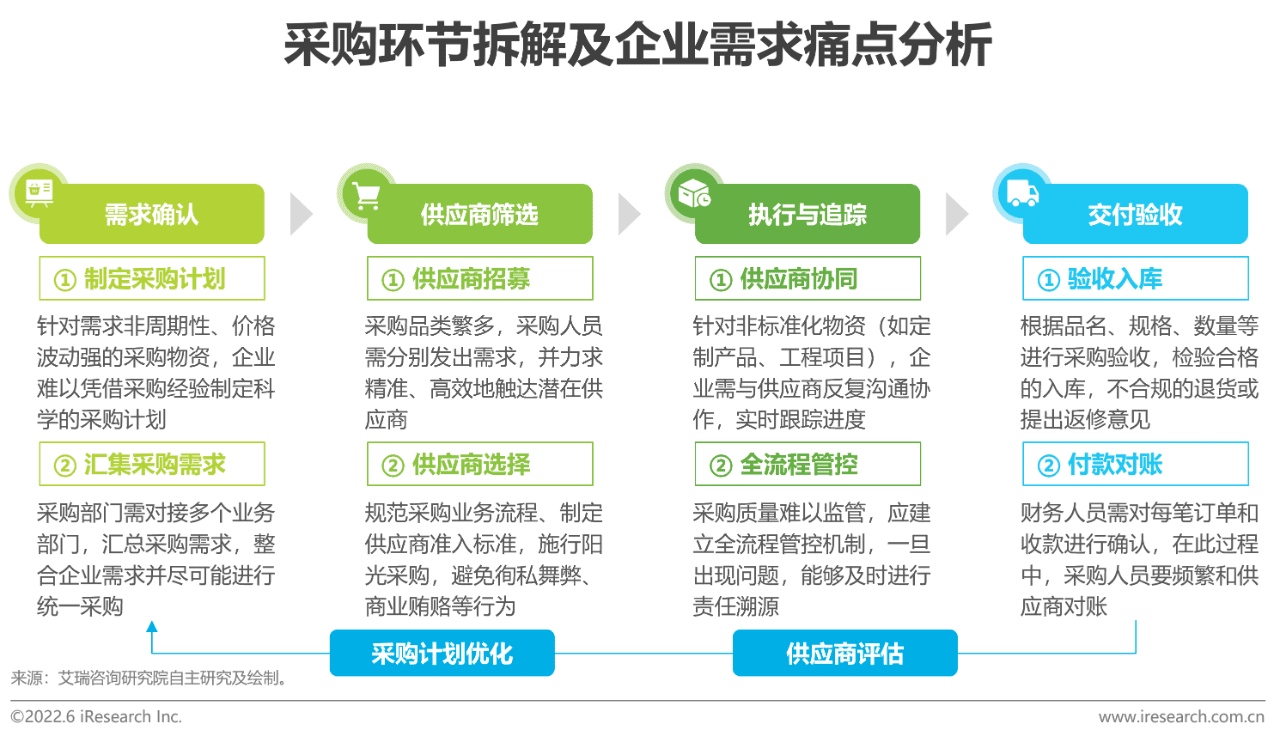
传统模式下,采购前期物资采购寻源难,供应商资源有限,无法筛选。供应商体系复杂,质量参差不齐;采购中期企业内部存在信息壁垒,外部供应商信息时效低,内外无法协同;采购后期,物料质量问题无法追溯,交货周期长等痛点愈发明显。
在传统采购效率低、成本高、耗时耗力等诸多痛点下,很多企业尝试寻求新的采购模式。
于此同时,数字化浪潮下,一些厂商发现中国大型企业、中型企业、小型企业采购量占比均为50%左右的水平。但在线上采购率方面与美国相比,中国占比仅为2%,数字化采购行业成长空间巨大。
在市场的激励下,厂商们逐渐发展出两种商业模式:平台化、工具化。
前者主要基于商品交易,以会员费、佣金费、交易差价再或者是,综合整体能力帮助企业进行采购数字化转型等方式盈利,主要参与者多是由信息资讯平台、贸易商、电商平台等企业转型而来,部分厂商有多年的行业经验以及客户积累。京东企业业务、1688、震坤行、西域等都是此模式下的代表性厂商。
后者则以向企业提供数字化解决方案的模式盈利,由于进入门口不高,参与者众多。相关数据显示,此类厂商占全国数字化采购厂商的95%。其中,一部分工具型厂商有ERP或行业咨询背景,以自身行业know-how帮助企业降本增效,主要参与者有企企通、甄云科技、商越科技等。
总体来看,平台型更注重企业外部供应商的链接、管理,工具型更注重企业内、外部业务的协同,但其中也不乏平台、工具双管齐下的厂商。
不同的商业模式,也面临着不同的问题。
在国内,采购主体分为三类,一是央国企、大型民营企业,这类企业有一定的数字化基础,供应商体系复杂,管理难度大,所以需要厂商具备对接ERP、MES等系统的能力,且有较高的后续服务要求;
二是中小微型企业。这类企业总体来讲数字化基础薄弱甚至没有,供应商体系简单且无需复杂的管理工具,需要成本低、适配性强的解决方案。
不同的采购主体也对应着不同的痛点和需求,且采购涉及类目、行业众多,无论是平台型模式还是工具型模式,都很难单独满足一个企业采购的所有需求。
但每个企业,都有一个开启数字化的“黑匣子”。打开它得前提是,需要工具和方法采集到企业业务中的常态数据,实现数字化技术在对应业务中的契合应用。
那么,如今采购能做到哪一步。
二、数字采购,行至中程
一份名为“2022数字化采购发展报告”统计显示,截止到2022年,企业在寻源、采购执行、供应商管理、需求与计划、品类管理、仓储物流各个环节数字化改造程度分别为68%、65%、61%、60%、47%、27%、21%。
其中,仓储物流数字化改造程度为21%,处于末位。
其实,在采购流程中,尤其是生产性物料采购,由于交付周期的不确定性,企业通常会维持3-4周消耗量的库存来确保生产安全。这种库存周转模式下,库存量的积压占据企业大量资金,仓库的租用费用也在消耗采购成本。
然而,在仓储管理方面,大多数企业仍主要依赖三方物流,跟踪相关物流信息和仓储信息较困难,在物流环节很难降本增效。
事实上,企业采购成本既除了采购商品价格成本,还有采购消耗的时间成本、相关管理成本、运营成本等隐性成本。其中管理成本涉及供应商管理、商品规范管理、人员管理、审批流程、风险管理等方面,而运营成本则囊括了资金成本、物流仓储成本、售后成本和渠道成本等。
在整体的采购综合成本中,显性成本仅占30~40%,隐性成本可高达60~70%。
这意味着,数字采购只走了40%的路。企业想要彻底实现采购数字化转型,将采购隐性成本降下来,将采购中心转向利润中心,必须将隐性运营成本降下来。
于是,诸多因素之下,一些企业试图将物流的压力转给平台厂商。
从目前采购数字化厂商的业务布局来看,京东企业业务、1688背靠京东、阿里,前者自建京东仓储物流,“采购后”的环节优势尽显,后者则有菜鸟物流体系,配合可以完成集中配送。
这是有自身B端配送体系企业的优势。
当然,站在当下来看,在采购数字化转型中,物流节点并未完全打通,一部分隐性成本难降。
此外,在物流这个较为明显的问题之外,仍存在其他一些短时间内难以解决的问题,例如采购标准化、质量管理等。可以说,想要完全实现采购中心的价值重塑,单就厂商而言,仍有很长的一段路要走。
三、现代企业的采购模型是什么?
但,一些星星之火已经出现。
汽车制造行业,往往涉及诸多领域,加之一般企业规模较大,所以导致非生产性采购管理十分复杂。
长城汽车是全球较为知名的SUV制造企业。在企业持续发展过程中,原本的信息化采购管理使得痛点愈发明显。
过去,用户在信息化系统里面提采购申请,几万名公司员工无法形成一个统一、规范、标准的要求。采购员收到需求之后,感觉需求部门提报的采购需求描述不准确,甚至有些没有品牌、型号,有些对名称、用途描述不清晰,根本看不懂。
这种情况下,曾经出现过一个部门一年买错了50多次。而且重复确认采购需求耗费了大量采购人员的时间。
其次,以往需求提报时,对价格一无所知,需求的审批人也看不到价格。这会导致一个问题,也许100元的A物资就能解决的问题,结果购买了300元的B物资,采购人员无法判断A物资可以替代B物资。
再有,以往的采购管理系统和ERP系统,凡是涉及用户提交订单、收货、对账等采购业务的主流程,都会涉及多系统操作和线下操作,采购流程繁琐,并没有解决在线协同的问题。
另外,过去集团内部的呆滞物料(物料存量过多耗用量极少而库存周转率极低的物料)、大型资产均需要招标处理。但之前其闲置物资只靠OA平台进行处置。渠道点一、周期长,影响闲置物资的盘活。一边采购新物资、一边浪费闲置物料,给集团带来了巨大损失。
需求驱动之下,其开始一系列的流程改造。
改造的第一步是流程的梳理。在集团原本的采购商城中嵌入价格协议。供应商通过协议,在商城输入商品图片、描述、价格、库存等内容,然后将商品推给采购方,采购方可以进行筛选之后再给公司内的需求用户。需求用户选择物品后系统直接将需求审批推送给领导审批。审批通过后,采购商在线确认。接下来就是发货、收货、支付。
在这个过程中,一是采购商城与长城汽车内部系统的协同解决方案即采购申请环节与OA系对接、入库环节与ERP系统对接、结算环节与ERP财务系统对接。
二是通过价格协议,让供应商提报物料价格。
三是部署闲置物质领用解决方案,闲置物品盘活人员可以利用商城搜索功能,寻找集团子公司、组织的需求方,进行集团内部的二次盘活。
四是移动端的解决方案,方便采购人员、需求方随时随地进入商城以及员工商城的解决方案,搭建采购入口。
总体来看,长城汽车利用平台化的模式将供应商的商品、仓配资源和线下交付体系等资源精准结合,搬到线上,重塑采购流程。继而以工具化模式将传统模式中的信息壁垒被打破。在企业内部,无缝集成ERP、OA、财务等系统,使采购部门、需求部门、财务部门多方在线协同。最终,实现了供应商、采购人员、需求方的三方协同。
因此,采购场景、采购品类、采购过程实现了数字化,并通过数据的沉淀和分析的方式,形成供应商评估、采购需求分析、支出预测等事前智能洞察机制。
数据显示,长城汽车采购流程数字化之后,采购业务变为主动,1~3天就可以收货,周期缩短;使用采购商城后,买错率几乎为0;对账从每月10天减少到3~4天;内部闲置物质盘活6000多万资产。
这是一个优质的采购样本。单就服务商自身的价值来看,其提供的不单纯是软件服务,更多的则是一个集合采购、线上寻源、软件集成以及供应链的服务。
此外,还不仅于此。另一个能够清晰看到的点是,在长城汽车内,采购不单纯发生在外部,更发生在内部,换言之,在数字化服务商的加持之外,长城汽车内部也基于采购进行了一系列的调整,基于此,才真正完成了采购中心从成本到利润中心角色的转变。
换言之,数字化转型既要外部力量,也更要内部推动。那么,企业该如何构建适合数字采购的土壤?或者说,什么才是最适合数字采购发展的土壤?
四、中台化、RPA的采购土壤
采购,对应的更是流程。而优化流程的模型,两个公认的点是中台和RPA。这也是“土壤”的答案。
以房地产相关的企业为例,在发展的几十年里,企业往往会不断扩展业务,涉及文娱、餐饮、商超、医疗、教育等诸多领域,成立了多个事业部。
采购过程中,每个事业部都需要供应商资源开发、合同商务、采购履行、结算支付、IT服务等方面的支持。在这种采购管理模式下,诸多事业部在基础服务方面的工作,很大程度上会有重复。
但基于“中台”模型,就可以提炼各条采购业务线的共同需求,整合到一个平台中。之后集中提供给前台各业务部门使用。前台要做什么采购、需要什么资源可以直接向采购服务部门要。
例如,建立一个共用的供应商资源池;合约管理与归档的整合能力,减少法务上的支出;电子签约的链接、采购物流系统的连接、数智化的仓储整合和连接能力等等。
从本质来看,基于中台思想,通过“小前台+大中台”的运营模式可以使得采购管理更加清晰高效,且信息的流转更为顺畅,出口更为统一。
而在单点层面,RPA则是另一个答案。
例如在采购申请环节,对于生产性物资,计划员将采购申请传递到需求池后,依据份额的设定自动提取价格协议,此时通过RPA工具自动将采购申请拆分为多个订单,并根据相关规则自动补全订单信息。之后,将转换成功的订单自动发送给供应商。
假设有8000行采购需求明细需要采购部门来处理,其中90%有明确价格协议和份额,那么将有7200行的采购需求可通过RPA数据工具直接转换成采购订单并发送给供应商,而采购人员只需要人工处理剩下的800行采购需求明细。
过去,8000行采购需求明细都要人工处理,这会是30个采购员的工作量,现在只需要5个人就可以完成。
RPA节省的纯事务性工作量,为企业采购大幅降低了间接成本。
总之,在诸多采购数字化厂商的助力下,企业可以通过中台化以及ERP对采购流程实现优化。站在整个采购数字化产业来看,这两者也正在被越来越多的企业采用,成为采购中心奔向利润中心的最佳“辅助”。
五、写在最后:
国内的采购电商平台、采购SaaS厂商、企业,一直走在不断创新、裂变的路上。
其中的一些动作也在愈发明朗。比如如今,企业在采购上的人力越来越少,因为如今的采购数字化厂商会更集约、更专业、更高效;再比如,采购服务商的服务在企业内部越来越前探,即在采购之外,更提供数字化转型的相关业务,即采购不单纯是采购,更是数字化赋能;再比如,很多企业基于采购,开始不断精简流程,采购真正成为了企业数字化转型的驱动力等等。
2023年,依然是数字采购最好的时代。
翻译:
Digitalization has changed the quality of many enterprise business processes.
The 2022 Digital Procurement Development Report shows that the value of digital procurement can reduce integrated supply chain costs by 30%. And more than 60% of the cost of the enterprise is spent by the purchasing department.
This means that digitally enabled purchasing centers change from “spending money” to “making money”, and business managers start to ask for profits from purchasing staff.
From this point of view, digitalization not only achieves cost reduction and efficiency increase for enterprises, but also turns procurement from a cost center into a profit center.
One set of data is that in 2021, the size of the national procurement market exceeds 174 trillion yuan, and the penetration rate of digital procurement across the country is about 7.5%, which means there is huge room for the growth of products and services based on the digital transformation of procurement in the corporate procurement market.
The questions to ponder behind this are:
- What is the route of transformation under the pain point of traditional procurement?
- How is the implementation of digital procurement?
- How does digitization reshape the purchasing Center?
- How can enterprises build a soil suitable for digital procurement?
2023, The “Two Lines” of Procurement
For a purchase of 700 pairs of sports shoes, how long will it take from the buyer’s intention to the supplier’s offer?
In the traditional purchasing model, the answer is seven days.
In the tea room of a company in Wangjing, Beijing, Mr. Zhang, the purchasing manager, keeps dialing the phone of his suppliers. It is the sixth day he has been giving out his purchasing requirements.
“It’s mind-boggling to me that as a globally renowned outdoor brand, the offer and response time for this case can take a week.” Mr. Zhang said he has been asking the progress of the quotation, and the supplier’s attitude is completely a picture of love to buy do not buy mentality.
This is a classic case of supply and demand mismatch. But this is only a microcosm of the traditional procurement model.
In the traditional mode, it is difficult to find the source of materials in the early stage of procurement, and the supplier resources are limited, which cannot be screened. Complex supplier system, uneven quality; Information barriers exist inside the enterprise in the middle stage of procurement. The information of external suppliers is of low timeliness, and internal and external cooperation cannot be achieved. In the later stage of procurement, the material quality problems cannot be traced and the delivery cycle is long.
Many enterprises try to seek a new procurement mode under the pain points of low efficiency, high cost, time consuming and energy consuming of traditional procurement.
At the same time, under the digital wave, some manufacturers found that large, medium and small Chinese enterprises all accounted for about 50% of the purchase volume. However, compared with the United States, the proportion of online procurement in China is only 2%, so the digital procurement industry has huge room for growth.
Under the incentive of the market, manufacturers have gradually developed two business models: platform and tool.
Under the incentive of the market, manufacturers have gradually developed two business models: platform and tool.
The former is mainly based on commodity trading and makes profits through membership fee, commission fee, trading price difference or comprehensive overall ability to help enterprises carry out procurement digital transformation. The main participants are mostly transformed from information platforms, traders, e-commerce platforms and other enterprises. Some manufacturers have years of industry experience and customer accumulation. Jingdong Enterprise Business, 1688, Zhenkunxing, Western Regions, etc., are the representative manufacturers under this model.
The latter is profitable by providing digital solutions to enterprises, and there are many participants due to the low entrance. Relevant data show that such manufacturers account for 95% of the country’s digital purchasing manufacturers. Among them, some tool manufacturers have ERP or industry consulting background, and use their own industry know-how to help enterprises reduce costs and increase efficiency. The main participants are Qiqitong, Zhenyun Technology, Shang Yue Technology, etc.
In general, the platform type pays more attention to the link and management of external suppliers, while the tool type pays more attention to the collaboration between internal and external businesses. However, there are also some manufacturers with both platforms and tools.
Different business models, but also facing different problems.
In China, procurement subjects are divided into three categories: first, central state-owned enterprises and large private enterprises. These enterprises have certain digital foundation, complex supplier system and difficult management, so they need the ability to connect with ERP, MES and other systems, and have high follow-up service requirements.
Second, small and medium-sized enterprises. Such enterprises generally have weak or no digital foundation, simple supplier system without complex management tools, and need low-cost, adaptable solutions.
Different procurement subjects also correspond to different pain points and needs, and procurement involves a large number of categories and industries, no matter platform mode or tool mode, it is difficult to meet all the needs of an enterprise’s procurement alone.
But every business has a “black box” that turns on digitisation. The premise of opening it is that tools and methods are needed to collect the normal data in the enterprise business, so as to realize the application of digital technology in the corresponding business.
So, what can purchasing do now?
Digital procurement, line to the middle
According to the “2022 Digital Procurement Development Report”, by 2022, the degree of digital transformation in sourcing, procurement implementation, supplier management, demand and planning, category management, warehousing and logistics will be 68%, 65%, 61%, 60%, 47%, 27% and 21%, respectively.
Among them, the digital transformation degree of warehousing logistics is 21%, ranking the last place.
In fact, in the procurement process, especially the procurement of production materials, due to the uncertainty of the delivery cycle, enterprises usually maintain 3-4 weeks of consumption inventory to ensure production safety. Under this inventory turnover mode, the inventory backlog occupies a large amount of capital of the enterprise, and the warehouse rental costs are also consuming the procurement costs.
Most enterprises still mainly rely on tripartite logistics.
However, in terms of warehousing management, most enterprises still mainly rely on tripartite logistics. It is difficult to track relevant logistics information and warehousing information, and it is difficult to reduce costs and increase efficiency in logistics links.
In fact, the procurement cost of enterprises is not only the cost of commodity price, but also the hidden cost of purchasing time cost, related management cost, operation cost and so on. The management cost involves supplier management, commodity standard management, personnel management, approval process, risk management, etc., while the operation cost includes capital cost, logistics and warehousing cost, after-sales cost, channel cost, etc.
In the overall procurement comprehensive cost, the explicit cost only accounts for 30 ~ 40%, while the implicit cost can be as high as 60 ~ 70%.
This means that digital procurement has only gone 40 per cent of the way. If enterprises want to completely realize the digital transformation of procurement, reduce the hidden cost of procurement and turn the procurement center to the profit center, they must reduce the hidden operating cost.
Therefore, under many factors, some enterprises try to transfer the pressure of logistics to platform manufacturers.
From the point of view of the business layout of the current procurement of digital manufacturers, Jingdong enterprise business, 1688 backed by Jingdong, Ali, the former self-built Jingdong warehousing logistics, “after procurement” link advantage, the latter has Cainiao logistics system, with centralized distribution can be completed.
This is the advantage of an enterprise with its own B terminal distribution system.
Of course, at present, in the digital transformation of procurement, logistics nodes are not fully connected, and some hidden costs are difficult to reduce.
In addition, in addition to the obvious problem of logistics, there are still some other problems that are difficult to solve in a short time, such as standardization of procurement, quality management and so on. It can be said that there is still a long way to go for the manufacturers alone to fully realize the value reconstruction of the procurement center.
What is the purchasing model of the modern enterprise?
But some glimmers of hope have emerged.
The automobile manufacturing industry often involves many fields, and the general enterprise scale is large, so the management of unproductive procurement is very complicated.
Great Wall Motor is a relatively well-known SUV manufacturer in the world. In the process of sustainable development of enterprises, the original information procurement management makes the pain point more obvious.
In the past, tens of thousands of employees of the company could not form a unified, standardized and standard requirement when users applied for procurement in the information system. After the buyer received the demand, he felt that the description of the purchase demand presented by the demand department was not accurate, even some did not have the brand, model, some did not have a clear description of the name and use, and could not understand it at all.
There has been a department a year to buy the wrong 50 times.
In this case, there has been a department a year to buy the wrong 50 times. And it takes a lot of time for the purchasing staff to repeatedly confirm the purchase requirements.
Secondly, in the past demand to report, the price know nothing, demand approver can not see the price. This may lead to A problem that can be solved with 100 yuan of material A. As a result, 300 yuan of material B is purchased, and the purchasing staff cannot judge that material A can replace Material B.
In addition, the previous procurement management system and ERP system, which involve the main process of purchasing business such as user order submission, goods receiving and account checking, will involve multi-system operation and offline operation, and the procurement process is cumbersome, but the problem of online collaboration has not been solved.
In addition, in the past, stagnant materials (materials with excessive material stock and very low inventory turnover) and large assets within the group need to be dealt with by tender. But before, its idle materials only rely on OA platform for disposal. Channel point one, long cycle, affect idle material revitalization. While purchasing new materials, while wasting idle materials, brought huge losses to the group.
Demand-driven, it began a series of process transformation.
The first step of transformation is to sort out the process. Embed price agreements in the group’s original shopping mall. Through the agreement, the supplier inputs the product picture, description, price, inventory and other contents in the mall, and then pushes the product to the purchaser, who can select the product and then give it to the company’s demand users. After the user selects the item, the system will directly push the requirement approval to the leader for approval. After approval, purchasers confirm online. The next step is to ship, receive and pay.
In this process, the first is the collaborative solution between the purchasing mall and the internal system of Great Wall Automobile, that is, the connection between the procurement application link and the OA department, the connection between the warehousing link and the ERP system, and the connection between the settlement link and the ERP financial system.
Second, through the price agreement, let the supplier provide the price of materials.
Third, the deployment of idle material utilization solutions, idle goods revitalizing personnel can use the mall search function, looking for the demand side of the group subsidiaries, organizations, the group’s secondary revitalization.
The fourth is the solution of mobile terminal, which is convenient for purchasing personnel and demander to enter the mall and employee mall anytime and anywhere, and build the procurement entrance.
In general, Great Wall Motor uses the platform mode to accurately combine the supplier’s commodities, warehouse allocation resources, offline delivery system and other resources to move online, reshaping the procurement process. Then the information barrier in the traditional mode is broken through the instrumental mode. Within the enterprise, it seamlessly integrates ERP, OA, finance and other systems, enabling the procurement department, demand department and finance department to cooperate online. Finally, it realizes the coordination among suppliers, purchasers and demanders.
procurement scenarios, procurement categories and procurement process are digitized,
Therefore, procurement scenarios, procurement categories and procurement process are digitized, and through data precipitation and analysis, supplier evaluation, procurement demand analysis, expenditure forecast and other prior intelligent insight mechanisms are formed.
Data show that after the digitalization of Great Wall Motor’s procurement process, the procurement business becomes active, and the goods can be received in 1 ~ 3 days, shortening the cycle; After using the shopping mall, the purchase error rate is almost 0; Reconciliation reduced from 10 days per month to 3-4 days; Internal idle material revitalize more than 60 million assets.
This is a good sample purchase. In terms of the value of service providers themselves, what they provide is not just software services, but more of a collection of procurement, online sourcing, software integration and supply chain services.
And it doesn’t stop there. Another point that can be clearly seen is that in Great Wall Motor, procurement is not only external, but also internal. In other words, in addition to the support of digital service providers, Great Wall Motor has also made a series of adjustments based on procurement. Based on this, the transformation of the role of procurement center from cost to profit center has been really completed.
In other words, digital transformation requires both external and internal forces. So how can companies build the right soil for digital purchasing? Or, what is the best place for digital procurement to grow?
The purchasing soil of mid – Taiwan Chemical and RPA
Procurement, the corresponding is the process. While optimizing the process model, the two recognized points are the middle desk and the RPA. This is also the answer to “soil”.
Take real estate-related enterprises as an example. In the decades of development, enterprises tend to constantly expand their business, involving entertainment, catering, supermarket, medical care, education and other fields, and set up several business divisions.
In the procurement process, each business division needs support from supplier resource development, contract commerce, procurement fulfillment, settlement and payment, and IT services. In this purchasing management mode, the work of many business divisions in basic services will be repeated to a large extent.
However, based on the “middle platform” model. The common needs of all purchasing business lines can be extracted and integrated into one platform. Then it is centrally provided to the front desk for all business departments to use. The front desk can directly ask the purchasing service department for the procurement and resources it needs.
For example, establish a common pool of vendor resources. Integration of contract management and filing to reduce legal expenses. Electronic contract link, procurement logistics system connection. Digital intelligent warehousing integration and connection capabilities, etc.
In essence, based on the idea of middle desk, the operation mode of “small front desk + large middle desk” can make the procurement management more clear and efficient. And the flow of information is smoother and the export is more unified.
At the single-point level, Rpas are another answer.
For example, in the process of purchase application, for productive materials. After the planner transfers the purchase application to the demand pool. The price agreement is automatically extracted according to the quota setting. At this time, the purchase application is automatically divided into multiple orders through the RPA tool. And the order information is automatically completed according to the relevant rules. The converted order is then automatically sent to the supplier.
Assuming that there are 8,000 lines of procurement demand details that need to be processed by the procurement department, 90% of which have clear price agreement and share. Then 7,200 lines of procurement demand can be directly converted into purchase orders through RPA data tool and sent to the supplier. While the procurement personnel only need to manually process the remaining 800 lines of procurement demand details.
In the past, 8,000 lines of procurement requirements details had to be handled manually. Which would be the workload of 30 purchasers, but now only 5 people can complete it.
The pure transactional workload saved by RPA greatly reduces the indirect cost for enterprise procurement.
In a word, with the help of many digital procurement manufacturers, enterprises can optimize the procurement process through mid-Taiwan and ERP. Standing in the whole procurement digital industry, these two are also being adopted by more and more enterprises, becoming the best “auxiliary” procurement center to the profit center.
Write at the end
Domestic procurement e-commerce platform, procurement SaaS manufacturers, enterprises, has been walking on the road of continuous innovation and fission.
Some of these moves are becoming clearer. For example, nowadays, enterprises have less and less manpower in procurement. Because today’s digital procurement manufacturers will be more intensive, more professional, more efficient. For another example, procurement service providers are more and more advanced in the enterprise. That is, in addition to procurement, they also provide related businesses of digital transformation. That is, procurement is not only procurement. But also digital empowerment. For another example, many enterprises have started to streamline their processes based on procurement, and procurement has really become the driving force of enterprise digital transformation.
2023 will still be the best year for digital shopping.
本文由数字化转型网(www.szhzxw.cn)转载而成,来源于网络;编辑/翻译:数字化转型网默然。

免责声明: 本网站(http://www.szhzxw.cn/)内容主要来自原创、合作媒体供稿和第三方投稿,凡在本网站出现的信息,均仅供参考。本网站将尽力确保所提供信息的准确性及可靠性,但不保证有关资料的准确性及可靠性,读者在使用前请进一步核实,并对任何自主决定的行为负责。本网站对有关资料所引致的错误、不确或遗漏,概不负任何法律责任。
本网站刊载的所有内容(包括但不仅限文字、图片、LOGO、音频、视频、软件、程序等) 版权归原作者所有。任何单位或个人认为本网站中的内容可能涉嫌侵犯其知识产权或存在不实内容时,请及时通知本站,予以删除。