
数据,不论形态、格式和类型,已经迅速成为企业最有战略意义的资产;数据资产已经成为了可以形成业务洞察及优势的战略资源,数据的体量、多样性和复杂性也正以指数级增长。就像其他重要的企业资产,数据需要适当的管理和治理水平, 以确保它的潜在价值得到理解和发挥。基于上述原因,近些年来产生了首席数据官-CDO这一新兴岗位,旨在帮助企业保护并解锁数据资产全部价值。
一、CDO职能
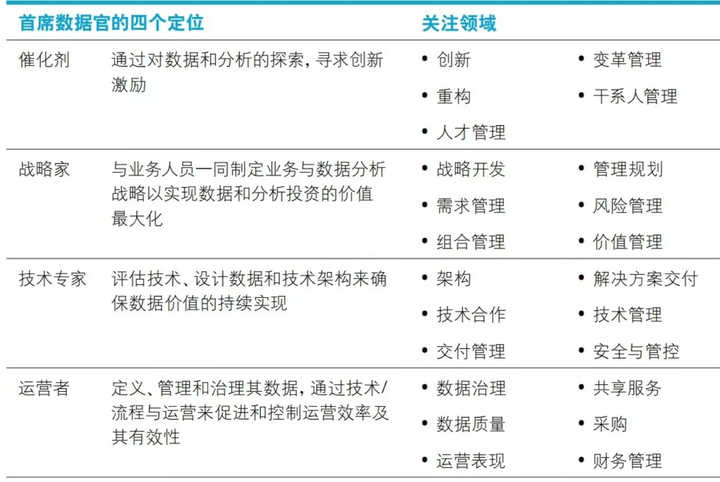
对企业数据工作战略指引和落地支持,关注数据资产的收集、治理和管理,保障关键数据质量,有效地管理企业级的信息资产。
从企业级视角出发,关注数据的战略价值和应用场景,打通数据壁垒,使数据可以便捷地跨部门及跨职能流通,推动数据在企业内更好的消费和利用。
布局数据生态圈,以适应和推动企业在数字化转型、大数据、人工智能、区块链、自动化领域的快速创新。
升级管理策略,应对新形势下的数据监管、数据报送、数据隐私、安全合规、共享互通等要求,提升满足企业应对监管和安全领域的需求。
获取数据中内涵的价值,通过数据分析主动支持业务。运用新兴技术产生可执行的数据分析洞察和切实的商业利润。
角色定位
二、数据相关角色
在企业内部,跟数据相关的存在多种角色。如何看待这些角色,他们的定位有何不同呢?让我们来辨析下。
1、首席信息官-CIO
通过评估和建立企业不同部门之间的联系来构建互联互通的技术生态圈。
评估及投资于企业级平台和应用授权,例如:可视化工具。
控制复杂多源的供应商环境,减少故障及停机风险,并优化服务。
通过与其他总裁级高管的紧密合作,将具备可扩展性的技术嵌入至各个管理运营领域,重新定义IT。
2、首席数据官-CDO
领导机构内数据管理与数据分析的工作事项。
通过建立和实现技术、工具,构建工作模式和流程,来解锁企业数据资产的价值。
将数据作为战略资产来管理落实数据治理、数据质量和其他管控来维持企业的数据完整性。
成为客户与营销、企业风险管理、法规合规和财务等领域业务高管的可信任伙伴。
利用新兴的大数据和分析技术培养创新能力。
3、首席数字官-CDO
通过使用数字化技术提供客户、风险、渠道等领域的深入洞察,以及如何改善的建议。
应用移动、社交媒体、金融科技、物联网等技术,创新业务模式,迁移传统流程。
具备创新及发展的偏好,包括教导并激励组织中的其他干系人。
能够在内部及外部组织推动数字化变革之旅。
4、首席分析官-CAO
为业务评估最合适的运营模式和数据变现方法。
定义和绘制企业范围内横跨战略、人员、流程、数据和技术的分析蓝图。
大量参与企业所需的业务变革、转型及培训,将分析融入企业文化中,形成洞察驱动型组织。
保持企业处在数据能力开发应用的前沿,并组织推动未来的洞察分析项目。
三、CDO对公司价值
一个优秀的,有前瞻力的首席数据官与一个能理解首席数据官潜在价值并合理授权的组织结合起来,可以为双方产生都带来最大的价值。
1)加强技术与数据管理
一个获得授权的首席数据官对公司的战略性信息管理规划负责。在这个方面,首席数据官协助引导企业能力发展的投资方向,并消除信息孤岛及信息冗余,加快数据质量问题的确认和修复,降低总体手动归集数据的成本后,可为公司带来实质性的财务收益。
2)降低企业风险
首席数据官将所有数据相关的活动放在相同的“伞” 下,并配合恰当的管控节点,如: 数据治理及管理,流程化的数据质量管理,主数据管理及元数据管理,从而实现了数据的整体治理。同时,其管理成效带来了更高的数据质量,更好的数据一致性,更易追踪的数据操作,并降低了内部监控及审查花费,对监管合规性的提升也产生了作用。
3)增加业务价值
首席数据官提高了工作效率及数据使用效率,使得整个企业内的业务运营得以强化并增值。首席数据官通过让业务人员自己使用数据来实现数据变现以及数据普及,同时通过丰富的数据分析工具和模型,为业务构建洞察优势。这些工作最终将帮助企业创新业务模式,并与行业内或跨行业的机构建立伙伴关系,洞悉客户行为,及客户留存所涉及的全景视图,在所有接触渠道中提升客户服务及销售,帮助企业理解新的商机。
四、CDO能力要求
一个由首席数据官带领的成熟企业,能极大地展现并积极地推动数据管理能力的提升,提供关键业务智能所需的洞察力,满足包括财务、风险、营销、销售、合规、产品开发、人力资源等各方面业务的需求。要做到这一点的关键是,首席数据官需要在组织中具备相匹配的影响力,与此对应,首席数据官必须具备必要的业务、技术和管理技能,以及别人往往不具备的经验。
1、技能/资质
1)领域经验
全面掌握某一的行业(例如金融、保险、医疗、交通、能源等)知识,包括关键业务、客户交互和其他内部和外部利益相关者的期望与需求。
2)IT背景
展现出信息管理和量化分析技能,包括IT基础架构、各种技术/平台、与供应商协商的能力、领导关键业务系统建设的经验。
3)量化思维
能够建立典型业务案例和业绩指标体系来展示业务价值,以获得项目资金/资源及度量业务价值的能力。
4)业务视角
精通覆盖风险、财务和客户的交叉领域从而驱动业务价值,对监管环境有充分理解,并能有效使用数据来落实合规及风险管理。
5)项目领导力
了解组织架构设计,并能够管理和推动大规模、跨职能、多级的项目,整合人员、技术、流程及工具形成长期战略和速赢成果。
6)沟通能力
能够在组织中宣传数据战略及实施路线,并就企业数据蕴含的内在价值在企业内对多层次的利益相关者进行培训,且作为企业变革推动者破除固有文化阻力。
2、个人特质
1)热情
具有捍卫数据作为战略性业务资产,能够为企业带来大量新的收入机会的领导决心。
2)洞察力
能够通过战略远见来识别新的商业模式、捕捉技术及数据领域发展的机会、避免潜在风险,能推动组织创新并形成长期竞争优势。
3)颠覆性
有提出新想法与争议话题的信心,并抱有对抗阻力、持续推进的态度来推动变革。
4)合作性
愿意作为“桥梁建设者” 及推动者来为各个部门性孤岛牵线搭桥、建设业务和技术的协同机制、统筹各方努力来推动形成可计量的业务成果。
5)敏捷性
有迅速转化为商业价值的能力,能够通过用一个务实的方法来实施解决方案、呈现数据价值,避免冗长的流程来构建“框架” 而与前线业务脱节。
六、CDO面临挑战
1)认知不足
公司管理层,很容易低估了组织数据资产、构建数据应用能力所需的努力及时间。此外,管理层不一定能理解该职位在合规性要求之外的商业价值。只要存在首席数据官,以及有限的员工支持,首席数据官就可以仅凭一己之力解决问题。但实际上,首席数据官的第一个工作是制定发展规划和实施路径,并说服其他人共同完成工作。
2)驱动不强
对于常常会存在的部门性数据孤岛,他们会认为企业级的数据管理将会带来工作上不必要的干扰,而忽视这样的管理方式可能带来的潜在好处。甚至将其视为对自己部门的流程及资源是一个威胁(包括财务及人事方面)。
3)成本压力
设立这一岗位可能需要一定数量的精英团队,而无论是成本,还是招聘压力,都会带来一些挑战。如果首席数据官缺少充足的预算、员工或威信,他就需要说服各个业务单元、后台部门以及 IT 部门提供额外的资源;但这也带来极大推进实施的难度。
4)发展不明
业务周期带来的工作优先级变化,以及高管们关注于短期的、 低成本高收入的业务目标,都有可能会影响对可以带来长期竞争优势的高效首席数据官所需的投入及财务支持。
5)技术迭代快
管理数量和复杂度都持续增加的数据;跟上不断加速的IT创新,并解决复杂存量系统的问题。
6)信任协同难
需要跟高管层面构建信任关系,为协同工作做好铺垫。特别是需匹配CIO与CTO的规划,来保证技术路线符合全局发展愿景,并具备相适应的优先级。
七、如何发挥CDO价值
1)让CDO成为真正高管
让首席数据官成为一个真正的总裁级高管。虽然首席数据官挂着一个总裁的头衔,但往往在总裁内部层级中位置过低,而难以发挥实质性的影响。一些公司将其设置位于首席信息官或者首席技术官的汇报层级下;另外一些地方,首席数据官则在业务那边,位于首席财务官-CFO,或者首席风险官-CRO,或者首席营销官-CMO下,因为数据被理解为由业务“掌控”, 而非 IT。
行业领先的做法可能会倾向于首席数据官直接向首席运营官-COO汇报,以保证首席数据官在业务和科技之间保持中立地位。但事实上,这没有一个单选的标准答案。因为首席数据官的位置会取决于机构的大小、复杂度、成熟度以及内部或者外部的考虑。
事实上,首席数据官需要一个可以发挥最大影响力的位置,兼顾到企业内数据消费者的数据可用性、完整性、质量及可靠性。作为一个持续发展的角色,首席数据官将不断增强对CEO、CFO、COO 的汇报,传递出数据是重要的、优先的业务事项,而非仅仅是一个IT的工作。
2)将数据管理视为战略举措
发出一个自上而下的信号,明确高效的、企业级数据管理是一个势在必行的战略举措。经常性的高管支持言论将向机构内大范围的员工发出一个明确的信号:首席数据官具有责任及必要的认可来管理,创新及协助业务明确方向,从而解锁其信息资产的内涵价值。
3)明确工作边界
未雨绸缪,提前划清工作边界。巩固首席数字官与首席技术官-CTO、首席信息官-CIO的正面关系是十分必要的。因为公司业务条线在传统意义上数据相关议程的资源或领导缺失或不足,而技术专家已经编制了数据字典,应用了分析技术等。当首席数据官逐渐被开始承担这些责任,就会产生矛盾。有了CEO及董事会的指导要求,这几个职位可就以互相协作,共同从机构的科技及数据资源中挖掘业务价值。
八、CDO发展方向
CDO这个角色,出现时间不长,但也经历了几个阶段。未来推测这个角色随着时间的推移, 其职责范围和管理维度会有所变化,但有一点看来是确定的:首席数据官,随着企业愈发意识到数据就是其潜在DNA,而不断成为一个重要且富有挑战的角色,并且将深入发掘数据资产价值从而为企业创造新的利润增长点,并提升利益相关者的回报。
第一阶段
典型以数据治理为主,专注于监管和实践数据管控,包括元数据、数据治理、数据管理、数据质量等。上层以数据仓库及典型报表功能应用为主。
第二阶段
承担更多数据分析职责,除了交付和管理数据外,还通过利用数据分析来获得业务价值。此外,关注利用新兴技术解决数据及分析挑战的创新思路。
第三阶段
将企业数据发展成真正的企业资产,强调战略性业务成长、成本、风险与合规。数据意识,分析驱动,建立“洞察驱动型组织”。
翻译:
Data, in all its shapes, formats and types, has quickly become a business’s most strategic asset. Data assets have become strategic resources that can form business insights and advantages, and the volume, diversity, and complexity of data is growing exponentially. Just like any other important enterprise asset, data requires the right level of management and governance to ensure its potential value is understood and realized. For these reasons, the emerging position of chief Data Officer-CDO has been created in recent years to help companies protect and unlock the full value of their data assets.
Functions of CDO
Strategic guidance and landing support for enterprise data work, focus on the collection, governance and management of data assets, ensure the quality of key data, and effectively manage enterprise-level information assets.
From an enterprise-level perspective, focus on the strategic value and application scenarios of data, break through data barriers, so that data can be easily circulated across departments and functions, and promote better consumption and utilization of data within the enterprise.
Lay out the data ecosystem to accommodate and drive rapid innovation in the areas of digital transformation, big data, artificial intelligence, blockchain and automation.
Upgrade management strategies to meet the requirements of data supervision, data reporting, data privacy, security compliance, sharing and interoperability under the new situation, and improve to meet the needs of enterprises in the field of supervision and security.
Capture the value inherent in your data and proactively support your business through data analysis. Use emerging technologies to generate actionable data analytics insights and tangible business profits.
Role orientation
Data related roles
Within the enterprise, there are multiple roles related to data. How do you see these characters and how do they fit differently? Let’s find out.
- Chief Information Officer -CIO
Build an interconnected technology ecosystem by assessing and establishing connections between different parts of the enterprise.
Evaluate and invest in enterprise platform and application licensing, such as visualization tools.
Control complex, multi-source supplier environments, reduce the risk of failure and downtime, and optimize service.
Redefine IT by working closely with other C-suite executives to embed scalable technologies in every area of management operations.
- Chief Data Officer -CDO
Lead data management and data analysis activities within the organization.
Unlock the value of enterprise data assets by building and implementing technologies, tools, and building working models and processes.
Manage data as a strategic asset Implement data governance, data quality, and other controls to maintain data integrity in your organization.
Become a trusted partner to business executives in areas such as customer and marketing, enterprise risk management, regulatory compliance and finance.
Harness emerging big data and analytics technologies to foster innovation.
- Chief Digital Officer -CDO
Provide in-depth insights into customer, risk, channel and more through the use of digital technologies, as well as recommendations on how to improve.
Apply mobile, social media, financial technology, Internet of Things and other technologies to innovate business models and migrate traditional processes.
Have a preference for innovation and development, including teaching and motivating other stakeholders in the organization.
Ability to drive digital change journeys within and outside organizations.
- Chief Analysis Officer -CAO
Evaluate the most appropriate operating model and data monetization method for the business.
Define and map an enterprise-wide analytical blueprint across strategy, people, processes, data, and technology.
Be heavily involved in the business change, transformation and training required by the organization, and integrate analytics into the corporate culture to form an insight-driven organization.
Keep the organization at the forefront of data capability development and application, and organize to drive future insight analysis projects.
The value of CDO to the company
A good, forward-thinking chief data officer combined with an organization that understands the potential value of a chief data officer and empowers it properly can generate the most value for both parties.
1) Strengthen technology and data management
An empowered chief Data officer is responsible for the company’s strategic information management plans. In this regard, the chief data officer can help guide the investment direction of the enterprise’s capability development, and eliminate information silos and information redundancy, accelerate the identification and repair of data quality problems, and reduce the cost of overall manual data collection, which can bring substantial financial benefits to the company.
2) Reduce enterprise risk
The Chief Data Officer brings all data-related activities under the same “umbrella” with appropriate control nodes such as: data governance and management, streamlined data quality management, master data management and metadata management, thereby achieving overall data governance. At the same time, its management effectiveness has led to higher data quality, better data consistency, more traceable data operations, and reduced internal monitoring and review costs, which has also contributed to improved regulatory compliance.
3) Add business value
Chief Data officers increase productivity and data usage, strengthening and adding value to business operations across the enterprise. The chief Data Officer enables business people to monetize and popularize their own data, while building insight benefits for the business through a wealth of data analysis tools and models. This work will ultimately help companies innovate business models and build partnerships within and across industries, gain insight into customer behavior and retention, improve customer service and sales across all contact channels, and help companies understand new business opportunities.
CDO capability requirements
A mature organization, led by a chief data officer, can greatly demonstrate and actively drive data management capabilities, providing the insights needed for critical business intelligence to meet the needs of all aspects of the business, including finance, risk, marketing, sales, compliance, product development, human resources, and more. The key to this is that a chief data officer needs to have a commensurate impact in the organization, which in turn requires a chief data officer to have the necessary business, technical and managerial skills, as well as experience that others often do not have.
Skills/Qualifications
1) Field experience
Comprehensive knowledge of an industry (e.g., finance, insurance, healthcare, transportation, energy, etc.), including key business, customer interactions, and the expectations and needs of other internal and external stakeholders.
2) IT background
Demonstrate information management and quantitative analysis skills, including IT infrastructure, a variety of technologies/platforms, the ability to negotiate with vendors, and experience leading the construction of business-critical systems.
3) Quantitative thinking
Ability to establish typical business cases and performance indicator systems to demonstrate business value, to obtain project funding/resources and to measure business value.
4) Business perspective
Proficient in driving business value across the intersection of risk, finance and customers, with a strong understanding of the regulatory environment and effective use of data for compliance and risk management.
5) Project leadership
Understand organizational design and be able to manage and drive large-scale, cross-functional, multilevel projects, integrating people, technology, processes, and tools to create long-term strategy and quick results.
6) Communication skills
Be able to communicate data strategy and implementation routes in the organization, train multiple levels of stakeholders within the organization on the intrinsic value of enterprise data, and break down cultural resistance as a change agent in the organization.
Personal traits
1) Enthusiasm
Leadership commitment to defend data as a strategic business asset that can open up a wealth of new revenue opportunities for the organization.
2) Insight
The ability to identify new business models, capture opportunities in technology and data, and avoid potential risks through strategic foresight can drive innovation and create long-term competitive advantage.
3) Disruptive
The confidence to come up with new ideas and controversial topics, and to push for change with an attitude of resistance and continuity.
4) Cooperation
Willing to act as a “bridge builder” and a facilitator to bridge various sectoral islands, build a collaborative mechanism of business and technology, and coordinate the efforts of all parties to promote the formation of measurable business results.
5) Agility
The ability to quickly translate into business value by taking a pragmatic approach to implementing solutions, presenting data value, and avoiding lengthy processes to build “frameworks” that are disconnected from the front-line business.
Cdos face challenges
1) Lack of cognition
It is easy for company management to underestimate the effort and time required to organize data assets and build data application capabilities. In addition, management may not necessarily understand the business value of the position beyond compliance requirements. As long as there is a chief data officer and limited staff support, the chief data officer can solve the problem on his own. But in reality, the chief data officer’s first job is to develop a development plan and implementation path, and convince others to work together to get the job done.
2) The drive is not strong
In the case of departmental silos that often exist, they may think that enterprise-level data management will bring unnecessary disruption to their work and ignore the potential benefits that such management can bring. They may even see it as a threat to their own department’s processes and resources (both financial and personnel).
3) Cost pressure
Setting up this role may require a certain number of elite teams, and both cost and recruitment pressure will present some challenges. If the chief data officer lacks sufficient budget, staff, or authority, he needs to convince various business units, back office, and IT departments to provide additional resources. But this also makes it extremely difficult to push forward implementation.
4) The development is unclear
The shifting priorities of the business cycle and executives’ focus on short-term, low-cost, high-revenue business goals can affect the investment and financial support needed for an effective chief data officer that can provide a long-term competitive advantage.
5) Fast technology iteration
Manage data that continues to grow in volume and complexity; Keep up with accelerating IT innovation and solve problems with complex inventory systems.
6) Trust coordination is difficult
Trust needs to be built with senior management to prepare for collaborative work. In particular, it is necessary to match the planning of the CIO and CTO to ensure that the technical path is in line with the overall development vision and has appropriate priorities.
How to play the value of CDO
1) Make Cdos real executives
Make the chief data Officer a true CEO. Although the chief data officer carries the title of president, he is often too low in the executive hierarchy to exert substantial influence. Some companies have it reporting below the chief information officer or chief technology officer; In other places, the chief data officer is on the business side, under the chief Financial Officer -CFO, or the Chief Risk Officer -CRO, or the Chief Marketing officer -CMO, because the data is understood to be “controlled” by the business, not IT.
Industry-leading practices may favor the chief data Officer reporting directly to the Chief Operating Officer -COO to ensure that the chief Data Officer maintains a neutral position between business and technology. But in fact, there is no single answer. The position of the chief data officer will depend on the size, complexity, maturity, and internal or external considerations of the organization.
In fact, the chief data Officer needs a position where he can have the greatest impact, taking into account data availability, integrity, quality and reliability for data consumers within the enterprise. In an ongoing role, the chief Data Officer will continue to enhance reporting to the CEO, CFO, and COO, communicating that data is an important, business priority and not just an IT job.
2) Think of data management as a strategic initiative
Sending a top-down signal that effective, enterprise-level data management is a strategic imperative. Regular executive support will send a clear signal to a wide range of employees across the organization that the chief data Officer has the responsibility and recognition necessary to manage, innovate, and help the business clear direction to unlock the intrinsic value of their information assets.
3) Define work boundaries
Plan ahead and define your work boundaries in advance. It is necessary to consolidate the positive relationship between the chief digital Officer and the chief Technology Officer -CTO and the Chief Information Officer -CIO. Because the resources or leadership of a company’s business lines in the traditional sense of the data-related agenda are missing or insufficient, technologists have compiled data dictionaries, applied analytical techniques, and so on. When the chief data officer starts to assume these responsibilities, there is a contradiction. With the guidance of the CEO and board of directors, these positions can work together to extract business value from the organization’s technology and data resources.
CDO development direction
The role of CDO has not been around for a long time, but it has also gone through several stages. The scope and managerial dimension of this role will change over time, but one thing seems certain: The Chief Data Officer, as organizations increasingly realize that data is their underlying DNA, is becoming an important and challenging role that will unlock the value of data assets to create new revenue drivers and improve returns for stakeholders.
The first stage
It typically focuses on data governance, focusing on supervision and practice of data control, including metadata, data governance, data management, data quality, etc. The upper layer mainly uses data warehouse and typical report function.
The second stage
Take on more data analytics responsibilities, in addition to delivering and managing data, but also by leveraging data analytics to gain business value. In addition, we focus on innovative ways to use emerging technologies to solve data and analytics challenges.
The third stage
Develop enterprise data into a true enterprise asset
本文由数字化转型网(www.szhzxw.cn)转载而成,来源于爱学习的数据咖;编辑/翻译:数字化转型网宁檬树。

免责声明: 本网站(http://www.szhzxw.cn/)内容主要来自原创、合作媒体供稿和第三方投稿,凡在本网站出现的信息,均仅供参考。本网站将尽力确保所提供信息的准确性及可靠性,但不保证有关资料的准确性及可靠性,读者在使用前请进一步核实,并对任何自主决定的行为负责。本网站对有关资料所引致的错误、不确或遗漏,概不负任何法律责任。
本网站刊载的所有内容(包括但不仅限文字、图片、LOGO、音频、视频、软件、程序等) 版权归原作者所有。任何单位或个人认为本网站中的内容可能涉嫌侵犯其知识产权或存在不实内容时,请及时通知本站,予以删除。