
企业数字化转型是通过将业务数字化整合,实现数据的全链贯通,帮助企业规避转型困难。同时,数字化转型不能一蹴而就,也具有曲折往复的特点。鉴于装备制造业工序多、路径长、离散化程度高,开展数字化转型实践时,应该从企业核心竞争力出发,以提质增效为目标,结合生产主要问题,依托新技术,思考如何选型,如何组织,如何实施。
一、装备制造业数字化转型的现状
装备制造业是国民经济发展的基础产业,装备制造业的发展水平是新型工业化的重要支撑力量,也代表着一个国家综合国力和技术水平。下游产业转型升级对装备制造业提出更高的要求,装备数字化已成为企业发展的必然选择。在数字化转型中企业将面临一些问题:
(1) 产品结构BOM及设计变更
大型装备制造业产品结构复杂,技术难题多,涉及不同种类的 BOM 清单,需要有针对性的产品结构设计,变更配套工艺,修改技术文档及有效管控过程。
(2) 生产周期长,在制品难管控
产品生产往往需要经过几十道加工工序,成品经装配、调试、入库、出厂后还需要继续售后服务。由于产品的零部件来自不同制造厂,各环节生产数据分散存储,“信息孤岛”效应明显,某一加工环节出现问题会给产品进度带来较大影响。此外,现有大型装备的订单管理模式较为粗犷,极大制约企业加工效能的提升。
(3) 标准工艺难制定
由于机械行业设备、人员状况复杂,实际生产中无法按标准工艺执行;导致多种加工工艺流程并存,成为生产现场管理的难点。
(4) 生产现场状况无法实时反馈
生产现场发生缺料、返工,以及工艺问题时,管理人员往往无法及时知晓,因而延误解决,影响生产进度。而某些生产环节出现问题可能导致交货延期,库存激增等问题。
二、装备制造行业数字化转型趋势
如今,装备制造行业已经从指数增长进入存量增长阶段,面临产品开发投入大、效率低、服务响应慢,售后服务被动,成本居高不下,行业增速放缓、市场环境变化等不利局面,数字化转型已成为装备制造企业的迫切需求。
(1) 解决方案
在数字化转型的背景下,企业基于数据和模型发现问题,通过场景化解决方案解答难题。
(2) 商业模式由产品中心向客户中心转变
随着市场要求不断提高,装备制造企业从单纯的设备供应者变为整体方案的解决者,从提供标准化产品转变为提供定制化产品。相应的,产品和服务的内在逻辑也从“以产品为中心”转向“以客户为中心”,倒逼企业通过数字化手段提升自身实时洞察能力,为客户参与产品设计、生产、制造、服务等全生命周期打造良好体验环境。
(3) 企业决策模式发生改变
随着以数据为基础的深度学习技术飞速发展,人工智能技术改变了装备制造企业的决策模式。通过大数据、机器学习等前沿技术,将企业生产、仓储、配送、销售等环节进行数字化建模及过程优化,智能排查经营漏洞、生成策略、选择策略,实现数据驱动的人工智能决策。
三、企业数字化转型的评价标准
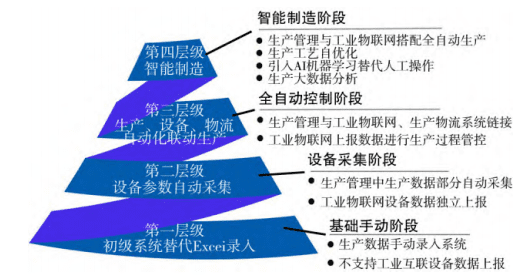
智能制造模型可将企业智能制造能力成熟度划分为4个等级 (见图1),提升企业智能制造水平由低到高,逐步递进,不能越级提升。
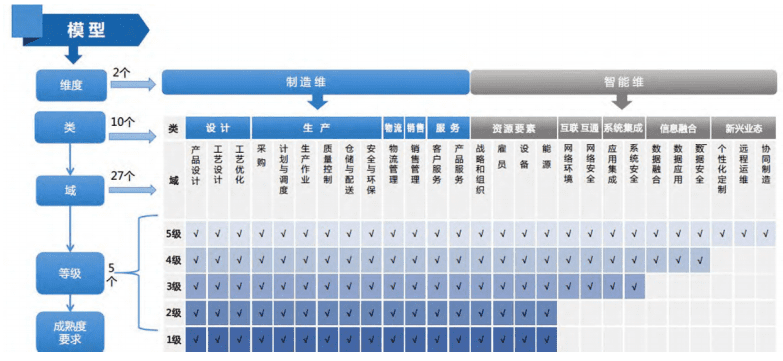
以 《智能制造能力成熟度模型》 作为评估装备制造企业制造能力的量化依据,从“智能”与“制造”两个方面出发,涵盖企业 10大类关键能力,涉及 27个细化要素,具体包括设计、生产、物流、销售、服务等重点环节,按照不同等级要求,构建智能制造能力成熟度矩阵模型 (见图 2),通过线上测评、人员访谈、系统演示、现场勘查等方式验证企业智能制造能力,帮助企业明确改进方向。
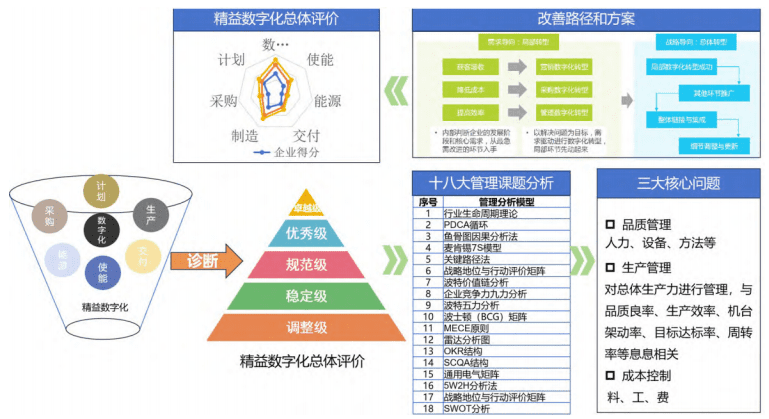
企业通过评估并与模型对标,了解自身智能制造水平,设定改进目标,通过分析,找出存在问题,制定合适的升级路径,提升自身的能力。通过分解智能制造成熟度模型,理清企业智能制造成熟度的递进框架、各业务层级之间的联系,以及每级智能制造水平的主要特征 (见图3),为企业建立一个描述智能制造综合水平的模型,同时,为不同类型企业智能制造水平的评估提供依据。
四、数字化转型关键技术与应用
(1) 智能化改造
①制造装备智能化
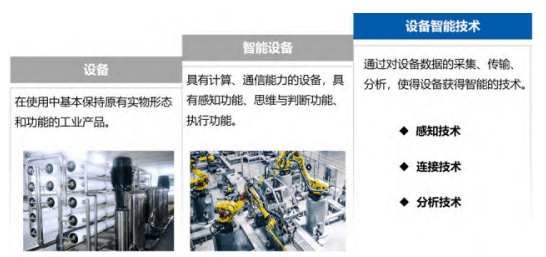
伴随下游需求的升级,对企业高效、高质量制造能力要求提升,对关键工序的控制尤为重要,一方面要求设备在计算、通信能力的基础上,还要具备一定的感知、思维与判断、执行等力;
另一方面,借助感知、连接及分析技术,采集分析现有设备数据,实现设备的智能化 (见图 4)。目前,重点企业关键工序数控化率已达 65%,随着“智改数转”深入推进,数字化能力有望进一步上升。
②产品设计智能化
首先,基于数字孪生新技术,结合有限元仿真分析手段,基于知识库架构,进行产品设计,建立原型模型,围绕产品全生命周期,构建基于设计、制造、订单管理等全要素一体的系统工程框架,进行产品数字化设计。
然后,应用人机工效学技术,提高安全性及工作效率。
最后,结合 ESG 发展要求及“碳中和”目标下企业发展的新机遇,开展绿色设计,减少制造、使用和回收过程中的环境污染及能源高效利用。
③设备管理智能化
针对生产全过程进行设备智能化管控。在初始阶段进行设备建模与工序匹配;采集生产过程中的关键数据,传输到 EIMS/MES 等智能决策终端,实现设备状态监测、故障报警、维保预警等过程管理 (见图 5);为提升企业过程管理能力,将设备能效模型、MTTR/MTBF 可靠性评估模型、SPC 风险预警控制模型融入到设备状态分析环节,通过量化指标,让管理者动态掌握企业的生产情况,通过全过程数据可视化为后续业务优化改进提供数据支撑。
(2) 数字化转型
整合企业内、外部任务流、信息流及数据流,以智能化应用为指引,优化生产与运营等核心环节。实现数字化主要体现在三个方面:
①数据打通 在实现核心体系互联的基础上,进一步与外部数据连接整合,为生产管理提供跨流程决策支撑。
②柔性自动化 通过模块化生产单元、新型数字设备,以及生产过程管理系统等增强生产系统的柔性,加强对需求变化的适应能力。
③工厂精益管理 通过建立从设备层到工厂层的精益生产管理体系,使生产流程更精准高效;以设备物联、生产制造流程信息化等为基础,打造信息透明工厂,提升异常事件的响应速度。
五、结语
本文从制造业实际出发,探讨装备制造业数字化转型中将要遇到的关键问题,提出企业数字化转型的具体思路,为相关企业进行数字化转型实践提供参考。

翻译:
Analysis of digital transformation of equipment manufacturing enterprises — based on CMMM evaluation
Enterprise digital transformation is through the digital integration of business, to achieve the full chain of data, to help enterprises avoid transformation difficulties. At the same time, digital transformation can not be achieved overnight, but also has the characteristics of twists and turns. In view of the multiple processes, long paths and high degree of decentralization of the equipment manufacturing industry, the practice of digital transformation should be carried out from the core competitiveness of the enterprise, with the goal of improving quality and efficiency, combined with the main production problems, relying on new technologies, and thinking about how to select, how to organize and how to implement.
The current situation of digital transformation of equipment manufacturing industry
Equipment manufacturing industry is the basic industry of national economic development, and the development level of equipment manufacturing industry is an important supporting force for new industrialization, and also represents a country’s comprehensive national strength and technical level. The transformation and upgrading of downstream industries put forward higher requirements for the equipment manufacturing industry, and the digitalization of equipment has become an inevitable choice for the development of enterprises. Some of the issues businesses will face in digital transformation are:
(1) Product structure BOM and design change
The product structure of large-scale equipment manufacturing industry is complex, and there are many technical problems, involving different types of BOM lists, which require targeted product structure design, change supporting processes, modify technical documents and effective control processes.
(2) The production cycle is long and the products in process are difficult to control
The production of products often needs to go through dozens of processing processes, and the finished products need to continue after-sales service after assembly, debugging, warehousing, and delivery. Because the parts of the product come from different manufacturers, the production data of each link is dispersed and stored, the effect of “information island” is obvious, and the problem of a certain processing link will have a greater impact on the progress of the product. In addition, the order management mode of the existing large equipment is relatively rough, which greatly restricts the improvement of the processing efficiency of enterprises.
(3) The standard process is difficult to establish
Due to the complex equipment and personnel conditions in the machinery industry, the actual production can not be carried out according to the standard process; It leads to the coexistence of various processing processes and becomes the difficulty of production site management.
(4) The situation of the production site cannot be feedback in real time
When there is a shortage of materials, rework, and process problems on the production site, the management staff often cannot be informed in time, thus delaying the solution and affecting the production schedule. Problems in some production links may lead to delivery delays, inventory surges and other problems.
The digital transformation trend of equipment manufacturing industry
Today, the equipment manufacturing industry has entered the stock growth stage from exponential growth, facing large investment in product development, low efficiency, slow service response, passive after-sales service, high costs, industry growth slowdown, market environment changes and other adverse situations, digital transformation has become an urgent need for equipment manufacturing enterprises.
(1) Solution
In the context of digital transformation, enterprises discover problems based on data and models, and solve difficult problems through scenario-based solutions.
(2) The business model is transformed from product center to customer center
With the continuous improvement of market requirements, equipment manufacturing enterprises have changed from simple equipment suppliers to overall solutions, and have changed from providing standardized products to providing customized products. Correspondingly, the internal logic of products and services has also shifted from “product-centric” to “customer-centric”, forcing enterprises to improve their real-time insight capabilities through digital means, and create a good experience environment for customers to participate in the whole life cycle of product design, production, manufacturing, and service.
(3) The enterprise decision-making mode has changed
With the rapid development of data-based deep learning technology, artificial intelligence technology has changed the decision-making mode of equipment manufacturing enterprises. Through big data, machine learning and other cutting-edge technologies, the enterprise production, warehousing, distribution, sales and other links of digital modeling and process optimization, intelligent investigation of business loopholes, generation of strategies, selection of strategies, to achieve data-driven artificial intelligence decision-making.
Evaluation criteria for enterprise digital transformation
The intelligent manufacturing model can divide the maturity of enterprise intelligent manufacturing capability into four levels (see Figure 1), and improve the level of enterprise intelligent manufacturing from low to high, gradually, and can not be upgraded.
FIG. 1 Intelligent manufacturing maturity assessment model
Taking the “Intelligent Manufacturing Capability Maturity Model” as the quantitative basis for evaluating the manufacturing capability of equipment manufacturing enterprises, starting from the two aspects of “intelligence” and “manufacturing”, it covers 10 categories of key capabilities of enterprises, involving 27 detailed elements, including key links such as design, production, logistics, sales and service, according to different level requirements. The maturity matrix model of intelligent manufacturing capability (see Figure 2) is constructed to verify the intelligent manufacturing capability of enterprises through online evaluation, personnel interviews, system demonstration, and on-site investigation, and help enterprises to clarify the direction of improvement.
Figure 2 Intelligent manufacturing maturity factor model and level details
Through evaluation and benchmarking with the model, enterprises understand their own intelligent manufacturing level, set improvement goals, and find out existing problems through analysis, develop appropriate upgrade paths, and improve their own capabilities. By decomposing the intelligent manufacturing maturity model, the progressive framework of enterprise intelligent manufacturing maturity, the links between various business levels, and the main characteristics of each level of intelligent manufacturing (see Figure 3) are sorted out to establish a model describing the comprehensive level of intelligent manufacturing for enterprises, and provide a basis for the assessment of the level of intelligent manufacturing for different types of enterprises.
Figure 3 is based on the improvement and optimization of the core issues in the manufacturing process of the enterprise
Key technologies and applications of digital transformation
(1) Intelligent transformation
① Intelligent manufacturing equipment
With the upgrading of downstream demand, the requirements for efficient and high-quality manufacturing capabilities of enterprises are improved, and the control of key processes is particularly important. On the one hand, the equipment is required to have a certain perception, thinking and judgment, and execution on the basis of calculation and communication capabilities.
On the other hand, with the help of perception, connection and analysis technology. The data of existing equipment is collected and analyzed to realize the intelligence of equipment (see Figure 4). At present, the numerical control rate of key processes in key enterprises has reached 65%. And with the in-depth promotion of “intelligent transformation and numerical transformation”, digital capability is expected to further rise.
Figure 4 Intelligent process of manufacturing equipment
② Intelligent product design
First of all, based on the new digital twin technology, combined with finite element simulation and analysis means, based on the knowledge base architecture, product design and prototype model are established. Centering on the whole life cycle of the product, a system engineering framework based on all elements such as design, manufacturing and order management is constructed to carry out product digital design.
Then, ergonomics technology is applied to improve safety and work efficiency.
Finally, combined with the requirements of ESG development and the new opportunities for the development of enterprises under the goal of “carbon neutrality”, green design is carried out to reduce environmental pollution and energy efficiency in the process of manufacturing, use and recycling.
③ Intelligent equipment management
Intelligent equipment control for the whole process of production. Equipment modeling and process matching in the initial stage. Collect key data in the production process and transmit it to intelligent decision-making terminals such as EIMS/MES to realize process management such as equipment condition monitoring, fault alarm and maintenance early warning (see Figure 5); In order to improve the enterprise process management ability, the equipment energy efficiency model, MTTR/MTBF reliability assessment model, and SPC risk early warning and control model are integrated into the equipment status analysis. Through quantitative indicators, managers can dynamically grasp the production situation of the enterprise. And provide data support for the subsequent business optimization and improvement through the whole process data visualization.
(2) Digital transformation
Integrate the internal and external task flow, information flow and data flow. And optimize the core links of production and operation with intelligent application as the guide. The realization of digitalization is mainly reflected in three aspects:
On the basis of realizing the interconnection of the core system. It is further integrated with external data connection to provide cross-process decision support for production management.
Flexible automation through modular production units, new digital equipment, and production process management systems to enhance the flexibility of production systems, strengthen the ability to adapt to changes in demand.
③ Factory lean management through the establishment of lean production management system from the equipment layer to the factory layer. So that the production process is more accurate and efficient. Based on the Internet of Things of equipment and the informatization of production and manufacturing processes. We will build an information transparent factory to improve the response speed of abnormal events.
Conclusion
Based on the actual situation of the manufacturing industry. This paper discusses the key problems to be encountered in the digital transformation of the equipment manufacturing industry, puts forward specific ideas for enterprise digital transformation. And provides references for relevant enterprises to carry out digital transformation practice.
本文由数字化转型网(www.szhzxw.cn)转载而成,来源于新工业网;作者:陈天启;编辑/翻译:数字化转型网小汤圆。
免责声明: 本网站(http://www.szhzxw.cn/)内容主要来自原创、合作媒体供稿和第三方投稿,凡在本网站出现的信息,均仅供参考。本网站将尽力确保所提供信息的准确性及可靠性,但不保证有关资料的准确性及可靠性,读者在使用前请进一步核实,并对任何自主决定的行为负责。本网站对有关资料所引致的错误、不确或遗漏,概不负任何法律责任。
本网站刊载的所有内容(包括但不仅限文字、图片、LOGO、音频、视频、软件、程序等) 版权归原作者所有。任何单位或个人认为本网站中的内容可能涉嫌侵犯其知识产权或存在不实内容时,请及时通知本站,予以删除。