导读:库存是什么?有人说,库存是负债;也有人说,库存是商机。你同意哪一种说法呢?
一、两种库存
其实,这两种说法都对。也就是说,库存有两种。
一种叫安全库存,是为了缓冲需求、计划、生产和供应波动的主动式备库,目的是提升及时到货率,增加客户满意度,为企业赢得更多商机。 数字化转型网(www.szhzxw.cn)
另一种叫呆滞库存,是因预想之外的波动产生的被动式库存,如客户突然取消订单、物流没有及时提货、设备突然出现故障、原材料不齐套等等,造成浪费、增加成本。
显而易见,针对这两种库存,我们需要采取不同的策略。对于安全库存,我们需要计算合理的水位和存放地点,过多会产生浪费,过少会丧失商机。而对于呆滞库存,我们要从需求、计划、物流等维度对它进行持续消减。
二、库存为何高起?
道理讲完,我们需要进入更深的层次,了解库存高起的主要成因。
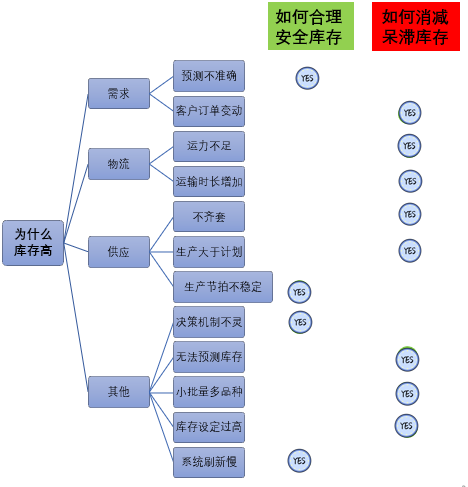
在需求端,销售预测不准确与客户订单频繁变动是确定安全库存水位时考虑的主要因素;在物流端,近期普遍出现的运力不足以及运输时间增长问题,都会导致库存呆滞;在供应端,材料不齐套、生产大于或小于计划、生产节拍不稳定都会导致安全库存增加或出现呆滞物料;
还有一些其他因素也会导致库存出现,如产销协同决策机制失调、无法预测未来库存、小批量多品种、安全库存设定过于保守、系统刷新太慢都会造成库存不准或库存过高的问题。
综合起来,如下图所示:
那么问题来了,既然我们已经知道库存的分类和产生的原因,应该如何降低库存呢?先别急着“大干快上”,我们要通过恰当的分析方法找到库存的主要成因,再“稳、准、狠”的把库存降下来。
言归正传,下面介绍这个用来降低库存的五步分析法。 数字化转型网(www.szhzxw.cn)
三、五步分析法
第一步,我们需要评估哪些成因对库存的影响大且改善的空间大,这就需要对成因进行分级分类,如下图所示:
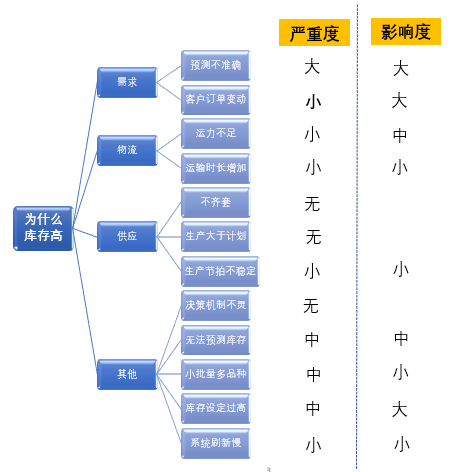
其中,严重度是指问题发生的几率或与行业标杆的差距,衡量改善空间的大小。影响度是指对绩效指标的影响,包括商机、库存金额、库龄和呆滞存货占比。大中小可以套用ABC原则。没有影响就空着,这是个隐藏维度,后续会讲。
第二步,将影响度放在横轴,严重度放在纵轴,就可以画出以下矩阵:
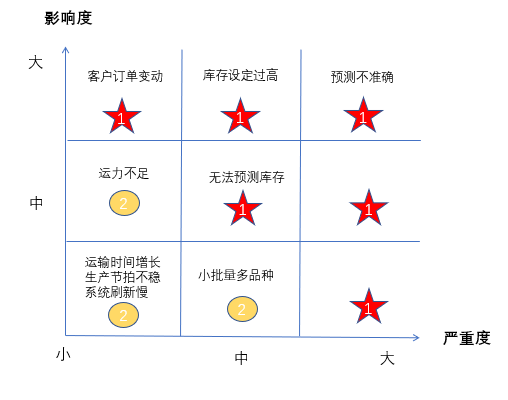
输出的结果是贡献度优先级排序,如下图所示: 数字化转型网(www.szhzxw.cn)
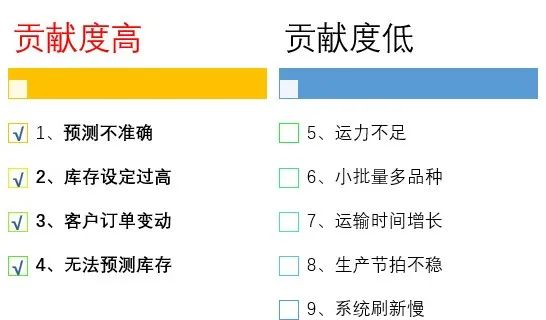
第三步,降低库存需要投入资源和时间。所以,除了考虑对降低库存贡献度的大小,我们还要考虑解决问题的复杂程度。因此,我们需要评估问题的改善方向、难度与时长,如下图所示:
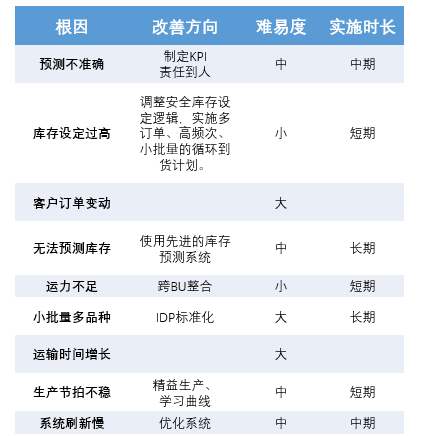
其中,难易度的大小可以从投资的额度、能力的要求等维度评估;时长可以划分为3个月内解决(短)、4-12个月解决(中)、12个月以上解决(长)。其中还有一个隐藏的维度,就是难度过大解决不了,后续会讲。
输出的结果就是:
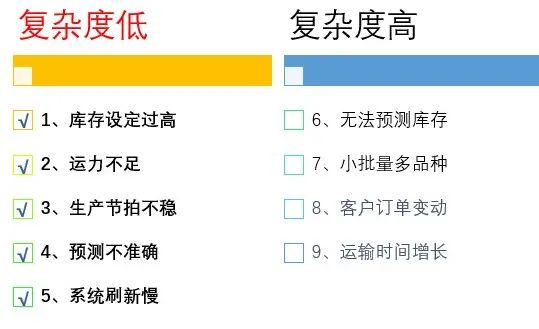
第四步,将贡献度放在纵轴,复杂度放在横轴,生成降库存策略矩阵,如下图所示:
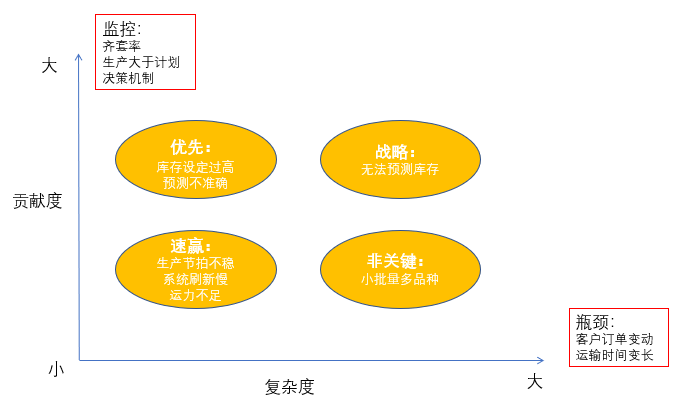
其中,我们将不同的降库存机会分为优先、速赢、战略和非关键这四个象限。
毫无疑问,优先是指容易达成且成绩较大的降库存机会,我们当然要优先去做;速赢是指虽然成绩较小,但是可以快速完成的降库存机会,我们放在第二位去做;对于需要较大投资且长期努力但是能够获得较大成绩的机会,我们视为战略机会,放在第三位去做;至于投入大、周期长、产出低的降库存机会,我们可以最后去做或者放弃。 数字化转型网(www.szhzxw.cn)
除了这四个象限,大家还记得那些没有出现问题的机会吗,即影响程度为零的机会,虽然它们现在没有造成库存问题,但是将来供需情况如果发生很大的变化也有可能出问题。
因此,我们需要设定相应的绩效指标,用来监控这些机会,以便及早制定措施。对于那些没有解决办法的问题,我们只能放弃,可以归类为瓶颈。至此,我们完成了对降库存机会的分级分类分析。
最后,第五步,我们需要从绩效指标、责任人、投资等角度对库存成因逐一制定改善方案并定期监控。(改善方案并不孤立,而是与需求管理、计划管理、供应管理、全面质量管理、精益生产等都相关。)
另外,对于已经产生的呆滞库存,要尽快识别并处理掉。伙伴们,学完这降库存的五步法,是不是思路更加清晰,更加容易下手了呢?希望大家尽快消化,学以致用。

翻译:
That’s right, that’s how the inventory came down!
What is inventory? Some say that inventory is a liability; Others say inventory is a business opportunity. Which statement do you agree with?
First, two kinds of inventory
In fact, both statements are true. In other words, there are two kinds of inventory.
One is called safety inventory, which is an active standby to cushion the fluctuation of demand, planning, production and supply, with the purpose of improving the timely arrival rate, increasing customer satisfaction, and winning more business opportunities for enterprises.
The other is called sluggish inventory, which is passive inventory caused by unexpected fluctuations, such as sudden customer cancellation of orders, logistics not timely delivery, sudden equipment failure, uneven raw materials, etc., resulting in waste and increase costs.
Clearly, different strategies are needed for these two types of inventory. For safety inventory, we need to calculate a reasonable water level and storage location, too much will produce waste, too little will lose business opportunities. As for sluggish inventory, we should continue to reduce it from the dimensions of demand, planning, logistics and so on. 数字化转型网(www.szhzxw.cn)
Second, why the inventory is high?
After the truth is said, we need to enter a deeper level to understand the main causes of high inventory.
On the demand side, inaccurate sales forecast and frequent changes in customer orders are the main factors to be considered when determining the safety stock level. On the logistics side, the shortage of transportation capacity and the increase of transportation time will lead to sluggish inventory. On the supply side, uneven materials, production greater than or less than the plan, and unstable production timing will lead to an increase in safety stocks or dull materials;
There are also some other factors that can lead to inventory, such as dysfunctional production and marketing coordination decision-making mechanism, inability to predict future inventory, small batch and multiple varieties, too conservative safety inventory setting, and too slow system refresh will cause inventory inaccurate or excessive inventory problems.
In summary, as shown in the following figure:
(▲ Reasons for high inventory)
So the question comes, now that we already know the classification of inventory and the cause of production, how should we reduce inventory? Don’t rush to “do it quickly”, we have to find the main causes of inventory through appropriate analysis methods, and then “steady, accurate, ruthless” to reduce the inventory. 数字化转型网(www.szhzxw.cn)
Without further ado, here’s a five-step analysis for reducing inventory.
Three, Five-step analysis
In the first step, we need to evaluate which causes have the greatest impact on inventory and have the greatest room for improvement, which requires the classification of causes, as shown in the figure below:
(▲ Cause classification diagram)
Among them, severity refers to the probability of problem occurrence or the gap with the industry benchmark, and measures the size of the improvement space. Impact refers to the impact on performance indicators, including business opportunities, inventory amount, inventory age and the proportion of inactive inventory. Large, medium and small can apply the ABC principle. It’s empty if it has no effect. It’s a hidden dimension. We’ll talk about that later.
In the second step, place the impact on the horizontal axis and the severity on the vertical axis, and the following matrix can be drawn:
(▲ Influence and Severity matrix)
The output result is the ranking of contribution priorities, as shown in the figure below:
(▲ Contribution priority ranking chart)
Third, reducing inventory takes resources and time. So, in addition to considering the size of the contribution to reducing inventory, we also have to consider the complexity of solving the problem. Therefore, we need to evaluate the direction, difficulty, and duration of improvement of the problem, as shown in the figure below: 数字化转型网(www.szhzxw.cn)
(▲ Issues to be evaluated)
Among them, the degree of difficulty can be evaluated from the dimensions of investment limit, ability requirements, etc. The duration can be divided into three months (short), four to 12 months (medium), and more than 12 months (long). There is also a hidden dimension, which is too difficult to solve, and we will talk about it later.
The output is:
(▲ Complexity sorting chart)
Fourth, put the contribution degree on the vertical axis and complexity on the horizontal axis to generate the inventory reduction strategy matrix, as shown in the figure below:
(▲ Inventory reduction strategy matrix)
Among them, we divide different inventory reduction opportunities into four quadrants: priority, quick win, strategic and non-critical. 数字化转型网(www.szhzxw.cn)
There is no doubt that priority refers to easy to achieve and achieve large inventory reduction opportunities, we must of course give priority to do; Quick win means that although the result is small, but can be quickly completed inventory reduction opportunities, we put the second to do; For opportunities that require large investment and long-term efforts but can achieve great results, we regard them as strategic opportunities and put them in the third place. As for the inventory reduction opportunities with large investment, long cycle and low output, we can do it last or give up.
In addition to these four quadrants, do you remember the opportunities that did not go wrong, that is, the opportunities that had zero impact, although they did not cause inventory problems now, they could also cause problems in the future if the supply and demand situation changed significantly?
Therefore, we need to set performance indicators to monitor these opportunities so that measures can be taken early. For those problems that have no solution, we can only give up and can be classified as bottlenecks. At this point, we have completed the classification analysis of inventory reduction opportunities.
Finally, in the fifth step, we need to make improvement plans for the causes of inventory one by one and monitor them regularly from the perspectives of performance indicators, responsible persons and investment. (The improvement plan is not isolated, but related to demand management, plan management, supply management, total quality management, lean production, etc.)
In addition, for the sluggish inventory that has been generated, it is necessary to identify and dispose of it as soon as possible. Partners, after learning this five-step method of reducing inventory, is it more clear and easier to start? I hope you can digest it as soon as possible and put what you have learned into practice. 数字化转型网(www.szhzxw.cn)
本文由数字化转型网(www.szhzxw.cn)转载而成,来源于采购实战家专栏 ,作者:采购小姜;编辑/翻译:数字化转型网宁檬树。
免责声明: 本网站(http://www.szhzxw.cn/)内容主要来自原创、合作媒体供稿和第三方投稿,凡在本网站出现的信息,均仅供参考。本网站将尽力确保所提供信息的准确性及可靠性,但不保证有关资料的准确性及可靠性,读者在使用前请进一步核实,并对任何自主决定的行为负责。本网站对有关资料所引致的错误、不确或遗漏,概不负任何法律责任。
本网站刊载的所有内容(包括但不仅限文字、图片、LOGO、音频、视频、软件、程序等) 版权归原作者所有。任何单位或个人认为本网站中的内容可能涉嫌侵犯其知识产权或存在不实内容时,请及时通知本站,予以删除。