
一、前言
钢铁企业生产制造过程具有成熟的技术体系,全流程工序繁多且上下游工序单元联系密切,但尚未做到工序间界面的无缝精准衔接。钢铁制造过程还存在生产效率低、能耗成本高、生产管控度不足、工序间协同融合不够以及企业与产业链上下游协同效率低等问题,但在现有技术体系下无法得到有效解决,而以5G为代表的新一代信息技术的飞速发展,为这些问题的解决提供了新思路。
山东钢铁集团有限公司(简称山钢)正处于转型升级的关键时期,同样面临着上述行业难题亟需解决。为了解决这些问题,山钢在新技术应用层面进行了诸多尝试和有效探索,并取得了初步成效,但融合应用过程中也出现了新技术嵌入钢铁流程缺少理论支撑、技术应用缺乏系统性、赋能作用不够明显等问题,因此,本文聚焦5G、数字孪生、人工智能/机器视觉技术等新一代信息技术如何嵌入山钢生产制造场景展开分析和研究,旨在为新技术在山钢生产制造场景赋能作用发挥提供指导。
二、新技术嵌入技术体系
1. 新技术间相互关联关系
(1)5G是必要条件。5G作为新一代信息通信技术,具有大带宽、低时延、广连接的特点,将5G技术与工业互联网技术相结合,形成“5G+工业互联网”技术,搭建全面连接的工业互联网平台,构建与钢铁生产深度融合的全产业链、全价值链的全新制造和服务体系。“5G+工业互联网”已成为钢铁行业实现数字化、网络化、智能化的必要和优选条件,助力企业降本、提质、增效、绿色、安全发展。
(2)人工智能/机器视觉是支撑。人工智能/机器视觉技术应用于钢铁制造全过程,需要5G技术发挥强力传输作用,才可有效解决废钢判级、金相识别、过程质量检测、无人运输等长期制约钢铁生产痛点问题,实现对生产过程的深度感知和精准管控,有力支撑智能化生产和科学运营决策。
(3)数字孪生是最终实现。数字孪生技术的应用和数字孪生体的构建与实现,一方面需要以“5G+工业互联网”为关键元素搭建工业互联网平台,以此为载体完成网络资源的共享、数据处理、模型构建、应用服务等;另一方面需要将人工智能/机器视觉技术应用于关键工艺、生产控制点,完成对过程控制关键因素的深度感知和精准控制。在二者结合基础之上,实现动态数字孪生。
2. 新技术嵌入技术体系
(1)体系结构。依据《钢铁行业智能制造标准体系建设指南》相关要求,基于5G、数字孪生、人工智能/机器视觉等嵌入技术特点及山钢生产实际,形成由“基础共性技术”“嵌入技术”和“应用场景”三部分构成的嵌入技术体系结构,如图1所示。 数字化转型网(www.szhzxw.cn)
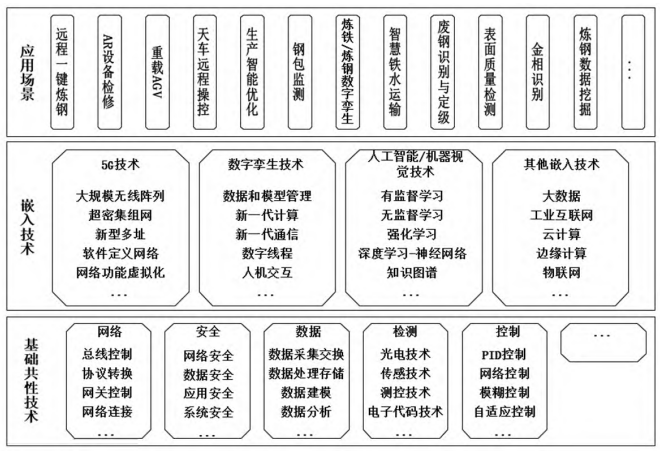
具体内容如下:①基础共性技术包括网络、安全、数据、检测、控制等部分,位于整个体系结构的底层,是嵌入技术和应用场景的支撑。②嵌入技术包括 5G 技术、数字孪生技术、人工智能/机器视觉技术和其他嵌入技术。其中,5G 技术涵盖大规模无线阵列技术、超密集组网技术、新型多址技术、软件定义网络技术、网络功能虚拟化技术等;数字孪生技术涵盖数据和模型管理技术、新一代计算技术、新一代通信技术、数字线程技术、数字孪生技术、人机交互技术等;人工智能/机器视觉技术涵盖有监督学习、无监督学习、强化学习、深度学习-神经网络等;其他嵌入技术涵盖大数据技术、工业互联网技术、云计算技术、边缘计算技术、物联网技术等。③应用场景位于结构图的最顶层,面向钢铁行业需求,对基础共性技术和嵌入技术进行细化和落地,指导嵌入技术融合应用。主要包括远程一键炼钢、AR设备检修、重载AGV、天车远程操控、生产智能优化、钢包监测、炼铁/炼钢数字孪生、智慧铁水运输、废钢识别与定级、表面质量检测、金相识别、炼钢数据挖掘等典型场景。 数字化转型网(www.szhzxw.cn)
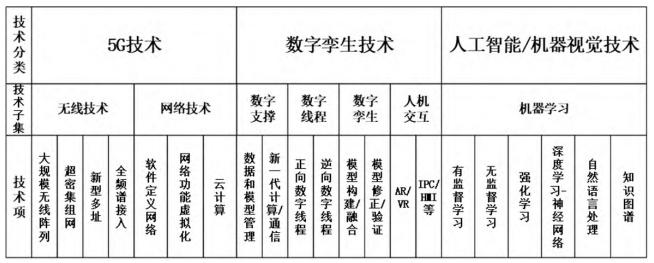
(2)关键技术集。在嵌入技术体系结构研究基础上,重点进行5G、数字孪生、人工智能/机器视觉等关键技术研究,总结提出了支撑三项嵌入技术的关键技术集,如图2所示。
(3)功能架构。嵌入技术体系功能架构主要包含 3 个层级,分别为边缘数据采集处理层、平台运行层和智能应用层。其中,5G 技术作为通信技术主要嵌入于边缘数据采集处理层,作用于数据采集、传输和边缘处理过程;人工智能/机器视觉技术主要嵌入于边缘数据采集处理和平台运行层,在边缘数据采集处理层主要结合应用场景完成图像识别和采集任务,在平台运行层进行模型构建、算法优化等工作;数字孪生技术嵌入 3 个层级,其中在边缘数据采集和处理层级借助 5G 和人工智能/机器视觉技术完成对物理实体的深度感知,在平台运行层完成模型构建优化任务,在智能应用层实现动态数字孪生展示,如图3所示。
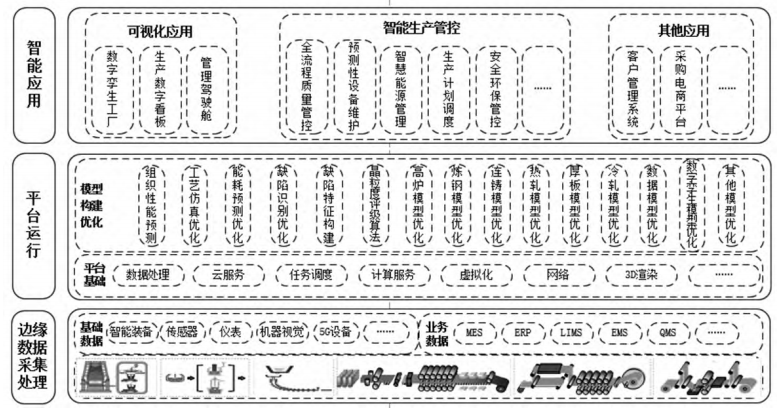
各层级具体功能如下:①底层是边缘数据采集处理层,通过大范围、深层次的数据采集,以及异构数据的协议转换与边缘处理,构建平台运行的数据基础。采集和汇聚处理来自钢铁生产全流程智能装备等的基础数据,以及MES等各相关系统的业务数据,实现数据向平台的集成。②中间层是平台运行层,基于工业数据分析等创新功能构建可扩展的开放式平台。将钢铁生产工艺与过程数据结合,固化技术、知识、经验等资源,构建“数据+机理”模型并优化,为智能应用提供平台环境。③顶层是智能应用层,形成满足不同场景的工业应用,完成价值实现。将嵌入技术融入数字孪生工厂、全流程质量管控、设备维护、能源管控、生产过程管控、客户服务、产业链协同等钢铁生产运营场景,实现应用创新和价值创造。
3. 嵌入应用原则
(1)根据政策时机应用。5G、数字孪生、人工智能/机器视觉等嵌入技术在国家政策层面总体程度不同,5G技术从2017年开始在不同层面陆续发布相关政策,旨在促进该项技术的快速推广应用;而数字孪生、人工智能/机器视觉技术在近几年的政府重点研发计划中有所涉及,但无论从政策频度还是力度方面都没有达到5G技术的程度。因此,几项嵌入技术应结合政策推进时机适时应用。
(2)结合技术成熟度实施。嵌入技术在行业内应用成熟度不同。5G和人工智能/机器视觉技术应用成熟度相对较高,尤其是人工智能/机器视觉技术,已取得了较显著的应用效果,5G技术使用较为广泛,但与WIFI6、WIFI7等新一代无线传输技术对比效果尚不明显,需要持续观察;数字孪生技术在行业内整体应用尚属初级阶段,多数应用只是实现了三维可视化,距离真正的动态数字孪生还有很长的路要走。目前情况下可以结合企业实际,进行探索性研发与实践。
(3)融合多项技术嵌入。嵌入技术在山钢两基地应用基础不同,在相关应用场景应用新技术时需要进行综合研判,融合5G、数字孪生和人工智能等多项技术,发挥各项技术的优势,从而实现新技术对生产运营过程的高效赋能。
(4)需求导向顺序推进。山钢各产线对嵌入技术融合应用的需求不同,新技术应用须坚持与问题和需求相结合的原则,特别是目前市场形势比较严峻的情况下,需要结合各自产线需求,如废钢识别与定级、过程数据分析优化建模等一些较迫切的场景优先推进,为降本增效提供支撑。
三、新技术嵌入重点场景建议
综合研究分析,优先在无人库区、废钢智能识别与判级、智慧铁水运输、产品表面质量检测等场景重点嵌入以5G为代表的新技术,进行相关融合应用工作。为更好的实现新技术赋能作用,在部分场景需要综合应用多种新技术。 数字化转型网(www.szhzxw.cn)
1. 无人库区
(1)现场应用基础。山钢已在日照基地冷轧中间库区等5个库区、莱芜基地板带厂宽带产线成品库区成功完成无人库区建设,这些库区的建设为5G和机器视觉技术的应用提供了条件。
(2)相关应用建议。①在库区建设时综合平衡使用多种新技术。无人库区建设需要平衡使用库位识别定位、防摇摆控制、多车防撞等多种关键性技术,如视频采集和传输是否需要使用 5G 替代WIFI,要结合场景和需求综合研判。②在条件复杂库区考虑分级分步实施相关工作。目前日照和莱芜生产基地已完成部分库区无人化升级,其他尚未实施的库区条件较为复杂,建议进行夯实基础工作,考虑分级分步。
(3)预计应用效果分析。本场景应用效果预计主要体现在节省人力成本方面和提升整体运行效率方面。以莱芜基地板带厂宽带线成品库为例,无人库区建设完成后共计减少相关操作人员 41 人,人工成本每年减少约 492 万元;同时,在库区发运效率提升、智能化水平提升、减少客户等待时间和优化库容等方面效果显著。
2. 废钢智能识别与判级
(1)现场基础。2021 年日照基地废钢量为92.75万t,废钢主要由自产废钢、外购废钢、铁块构成,其中外购废钢约占70%;2021年莱芜基地废钢量为91.76万t,废钢主要由自产废钢、内调废钢、铁块和 5 类外购废钢,其中外购废钢用量约占 20%。目前,日照基地尚未开展废钢智能识别与判级技术应用,莱芜基地已在新旧动能转换区实施,项目正在进行现场设备安装工作。
(2)相关应用建议。加快莱芜基地新旧动能转换区废钢智能识别与判级项目推进进度,重点开发并优化异物识别、废钢定级和扣杂指导等模型和相关算法,针对不同的识别类型完善识别和判级策略,以实现精准识别和准确定级。同步在总结莱芜基地智能识别与判级项目实施过程中的经验的基础上,高效完成项目移植和复制,加快推进日照基地项目建设。 数字化转型网(www.szhzxw.cn)
(3)预计应用效果。废钢智能识别与判级项目应用后,预计废钢总体评级准确率≥95%,扣重准确率≥90%。根据不完全统计,普钢生产企业其废钢采购成本高达销售额10%,而由于错误定级、废钢成分夹杂等原因造成废钢采购成本约5%~10%的浪费。以500万t企业计算,年采购废钢50~100万t,采购成本10~20亿元,按照废钢智能识别定级系统可降低1%的废钢采购成本,该技术应用后带来的年经济效益1 000~2 000万元。
3. 智慧铁水运输
(1)现场基础。日照基地铁水采用特制汽车运输,车辆和铁水罐上都有 RIFD 标识,铁水罐空重100 t 左右,铁水罐满载共 300 t 左右,铁水温降100 ℃左右。已建有MES系统和铁钢包调度系统,MES系统负责铁区、钢区的衔接及跟踪,铁钢包调度系统负责铁水罐和铁水罐车的调度,具有跟踪、识别等功能,满足车、罐及铁水的信息对应。莱芜基地新区采用火车运输,采用敞口罐运输,有简单铁水运输管理系统完成初步铁水路径规划及执行作业;新旧动能转换区采用汽车运输,有管理系统完成路径规划运输和执行;铁水运输平均温降大约120 ℃左右(最高温降约为200 ℃)。
(2)相关应用建议。日照基地目前正在进行铁水运输系统无人化升级交流,根据车辆情况需要对铁水运输车辆本体动力系统、制动系统等进行升级改造、完成自动驾驶功能开发以及配套的软件系统开发,同时还需要与铁钢包系统做好数据对接。莱芜基地新区铁路铁水运输系统尚未开始无人化升级,建议优先考虑新区铁路运输系统无人化升级,同步要考虑铁水运输过程中的保温措施(铁水加盖等),以降低铁水温降;陶家岭新旧动能转换区可以参考日照基地无人化升级项目推进情况适时推进。
(3)预计应用效果。该场景应用效果主要体现在降低铁水温降、提高运输效率、提高铁水罐周转率、降低人力成本等方面。以赛迪奇智某案例为例,其在为南方某钢铁成功减少在建 3#高炉配套的机车 1 台,减少混铁车 3 台,直接减少经济投入约3 600 万元;提高机车产能,罐车周转率从3.4提高至 4.3,预计减少铁水温降5~10 ℃;降低设备维护费用和机车油耗,路径自动规划,衔接顺畅带来油耗减少10%;可节约劳动力成本70%。莱芜基地新区铁路无人化后,预计可在降低铁水温降、节约人力成本、提升运输效率等方面获得可观效益。 数字化转型网(www.szhzxw.cn)
4. 炼钢数字孪生
(1)现场基础。日照基地1#LF采用三维数字化和数字孪生技术研究,将静态数据和动态数据与数字孪生体协同联动,实现LF 精炼三维可视智能化集成映射。2022年11月5日,已完成三维可视化数字孪生应用功能与实际生产过程进行现场测试对比,三维可视化数字孪生应用的设备状态、数据等均与实际生产数据一致,并且可以达到实时同步,且操作简单易用。莱芜基地围绕4#转炉开展转炉三维可视化技术研究应用,实现数字孪生技术初步应用,极大的提升了智能炼钢可视化水平,是目前智能化炼钢最高水平展示。数字孪生项目应用实施后,有效提高了转炉过程控制智能化水平,显著改善了转炉经济综合指标。
(2)相关应用建议。山钢两基地已在高炉、转炉过程控制初步进行了数字孪生技术应用尝试,应用后效果已经显现,可为操作人员优化操作提供参考和依据,建议可在已有基础上优先在炼钢场景逐步深化相关技术应用。
(3)预计应用效果。数字孪生技术在炼钢场景应用后目前已取得了较好的效果,以莱芜基地4#转炉数字孪生系统为例,应用该项技术后,钢铁料消耗平均吨钢降低 21 kg,氧气消耗量降低 2 m3/t,出钢温度降低15 ℃,消除了转炉冶炼过程中的异常因素影响,转炉喷溅率降低 30%~50%,单炉座年直接经济效益达5000余万元。 数字化转型网(www.szhzxw.cn)
5. 产品表面质量检测
(1)现场基础。山钢产品表面质量检测设备应用主要集中在4 300 mm宽厚板产线、炉卷产线、热连轧产线和冷轧产线等轧线,实现板/带产品表面质量在线检测,总体用用效果较好。以日照基地冷轧产线为例,冷轧现有表面质量检测仪5台,其中3台分别安装于3条处理线出口质检活套下面,圆盘剪前面;2台分别安装于酸轧工艺段出口和酸洗平整机出口。
(2)相关应用建议。①深化新技术应用,解决存在的难点问题。目前在用的表面质量检测设备普遍存在缺陷图片实时性差、规则库支撑作用发挥不够等问题。因此,需要深化“5G+AI+大数据”技术应用,取代原有网络传输形式,利用5G技术大带宽、低时延的特性提升缺陷图片实时采集能力;同时应用大数据算法,优化缺陷规则库以提升表面质量检测设备检测精度。②统筹人力资源,实现岗位优化。目前在炼钢区域、部分热轧板带和冷轧部分区域仍有应用需求,在技术应用时要考虑应用“5G+AI”技术应用,实现表面缺陷高精度识别,并结合人工经验和缺陷大数据自动给出合理的判定结果。有了技术手段的支撑,可以考虑将部分具备条件的产品质量人工检测点进行集中管控,优化配置岗位资源,达到提升效率的目的。
(3)预计应用效果。该技术应用后,可实现自动实时检测和快速识别标记,完成高精度检测(缺陷检出率≥95%,分类准确率≥90%),有效降低产品质量损失,提升质量异议风险管控能力,减少抽检率(抽检率可由人工的 45% 提升到 91%),优化工艺、提高生产效率。
四、结语
聚焦5G、数字孪生、人工智能/机器视觉等新一代信息技术嵌入山钢生产制造进行分析,重点从嵌入技术体系和嵌入场景两个维度深入展开,研究了嵌入体系结构、关键技术集和应用架构,形成嵌入技术体系,结合山钢生产实际情况给出相关应用建议及重点应用场景,为新技术创新融合应用提供指导,助力新技术与传统生产制造技术体系的融合,力求达到赋能目标。 数字化转型网(www.szhzxw.cn)

翻译:
New generation of information technology embedded in manufacturing application analysis
Introduction
The production and manufacturing process of iron and steel enterprises has a mature technical system, and the whole process has many processes and the upstream and downstream process units are closely connected, but the interface between the processes has not been seamless and accurate. There are also problems in the steel manufacturing process such as low production efficiency, high energy consumption cost, insufficient production control, insufficient collaborative integration between processes, and low collaborative efficiency between enterprises and the upstream and downstream of the industrial chain, but they cannot be effectively solved under the existing technical system, and the rapid development of the new generation of information technology represented by 5G provides new ideas for solving these problems.
Shandong Iron and Steel Group Co., LTD. (referred to as Shangang) is in a critical period of transformation and upgrading, and also faces the above industry problems need to be solved. In order to solve these problems, Shangang has made many attempts and effective exploration at the level of new technology application, and achieved initial results. However, in the process of integration and application, there are also problems such as lack of theoretical support for new technology embedded in steel process, lack of systematic technology application, and insufficient enabling effect. This paper focuses on the analysis and research of how 5G, digital twin, artificial intelligence/machine vision technology and other new generation information technologies are embedded in the production and manufacturing scene of Shansteel, aiming to provide guidance for the enabling role of new technologies in the production and manufacturing scene of Shansteel. 数字化转型网(www.szhzxw.cn)
The new technology is embedded in the technical system
1. Interconnectedness among new technologies
(1) 5G is necessary. As a new generation of information and communication technology, 5G has the characteristics of large bandwidth, low delay and wide connectivity. Combining 5G technology and industrial Internet technology, 5G technology will form “5G+ Industrial Internet” technology, build a fully connected industrial Internet platform, and build a new manufacturing and service system of the whole industrial chain and the whole value chain that is deeply integrated with steel production. “5G+ Industrial Internet” has become a necessary and preferred condition for the iron and steel industry to achieve digitalization, networking and intelligence, helping enterprises to reduce costs, improve quality, increase efficiency, green and safe development.
(2) Artificial intelligence/machine vision is the support. The application of artificial intelligence/machine vision technology to the entire process of steel manufacturing requires 5G technology to play a strong transmission role in order to effectively solve the long-term constraints of steel production pain points such as scrap grade judging, metallographic identification, process quality testing, and unmanned transportation, achieve depth perception and accurate control of the production process, and strongly support intelligent production and scientific operation decisions.
(3) Digital twin is the final implementation. The application of digital twin technology and the construction and implementation of digital twin, on the one hand, it is necessary to build an industrial Internet platform with “5G+ Industrial Internet” as the key element, and complete the sharing of network resources, data processing, model construction, application services, etc. On the other hand, artificial intelligence/machine vision technology needs to be applied to key processes and production control points to complete depth perception and accurate control of key factors in process control. Based on the combination of the two, the dynamic digital twin is realized.
2. The new technology is embedded in the technical system
(1) Architecture. According to the relevant requirements of the “Steel Industry Intelligent Manufacturing Standard System Construction Guide”, based on the embedded technology characteristics such as 5G, digital twin, artificial intelligence/machine vision and the actual production of Shansteel, an embedded technology architecture composed of “basic common technology”, “embedded technology” and “application scenario” is formed, as shown in Figure 1. 数字化转型网(www.szhzxw.cn)
Figure 1 Embedded technology architecture
The specific contents are as follows: (1) Basic common technologies include network, security, data, detection, control and other parts, located at the bottom of the entire architecture, is the support of embedded technologies and application scenarios. Embedded technologies include 5G technology, digital twin technology, artificial intelligence/machine vision technology and other embedded technologies. Among them, 5G technology covers large-scale wireless array technology, ultra-dense networking technology, new multiple access technology, software defined network technology, network function virtualization technology, etc. Digital twin technology covers data and model management technology, new generation computing technology, new generation communication technology, digital thread technology, digital twin technology, human-computer interaction technology, etc. Artificial intelligence/machine vision technology covers supervised learning, unsupervised learning, reinforcement learning, deep learning-neural networks, etc. Other embedded technologies include big data technology, industrial Internet technology, cloud computing technology, edge computing technology, Internet of Things technology, etc. ③ The application scenario is located at the top level of the structure chart, facing the needs of the steel industry, the basic common technology and embedded technology are refined and landed, and the integration application of embedded technology is guided. It mainly includes typical scenarios such as remote one-click steelmaking, AR equipment maintenance, heavy-duty AGV, crane remote control, intelligent production optimization, ladle monitoring, ironmaking/steelmaking digital twin, intelligent hot metal transportation, scrap identification and grading, surface quality detection, metallographic identification, steelmaking data mining and so on.
(2) Key technology set. On the basis of the embedded technology architecture research, key technologies such as 5G, digital twin and artificial intelligence/machine vision are focused on, and key technology sets supporting the three embedded technologies are summarized and proposed, as shown in Figure 2.
Figure 2 Embed technology Key technology set
(3) Functional architecture. The functional architecture of embedded technology system mainly includes three levels, namely edge data acquisition and processing layer, platform operation layer and intelligent application layer. Among them, 5G technology, as a communication technology, is mainly embedded in the edge data acquisition and processing layer, and acts on the data acquisition, transmission and edge processing process. Artificial intelligence/machine vision technology is mainly embedded in the edge data acquisition and processing layer and the platform operation layer. In the edge data acquisition and processing layer, image recognition and acquisition tasks are mainly completed in combination with application scenarios, and model construction and algorithm optimization are carried out in the platform operation layer. Digital twin technology is embedded in three levels, among which 5G and artificial intelligence/machine vision technologies are used to achieve depth perception of physical entities at the edge data acquisition and processing level, model construction optimization is completed at the platform operation level, and dynamic digital twin display is realized at the intelligent application level, as shown in Figure 3. 数字化转型网(www.szhzxw.cn)
Figure 3. Functional architecture of embedded technology architecture
The specific functions of each level are as follows: (1) The bottom layer is the edge data collection and processing layer, which builds the data foundation of platform operation through large-scale and deep-level data collection, protocol conversion and edge processing of heterogeneous data. Collect and gather the basic data from the intelligent equipment of the whole process of steel production, as well as the business data of various related systems such as MES, to realize the integration of data to the platform. The middle layer is the platform operation layer, which builds an extensible open platform based on innovative functions such as industrial data analysis. The steel production process and process data are combined, technology, knowledge, experience and other resources are solidified, and a “data + mechanism” model is constructed and optimized to provide a platform environment for intelligent applications. ③ The top layer is the intelligent application layer, forming industrial applications that meet different scenarios and complete the realization of value. The embedded technology will be integrated into the digital twin factory, the whole process quality control, equipment maintenance, energy control, production process control, customer service, industrial chain coordination and other steel production and operation scenarios to achieve application innovation and value creation.
3. Embed application principles
(1) Application according to policy timing. 5G, digital twin, artificial intelligence/machine vision and other embedded technologies have different degrees at the national policy level, and 5G technology has successively issued relevant policies at different levels since 2017, aiming to promote the rapid promotion and application of this technology; The digital twin, artificial intelligence/machine vision technology has been involved in the government’s key research and development plans in recent years, but it has not reached the degree of 5G technology in terms of policy frequency or intensity. Therefore, several embedded technologies should be combined with policies to promote timely application.
(2) Implementation in combination with technical maturity. The application maturity of embedded technology in the industry is different. The application maturity of 5G and artificial intelligence/machine vision technology is relatively high, especially artificial intelligence/machine vision technology, which has achieved significant application effects. 5G technology is widely used, but the comparison effect with WIFI6, WIFI7 and other new generation wireless transmission technologies is not obvious, and continuous observation is needed. The overall application of digital twin technology in the industry is still in the initial stage, and most applications only achieve three-dimensional visualization, and there is still a long way to go from the real dynamic digital twin. Under current circumstances, exploratory research and development and practice can be carried out in combination with the actual situation of enterprises.
(3) Integration of multiple technology embeddings. The application basis of embedded technology in the two bases of Shangang is different, and comprehensive research and judgment should be carried out in the application of new technologies in relevant application scenarios, integrating 5G, digital twin and artificial intelligence and other technologies, giving play to the advantages of various technologies, so as to realize the efficient enabling of new technologies to the production and operation process.
(4) demand-oriented sequential promotion. Shan Steel production lines have different requirements for the integration and application of embedded technology, and the application of new technology must adhere to the principle of combining problems and needs, especially under the current severe market situation, it is necessary to combine the needs of their own production lines, such as scrap identification and grading, process data analysis and optimization modeling, and other more urgent scenarios, to provide support for cost reduction and efficiency. 数字化转型网(www.szhzxw.cn)
Suggestions on key scenarios for new technology embedding
Comprehensive research and analysis, priority is given to embedding new technologies represented by 5G in scenarios such as unmanned reservoir area, intelligent identification and grading of scrap steel, intelligent hot metal transportation, and product surface quality detection, and related fusion applications are carried out. In order to better realize the enabling effect of new technologies, a variety of new technologies need to be comprehensively applied in some scenarios.
1. No man reservoir area
(1) Field application basis. Shangang has successfully completed the construction of unmanned reservoir areas in five reservoirs, including the cold rolling middle reservoir area of Rizhao Base and the finished product reservoir area of the broadband production line of the Laiwu base strip factory, which provides conditions for the application of 5G and machine vision technology.
(2) Relevant application suggestions. ① The use of a variety of new technologies in the construction of the reservoir area. The construction of unmanned reservoir area needs to balance the use of storage location identification and positioning, anti-swing control, multi-vehicle collision avoidance and other key technologies, such as whether 5G is needed to replace WIFI in video acquisition and transmission, and comprehensive research and judgment should be combined with the scene and demand. ② In the reservoir area with complex conditions, the relevant work should be implemented step by step. At present, Rizhao and Laiwu production bases have completed the unmanned upgrading of some reservoir areas, and the conditions of other reservoir areas that have not yet been implemented are more complicated. It is recommended to consolidate the foundation and consider steps by levels.
(3) Expected application effect analysis. The application effect of this scenario is expected to save labor costs and improve the overall operating efficiency. Taking Laiwu base strip factory broadband line finished products warehouse as an example, after the completion of the construction of the unmanned reservoir area, a total of 41 related operators are reduced, and the labor cost is reduced by about 4.92 million yuan per year; At the same time, the delivery efficiency in the reservoir area is improved, the intelligence level is improved, the customer waiting time is reduced and the storage capacity is optimized.
2. Scrap intelligent identification and grading
(1) Site basis. In 2021, the amount of scrap steel in Rizhao Base is 927,500 tons, and the scrap is mainly composed of self-produced scrap, purchased scrap and iron block, of which the purchased scrap accounts for about 70%. In 2021, the amount of scrap steel in Laiwu Base is 917,600 tons, and the scrap is mainly composed of self-produced scrap, internally transferred scrap, iron block and 5 types of outsourced scrap, of which the amount of outsourced scrap accounts for about 20%. At present, Rizhao base has not yet carried out the application of scrap intelligent identification and grading technology, Laiwu base has been implemented in the old and new kinetic energy conversion area, and the project is undergoing on-site equipment installation work. 数字化转型网(www.szhzxw.cn)
(2) Relevant application suggestions. Accelerate the progress of the intelligent identification and grading project of scrap in the old and new kinetic energy conversion zone of Laiwu Base, focus on the development and optimization of models and related algorithms such as foreign body identification, scrap grading and impurity guidance, and improve the identification and grading strategies for different identification types to achieve accurate identification and grading. On the basis of summarizing the experience in the implementation of the intelligent identification and grading project of Laiwu Base, we will efficiently complete the transplantation and replication of the project and accelerate the construction of Rizhao Base project.
(3) Expected application effect. After the application of scrap intelligent identification and grading project, it is expected that the overall rating accuracy of scrap is ≥95%, and the weight accuracy is ≥90%. According to incomplete statistics, the scrap procurement cost of general steel production enterprises is as high as 10% of sales, and the waste of scrap procurement cost is about 5% to 10% due to wrong grading, scrap composition inclusion and other reasons. According to the calculation of 5 million t enterprises, the annual purchase of scrap is 500 ~ 1 million t, and the procurement cost is 1 ~ 2 billion yuan. According to the intelligent identification and grading system of scrap, the purchase cost of scrap can be reduced by 1%, and the annual economic benefits brought by the application of this technology are 10 ~ 20 million yuan. 数字化转型网(www.szhzxw.cn)
3. Smart hot metal transportation
(1) Site basis. Rizhao base of hot metal is transported by special cars, RIFD marks on the vehicles and hot water tanks, the empty weight of hot water tanks is about 100 t, the full load of hot water tanks is about 300 t, and the iron water temperature is about 100 ℃. MES system and ladle scheduling system have been built, MES system is responsible for the connection and tracking of iron zone and steel zone, and ladle scheduling system is responsible for the scheduling of molten iron tank and molten iron tank car, with tracking, identification and other functions to meet the information correspondence of car, tank and molten iron. Train transportation and open tank transportation are adopted in Laiwu New base area, and a simple hot metal transportation management system is used to complete preliminary hot metal path planning and execution. The new and old kinetic energy conversion area adopts automobile transportation, and there is a management system to complete the route planning transportation and execution; The average temperature drop of hot metal transport is about 120 ℃ (the maximum temperature drop is about 200 ℃).
(2) Relevant application suggestions. Rizhao Base is currently conducting unmanned upgrade communication of molten metal transport system, upgrading of molten metal transport vehicle body power system and brake system according to the needs of the vehicle, completing the development of automatic driving function and the development of supporting software system, and also needs to do a good job of data docking with the ladle system. The unmanned upgrade of railway hot metal transportation system in Laiwu Base New District has not yet begun, so it is suggested that priority should be given to the unmanned upgrade of railway transportation system in New District, and thermal insulation measures (hot metal covering, etc.) should be taken into account in the process of hot metal transportation to reduce the temperature of iron water; Taojialing old and new kinetic energy conversion area can be promoted in a timely manner with reference to the advancement of the unmanned upgrade project of Rizhao Base. 数字化转型网(www.szhzxw.cn)
(3) Expected application effect. The application effect of this scenario is mainly reflected in reducing the iron temperature drop, improving the transportation efficiency, improving the turnover rate of the iron water tank, and reducing the labor cost. Taking a case of CediQizhi as an example, it successfully reduced 1 locomotive and 3 mixing cars supporting 3# blast furnaces under construction for a steel company in Southern China, directly reducing economic investment of about 36 million yuan; Increase locomotive capacity, tank car turnover from 3.4 to 4.3, is expected to reduce iron water temperature drop 5 ~ 10 ℃; Reduce equipment maintenance costs and locomotive fuel consumption, automatic route planning, smooth connection to reduce fuel consumption by 10%; It can save 70% of labor cost. After the unmanned railway in Laiwu Base New Area, it is expected to obtain considerable benefits in reducing iron water temperature, saving labor cost and improving transportation efficiency.
4. Steelmaking digital twins
(1) Site basis. Rizhao Base 1#LF adopts 3D digitization and digital twin technology research, and cooperates static data and dynamic data with digital twins to realize the three-dimensional visual intelligent integrated mapping of LF refining. On November 5, 2022, the 3D visual digital twin application function was completed for field testing and comparison with the actual production process, and the equipment status and data of the 3D visual digital twin application were consistent with the actual production data, and could achieve real-time synchronization, and the operation was simple and easy to use. Laiwu Base carries out the research and application of three-dimensional visualization technology of converter around the 4# converter, realizes the preliminary application of digital twin technology, greatly improves the visualization level of intelligent steelmaking, and is the highest level of intelligent steelmaking display at present. After the implementation of the digital twin project, the intelligent level of the converter process control has been effectively improved, and the comprehensive economic index of the converter has been significantly improved.
(2) Relevant application suggestions. The two bases of Shandong Iron and Steel have preliminarily applied the digital twin technology in the process control of blast furnaces and converter, and the effect has been shown after application, which can provide reference and basis for operators to optimize the operation, and it is suggested that the application of relevant technologies can be gradually deepened in the steelmaking scene on the existing basis.
(3) Expected application effect. After the application of digital twin technology in the steelmaking scene, good results have been achieved. Taking the digital twin system of the 4# converter in Laiwu Foundation as an example, after the application of this technology, the average ton of steel consumption is reduced by 21 kg, the oxygen consumption is reduced by 2 m3/t, the steel temperature is reduced by 15 ℃, and the influence of abnormal factors in the smelting process of the converter is eliminated. The spatter rate of converter is reduced by 30% ~ 50%, and the direct economic benefit of single furnace base is more than 50 million yuan. 数字化转型网(www.szhzxw.cn)
5. Product surface quality inspection
(1) Site basis. The application of surface quality testing equipment is mainly concentrated in 4 300 mm wide and thick plate production line, furnace coil production line, hot continuous rolling production line and cold rolling production line, to achieve online surface quality testing of plate/strip products, and the overall use effect is good. Taking the cold rolling production line of Rizhao base as an example, there are 5 surface quality detectors in cold rolling, 3 of which are installed under the quality control looper at the outlet of 3 processing lines and in front of the disc scissors; 2 sets are respectively installed at the outlet of the acid rolling process and the outlet of the pickling flat machine.
(2) Relevant application suggestions. ① Deepen the application of new technologies and solve existing difficult problems. At present, the surface quality inspection equipment in use generally has some problems, such as poor real-time performance of defective images and insufficient support of rule base. Therefore, it is necessary to deepen the application of “5G+AI+ big data” technology, replace the original form of network transmission, and use the characteristics of 5G technology with large bandwidth and low delay to improve the real-time acquisition capability of defect images. At the same time, big data algorithm is applied to optimize the defect rule base to improve the detection accuracy of surface quality inspection equipment. ② Coordinate human resources and realize job optimization. At present, there are still application needs in steelmaking areas, some hot rolled strips and some cold rolled areas. In technical application, the application of “5G+AI” technology should be considered to achieve high-precision identification of surface defects, and reasonable judgment results can be automatically given based on manual experience and defect big data. With the support of technical means, we can consider the centralized control of some qualified product quality manual inspection points, optimize the allocation of post resources, and achieve the purpose of improving efficiency.
(3) Expected application effect. After the application of this technology, it can realize automatic real-time detection and rapid identification of marks, complete high-precision detection (defect detection rate ≥95%, classification accuracy ≥90%), effectively reduce product quality loss, improve quality objection risk control ability, reduce sampling rate (sampling rate can be increased from 45% to 91%), optimize the process and improve production efficiency. 数字化转型网(www.szhzxw.cn)
Conclusion
Focus on 5G, digital twin, artificial intelligence/machine vision and other new generation of information technology embedded in Shansteel production and manufacturing analysis, focus on the two dimensions of embedded technology system and embedded scenario in-depth, research the embedded system structure, key technology set and application architecture, the formation of embedded technology system, combined with Shansteel production actual situation to give relevant application suggestions and key application scenarios. Provide guidance for the integration of new technology innovation and application, help the integration of new technology and traditional manufacturing technology system, and strive to achieve the goal of empowerment.
本文由数字化转型网(www.szhzxw.cn)转载而成,来源于新工业网;编辑/翻译:数字化转型网宁檬树。
免责声明: 本网站(https://www.szhzxw.cn/)内容主要来自原创、合作媒体供稿和第三方投稿,凡在本网站出现的信息,均仅供参考。本网站将尽力确保所提供信息的准确性及可靠性,但不保证有关资料的准确性及可靠性,读者在使用前请进一步核实,并对任何自主决定的行为负责。本网站对有关资料所引致的错误、不确或遗漏,概不负任何法律责任。
本网站刊载的所有内容(包括但不仅限文字、图片、LOGO、音频、视频、软件、程序等) 版权归原作者所有。任何单位或个人认为本网站中的内容可能涉嫌侵犯其知识产权或存在不实内容时,请及时通知本站,予以删除。