2023年,在中国和欧美发达经济体,是合成生物学行业蓬勃发展的一年。‘
一、投融资
从投融资来看,在中国有超过80个有关合成生物学的企业项目获得投资,单个项目的融资额从几千万到几十亿不等,总投资金额超过200亿人民币,其中最大融资项目是凯赛生物的“开展系列生物基聚酰胺材料方面的战略合作“项目,达66亿。这显示了合成生物学行业的投资热度依然高涨。
这些获得投资的项目大部分是在上海、浙江、广东、北京、山东、湖南等地区,这些地区是中国合成生物学领域创新创业的高地。这些项目涵盖了香精香料、健康食品、生物医药、人造肉、AI+合成生物学、大宗化学品、工艺装备、仪器设备等众多领域,显示了合成生物学技术广泛的应用场景和广阔的市场需求。
根据不完全统计数据,国外也有超过30项涉及合成生物学的项目获得投资,总投资额超过30亿美元,其中融资额最大的是总部位于加利福尼亚州南旧金山的综合开发和制造组织 (IDMO)、致力于临床和工业规模的细胞治疗制造的Cellares公司,获得2.55亿美元的C轮投资。
二、政策法规
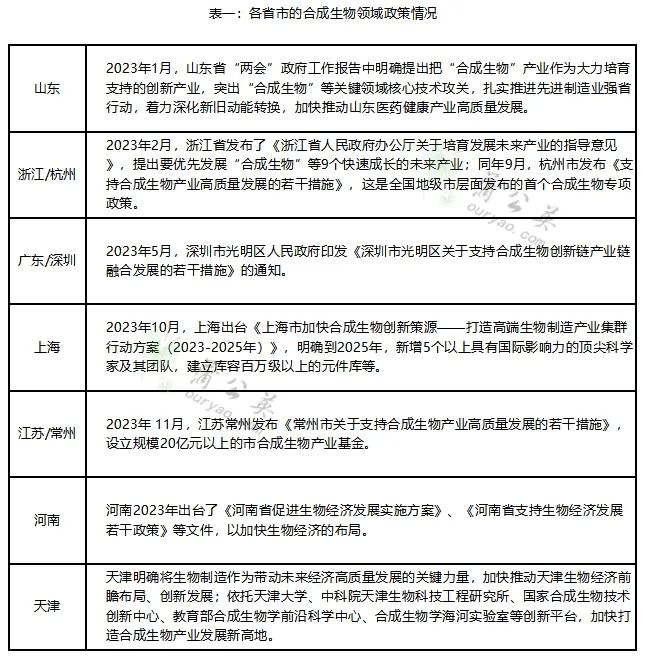
从各国的政策法规来看,2023年1月工业和信息化部等六部门印发《加快非粮生物基材料创新发展三年行动方案》,国家部委层面先后出台了8个与合成生物行业相关的政策法规,旨在推动、规范合成生物学技术的发展。省市层面,上海、浙江、广东(深圳)、山东、天津、河南等省市更是出台各种政策、优惠措施鼓励合成生物学企业的落户与发展,尤其是长三角和珠三角地区尤为前瞻和突进,各省市的政策详见表一。 数字化转型网(www.szhzxw.cn)
早在2022年9月美国白宫就发布《关于推进生物技术和生物制造创新以实现可持续、安全和可靠的美国生物经济的第14081号行政命令》,旨在推动美国合成生物技术的进步与发展。目前合成生物学领域,中国和美国不管是法规还是技术上属于齐头并进的状态。
三、技术的发展进步
从技术的发展进步来看,基因编辑和合成技术、碳中和、底盘细胞构建、复杂生物系统人工培育、AI算法等领域进步显著。
2023年3月9日Ansa Biotechnologies公司宣布成功从头合成出世界上最长的DNA寡核苷酸,该序列长达1005个碱基。
2023年,人类首次实现了重新设计并合成了真核细胞的全基因组。
2023年8月16日天津工业生物所发表由二氧化碳从头人工合成己糖的技术,该研究提出了一个多功能的化学酶路线图,打开了化学加生物技术人工合成复杂天然分子的产业化应用的可能路径。
2023年6月,来自英国、美国、中国、以色列的多个研究团队在“人工创造人类胚胎模型”上的突破性进展:采用不同的策略方法,科学家们实现了在无需精子和卵子的情况下,完全利用人类干细胞,在体外制造出与人类胚胎十分类似的组织结构。 数字化转型网(www.szhzxw.cn)
四、存在的问题
2023年8月10日,合成生物学开山鼻祖Amyris宣布,Amyris及其美国子公司已根据美国破产法第11章申请破产,并计划出售其消费品牌,以改善公司的流动资金状况。这样预示着在合成生物学领域的创业项目还存在巨大的风险和不确定性。
当下存在的主要问题有:
可进行产业化的品种有限导致同质竞争严重,大部分合成生物学企业都布局于化妆品原料、保健食品原料等品种,内卷厉害;;
不少项目的技术水平离产业化距离较远;
法规与安全问题,人造肉等全新技术制造出来的产品的安全性以及与此相关的法律法规的建立和完善还有很长的路要走。 数字化转型网(www.szhzxw.cn)
小结
在未来的5-10年乃至更长的时间里,合成生物学等生物技术将大大推动行业和经济的发展。生物技术的发展和产业生产技术的转型,是应对和解决气候变化、粮食安全、能源独立性和环境可持续性等重大挑战的有效途径。合成生物技术将极大的推动农业、食品、材料、能源和制药等行业转型与发展。据预测,2028年合成生物产业产值将达到370亿美元,2030年将达到1000亿美元。
翻译:
2023 Synthetic Biology industry inventory
2023, in China and the developed economies of Europe and the United States, is a year of vigorous development of synthetic biology industry.
1. Investment and financing
From the perspective of investment and financing, there are more than 80 corporate projects related to synthetic biology in China, with the financing amount of a single project ranging from tens of millions to billions, and the total investment amount of more than 20 billion yuan, among which the largest financing project is the “strategic cooperation in the development of a series of bio-based polyamide materials” project of Kaisai Biology, reaching 6.6 billion yuan. This shows that investment in the synthetic biology industry is still hot.
Most of these funded projects are in Shanghai, Zhejiang, Guangdong, Beijing, Shandong, Hunan and other regions, which are the highlands of innovation and entrepreneurship in the field of synthetic biology in China. These projects cover many fields such as flavors and fragrances, health food, biomedicine, artificial meat, AI+ synthetic biology, bulk chemicals, process equipment, instruments and equipment, showing a wide range of application scenarios and broad market demand for synthetic biology technology.
According to incomplete statistics, there are also more than 30 projects involving synthetic biology abroad, with a total investment of more than $3 billion, of which the largest financing is the Integrated Development and Manufacturing Organization (IDMO), headquartered in South San Francisco, California, dedicated to clinical and industrial scale cell therapy manufacturing Cellares company. Raised $255 million in Series C funding. 数字化转型网(www.szhzxw.cn)
2. Policies and Regulations
From the perspective of policies and regulations of various countries, in January 2023, six departments including the Ministry of Industry and Information Technology issued the Three-year Action Plan to accelerate the Innovation and development of Non-food bio-based materials, and eight policies and regulations related to the synthetic biology industry have been introduced at the level of national ministries and commissions, aiming to promote and standardize the development of synthetic biology technology. At the provincial and municipal level, Shanghai, Zhejiang, Guangdong (Shenzhen), Shandong, Tianjin, Henan and other provinces and cities have introduced various policies and preferential measures to encourage the settlement and development of synthetic biology enterprises, especially in the Yangtze River Delta and Pearl River Delta regions. The policies of each province and city are shown in Table 1.
As early as September 2022, the White House issued Executive Order 14081 on Advancing Biotechnology and Biofutrition Innovation to Achieve a Sustainable, Safe and Reliable U.S. Bioeconomy to promote the progress and development of synthetic biotechnology in the United States. At present, in the field of synthetic biology, China and the United States are in a state of parallel regulation and technology.
3. Technological development and progress
From the perspective of technological development and progress, remarkable progress has been made in the fields of gene editing and synthesis technology, carbon neutrality, chassis cell construction, artificial cultivation of complex biological systems, and AI algorithms.
On March 9, 2023, Ansa Biotechnologies announced the successful de novo synthesis of the world’s longest DNA oligonucleotide sequence, which is 1005 bases long.
In 2023, the entire genome of a eukaryotic cell was redesigned and synthesized for the first time.
On August 16, 2023, Tianjin Institute of Industrial Biology published the technology of de novo synthesis of hexose from carbon dioxide, which proposed a multifunctional chemical enzyme roadmap and opened the possible path of industrial application of synthetic synthesis of complex natural molecules by chemical and biological technologies.
In June 2023, a number of research teams from the United Kingdom, the United States, China and Israel made a breakthrough in the “artificial creation of human embryo model” : using different strategies and methods, scientists achieved the complete use of human stem cells without the need for sperm and eggs, and created a very similar tissue structure with human embryos in vitro.
4. Existing problems
On August 10, 2023, Amyris, the founder of synthetic biology, announced that Amyris and its U.S. subsidiary have filed for Chapter 11 bankruptcy and plan to sell its consumer brands to improve the company’s liquidity position. This indicates that entrepreneurial projects in the field of synthetic biology still have huge risks and uncertainties. 数字化转型网(www.szhzxw.cn)
The main problems currently exist are:
Limited varieties that can be industrialized lead to serious homogeneous competition, most synthetic biology companies are distributed in cosmetics raw materials, health food raw materials and other varieties, the internal volume is strong;
The technical level of many projects is far from industrialization;
Regulations and safety issues, the safety of products made by new technologies such as artificial meat, and the establishment and improvement of relevant laws and regulations still have a long way to go.
Brief summary
In the next 5-10 years and beyond, biotechnologies such as synthetic biology will greatly boost the industry and the economy. The development of biotechnology and the transformation of industrial production technologies are effective ways to address and solve major challenges such as climate change, food security, energy independence and environmental sustainability. Synthetic biotechnology will greatly promote the transformation and development of agriculture, food, materials, energy and pharmaceutical industries. It is predicted that the output value of the synthetic biology industry will reach $37 billion in 2028 and $100 billion in 2030. 数字化转型网(www.szhzxw.cn)
本文由数字化转型网(www.szhzxw.cn)转载而成,来源于尚科生物;编辑/翻译:数字化转型网宁檬树。

免责声明: 本网站(http://www.szhzxw.cn/)内容主要来自原创、合作媒体供稿和第三方投稿,凡在本网站出现的信息,均仅供参考。本网站将尽力确保所提供信息的准确性及可靠性,但不保证有关资料的准确性及可靠性,读者在使用前请进一步核实,并对任何自主决定的行为负责。本网站对有关资料所引致的错误、不确或遗漏,概不负任何法律责任。
本网站刊载的所有内容(包括但不仅限文字、图片、LOGO、音频、视频、软件、程序等) 版权归原作者所有。任何单位或个人认为本网站中的内容可能涉嫌侵犯其知识产权或存在不实内容时,请及时通知本站,予以删除。