导读
当前,新质生产力成为中国经济的高频词汇,市场对于新质生产力的讨论层出不绝。
“新质生产力”首次写入中国政府工作报告,并被列为2024年十大工作任务的首位。
本文我们以“新质生产力”为研究对象,为大家深刻剖析新质生产力的概念、内涵以及相关产业与市场机遇。
一、概念及内涵
1、新质生产力的定义与内涵
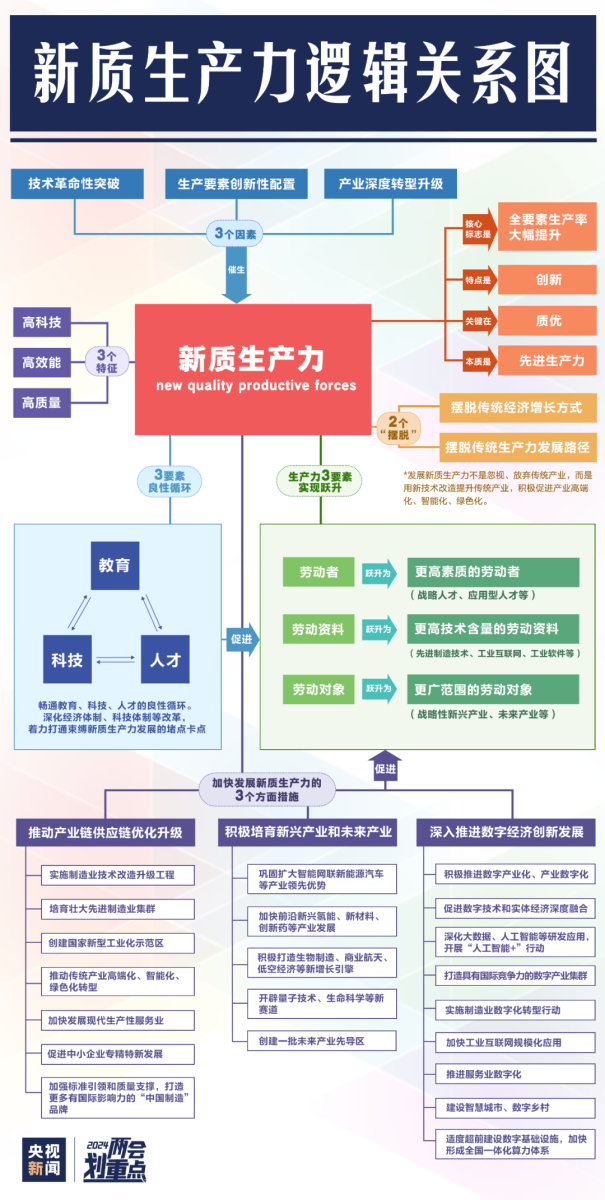
定义:新质生产力是由技术革命性突破、生产要素创新性配置、产业深度转型升级而催生的当代先进生产力,它以劳动者、劳动资料、劳动对象及其优化组合的质变为基本内涵,以全要素生产率提升为核心标志。 数字化转型网(www.szhzxw.cn)
培育新质生产力的内涵:一是打造新型劳动者队伍;二是用好新型生产工具;三是塑造适应新质生产力的生产关系。
新技术与产业的外延:在关键性、颠覆性技术突破中,注重与新一代信息技术、新能源、新材料、先进制造、生物技术等战略性新兴产业,人工智能、量子信息、脑机接口、卫星互联网、人形机器人等未来产业创新结合。
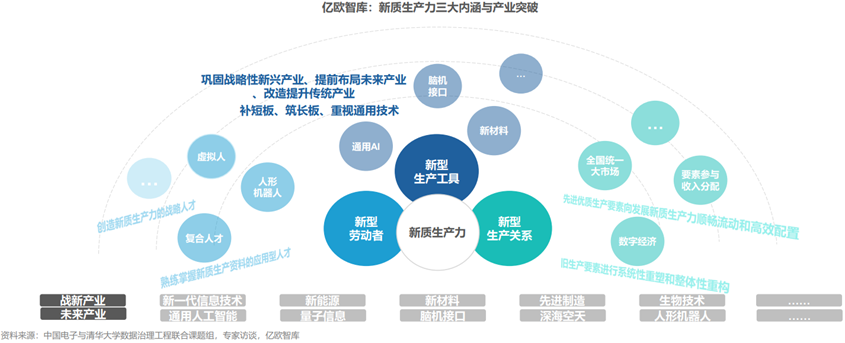
2、新质生产力主要包括战略新兴产业以及未来产业两大内容
新质生产力是创新起主导作用,摆脱传统经济增长方式、生产力发展路径,具有高科技、高效能、高质量特征,符合新发展理念的先进生产力质态。它由技术革命性突破、生产要素创新性配置、产业深度转型升级而催生,以劳动者、劳动资料、劳动对象及其优化组合的跃升为基本内涵,以全要素生产率大幅提升为核心标志,特点是创新,关键在质优,本质是先进生产力。
其核心要义是通过整合科技创新资源,积极培育战略性新兴产业,前瞻布局未来产业,开辟发展新领域新赛道,塑造发展新动能新优势。 数字化转型网(www.szhzxw.cn)
从行业属性来看,一切利用新技术提升生产力水平的细分领域,都属于新质生产力的应用范畴,既包括新一代信息技术、新能源、新材料、先进制造、生物技术等战略性新兴产业,也包括人工智能、量子信息、工业互联网、卫星互联网、机器人等未来产业。
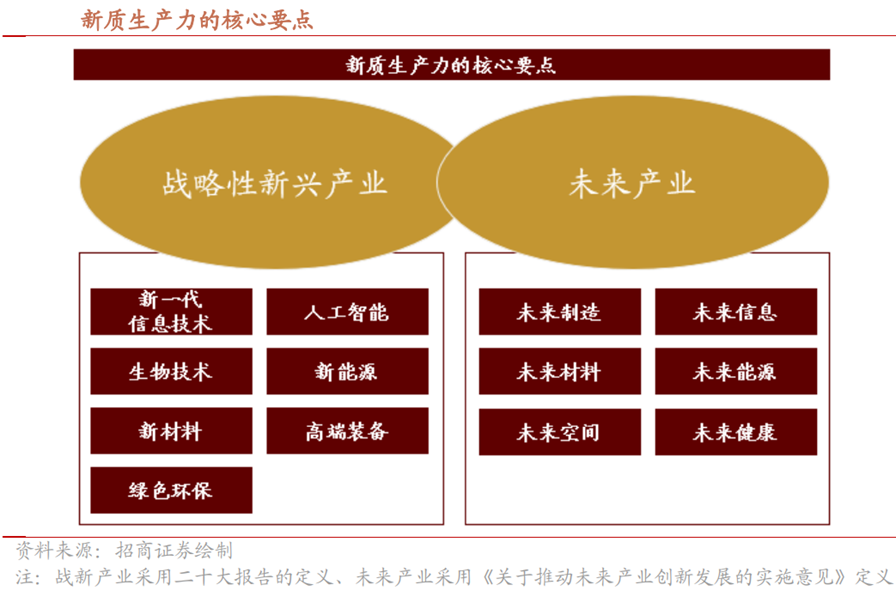
●战略性新兴产业:根据最新定义,战略性新兴产业主要包含新一代信息技术、人工智能、生物技术、新能源、新材料、高端装备、绿色环保等领域。 数字化转型网(www.szhzxw.cn)
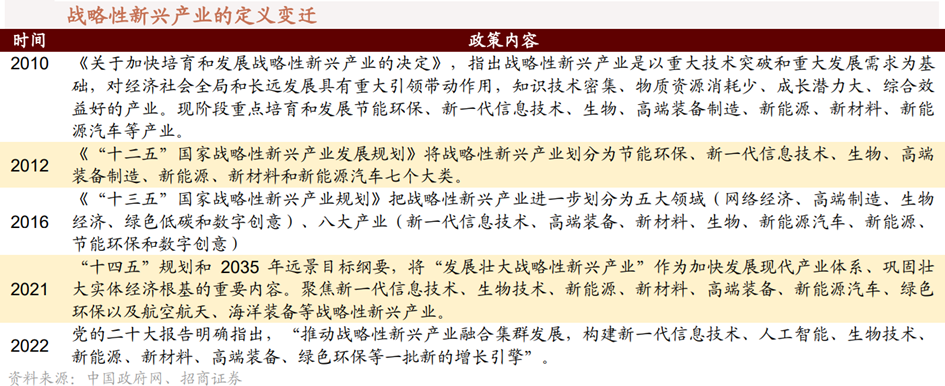
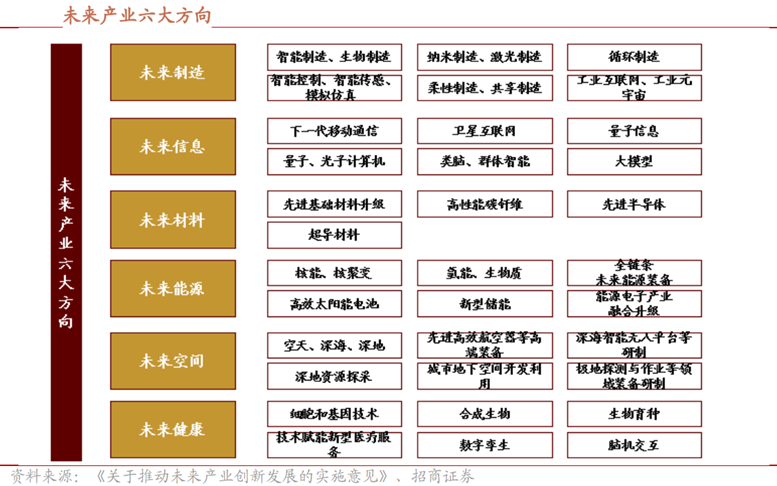
●未来产业:1月29日,7部门联合发布《关于推动未来产业创新发展的实施意见》,其中提出“要重点推进未来制造、未来信息、未来材料、未来能源、未来空间和未来健康六大方向产业发展。”
3、硬科技是新质生产力核心,已逐步被国家提升至战略层面重点部署
加速硬科技发展是发展新质生产力的关键。硬科技概念由中国科学院西安光机所光学博士米磊于2010年正式提出后,经过10年的萌芽、孕育和发展,当前已经上升到国家话语体系,其内涵也在不断的丰富迭代。
硬科技是指基于科学发现和技术发明之上,需要长期研发投入、持续积累形成的,具有较高技术门槛和明确应用场景,难以被复制和模仿,对经济社会发展具有重大支撑作用的关键核心技术。硬科技处于全球价值链的高端环节,具有高知识产权壁垒、高资本投入、高信息密集度、高产品附加值、高产业控制力等特点,是衡量一个国家核心竞争力的重要标志,是核心技术和高技术的典型代表。代表性领域共包含光电芯片、人工智能、航空航天、生物技术、信息技术、新材料、新能源、智能制造等八大新兴科技领域。
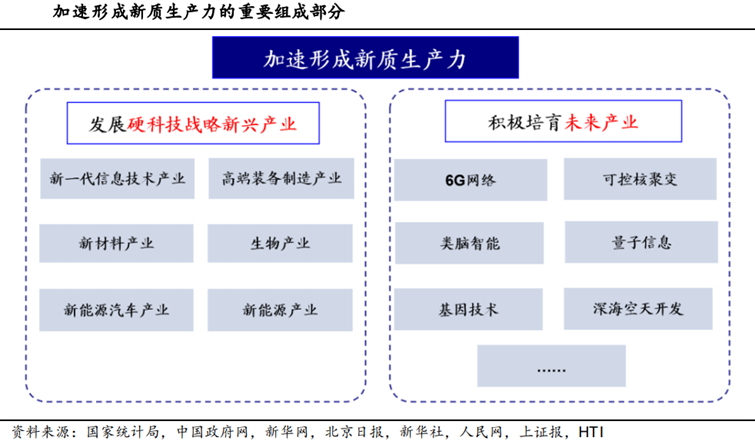
新质生产力的核心在于整合科技创新资源,一方面引领发展战略性新兴产业,国家统计局发布的《战略性新兴产业分类(2018)》中有新一代信息技术产业、高端装备制造产业、新材料产业、生物产业、新能源汽车产业、新能源产业六大产业和硬科技的概念不谋而合;另一方面积极培育未来产业,在6G网络、可控核聚变、类脑智能、量子信息、基因技术、深海空天开发等前沿科技和产业变革领域赢得发展主动权,从而以硬科技创新带动新经济增长点不断涌现。 数字化转型网(www.szhzxw.cn)
二、产业布局与市场机遇
1、“新质生产力”指引下的市场机遇
今年的政府工作报告中提出,大力推进现代化产业体系建设,加快发展新质生产力。习近平在参加江苏代表团审议时强调,要牢牢把握高质量发展这个首要任务,因地制宜发展新质生产力。
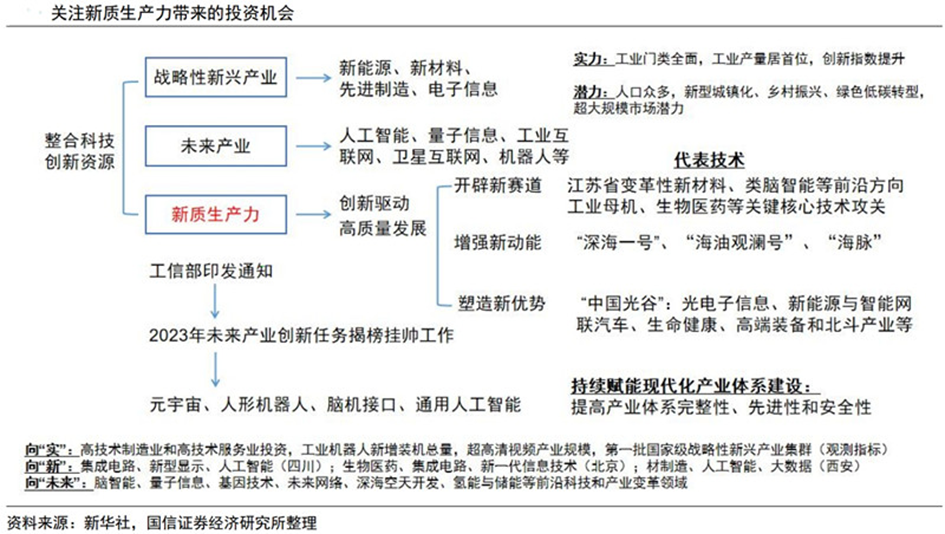
发展新质生产力要以科技创新引领产业全面振兴。要立足现有产业基础,扎实推进先进制造业高质量发展,加快推动传统制造业升级,发挥科技创新的增量器作用,全面提升三次产业,不断优化经济结构、调整产业结构。整合科技创新资源,引领发展战略性新兴产业和未来产业,加快形成新质生产力。
战略新兴产业(新能源、新材料、先进制造、电子信息)、未来产业(人工智能、量子计算、工业互联网、卫星互联网、机器人等)将在新时期释放出发展红利,具有较好的市场发展机遇。
2、产业布局
根据政府发布相关文件,我们将分别对相关产业布局方向进行细致梳理,以帮助大家更详细地了解在新质生产力指以下新兴产业与未来产业具体的市场布局方向。
(1)新兴产业布局方向
一是新一代信息技术,主要包括第五代移动通信(5G)、电子信息制造、软件和新兴数字领域。《实施方案》指出:新一代信息技术主要面向重点场景和行业应用,优化完善5G标准。研制集成电路、基础器件、能源电子、超高清视频、虚拟现实等电子信息标准。研制基础软件、工业软件、应用软件等软件标准。研制大数据、物联网、算力、云计算、人工智能、区块链、工业互联网、卫星互联网等新兴数字领域标准。
二是新能源,主要包括新能源发电、新能源并网和新能源关键设备。《实施方案》指出:新能源主要是研制光伏发电、光热发电、风力发电等新能源发电标准,优化完善新能源并网标准,研制光储发电系统、光热发电系统、风电装备等关键设备标准。 数字化转型网(www.szhzxw.cn)
三是新材料,主要包括先进石化化工材料、先进钢铁材料、先进有色及稀土材料、先进无机非金属材料、高性能纤维及制品和高性能纤维复合材料。《实施方案》指出:新材料主要是研制先进石化化工材料、先进钢铁材料、先进有色金属及稀土材料、先进无机非金属材料、高性能纤维及制品和高性能纤维复合材料标准。面向产业融合发展需求和应用场景探索,开展前沿新材料标准预研。
四是高端装备,主要包括工业机器人、高端数控机床、农机装备、工程机械、医疗装备、智能检测装备和增材制造装备。《实施方案》指出:高端装备主要是研制工业机器人基础共性、关键技术和行业应用标准。研制高端数控机床关键共性技术、整机、数字化控制与核心部件标准。研制农机装备基础通用、关键技术以及高端化智能化绿色化标准。研制工程机械基础通用、关键材料、核心部件、电动化以及高端化智能化绿色化标准。研制医疗装备关键材料、核心部件、运行服务与集成应用标准。研制智能检测装备基础、关键技术和互联互通标准。研制增材制造装备核心工艺和部件、关键技术、测试评估等标准。研制装备数字化和智能制造基础共性、关键技术、典型行业应用等标准。
五是新能源汽车,主要包括新能源汽车整车、关键部件系统、核心元器件、智能网联技术和充换电基础设施。《实施方案》指出:主要聚焦新能源汽车领域,研制动力性测试、安全性规范、经济性评价等整车标准,驱动电机系统、动力蓄电池系统、燃料电池系统等关键部件系统标准,汽车芯片、传感器等核心元器件标准,自动驾驶系统、功能安全、信息安全等智能网联技术标准,以及传导充电、无线充电、加氢等充换电基础设施相关标准。
六是绿色环保,主要包括碳达峰碳中和、绿色制造、工业节能、工业节水、工业环保和工业资源综合利用。《实施方案》指出:绿色环保主要聚焦实现碳达峰碳中和目标,研制温室气体基础通用、核算核查、技术与装备、监测、管理与评价标准。优化完善绿色产品、绿色工厂、绿色工业园区和绿色供应链等标准。研制工业节能、工业节水、工业环保、工业资源综合利用等标准。
七是民用航空,主要包括航空器、发动机、机载系统和通用基础与运营支持。《实施方案》指出:民用航空主要聚焦研制商用飞机、水陆两栖飞机、直升机、无人机以及新动力、新构型航空器等航空器标准。研制整机、关键重要部件、适航符合性、客户服务等发动机标准。研制航空电子系统、飞行控制系统与机电系统等机载系统标准。研制基础产品、全生命周期数据、生产制造等航空通用基础标准,以及运营支持标准。 数字化转型网(www.szhzxw.cn)
八是船舶与海洋工程装备,主要包括高技术船舶和海洋工程装备。《实施方案》指出:船舶与海洋工程装备主要聚焦高技术船舶领域,研制重点船型总体设计、总装建造标准,关键零部件和系统标准,以及绿色管理标准。聚焦海洋工程装备领域,研制总体设计、总装建造、关键系统标准,研制潜水器标准。
(2)未来产业布局方向
一是元宇宙。《实施方案》指出:开展元宇宙标准化路线图研究。加快研制元宇宙术语、分类、标识等基础通用标准,元宇宙身份体系、数字内容生成、跨域互操作、技术集成等关键技术标准,虚拟数字人、数字资产流转、数字内容确权、数据资产保护等服务标准,开展工业元宇宙、城市元宇宙、商业元宇宙、文娱元宇宙等应用标准研究,以及隐私保护、内容监管、数据安全等标准预研。
二是脑机接口。《实施方案》指出:开展脑机接口标准化路线图研究。加快研制脑机接口术语、参考架构等基础共性标准。开展脑信息读取与写入等输入输出接口标准,数据格式、传输、存储、表示及预处理标准,脑信息编解码算法标准研究。开展制造、医疗健康、教育、娱乐等行业应用以及安全伦理标准预研。
三是量子信息。《实施方案》指出:开展量子信息技术标准化路线图研究。加快研制量子信息术语定义、功能模型、参考架构、基准测评等基础共性标准。聚焦量子计算领域,研制量子计算处理器、量子编译器、量子计算机操作系统、量子云平台、量子人工智能、量子优化、量子仿真等标准。聚焦量子通信领域,研制量子通信器件、系统、网络、协议、运维、服务、测试等标准。聚焦量子测量领域,研制量子超高精度定位、量子导航和授时、量子高灵敏度探测与目标识别等标准。
四是人形机器人。《实施方案》指出:研制人形机器人术语、通用本体、整机结构、社会伦理等基础标准。开展人形机器人专用结构零部件、驱动部件、机电系统零部件、控制器、高性能计算芯片及模组、能源供给组件等基础标准预研。研制人形机器人感知系统、定位导航、人机交互、自主决策、集群控制等智能感知决策和控制标准。开展人形机器人运动、操作、交互、智能能力分级分类与性能评估等系统评测标准预研。开展机电系统、人机交互、数据隐私等安全标准预研。面向工业、家庭服务、公共服务、特种作业等场景,开展人形机器人应用标准预研。 数字化转型网(www.szhzxw.cn)
五是生成式人工智能。《实施方案》指出:围绕多模态和跨模态数据集,研制视频、图像、语言、语音等数据集和语料库的标注要求、质量评价、管理能力、开源共享、交易流通等基础标准。围绕大模型关键技术领域,研制通用技术要求、能力评价指标、参考架构,以及训练、推理、部署、接口等技术标准。围绕基于生成式人工智能(AIGC)的应用及服务,面向应用平台、数据接入、服务质量及应用可信等重点方向,研制AIGC模型能力、服务平台技术要求、应用生态框架、服务能力成熟度评估、生成内容评价等应用标准。在工业、医疗、金融、交通等重点行业开展AIGC产品及服务的风险管理、伦理符合等标准预研。
六是生物制造。《实施方案》指出:研制传感器等关键元器件,生物反应器等生产设备,生产技术规范等工艺标准。优化完善生物制造食品、药品、精细化学品等应用领域的产品、检测和评价方法等标准。
七是未来显示。《实施方案》指出:开展量子点显示、全息显示、视网膜显示等先进技术标准预研。研制Micro-LED显示、激光显示、印刷显示等关键技术标准,新一代显示材料、专用设备、工艺器件等关键产品标准,以及面向智慧城市、智能家居、智能终端等场景的应用标准。
八是未来网络。开展6G基础理论、愿景需求、典型应用、关键能力等标准预研。面向下一代互联网升级演进,构建“IPv6+”技术标准体系,开展分段路由(SRv6)、应用感知网络(APN6)、随路检测(iFit)等核心技术标准研制;面向产业数字化转型紧迫需求,加快确定性网络、数字孪生网络、算网融合/算力网络、自智网络、网络内生安全等关键网络技术标准研制;面向海空天地一体化、高通量全息通信、海量人机物通信等新场景,开展新型网络体系结构、路由协议、智能管控等标准预研。开展Web3.0相关标准预研,研制术语、参考架构等基础类标准,跨链技术要求、分布式数字身份分发等技术类标准,以及面向数据资产交易、数字身份认证、数字藏品管理等场景的应用类标准。九是新型储能。聚焦锂离子电池领域,研制电池碳足迹、溯源管理等基础通用标准,正负极材料、保护器件等关键原材料及零部件标准,以及回收利用标准。面向钠离子电池、氢储能/氢燃料电池、固态电池等新型储能技术发展趋势,加快研究术语定义、运输安全等基础通用标准,便携式、小型动力、储能等电池产品标准。
翻译:
New quality productivity-related industries and market opportunities in-depth review
Introduction
At present, the new quality productivity has become a high-frequency word in China’s economy, and the market has been constantly discussing the new quality productivity.
“New quality productivity” was written into the Chinese government work report for the first time, and was listed as the top ten work tasks for 2024.
In this paper, we take “new quality productivity” as the research object, and deeply analyze the concept and connotation of new quality productivity as well as related industries and market opportunities.
First, concept and connotation
1. Definition and connotation of new quality productivity
Definition: The new quality productivity is the modern advanced productivity that is generated by the revolutionary breakthrough of technology, the innovative allocation of production factors, and the deep transformation and upgrading of industries. It takes the qualitative change of labor, labor means, labor objects and their optimal combination as its basic connotation, and the improvement of total factor productivity as its core symbol.
The connotation of cultivating new quality productivity: first, to build a new type of labor force; Second, make good use of new production tools; The third is to shape the production relations that adapt to the new quality of productive forces.
Extension of new technologies and industries: In the key and disruptive technological breakthroughs, focus on the combination of new generation information technology, new energy, new materials, advanced manufacturing, biotechnology and other strategic emerging industries, artificial intelligence, quantum information, brain-computer interface, satellite Internet, humanoid robots and other future industrial innovation. 数字化转型网(www.szhzxw.cn)
2. New quality productivity mainly includes two major contents: strategic emerging industries and future industries
The new quality productivity is an advanced productivity quality that plays a leading role in innovation, gets rid of the traditional economic growth mode and productivity development path, and has the characteristics of high technology, high efficiency and high quality, and is in line with the new development concept. It is driven by revolutionary technological breakthroughs, innovative allocation of production factors, and deep industrial transformation and upgrading. It takes the improvement of workers, labor materials, labor objects and their optimal combinations as its basic connotation, and a substantial increase in total factor productivity as its core symbol. It is characterized by innovation, the key is high quality, and the essence is advanced productivity.
Its core essence is to actively cultivate strategic emerging industries through the integration of scientific and technological innovation resources, forward-looking layout of future industries, open up new fields and new tracks for development, and shape new momentum and new advantages for development.
From the perspective of industry attributes, all the subdivisions that use new technologies to improve the level of productivity belong to the application category of new quality productivity, including strategic emerging industries such as new generation information technology, new energy, new materials, advanced manufacturing, and biotechnology, as well as future industries such as artificial intelligence, quantum information, industrial Internet, satellite Internet and robotics.
Strategic emerging industries: According to the latest definition, strategic emerging industries mainly include the new generation of information technology, artificial intelligence, biotechnology, new energy, new materials, high-end equipment, green environmental protection and other fields.
● Future industry: On January 29, seven departments jointly issued the “Implementation Opinions on Promoting the Innovation and Development of Future Industries”, which proposed that “we should focus on promoting the development of six major industrial directions: future manufacturing, future information, future materials, future energy, future space and future health.”
3. Fard science and technology is the core of new quality productivity, has been gradually promoted by the state to the strategic level of key deployment
Accelerating the development of hard science and technology is the key to developing new quality productivity. After the concept of hard science and technology was formally proposed by Dr. Mi Lei of Xi ‘an Institute of Optics and Machinery of the Chinese Academy of Sciences in 2010, after 10 years of germination, gestation and development, it has now risen to the national discourse system, and its connotation is constantly enriched and iterated. 数字化转型网(www.szhzxw.cn)
Hard technology refers to the key core technologies based on scientific discoveries and technological inventions, which require long-term R&D investment and continuous accumulation, have a high technical threshold and clear application scenarios, are difficult to be copied and imitated, and have a major supporting role for economic and social development. Hard technology is located in the high-end link of the global value chain, with high intellectual property barriers, high capital investment, high information intensity, high added value of products, high industrial control and other characteristics, is an important indicator of a country’s core competitiveness, is a typical representative of core technology and high technology. The representative fields include photoelectric chips, artificial intelligence, aerospace, biotechnology, information technology, new materials, new energy, intelligent manufacturing and other eight emerging science and technology fields.
The core of new quality productivity lies in the integration of scientific and technological innovation resources. On the one hand, it leads the development of strategic emerging industries. In the “Classification of Strategic Emerging Industries (2018)” issued by the National Bureau of Statistics, there are six industries, namely the new generation information technology industry, high-end equipment manufacturing industry, new material industry, biological industry, new energy automobile industry and new energy industry, which coincide with the concept of hard science and technology. On the other hand, we will actively cultivate future industries, and win the development initiative in cutting-edge technologies and industrial transformation fields such as 6G network, controlled nuclear fusion, brain-like intelligence, quantum information, gene technology, deep sea, air and space development, so as to drive new economic growth points with hard scientific and technological innovation.
Second, industrial layout and market opportunities
1. Market opportunities under the guidance of “New quality productivity”
In this year’s government work report, we proposed to vigorously promote the construction of a modern industrial system and accelerate the development of new quality productive forces.
To develop new quality productive forces, scientific and technological innovation should lead the all-round revitalization of industries. Based on the existing industrial foundation, we should solidly promote the high-quality development of advanced manufacturing, accelerate the upgrading of traditional manufacturing, give full play to the role of scientific and technological innovation as an extender, comprehensively upgrade the three industries, and constantly optimize the economic structure and adjust the industrial structure. We will integrate scientific and technological innovation resources, lead the development of strategic emerging industries and future industries, and accelerate the formation of new quality productivity. 数字化转型网(www.szhzxw.cn)
Strategic emerging industries (new energy, new materials, advanced manufacturing, electronic information) and future industries (artificial intelligence, quantum computing, industrial Internet, satellite Internet, robots, etc.) will release development dividends in the new era and have good market development opportunities.
2. Industrial layout
According to the relevant documents issued by the government, we will carefully sort out the layout direction of the relevant industries to help you understand in more detail the specific market layout direction of the following emerging industries and future industries in the new quality productivity.
(1) Layout direction of emerging industries
The first is the new generation of information technology, which mainly includes the fifth generation of mobile communications (5G), electronic information manufacturing, software and the emerging digital field. The “Implementation Plan” pointed out that the new generation of information technology is mainly for key scenarios and industrial applications, and the optimization and improvement of 5G standards. Develop electronic information standards such as integrated circuits, basic devices, energy electronics, ultra high-definition video, virtual reality, etc. Development of basic software, industrial software, application software and other software standards. Developing standards in emerging digital fields such as big data, Internet of Things, computing power, cloud computing, artificial intelligence, blockchain, industrial Internet, and satellite Internet. 数字化转型网(www.szhzxw.cn)
The second is new energy, mainly including new energy power generation, new energy grid connection and new energy key equipment. The “Implementation Plan” pointed out that: new energy is mainly to develop photovoltaic power generation, solar thermal power generation, wind power generation and other new energy generation standards, optimize and improve new energy grid-connected standards, and develop light storage power generation systems, solar thermal power generation systems, wind power equipment and other key equipment standards.
The third is new materials, mainly including advanced petrochemical and chemical materials, advanced iron and steel materials, advanced nonferrous and rare earth materials, advanced inorganic non-metallic materials, high-performance fibers and products and high-performance fiber composite materials. The Implementation Plan pointed out that the new materials mainly include the development of advanced petrochemical and chemical materials, advanced steel materials, advanced non-ferrous metals and rare earth materials, advanced inorganic non-metallic materials, high-performance fibers and products, and high-performance fiber composite materials standards. Facing the needs of industrial integration and development and the exploration of application scenarios, pre-research on cutting-edge new material standards is carried out.
The fourth is high-end equipment, mainly including industrial robots, high-end CNC machine tools, agricultural machinery equipment, construction machinery, medical equipment, intelligent testing equipment and additive manufacturing equipment. The “Implementation plan” pointed out that high-end equipment is mainly to develop the basic commonalities, key technologies and industry application standards of industrial robots. Develop key common technology, complete machine, digital control and core component standards for high-end CNC machine tools. The development of agricultural machinery and equipment basic general, key technologies and high-end intelligent green standards. Development of construction machinery basic general, key materials, core components, electrification and high-end intelligent green standards. Develop medical equipment key materials, core components, operation services and integrated application standards. We will develop the basis for intelligent testing equipment, key technologies and connectivity standards. Develop standards for core processes and components, key technologies, testing and evaluation of additive manufacturing equipment. Development of equipment digitization and intelligent manufacturing basic commonalities, key technologies, typical industry applications and other standards. 数字化转型网(www.szhzxw.cn)
The fifth is new energy vehicles, mainly including new energy vehicles, key component systems, core components, intelligent network technology and charging and replacement infrastructure. The Implementation Plan states: It mainly focuses on the field of new energy vehicles, and develops vehicle standards such as power testing, safety specifications, and economic evaluation; system standards for key components such as drive motor systems, power battery systems, and fuel cell systems; standards for core components such as automotive chips and sensors; and intelligent networking technology standards such as automatic driving systems, functional safety, and information security. And conduction charging, wireless charging, hydrogenation and other charging infrastructure related standards.
The sixth is green environmental protection, mainly including carbon peak carbon neutrality, green manufacturing, industrial energy saving, industrial water saving, industrial environmental protection and comprehensive utilization of industrial resources. The “Implementation plan” pointed out that: green environmental protection mainly focuses on achieving the goal of carbon peak carbon neutrality, and the development of greenhouse gas basic general, accounting verification, technology and equipment, monitoring, management and evaluation standards. We will improve standards for green products, green factories, green industrial parks and green supply chains. To develop standards for industrial energy conservation, industrial water conservation, industrial environmental protection, and comprehensive utilization of industrial resources.
The seventh is civil aviation, which mainly includes aircraft, engines, airborne systems and general infrastructure and operational support. “Implementation Plan” pointed out: civil aviation mainly focuses on the development of commercial aircraft, amphibious aircraft, helicopters, unmanned aerial vehicles and new power, new configuration aircraft and other aircraft standards. Develop engine standards such as complete engine, key important components, airworthiness compliance, customer service, etc. Development of airborne system standards such as avionics systems, flight control systems and electromechanical systems. Development of basic products, full life cycle data, manufacturing and other aviation general basic standards, as well as operational support standards.
Eighth, ships and Marine engineering equipment, mainly including high-tech ships and Marine engineering equipment. The “Implementation Plan” pointed out that the ship and ocean engineering equipment mainly focuses on the field of high-tech ships, and develops the overall design of key ship types, final assembly and construction standards, key parts and system standards, and green management standards. Focusing on the field of Marine engineering equipment, the development of overall design, final assembly and construction, key system standards, and the development of submersible standards. 数字化转型网(www.szhzxw.cn)
(2) Future industrial layout direction
One is the meta-universe. “Implementation Plan” pointed out: to carry out the meta-universe standardization roadmap research. We will speed up the development of basic universal standards for meta universe terminology, classification, and identification; key technical standards for meta universe identity system, digital content generation, cross-domain interoperability, and technology integration; and service standards for virtual digital people, digital asset transfer, digital content rights verification, and data asset protection. Research on applied standards such as industrial meta-universe, urban meta-universe, commercial meta-universe, and cultural and entertainment meta-universe, as well as pre-research on standards such as privacy protection, content supervision, and data security.
The second is brain-computer interface. The “Implementation Plan” pointed out that the roadmap of brain-computer interface standardization should be studied. Accelerate the development of brain-computer interface terminology, reference architecture and other basic common standards. Research on input-output interface standards such as brain information reading and writing, data format, transmission, storage, representation and preprocessing standards, and brain information encoding and decoding algorithm standards. To carry out manufacturing, medical health, education, entertainment and other industry applications and safety ethics standards. 数字化转型网(www.szhzxw.cn)
The third is quantum information. The “Implementation Plan” pointed out that the standardization roadmap of quantum information technology should be studied. Accelerate the development of basic common standards such as quantum information term definition, functional model, reference framework, benchmark evaluation and so on. Focusing on the field of quantum computing, we will develop standards such as quantum computing processors, quantum compilers, quantum computer operating systems, quantum cloud platforms, quantum artificial intelligence, quantum optimization, and quantum simulation. Focusing on the field of quantum communication, the development of quantum communication devices, systems, networks, protocols, operation and maintenance, service, testing and other standards. Focusing on the field of quantum measurement, standards such as quantum ultra-precision positioning, quantum navigation and timing, quantum high-sensitivity detection and target recognition are developed.
Four are humanoid robots. “Implementation Plan” pointed out: the development of humanoid robot terminology, general ontology, machine structure, social ethics and other basic standards. Preresearch on basic standards for humanoid robot special structural components, drive components, electromechanical system components, controllers, high-performance computing chips and modules, energy supply components, etc. Intelligent sensing decision and control standards such as humanoid robot perception system, positioning and navigation, human-computer interaction, autonomous decision making and cluster control are developed. The system evaluation standards of humanoid robot movement, operation, interaction, intelligence ability classification and performance evaluation are pre-researched. Conduct pre-research on electromechanical systems, human-computer interaction, data privacy and other security standards. For industry, home services, public services, special operations and other scenarios, to carry out humanoid robot application standards. 数字化转型网(www.szhzxw.cn)
The fifth is generative artificial intelligence. The “Implementation Plan” points out that: around the multi-modal and cross-modal data sets, the development of video, image, language, speech and other data sets and corpus annotation requirements, quality evaluation, management capabilities, open source sharing, transaction circulation and other basic standards. Developing general technical requirements, capability evaluation indicators, reference framework, and technical standards such as training, reasoning, deployment, and interface around key technology fields of large models. Focusing on the application and service based on generative artificial intelligence (AIGC), and facing the key directions of application platform, data access, service quality and application trust, AIGC model capability, service platform technical requirements, application ecological framework, service capability maturity assessment, generated content evaluation and other application standards are developed. Conduct pre-research on risk management and ethical compliance of AIGC products and services in key industries such as industry, medical care, finance and transportation.
Six is biofabrication. The Implementation Plan points out that: the development of key components such as sensors, production equipment such as bioreactors, production technical specifications and other process standards. Optimize and improve standards for products, testing and evaluation methods in bio-manufactured food, pharmaceuticals, fine chemicals and other application fields.
Seven is the future display. The Implementation Plan pointed out that the pre-research on advanced technical standards such as quantum dot display, holographic display, and retinal display should be carried out. The development of Micro-LED display, laser display, printing display and other key technical standards, a new generation of display materials, special equipment, process devices and other key product standards, as well as for smart city, smart home, smart terminal and other scenarios of application standards. 数字化转型网(www.szhzxw.cn)
Eight is the future network. Conduct pre-research on 6G basic theory, vision needs, typical applications, key capabilities and other standards. For the next generation of Internet upgrade and evolution, the “IPv6+” technical standard system has been established, and core technical standards such as segmented routing (SRv6), application awareness network (APN6), and on-line detection (iFit) have been developed. To meet the urgent needs of industrial digital transformation, accelerate the development of key network technology standards such as deterministic network, digital twin network, computing network convergence/computing power network, self-intelligent network, and network endogenous security; For new scenarios such as the integration of sea, air and earth, high-throughput holographic communication, and massive human-machine and object communication, pre-research on standards such as new network architecture, routing protocols, and intelligent management and control has been carried out. Conduct pre-research on Web3.0 standards, develop basic standards such as terminology and reference architecture, cross-chain technical requirements, distributed digital identity distribution and other technical standards, as well as application standards for data asset trading, digital identity authentication, digital collection management and other scenarios. Nine is new energy storage. Focusing on the field of lithium-ion batteries, the development of basic general standards such as battery carbon footprint, traceability management, key raw materials and parts standards such as positive and negative electrode materials, protection devices, and recycling standards. Facing the development trend of new energy storage technologies such as sodium-ion batteries, hydrogen energy storage/hydrogen fuel cells, and solid-state batteries, we will accelerate the research on basic general standards such as term definition, transportation safety, and portable, small power, energy storage and other battery product standards.
本文由数字化转型网(www.szhzxw.cn)转载而成,来源于制造前沿;编辑/翻译:数字化转型网宁檬树。

免责声明: 本网站(https://www.szhzxw.cn/)内容主要来自原创、合作媒体供稿和第三方投稿,凡在本网站出现的信息,均仅供参考。本网站将尽力确保所提供信息的准确性及可靠性,但不保证有关资料的准确性及可靠性,读者在使用前请进一步核实,并对任何自主决定的行为负责。本网站对有关资料所引致的错误、不确或遗漏,概不负任何法律责任。
本网站刊载的所有内容(包括但不仅限文字、图片、LOGO、音频、视频、软件、程序等) 版权归原作者所有。任何单位或个人认为本网站中的内容可能涉嫌侵犯其知识产权或存在不实内容时,请及时通知本站,予以删除。