一、宏观环境逼迫石油石化行业数字化转型
全球石油石化行业宏观环境:能源需求持续增长,2021全球能源需求与2020年相比增长约4.6%;可再生能源发展迅猛,全球可再生能源发电量尤其是太阳能光伏发电和风能发电同比保持较高的增长率,2021年增长超过10%;双碳目标成发展刚需,多国都确立碳达峰碳中和目标,能源消费未来更加偏重于可再生能源。
中国石油石化行业宏观环境:中国原油对外依存度高,由于经济快速增长和国内能源供给不足,中国原油对外依存度逐年攀升,2021年超过了70%;中国国家能源战略清晰,国家提出“四个革命、一个合作”的能源安全新战略,积极推进能源生产和利用方式的变革,优化能源生产和消费结构,提高能源利用效率,建设清洁低碳、安全高效的能源体系,提高能源供给保障能力的决心。
优化能源结构布局绿色发展:企业层面,借助数字技术,企业可实时监测及管控碳排放,优化生产环节,实现能效提升、模式升级;IT层面,在双碳目标下,企业需积极利用云计算、人工智能、大数据、物联网、数字孪生等技术直接或者间接降低能耗,节约资源。
二、石油石化企业数字化转型的抓手与路线
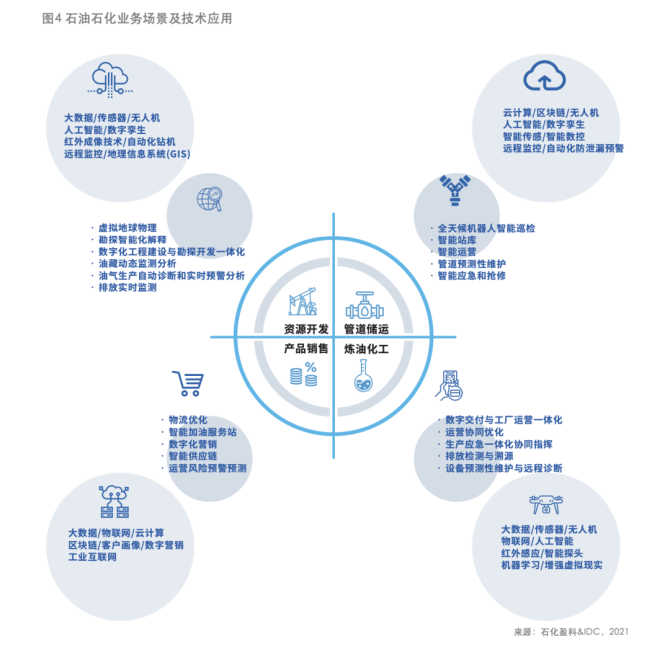
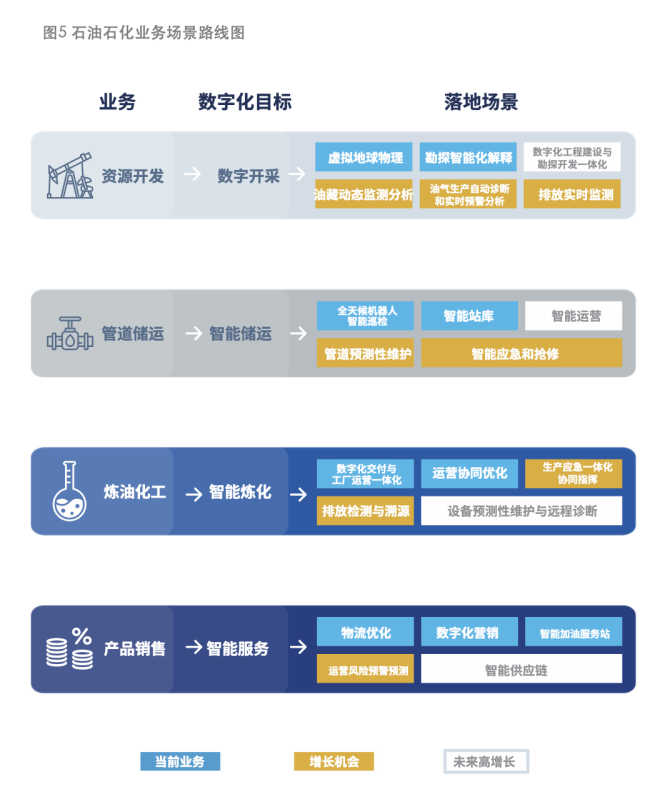
石油石化企业需要在2大领域入手数字化,一是关键业务数字化,二是运营管理数字化。关键业务数字化包括: 资源开发、 管道储运、 炼油化工 、 产品销售 。
运营管理数字化包括: 生产管控、 安全环保 、 业财融合 、 人力资源 。
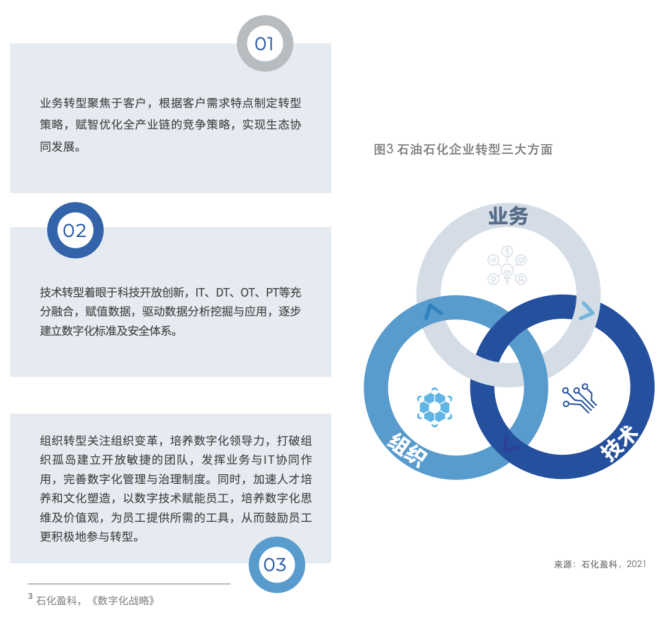
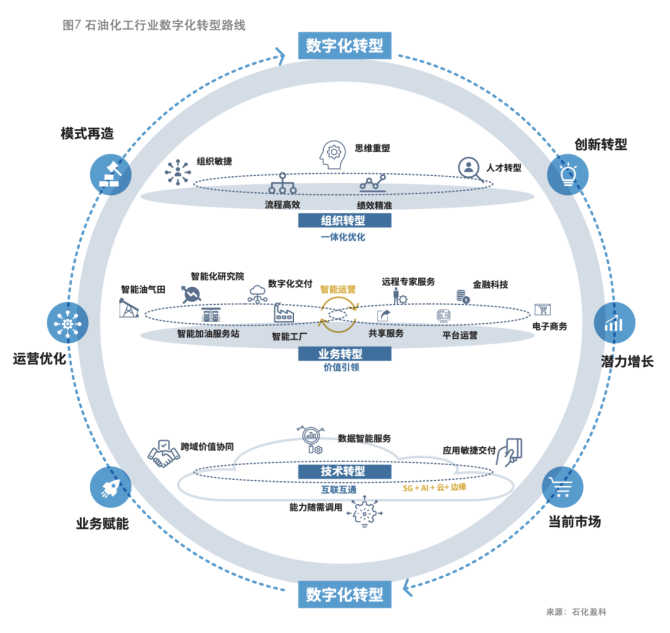
石油石化行业数字化转型应分别从业务、技术和组织三个方面展开,逐点突破并打通各环节联动性,聚焦价值链升级,形成全链条竞争战略, 构建数据驱动的开放价值生态。转型策略包括甄别重点,精准施策、树立标杆、快速推广、动态评估及持续改进等。
石油石化企业要聚焦转型场景识别业务优先级。石油石化企业希望能够通过工业信息网络来创建信息流,便于数据治理和分析供决策者使用,识别投资重点及研发方向。鉴于能源生产环节多样,确认业务场景优先级并找到发力点将决定资本投入能否 被有效利用。 对于我国的石油石化企业,短期内在现有业务中推行数字化转型充满了机遇和挑战。企业应当从以下 几个维度考量业务场景转型的优先级。
三、石油石化企业需打造的核心能力与模式
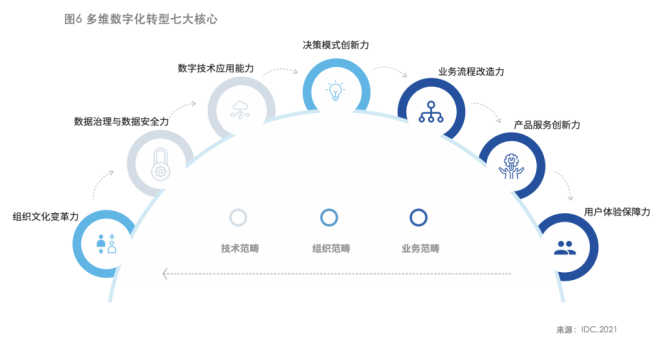
想要实现成功的数字化转型,企业必须构建自身的数字化综合能力,其中包括7个方面: 数字技术应用能力 :数字技术投入、新技术的转化能力与应用成熟度。 决策模式创新力 :管理层对数字化重视度、数字化战略的制定。 业务流程改造力 :数字化流程构建、数字化平台的构建与运营。 产品服务创新力 :生产研发的数字化、生产运行的数字化。 用户体验保障力 :客户服务的数字化、产品销售数字化。 组织文化变革力 :组织架构变革、数字人才能力构建、资产管理、安全管理数字化。 数据治理与数据安全力 :数据安全、数据治理能力。
石油石化行业数字化转型应以数据为核心,以平台为抓手,全方位、全链条推进企业高效质量变革、 效率变革、动力变革,打造高效益的开发模式,实现管理流程、运营模式的重组变革,业务运行的敏捷高效、降本增效,不断拓展产业链的价值空间,建设全新的产业协作、资源配置和价值创造体系。石油石化企业开展数字化转型要加强顶层设计,制定适合自身的转型路线,通过构建数字化平台,开展数据治理,不断释放数字价值,培育数字文化。
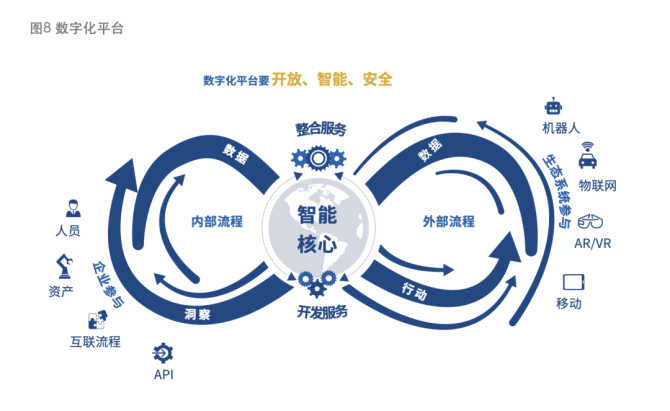
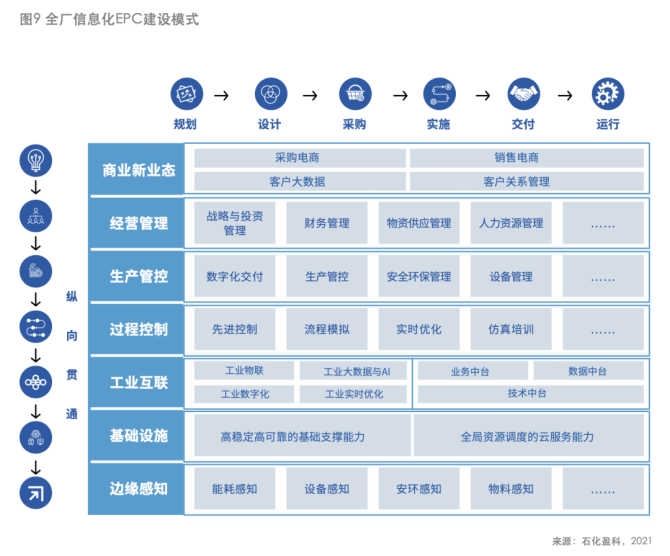
采用一体化模式加速数字化转型的进程。 经过多年实践探索,我国全厂信息化EPC模式逐渐成熟,已建成的优秀案例将为未来的项目提供借鉴 参考。炼化企业需要认识到全厂信息化EPC模式的优势,积极主动寻求合作伙伴,将工业互联网平台视为发展基石,依托数字化底座,加速建设智能工厂。
四、实践新标杆:中科炼化
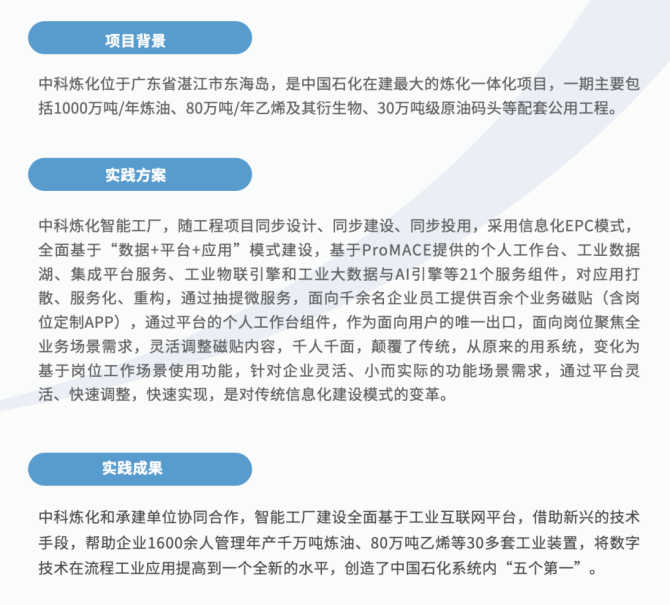
- 第一家全面基于工业互联网平台的智能工厂
- 第一家集中集成无信息孤岛的智能工厂
- 第一家开展全厂数字化交付的智能工厂
- 第一家采用EPC模式进行建设和管理的智能工厂
- 第一家建成并应用“千人千面”个人工作台实现业务协同的智能工厂
翻译:
The macro environment forces the digital transformation of the petroleum and petrochemical industry
Global oil and petrochemical industry macro environment: energy demand continues to grow, 2021 global energy demand increased by about 4.6% compared to 2020; Renewable energy is developing rapidly, and the global renewable energy generation, especially solar photovoltaic power generation and wind power generation, maintains a high growth rate year-on-year, increasing by more than 10% in 2021; The two-carbon goal has become a need for development, and many countries have established the goal of peaking carbon neutrality, and energy consumption will be more focused on renewable energy in the future.
Macro environment of China’s petroleum and petrochemical industry: China’s crude oil dependence on foreign countries is high. Due to rapid economic growth and insufficient domestic energy supply, China’s crude oil dependence on foreign countries has been rising year by year, exceeding 70% in 2021; China’s national energy strategy is clear, and the state has put forward a new energy security strategy of “four revolutions and one cooperation”, actively promoting the transformation of energy production and utilization mode, optimizing the structure of energy production and consumption, improving energy utilization efficiency, building a clean, low-carbon, safe and efficient energy system, and enhancing energy supply security capacity.
Green development: At the enterprise level, with the help of digital technology, enterprises can monitor and control carbon emissions in real time, optimize production links, and achieve energy efficiency improvement and model upgrading; At the IT level, under the dual-carbon goal, enterprises need to actively use cloud computing, artificial intelligence, big data, Internet of things, digital twins and other technologies directly or indirectly to reduce energy consumption and save resources.
The starting point and route of digital transformation of petroleum and petrochemical enterprises
Petroleum and petrochemical enterprises need to start digitization in two major areas, one is the digitalization of key business, and the other is the digitalization of operation management. Key business digitization includes: resource development, pipeline storage and transportation, refining and chemical industry, and product sales.
Digitalization of operation management includes: production control, safety and environmental protection, integration of industry and finance, and human resources.
The digital transformation of the petroleum and petrochemical industry should be carried out from the three aspects of business, technology and organization, breaking through and connecting all links point by point, focusing on the upgrading of the value chain, forming a full-chain competition strategy, and building a data-driven open value ecology. The transformation strategy includes identifying key points, implementing precise policies, setting benchmarks, rapid promotion, dynamic evaluation and continuous improvement.
Petroleum and petrochemical enterprises should focus on transformation scenarios to identify business priorities. Oil and petrochemical companies want to create information flows through industrial information networks, facilitate data governance and analysis for decision makers to use, identify investment priorities and research and development directions. Given the diversity of energy production processes, prioritizing business scenarios and finding power points will determine whether capital investment can be used effectively. For China’s petroleum and petrochemical enterprises, the implementation of digital transformation in the existing business in the short term is full of opportunities and challenges. Enterprises should consider the priority of business scenario transformation from the following dimensions.
The core capabilities and models that petroleum and petrochemical enterprises need to build
In order to achieve successful digital transformation, enterprises must build their own digital comprehensive capabilities, including seven aspects: digital technology application capabilities: digital technology investment, new technology transformation capabilities and application maturity. Decision-making model innovation: management attaches importance to digitalization and makes digital strategy. Business process transformation: digital process construction, digital platform construction and operation. Product service innovation: digitalization of production research and development, digitalization of production operation. User experience guarantee: digitalization of customer service and product sales. Organizational culture change: organizational structure change, digital talent capacity building, asset management, security management digitalization. Data governance and data security capabilities: Data security, data governance capabilities.
The digital transformation of the petroleum and petrochemical industry should take the data as the core, take the platform as the starting point, promote the efficient quality change, efficiency change and power change of enterprises in an all-round and whole chain, create a high-efficiency development model, realize the reorganization and change of management process and operation mode, make the business operation agile and efficient, reduce cost and increase efficiency, and constantly expand the value space of the industrial chain. We will build a new system of industrial collaboration, resource allocation and value creation. To carry out digital transformation, petroleum and petrochemical enterprises should strengthen the top-level design, formulate the transformation route suitable for themselves, and continuously release the digital value and cultivate the digital culture by building a digital platform and carrying out data governance.
Accelerate digital transformation with an integrated approach.
After years of practice and exploration, China’s whole-plant information EPC model is gradually mature, and the outstanding cases that have been built will provide references for future projects. Refining and chemical enterprises need to recognize the advantages of the whole-plant information EPC model, actively seek partners, regard the industrial Internet platform as the cornerstone of development, and rely on the digital base to accelerate the construction of smart factories.
Practice new benchmark: Zhongke Refining and Chemical
The first smart factory fully based on the industrial Internet platform
The first centralized integration of smart factories without information islands
The first smart factory to carry out whole-plant digital delivery
The first smart factory to be built and managed using the EPC model
The first smart factory built and applied the “thousand thousand faces” individual workbench to achieve business collaboration
本文由数字化转型网(www.szhzxw.cn)转载而成,来源于IDC;编辑/翻译:数字化转型网宁檬树。

免责声明: 本网站(http://www.szhzxw.cn/)内容主要来自原创、合作媒体供稿和第三方投稿,凡在本网站出现的信息,均仅供参考。本网站将尽力确保所提供信息的准确性及可靠性,但不保证有关资料的准确性及可靠性,读者在使用前请进一步核实,并对任何自主决定的行为负责。本网站对有关资料所引致的错误、不确或遗漏,概不负任何法律责任。
本网站刊载的所有内容(包括但不仅限文字、图片、LOGO、音频、视频、软件、程序等) 版权归原作者所有。任何单位或个人认为本网站中的内容可能涉嫌侵犯其知识产权或存在不实内容时,请及时通知本站,予以删除。