
上一期中,我们介绍了机械设备行业正悄然向三大“机械+”方向拓展,以此建立新的护城河。在这一期中,我们将关注机械设备企业如何挖掘数字化解决方案的潜力,通过呈现转型过程中的常见的误区和挑战,并提出五条应对举措,助力企业克服一系列潜在的障碍,从而加速方案落地,顺利实现转型。
近年来,数字化浪潮已逐渐渗透机械设备行业的多个环节,涵盖产品开发、制造、销售、服务等,许多企业以数字化为抓手,极大提升了效率、生产力和客户粘性。
值得注意的是,除了优化运营,数字化可以赋能企业商业模式转型:从传统的“以产品为中心”转向“以解决方案为中心”。实践中,伴随行业竞争加剧、硬件创新放缓,过去的模式难以维持企业的增长及盈利性。置身崭新的模式下,企业可依托数字化和技术创新,有机结合硬件、软件和服务,为客户打造定制化的解决方案。贝恩发现,“以解决方案为中心”的模式既能提升企业的利润率、推动增长,又能够强化与客户的关系:以工业自动化领域为例,解决方案业务已跃居增长最快的细分市场(见下图)。
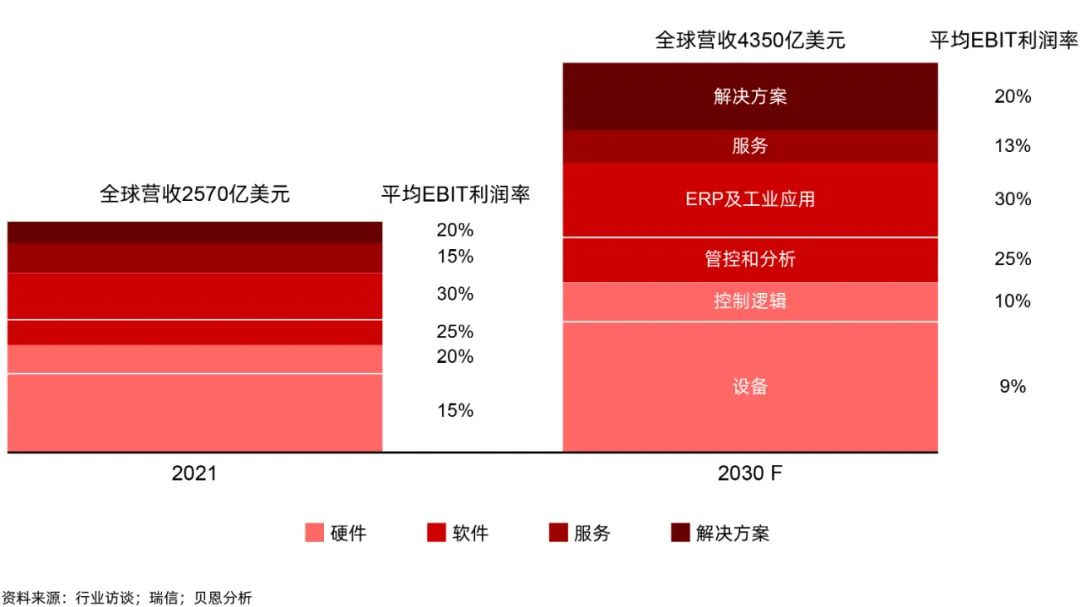
一、数字化解决方案的常见误区及挑战
尽管越来越多的企业已经认识到数字化解决方案的战略意义,但是,往往囿于两大认知误区,仍怠于行动:首先,数字化转型及相应的运营、组织升级是一个长期的过程,需假以时日才能充分展现成果,让许多企业产生了可以从长计议的错觉;其次,大多数企业对于数字化、新技术已有一定的投入,然而,这些投入普遍缺乏系统性,领导者却可能错误地认为变革已稳步推进。
贝恩此前针对不同行业约1,200家企业的调研显示,在数字化转型方面,仅有不到5%的受访企业实现或超越了既定目标,大多数的企业低估了转型难度。此外,很多企业也低估了转型的潜力,具体表现为,仅仅看到了数字化对于降本、优化流程的价值,未能深入挖掘其对于收入的贡献。贝恩在2019年开展的一项针对205家工业企业的调研表明:数字化转型处于领先地位的受访企业,在竞争中制胜的可能性比落后企业高出四倍,而那些较落后的企业,整体业绩不如竞争对手。
基于多年的机械设备行业咨询经验,贝恩归纳出企业在推动数字化转型、建设以解决方案为中心的业务模式时常见的五大误区及挑战。
1、客户生命周期的收益模式发生变化
未来,企业的收入将从过去的一次性产品销售,转变为定期收取费用,在此背景下,客户全生命周期的收益管理更加复杂。
2、资产负债表发生变化
新的收益模式下,从前那些销售后即转移所有权的产品,可能被纳入机械设备企业的资产负债表中,从而改变了企业的风险特征、融资需求。
3、运营模式面临变革
不同于硬件产品,企业需要重新设计解决方案的开发、销售模式。与此同时,新模式对于企业管理层、员工都提出了新的能力要求,比如销售解决方案的能力和人才的数字化胜任力等。
4、创新周期加速
传统的工业产品的创新周期往往历时数年,但是,解决方案通常需要每6~12个月更新一次。
5、接入生态系统
成功的解决方案需要与客户内部流程深度整合,所以,企业需要拓展与生态系统伙伴的合作,确保落地和兼容性。
二、五大举措助力数字化解决方案落地
通过开展试点,企业能够在低风险的情形下探索新业务,然而,全面推行新模式往往需要历时数年。对此,贝恩总结出五条举措,助力机械设备企业落地数字化方案:
1、审视利润池、识别潜在的竞争对手
机械设备行业的利润池面临两大变化:一是传统产品及服务面临同质化和低价竞争,利润承压;二是基于数字化、科技的产品及服务涌现,利润空间更高,因而吸引了更多的入局者。放眼未来,随着市场边界不断模糊、进入壁垒变低,过去的供应商、客户都可能成为潜在的竞争对手,机械设备企业应当居安思危。
2、制定清晰的愿景
对于传统市场,企业在制定进入战略时往往从分析市场规模、设立目标市场份额入手。对于数字化解决方案业务,企业则需要更具备战略思维,清晰定义愿景,平衡两方面的考量:其一,数字化解决方案是全新领域,企业可以定义自身玩法、培育新市场;其二,开展新业务所需的投入,与覆盖场景宽度、技术栈整合程度正相关,在资源稀缺的情况下,领导者要聚焦与整体战略、核心客户需求最以某跨国食品加工设备企业为例。该企业发现,数字化解决方案能削减高达1/3的客户工厂的运营成本:通过使用传感器,远程监控设备状态,客户可以提前规划维保工作、缩短停机时间,显著降低运营成本。该企业设计了对应的解决方案和变现模式,向客户承诺了设备可实现的技术指标,并收取相应的费用。测算显示,该业务若全面推广至现有客户,可为该企业带来每年数亿美元的额外收入。
3、精准定位高潜客群,打造针对性方案
想要打造成功的数字化解决方案业务,要求企业建立有别以往的竞争优势。在传统硬件业务中,产品是成本大头,因此,企业的致胜要素是产品领先,采取聚焦规模的玩法,即通过规模效应降低成本,再将节约的成本投入到新产品研发中。相比之下,解决方案业务还涵盖了高毛利的软件和服务,弱化了直接成本对竞争力的影响,如何更有效地获取、留存客户成为制胜关键。那些领先的企业往往能够精准划分客群,将资源投入到高潜客群中,从而最大化客户带来的长期价值。
喜利得是一家总部位于列支敦士登的制造商,专门生产电动工具、紧固系统和其它建筑业、制造业用品。该公司注意到,运用数字化工具可以显著提升建筑业的生产力,但是,中等规模的建筑承包商尚未大规模采用该类解决方案。针对这一细分市场,喜利得去年收购了位于旧金山的建筑科技公司Fieldwire,其软件定位于帮助承包商协调现场施工人员,据报平均能够提升超过12%的生产力。
4、明确路线图,合理选择自建/合作/收购,打造新能力
在定义目标客群和场景后,企业需融合技术栈各个环节、打造解决方案,这一过程常常会涉及传统硬件业务以外的产品及能力(如软件)。为了补全缺口,企业须在自建、合作还是兼并收购中做出选择。对于部分有巨大变现潜力的控制点,企业需自身把握;在其他环节,企业则可以充分利用外部资源来保质降本。
在中国市场,生态系统思维尤为重要:过去十年中,成熟的互联网、科技生态已经汇聚了大量数据、科技、人才,传统机械设备企业若能充分利用成熟的外部生态,可以事半功倍,实现双赢。以三一集团为例,通过与腾讯合作,双方共建了物联网平台、智慧中台;通过与中国联通、中国电信合作,拓宽了5G应用;通过与华为合作,三一借力后者在ICT、智能制造、智慧园区等方面的积累。
除了接入外部生态,企业还需积极布局内部能力建设,比如,升级研发模式以应对更快的开发周期,升级销售能力以适应顾问式的销售模式等。企业自身的数字化人才储备、招募和胜任力提升也是重中之重,比如,拥有契合整体数字化战略的人才策略及路线图,并且在领导层、数字化团队负责人、数字化团队成员、其他基层员工等各个层级进行查漏补缺。
在自建、合作以外,有一部分机械设备企业通过收购来加速变革。比如,日立以96亿美元收购了数字工程服务公司GlobalLogic,助力其Ramada数字化解决方案业务。
5、针对新业务特点设计新的评估维度,并加强风险管控
在布局解决方案业务时,企业需要制订清晰的战略、财务路线图,并设置合适的关键绩效指标。比如,在业务初期,相较EBITDA利润率,客户流失率或单位客户边际收益可能是更有意义的评估指标。此外,企业需考虑风险管控:数字化解决方案往往拥有独特的变现模式(如基于使用或结果付费),其风险与传统的产品销售不同;另一方面,投资者、股东不一定能充分理解新业务所需的投资和回报周期。为了有效管理新业务、控制风险,部分企业的新业务在企业内部高度独立,还有部分企业选择业务分拆、体外孵化等方式,如三一重工的树根互联、徐工的汉云。
数字化解决方案关乎机械设备企业的未来发展轨迹,广大企业应当进行系统性规划,并且有效落地执行,从而推动转型顺利。
翻译:
In the last issue, we introduced that the machinery and equipment industry is quietly expanding to the three “machinery +” direction, in order to establish a new moat. In this installment, we will focus on how machinery and equipment companies can tap the potential of digital solutions, by presenting common misunderstandings and challenges in the transformation process, and propose five measures to help companies overcome a series of potential obstacles, so as to accelerate the implementation of solutions and smoothly achieve transformation.
In recent years, the wave of digitalization has gradually penetrated many aspects of the machinery and equipment industry, covering product development, manufacturing, sales, service, etc. Many enterprises take digitalization as the starting point, which greatly improves efficiency, productivity and customer stickiness.
It is worth noting that, in addition to optimizing operations, digitalization can enable enterprises to transform their business models: from traditional “product-centric” to “solution-centric.” In practice, as industry competition intensifies and hardware innovation slows, the past model cannot sustain growth and profitability. In this new model, companies can rely on digitalization and technological innovation to organically combine hardware, software and services to create customized solutions for customers. Bain found that a solution-centric approach can both boost margins and drive growth, while strengthening customer relationships: in industrial automation, for example, the solutions business has emerged as the fastest-growing market segment (see chart below).
In the industrial automation sector, the solutions business will be the future revenue growth engine
Common misunderstandings and challenges of digital solutions
Although more and more enterprises have recognized the strategic significance of digital solutions, they are often slow to act due to two major cognitive misunderstandings: First, digital transformation and the corresponding operational and organizational upgrading is a long-term process that takes time to fully show results, giving many enterprises the illusion that they can take a long-term view; Second, most companies already have some investment in digitization and new technologies, but these investments are generally not systematic, and leaders may mistakenly believe that change has been steadily advanced.
According to a previous Bain survey of about 1,200 companies across a variety of industries, less than 5% of respondents met or exceeded their stated goals for digital transformation, and most companies underestimated the difficulty of transformation. In addition, many companies underestimate the potential of transformation, by only seeing the value of digitization for cost reduction and process optimization, and failing to dig deeper into its contribution to revenue. A study of 205 industrial companies conducted by Bain in 2019 found that respondents who are at the forefront of digital transformation are four times more likely to win the competition than those who are lagging behind, and those who are lagging behind are underperforming their competitors overall.
Based on years of experience consulting in the machinery and equipment industry, Bain has identified five common misconceptions and challenges that companies face when driving digital transformation and building solution-centric business models.
Five myths and challenges
- The revenue model of the customer life cycle changes
In the future, the revenue of enterprises will shift from one-time product sales in the past to regular fees, in this context, the revenue management of the customer’s full life cycle is more complicated.
- Balance sheet changes
Under the new income model, those products that transfer ownership after sale may be included in the balance sheet of machinery and equipment enterprises, thus changing the risk characteristics of enterprises and financing needs.
- The operating model is facing changes
Unlike hardware products, enterprises need to redesign the development and sales model of solutions. At the same time, the new model puts forward new requirements for enterprise management and employees, such as the ability to sell solutions and the digital competency of talents.
- The innovation cycle is accelerating
Traditional industrial product innovation cycles often take years, but solutions typically need to be updated every 6-12 months.
- Connect to the ecosystem
Successful solutions require deep integration with customers’ internal processes, so companies need to expand their collaboration with ecosystem partners to ensure delivery and compatibility.
Five initiatives to help digital solutions landing
Pilots allow companies to explore new businesses with low risk, but it often takes years to fully implement new models. In this regard, Bain summed up five initiatives to help machinery and equipment companies land digital solutions:
Examine the profit pool and identify potential competitors
The profit pool of the machinery and equipment industry faces two major changes: first, traditional products and services face homogenization and low-price competition, and profits are under pressure; The second is the emergence of products and services based on digitalization and technology, with higher profit margins, thus attracting more entrants. Looking to the future, with the blurring of market boundaries and lower barriers to entry, suppliers and customers in the past may become potential competitors, and machinery and equipment companies should be prepared for danger.
Develop a clear vision
For the traditional market, enterprises often start from analyzing the market size and setting up the target market share when formulating the entry strategy. For the digital solutions business, companies need to be more strategic, clearly define the vision, and balance two considerations:. First, digital solutions are a new area, enterprises can define their own play and cultivate new markets. Second, the investment required to carry out new business is positively related to the width of the coverage scene and the integration degree of the technology stack. In the case of scarce resources, leaders should focus on the overall strategy and core customer needs, especially a multinational food processing equipment enterprise.
The company has found that digital solutions can cut operating costs at customers’ plants by up to a third:. By using sensors to remotely monitor equipment status, customers can plan maintenance ahead of time, reduce downtime, and significantly reduce operating costs. The enterprise designed the corresponding solution and realization mode, promised the customer the technical indicators that the equipment can achieve, and charged the corresponding fees. Estimates show that the business, if fully rolled out to existing customers, could generate hundreds of millions of dollars in additional annual revenue for the company.
Accurately locate high potential customers and create targeted programs
To build a successful digital solutions business, you need to build a competitive advantage that is different than before. In the traditional hardware business, the product is the main cost, therefore, the winning factor of the enterprise is the product leadership, take the focus on the scale of the game, that is, reduce the cost through the scale effect, and then put the cost savings into the development of new products. In contrast, the solutions business also covers high-margin software and services, which reduces the impact of direct costs on competitiveness. And how to acquire and retain customers more effectively becomes the key to success. Those leading companies are often able to accurately segment their customers and invest resources in high potential customers to maximize the long-term value of their customers.
Hilti is a Liechtenstein-based manufacturer specializing in power tools, fastening systems and other construction and manufacturing supplies. The company noted that the use of digital tools can significantly improve the productivity of the construction industry. But medium-sized construction contractors have not yet adopted such solutions on a large scale. Targeting this market segment, Hilti last year acquired Fieldwire. A SAN Francisco-based construction technology company whose software, positioned to help contractors coordinate construction crews on site, has reported an average productivity increase of more than 12 percent.
Clear the road map, reasonable choice of self-construction/cooperation/acquisition, to create new capabilities
After defining the target audience and scenario, the enterprise needs to integrate the various aspects of the technology stack to create a solution. A process that often involves products and capabilities (such as software) outside the traditional hardware business. To fill the gap, companies must choose between self-establishment, partnerships or mergers and acquisitions. For some control points with huge realization potential, enterprises need to grasp themselves. In other links, enterprises can make full use of external resources to maintain quality and reduce costs.
In the Chinese market, ecosystem thinking is particularly important:
In the past decade, the mature Internet, science and technology ecology has gathered a large number of data, technology, talent, traditional machinery and equipment enterprises if they can make full use of the mature external ecology, can get twice the result with half the effort, achieve a win-win situation. Taking Sany Group as an example, through cooperation with Tencent. The two sides have built an Internet of Things platform and smart center. Expanded 5G applications through cooperation with China Unicom and China Telecom. By cooperating with Huawei, Sany leverages the latter’s accumulation in ICT, intelligent manufacturing, and smart parks.
In addition to accessing the external ecosystem, enterprises also need to actively deploy internal capacity building. Such as upgrading research and development models to cope with faster development cycles. And upgrading sales capabilities to adapt to consulting sales models. The company’s own digital talent reserve, recruitment and competency improvement is also a top priority. Such as having a talent strategy and roadmap that fits the overall digital strategy. And checking gaps at various levels such as leadership, digital team leaders, digital team members, and other grass-roots employees.
In addition to self-construction and cooperation, some machinery and equipment companies accelerate change through acquisition. For example, Hitachi acquired digital engineering services company GlobalLogic for $9.6 billion to boost its Ramada digital solutions business.
Design new evaluation dimensions according to new business characteristics and strengthen risk management and control
When laying out a solution business, companies need to develop a clear strategic, financial road map and set appropriate key performance indicators. For example, in the early stages of a business, churn or marginal revenue per customer may be more meaningful metrics to evaluate than EBITDA margins. In addition, companies need to consider risk management:. Digital solutions often have unique monetization models (such as payment based on use or results) that are different in risk from traditional product sales; On the other hand, investors and shareholders may not fully understand the investment and return cycles required for new businesses. In order to effectively manage new business and control risks. Some enterprises’ new business is highly independent within the enterprise. And some enterprises choose business spin-off, in vitro incubation and other ways. Such as Sany Heavy Industry’s Root Interconnection and Xugong’s Hanyun.
Digital solutions are related to the future development trajectory of machinery and equipment enterprises. And the majority of enterprises should carry out systematic planning and effective implementation. So as to promote the smooth transformation.
本文由数字化转型网(www.szhzxw.cn)转载而成,来源于贝恩公司;编辑/翻译:数字化转型网宁檬树。

免责声明: 本网站(https://www.szhzxw.cn/)内容主要来自原创、合作媒体供稿和第三方投稿,凡在本网站出现的信息,均仅供参考。本网站将尽力确保所提供信息的准确性及可靠性,但不保证有关资料的准确性及可靠性,读者在使用前请进一步核实,并对任何自主决定的行为负责。本网站对有关资料所引致的错误、不确或遗漏,概不负任何法律责任。
本网站刊载的所有内容(包括但不仅限文字、图片、LOGO、音频、视频、软件、程序等) 版权归原作者所有。任何单位或个人认为本网站中的内容可能涉嫌侵犯其知识产权或存在不实内容时,请及时通知本站,予以删除。