在《数字化转型“降本增效”的底层逻辑是什么》中,我们提到,数字化和数字化转型的“降本增效”体现在:“科学管理”、“精益管理”、“管理自动化”、“以数据为中心的业务变革”四个阶段。
其中“科学管理”和“精益管理”两阶段分别以“业务活动步骤化”和“步骤环节要素化”为主要标志,是与信息系统无关的。从“管理自动化”对应的“要素数据规格化”开始,涉及到了信息系统和数据。尤其是到了“以数据为中心的业务变革”阶段,数据开始登上中心舞台。在本文,我们根据业务使用的数字模型规则不同,及数据驱动业务方式的不同,提出“以数据为中心的业务变革”三种范式。
为便于读者理解,首先提出数字模型这一概念:数字模型是对系统结构信息和行为的数字化表达,是依据实际需求来建立反映实际系统特征及运行规则的抽象化定量描述。通过定义一定的数学或者逻辑关系,来解释和预测数据的行为和变化。
结合在《从信号处理到数字化和数字化转型》中的类比,物理信号在经过“抽样”、“量化”、“编码”后形成的数字信号及其处理规律,就是物理信号的数字模型。而对于数字信号的处理,有其完全不同于模拟信号的处理规则,如奈奎斯特抽样定理、快速傅里叶变换、小波分析等。

而企业的业务活动在“数字化”后,也即经过“业务活动步骤化”、“步骤环节要素化”、“要素数据规格化”三阶段后,形成了业务活动的数字模型。
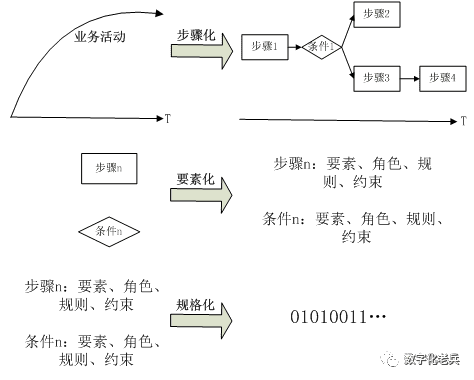
下面介绍“以数据为中心的业务变革”的三种范式:
一、系统数字化、规则模拟化,模型驱动业务
以企业管理精益看板方法的数字化表达——数字看板为代表。数字看板是企业业务活动的数字化模型,通过明确业务场景和客户价值目标,深入业务活动的全生命周期各实际操作环节体验和考察,分析影响价值目标传递和实现的因素;对业务活动进行步骤划分完成“业务活动步骤化”;明确步骤之间的转换条件和要素指标,更新流程规则并开展资源配置。实时监测资源和运行条件,确保资源条件一旦具备即刻开展相关业务活动,解决影响价值传递和实现的因素,实现“步骤环节要素化”;以步骤定时记录的方式,将步骤执行过程中反映业务活动全过程、全状态信息的数据记录下来,实现业务价值流动可视化;通过显式化业务流程规则并将其数据化、规格化,在业务运行过程中发挥看板对业务的拉动机制,加速用户价值流动,并有效驱动数据更新和状态跳转;通过为各类资源建立状态参数,动态监测资源占用情况,有效暴露资源瓶颈,过程体现“要素数据规格化”。
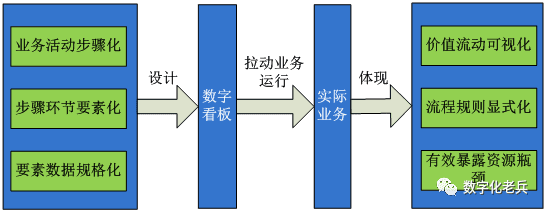
数字看板作为“以数据为中心的业务变革”的第一种范式代表,其特点为:
1.数字模型的系统结构和行为数字化、规则“模拟化”。业务本身及其运行过程采用数字化表达,但其业务流程规则并不是业务数字化后新产生的规则,而是业务本身固有的“模拟化”规则;
2.模型规则清晰简单;业务流程规则为企业的生产和管理活动规则,相对简单明了,业务流程规则直接作为数字模型规则使用;
3.数字模型与业务的关系为模型驱动业务;整个运行过程以“价值流动可视化”、“流程规则显式化”、“有效暴露资源瓶颈”的方式,实现数字看板对业务的拉动。虽然业务的执行结果也会影响数字看板的改进,但这种影响是非实时的。总体上讲,数字模型与业务的关系为模型驱动业务。
二、系统数字化、规则模拟化,模型和业务相互驱动
以装备制造业领域的数字工程为代表。数字工程由美国国防部2018年在其“国防部数字工程战略”中提出。数字工程战略旨在推进数字工程转型,将国防部线性、以文档为中心的采办流程转变为动态、以数字模型为中心的数字工程生态系统,完成以模型和数据为核心谋事做事的范式转移。
对于装备制造企业,其数字工程包含数字样机(装备的数字模型)、数字线索(Digital Thread)、数字孪生(Digital Twins)三部分。数字工程通过在装备的论证立项、研制、生产、测试定型、使用维护等全周期建立数字模型,并在装备全生命周期中连续传递形成数字样机,以实现对装备的全面、端到端数字化表达。通过数字线索(可以简单理解为数据模型和数据的共享、传递机制),在装备的全生命周期内将设计、研制、生产、测试、运行中的各类数据在数字样机和物理实体装备之间传递,以实现数字样机在仿真运行过程中与物理实体装备开展迭代和同步更新完善,也称为数字孪生。
通过数字孪生方式迭代优化后的数字样机,可以帮助设计师在数字环境中快速迭代和优化设计方案,缩短产品研发周期,提高产品竞争力;在数字环境中模拟和测试各种方案,避免现实世界中的高昂成本和潜在风险,以及降低维护成本和延长设备寿命。
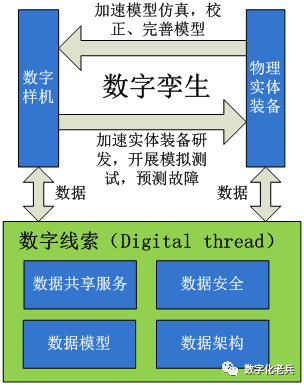
数字工程作为“以数据为中心的业务变革”的第二种范式代表,其特点为:
1.数字模型的系统结构和行为数字化、规则“模拟化”;装备的组成结构、几何外形、学科特性、功能效能在其全生命周期进行了数字化表达,成为数字样机,但数字样机仿真运行的原理和规则并不是其新产生的规则,而是装备本身固有的“模拟化”规则,如装备的功能、效能、组成结构、相互作用等的科学、技术和工程原理等;
2.模型规则复杂,具备一定程度的不确定性和不可预见性;装备的运行规则由相关科学、技术和工程原理为主,这些规则运用在实体装备上,由于装备设计、生产和维护过程中的操作误差及运行环境因素,具有复杂性和一定程度的不确定性、不可预见性;而数字样机作为实体物理装备的数字化表达,相对于“模拟化”实体物理装备丢失了很多细节,装备的“模拟化”运行规则运用在数字样机上,会进一步降低数字样机的仿真可信度。因此需要采取数字孪生技术,通过数字样机与实体装备迭代优化的方式提高数字样机其可信度;
3.数字模型与业务的关系为模型与业务相互驱动;数字工程的运行过程是在装备的全生命周期规范数字样机的开发、集成和使用,通过数字线索在数字样机和物理实体装备之间实时传递运行数据,以实现二者的共同迭代和同步完善,即数字孪生。这种业务模式,即为模型与业务相互驱动、迭代优化的模式。数字化转型网www.szhzxw.cn
三、系统数字化、规则数字化、模型和业务相互驱动
以大数据和数据智能技术在公共管理和消费行业的运用,尤其是在新媒体、金融、零售、餐饮等行业的成功运用为标志。如互联网营销推荐、网上娱乐和阅读推荐、金融风控、公共安全、基于经营数据的决策辅助等。这些场景下的数字模型,就是以部分机器学习模型为基础,例如以支持向量机为代表的几何模型、以贝叶斯分类器为代表的概率模型和以人工神经网络为代表的仿生模型等。
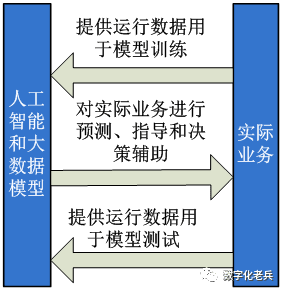
大数据和数据智能技术的运用作为“以数据为中心的业务变革”的第三种范式代表,其特点为:
1.数字模型的系统结构和行为数字化、规则数字化;对于大数据和数据智能技术在公共管理和消费行业的运用,其业务活动通过用户在互联网上的登录、驻留、操作访问、消费和个人定位来记录,且多以APP的形式收集用户个人数据,其通过互联网数据刻画的系统结构和行为天然具备数字化特征。而其业务规则也大多依靠模型算法,根据业务运行中采集到的现有数据去自主学习、关联和生成。
2.模型规则具有模糊性、非确定性且缺乏理论解释;在大数据和机器学习的应用场景下,较少依赖甚至完全不依赖现有场景“模拟化”规则,在大多数场景下也几乎没有现成规则可以遵循。这种模型通常需要较大的数据量用于模型的训练,生成的规则很大程度依赖不完备的训练数据,具有相当大的模糊性、非确定性且缺乏理论解释,适合无明确的现有规则或仅依靠现有规则不足以支撑业务运行、主观性强、容错性高的应用场景,由于其技术特点,暂无法满足业务规则专业型强、复杂度高的场景。
3.数字模型与业务的关系为模型与业务相互驱动;大数据和数据智能技术的运用,是以现有业务采集数据为依托,通过数据分析、挖掘和训练模型,生成新的知识和规则,再通过这些知识和规则运用于新的数据,通过业务结果实时反馈给数字模型进行测试和新的训练,以进一步改进模型。整个过程是模型与业务相互驱动、迭代优化的模式。
四、“三种范式”的总结
下面我们对“以数据为中心的业务变革”的三种范式总结如下:
“以数据为中心的业务变革”的三种范式总结
| 范式名称 | 模型特征 | 规则特征 | 模型与业务的关系 | 典型业务场景 |
| 系统数字化、规则模拟化,模型驱动业务 | 系统结构和行为数字化、规则“模拟化”, | 1.业务规则清晰简单,2.模型规则直接采用 | 模型驱动业务 | 精益管理数字看板 |
| 系统数字化、规则模拟化,模型和业务相互驱动 | 系统结构和行为数字化、规则“模拟化” | 1.业务规则复杂,具备一定程度的不确定性和不可预见性;2.模型规则通过业务规则结合业务结果实时反馈迭代优化 | 模型与业务相互驱动 | 数字工程 |
| 系统数字化、规则数字化、模型和业务相互驱动 | 系统结构和行为数字化、规则数字化 | 1.业务无明确规则或仅依赖现有规则无法支撑业务运行,主观性强;2.规则规则具有模糊性、非确定性且缺乏理论解释 | 模型与业务相互驱动 | 大数据和数据智能技术在新媒体、金融、零售、餐饮等行业的成功运用 |
以上三种范式可供企业在数字化转型中,用于开展数字场景构建的参考。对于具体企业,可根据自身各业务线的特点灵活开展相关建设:
如业务线的部分步骤环节缺乏明确规则,决策主观性强,容错度高,但属于数据密集型环节,就可以考虑采用第三种范式,构建数据智能模型,用于决策辅助;
如业务线大部分步骤环节属于常规业务工作,业务规则清晰、明确,就适合采用第一种范式,建设数字看板,通过精益看板方法拉动业务;
如业务线部分步骤环节学科性、专业性强,相关原理、规则复杂,容错度低,使用第一种范式会因模型仿真置信度不足造成不良后果,使用第三种范式因技术受限,无法满足专业性强、复杂度高的场景需求,就适合搭建数字孪生场景,以第二种范式建设。
五、展望未来——第四种范式?
有的读者可能想问,除此以外有没有更好的范式?要回答这个问题,还是回到本文开始提到的数字信号处理。从数字化转型的角度,数字信号作为模拟信号的数字模型,完全抛弃了模拟信号处理的物理方法:
奈奎斯特采样定理说明了采样频率与信号频谱之间的关系,明确当采样频率大于信号中最高频率的2倍时,采样后的数字信号能够完整保留原始信号中的所有信息,是连续信号离散化的基本依据;
离散傅里叶变换作为一种将时域信号转换为频域信号的数学工具,方便数字信号处理的数字滤波、数字调制等操作,推动了数字信号处理成为现代通信技术的重要基础;方便图像处理的图像增强、滤波、特征提取等操作,成为图像处理技术的重要基础。快速傅里叶变换算法提供了计算机计算离散傅里叶变换的高效、快速计算方法;
而小波变换继承和发展了傅里叶变换局部化的思想,能够提供一个随频率改变的“时间—频率”窗口,能对时间(空间)频率的局部化分析,达到高频处时间细分、低频处频率细分,能自动适应时频信号分析的要求,从而可聚焦到信号的任意细节,解决了傅里叶变换的困难问题,成为继傅里叶变换以来科学方法上的重大突破,在信号处理领域,甚至数学、量子力学、计算机分类与识别、军事电子对抗、语音与音乐的人工合成、故障诊断等更多领域发挥了重要的作用。
综上所述,数字信号处理作为信号处理领域数字化转型的成果,其建立了以新理论为基础的整套数字化处理规则,成为数字化领域的典范。在当前人工智能的热潮下,大数据和人工智能的泡沫吹得很大,部分学者甚至提出了数据智能是在理论、实验、仿真之外,“只需知其然,不需知其所以然”的知识生成第四范式,这其实是在掩盖基于数据分析的人工智能目前缺乏理论基础这一苍白事实。笔者认为,目前基于数据分析的人工智能还没有突破纯实验科学的范畴,在企业的数字化转型中,其技术局限于本文提出的第三范式。
追求“知其然,更知其所以然”是人类探索未知世界,追求科学规律的基本精神。时代呼唤更多的奈奎斯特采样定理、快速傅里叶变换和小波变换,也许这是“以数据为中心的业务变革”“第四种范式”的未来所在吧!

翻译:
In What is the underlying logic of “Cost Reduction and Efficiency Improvement” in digital transformation, we mentioned that the “cost reduction and efficiency improvement” of digitalization and digital transformation is reflected in four stages: “scientific management”, “lean management”, “management automation” and “data-centric business change”.
Among them, the two stages of “scientific management” and “lean management” are mainly marked by “steps of business activities” and “steps and elements” respectively, which have nothing to do with information system.
From the “management automation” corresponding to “factor data normalization”
it involves information system and data. Especially in the “data-centric business transformation” phase, data is starting to take center stage. In this paper, we propose three paradigms of “data-centric business transformation” according to the different rules of digital models used by businesses and the different ways of data-driven business.
In order to facilitate readers’ understanding, the concept of digital model is first put forward: digital model is the digital expression of system structure information and behavior, and it is an abstract quantitative description that reflects the characteristics and operation rules of the actual system according to the actual needs. Explain and predict the behavior and changes of data by defining certain mathematical or logical relationships.
Combined with the analogy in “From Signal Processing to Digitalization and Digital Transformation”.
The digital signal and its processing law formed after the physical signal is “sampled”, “quantified” and “encoded” is the digital model of the physical signal. For digital signal processing, there are completely different from analog signal processing rules, such as Nyquist sampling theorem, fast Fourier transform, wavelet analysis and so on.
Analog signal digitization diagram
After the “digitization” of the business activities, the digital model of the business activities is formed after the three stages of “the steps of the business activities”, “the elements of the steps” and “the normalization of the factor data”.
Service digitization diagram
Here are three paradigms for data-centric business change:
First, the system is digitized, the rules are simulated, and the model drives the business
It is represented by digital Kanban, the digital expression of lean Kanban method in enterprise management. Digital Kanban is a digital model of enterprise business activities. By clarifying business scenarios and customer value objectives, it analyzes the factors affecting the delivery and realization of value objectives through in-depth experience and investigation of practical operation links in the whole life cycle of business activities.
The steps of business activities are divided to complete the “steps of business activities”; Clarify the conversion conditions and factor indicators between steps, update process rules and carry out resource allocation. Real-time monitoring of resources and operating conditions, to ensure that once the resource conditions are available, immediately carry out relevant business activities, solve the factors affecting the value delivery and realization, and achieve “step elements”; The data reflecting the whole process and state information of business activities in the process of step execution is recorded in the way of step periodic recording to realize the visualization of business value flow.
Through explicit business process rules and their datatization and standardization, Kanban can exert the pulling mechanism of business in the process of business operation, accelerate the flow of user value, and effectively drive data update and state jump; Through the establishment of status parameters for various resources, dynamic monitoring of resource occupation, effective exposure of resource bottlenecks, the process reflects “factor data normalization”.
Digital Kanban business relationship diagram
As the first paradigm representative of “data-centric business change”, digital Kanban is characterized by:
- The system structure and behavior of the digital model are digitized and the rules are “analog”. The business itself and its operation process are expressed digitally. But the business process rules are not the new rules produced after the business digitization. But the inherent “analog” rules of the business itself.
- The model rules are clear and simple; Business process rules are the production and management activity rules of enterprises, relatively simple and clear, business process rules are directly used as digital model rules;
- The relationship between digital model and business is model-driven business; The whole operation process realizes the pull of digital Kanban on business by means of “visualization of value flow”, “explicit process rules” and “effective exposure of resource bottleneck”. Although the results of business execution can also affect the improvement of digital Kanban, the impact is not real-time. In general, the relationship between digital models and business is model-driven business.
Second, system digitalization, rule simulation, model and business drive each other
It is represented by digital engineering in the field of equipment manufacturing industry. Digital Engineering was proposed by the U.S. Department of Defense in its Department of Defense Digital Engineering Strategy in 2018. The Digital Engineering strategy aims to advance the transformation of digital engineering, transforming DOD’s linear, document-centric acquisition process into a dynamic, digital model-centric digital engineering ecosystem, and completing the paradigm shift of doing things with models and data at the core.
For equipment manufacturing enterprises, its Digital engineering includes Digital prototype (digital model of equipment), digital Thread (Digital Thread), digital Twins (digital twins) three parts. Digital engineering establishes a digital model in the whole cycle of equipment demonstration, project approval, development, production, testing, stereotyping, use and maintenance, and continuously transmits a digital prototype in the whole life cycle of equipment to achieve a comprehensive, end-to-end digital expression of equipment.
Through digital clues (which can be simply understood as the sharing and transmission mechanism of data models and data), various types of data in design, development, production, testing and operation can be transferred between the digital prototype and the physical equipment during the whole life cycle of the equipment, so as to realize the iteration and synchronous update and improvement of the digital prototype and the physical equipment during the simulation operation. Also known as digital twins.
The iteration and optimization of digital prototype by digital twin can help designers quickly iterate and optimize design schemes in digital environment, shorten product development cycle and improve product competitiveness. Simulate and test solutions in a digital environment to avoid high costs and potential risks in the real world. As well as reduce maintenance costs and extend equipment life.
Digital twin diagram of digital prototype and physical device
As the second paradigm of “data-centric business change”, digital engineering is characterized by:
- The system structure and behavior of the digital model are digitized and the rules are “analog”; The composition structure, geometric shape, disciplinary characteristics and functional efficiency of the equipment are expressed digitally in its whole life cycle, becoming a digital prototype. However, the principle and rules of the simulation operation of the digital prototype are not the newly generated rules. But the inherent “simulation” rules of the equipment itself. Scientific, technical and engineering principles, such as the function, efficiency, composition, structure and interaction of equipment;
The model rules are complex, with a certain degree of uncertainty and unpredictability.
- The operation rules of equipment are mainly based on relevant science, technology and engineering principles, and these rules are applied to physical equipment. Due to operational errors and operating environment factors in the process of equipment design, production and maintenance, they are complicated and have a certain degree of uncertainty and unpredictability.
- As a digital expression of physical equipment, digital prototype loses many details compared to “analog” physical equipment. And the application of “analog” operation rules of equipment to digital prototype will further reduce the simulation credibility of digital prototype. Therefore, it is necessary to adopt digital twin technology to improve the reliability of digital prototype by iterative optimization of digital prototype and physical equipment.
- The relationship between digital model and business is driven by each other; The operation process of digital engineering is to standardize the development, integration and use of digital prototype in the whole life cycle of equipment, and transfer operational data in real time between digital prototype and physical equipment through digital clues, so as to achieve the common iteration and synchronous improvement of the two, that is, digital twin. This business model is the model and business drive each other, iterative optimization model.
Third, system digitization, rule digitization, model and business drive each other
It is marked by the application of big data and data intelligence technology in public management and consumer industries, especially in new media, finance, retail, catering and other industries. Such as Internet marketing recommendation, online entertainment and reading recommendation, financial risk control, public safety, decision aid based on business data, etc. The digital models in these scenarios are based on some machine learning models, such as geometric models represented by support vector machines, probabilistic models represented by Bayesian classifiers and bionic models represented by artificial neural networks.
Schematic diagram of AI and big data models interacting with real business
The application of big data and data intelligence technology represents the third paradigm of “data-centric business transformation”, which is characterized by:
- Digitization of system structure, behavior and rules of digital models; For the application of big data and data intelligence technology in public management and consumer industries, its business activities are recorded through users’ login, residence, operation access, consumption and personal positioning on the Internet, and most of the users’ personal data is collected in the form of apps. The system structure and behavior depicted by Internet data naturally have digital characteristics. And most of its business rules rely on model algorithms to independently learn, associate and generate according to the existing data collected during business operation.
The model rules are fuzzy, uncertain and lack of theoretical explanation
- In the application scenarios of big data and machine learning. There is less or even no reliance on the existing scenario “simulation” rules. And there are almost no ready-made rules to follow in most scenarios.
- This model usually requires a large amount of data for the training of the model, and the generated rules are largely dependent on incomplete training data, with considerable fuzziness, uncertainty and lack of theoretical explanation. It is suitable for application scenarios where there is no clear existing rules or existing rules alone are not enough to support business operation, are subjective and have high fault tolerance. The scenario with strong professional and complex business rules cannot be met for the time being.
- The relationship between digital model and business is driven by each other; The application of big data and data intelligence technology is based on the data collected by existing businesses, through data analysis, mining and training models, new knowledge and rules are generated, and then these knowledge and rules are applied to new data, and business results are fed back to digital models in real time for testing and new training, so as to further improve the model. The whole process is the model and business drive each other, iterative optimization mode.Summary of “three paradigms”
Here we summarize the three paradigms for data-centric business change:
Summary of the three paradigms of “Data-centric Business Change”
Paradigm name model Feature rules Feature model and business relationship Typical business scenario system digitization, rule simulation, model-driven business system structure and behavior digitization, rule “simulation”, 1. The business rules are clear and simple, 2. The model rules directly adopt the model-driven business lean management digital Kanban system digitalization and rule simulation, and the model and business drive the system structure and behavior digitalization and rule “simulation”
1. Business rules are complex, with a certain degree of uncertainty and unpredictability;
2. Model rules Through business rules combined with business results real-time feedback iterative optimization model and business drive digital engineering system digitization, rule digitization, model and business drive system structure and behavior digitization, rule digitization
1. Business without clear rules or relying only on existing rules cannot support business operation, which is highly subjective.
2. Rules are fuzzy, uncertain and lack of theoretical explanation. The model and business interact to drive the successful application of big data and data intelligence technology in new media, finance, retail, catering and other industries
The above three paradigms can be used as reference for enterprises to carry out digital scene construction in digital transformation.
For specific enterprises, relevant construction can be carried out flexibly according to the characteristics of their own business lines:
If some steps of the business line lack clear rules, decision-making is subjective, and fault tolerance is high. But it is data-intensive. The third paradigm can be considered to build a data intelligence model for decision assistance.
If most of the steps of the business line belong to the routine business work. And the business rules are clear and clear, it is suitable to adopt the first paradigm, build digital Kanban. And pull the business through lean Kanban method;
For example, the steps of the business line are highly disciplinary and professional, the relevant principles and rules are complex, and the fault tolerance is low. The use of the first paradigm will cause adverse consequences due to the lack of confidence in model simulation, and the use of the third paradigm can not meet the requirements of professional and complex scenes due to technical limitations, so it is suitable to build digital twin scenes and build with the second paradigm.
Looking to the Future – A fourth paradigm?
Some readers may ask, is there a better paradigm? To answer this question, go back to the digital signal processing mentioned at the beginning of this article. From the perspective of digital transformation, digital signals, as a digital model of analog signals. Completely abandon the physical methods of analog signal processing:
The Nyquist sampling theorem explains the relationship between the sampling frequency and the signal spectrum. It is clear that when the sampling frequency is more than 2 times of the highest frequency in the signal. The sampled digital signal can retain all the information in the original signal completely, which is the basic basis for the discretization of continuous signal.
As a mathematical tool to convert time domain signals into frequency domain signals, discrete Fourier transform facilitates digital signal processing operations such as digital filtering and digital modulation, and promotes digital signal processing to become an important foundation of modern communication technology. The operation of image enhancement, filtering and feature extraction, which is convenient for image processing, has become an important basis of image processing technology. Fast Fourier transform algorithm provides an efficient and fast computing method for computing discrete Fourier transform.
The wavelet transform inherits and develops the idea of Fourier transform localization.
and can provide a “time-frequency” window that changes with frequency. It can locally analyze the time (space) frequency, achieve time subdivision at high frequency and frequency subdivision at low frequency, and automatically adapt to the requirements of time-frequency signal analysis, so that any details of the signal can be focused. It has solved the difficult problem of Fourier transform, and has become a major breakthrough in scientific methods since Fourier transform, and has played an important role in the field of signal processing, even mathematics, quantum mechanics, computer classification and recognition, military electronic countermeasures, artificial synthesis of speech and music, fault diagnosis and other fields.
To sum up, digital signal processing, as a result of digital transformation in the field of signal processing, has established a complete set of digital processing rules based on new theories.
And has become a model in the field of digitalization. Under the current craze of artificial intelligence, the bubble of big data and artificial intelligence has been blown very large, and some scholars even proposed that data intelligence is the fourth paradigm of knowledge generation that “only needs to know what is happening, and does not need to know why” outside of theory, experiment and simulation, which is actually covering up the pale fact that artificial intelligence based on data analysis currently lacks a theoretical basis.
The author believes that at present, artificial intelligence based on data analysis has not broken through the scope of pure experimental science, and its technology is limited to the third paradigm proposed in this paper in the digital transformation of enterprises.
The pursuit of “knowing how it is and knowing why it is” is the basic spirit of human exploration of the unknown world and pursuit of scientific laws. The Times call for more Nyquist. Sampling theorem, fast Fourier transform and wavelet transform. Maybe this is the future of the “fourth paradigm” of “data-centric business transformation”!
本文由数字化转型网(www.szhzxw.cn)转载而成,来源于数字化老兵aloha;编辑/翻译:数字化转型网小汤圆。
免责声明: 本网站(https://www.szhzxw.cn/)内容主要来自原创、合作媒体供稿和第三方投稿,凡在本网站出现的信息,均仅供参考。本网站将尽力确保所提供信息的准确性及可靠性,但不保证有关资料的准确性及可靠性,读者在使用前请进一步核实,并对任何自主决定的行为负责。本网站对有关资料所引致的错误、不确或遗漏,概不负任何法律责任。
本网站刊载的所有内容(包括但不仅限文字、图片、LOGO、音频、视频、软件、程序等) 版权归原作者所有。任何单位或个人认为本网站中的内容可能涉嫌侵犯其知识产权或存在不实内容时,请及时通知本站,予以删除。