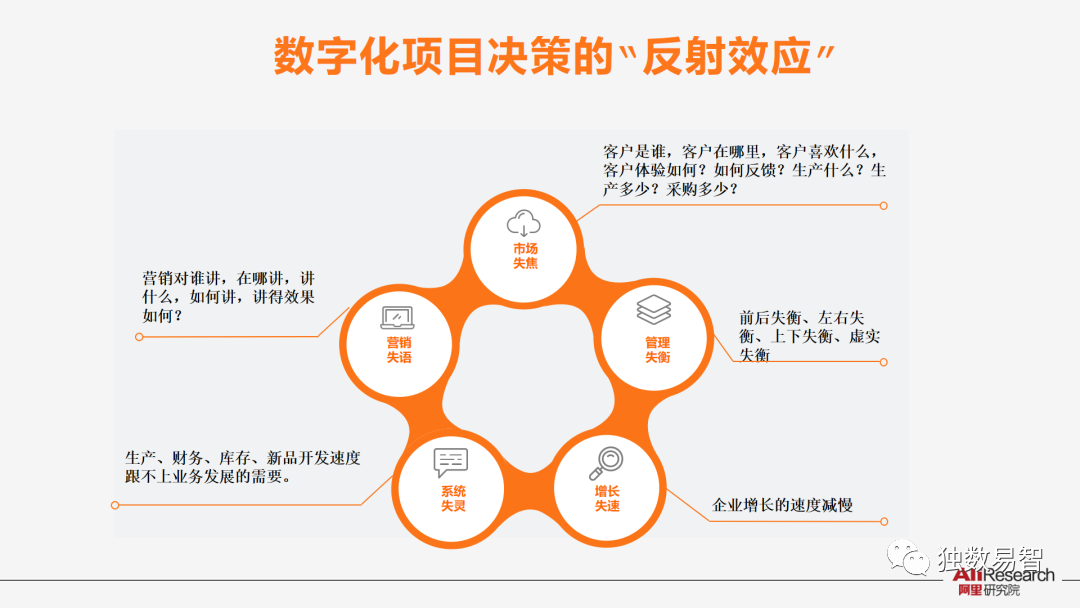
企业要做数字化转型,首先要做数字化转型的整体规划,这时往往需要外部顾问的介入。外部顾问的价值在于他们拥有对数字化转型的整体认知,并且拥有丰富的引导和教练技巧,能够带领企业的高层管理者制定出一个适合企业、可落地的数字化转型方案。而且在后续的落地过程中,外部顾问也需要全程参与,为转型试点的团队提供支持。
在这个过程中,外部顾问扮演着咨询顾问 + 培训师 + 企业教练的多重角色,要求具备多维度的专业能力,以及协调组织达成目标的领导力。这种多重角色的要求,以及咨询的方法都和传统的出具方案的咨询顾问不一样。可以说,数字化时代,不仅企业需要数字化转型,企业制定战略的方法论需要转型,连指导企业实施数字化转型的顾问也需要转型。
数字化时代也在颠覆传统的战略制定范式。具体发生了哪些变化呢?我们先从传统的咨询范式说起,然后看看在数字化时代,咨询顾问的角色发生了哪些变化。
一、咨询范式正在面临改变
传统的战略规划的思路是:战略咨询公司派出一个项目小组到企业,调研客户的需求和现状,然后做市场分析,调研访谈,最后制作一份精美的报告。这些报告无论在专业性还是呈现方式方面都很专业,但因为咨询公司并不参与战略的执行,这些美好计划能不能落地,就要看企业的造化了。
公司将战略咨询外包给咨询公司有其历史背景。首先,公司管理层大都是所在业务背景,受过专业商业训练的人不多,咨询公司的方法论有一种认知优势;其次,咨询公司有专有的数据库和专业工具,他们能找到一些外部公司无法获取的信息;再次,公司决策需要第三方背书,咨询顾问相当于 CEO 的智库,他们善于把 CEO 的想法条理化,使之看上去很专业,这样更容易获得董事会的认可,而且可以减少 CEO 面临决策的责任。 数字化转型网(www.szhzxw.cn)
现在战略咨询公司的这几个优势都被大大削弱。首先是认知优势,目前绝大多数大公司的高管大都受过专业的商业训练,甚至有些本来就是咨询顾问出身,他们从乙方变成了甲方,因此那些知识和技能优势不存在了。其次是信息优势,由于互联网的信息化优势很明显,获得信息比以前更容易,很多“最佳实践”的价值也大大折扣,信息优势也被削弱了。
在一个相对静态的社会里,这种咨询的范式是有价值的,不过随着环境变化越来越快,昨天的“最佳实践”很可能明天就变成笑话了。苹果在刚进入手机市场的时候,咨询公司如果参照诺基亚的“最佳实践”来给方案,还会有今天的 iPhone 吗?对于新兴行业来说,并不存在这样的“最佳实践”,因此这种扮演全知全能神的专家顾问也就慢慢过时了。
更重要的是,在一个高度变化的情况下,战略制定和执行将不再可分,依靠调研得出来的咨询方案未必能体现企业的真实情况,方案的制定者如果不参与方案的执行,将无法真正落地。而且企业的周期越来越短,战略周期也越来越短,企业已经不需要一个长达三年的战略,而是一个不断更新的战略。
亨利 • 明茨伯格对那些踌躇满志的咨询顾问有一个很有趣的比喻:他们是一群候鸟,匆匆忙忙地在一个小岛上巡视一番,快速下结论,然后就飞走了。用他的理论来说,咨询顾问和管理者的职能非常相似,它是一门手艺,光知道理论是远远不够的,很多东西需要多年的实践才能慢慢领悟到。如果一个咨询顾问,只会整天谈一些大而无当的战略,甚至对企业都缺少基本的了解,写一些放诸四海而皆准的咨询报告,不能真正帮助企业解决问题,那么他们的价值就是非常可疑的。
咨询公司也在变化!包括像麦肯锡这样顶尖的咨询公司也在变革其咨询范式,一种新的咨询范式正在出现,从一个咨询方案的制定者变为一个群体方案的引导者。
实践永远是领先于理论的。其实早在 20 世纪 80年代,通用电气的杰克 • 韦尔奇就开始在公司内部推行这种咨询范式了,他称之为“群策群力”(Workout)。他把公司高层卷入战略的制定中,以真实问题切入,发动群体智慧,结合一些咨询模型和教练工具,以期解决真实问题,并且在这个过程中发展团队解决问题的能力,真正做到“干中学,学中干”!
这种“干中学、学中干”的做法就是现在比较流行的“行动学习”。很多人把“行动学习”理解成“引导技术”,这是一个莫大的误解。行动学习其实是一种方法论和一套体系,它把咨询、培训和教练综合在一起,在解决问题的同时发展团队能力。在领导力发展、战略问题的解决以及组织变革转型方面,行动学习都得到了很好地运用。 数字化转型网(www.szhzxw.cn)
这种“行动学习”的咨询范式有点类似于李小龙发明的“截拳道”。初看上去似乎什么路数都有,有点野路子的感觉,但实战能力很强。它吸取了很多有价值的东西,并融会贯通自成一派,不强调理论的完美,而强调其实战目标的实现——解决问题并发展能力,它充分发挥了群体智慧的优势,而且不断迭代更新,也体现了数字化时代的特质。
二、IBM 给华为做顾问的启示
IBM 本是一家 IT 公司,如果将它旗下的咨询和服务业务剥离出来,或许能成为全球最大的管理咨询公司。由于 IBM 既做业务也做咨询,因此 IBM 比其他咨询公司更了解客户需要什么,而且能够切切实实地提供相关的解决方案。他们常说:“我们给客户的药,都是我们先尝过的。”这样对于那些厌倦了各种报告但没有产生太大实际收益的公司是有说服力的。
IBM 也是华为管理体系的主要构建者。1997 年,华为发展迅速,但是管理体系还比较落后,任正非居安思危,觉得公司有必要转型,向一家具有国际竞争能力的跨国公司迈进。那一年的圣诞节,任正非远赴美国,拜访 IBM、惠普、休斯和朗讯四家高科技公司,看了一圈下来,认为只有 IBM 可以做华为的老师,于是花重金聘请 IBM 的咨询顾问。
与华为分享管理经验、帮助华为再造流程的,正是在 IBM 中扮演龙头角色的全球服务部。华为选择IBM 做咨询的原因有三个:首先,IBM 从事的 IT 行业和华为从事的通信行业比较相近;其次,IBM 既有传统的业务部门,也有新兴的咨询和服务部门,能够帮助他们解决问题;再次,IBM 从 1995 年以来进行的转型经验,正是华为需要的。 数字化转型网(www.szhzxw.cn)
任正非决定全面植入 IBM 的管理体系。其核心是所有的工作都围绕一个核心——高绩效,途径是变封闭式的研发为开放式的服务,并将整个公司的成本都折算到各个产品线上。这一决定当时在华为内部引起强烈反弹,很多人认为,IBM 的情况和华为相差甚远,这样“生搬硬套”没准会“水土不服”。面对内部阻力,任正非非常强势地提出:“如果鞋子不合适,那就把脚削掉。”任正非提出“先固化后优化”的要求,也就是说,先将 IBM 的那一套管理体系强力执行下去,等固化了这一套体系之后,再根据企业实际情况进行优化。
IBM 的全球服务部门派出 50 位咨询顾问,在华为一待就是 5 年,和华为的中高层一起致力于改进工作。华为也积极配合,专门成立管理工程部,主抓流程再造。5 年之后,华为付出了超过 10 亿元人民币的再造代价,终于将自己打造成一家有国际竞争能力的企业。可以不夸张地说,华为从 20 世纪 90 年代中期几十亿元人民币年收入的中国通信公司演变成为现在年收入接近千亿元人民币的全球通信制造公司,IBM“传、帮、带”功不可没,在华为的血液里,有着 IBM 的蓝色成分。
当然,华为的这种路径并不是唯一的选择,对于大多数中小企业来说也未必合适。但华为的做法至少能够给很多中国企业以这样的启示:第一,把咨询当作是战略层面的事情,又有清晰的变革目标和路径。
第二,咨询顾问应该是这方面的专家,而且能够长期待在公司内部,致力于和公司的内部人解决问题。第三,公司应该从上到下参与咨询和变革,其中公司高层的支持和参与尤为重要。第四,做事情要有长远眼光,一旦认定是在做一个正确的事情,要有坚持正确理念的勇气和决心。
“借来的光,点不亮自己的灯。”任何一个企业都是特殊的,没有一把能解决所有问题的“屠龙刀”。企业在聘请咨询顾问的时候,也要有一个清晰的预期——那些咨询顾问更像是教练,他们能告诉你怎么做,但要真正实现目标,必须依靠自己持续不断地努力。从某种意义上来说,企业是在自己发现并解决问题,而一个优秀的咨询顾问,则能够很好地帮助企业去发现并解决这些问题,他们带来的是“外来者的眼光”。
三、数字化时代对顾问的新要求
外部顾问在给企业制定数字化转型战略时,有三个关键词需要特别注意:敏捷、共创和迭代。所谓敏捷,就是要把战略规划的周期大幅压缩,从传统的三年压缩到半年。因为外部环境在快速变化,我们已经很难预料到三年后的变化,这时要强调战略规划的弹性。有的人担心战略变化过于频繁有投机主义倾向,这就需要有使命、愿景和价值观的支持,确保大方向的基本一致,只是在一些局部和细节上不断调整。
所谓共创,就是要把战略的规划和执行合二为一,让外部顾问和企业高层一起用工作坊的方式去探讨战略,外部顾问的优势是知识面更全面,又有很多工具和方法论,而且能以教练或引导式的身份参与讨论。企业高管的优势是更理解企业和行业的状况,而且他们本身就是项目的执行者,通过这种方式可以更加敏捷地开发。 数字化转型网(www.szhzxw.cn)
所谓迭代,就是要从机会和问题出发,不断修正之前的假设。企业在执行战略的过程中,经常会发现有些假设未必能反映真实情况,因此需要不断调整和优化。企业一方面要从机会出发,不断寻找新的战略可能性;另一方面也要从问题出发,在不断解决问题的过程中,完善公司的战略和战术。
这三个制定战略的新范式也对顾问提出了新的要求,咨询顾问的角色也在发生某种变化。他们不再是那些掌握行业秘密,给 CEO 现场答案的人,他们更像是一名发现问题和解决问题的引导者,结合企业的目标和问题,发动企业的管理层,群策群力、团队学习,真正解决企业的实际问题。这个过程中,外部顾问同时发挥顾问、教练和培训师的角色,结合企业内部高管对企业和行业的经验和理解,才能制定出符合企业实际、能落地的解决方案。管理大师彼得 • 德鲁克就是这样做顾问的,他认为咨询顾问是“思想的试验场”。1943 年,德鲁克到通用汽车做咨询顾问,在通用汽车呆了两年时间。其间,德鲁克会与通用汽车的总裁斯隆一道出席会议,并一起讨论出现的问题。两年以后,德鲁克写了一本书——《公司的概念》,这本书后来被公认为管理成为一门学科的滥觞之作。
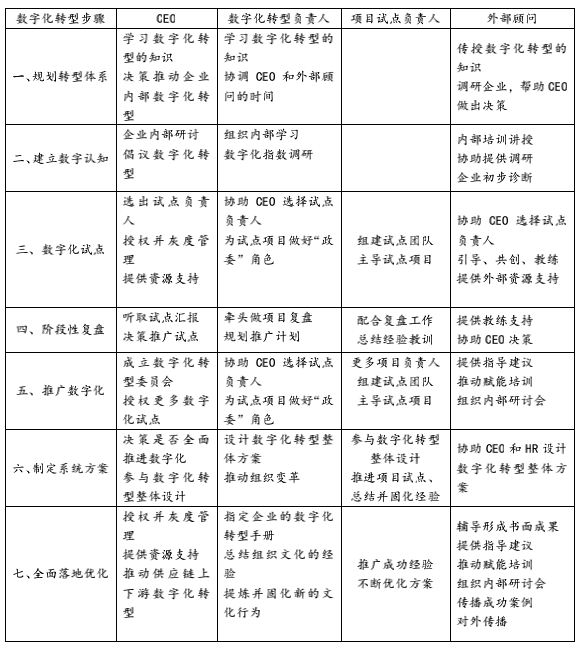
数字化转型过程需要多方协作,如果把参与者分为三个部分:CEO、数字化转型负责人、项目试点负责人和外部顾问,他们之间的分工如下:
虽然德鲁克的很多想法并没有运用到通用汽车的实践中去,但无疑对斯隆的很多管理思想还是有影响的。
德鲁克的工作方法值得现在的咨询顾问学习。首先,咨询顾问应该是某一个领域的专家,同时又要对服务的企业有深入地了解。他以一个专家的学识,利用自己或者同事积累的素材,通过深入调研企业,帮助企业找到问题,为这个企业指明发展的方向。如果可以的话,他会给企业提供清晰的解决方案,帮助企业解决遇到的问题。 数字化转型网(www.szhzxw.cn)
虽然咨询顾问是一个真正的专家,但他应该认识到:真正的答案并不掌握在自己的手里,而是那些对自己的企业和行业有深刻认识的客户手中,自己的责任是去启发引领他们找到真相。再资深的顾问,都别把自己当成知晓所有答案的救世主,客户往往比你更聪明。优秀的咨询顾问应该是这个企业家的“教练”,帮助客户分析公司和行业的情况,然后帮助这些企业家完成变革。

翻译:
Digital transformation to land, how to use external consultants?
In order to do digital transformation, enterprises must first do the overall planning of digital transformation, which often requires the intervention of external consultants. The value of external consultants is that they have an overall understanding of digital transformation, and have a wealth of guidance and coaching skills, and can lead the company’s senior management to develop a suitable digital transformation solution. And in the subsequent landing process, external consultants also need to be involved throughout the process to provide support for the transformation pilot team.
In this process, external consultants play multiple roles as consultants, trainers and corporate coaches, requiring multi-dimensional professional capabilities and leadership to coordinate the organization to achieve its goals. The requirements of this multiple role, as well as the method of consultation, are different from the traditional consultants who produce solutions. It can be said that in the digital era, not only enterprises need digital transformation, the methodology of enterprise strategy development needs transformation, and the consultants who guide enterprises to implement digital transformation also need transformation. 数字化转型网(www.szhzxw.cn)
The digital age is also upending traditional paradigms of strategy making. What exactly has changed? Let’s start with the traditional consulting paradigm, and then look at how the role of the consultant has changed in the digital age.
First, the consulting paradigm is changing
The traditional idea of strategic planning is: the strategic consulting company sends a project team to the enterprise to investigate the needs and current situation of the customer, then does market analysis, research and interview, and finally produces a beautiful report. These reports are very professional in terms of professionalism and presentation, but because the consulting firm is not involved in the execution of the strategy, whether these wonderful plans can be implemented depends on the nature of the company. 数字化转型网(www.szhzxw.cn)
There is a historical background for companies to outsource strategic consulting to consulting firms. First of all, the company’s management is mostly in the business background, not many people have professional business training, the consulting company’s methodology has a cognitive advantage; Second, consulting firms have proprietary databases and specialized tools that enable them to find information that outside firms cannot. Third, corporate decisions need third-party endorsement. Consulting consultants are equivalent to think tanks of ceos. They are good at organizing ceos’ ideas and making them look professional, which is easier to obtain the recognition of the board of directors and can reduce the responsibility of ceos in making decisions.
Now all these advantages of strategy consulting firms have been greatly diminished. The first is the cognitive advantage, most of the senior executives of large companies have professional business training, even some of them were originally consultants, they changed from Party B to Party A, so those knowledge and skills advantages do not exist. The second is the information advantage, because the information advantage of the Internet is obvious, access to information is easier than before, and the value of many “best practices” is greatly discounted, and the information advantage is also weakened.
In a relatively static society, this consulting paradigm has value, but as the environment changes faster and faster, yesterday’s “best practices” may well become jokes tomorrow. When Apple first entered the mobile phone market, would the iPhone exist today if the consulting firm had followed Nokia’s “best practices”? There are no such “best practices” for emerging industries, so the expert advisor acting as an all-knowing god is slowly becoming obsolete.
More importantly, in a highly changing situation, strategy formulation and implementation will no longer be separable, relying on the consulting plan obtained by research may not reflect the real situation of the enterprise, if the plan makers do not participate in the implementation of the plan, they will not be able to truly land. Moreover, the enterprise cycle is getting shorter and shorter, and the strategic cycle is getting shorter and shorter, and the enterprise no longer needs a three-year strategy, but a constantly updated strategy.
Henry Mintzberg has an interesting analogy for aspiring consultants: they are a flock of migratory birds that scurry around an island, jump to conclusions, and then fly away. According to his theory, the function of consultants and managers is very similar, it is a craft, only to know the theory is far from enough, many things need years of practice to slowly understand. If a consultant will only talk about some big and unreasonable strategies all day long, or even lack a basic understanding of the enterprise, write some universal consulting reports, and can not really help the enterprise solve the problem, then their value is very questionable. 数字化转型网(www.szhzxw.cn)
Consulting firms are changing too! Leading consulting firms, including McKinsey, are also changing their consulting paradigm, and a new consulting paradigm is emerging, from one that is the architect of consulting solutions to one that is the leader of group solutions.
Practice is always ahead of theory. In fact, in the 1980s, Jack Welch of General Electric began implementing this consulting paradigm within his company, which he called a “Workout.” He involved the senior management of the company in the formulation of strategy, cut to the real problem, mobilize the wisdom of the group, combined with some consulting models and coaching tools, in order to solve the real problem, and in the process to develop the team’s problem-solving ability, truly achieve “learning from doing, learning from doing”!
This practice of “doing and learning” is now more popular “action learning”. Many people interpret “action learning” as “guided technology,” which is a great misunderstanding. Action learning is a methodology and a system that combines consulting, training and coaching to develop team capacity while solving problems. Action learning has been well used in leadership development, strategic problem solving, and organizational transformation.
This “action learning” counseling paradigm is somewhat similar to Jeet Kune Do, invented by Bruce Lee. At first it seems to have any way, a little wild feeling, but the actual combat ability is very strong. It absorbs a lot of valuable things, and integrates its own school, does not emphasize the perfection of the theory, but emphasizes the realization of the actual war goal – solving problems and developing capabilities, it gives full play to the advantages of the wisdom of the crowd, and constantly iterated and updated, but also reflects the characteristics of the digital age.
Second, inspiration from IBM as a consultant to Huawei
IBM is an IT company that, if spun off from its consulting and services businesses, could become the world’s largest management consulting firm. Because IBM does business as well as consulting, IBM understands what clients need better than other consulting firms and can actually provide relevant solutions. They often say, “The medicine we give our clients is the one we taste first.” This is persuasive for companies that are tired of reports but don’t generate much real revenue.
IBM is also the main builder of Huawei’s management system. In 1997, Huawei was developing rapidly, but the management system was still relatively backward, and Ren Zhengfei felt that it was necessary for the company to transform into a multinational company with international competitiveness. That year’s Christmas, Ren Zhengfei went to the United States, visited IBM, HP, Hughes and Lucent four high-tech companies, saw a circle down, that only IBM can be Huawei’s teacher, so spent a lot of money to hire IBM consultants. 数字化转型网(www.szhzxw.cn)
It is Global Services, which plays a leading role in IBM, that shares management experience with Huawei and helps it reengineer processes. There are three reasons for Huawei to choose IBM as its consultant. First, IBM’s IT industry is similar to Huawei’s communication industry. Second, IBM has both traditional business units and emerging consulting and services units that can help them solve problems. Thirdly, IBM’s transformation experience since 1995 is exactly what Huawei needs.
Ren Zhengfei decided to fully integrate IBM’s management system. At its core, all work revolves around one core – high performance – by turning closed research and development into open services and translating the costs of the entire company into individual product lines. This decision caused a strong backlash within Huawei at the time, and many people believed that IBM’s situation was very different from Huawei’s, so “raw adaptation” might “adapt to the soil”. In the face of internal resistance, Ren was very forceful: “If the shoes do not fit, then cut off the feet.” Ren Zhengfei put forward the requirement of “first solidification and then optimization”, that is to say, the first set of IBM’s management system is strongly implemented, and after curing this set of system, it is optimized according to the actual situation of the enterprise.
IBM’s global services division sent 50 consultants to Huawei for five years, working with Huawei’s middle and senior management to improve the work. Huawei also actively cooperated by setting up a management engineering department to focus on process reengineering. Five years later, Huawei paid more than 1 billion yuan to rebuild the cost, and finally built itself into a company with international competitiveness. It is not an exaggeration to say that Huawei has evolved from a Chinese communications company with an annual income of several billion yuan in the mid-1990s to a global communications manufacturing company with an annual income of close to one hundred billion yuan, and IBM’s “transmission, help and belt” have contributed greatly, and IBM’s blue components are in Huawei’s blood. 数字化转型网(www.szhzxw.cn)
Of course, Huawei’s path is not the only option, and it may not be appropriate for most small and medium-sized enterprises. However, Huawei’s practice can at least give many Chinese enterprises this inspiration: first, consulting is regarded as a strategic level, and there is a clear goal and path for change.
Second, consultants should be experts in the field and be able to stay inside the company for a long time and focus on solving problems with people inside the company. Third, the company should be involved in consultation and change from the top down, where the support and involvement of the company’s top management is particularly important. Fourth, do things with a long-term vision, once you believe that you are doing a right thing, you must have the courage and determination to adhere to the right concept.
“Borrowed light cannot light its own lamp.” Every enterprise is special, and there is no one “dragon knife” that can solve all problems. When companies hire consultants, they also need to have clear expectations – they are more like coaches who can tell you what to do, but to really achieve their goals, they have to rely on their own continuous effort. In a sense, the enterprise is discovering and solving problems by itself, and a good consultant can help the enterprise to find and solve these problems well, they bring the “outsider’s vision”.
Third, the new requirements for consultants in the digital age
There are three key words that external consultants need to focus on when developing digital transformation strategies for companies: agile, co-creation, and iteration. The so-called agile is to greatly compress the cycle of strategic planning, from the traditional three years to six months. Because the external environment is changing rapidly, it is difficult for us to predict the changes after three years, so we should emphasize the flexibility of strategic planning. Some people worry that the strategy changes too often have an opportunistic tendency, which requires the support of the mission, vision and values to ensure that the general direction is basically the same, only some parts and details are constantly adjusted. 数字化转型网(www.szhzxw.cn)
The so-called co-creation is to combine the planning and execution of the strategy into one, so that external consultants and corporate executives can discuss the strategy together in the form of workshops. The advantage of external consultants is that they have more comprehensive knowledge, have many tools and methodologies, and can participate in the discussion as a coach or guide. Business executives have the advantage of being more understanding of business and industry conditions, and being the project implementers themselves, so they can develop more agile in this way.
The so-called iteration is to start from opportunities and problems, and constantly revise the previous assumptions. In the process of implementing strategies, enterprises often find that some assumptions may not reflect the real situation, so they need to constantly adjust and optimize. On the one hand, enterprises should start from the opportunity and constantly look for new strategic possibilities; On the other hand, we should also start from the problem and improve the company’s strategy and tactics in the process of constantly solving the problem.
These three new paradigms for strategizing are also placing new demands on consultants, and the role of consultants is changing somewhat. They are no longer those who grasp the secrets of the industry and give the on-site answers to the CEO, they are more like a leader to find and solve problems, combine the goals and problems of the enterprise, mobilize the management of the enterprise, work together, team learning, and truly solve the actual problems of the enterprise. In this process, external consultants play the role of consultant, coach and trainer at the same time, combined with the experience and understanding of the enterprise and the industry of the internal executives, in order to develop a solution that conforms to the actual situation of the enterprise and can be landed. Peter Drucker, the management guru, did just that, describing consultants as “testing grounds for ideas”. In 1943, Drucker joined General Motors as a consultant and stayed there for two years. Drucker would attend meetings with Sloan, the president of General Motors, and discuss problems together. Two years later, Drucker wrote a book, The Concept of the Corporation, which is later recognized as the beginning of management as a discipline.
The digital transformation process requires multi-party collaboration, if the participants are divided into three parts: the CEO, the digital transformation leader, the project pilot leader, and the external consultant, the division of labor between them is as follows:
Although many of Drucker’s ideas were not applied to the practice of General Motors, they undoubtedly had an impact on many of Sloan’s management ideas.
Drucker’s methods are worth learning from today’s consultants. First of all, the consultant should be an expert in a certain field, but also have a deep understanding of the business. With the knowledge of an expert, he makes use of the materials accumulated by himself or his colleagues to help enterprises find problems through in-depth research and point out the direction of development for the enterprise. If he can, he will provide clear solutions to help companies solve the problems they encounter.
Although the consultant is a true expert, he should realize that the real answer is not in his own hands, but in the hands of clients who have a deep understanding of their business and industry, and it is his responsibility to enlighten and lead them to find the truth. No matter how senior a consultant is, don’t think of yourself as the savior who has all the answers. Clients are often smarter than you. A good consultant should be the entrepreneur’s “coach,” helping the client analyze the company and the industry, and then help the entrepreneur complete the change.
本文由数字化转型网(www.szhzxw.cn)转载而成,来源于新工业网;编辑/翻译:数字化转型网宁檬树。
免责声明: 本网站(https://www.szhzxw.cn/)内容主要来自原创、合作媒体供稿和第三方投稿,凡在本网站出现的信息,均仅供参考。本网站将尽力确保所提供信息的准确性及可靠性,但不保证有关资料的准确性及可靠性,读者在使用前请进一步核实,并对任何自主决定的行为负责。本网站对有关资料所引致的错误、不确或遗漏,概不负任何法律责任。
本网站刊载的所有内容(包括但不仅限文字、图片、LOGO、音频、视频、软件、程序等) 版权归原作者所有。任何单位或个人认为本网站中的内容可能涉嫌侵犯其知识产权或存在不实内容时,请及时通知本站,予以删除。