
中小制造企业是经济社会发展的生力军,目前国内外经济环境复杂多变,中小制造企业面临要素成本上升、创新发展动能不足、市场竞争加剧等问题,所以中小企业数字化转型已不是“选择题”,而是关乎生存和长远发展的“必修课”。
工信部发布的中小企业数字化转型分析报告显示,目前中小企业数字化转型处于初步探索阶段的企业占比79%,达到深度应用阶段的企业占比9%,不少中小制造企业受市场环境、行业特征以及数字化基础等因素影响,数字化成熟度存在差异。所以,建立行之有效的中小制造企业成熟度评价模型,既可以为企业诊断当前数字化转型现状提供工具箱和方法论,又可以作为指南针为企业提供方向与指导。
一、数字化转型评价研究现状
随着物联网、大数据、人工智能、5G、云计算等信息技术与企业发展的深度融合,企业数字化评价模型也受到越来越多的学者关注。结合研究现状,针对中小制造企业数字化转型成熟度评价研究较少,加之中小企业数字化转型之路更加严峻,所以建立合适的数字化成熟度评价模型,帮助中小企业制造数字化转型具有重要意义。数字化转型网www.szhzxw.cn
而根据制造企业数字化能力的不同维度,国内外学者提出了相关理论模型,例如德国机械与工程协会(VDMA)针对机械工程行业提出的工业4.0就绪度模型(IRI)聚焦在资源、信息系统、文化和组织架构4个领域,从战略和组织、智能工厂、智能操作、智能产品、数据驱动、人员等6个维度来评价企业的工业4.0就绪度。
美国国家标准研究所(NIST)提出的智能制造就绪度水平模型(SMSRL)主要从组织成熟度,信息技术成熟度,绩效管理成熟度和信息连接成熟度等4个维度评估制造公司是否采用数据密集型技术进行性能管理的准备情况。工业和信息化部在2020年发布的《国家智能制造能力成熟度模型》提出,从人员、技术、资源和制造4个能力要素在企业进行管理提升和综合应用的程度,客观评价各地区、各行业智能制造发展水平,为企业精准提升智能制造能力,起到重要的参考价值。成熟度评价模型对比如表1所示。

二、评价模型构建
1、评价指标选取原则
为建立更加规范、贴合中小制造企业数字化转型的指标体系,本研究在选取指标时遵循以下原则:
①科学性原则。指标选取应能表征数字化转型的内涵和特征,实际反映数字化转型发展阶段,指标采集应准确可控,定性和定量相结合,有效支持数字化转型水平与能力、效能与效益的评估、分析、诊断和改进;数字化转型网www.szhzxw.cn
②实效性原则。指标体系应具有典型性,能够从战略层面、发展基础、应用场景和创新发展反映中小制造企业数字化发展现状与转型趋势,以评估企业数字化转型水平与能力;
③可操作性原则。评估指标宜易于选取,能够和企业实际相结合,便于采集与分析,围绕企业数字化和数据管理能力建设,突出对战略、基础设施、制造、管理、服务等关键环节数字化转型的评估,具有广泛适用性。
2、评估模型指标选择及解释
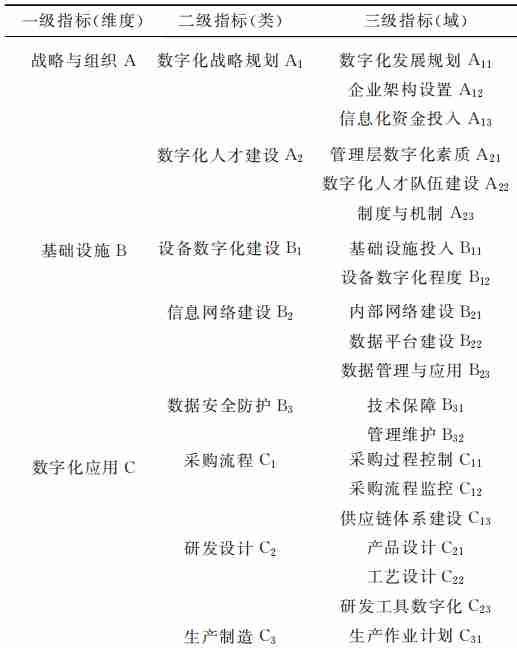
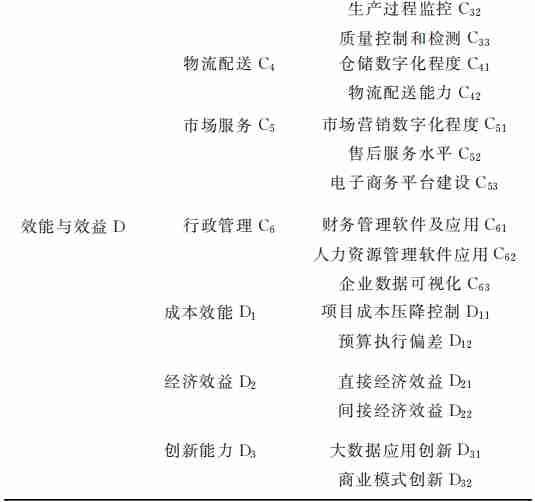
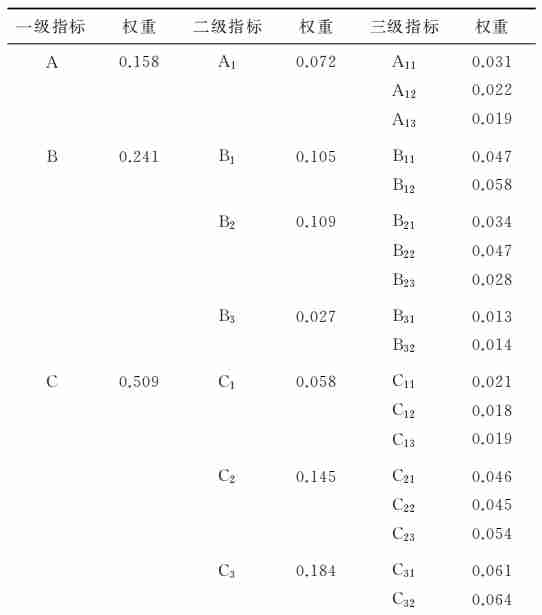
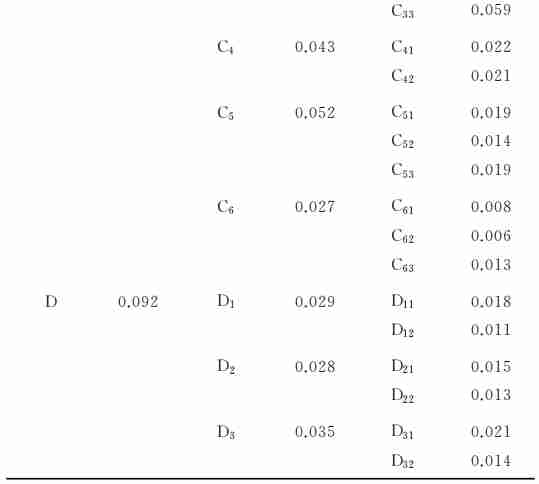
在分析、汲取两化融合和数字化评价模型的基础上,结合当前中小制造企业数字转型现状,本研究以战略与组织、基础设施、数字化应用、效能与效益4个维度为核心,设立14个二级指标(类)36个三级指标(域)对中小制造企业数字化转型的评价模型构建进行探究,如表2所示
(1)战略与组织。
中小制造企业数字化战略的顶层设计与实施,是数字化建设顺利开展的前提,具体表现在数字化战略规划和人才建设两个方面:数字化战略规划主要评价数字化转型规划制定和企业发展战略的一致性,企业架构设置时是否放在重要位置,以及在企业自动化、信息化建设运维以及研发投入等相关资金投入的水平。
数字化人才建设主要评价中小制造企业专职人员队伍建设,信息化主管领导层级以及研发、生产和管理人员的信息化相关程度,企业数字化转型中人才保障制度、机制建设的全面性。
(2)基础设施。
基础设施信息化建设是中小制造企业数字转型的基石,本维度选取设备数字化建设、信息网络建设和数据安全防护作为主要评价指标。设备数字化建设重点评估中小制造企业在设备、软件与系统构建过程中投入水平和适度性,设备设施的智能化或数字化水平。
信息网络建设重点评估企业信息化架构和网络环境建设水平,数据资源采集及数据集中管理应用,以及信息化资源积累与整合、云服务平台建设等。数据安全防护重点评估信息资源、设备设施和系统安全保护,同时关注数据安全管理和防范机制建设。数字化转型网www.szhzxw.cn
(3)数字化应用。
通过评估数字化技术在采购流程、研发设计、生产制造、物流配送、市场服务以及行政管理等方面数字化场景引入应用,衡量整个制造企业信息化、数据化和智能化应用的深度。采购流程数字化应用指标反映在企业采购全过程的数据化水平、采购流程的可视化和供应链体系的智能建设。
研发设计数据化应用指标反映在数字化产品模型或原型样机、模块化设计和计算机辅助产品工艺设计的水平与能力。生产制造数字化应用指标反映在企业生产作业计划编制与执行、过程信息监控、生产异常管控以及产品质量检测和产品质量信息追溯等方面。
物流配送数字化应用指标反映在仓库管理智能化应用水平和对物流信息进行跟踪反馈水平。市场服务数字化应用指标反映在企业利用大数据进行市场细分与定位,预测市场趋势并进行优化定价和营销策略选择,并通过电子商务平台建设,做好质量问题、维修过程等售后服务反馈。行政管理数字化应用指标反映在财务业务集成和财务管理软件的覆盖率,以及智能测算绩效实现人力资源管理精细化、智能化的能力与水平。数字化转型网www.szhzxw.cn
(4)效能与效益。
数字化效能和效益是企业实施数字化转型产出,主要通过评估在成本效能、经济效益和创新能力的提升判断数字化转型成熟度。成本效能主要体现在中小制造企业成本利润率的提高、采购降本指标完成率以及测算预算执行偏差率。
经济效益主要评价通过数字化转型在营业收入增长,人均劳动生产率、存货周转率及流动资产周转率提升等直接或间接带来的经济效益。在创新能力评估方面,可以细分为大数据应用创新和商业模式创新。
3、中小制造企业数字化转型成熟度评价
针对成熟度评价模型中4个核心维度、14个二级指标和36个三级指标,通过构建判断矩阵、专家评分、计算权重和一致性检验等程序,利用层次分析法确定其指标权重,进行中小制造企业数字化转型成熟度综合评价并定级。
(1)构建判断矩阵
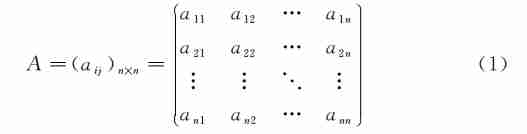
矩阵A中aij表示指标i相对于指标j的比较结果,判断矩阵如下:
(2)专家评分
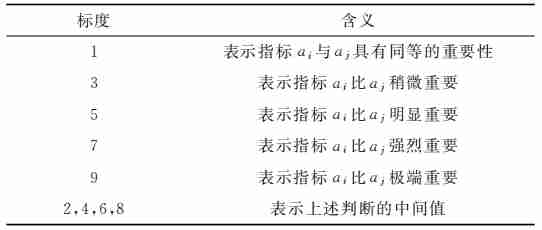
邀请评估专家基于指标解释,对成熟度模型同层次的指标两两比较,根据1-9标度方法进行重要性评分,规则如表3所示。
(3)计算指标权重
将矩阵A的各行指标用方根法进行几何平均得出平方根向量.Wi,进行归一化处理,计算得到中小制造企业数字化转型成熟度各评价指标权重和特征向量Wi。

(4)一致性检验
由于判断矩阵中评估专家主观判断会产生一定的偏差,所以需要检验一致性。首先利用公式(3)对判断矩阵的一致性指标进行计算:

其中λmax为矩阵A的最大特征值。再利用公式(4)计算判断矩阵的随机一致性比率CR:

当一致性指标计算结果CR<0.1时,可以认为构建判断矩阵具有满意的一致性,否则需要专家重新判断评分。RI为平均随机一致性指标标准值,其参考值如表4所示。

(5)综合评价
根据中小制造企业实际情况对照数字化转型成熟度等级,评审专家对三级指标根据数字化成熟度从低到高进行0~5赋分,根据各指标得分结合权重进行加权求和得出最后得分,对标成熟度评价模型设置的等级分值,即可以自诊企业整体数字化转型的成熟度。
本研究通过参考中国电子技术标准化研究院等发布的智能制造能力成熟度模型,将中小制造企业数字化转型成熟度划分为5个等级,分别是规划级(一级)、规范级(二级)、集成级(三级)、优化级(四级)和引领级(五级),各级别评分如表5所示。数字化转型网www.szhzxw.cn
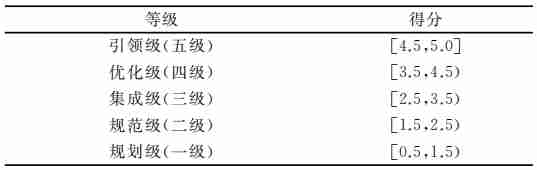
规划级(一级):企业开始对准备实施数字化转型,能够对研发设计、生产制造、物流配送、销售运营和市场服务等核心业务活动进行流程化管理。
规范级(二级):企业对核心装备和核心业务活动等进行数字化转型改造和规范,通过自动化技术、信息技术手段实现单一业务活动的数据共享。
集成级(三级):企业实现数字化装备、信息系统等的数据共享,开展跨业务活动间的综合集成。
优化级(四级):企业已实现对人员、资源、制造等数据挖掘与数字化转型,能够对核心业务活动的精准预测与优化。
引领级(五级):企业数字化成熟度已经处于行业领先水平,实现全业务活动创新协同并衍生新的数字化制造模式与商业模式。
三、综合评价模型应用
1、成熟度综合评价模型实证分析
针织服装制造是浙江义乌的特色产业集群,据统计,义乌现有针织生产企业超1200家,主要产品占据国内市场份额的80%、全球的25%。
2021年,针织服装产业集群入选浙江首批产业集群新智造试点,在政策扶持下多家企业实现数字车间和数字化生产线覆盖,智能制造由点状突破向整体提升转变发展。在龙头企业带领下,针织服装中小制造企业逐步实现数字化转型,为全面客观的评价数字化成熟度,检验综合评价模型实效,通过走访生产基地、产业中心和创业园并发放调查问卷,获取100多家针织服装细分行业中小制造企业反馈,收集有效调查问卷共计113份。并邀请来自政府、企业和高校的专家根据义乌针织服装制造业特点对模型指标进行评分并计算获得指标权重,如表6所示。
根据统计结果发现,受访企业中69%的企业还未能达到深度数字化转型,具体评价结果见表7。首先是针织服装中小制造企业在研发设计指标数字化成熟度最高,有82%的受访企业评分已达到三级以上,证明企业正由中低端代工生产向品牌化研发设计生产转变;其次是生产制造、设备数字化建设指标成熟度较高,分别有75%和68%的企业评分在三级以上,通过调研发现众多企业已经实现生产智能化。
此外,评价模型应用反映出一些指标成熟度不高,阻碍了企业数字化转型,主要集中在数字化战略规划、信息网络建设和成本效能等方面。数字化转型网www.szhzxw.cn
在数字化战略规划指标评分中,只有14%的受访企业达到成熟度三级以上,多数企业数字化转型意愿强烈,但是缺乏清晰的战略目标和实现路径,没有企业顶层设计进行谋划,数字技术人才十分紧缺;在信息网络建设方面,只有17%的受访企业评分在三级以上,在基础设施建设上,企业重视智能生产设备的投入,但在软件与系统构设、数据平台搭建和企业信息化架构等投入不足;在成本效能指标上,只有19%的企业成熟度在三级以上,主要体现在中小制造企业资金力量相对薄弱,融资渠道有限,在数字化车间、智能制造设备等方面投入资金大,导致资金流动性较差,增加了生产成本,如表7所示。

2、数字化转型的建议
针对针织服装产业集群成熟度综合评价模型应用中存在的问题,可以通过以下几个维度的提升来推进中小制造企业数字化转型:
(1)数字化战略与组织方面开展企业数字化转型顶层设计,管理者应重视企业的数字化转型,作为一项系统工程制定战略规划,合理优化资源配置,从组织架构、政策、资金投入等保障数字化转型的开展,同时加强数字化人才队伍建设,提升研发、生产和管理人员的信息化程度,建立全面的人才保障制度。
(2)基础设施数字化投入上企业跳出“重硬轻软”的思维模式,搭建工业互联网数据平台加大对软件与系统构设,特别是智慧控制、自主修复相关的网络化自动控制软件,产品计算、物联网和信息系统等智慧连接系统等投入,不断提升数字化信息平台的服务功能,丰富其应用场景,加快实现中小企业由“制造”向“智造”转变。
(3)与大企业相比,中小企业没有足够的技术水平和资金实力开展数字化转型,中小企业可以利用信贷和资本市场相结合的方式拓宽融资渠道,一方面,可以争取政府传统产业数字化转型专项资金支持;另一方面,可以利用信息化技术透明化企业融资信息,争取国有大型商业银行、地方金融机构以及民间融资市场的长期投资,来推动中小制造企业的数字化转型升级。数字化转型网www.szhzxw.cn
四、结 语
本文结合当前中小制造企业数字化转型现状,从战略与组织、基础设施、数字化应用、效能与效益4个维度,将数字化转型的相关因素归纳为可观、可测的因子,以量化数据为基础,设立14个二级指标(类)和36个三级指标(域),对中小企业数字化转型成熟度评价模型构建进行探究,并通过应用对标成熟度等级,让中小制造企业自我诊断数字化转型存在中的问题,引导企业将制造资源配置范围从传统要素向数据要素拓展,提升数字化转型发展水平。
翻译:
Small and medium-sized manufacturing enterprises are the new force of economic and social development. At present, the domestic and international economic environment is complex and changing, and small and medium-sized manufacturing enterprises are faced with problems such as rising factor costs, lack of momentum for innovation and development, and intensified market competition. Therefore, the digital transformation of small and medium-sized enterprises is no longer a “multiple choice”, but a “required course” for survival and long-term development.
According to the analysis report on the digital transformation of smes released by the Ministry of Industry and Information Technology, 79% of smes are in the preliminary exploration stage of digital transformation, and 9% are in the deep application stage. Many smes are affected by market environment, industry characteristics, digital basis and other factors, and there are differences in digital maturity. Therefore, the establishment of an effective maturity evaluation model for small and medium-sized manufacturing enterprises can not only provide a toolbox and methodology for enterprises to diagnose the current situation of digital transformation, but also provide direction and guidance for enterprises as a compass.
Research status of digital transformation evaluation
With the deep integration of the Internet of Things, big data, artificial intelligence, 5G, cloud computing and other information technologies with enterprise development, enterprise digital evaluation model has attracted more and more scholars’ attention. Combined with the research status, there are few studies on the evaluation of digital transformation maturity of small and medium-sized manufacturing enterprises, and the road of digital transformation of small and medium-sized enterprises is more severe, so it is of great significance to establish an appropriate digital maturity evaluation model to help small and medium-sized manufacturing digital transformation.
According to different dimensions of digital capability of manufacturing enterprises, domestic and foreign scholars have proposed relevant theoretical models. For example, Industry 4.0 readiness model (IRI) proposed by German Mechanical and Engineering Association (VDMA) for mechanical engineering industry focuses on four fields, namely resources, information system, culture and organizational structure. The enterprise’s industry 4.0 readiness is evaluated from six dimensions: strategy and organization, intelligent factory, intelligent operation, intelligent products, data-driven and personnel.
The intelligent manufacturing readiness level model (SMSRL) proposed by the National Institute of Standards (NIST) mainly evaluates the readiness of manufacturing companies to adopt data-intensive technologies for performance management from four dimensions: organizational maturity, information technology maturity, performance management maturity and information connection maturity. The Maturity Model of National Intelligent Manufacturing Capability released by the Ministry of Industry and Information Technology in 2020 proposes to objectively evaluate the development level of intelligent manufacturing in various regions and industries from the perspective of personnel, technology, resources and manufacturing capability factors in enterprise management improvement and comprehensive application, which plays an important reference value for enterprises to accurately improve intelligent manufacturing capability. The maturity evaluation model pairs are shown in Table 1.
Evaluation model construction
Selection principles of evaluation indicators
In order to establish a more standardized and suitable index system for the digital transformation of small and medium-sized manufacturing enterprises, the following principles were followed in the selection of indexes:数字化转型网www.szhzxw.cn
① Scientific principle. The selection of indicators should be able to represent the connotation and characteristics of digital transformation, and actually reflect the development stage of digital transformation. The collection of indicators should be accurate and controllable, combined with qualitative and quantitative, to effectively support the evaluation, analysis, diagnosis and improvement of the level and ability of digital transformation, efficiency and benefit.
② The principle of effectiveness. The index system should be typical, which can reflect the digital development status and transformation trend of small and medium-sized manufacturing enterprises from the strategic level, development basis, application scenarios and innovative development, so as to evaluate the digital transformation level and ability of enterprises.
(3) Operability principle. Evaluation indicators should be easy to select, can be combined with the actual situation of enterprises, and easy to collect and analyze. Centering on enterprise digitalization and data management capacity building. The evaluation of digital transformation of strategy, infrastructure, manufacturing, management, service and other key links should be highlighted, which has wide applicability.
Selection and interpretation of evaluation model indicators
Based on the analysis and learning of the integration of the two and digital evaluation model, combined with the current situation of the digital transformation of small and medium-sized manufacturing enterprises, this study takes the four dimensions of strategy and organization, infrastructure, digital application, efficiency and benefit as the core, sets up 14 second-level indicators (categories) and 36 third-level indicators (domains) to explore the construction of the evaluation model of the digital transformation of small and medium-sized manufacturing enterprises. As shown in Table 2.
(1) Strategy and organization.数字化转型网www.szhzxw.cn
The top-level design and implementation of digital strategy of small and medium-sized manufacturing enterprises is the premise for the smooth development of digital construction, which is reflected in digital strategic planning and talent construction: Digital strategic planning mainly evaluates the consistency between digital transformation planning and enterprise development strategy, whether enterprise architecture is placed in an important position, and the level of capital investment in enterprise automation, information construction, operation and maintenance, and R&D investment.
The construction of digital talents mainly evaluates the construction of full-time personnel in small and medium-sized manufacturing enterprises, the level of information management and the relevant degree of information technology of R&D, production and management personnel, as well as the comprehensiveness of talent security system and mechanism construction in enterprise digital transformation.
(2) Infrastructure.
Infrastructure informatization construction is the cornerstone of digital transformation of small and medium-sized manufacturing enterprises. In this dimension, equipment digitization construction, information network construction and data security protection are selected as the main evaluation indicators. Equipment digital construction focuses on evaluating the input level and appropriateness of small and medium-sized manufacturing enterprises in the construction process of equipment, software and system, as well as the intelligent or digital level of equipment and facilities.
Information network construction focuses on evaluating the construction level of enterprise information architecture and network environment, data resource collection and centralized data management and application, as well as the accumulation and integration of information resources and the construction of cloud service platform. Data security protection focuses on the evaluation of information resources, equipment, facilities and system security protection, while focusing on data security management and prevention mechanism construction.
(3) Digital application.
By evaluating the introduction and application of digital technology in the procurement process, research and development design, production and manufacturing, logistics and distribution, market services and administrative management, the depth of informatization, data and intelligent application in the whole manufacturing enterprise is measured. The digital application index of procurement process is reflected in the digital level of the whole process of procurement. The visualization of procurement process and the intelligent construction of supply chain system.
The data application index of R & D design is reflected in the level and ability of digital product model or prototype, modular design and computer-aided product process design. The application index of manufacturing digitization is reflected in the preparation and implementation of production operation plan, process information monitoring, abnormal production control, product quality testing and product quality information tracing.数字化转型网www.szhzxw.cn
The digital application index of logistics distribution reflects the intelligent application level of warehouse management and the tracking and feedback level of logistics information. The digital application index of market service reflects that enterprises use big data to carry out market segmentation and positioning, predict market trends, optimize pricing and marketing strategy selection, and provide quality problems, maintenance process and other after-sales service feedback through the construction of e-commerce platform. The digital application index of administrative management is reflected in the coverage rate of financial business integration and financial management software, as well as the ability and level of intelligent performance measurement to realize the refinement and intelligence of human resource management.
(4) Efficiency and benefit.
Digital efficiency and benefit are the output of enterprises implementing digital transformation. The maturity of digital transformation is judged mainly by evaluating the improvement of cost efficiency, economic benefit and innovation ability. Cost effectiveness is mainly reflected in the improvement of cost profit rate of small and medium-sized manufacturing enterprises. The completion rate of procurement cost reduction index and the deviation rate of estimated budget implementation.
Economic benefits mainly evaluate the economic benefits directly or indirectly brought by digital transformation in the growth of business income, per capita labor productivity, inventory turnover and current assets turnover. In terms of innovation capability evaluation, it can be subdivided into big data application innovation and business model innovation.
Evaluation of digital transformation maturity of small and medium-sized manufacturing enterprises
Aiming at the 4 core dimensions, 14 secondary indexes and 36 tertiary indexes in the maturity evaluation model. The index weights were determined by the analytic hierarchy process (AHP) through the construction of judgment matrix, expert scoring, calculation weight and consistency test. And the digital transformation maturity of small and medium-sized manufacturing enterprises was comprehensively evaluated and graded.
(1) Construct a judgment matrix
aij in matrix A represents the comparison result of index i with index j. And the judgment matrix is as follows:
(2) Expert rating
Evaluation experts are invited to make pairwise comparison of indicators at the same level of maturity model based on indicator interpretation, and conduct importance rating according to scale method 1-9. The rules are shown in Table 3.
Table 3 Index comparison scale and description数字化转型网www.szhzxw.cn
(3) Calculate index weights
The square root vector is obtained by geometrically averaging each index of matrix A using the root method. Wi, carry out normalization processing, and calculate the weight of each evaluation index and feature vector Wi of digital transformation maturity of small and medium-sized manufacturing enterprises.
(4) Consistency test
Because the subjective judgment of evaluation experts in the judgment matrix will produce certain deviation, so it is necessary to check the consistency. Firstly, Formula (3) is used to calculate the consistency index of the judgment matrix:
Where λmax is the maximum eigenvalue of matrix A. Then formula (4) is used to calculate the random consistency ratio CR of the judgment matrix:
When CR < 0.1 is the calculated result of consistency index, it can be considered that the constructed judgment matrix has satisfactory consistency; otherwise, experts need to judge and score again. RI is the standard value of average random consistency index, and its reference value is shown in Table 4.
Table 4 Reference standard values of average random consistency indicators
(5) Comprehensive evaluation
According to the actual situation of small and medium-sized manufacturing enterprises and the digital transformation maturity level. The evaluation experts assign 0~5 points to the three-level indicators according to the digital maturity level from low to high. According to the score of each index combined with the weight. The weighted summation is carried out to obtain the final score. The grade score set by the standard maturity evaluation model is the maturity of the overall digital transformation of the enterprise.
By referring to the intelligent manufacturing capability maturity model released by China Institute of Electronic Technology Standardization, this study divides the digital transformation maturity of small and medium-sized manufacturing enterprises into five levels, namely, planning level (level 1), specification level (level 2), integration level (level 3), optimization level (level 4) and leading level (level 5).
The scores of these levels are shown in Table 5.
Table 5 Reference for evaluation of maturity level of digital transformation of small and medium-sized manufacturing enterprises
Planning level (Level 1) :. Enterprises begin to prepare for the implementation of digital transformation, and can process management of core business activities such as research and development, design, production and manufacturing, logistics distribution, sales operation and marketing services.
Specification level (Level 2) :. Enterprises carry out digital transformation and standardization of core equipment and core business activities. And realize data sharing of single business activities through automation technology and information technology means.
Integration level (Level 3) : The enterprise realizes data sharing of digital equipment, information system, etc. And carries out comprehensive integration among cross-business activities.
Optimization level (Level 4) :. The enterprise has realized data mining and digital transformation of personnel, resources, manufacturing, etc. And can accurately predict and optimize core business activities.
Leading level (Level 5) : The digital maturity of the enterprise has been at the industry-leading level. And it can realize the innovation and collaboration of all business activities and derive new digital manufacturing model and business model.
Application of comprehensive evaluation model
Empirical analysis of maturity comprehensive evaluation model
Knitwear manufacturing is a characteristic industrial cluster in Yiwu, Zhejiang Province. According to statistics, there are more than 1200 knitwear manufacturing enterprises in Yiwu. And their main products account for 80% of the domestic market and 25% of the global market.
In 2021, the knitwear industry cluster was selected as the first batch of Zhejiang industrial cluster new intelligent manufacturing pilot. With the support of policies, many enterprises realized the coverage of digital workshops and digital production lines. And the intelligent manufacturing transformed from a point breakthrough to an overall improvement. Under the leadership of leading enterprises, small and medium-sized knitted garment manufacturing enterprises have gradually realized digital transformation.
In order to comprehensively and objectively evaluate the digital maturity and test the effectiveness of the comprehensive evaluation model, feedback was obtained from more than 100 small and medium-sized knitted garment manufacturing enterprises in the subdivided industry by visiting production bases, industrial centers and entrepreneurship parks and issuing questionnaires. A total of 113 effective questionnaires were collected. In addition, experts from the government, enterprises and universities are invited to score the model indicators according to the characteristics of Yiwu knitted clothing manufacturing industry and calculate the index weights, as shown in Table 6.
Table 6 Index weights of digital transformation maturity evaluation models for small and medium-sized manufacturing enterprises
According to the statistical results, 69% of the surveyed enterprises have not yet achieved deep digital transformation, and the specific evaluation results are shown in Table 7.
First of all, small and medium-sized knitwear manufacturers have the highest maturity in R & D and design index digitalization, and 82% of the surveyed enterprises have reached level 3 or above, which proves that enterprises are shifting from low-end OEM production to brand R & D, design and production. Secondly, production and manufacturing, equipment digital construction index maturity is relatively high, respectively, 75% and 68% of the enterprises scored above level 3. Through the survey found that many enterprises have realized intelligent production.
In addition, the application of evaluation model reflects that some indicators are not mature enough. Which hinders enterprises’ digital transformation, mainly focusing on digital strategic planning, information network construction and cost efficiency.
In the index score of digital strategic planning, only 14% of the surveyed enterprises reached the maturity level 3 or above. Most enterprises have strong intention of digital transformation, but lack clear strategic goals and realization paths, no enterprise top-level design planning, and digital technical talents are in short supply. In terms of information network construction, only 17% of the surveyed enterprises scored above level 3. In terms of infrastructure construction, enterprises attach importance to investment in intelligent production equipment. But invest less in software and system construction, data platform construction and enterprise information architecture.
In terms of cost effectiveness index, only 19% of enterprises are above level 3 in maturity, which is mainly reflected in small and medium-sized manufacturing enterprises’ relatively weak capital strength, limited financing channels, large investment in digital workshops, intelligent manufacturing equipment, etc., resulting in poor capital liquidity and increased production costs, as shown in Table 7.
Table 7 Evaluation results of digital transformation maturity of knitted clothing manufacturing enterprises
Suggestions for digital transformation
In view of the problems existing in the application of the comprehensive evaluation model of maturity of knitted garment industry cluster. The digital transformation of small and medium-sized manufacturing enterprises can be promoted through the improvement of the following dimensions:
(1) The top-level design of enterprise digital transformation should be carried out in the aspect of digital strategy and organization. Managers should attach importance to enterprise digital transformation, formulate strategic planning as a systematic project, rationally optimize resource allocation, guarantee the implementation of digital transformation from organizational structure, policy and capital investment, and strengthen the construction of digital talent team. We will raise the informatization level of R&D, production and management personnel, and establish a comprehensive talent security system.
(2) Enterprises should jump out of the thinking mode of “heavy hard and light soft” in infrastructure digitization investment, build industrial Internet data platform, increase investment in software and system construction, especially in intelligent control and self-repair related network automatic control software, product computing, Internet of things, information system and other intelligent connected systems, and constantly improve the service function of digital information platform. Enrich its application scenarios and speed up the transformation of smes from “manufacturing” to “intelligent manufacturing”.
(3) Compared with large enterprises, small and medium-sized enterprises do not have enough technical level and financial strength to carry out digital transformation. Small and medium-sized enterprises can broaden financing channels by combining credit and capital market. On the one hand, they can win the government’s special fund support for digital transformation of traditional industries. On the other hand, information technology can be used to make corporate financing information transparent and win long-term investment from large state-owned commercial banks, local financial institutions and private financing markets to promote the digital transformation and upgrading of small and medium-sized manufacturing enterprises.
Conclusion
In this paper, based on the current situation of digital transformation of small and medium-sized manufacturing enterprises. From four dimensions of strategy and organization, infrastructure, digital application, efficiency and benefit. The relevant factors of digital transformation are summarized into observable and measurable factors. Based on quantitative data, 14 second-level indicators (categories) and 36 third-level indicators (domains) are set up. This paper explores the construction of digital transformation maturity evaluation model for small and medium-sized enterprises. And enables small and medium-sized manufacturing enterprises to self-diagnose existing problems in digital transformation through the application of benchmarking maturity level. And guides enterprises to expand the allocation scope of manufacturing resources from traditional elements to data elements. So as to improve the development level of digital transformation.
本文由数字化转型网(www.szhzxw.cn)转载而成,来源:《科技创业月刊》 2023年第1期;作者:李婷婷;编辑/翻译:数字化转型网宁檬树。

免责声明: 本网站(https://www.szhzxw.cn/)内容主要来自原创、合作媒体供稿和第三方投稿,凡在本网站出现的信息,均仅供参考。本网站将尽力确保所提供信息的准确性及可靠性,但不保证有关资料的准确性及可靠性,读者在使用前请进一步核实,并对任何自主决定的行为负责。本网站对有关资料所引致的错误、不确或遗漏,概不负任何法律责任。
本网站刊载的所有内容(包括但不仅限文字、图片、LOGO、音频、视频、软件、程序等) 版权归原作者所有。任何单位或个人认为本网站中的内容可能涉嫌侵犯其知识产权或存在不实内容时,请及时通知本站,予以删除。