一、意义非凡的1776年
哪一年对当今世界影响最为深远?无疑1776年。这一年发生了三件大事,奠定了现代文明的基础。
3月8日,苏格兰发明家詹姆斯·瓦特和合伙人马修·博尔顿改良出第一台有实用价值的蒸汽机,掀开了工业革命的序幕。第二天,另一名苏格兰人亚当·斯密的《国富论》首次出版,标志着经济学成为一门独立学科。在大西洋彼岸,7月4日第二次大陆会议批准《独立宣言》,正式宣布美国建国。
人们对经济增长已习以为常,但在人类历史长河中它还是一个新现象。“发明”经济增长的是蒸汽机或者说工业革命。其重要意义怎么强调都不为过,“综观世界经济史,工业革命是唯一一件大事” (Irad Kimhi,2006) ,“蒸汽机使得整个世界早期发展历史的所有剧本都显得拙劣无比” (伊恩·莫里斯,2010) ,“人类历史中其实只发生了一件事,即 1800 年前后开始的工业革命。只有工业革命之前的世界和工业革命之后的世界之分,人类其他历史细节虽有趣 , 但不重要” (格里高利·克拉克,2013) 。下图直观呈现出工业革命前后两个完全不同的世界。

资料来源:格里高利·克拉克:《告别施舍:世界经济简史》,广西师范大学出版社,2020
工业革命使人类财富快速增长。经济学是一门研究财富的学问,是推动增长的大的无形的力量。马歇尔在《经济学原理》 (1890) 开篇中作出著名论断:“世界历史的两大构成力量,就是宗教和经济的力量。”凯恩斯亦指出 (1936) :“经济学家以及政治哲学家之思想,其力量之大,往往出乎常人意料。事实上统治世界者,就只是这些思想而已。”斯密的《国富论》是经济学开山之作,它和瓦特蒸汽机同时产生,不能说完全是巧合。蒸汽机为工业革命提供了动力,斯密则告诉人们如何使用这股力量。
英国在开启工业革命、创立经济学的时候,北美十三块殖民地脱离了其统治而建立了美国。美国建国时间晚,但领土扩张快,星条旗由最初的13颗星增加到50颗 (1960年) 。尤其是抓住了两次工业革命和两次世界大战的机遇,实力迅速提高,最终取代日不落的英国成为世界霸主,深刻影响着国际格局和文明方向。
1776年的中国,正值乾隆四十一年。这一年,终于平定了大小金川之乱,正在加紧编修《四库全书》。
二、开启数字革命的1946年
如果进一步问,有没有一个年份可以和1776年相媲美。我首先想到的是1946年。这一年的2月14日,世界第一台通用数字计算机ENIAC在宾夕法尼亚大学宣布诞生。ENIAC是图灵完全的,可编程,采用十进制运算,计算速度比机电机器提高了1000倍,这是一个巨大飞跃。ENIAC的发明标志着数字时代的黎明。
其后,晶体管 (1947) 、集成电路 (1958) 、光纤通信 (1966) 、阿帕网 (1969) 、微处理器 (1971) 、万维网 (1989) 等一系列重大发明相继出现,电子商务、物联网、云计算、大数据、人工智能、区块链等技术商业模式此起彼伏,深刻改变了经济社会,引发了一场新的革命。这场革命起源于二战之后并延续至今,以计算机、互联网和新一代信息技术为标志,是一场数字技术革命,具有“指数级的增长、数字化的进步、组合式的创新”等特征 (埃里克·布林约尔弗森,安德鲁·麦卡菲,2016) 。
当下这场革命,亦被称为“第二次机器革命”“第三次工业革命” “第四次工业革命”“新工业革命”“新一轮科技革命和产业变革”。不管称谓如何,不管是第几次,大家都同意——数字化以及基于数字化的智能化是核心主题,本质上是数字革命。
数字经济是数字革命的市场化和产业化,是继农业经济、工业经济之后新的经济形态。数字经济之新,主要体现在新技术 (数字技术) 、新要素 (数据) 、新设施 (数字新基建) 、新速度 (指数增长) 和新素养 (数字素养) 五个方面。近三十年,数字经济的发展图景波澜壮阔又扣人心弦,已成为国民经济的先导产业、支柱产业,赋能效应不断显现。
三、数字经济是支柱产业是重要就业渠道
对支柱产业尚无明确统一的标准,它一般是指产业规模占GDP比重达到5%以上,且发展前景好、产业关联度大、就业涵盖广的行业。主要国家数字经济增加值占GDP的比重均在5%以上,且保持着比国民经济整体更快的增长速度。2020年,我国数字经济核心产业增加值占GDP的比重已达到7.8%,是继制造业 (26.2%) 、批发和零售业 (9.4%) 、金融业 (8.3%) 、农林牧渔业 (8.0%) 之后的第五大行业。2021年,美国数字经济增加值占GDP的10.3%,是继房地产和租赁业、政府、制造业之后的第四大行业。2019年,加拿大数字经济增加值占GDP的5.5%,是全国第8大行业。如下图所示。
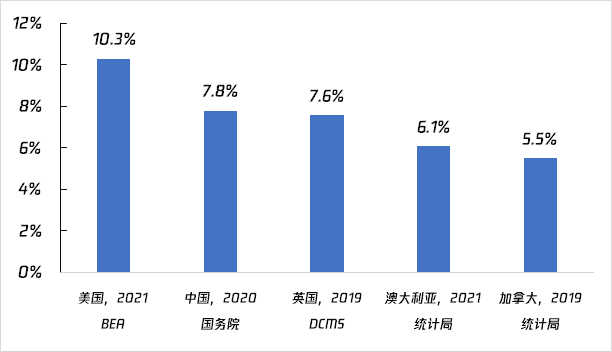
注1:各国对数字经济的称谓不同。美国和加拿大是数字经济,英国是数字部门,澳大利亚是数字活动。我国此处特指数字经济核心产业,数据来源国务院《“十四五”数字经济发展规划》;
注2:英国用GVA(而不是GDP)来衡量经济规模。
数字经济贡献的就业岗位数量不断增加,在美加英占5%左右的份额。根据BEA数据,2020年美国数字经济提供了781万个全职和兼职工作岗位,占总就业岗位的5.3%,是全美第8大就业渠道。根据加拿大统计局数据,数字经济就业岗位数占总就业岗位数的比重逐年提升,2019年达到4.5%。根据DCMS 数据,从2019年到当时的最近一年 (即2020年7月-2021年6月) ,英国就业岗位数量减少了57.9万,而数字部门的就业岗位数量增加了21.1万,占全国就业岗位数量的比重由4.6%提高到5.4%。
四、数字技术极大提高劳动生产率
技术变革是推动长期增长的最重要单一力量 (Abramovitz,1956) ,蒸汽机、发电机和数字技术等通用目的技术 (GPTs) 尤是如此。需要注意,通用目的技术并不能立刻推动经济增长,需要花费较长时间才能对生产率产生实质影响。英国经济学家Nicholas Crafts (2018) 指出,蒸汽机在1830年之前对劳动生产率增长的贡献很小,直到瓦特改良蒸汽机100年后,对劳动生产率的贡献才达到顶峰。斯坦福大学教授保罗·大卫 (1990) 研究发现,发电机在发明40年后才带来实质性的生产力提高。
任何一项新技术都是由多个小发明、小改进逐渐累积起来的,有一个从简单到复杂、从量变到质变的过程。数字技术也是这样。从1946年ENIAC到1989年万维网的40余年间,重大技术发明不断涌现,但对生产率的影响并不明显。罗伯特·索洛曾大呼 (1987年) :“计算机带来的改变无处不在,只有在统计数据中例外!”进入1990年代,计算机和互联网迅速走进百姓大众,数字技术对生产率的影响开始变得随处可见。欧洲央行 (2020) 指出:“从历史视角来看,索洛悖论并不是什么悖论。”
根据美联储David Byrne、美国企业研究所Stephen Oliner和国家经济研究局 (NBER) Daniel Sichel的联合研究 (2013) ,在1974-1995年、1995-2004年和2004-2012年三个阶段,IT (包括半导体、硬件、软件和通信设备) 为美国非农部门劳动生产率增长分别贡献了0.77个百分点、1.5个百分点和0.64个百分点。尽管近年 (2004-2012年) IT对劳动生产率增长贡献的绝对数有所下降,但贡献率仍保持高达40%以上。
数字技术对拉动经济增长有着极大潜力。根据麦肯锡数据,到2025年数字技术可拉动澳大利亚GDP增长率上升0.7-1.2个百分点,使GDP增加1400-2500亿澳元;根据埃森哲数据,到2035年人工智能有潜力使我国经济总增加值提升7.111万亿美元,拉动经济增长率上升1.6个百分点。
五、结语
技术变革是一股伟大而神奇的力量。“人们对它讨论颇多,有人顶礼膜拜,有人拒绝抵制,却没有多少人理解” (Thomson,1984) 。瓦特改良蒸汽机之前,纽科门蒸汽机 (1712年) 已发明60多年;直到改良一百多年后,术语“Industrial Revolution”才在Arnold Toynbee (1881年) 的推动下为大众所知。人工智能和计算机一样古老,图灵就被同时誉为“计算机科学之父”和“人工智能之父”,从深蓝、AlphaGo到近期的ChatGPT,人工智能一次次挑动人们兴奋的神经。 它总是那样,喜欢颠覆自以为是的剧本,然后在意想不到的时候投来一束永恒的光。
里德利说得好 (2021) :“创新是自由之子,是繁荣之母。”后半句说明了创新的重要意义,前半句说明了创新如何发生。技术变革只能通过新思想的涌现而产生 (莫基尔,1990) 。数字经济就是几十年来技术创新变革的产物。未来也是 。
翻译:
The Year 1776 was remarkable
What year has had the most impact on the world today? 1776, no doubt. Three events took place that year that laid the foundations of modern civilization.
On March 8, Scottish inventor James Watt and his partner Matthew Boulton modified the first practical steam engine, kicking off the Industrial Revolution. The next day, another Scot, Adam Smith, published the Wealth of Nations for the first time, marking the emergence of economics as a discipline in its own right. On the other side of the Atlantic, on July 4, the Second Continental Congress ratified the Declaration of Independence, formally declaring the United States a nation.
Economic growth is commonplace, but it is a new phenomenon in human history. The “invention” of economic growth was the steam engine or the Industrial Revolution. Its significance cannot be overemphasized, “The Industrial Revolution is the only major event in the history of the world economy” (Irad Kimhi, 2006), “the steam engine makes all the scripts of the entire early history of the world look bad” (Ian Morris, 2010), “There is really only one thing that happened in human history, The Industrial Revolution, which began around 1800. There is only a distinction between the world before the Industrial Revolution and the world after the Industrial Revolution, and other details of human history are interesting but unimportant “(Gregory Clark, 2013). The following graphic illustrates two very different worlds before and after the Industrial Revolution.
The Industrial revolution brought an abrupt rise in per capita income, which had long been stagnant
Source: Gregory Clark, Farewell to Alms: A Brief History of the World Economy, Guangxi Normal University Press, 2020
The Industrial revolution brought about a rapid increase in human wealth.
Economics is the study of wealth, the big invisible force that drives growth. In the opening words of his Principles of Economics (1890), George Marshall famously declared: “The two great constituent forces of world history are religious and economic forces.” John Maynard Keynes (1936) wrote: “The ideas of economists and political philosophers are often more powerful than most people expect. In fact, it is only these ideas that rule the world.” Smith’s “Wealth of Nations” is the founding work of economics, it and the Watt steam engine produced at the same time, can not be said to be completely coincidental. The steam engine powered the Industrial Revolution, and Smith showed people how to use that power.
When Britain started the Industrial Revolution and founded economics, the thirteen colonies in North America broke away from its rule and founded the United States. The United States was founded late, but its territory expanded rapidly, and the flag was increased from 13 stars to 50 (in 1960). In particular, it seized the opportunities of the two industrial revolutions and the two world Wars, and its strength increased rapidly, eventually replacing the United Kingdom as the hegemon of the world, which had a profound impact on the international pattern and the direction of civilization.
The year 1776 in China was the forty-first year of Qianlong. This year, finally pacified the size of the Jinchuan chaos, is stepping up the compilation of the “four libraries”.
The year 1946, the beginning of the digital Revolution
If you ask further, is there a year comparable to 1776? The first thing that comes to mind is 1946. On February 14, the world’s first general-purpose digital computer, ENIAC, was announced at the University of Pennsylvania. The ENIAC was Turing’s complete, programmable, decimal-based computing, which was 1,000 times faster than electromechanical machines, a huge leap forward. The invention of the ENIAC marked the dawn of the digital age.
Since then, a series of major inventions such as the transistor (1947), integrated circuit (1958), optical fiber communication (1966), ARPANET (1969), microprocessor (1971), and World Wide Web (1989) have appeared one after another. E-commerce, the Internet of Things, cloud computing, big data, artificial intelligence, blockchain and other technological business models have emerged one after another, profoundly changing the economy and society and triggering a new revolution. This revolution originated after World War II and continues to this day, marked by computers. The Internet and the new generation of information technology, is a digital technological revolution with “exponential growth, digital progress, and combinational innovation” (Eric Brynjolfsen and Andrew McAfee, 2016).
The current revolution is also known as the “second machine revolution”, “third Industrial revolution”, “fourth Industrial revolution”, “new Industrial revolution” and “a new round of scientific and technological revolution and industrial transformation”. Regardless of the name, no matter how many times, everyone agrees – digitization and the intelligence that builds on it is the core theme. Essentially the digital revolution.
Digital economy is the marketization and industrialization of digital revolution, and a new economic form after agricultural economy and industrial economy.
The newness of digital economy is mainly reflected in five aspects: new technology (digital technology), new elements (data), new facilities (digital new infrastructure), new speed (exponential growth) and new literacy (digital literacy). In the past 30 years, the development picture of the digital economy has been magnificent and exciting. And it has become the leading industry and pillar industry of the national economy. And the enabling effect has been constantly emerging.
The digital economy is a pillar industry and an important employment channel
There is no clear and unified standard for pillar industries, which generally refers to the industry scale accounting for more than 5% of GDP. and the development prospect is good. The industrial correlation degree is large, and the employment covers a wide range of industries. The added value of the digital economy in major countries accounted for more than 5% of GDP. And maintained a faster growth rate than the national economy as a whole.
In 2020, the added value of the core industry of China’s digital economy has reached 7.8% of GDP. And is the fifth largest industry after manufacturing (26.2%), wholesale and retail trade (9.4%), financial industry (8.3%), agriculture, forestry, animal husbandry and fishery (8.0%). In 2021, the value added of the US digital economy will account for 10.3% of GDP, making it the fourth largest industry after real estate and leasing, government, and manufacturing. In 2019, the value added of Canada’s digital economy accounted for 5.5 per cent of GDP, making it the eighth largest sector in the country. As shown in the following picture.
Figure: The proportion of digital economy value added to GDP of major countries
Note 1: Countries have different names for the digital economy. The US and Canada are the digital economy, the UK is the digital sector, and Australia is the digital activity. China here refers to the core industry of digital economy. The data source of The State Council “14th Five-Year” digital economy Development Plan “;
Note 2: The UK uses GVA (rather than GDP) to measure the size of the economy.
The number of jobs contributed by the digital economy is increasing, accounting for about 5% in the US, Canada and the UK.
According to BEA data, the digital economy in the United States provides 7.81 million full – and part-time jobs in 2020. Accounting for 5.3% of total jobs, making it the eighth largest employment pipeline in the country. According to Statistics Canada, the proportion of digital economy jobs in total employment has increased year by year, reaching 4.5% in 2019. According to DCMS data, from 2019 to the most recent year at that time (July 2020 to June 2021), the number of jobs in the UK fell by 579,000, while the number of jobs in the digital sector increased by 211,000. Increasing its share of national jobs from 4.6% to 5.4%.
Digital technology has greatly improved labor productivity
Technological change is the single most important force driving long-term growth (Abramovitz, 1956), especially general-purpose technologies (GPTs). Such as steam engines, generators, and digital technologies. It is important to note that general-purpose technologies do not immediately boost economic growth and take longer to have a real impact on productivity. British economist Nicholas Crafts (2018) pointed out that the steam engine’s contribution to labor productivity growth was small before 1830. And it did not reach its peak until 100 years after Watt improved the steam engine. Stanford University professor Paul David (1990) found that the generator did not bring substantial productivity gains until 40 years after its invention.
Any new technology is gradually accumulated by a number of small inventions, small improvements, there is a process from simple to complex, from quantitative change to qualitative change.
It’s the same with digital technology. In the more than 40 years between the ENIAC in 1946 and the World Wide Web in 1989, major technological inventions emerged. But the impact on productivity was not obvious. Robert Solow declared (1987), “The changes brought about by computers are everywhere. Except in statistics!” In the 1990s, computers and the Internet quickly became available to the masses. And the impact of digital technology on productivity began to become visible everywhere. “From a historical perspective, the Solow paradox is not a paradox,” notes the European Central Bank (2020).
According to a joint study (2013) by David Byrne of the Federal Reserve, Stephen Oliner of the American Enterprise Institute. And Daniel Sichel of the National Bureau of Economic Research (NBER), in the three periods 1974-1995, 1995-2004, and 2004-2012, IT (including semiconductors, hardware, software, and communications equipment) contributed 0.77 percentage points, 1.5 percentage points, and 0.64 percentage points, respectively, to U.S. nonfarm sector labor productivity growth. Although the absolute contribution of IT to labor productivity growth has declined in recent years (2004-2012). The contribution rate remains high at more than 40%.
Digital technology has great potential to drive economic growth. According to McKinsey, digital technologies could boost Australia’s GDP growth rate by 0.7-1.2 percentage points by 2025, adding A $140-250 billion to GDP. According to Accenture data, by 2035, AI has the potential to increase the gross value added of China’s economy by $7.111 trillion, boosting economic growth by 1.6 percentage points.
Conclusion
Technological change is a great and magical force. “People talk about it a lot, some worship it, some refuse to resist it. But not many understand it” (Thomson, 1984). Before Watt improved the steam engine, Newcomen’s steam engine (1712) had been invented for more than 60 years. It was not until more than a hundred years after the reformation that the term “Industrial Revolution” became known to the general public, promoted by Arnold Toynbee (1881). Artificial intelligence is as old as computers, and Alan Turing has been hailed as the “father of computer science” and the “father of artificial intelligence” at the same time. From Deep Blue, AlphaGo to the recent ChatGPT, artificial intelligence has stirred people’s excitement again and again. It always does, likes to subvert the self-righteous script, and then throws a beam of eternal light at unexpected times.
Ridley said it best (2021) : “Innovation is the child of freedom and the mother of prosperity.” The second half of the sentence explains the significance of innovation. And the first half of the sentence explains how innovation occurs. Technological change can only come about through the emergence of new ideas (Mokiel, 1990). The digital economy is the product of decades of technological innovation and change. So is the future.
本文由数字化转型网(www.szhzxw.cn)转载而成,来源于首席数字官;编辑/翻译:数字化转型网宁檬树。

免责声明: 本网站(https://www.szhzxw.cn/)内容主要来自原创、合作媒体供稿和第三方投稿,凡在本网站出现的信息,均仅供参考。本网站将尽力确保所提供信息的准确性及可靠性,但不保证有关资料的准确性及可靠性,读者在使用前请进一步核实,并对任何自主决定的行为负责。本网站对有关资料所引致的错误、不确或遗漏,概不负任何法律责任。
本网站刊载的所有内容(包括但不仅限文字、图片、LOGO、音频、视频、软件、程序等) 版权归原作者所有。任何单位或个人认为本网站中的内容可能涉嫌侵犯其知识产权或存在不实内容时,请及时通知本站,予以删除。