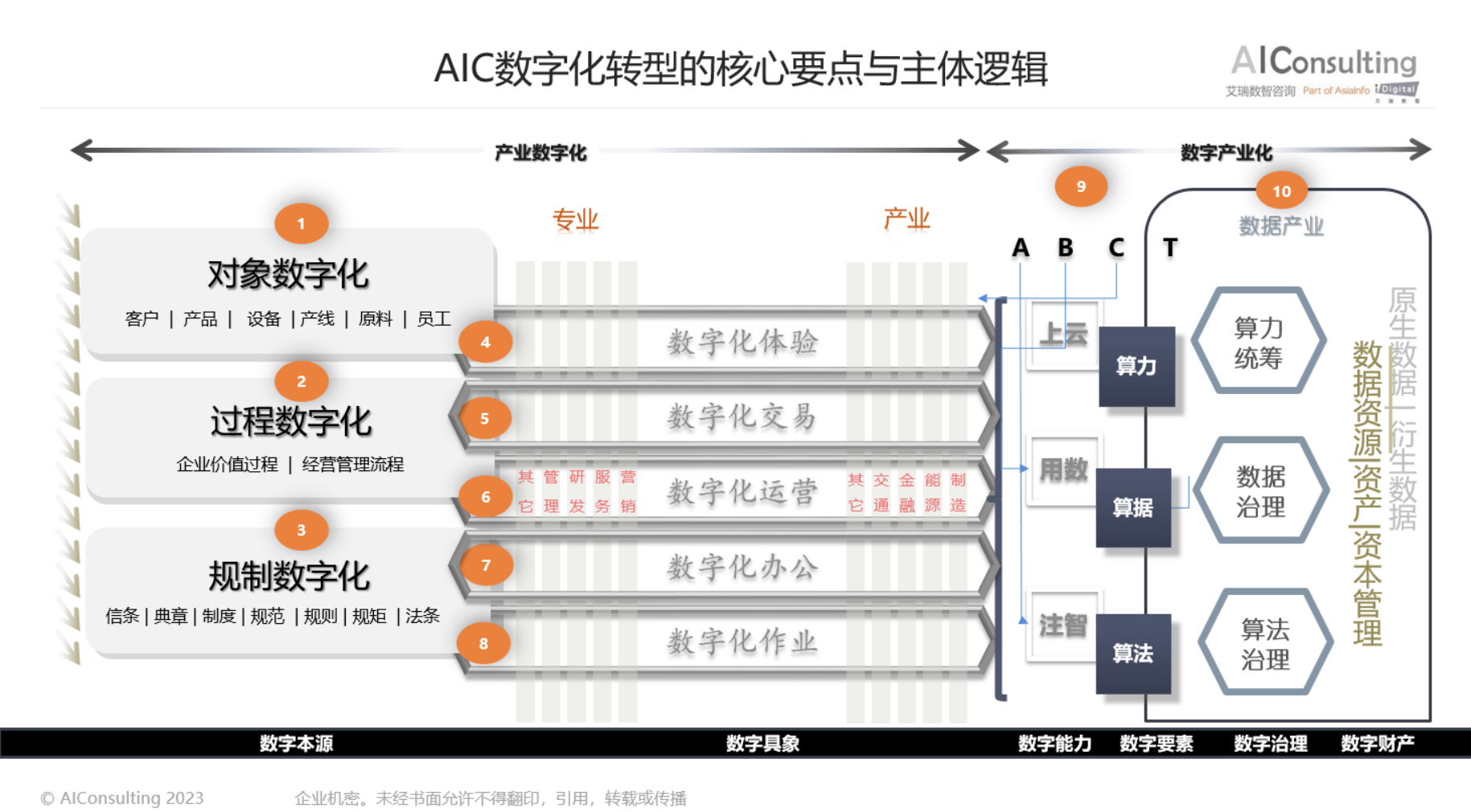
数字化转型的AIC框架自左到右体现了从数字本源,到数字具象,到数字能力、要素、数字治理和数字资产的层层架构。
无论是亚当斯密在国富论中提出的“企业的存在是为了追求利润”还是彼得德鲁克这位管理学之父的“企业的首要任务是创造客户”,现代企业的形态与构成都大同小异。一个企业甚至一个社会的运行,需要的基本要素也无外乎是对象(企业活动需要的人、财、物或者商业中的人、货、场),过程(英文中为process,主要是沿时间轴的企业价值变化——主要是增加,当然也有可能逆转——的可识别可定义可管理的历程)和规制(人为定义的制度与规则及未来智能化的相应计算结论等)。如果从主客体论的角度来看,大致“对象”更多是客观存在,“过程”可能主观意志对现实的总结与归纳,而“规制”则更多是生物因素使然。
企业数字化从本质上来说,就是企业层面的数字化工作可以抽象成三大数字化视角:对象数字化,过程数字化和规制数字化。我们和托马斯·西贝尔的看法一致,认定驱动数字化及其转型的技术(称之为指数级技术)主要就是ABCT(人工智能,大数据,云雾计算和物联网)。技术对于对象、过程、规制的穿透性并不一样。前者(对象)在数字世界中更多是以孪生形式存在发展,而中者(过程)与后者(规制)数字化程度最高,其物理世界的存在空间就越小。

话虽然这么说,但是在大多数关于数字化和数字化转型的论述中,三个方面的平衡意识或表现许多时候是缺乏的。比如一个被广泛应用的企业数字化的定义是这样表述的:数字化的底层逻辑,是应用数字技术将现实世界的企业经营管理过程映射到数字世界,再将经过数字算法的结果回嵌应用到现实世界……需要对现实世界的企业经营过程进行系统拆解。这里,我们唯一看到的是如何处理企业的“经营管理过程”。人或者机器在这个过程中的作用主要是做决策,而自身如何被描述被洞察没有提及。于是“决策革命”常常变成了数字化转型的主要标志物。注意过程一词在英文中是process,它也被同时翻译成“流程”,于是经营管理过程和企业流程到底是一回事还是两回事,在数字化中的指向和结果是相同的还是不同的,又会引起许多纷乱。数字化转型网www.szhzxw.cn
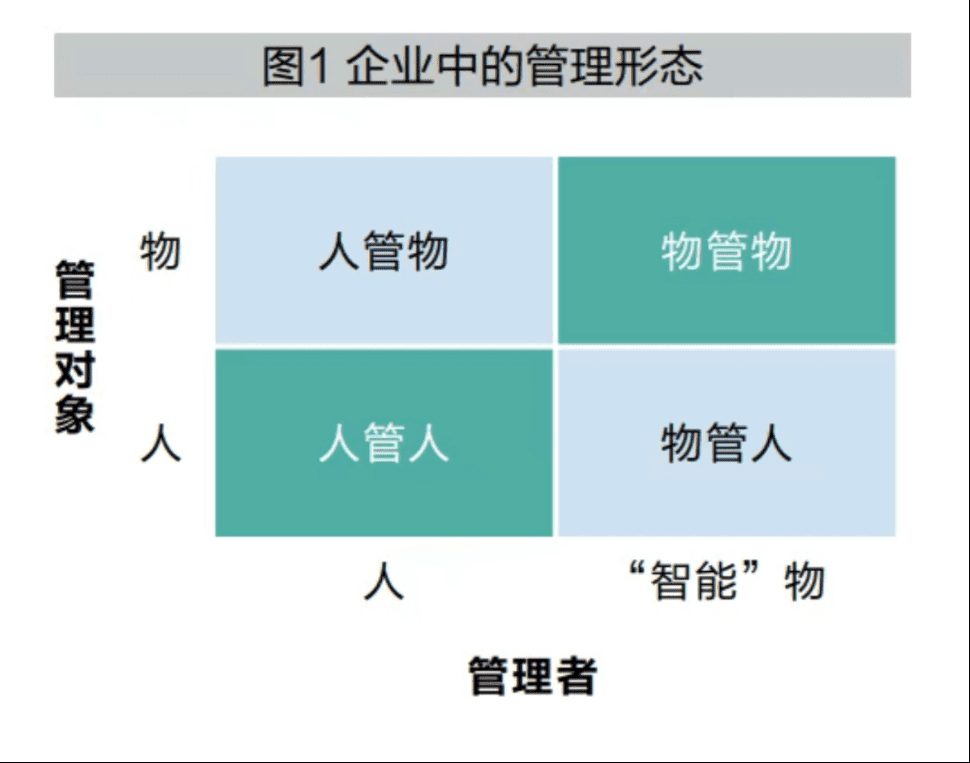
一些谈“对象”在未来数字化的组织中变化的文章指出企业管理的主体(管理者)将扩展至人与物两种基本类型。企业管理的客体(管理对象)仍然是人和物两大基本类型。主体的变化体现在一些具有智能的物不再是被管理的对象,亦可在某种场景中“发号施令”,参与管理工作。当这些对象能够决策时,显然单纯的自身数字化(对象数字化)就不足以解释这些变化。什么样的过程(此处用流程就不见得合适)和规则能够为机器智能背书,应当是需要专门研究与开发的。
在许多已经初步实现数字化的组织中,其数字化更多的是在适用数字孪生的场景(比如中国的高速公路体系),而数字化的价值如何体现出来依然还没有解决。通过数字系统,高速公路的路网布局以致沿线的一车一道,一草一木都可以实时投射到运控大屏上。不论白天黑夜,整条高速的运行情况,车辆异常都尽在视野中。但单纯这样,主要解决的还是安全巡查的效率,还不是真正意义上对高速网线的数字化运营。车流的优化、调度与治理,环境的维护、保养与变级,在单纯的数字孪生中没有得到实现。过程,规制的数字化将是更为宏大的任务,最终实现的意义也更为有价值。
于是,我们数字化转型框架中的这“三化”,就被认为是本源,是数字化转型的第一定律,也是我们构建整个体系的顶层逻辑。数字化转型网www.szhzxw.cn

无论是全面质量管理理论的“人机料法环”、生产管理四条主线“人、财、物、产品”还是企业构成要素之“人力、物力、财力、信息、技术、知识、时间、空间、市场、客户、环境等”,这些看似都着眼于对象的理论背后没有过程和规制都转不起来。即使是Grieves教授定义的数字孪生模型中的现实世界物理实体、虚拟实体和联系二者的数据传输连接,说的是组织涉及的物理实体和系统的属性、结构、状态、性能、功能和行为映射到虚拟世界,并利用数字技术来改变其业务流程和服务模式,以提高效率和增加价值。作为数字孪生理论的大师,单纯的物理-虚拟的对映投射显然是一个方面。教授用“连接”的概念来泛指我们所认定的过程数字化和规制数字化两个方面的动作。数字化转型网www.szhzxw.cn
行文至此,想起了国内广为流传的“信息-物理系统”模型的错误翻译与理解,延续至今少人意识。原文为Cyber-Physical Systems,CPS里的Cyber和信息根本就是两个不同概念。物理空间与赛博空间关系的这个理论,简单地说就是把数字孪生投放进去后让物理对象有规律、有过程地在赛博空间被感知,可实时、能自智地运营起来。信息和数据、知识一样,在其中发挥作用,但本身不是和物理(physical) 融合交互的主体。不理解这些,信息化的思维就无法迈进数字化,智能化的大门。
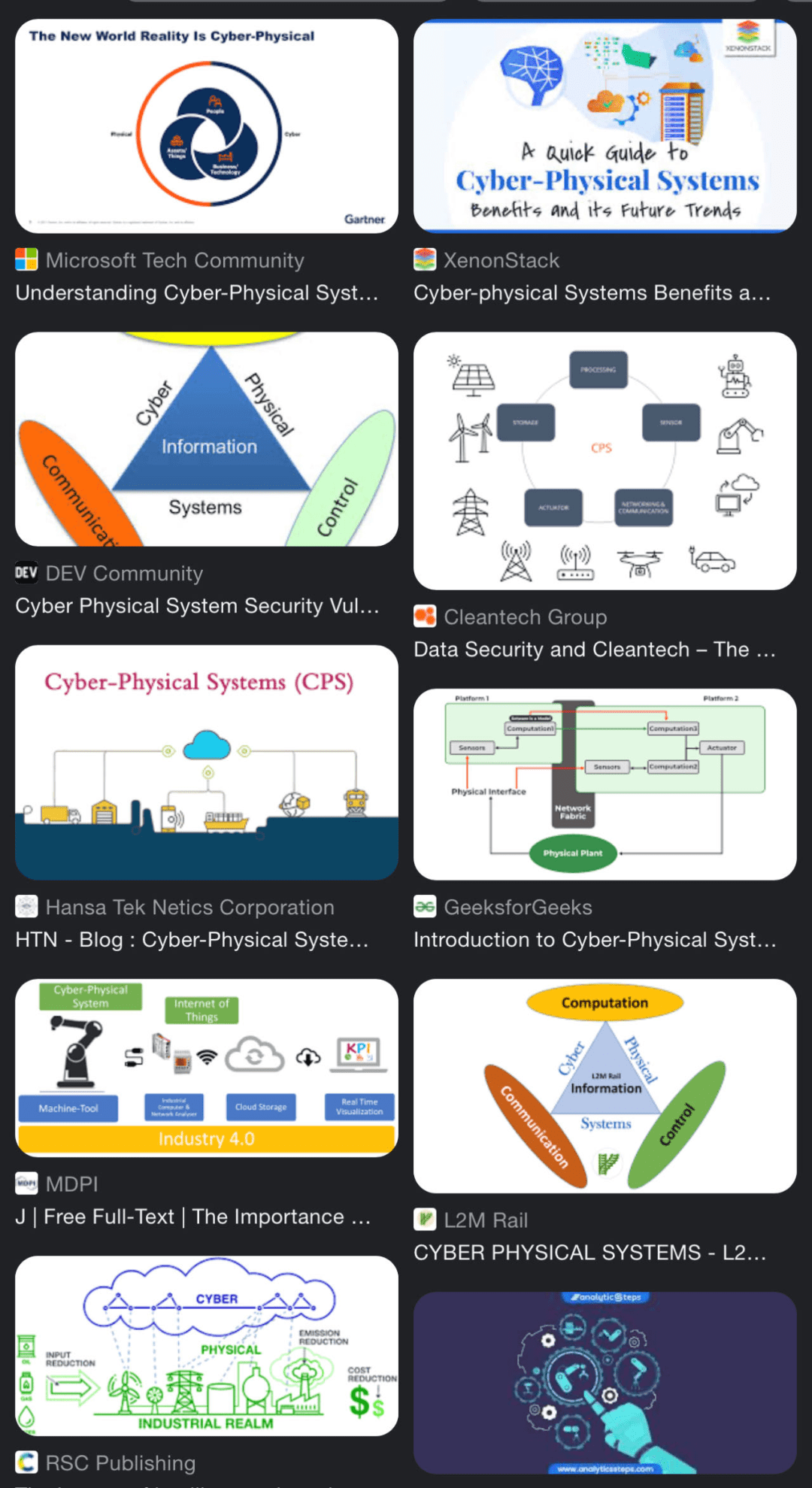
谷歌搜索上关于Cyber-Physical Systems的各种模型列举
我们将在下面三篇文章中分别详述我们对对象数字化和过程数字化、规制数字化实现方式的具体思考。

翻译:
The first law of digital transformation: object digitization, process digitization, regulation digitization
The AIC framework for digital transformation represents layers of architecture from digital origin, to digital embodiment, to digital capabilities, elements, digital governance and digital assets.
Whether Adam Smith proposed in the Wealth of Nations that “the existence of enterprises is to pursue profit” or Peter Drucker. The father of management, “the primary task of enterprises is to create customers”. The form and composition of modern enterprises are much the same. The basic elements needed for the operation of an enterprise or even a society are nothing more than objects (people, goods, things needed by enterprise activities or people, goods. And fields in business) and processes (process in English), mainly changes in enterprise value along the time axis – mainly increases.
Of course, it is also possible to reverse – the process of identification, definition and management) and regulation (artificially defined institutions and rules and the corresponding computational conclusions of future intelligence, etc.). From the perspective of subject-object theory, generally speaking, “object” is more objective existence, “process” may be the summary and induction of the reality by the subjective will, and “regulation” is more caused by biological factors.
In essence, enterprise digitalization is that the digitalization work at the enterprise level can be abstracted into three digital perspectives: object digitalization, process digitalization and regulation digitalization. We agree with Thomas Siebel that the technologies driving digitalization and its transformation (call them exponential technologies) are primarily ABCT (Artificial intelligence, Big Data, cloud computing, and the Internet of Things). The penetration of technology to objects, processes, and regulations is not the same. The former (object) exists and develops more in the form of twins in the digital world. While the middle (process) and the latter (regulation) have the highest degree of digitalization. And the existence space of their physical world is smaller.数字化转型网www.szhzxw.cn
That being said, in most of the discourse about digitalization and digital transformation, a balanced sense or representation of these three aspects is often lacking.
For example, a widely used definition of enterprise digitalization is as follows:. The underlying logic of digitalization is the application of digital technology to map the real world business operation and management process to the digital world. And then the results of digital algorithms are embedded back into the real world…… The real world business process needs to be systematically dismantled. Here, the only thing we see is how to deal with the “management process” of the enterprise.
The role of humans or machines in this process is mainly to make decisions. And how they are described and perceived is not mentioned. As a result, the “decision revolution” has often become the hallmark of digital transformation. Note that the word “process” in English is process, and it is also translated into “process” at the same time. So the business management process and the enterprise process are one thing or two different things. And the direction and result in digitalization are the same or different, which will cause a lot of confusion.
Some articles on the change of “object” in the future digital organization point out that the subject of business management (manager) will be extended to two basic types of people and things.
The object of enterprise management (management object) is still the two basic types of people and things. The change of the subject is reflected in that some intelligent objects are no longer the objects to be managed. But can also “command” in a certain scene and participate in management work. When these objects are able to make decisions. It is clear that mere digitization of themselves (object digitization) is not enough to explain these changes. What kind of processes (processes are not necessarily appropriate here) and rules can underwrite machine intelligence should be specifically researched and developed.数字化转型网www.szhzxw.cn
Images reproduced from https://mp.weixin.qq.com/s/VZmlxylfKVc5QvfPHwbd9w
In many organizations that have already started digitizing. The digitalization is more in the case of digital twins (such as China’s highway system). And how the value of digitalization will be realized is still unresolved. Through the digital system, the highway network layout so that a car along the line, grass and trees can be projected to the operation control screen in real time. Regardless of day and night, the operation of the entire high-speed, vehicle anomalies are all in the field of vision.
However, simply in this way, the main solution is still the efficiency of security inspections. Znd it is not the digital operation of high-speed network cables in the true sense. The optimization, scheduling and management of traffic flow. And the maintenance, maintenance and gradation of the environment have not been realized in the simple digital twin. The digitization of process and regulation will be a more ambitious task. And the meaning of the final realization will be more valuable.
Therefore, this “three” in our digital transformation framework is considered to be the source, the first law of digital transformation, and the top-level logic for us to build the entire system.
Whether it is the “human-machine material law” of total quality management theory. The four main lines of production management “people, money, things, products”, or the elements of enterprise “manpower, material resources, financial resources, information, technology, knowledge, time, space, market, customers, environment, etc.”. These theories that seem to focus on the object can not be turned around without process and regulation.
Even in the digital twin model defined by Professor Grieves. The data transmission connection between real-world physical entities, virtual entities. And connections refers to the mapping of the properties, structure, state, performance, function. And behavior of the physical entities and systems involved in the organization into the virtual world and the use of digital technologies to change their business processes and service models. To improve efficiency and add value. As a master of the digital twin theory, pure physical-virtual enantiomotation is clearly one aspect. The professor uses the concept of “connectivity” to refer to what we consider to be both the digitization of processes and the digitization of regulations.
At this point, I think of the wrong translation and understanding of the “information-physical system” model, which is widely spread in China, and few people are still aware of it.
In cyber-physical Systems, Cyber and information in CPS are two different concepts. The theory of the relationship between physical space and cyberspace simply means that after digital twins are put in, physical objects can be perceived in cyberspace regularly and in a process. And can be operated in real time and self-intelligently. Information, like data and knowledge, plays a role in it. But is not itself the subject of interaction with physical fusion. Without understanding these, information-based thinking will not be able to step into the digital, intelligent door.数字化转型网www.szhzxw.cn
Google search for various models of Cyber-Physical Systems
In the following three articles. We will detail our specific thoughts on the realization of object digitization, process digitization and regulation digitization.
本文由数字化转型网(www.szhzxw.cn)转载而成,来源于AIC商业导论;编辑/翻译:数字化转型网宁檬树。
免责声明: 本网站(https://www.szhzxw.cn/)内容主要来自原创、合作媒体供稿和第三方投稿,凡在本网站出现的信息,均仅供参考。本网站将尽力确保所提供信息的准确性及可靠性,但不保证有关资料的准确性及可靠性,读者在使用前请进一步核实,并对任何自主决定的行为负责。本网站对有关资料所引致的错误、不确或遗漏,概不负任何法律责任。
本网站刊载的所有内容(包括但不仅限文字、图片、LOGO、音频、视频、软件、程序等) 版权归原作者所有。任何单位或个人认为本网站中的内容可能涉嫌侵犯其知识产权或存在不实内容时,请及时通知本站,予以删除。