在《企业开展数字化转型的常见误区》中我们提到,企业开展数字化转型的常见误区之一就是“认为数字化转型主要是IT部门的事”。在数字化转型中,应当“由数据或者数字化转型管理部门组织搭台或编剧,业务部门亮相出演,IT部门录制节目出剧集”。从中可以看出,IT部门在企业数字化转型过程中,是幕后英雄的角色。那么在数字化转型中,企业到底需要什么样的IT部门,IT部门自身的发展又该何去何从呢?
一、IT部门职能定位和价值体现的变化
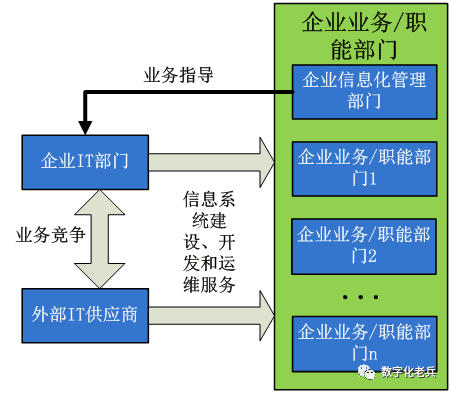
在数字化转型前,企业各业务部门分别负责企业相应业务领域的发展(如XX事业部等),职能部门分别负责履行相关管理职能(如质量、财务、人事等)。业务部门和职能部门根据需要,自行建设或由企业信息化管理部门统筹建设相应的网络系统和应用系统,以服务业务或职能管理需要。企业IT部门一般是从企业内部信息系统的运维团队发展而来,其主要工作是以信息系统为中心,为企业各部门提供信息系统的开发、建设和运维服务,这也是IT部门的价值所在。 数字化转型网www.szhzxw.cn
在这种情况下,企业IT部门和其他部门是供应商和客户的关系,和外部IT供应商是业务竞争关系。而信息系统的的开发和建设,是由企业业务部门和职能部门主导立项、提出需求,IT部门响应,随后进行设计、开发、测试、业务上线等工作。在这个过程中。在这个过程中,企业IT部门或外部IT供应商接触不到企业核心业务的管理制度、业务流程、管控要素、责任体系、运行机制等运行细节。
进入数字化时代,数字化转型的目标是“以数据为中心的业务变革”。我们在《坚持业务和技术协同推动企业数字化转型》中提到,在制定了数字化转型战略后,企业要做的第一步工作就是建立包括业务、数据、应用、技术架构在内,对企业业务信息系统中的体系性、普遍性问题提供通用解决方案的企业架构。更确切的说,是基于业务导向和驱动的架构来理解、分析、设计、构建、集成、扩展、运行和管理信息系统。在企业架构制定后的信息系统设计选型,以及协调推进业务上线、数据治理和信息系统建设,连同企业架构本身,主体责任是企业的规划部门和各业务部门。
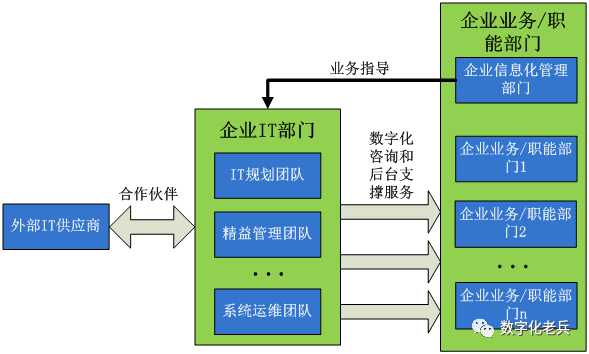
面对上述工作,这些部门无法在没有IT技术团队支撑的情况下独立完成。而上述工作包括了企业的战略规划、企业架构、数据治理、信息系统建设,以及一体融合的业务数字化运营和信息系统运维,外部IT厂商难以全链条覆盖;涉及到企业核心业务的细节,更无法完全交给外部IT供应商。而IT部门作为企业内设机构,在企业内部的管理协调和业务理解方面具备先天优势,应当作为企业数字化转型的智囊团,发挥总体技术和智力支撑作用。 数字化转型网www.szhzxw.cn
在这种情况下,企业IT部门和其他部门是业务后台与前台、支撑与决策的关系,和外部IT厂商是甲乙方及技术、业务合作伙伴的关系。
二、当前IT部门建设存在的问题
(一)职能和价值定位不清,对错“标杆”找错“赛道”
很多企业IT部门未能适应在数字化转型中,部门职能定位和价值体现发生的变化。部分IT部门领导认为,IT部门需要保持和提高技术竞争力,就要对标优秀的IT供应商,在产品研发上与他们看齐和竞争,觉得依靠IT供应商就是失去了自己的“核心竞争力”。在部分企业尤其是大型企业中,这种想法在IT人员中具有较大市场,原因在于企业IT部门员工习惯于和技术同行作比较,内心推崇行业内优秀外部供应商的技术能力和产品研发实力,这种自下而上的氛围影响到IT部门领导甚至企业领导。部分企业领导也认为,企业数字化转型所需的IT产品由“自己人”来做,更加安全可靠。
结果部分企业领导在这种认识下,什么都想自己做,在IT部门内部建立了IPD机制,轰轰烈烈搞起了产品研发。结果一方面由于研发和产品管理能力的差距,系统开发效率低下,质量不高,导致IT部门疲于应付、服务跟不上,使用部门苦不堪言;另一方面由于IT部门主要精力投入到产品研发中,对于在企业数字化转型发挥从战略规划、企业架构、数据治理到数字化运营等更大范围内的智囊和后台支撑作用,既没有兴趣,也没有精力,进一步加剧了企业数字化转型的困难。 数字化转型网www.szhzxw.cn
实际上,这种想法属于以旧的思维去看待IT部门的定位,未能洞察到在数字化时代IT部门职能定位和价值体现的变化,找错了“赛道”。IT供应商的核心业务就是向市场提供IT产品和服务,而企业IT部门则要为企业的数字化转型提供总体技术和智力支撑,二者间是互补的伙伴而非竞争关系。
对于企业领导关注的IT产品“安全可靠”问题,实际上是个IT产品供应链自主可控的问题。这个问题某种程度上讲是国家层面在全国范围内统筹考虑的事项,不代表单个企业就要建设“大而全”的内部IT供应体系。寄希望于在企业内部建这样的体系,本身也偏离了企业主营业务,违背了数字化转型“降本增效”的初衷。
(二)囿于思维认识和格局站位,不愿自我转型
IT部门职能定位和价值体现的变化,需要从企业分管信息化领导、IT部门领导到IT部门基层员工自上而下开展一场意识更新和自我转型。而部分企业IT部门领导,甚至企业分管信息化的领导,囿于思维认识和格局站位,不愿开展这样的自我转型。
出现这种情况,一方面是IT部门领导自身的认识问题,但另一方面也有企业内部的深层次体制矛盾。长期以来,企业IT部门在企业内部作为服务部门,没有职能权力,地位偏低,人员成长通道不畅。而业务部门居于强势地位,在信息系统建设过程中随意变更需求,要求IT部门及时响应;系统使用中出现问题不去反思业务体系,习惯性甩锅给IT部门;有了成绩是自己的,出了问题是IT部门的。我们在《企业开展数字化转型的常见误区》中提过,信息系统好不好用,表现在系统本身,根源在系统背后。IT部门背锅背怕了,就把企业内部兄弟部门间的协作关系处成了甲乙方打擂台的关系了。
在这种情况下,IT部门更习惯于与业务部门划清工作界面。在系统开发过程中认为需求梳理是业务部门的事,IT部门的责任是对业务部门提供的需求说明进行对接和分析。其实使用“需求对接”或“需求分析”这个词,潜意识里已经把自己放在IT供应商的位置上,站在供应商的角度与客户打擂台了。
到了企业制定数字化转型战略、制定企业架构、开展数据治理和数字化运营等工作的时候,业务部门苦于无从下手,需要IT部门提供技术和智力支撑和帮助的时候,IT部门偏向于退避三舍、划清工作界面,不愿主动参与,增加了相关工作的协调难度。
(三)沉迷象牙塔内难以自拔,自我赋能陷入内卷
部分企业IT部门沉迷技术象牙塔,所属人员缺乏管理思维和价值逻辑,喜欢吹技术泡泡,片面追求新技术甚至是不成熟的新概念。给企业领导一汇报,PPT满屏都是不严谨不准确、由厂商炒作起来的模糊技术概念,既少了工程技术人员应有的理性思考和科学严谨,又少了管理思维中的效益追求、价值逻辑和成本管理意识。
部分企业IT部门醉心在IT体系内搞自我优化,搞自我封闭循环。如搞网络安全的,缺乏对企业核心业务价值的认识,片面加码安全措施,细化安全规则,追求不计管理成本的高安全可靠,给企业业务运行增加了不必要的负担。再如搞信息系统运维的,专心研究细化运维分工和派单机制,把常规的IT服务体系对用户的服务界面搞得很复杂,用户办理一项业务,需要在A系统提a申请、b申请,在B系统提c申请、d申请,每个申请还要详细写出XX要素,以专业人士的标准要求普通用户,给用户带来了更多的不便。这种行为在企业领导和业务部门眼中就是内卷。
(四)专业偏科,存在能力和人才短板、
长期以来,企业IT部门作为信息系统开发、建设和服务部门,在团队能力和人才队伍建设方面,偏向于软件开发、测试、和IT运维等领域。 数字化转型网www.szhzxw.cn
而对于企业数字化转型中,转型办公室组织制定数字化转型战略需要IT规划团队的支持,组织制定企业架构需要IT架构团队的支持;业务部门制定业务架构、推进业务数字化、开展业务数字化运营需要精益管理团队的支持;信息化管理部门制定应用架构和技术架构、开展信息系统设计选型、建设和上线需要系统开发建设团队、网络安全团队和运维团队的支持;数据管理部门制定数据架构、开展数据治理、建立数据共享模型、开发数据共享服务和数据智能应用需要数据架构与治理团队、数据安全团队、数据智能团队和系统开发建设团队的支持。
对于上述需求,企业IT部门不可避免存在专业偏科的现象和能力、人才短板,尤其是缺少既懂管理、又懂技术的复合型人才和能够协调数字化转型全链条推进的IT部门领导。
三、IT部门怎样转型以适应企业数字化转型建设需要
(一)找准部门核心竞争力
在数字化时代,企业IT部门作为企业数字化转型的智囊团,发挥着总体技术和智力支撑作用。在这一定位下,IT部门要从以下两方面找准部门的核心竞争力:
(1)企业数字化转型后台智囊的技术抓总能力
这个技术抓总能力,就是从企业数字化转型“确定数字化转型战略,制定企业架构,同步推动业务“数字化”和信息系统设计选型,协调推进业务上线、数据共享和信息系统建设,一体融合业务数字化运营和信息系统运维”的全链条全过程出发,考虑业务部门和职能部门在组织开展相关工作过程中的咨询和技术支持需要,所应具备的总体预见能力、论证能力、规划能力、架构能力和技术协调能力,以及对企业业务的深刻认识和理解。
(2)和IT供应商的技术交流与项目技术管理能力
在数字化转型中,企业所需要的IT产品主要从外部供应商获取。在项目调研、交流、招标采购和后续实施过程中,IT供应商的目标是卖产品,而企业的诉求是采购适合自身数字化转型需要的IT产品和服务以支撑转型。 数字化转型网www.szhzxw.cn
企业IT部门作为甲方技术代表,在产品和技术调研过程中,应当具备与IT供应商开展平等技术交流的能力,能够透过供应商售前团队吹的技术泡泡、布的效果迷雾中看清其本质,为企业领导和相关业务部门决策提供专业化建议;在项目采购过程中,能够结合项目需求制定准确合理的技术指标,以确保合同体现企业实际需要;在后续项目实施过程中的定制开发、业务上线测试等工作中,实施专业化技术管理,吃透IT供应商产品技术,具备自行开展后续功能扩展和运维的能力。
(二)赋能业务、赋能用户,而不是自我赋能
在数字化转型中,企业IT部门作为“节目录制”,其作用是赋能业务、赋能用户,而不是自我赋能。IT部门领导应当从企业整体利益和IT部门长远发展角度,扩大格局、提高站位,积极主动参与业务部门主导的企业数字化转型各阶段活动,为其出谋划策,解决转型工作中的难题。 数字化转型网www.szhzxw.cn
对于IT部门自己的业务,应当以用户价值为导向,而不是以IT部门自我价值或技术价值为导向,企业IT业务的核心价值就是服务用户、服务主体业务,IT部门基于这一认知,就能够自觉优化服务体系,减轻用户负担,提高服务质量,从另一个角度赋能业务和用户。
作为IT部门,成就业务和用户就是成就自己。当企业数字化转型中各业务部门都把IT部门作为智囊和依托时,IT部门作为技术抓总部门,在企业领导眼里,自然会有其相应的贡献和地位。
(三)建设全链条专业团队,促进专业型和复合型人才共同成长
根据企业数字化转型全链条全过程活动,转型办、各业务部门、信息化管理部门、数据管理部门都需要IT部门作后台提供技术和智力支持,IT部门需要建设包括IT规划、IT架构、精益管理、系统开发建设、网络安全、数据架构与治理、数据安全、数据智能、系统运维等专业团队和技术人才。
此外,为开展企业数字化转型的总体预见、论证、规划、架构和技术协调工作,还应着重培养懂技术、会管理、精业务的复合型人才。能够做到用管理思维理解业务部门和职能部门需求,用管理语言同管理人员沟通;用技术思维理解技术人员观点和诉求,用技术语言同技术人员沟通,具备数字化转型全链条技术支撑工作的的统一协调控制能力。
作为企业领导,应当认识到IT部门对于企业数字化转型的重要性和其职能价值定位的变化,为IT部门的专业型和复合型人才开辟和拓宽职业发展路径,为留住人才、用好人才提供保障。

英文翻译:
In “Common Misconceptions about Digital transformation in Enterprises,” we mentioned that one of the common misconceptions about digital transformation in enterprises is “thinking that digital transformation is primarily a matter for the IT department.” In digital transformation, IT should be “organized by the data or digital transformation management department to set up a station or screenwriter, the business department to appear. And the IT department to record programs and episodes.” IT can be seen that the IT department is the hero behind the scenes in the process of enterprise digital transformation. So in the digital transformation, what kind of IT department does the enterprise need. And where should the development of the IT department itself go?
Changes in the functional positioning and value embodiment of the IT department
Before the digital transformation, the business departments of the enterprise were respectively responsible for the development of the corresponding business areas of the enterprise (such as XX division, etc.), and the functional departments were respectively responsible for the performance of relevant management functions (such as quality, finance, personnel, etc.). Business departments and functional departments shall build corresponding network systems and application systems by themselves or by the enterprise information management department as a whole according to the needs of business or functional management. The enterprise IT department is generally developed from the operation and maintenance team of the enterprise’s internal information system, and its main work is to provide information system development, construction and operation and maintenance services for all departments of the enterprise, which is also the value of the IT department.
In this case, the relationship between the enterprise IT department and other departments is supplier and customer. And the relationship between external IT suppliers is business competition. The development and construction of the information system is led by the business department and functional department of the enterprise to establish the project and put forward the demand. And the IT department responds, and then carries out the design, development, testing, and business on-line. In the process. In this process, the enterprise IT department or external IT suppliers do not have access to the management system, business process, control elements, responsibility system, operation mechanism and other operational details of the enterprise’s core business.
Entering the digital age, the goal of digital transformation is “data-centric business transformation”.
We mentioned in “Adhering to Business and Technology Collaboration to Promote Enterprise Digital transformation” that after formulating the digital transformation strategy, the first step for enterprises to do is to establish an enterprise architecture that includes business, data, application, and technology architecture to provide universal solutions to systemic and universal problems in enterprise business information systems.
Rather, it is to understand, analyze, design, build, integrate, extend, operate . And manage information systems based on a business-oriented and driven architecture. After the establishment of the enterprise architecture, the main responsibility of the information system design and selection, as well as the coordination and promotion of business on-line, data governance and information system construction, together with the enterprise architecture itself, is the enterprise planning department and various business departments.
In the face of the above work, these departments cannot do IT independently without the support of the IT technical team.
The above work includes enterprise strategic planning, enterprise architecture, data governance, information system construction. And integrated business digital operation and information system operation and maintenance, which is difficult for external IT manufacturers to cover the whole chain. The details involved in the core business of the enterprise can not be completely left to external IT vendors. As an internal organization, the IT department has inherent advantages in internal management coordination. And business understanding, and should play an overall technical . And intellectual supporting role as a think tank for enterprise digital transformation. 数字化转型网www.szhzxw.cn
In this case, the relationship between the enterprise IT department and other departments is the relationship between the business background. And the front desk, support and decision-making, and the relationship between external IT manufacturers and technology and business partners.
Problems existing in the construction of the current IT department
(1) Function and value positioning is unclear, right and wrong “benchmark” to find the wrong “track”
Many enterprise IT departments have failed to adapt to the changes in their functional positioning. And value representation during digital transformation. Some IT department leaders believe that IT departments need to maintain and improve technical competitiveness, IT is necessary to benchmark excellent IT suppliers, in product research and development with them and compete, feel that relying on IT suppliers is to lose their “core competitiveness.” In some enterprises, especially large enterprises, this idea has a large market in IT personnel .
Because the employees of the enterprise IT department are used to comparing with their technical peers. And the technical ability and product research and development strength of excellent external suppliers in the industry are respected in the heart. This bottom-up atmosphere affects the leaders of the IT department and even the enterprise leaders. Some business leaders also believe that the IT products required for enterprise digital transformation are done by “people”, which is more secure and reliable.
As a result, some enterprise leaders, under this understanding, want to do everything themselves, establish an IPD mechanism within the IT department. And vigorously develop products. On the one hand, due to the gap in R&D and product management capabilities, the system development efficiency is low and the quality is not high, resulting in IT departments struggling to cope, services can not keep up.
And user departments are miserable; On the other hand.
Because the IT department is mainly devoted to product research and development, it has neither interest nor energy to play a larger role in the enterprise digital transformation from strategic planning, enterprise architecture, data governance to digital operations and other think tanks. And background support, which further aggravates the difficulties of enterprise digital transformation.
In fact, this kind of thinking belongs to the old thinking to look at the positioning of the IT department, failing to understand the changes in the functional positioning. And value embodiment of the IT department in the digital era, and looking for the wrong “track”. The core business of IT suppliers is to provide IT products and services to the market, while enterprise IT departments provide overall technical and intellectual support for the digital transformation of enterprises, and the two are complementary partners rather than competition.
For enterprise leaders concerned about the IT product “safety and reliability” problem, in fact. Is an IT product supply chain autonomous and controllable issue. To some extent, this issue is a matter of overall consideration at the national level across the country, and does not mean that a single enterprise should build a “large and complete” internal IT supply system. Hoping to build such a system within the enterprise itself also deviates from the main business of the enterprise, and goes against the original intention of digital transformation to “reduce costs and increase efficiency”.
(2) Confined to thinking understanding and pattern position, unwilling to self-transformation
The changes in the functional positioning and value embodiment of IT departments need to carry out a top-down consciousness renewal and self-transformation from the leaders in charge of information technology, IT department leaders to the grass-roots employees of IT departments. However, some enterprise IT department leaders, and even enterprise leaders in charge of information technology, are limited in thinking and understanding and pattern positions . And are reluctant to carry out such self-transformation.
On the one hand, this is a problem of the understanding of the IT department leaders themselves . But on the other hand, there are deep-seated institutional contradictions within the enterprise. For a long time, as a service department within the enterprise. The enterprise IT department has no functional power, low status and poor personnel growth channel. However, the business department is in a strong position. And changes the requirements at will in the process of information system construction, requiring the IT department to respond in time.
When problems arise in the use of the system, they do not reflect on the business system and habitually dump the blame on the IT department. The achievements are their own, and the problems are the IT department’s. We mentioned in the “Common mistakes of enterprises to carry out digital transformation” that the information system is not easy to use, manifested in the system itself . And the root cause is behind the system. The IT department is afraid of the pot back. And the cooperation between brother departments within the enterprise has become the relationship between A and B.
In this case, the IT department is more accustomed to separating the work interface from the business.
In the process of system development, IT is believed that the requirement sorting is the business department’s business. And the responsibility of the IT department is to connect and analyze the requirement description provided by the business department. In fact, the use of the term “demand docking” or “demand analysis” subconsciously has put itself in the position of IT suppliers. Standing in the perspective of suppliers and customers. 数字化转型网www.szhzxw.cn
When enterprises develop digital transformation strategies, formulate enterprise architecture, carry out data governance and digital operations, business departments are struggling to start, and need IT departments to provide technical and intellectual support and help, IT departments tend to shy away from each other, clear the work interface, and are unwilling to take the initiative to participate, which increases the difficulty of coordination of related work.
(3) It is difficult to extricate oneself from the ivory tower, and self-enabling falls into the inner volume
Some enterprise IT departments are addicted to the technology ivory tower. And their personnel lack management thinking and value logic, like to blow technology bubbles. And one-sided pursuit of new technologies or even immature new concepts. To a report to the enterprise leader, the PPT is full of imprecise and inaccurate, vague technical concepts hyped up by the manufacturer, both less rational thinking and scientific rigor of engineering and technical personnel. And less the pursuit of efficiency, value logic and cost management consciousness in management thinking.
Some enterprise IT departments are obsessed with self-optimization in the IT system, engaging in a self-closed cycle. Such as network security, the lack of understanding of the core business value of the enterprise, one-sided security measures, detailed security rules, the pursuit of high safety and reliability regardless of management costs, to the enterprise business operation increased unnecessary burden. Another example is to engage in information system operation and maintenance, concentrate on the study of detailed operation.
And maintenance division of labor and order dispatching mechanism, the conventional IT service system to the user’s service interface is very complicated, the user to handle A business, need to submit a application in system A, b application, c application in system B, d application, each application must be written in detail XX elements, to the standard of professionals require ordinary users. It brings more inconvenience to users. This kind of behavior in the eyes of business leaders and business departments is internal.
(4) Specialization, ability and talent shortcomings,
For a long time, the enterprise IT department, as an information system development, construction. And service department, has been biased towards software development, testing. And IT operation and maintenance in terms of team capacity and talent team construction. 数字化转型网www.szhzxw.cn
For enterprise digital transformation, the transformation office needs the support of IT planning team to formulate digital transformation strategy. And the organization needs the support of IT architecture team to formulate enterprise architecture. Business departments need the support of lean management team to formulate business structure, promote business digitization. And carry out business digital operation; The information management department needs the support of the system development. And construction team, network security team and operation.
And maintenance team to formulate the application architecture and technical architecture, and carry out the design, selection, construction and launch of the information system.
The data management department needs the support of data architecture. And governance team, data security team, data intelligence team and system development. And construction team to formulate data architecture, carry out data governance, establish data sharing model, develop data sharing service. And data intelligence application.
For the above needs, the enterprise IT department inevitably has the phenomenon of specialization and ability, talent shortcomings, especially the lack of both management. And technology understanding of the composite talents and can coordinate the digital transformation of the whole chain of IT department leaders.
Third, how does the IT department transform to meet the needs of enterprise digital transformation construction
Identify the core competitiveness of the department
In the digital age, the enterprise IT department. As the think tank of the enterprise digital transformation, plays the overall technical and intellectual support role. Under this certain position, the IT department should identify the core competitiveness of the department from the following two aspects: 数字化转型网www.szhzxw.cn
(1) The overall technical ability of the backstage think tank of enterprise digital transformation
This technology capability is to start from the whole chain process of enterprise digital transformation “determining digital transformation strategy, formulating enterprise architecture, simultaneously promoting business” digitalization “and information system design and selection, coordinating business online, data sharing and information system construction, integrating business digital operation and information system operation and maintenance”. Considering the consulting and technical support needs of business departments and functional departments in the process of organizing and carrying out relevant work. The overall foresight ability, demonstration ability, planning ability, framework ability and technical coordination ability should be possessed, as well as the deep knowledge and understanding of the enterprise business.
(2) Ability of technical communication and project technical management with IT suppliers
In digital transformation, the IT products that enterprises need are mainly obtained from external vendors. In the process of project research, communication, bidding and procurement. And subsequent implementation. The goal of IT suppliers is to sell products, while the demand of enterprises is to purchase IT products. And services suitable for their own digital transformation needs to support the transformation. 数字化转型网www.szhzxw.cn
As a technical representative of Party A, the IT department of the enterprise shall have the ability to carry out equal technical exchanges with IT suppliers in the process of product and technology research. And be able to see the essence through the technical bubbles blown by the supplier’s pre-sales team and the mist of the effect, so as to provide professional suggestions for the decision-making of the enterprise leaders and relevant business departments; In the process of project procurement, I can formulate accurate.
And reasonable technical indicators according to the project needs to ensure that the contract reflects the actual needs of the enterprise. In the follow-up project implementation process of custom development, business online testing and other work, implement professional technical management, understand the product technology of IT suppliers, have the ability to carry out follow-up function expansion and operation and maintenance.
(3) Empower business, empower users, not self-empower
In digital transformation, the role of enterprise IT departments as “program recording” is to empower the business. And users, not to empower themselves. IT department leaders should, from the perspective of the overall interests of the enterprise and the long-term development of the IT department, expand the pattern and improve the position, actively participate in the various stages of enterprise digital transformation activities led by the business department, offer suggestions for it, and solve the problems in the transformation work. 数字化转型网www.szhzxw.cn
For the IT department’s own business, IT should be oriented by user value, rather than the self-value or technical value of IT department. The core value of enterprise IT business is to serve users and the main business. Based on this understanding, IT department can consciously optimize the service system, reduce the burden on users, and improve service quality. Empower business and users from another perspective.
As an IT department, achieving business and users is achieving yourself. When all business departments regard the IT department as the think tank and support in the digital transformation of enterprises. The IT department as the technology department will naturally have its corresponding contribution. And status in the eyes of enterprise leaders.
(4) Build a professional team of the whole chain to promote the common growth of professional and interdisciplinary talents
According to the whole process of the enterprise digital transformation chain, the transformation office, all business departments, information management departments. And data management departments need the IT department as the background to provide technical and intellectual support. IT departments need to build professional teams and technical personnel, including IT planning. IT architecture, lean management, system development and construction, network security, data architecture . And governance, data security, data intelligence, and system operation and maintenance.
In addition, in order to carry out the overall foresight, demonstration, planning, framework and technical coordination of enterprise digital transformation. It should also focus on cultivating interdisciplinary talents who understand technology, management and fine business. Able to use management thinking to understand the needs of business departments and functional departments.
And communicate with managers in management language; Understand the views and demands of technical personnel with technical thinking, communicate with technical personnel with technical language, and have the unified coordination and control ability of the technical support work of the whole chain of digital transformation. 数字化转型网www.szhzxw.cn
As enterprise leaders, they should realize the importance of IT department for enterprise digital transformation and the change of its functional value orientation, open up. And broaden career development paths for professional and composite talents in IT department, and provide guarantee for retaining and making good use of talents.
本文由数字化转型网(www.szhzxw.cn)转载而成,来源于 数字化老兵;编辑/翻译:数字化转型网小汤圆。

免责声明: 本网站(https://www.szhzxw.cn/)内容主要来自原创、合作媒体供稿和第三方投稿,凡在本网站出现的信息,均仅供参考。本网站将尽力确保所提供信息的准确性及可靠性,但不保证有关资料的准确性及可靠性,读者在使用前请进一步核实,并对任何自主决定的行为负责。本网站对有关资料所引致的错误、不确或遗漏,概不负任何法律责任。
本网站刊载的所有内容(包括但不仅限文字、图片、LOGO、音频、视频、软件、程序等) 版权归原作者所有。任何单位或个人认为本网站中的内容可能涉嫌侵犯其知识产权或存在不实内容时,请及时通知本站,予以删除。