一、数字化转型概述
首先还是看下对于数字化转型的一个基本定义,我们在这里引用两个定义,一个是百度百科的定义,一个是IDC的定义。
(一)先看下百度百科上对数字化转型定义如下:
数字化转型(Digital transformation)是建立在数字化转换(Digitization)、数字化升级(Digitalization)基础上,进一步触及公司核心业务,以新建一种商业模式为目标的高层次转型。数字化转型Digital transformation是开发数字化技术及支持能力以新建一个富有活力的数字化商业模式。
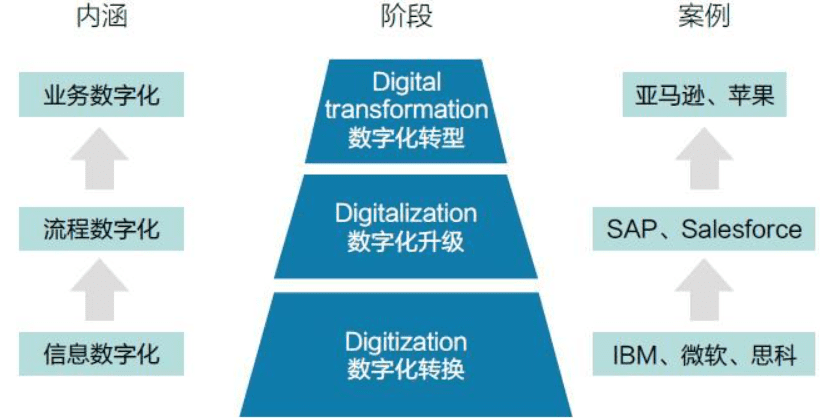
(二)在这里给出了数字化转型发展的三个阶段:
数字化转换:信息数字化,模拟数据到01二进制数字化转型网www.szhzxw.cn
数字化升级:流程数字化,典型是各类IT应用系统
数字化转型:业务数字化,典型代表亚马逊,苹果
同时对于数字化转型给出了另外一句关键描述即:
数字化转型表明,只有企业对其业务进行系统性、彻底的(或重大和完全的)重新定义——而不仅仅是IT,而是对组织活动、流程、业务模式和员工能力的方方面面进行重新定义的时候,成功才会得以实现。
(三)而对于IDC对数字化转型定义相对更加精简,如下:
数字化转型是利用数字化技术(例如云计算、大数据、人工智能、物联网、区块链等)和能力来驱动组织商业模式创新和商业生态系统重构的途径和方法即是数字化转型。其目的是实现企业业务的转型、创新、增长。
在这个概念里面实际核心强调了两点,其一是数字化技术的应用,其二是业务或商业模式重塑。其中业务重塑是根本目标,而数字化技术只是工具和手段,在这点上不能本末倒置。
虽然当前很多IT咨询机构,软件服务商等都在推自己的数字化转型解决方案,但是企业要意识到数字化转型绝非简单的数字化技术或工具应用,上个系统就能够解决的。
二、对数字化转型的进一步理解
(一)连接-数据-智能
在我前面文章曾经谈到过,企业的数字化应立足于顶端设计,结合企业的核心竞争力,如产品设计能力、社会化服务能力、渠道终端覆盖力,以及未来的产业互联、生态发展方向,依托企业自身优势,抓取企业自身的数字化本质。数字化转型网www.szhzxw.cn
即企业数字化是将当前的数字技术应用到企业的战略和业务目标达成。而对于数字化转型的本质主要包括三个方面的内容。
连接:万物互联,解决人和人,人和物,物和物的连接问题
数据:连接后产生集成和协同,协同过程自然会产生数据
智能:数据经过加工和提炼,形成智能化分析应用
其中连接解决基本的业务链协同问题,通过连接下的业务协同形成数据沉淀,通过数据的存储处理,管控治理形成数据服务能力反哺业务。同时数据持续积累又进一步为机器学习,深度学习等智能化分析应用提供服务。
(二)数字化能力框架重构
基于以上思考,我们就可以更好地理解和重构数字化框架。
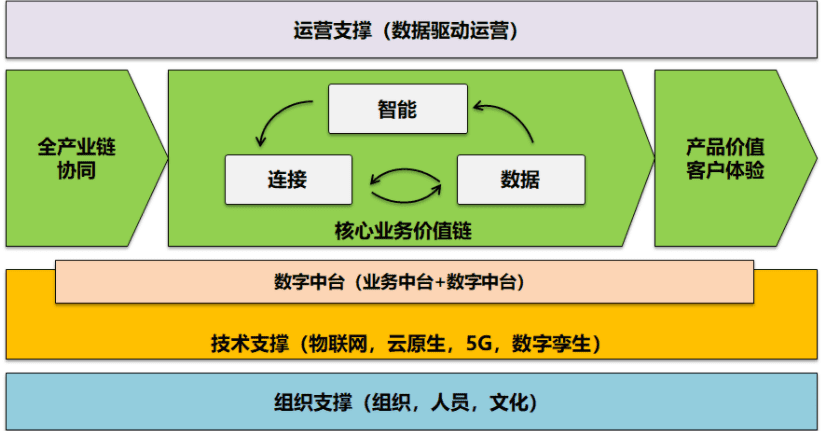
上图是我对企业数字化转型能力框架的一个重构,绿色部分还是围绕核心业务价值链的内容。其中最核心的是连接,数据和智能三个部分内容。另外在下层增加了组织支撑和技术支撑两部分内容。
组织支撑:包括了组织,人员,文化,过程等内容。数字化转型网www.szhzxw.cn
技术支撑:包括了云原生,物联网,5G和数字孪生等,也包括数字中台构建。
在最上面增加了运营支撑。
运营支撑:核心是基于数据驱动思维下,以价值创造为目标的持续改进。
以上即是对企业数字化转型框架的重构理解,对于该能力框架后续准备再专门写文章来进行说明,从该框架至少可以清楚的明白当我们谈一个管理,业务或技术内容的时候,再整个框架里面具体的位置。
三、从信息化到数字化
当谈数字化转型的时候,首先还是需要进一步理解清楚数字化这个概念,才能够更好地谈数字化转型。对于信息化大家都容易理解,那么数字化是否就是简单地增加了类似物联网,人工智能,5G,区块链等新技术就变成数字化了?数字化转型网www.szhzxw.cn
重新理解数字化
简单来说数字化本身就是信息化的进一步深入,信息化也是数字化发展的前期阶段,是数字化整体范畴的一个子集。
在这里,还是需要从技术和业务两个层面来重新理解数字化。
对于技术层面谈数字化,在这里提出一个重要观点如下:
即数字化是在传统信息化基础上,通过万物互联的核心思路,来解决了物和信息在时间和空间上的完整融合,形成一个整体。
这里强调了两个关键,其一是连接,其二是时空信息的融合。
我原来谈到过,在实施ERP或其他内部IT系统的时候,谈得最多的就是物流,信息流和资金的统一。但是这个过程的实现更多的是通过人工去操作,人去录入单据数据,人去推动整个业务流程的流转。
而到了数字化阶段,在应用了物联网,5G等技术后,不仅仅是人和物的连接来产生信息,而是物和物本身也可以连接并自动产生信息。在万物互联下,信息的产生不再是只能够通过人工输入信息,而是自动产生,自动计算,自动流转。
我前面举过一个最简单例子如下:
传统进销存下,当货物入库的时候你手工在系统里面录入一张入库单。而在数字化阶段,更好的方式是货物推进仓库的时候,通过RFID自动扫描和感知,自动产生入库信息并进行计算汇总处理。
第二个关键点,即在传统的信息化阶段,我们产生的信息只有时间信息,而没有附属空间信息,比如一个货物什么时候入库的,入库数量多少我们查询系统可以知道。但是这个货物当前在什么位置,包括货物具体的空间位移路线,我们并不清楚。同时货物本身的时间信息和空间信息本身也是脱节的。
而在数字化阶段,时空信息进一步融合,一个事物我们不仅仅是知道它的生命周期时间状态,更加重要的是知道它的空间地理位置状态,这个两个信息本身是一体的。在最早的时候有资产管理系统管理资产信息,而现在提出一个概念叫数字资产,里面一个关键点就是时空信息的融合。
在数字化基础上,特别是在智能制造领域提得比较多的是数字孪生的概念,可以先看下对于这个概念的简单定义如下:
数字孪生是充分利用物理模型、传感器更新、运行历史等数据,集成多学科、多物理量、多尺度、多概率的仿真过程,在虚拟空间中完成映射,从而反映相对应的实体装备的全生命周期过程。数字孪生是一种超越现实的概念,可以被视为一个或多个重要的、彼此依赖的装备系统的数字映射系统。
这个定义在时空融合上又进一步体现了抽象世界和现实世界的融合。而这本身也是数字化技术发展的一个重要趋势。
简单来说谈数字化你要跳出单纯的数字工具和技术的约束,从整个信息化发展演进的趋势,从万物互联,时空融合,抽象现实融合角度来重新思考数字化。
四、数字化转型-内和外
当谈数字化转型的时候,还是得回到当前企业能够看到的成功实践究竟有哪些可以参考。当在分析这些实践的时候,实际包括了内和外两个关键的维度来分析。
(一)内部-能力提升和重构
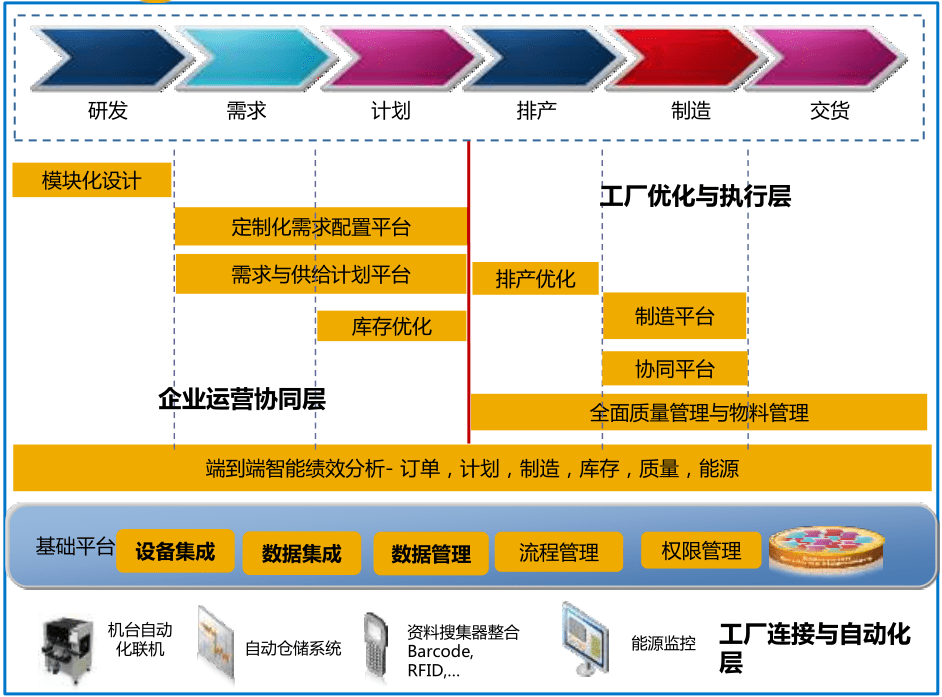
在前面已经谈到企业数字化转型中仍然需要完成企业内部信息化建设和集成问题。这个集成包括了横向以业务价值链为核心的协同和集成,也包括了垂直的以生产制造为核心的集成。同时还得实现横向和纵向之间的集成。
对于已经具备信息化基础的企业来说,实际就是两个重点,一个是解决系统间的整合和集成问题,一个就是如何利用新的数字化技术来解决自动化和智能化问题。在当前的实践中包括了类似智能仓储和物流,数字资产管理,数字孪生,智能制造等基本围绕这两个重点展开。
任何企业谈数字化转型,其核心基础仍然经过数字化重构和整合后的内部能力,这个能力目标就是实现业务的敏捷,自动化,面对市场和客户需求时候的足够柔性应变能力。
如果这个基础能力不具备,就快速地去做消费互联和产业互联,那很可能是赶鸭子上架无法支撑。企业跨越边界走出去是个好事,但是有个过程积累能力,把内功练好。
(二)外部-消费互联和产业互联
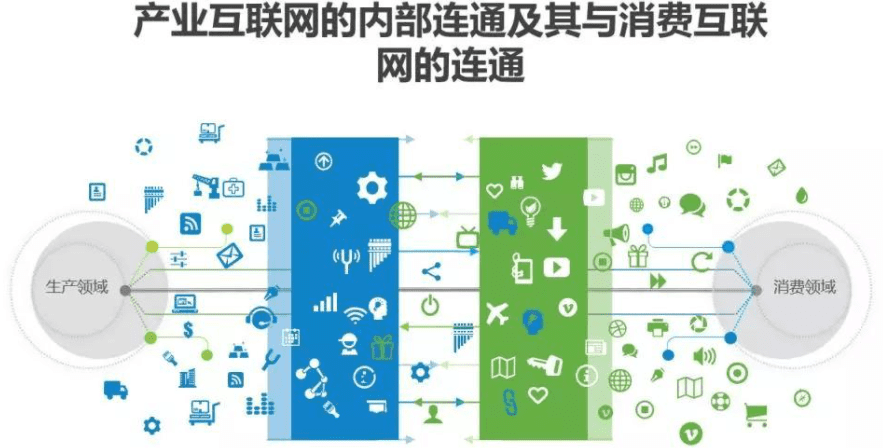
跨越企业内部边界到外部,谈得最多的就是消费互联和产业互联。这种互联当天实践最多的就是快消行业或直接面对C端客户的行业。
因为在从内走向外的时候,实际企业很多在模仿互联网的玩法。
比如从最早谈得比较多的O2O线上线下整合,企业自建垂直一体化电商,企业构建自己的能力中台并建立外部连接生态,拓展自己的品牌和自媒体运营并实现公域流量到私域流量的转换,通过运营和对数据的分析来实现业务的持续改善等。
这些玩法互联网企业玩后的2到3年,开始在传统企业数字转型中玩,包括谈得比较多的中台建设同样是如此。在这个走向外部过程中有的企业成功了,有的企业失败了。你观察这些企业你会发现,真正成功的大部分还是大的企业,原来信息化做的足够成熟的企业,而不是那些简单的引入软件厂商中台咨询和建设的企业。
其核心原因主要是两点:
其一是前面谈到的内部能力修炼是基础
其二是数字化转型本质是业务问题,其次才是技术问题
最近几年,有个很不好的风气就是过度强调营销,强调抢占流量风口,但是实际上任何一个企业来说核心仍然是提供有价值和有竞争力的产品和服务。你只要提供的有竞争力的产品,那么流量是否在你那边并不是最重要的事情。
术业有专攻,任何一个企业要搞清楚自己的核心竞争力在哪里,要专注在自己的核心竞争优势打造上,而不是去做自己不擅长的事情。
我一直在强调企业不要想着整个产业链,或者说从产品从生产到交付到客户的过程链全部通吃,而是应该将自己垂直的一块做好。能够有人帮你代理,或者帮你分销是好事情,你随时少赚了部分钱,但是同样减少了成本和风险。
其次就是前面谈过的,内部能力不足够不要轻易直接面对C端客户,当你真正面对C端的时候你会发现需求敏捷性,需求多样化急剧增加。那么你当前的价值链,你的生产,物流等过程能否做到足够的敏捷响应和柔性?
如果无法做到,可以看到需求满意度就下降,反而是影响到公司品牌战略。
包括最近1到2年比较火的产业互联概念,在我前面也有文章详细介绍,但是你理解了产业互联你就明白这个不适合大部分企业,或者说产业互联仅仅适合垂直行业下的上来头部企业来玩,来进行生态链整合,更多的企业仅仅是接入和跟随。
五、为何要进行数字化转型?
当谈企业数字化转型的时候,和多年前谈为何企业要上ERP感觉一样。比如上ERP是找死,不上ERP是等死。这个想法对数字化转型仍然适用。
企业为何要进行数字化转型,难道是别的企业都在做数字化转型所以我们也要跟着做,还是说互联网很多概念和思想很好的,我们想先做下尝试。还是说仅仅是增加些企业的宣传口号和噱头。
在数字化能力框架构图里面就可以看到,数字化实际涉及到企业的战略,业务,组织,流程,IT和技术多方面的内容,绝对不是简单的数字化工具和技术的应用。同时衡量数字化转型是否成功的标准也很简单,即:
数字化转型是否真正提升了企业的核心价值和能力。
对于为何要进行数字化转型,我准备从两个方面来展开谈,其一从业务角度,其二是从技术角度来谈。
业务角度-业务目标驱动
企业提出数字化转型很多还是围绕企业战略和业务目标实现提出的,简单来说就是当前构建的IT和技术能否高效,敏捷的支撑企业业务目标和战略的达成。
业务驱动IT,IT需要匹配业务战略和目标。
在业务目标达成过程中,可以看到引入更多的数字化技术后,整个技术支撑平台能够更加高效,敏捷和自动化,更好的支撑业务战略达成。那么这个数字化转型是有意义的,即为企业创造了价值,提升了企业核心竞争力。
可以看下华为数字化转型的案例。
过去30年,华为通过不断变革以及IT的实施,有效支持了业务的发展;随着业务全球化、复杂化以及不确定性的增长,华为决策者认为,如果仍采用中央集群管理方式作战,既不能适应新的挑战,也无法匹配华为“把数字世界带入每个人、每个家庭、每个组织,构建万物互联的智能世界”的愿景,未来的作战方式应该是一线在充分授权的情况下精兵作战。在这种作战方式下,整个组织的管理架构、运作流程以及IT系统都需要改变。
为此,华为提出了数字化转型的目标:在未来3~5年率先实现数字化华为,实现大平台支撑下的精兵作战。对外,要对准作战,通过与客户交易过程的数字化,实现客户、消费者、合作伙伴、供应商和员工这5类用户的ROADS体验(Real-time实时、On-demand按需、All-online全在线、DIY服务自助、Socia l社交化),提高客户满意度;对内,实现各业务领域的数字化与服务化,打通跨领域的信息断点,达到领先于行业的运营效率。
并在9大领域进行了数字化转型实践。
1、研发上云,全球协同
2、大平台能力支撑销售作战
3、集成服务交付实时可视
4、全球制造运营与指挥中心
5、智慧物流与数字化仓储
6、财务快速结账和自动支付
7、全联接协同办公
8、华为智慧园区
9、手机电商
简单来说即所有的实践你可以理解为同时包括了业务和技术两部分内容,体现的是业务和技术的融合。其次就是数字化转型实践最终是支撑业务战略和目标达成。
(二)技术角度-技术推动业务
在数字化时代体现一个新特征,即IT反向推动业务流程改进,业务战略目标达成等。
当前类似人工智能,物联网,智能制造,数字化,人工智能,消费互联和产业互联各种新的概念和技术不断发展。这些概念本身的发展就对传统企业传统的生产制造,市场营销等造成了巨大的影响。比如传统市场营销方法往往已经跟不上节奏,现在谈的多是数字化影响,谈的企业自媒体和品牌打造,谈的公域流量如何引流为你自己的私域流量等。
而这些内容由于涉及到新技术和IT等,传统的业务部门和业务人员往往难以深入去思考如何去优化改进业务,如何去应用。
相反,企业的CIO往往具备这种引导能力,特别是那些有IT和技术背景,同时又熟悉企业内部业务和核心价值链的CIO,往往不再是单纯的建设IT支撑业务,而变化为了如何构建IT来推动业务发展。这个趋势发展下,IT往往也不再是单纯的成本单位,而可能变化为利润单位。
企业CIO要意识到,虽然新技术很重要,但是新技术下产生的新的业务和商业逻辑更加重要,只要对新的业务模式清楚了解后,往往才能够更加清晰的认识新技术和架构。
当重新思考数字化转型的时候,一个新观点如下:
数字化转型不是简单的满足企业当前战略和业务目标,而是重新去思考当前的数字化经济和万物互联时代。在理解市场和数字化转型核心思想后,提出和践行适合企业发展的新的业务战略和商业模式,实现企业一种新的破局。
做数字化转型的要意识到,满足业务目标是一方面,但是当你理解了数字化后完全可以提出新的业务目标,或对当前的商业模式逻辑进行重塑。
技术也可以推动业务变革,在新的数字经济下成为可能。
包括后面你会看到一些典型的现象。
比如一些传统的轻资产企业,在数字化转型后你很难说这个企业是一个传统的业务企业还是一个互联网企业,业务和IT已经高度融合,比如类似瑞幸咖啡,喜茶这类企业,很难说是一个传统企业还是互联网企业。再比如一个新的部门,比如数字化营销部,这个部门你已经很难用传统的业务部门视角来看待。
一个企业在传统模式下经营太久,很多时候很难跳出盒子来思考问题,比如传统方式下你都是市场和产品的视角,但是新经济模式下这个模式会变成客户的视角,变成基于数据的运营视角,这个不是传统业务的简单优化,而是变革。
变革很难,有时候是革自己的命。
比如软件企业,原来是传统的软件开发和实施,现在转变为云服务,原来一个项目可以收100万,但是现在按照云服务一年只能够收10万。这种就是大的业务和商业模式的革新,虽然对企业来说短期利益受损,但是符合企业整体远期商业战略。
六、如何进行数字化转型?
在这里我想先强调一点,即有些内容是属于企业在信息化建设阶段就需要完成的事情,最典型的就是类似基础平台建设,围绕ERP的横向价值链信息化,围绕MES为核心的纵向信息化,同时横向和纵向的集成和协同等。还有就是基于传统IT的BI或大数据分析平台建设等。
这些内容属于当前有些把其归结到数字化转型里面,实际是不太合理。如果确实要算可以算作为数字化转型的初级阶段,即你原来信息化建设遗留的问题你需要在数字化阶段还账。
(一)业务数字化-数据驱动
业务数字化是在谈数字化转型的时候经常谈到的一个概念,在这里我更想强调数字化转型的第二个本质,即数据。
连接的重要性实际上在前面已经强调,连接的价值不仅仅是支撑了业务协同,更加重要的是产生了数据。数据本身又支撑业务运作,数据反哺业务;其次就是数据本身可以持续积累,数据应用于分析和决策,数据产生智能。
在信息化阶段也强调数据,强调BI或数据决策分析,但是在数字化阶段对数据进一步强化,这个强化体现在两点。其一是数据能力要持续不断地实时或准实时地支撑业务运作;其二是数据本身通过积累后进行分析产生价值,并进一步为人工智能提供支撑。
在数字化阶段,进一步强调了互联网常说的运营这个概念。
数据驱动运营,运营本身衔接市场需求和内部能力。运营是真正拉近了企业内部IT能力和外部需求和用户之间的关键桥梁。
数据+运营是转型过程中一个关键的思维转变。
简单来说企业不再是简单的生产产品交付给市场或客户,而是如何建立市场和内部能力之间的纽带,通过持续不断的数据分析来促进产品销售和优化改进。
(二)如何分阶段演进
当谈数字化转型的时候,现在谈得最多的就是消费互联和产业互联,谈自建电商平台,谈线上和线下的打通,谈数字化营销,谈自媒体运营和C端用户触达,谈互联网引流等。注意这些更多的是面对类似快消类行业,并不是对于所有企业都适用。
刚才一直在谈的就是数字化转型一定要围绕连接,数据和智能化三个要素展开。按信息化到数字化到智能化进行演进,按从内到外的顺序逐步打通。
比如一个传统的制造行业,那么这个企业的重点一定不是在于快速地去打通外部,而是如何更好的整合内部IT能力,制造能力,解决低成本,高效敏捷响应市场的能力。
其次,数字化转型一定要考虑分阶段演进,当前数字化转型建设一定是按垂直细分线条逐个去解决,而不是建立大而全的系统或平台。类似当前很多企业在构建的大数字中台,基本都是错误做法,成本投入巨大,短期难见效益,后期难以维护。
思路1:按连接-数据-智能思路演进
当谈数字化演进路线的时候,实际上数字化转型的三个核心内容正是最基本的演进路线。即企业在进行数字化建设的时候优先还是要考虑解决连接和协同问题,这个过程有些是处理信息化阶段没有做完的事情,进行优化和整合。
其次是数据驱动运营,数据贯穿整个数字化建设生命周期,即业务和数据建设两条线是并行的。传统方式是IT系统建设完成后才考虑如何利用数据进行分析决策,而新的构建思路是数据建设配合业务建设和协同并行,数据不断的反哺业务,支撑业务运作。
最后是智能,智能不是简单基于预设规则的自动化,而是可以自适应地进行规则调整和优化,这个需要的是大数据的积累,不是一蹴而就的,但是前期要有这个意识。
思路2:由内而外-从三流整合到生态整合
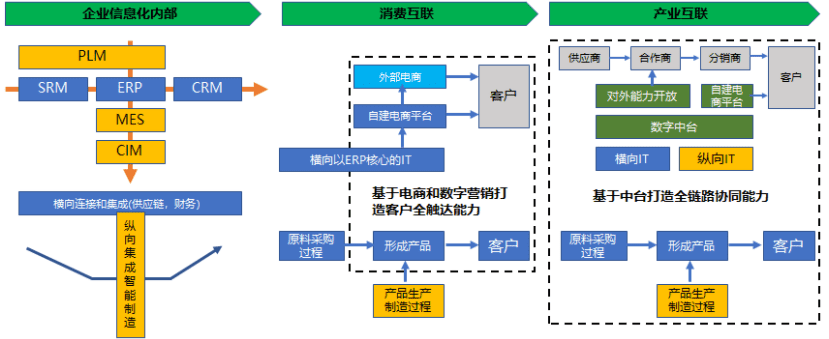
在海尔分享自己的数字化转型经验的时候,谈到了海尔电商发展的四个阶段,即从最早的电商平台建设到后期的生态整合,如下:
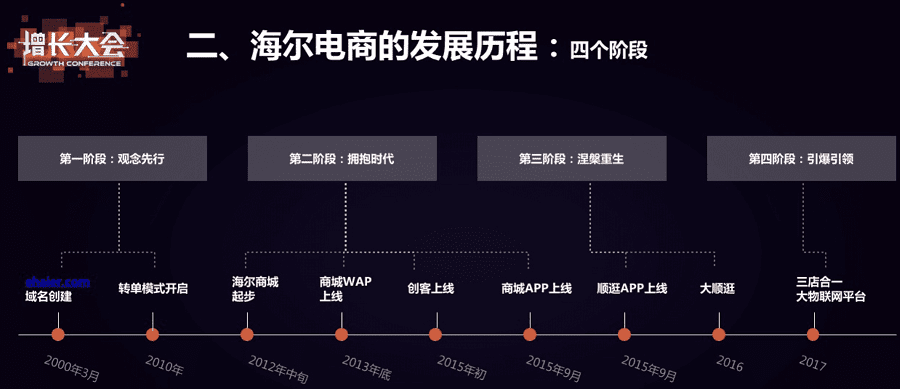
在海尔电商的发展前期,重点还是希望通过构建电商平台来打通内部和外部,打通线上和线下,对物流,信息流,资金流进一步的整合。在这个里面不仅仅是业务和流程的变革,更加重要的是数据驱动运营思维的转变。其核心就是如何真正基于数据分析持续运营,将被动的等待市场和客户,变化为主动的经营流量和拓展客户。
其次,当从消费互联转到产业互联的时候,实际真正的重点在于生态的整合,即真正去构建构建一个完整的生态体系和开放能力平台,这个生态平台才是能够持续不断发挥价值的地方。类似小米也一样,实际并不是一个单纯的手机厂商,而是一个生态平台建设和运营商,真正赚钱的反而是对整个生态体系的持续运营和增值服务提供。
思路3:目标细分和短周期迭代
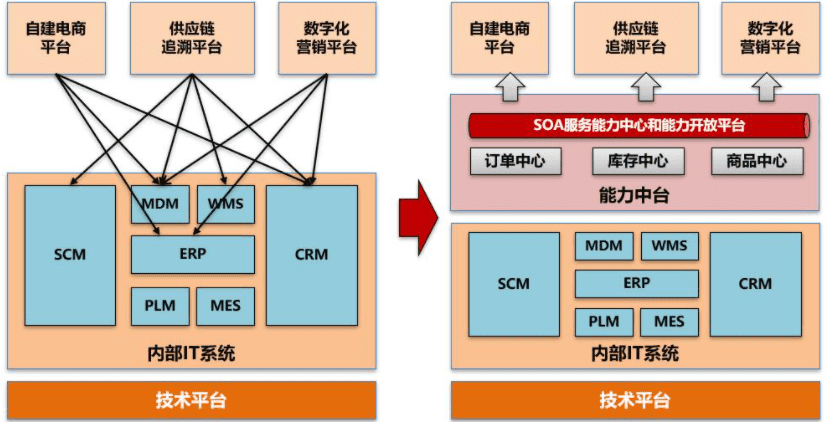
在前面我就提出,企业数字化转型务必不要搞大而全的模式。而是围绕企业战略和业务目标,将大目标分解为子目标,然后围绕每个子目标进行业务,组织,IT技术的改造和优化。那种见大而全的数字化平台或中台的模式一定不适用。
比如你的目标可以是打通线上和线下,实现三流整合,这个就是一个分解后的小目标。围绕这个小目标你就需要对业务流程,组织架构,IT系统等进行优化和重构,才能够满足这个目标的达成。
几年前我参与的一个企业自建电商平台项目即是上面这个目标,围绕这个目标构建了一个垂直一体化的O2O电商平台,打通线上和线下,同时形成统一的对外能力开放。而对内也不是完全废弃原来遗留IT系统,只是对遗留系统进行API能力抽象和整合,同时适配的方式形成一个能力中台。在这种模式下基本4个月所有的时间就完成建设和上线。

英文翻译:
I. Overview of digital transformation
First of all, let’s take a look at a basic definition of digital transformation, we cite two definitions here, one is the definition of Baidu Encyclopedia, one is the definition of IDC.
(1) First look at the definition of digital transformation on Baidu Encyclopedia as follows:
Digital transformation is a high-level transformation based on Digitization and Digitalization, which further touches the core business of the company and aims to build a new business model. Digital transformation is the development of digital technologies and supporting capabilities to create a dynamic digital business model.
(2) Three stages of digital transformation development are given here:
Digital conversion: Information digitization, analog data to 01 binary
Digital upgrade: process digitalization, typically all kinds of IT application systems
Digital transformation: Business digitization, typically represented by Amazon, Apple
At the same time, another key description of digital transformation is given:
Digital transformation shows that success can only be achieved when organizations systematically and radically (or significantly and completely) redefine their business – not just IT, but every aspect of organizational activities, processes, business models, and employee capabilities.
(3) IDC’s definition of digital transformation is more concise, as follows:
Digital transformation is the use of digital technologies (such as cloud computing, big data, artificial intelligence, Internet of things, blockchain, etc.) and capabilities to drive business model innovation and business ecosystem reconstruction of the way and method is digital transformation. Its purpose is to realize the transformation, innovation and growth of enterprise business.
In this concept, the actual core emphasizes two points, one is the application of digital technology, and the other is the business or business model reshaping. Among them, business reshaping is the fundamental goal, and digital technology is only a tool and means, which cannot be put before the horse.数字化转型网www.szhzxw.cn
Although many IT consulting institutions and software service providers are pushing their own digital transformation solutions, enterprises should realize that digital transformation is not a simple digital technology or tool application, which can be solved by the last system.
Second, further understanding of digital transformation
(1) Connection – data – intelligence
As mentioned in my previous article, the digitalization of enterprises should be based on the top design, combined with the core competitiveness of enterprises, such as product design ability, social service ability, channel terminal coverage, as well as the future industrial interconnection and ecological development direction, and rely on their own advantages to grasp the digital nature of enterprises.
Enterprise digitalization is the application of current digital technologies to the achievement of strategic and business objectives of the enterprise. The essence of digital transformation mainly includes three aspects.
Connection: everything is connected, solving the connection problem of people and people, people and things, things and things
Data: Integration and collaboration are generated after connection, and the collaborative process naturally generates data
Intelligence: Data is processed and refined to form intelligent analysis applications
Among them, connectivity solves the basic business chain collaboration problem, data precipitation is formed through business collaboration under connection, and data service capability is formed through data storage and processing, management and governance. At the same time, the continuous accumulation of data further provides services for intelligent analysis applications such as machine learning and deep learning.数字化转型网www.szhzxw.cn
(2) Reconstruction of digital capability framework
Based on these considerations, we can better understand and reframe the digital framework.
Above is a reconstruction of my enterprise digital transformation capability framework, the green part is still around the core business value chain content. The core of it is the three parts of connectivity, data and intelligence. In addition, two parts of organizational support and technical support are added in the lower layer.
Organization support: including organization, people, culture, process and so on.
Technical support: includes cloud native, Internet of Things, 5G and digital twins, etc., and also includes digital middle platform construction.
Added operational support at the top.
Operation support: The core is continuous improvement based on data-driven thinking with the goal of value creation.
The above is the reconstruction understanding of the enterprise digital transformation framework, for the follow-up preparation of the capability framework to write a special article to explain, from the framework can at least clearly understand when we talk about a management, business or technical content, then the specific position in the entire framework.
Third, from information to digital
When talking about digital transformation, first of all, we need to further understand the concept of digital, in order to better talk about digital transformation. It is easy for everyone to understand information, so is digitalization simply adding new technologies like the Internet of Things, artificial intelligence, 5G, blockchain and so on to become digital?
(1) Reunderstanding digitalization
In short, digitization itself is the further deepening of informatization, and informatization is also the early stage of digital development, which is a subset of the overall category of digitalization.
Here again, digitalization needs to be reunderstood at both the technical and business levels.
(A) For the technical level of digitalization, here put forward an important point of view as follows:
That is, digitalization is based on traditional information technology and solves the complete integration of things and information in time and space through the core idea of the Internet of everything, forming a whole.
Two key points are emphasized here, one is the connection, and the other is the fusion of space-time information.
As I mentioned earlier, when implementing ERP or other internal IT systems, the most talked about is the unification of logistics, information flow and capital. However, the realization of this process is more through manual operation, people to enter the document data, people to promote the flow of the entire business process.
In the digital stage, after the application of technologies such as the Internet of Things and 5G, it is not only the connection of people and things to generate information, but the things and things themselves can also be connected and automatically generate information. Under the Internet of everything, the generation of information is no longer only through manual input of information, but automatic generation, automatic calculation, automatic flow.
(2) The simplest example I have given is as follows:
Traditionally, when the goods are in storage, you manually enter a storage slip into the system. In the digital stage, the better way is when the goods are promoted to the warehouse, through RFID automatic scanning and perception, automatic storage information is generated and calculated and summarized.
The second key point is that in the traditional information stage, the information we generate only has time information, but no attached spatial information, such as when a cargo is stored and how much it is stored we can query the system to know. However, we are not clear about the current location of the goods, including the specific spatial displacement route of the goods. At the same time, the temporal information and spatial information of the goods themselves are also disjointed.
In the digital stage, space-time information is further integrated, and we not only know its life cycle time state of a thing, but more importantly, we know its spatial and geographical location state, the two information itself is one. In the earliest time, there was an asset management system to manage asset information, and now put forward a concept called digital assets, in which a key point is the integration of space-time information.
(3) On the basis of digitalization, especially in the field of intelligent manufacturing, the concept of digital twins is more often mentioned, you can first look at the simple definition of this concept as follows:
Digital twin is a multi-disciplinary, multi-physical, multi-scale and multi-probability simulation process that makes full use of data such as physical model, sensor update and operation history, and completes mapping in virtual space to reflect the whole life cycle process of the corresponding physical equipment. A digital twin is a transcendental concept that can be viewed as a digital mapping system of one or more important, interdependent equipment systems.
This definition further reflects the integration of the abstract world and the real world in the integration of time and space. And this is itself an important trend in the development of digital technology.
In short, when it comes to digitalization, you should jump out of the constraints of simple digital tools and technologies, and rethink digitalization from the perspective of the development and evolution of information technology, the interconnection of everything, the integration of time and space, and the integration of abstract reality.
Digital transformation – inside and out
When it comes to digital transformation, we still have to go back to what successful practices companies can see today. When analyzing these practices, we actually include two key dimensions, internal and external.
(1) Internal – capacity improvement and reconstruction
As mentioned above, it is still necessary to complete the internal information construction and integration in the digital transformation of enterprises. This integration includes horizontal collaboration and integration centered on the business value chain, as well as vertical integration centered on manufacturing. It is also necessary to achieve horizontal and vertical integration.
For enterprises that already have the basis of information technology, there are actually two key points, one is to solve the integration and integration problem between systems, and the other is how to use new digital technologies to solve the problem of automation and intelligence. In the current practice, including similar intelligent warehousing and logistics, digital asset management, digital twins, intelligent manufacturing and other basic focus on these two.
When any enterprise talks about digital transformation, its core foundation is still the internal capability after digital reconstruction and integration, and the goal of this capability is to achieve business agility, automation, and flexible enough adaptability in the face of market and customer needs.
If this basic ability does not have, quickly to do consumer Internet and industrial Internet, it is likely to be unable to support the duck shelf. It is a good thing for enterprises to go out across the border, but there is a process of accumulating ability and practicing internal skills.数字化转型网www.szhzxw.cn
(2) External – consumer and industrial interconnection
Across the internal boundaries of enterprises to the outside, the most talked about is the consumer Internet and industrial Internet. The most common practice of this interconnection is the FMCG industry or the industry that directly faces C-side customers.
Because when going from inside to outside, many actual enterprises are imitating the way the Internet plays.
For example, from the earliest talked about more O2O online and offline integration, enterprises to establish their own vertical integration of e-commerce, enterprises to build their own capabilities and establish an external connection ecology, expand their own brand and we media operations and realize the conversion of public domain traffic to private domain traffic, through operation and data analysis to achieve continuous improvement of business.
After 2 to 3 years of playing these games, Internet companies began to play in the digital transformation of traditional enterprises, including the construction of middle Taiwan, which is more talked about. In this process of going outside, some enterprises have succeeded and some enterprises have failed. When you look at these enterprises, you will find that most of the really successful enterprises are still large enterprises, and the original informatization enterprises are mature enough, rather than those who simply introduce software manufacturers to consult and build enterprises.
The core reasons are mainly two points:
One is that the internal ability cultivation mentioned earlier is the foundation
The second is that digital transformation is essentially a business problem, not a technical problem
In recent years, there is a very bad atmosphere is to over-emphasize marketing, emphasizing to seize the traffic outlet, but in fact, the core of any enterprise is still to provide valuable and competitive products and services. As long as you provide a competitive product, then whether the traffic is on your side is not the most important thing.数字化转型网www.szhzxw.cn
Any enterprise should figure out where its core competitiveness is. And focus on building its core competitive advantage, rather than doing things that it is not good at.
I have been stressing that enterprises should not think about the entire industrial chain, or the process chain from product production to delivery to customers, but should do a good job of their own vertical piece. It’s good to have someone to represent you, or distribute for you, because you’re making less money at any time, but you’re also reducing costs and risks.
Secondly, as discussed earlier, the internal ability is not enough to directly face the C-side customers easily, when you really face the C-side you will find that the demand agility and demand diversification increase sharply. Can your current value chain, your production, logistics and other processes be sufficiently responsive and flexible?
If it cannot be done, it can be seen that demand satisfaction will decline, but it will affect the company’s brand strategy.
Including the recent 1 to 2 years of relatively hot industrial Internet concept, there are also articles in front of me, but you understand the industrial Internet you understand that this is not suitable for most enterprises, or industrial Internet is only suitable for vertical industries under the head of enterprises to play, to carry out the integration of the ecological chain, more companies are just access and follow.
Why Digital transformation?
When talking about enterprise digital transformation, it feels the same as years ago when talking about why enterprises need ERP. For example, on ERP is looking for death, not on ERP is waiting for death. This idea still holds true for digital transformation.
Why do enterprises want to carry out digital transformation, is it that other enterprises are doing digital transformation so we have to follow suit, or that many concepts and ideas of the Internet are very good, we want to try first. Or are they just adding corporate slogans and gimmicks?
As can be seen in the digital capability framework composition, digitalization actually involves the strategy, business, organization, process, IT and technology of the enterprise, and is definitely not a simple application of digital tools and technologies. At the same time, the criteria for measuring the success of digital transformation are simple:
Whether digital transformation truly enhances the core values and capabilities of the enterprise.V
I’m going to talk about the reasons for digital transformation from two perspectives, one from a business perspective and the other from a technical perspective.
(1) Business perspective – business goal driven
Many of the digital transformation proposed by enterprises revolve around the realization of enterprise strategy and business objectives. Simply put, IT is whether the current IT and technology can efficiently and flexibly support the realization of enterprise business objectives and strategies.
Business drives IT, and IT needs to match business strategy and goals.
In the process of achieving business objectives, it can be seen that after the introduction of more digital technologies, the entire technology support platform can be more efficient, agile and automated, and better support the achievement of business strategies. Then this digital transformation is meaningful, that is, it creates value for the enterprise and enhances the core competitiveness of the enterprise.
Take a look at the case of Huawei’s digital transformation.
Over the past 30 years, Huawei has effectively supported the development of its business through continuous changes and IT implementation. With the growth of business globalization, complexity and uncertainty, Huawei’s decision makers believe that if they still use a centralized cluster management mode of combat, it can not adapt to new challenges, nor can it match Huawei’s vision of “bringing the digital world to every person, every family, and every organization, and building a smart world where everything is connected”. The future mode of warfare should be the front line with full authorization under the condition of elite combat. In this way of fighting, the entire organization’s management structure, operational processes, and IT systems need to change.
To this end, Huawei has put forward the goal of digital transformation: to take the lead in realizing digital Huawei in the next 3 to 5 years and realize elite combat supported by large platforms. Externally, the road experience of customers, consumers, partners, suppliers and employees (Real-time, On-demand, All-online, DIY service self-service, socializing) should be realized through the digitalization of the transaction process with customers. Improve customer satisfaction; Internally, digitalization and service in various business areas are realized, information breakpoints in cross-fields are opened, and operational efficiency ahead of the industry is achieved.数字化转型网www.szhzxw.cn
And digital transformation practices in nine areas.
1, research and development on the cloud, global collaboration
2, large platform ability to support sales operations
3.Real-time visibility of integrated service delivery
4, global manufacturing operations and command center
5.Intelligent logistics and digital warehousing
6, financial fast checkout and automatic payment
7, fully connected collaborative office
8.Huawei Smart Park
9.Mobile e-commerce
To put it simply, all practices can be understood as including both business and technology, reflecting the integration of business and technology. The second is that digital transformation practices ultimately underpin business strategy and goals.
(2) Technology Perspective – Technology drives business
IT reflects a new feature in the digital age, that is, IT inversely promotes business process improvement and business strategic goal achievement.
At present, various new concepts and technologies such as artificial intelligence, Internet of Things, intelligent manufacturing, digitalization, artificial intelligence, consumer Internet and industrial Internet continue to develop. The development of these concepts has had a huge impact on the traditional manufacturing and marketing of traditional enterprises. For example, traditional marketing methods have often been unable to keep up with the pace, and now they are talking about the digital impact, talking about enterprise self-media and brand building, and talking about how public domain traffic is diverted to your own private domain traffic.
As these contents involve new technologies and IT, traditional business departments and business personnel often find it difficult to think deeply about how to optimize and improve the business and how to apply them.
On the contrary, enterprise CIOs often have this guidance ability, especially those who have IT and technology background, but also familiar with the internal business and core value chain of the enterprise CIOs, often no longer simply build IT support business, but change to how to build IT to promote business development. With the development of this trend, IT is often no longer a simple cost unit, but may change into a profit unit.数字化转型网www.szhzxw.cn
Enterprise CIOs should realize that although new technologies are important, the new business and business logic generated under new technologies are more important, as long as a clear understanding of the new business model, often can more clearly understand the new technology and architecture.
When it comes to rethinking digital transformation, a new perspective is as follows:
Digital transformation is not simply to meet the current strategic and business objectives of the enterprise, but to rethink the current digital economy and the Internet of everything era. After understanding the core ideas of the market and digital transformation, we propose and practice new business strategies and business models suitable for the development of enterprises, so as to realize a new game-breaking of enterprises.
To do digital transformation, realize that meeting business goals is one thing, but when you understand digital, you can come up with new business goals, or reshape the current business model logic.
Technology can also drive business change, made possible in the new digital economy.
And then you’ll see some typical phenomena.
For example, for some traditional asset-light enterprises, after digital transformation, IT is difficult to say whether the enterprise is a traditional business enterprise or an Internet enterprise, and the business and IT have been highly integrated. For example, it is difficult to say whether it is a traditional enterprise or an Internet enterprise, such as Luckin Coffee and Hitea. Take a new department, like digital marketing, which is hard to see from a traditional business unit perspective.
For example, in the traditional way, you are the perspective of the market and products, but in the new economic model, this model will become the perspective of customers, into the perspective of data-based operations, which is not a simple optimization of traditional business, but a change.
Change is hard. Sometimes it’s self-defeating.
For example, software companies, originally traditional software development and implementation, are now transformed into cloud services, the original project can receive 1 million, but now according to cloud services can only receive 100,000 a year. This is the big business and business model innovation, although the short-term interests of enterprises are damaged, but in line with the overall long-term business strategy of enterprises.
How to carry out digital transformation?
Here I would like to first emphasize that some contents belong to the things that enterprises need to complete in the information construction stage, the most typical is similar basic platform construction, horizontal value chain information around ERP, vertical information around MES as the core, and horizontal and vertical integration and collaboration. There is also the construction of BI or big data analysis platforms based on traditional IT.
Some of these contents are currently attributed to digital transformation, which is actually not very reasonable. If you really want to count it, you can count it as the initial stage of digital transformation, that is, you need to pay back the problems left over from the original information construction in the digital stage.数字化转型网www.szhzxw.cn
(1) Business digitalization – data-driven
Business digitization is a concept that is often talked about when talking about digital transformation, and here I would like to emphasize the second essence of digital transformation, that is, data.
The importance of connectivity has in fact been emphasized earlier, the value of connectivity is not only to support business collaboration, but more importantly to generate data. The data itself supports the business operation, and the data feeds the business; The second is that data itself can be continuously accumulated, data is applied to analysis and decision-making, and data generates intelligence.
In the information stage, data is also emphasized, emphasizing BI or data decision analysis, but in the digital stage, the data is further strengthened, which is reflected in two points. The first is the data capability to continuously support business operations in real time or near real time; The second is that the data itself generates value through analysis after accumulation and further provides support for artificial intelligence.
In the digital phase, the concept of operation, which is often said on the Internet, is further emphasized.
Data-driven operations, the operations themselves connect to market needs and internal capabilities. Operations is truly the key bridge between an enterprise’s internal IT capabilities and external needs and users.
Data + Operations is a key mindset shift in the transformation process.
In short, enterprises are no longer simply producing products to deliver to the market or customers, but how to establish a link between the market and internal capabilities, through continuous data analysis to promote product sales and optimize improvement.
(2) How will it evolve in stages
When talking about digital transformation, the most talked about is consumer Internet and industrial Internet, talk about self-built e-commerce platforms, talk about online and offline opening up, talk about digital marketing, talk about media operation and C-end user access, talk about Internet drainage and so on. Note that these are more in the face of similar FMCG industries, and are not applicable to all companies.数字化转型网www.szhzxw.cn
What I have been talking about is that digital transformation must revolve around the three elements of connectivity, data and intelligence. According to the evolution of information to digital to intelligent, in the order of from inside to outside gradually open up.
For example, in a traditional manufacturing industry, the focus of the enterprise must not be to quickly open up the outside, but how to better integrate the internal IT capabilities, manufacturing capabilities, low-cost solutions, efficient and agile response to the market.
Secondly, digital transformation must consider phased evolution, and the current digital transformation construction must be solved one by one according to the vertical subdivision line, rather than establishing a large and comprehensive system or platform. Similar to the current construction of large digital platforms by many companies, it is basically the wrong approach, the cost is huge, the short-term benefits are difficult to see, and the later period is difficult to maintain.
Idea 1: Evolution according to connection-data-intelligence
When talking about the digital evolution route, in fact, the three core contents of digital transformation are the most basic evolution route. That is, when enterprises carry out digital construction, they should give priority to solving the problem of connection and collaboration, and some of this process is to deal with the things that have not been completed in the information stage, optimize and integrate.
The second is data-driven operation, where data runs through the entire digital construction life cycle, that is, business and data construction are parallel. The traditional way is to consider how to make use of data for analysis and decision-making after the completion of IT system construction, while the new construction idea is that data construction will cooperate with business construction and cooperate and parallel, and data will continuously feed back the business and support business operation.
Finally, intelligence, intelligence is not simply based on the automation of preset rules, but can adapt to the adjustment and optimization of rules, which requires the accumulation of big data, not overnight, but the early stage to have this awareness.
Idea 2: From the inside out – from third-rate integration to ecological integration
When Haier shared its digital transformation experience, it talked about the four stages of Haier’s e-commerce development, that is, from the earliest e-commerce platform construction to the later ecological integration, as follows:
In the early stage of the development of Haier’s e-commerce, the focus is still to build an e-commerce platform to open up internal and external, online and offline, and further integrate logistics, information flow and capital flow. In this is not only business and process change, but more importantly, the transformation of data-driven operational thinking. Its core is how to truly continue to operate based on data analysis, passively waiting for the market and customers, and change to active business flow and expand customers.数字化转型网www.szhzxw.cn
Secondly, when turning from consumer Internet to industrial Internet, the real focus is on ecological integration, that is, to really build a complete ecosystem and open capability platform, which is the place where the value of this ecological platform can continue to play. Similar to Xiaomi, the actual is not a simple mobile phone manufacturer, but an ecological platform construction and operator, the real money is the continuous operation of the entire ecosystem and value-added services.
Idea 3: Target segmentation and short cycle iteration
I mentioned earlier that the enterprise digital transformation must not engage in a large and comprehensive model. IT is about enterprise strategy and business goals, breaking the big goal into sub-goals, and then transforming and optimizing the business, organization, and IT technology around each sub-goal. The all-encompassing digital platform or mid-platform model will not work.
For example, your goal can be to get through online and offline, to achieve third-rate integration, which is a small goal after decomposition. Around this small goal, you need to optimize and restructure business processes, organizational structures, IT systems, etc., in order to meet this goal.
A few years ago, I participated in an enterprise self-built e-commerce platform project that is the above goal, and built a vertically integrated O2O e-commerce platform around this goal, connecting online and offline, and forming a unified external capacity opening. Internally, IT is not completely abandoned the original legacy IT system, but only the API capability abstraction and integration of the legacy system, and the way of adaptation forms a capability center. In this mode, it takes almost four months to complete the construction and launch.
本文由数字化转型网(www.szhzxw.cn)转载而成,来源于灯塔工厂;编辑/翻译:数字化转型网小汤圆。

免责声明: 本网站(https://www.szhzxw.cn/)内容主要来自原创、合作媒体供稿和第三方投稿,凡在本网站出现的信息,均仅供参考。本网站将尽力确保所提供信息的准确性及可靠性,但不保证有关资料的准确性及可靠性,读者在使用前请进一步核实,并对任何自主决定的行为负责。本网站对有关资料所引致的错误、不确或遗漏,概不负任何法律责任。
本网站刊载的所有内容(包括但不仅限文字、图片、LOGO、音频、视频、软件、程序等) 版权归原作者所有。任何单位或个人认为本网站中的内容可能涉嫌侵犯其知识产权或存在不实内容时,请及时通知本站,予以删除。