一、动力电池智能制造的背景
动力电池作为新能源汽车的核心零件,是新能源汽车能源存储与转换的基础单元,其技术发展水平将成为全球汽车产业电动化转型的关键支撑。近年来,全球对新能源汽车的发展都已形成共识,各主要经济体都制定了动力电池的发展规划。从目前来看,国际动力电池市场的需求强劲,而我国在整个产业链上多个环节都拥有一半以上的产能,预计未来十年将是产业发展的关键时期。
在现有低碳环保出行的理念下,多国政府积极出台相应政策(如“限制燃油车销售”和“规划新能源汽车比例”等),推动电动汽车快速发展,从而带动动力电池产业的良好发展。根据SNEResearch公布的数据,2022年全球动力电池建成产能已接近1TWh;同年全球动力电池装机量为517.9GWh,同比增长高达75%。这些数据反映动力电池市场仍然存在巨大的需求。
在高端动力电池产品领域,我国与国外领先技术差距不大。我国在磷酸铁锂动力电池技术方面处于领先地位,不仅在车用动力电池大规模工业化稳定生产、低成本和高安全方面具有显著的技术优势,还积累了丰富的应用经验。总体而言,在先进材料、新电池体系和回收技术方面,我国还需进一步提升;但在电池系统和大宗材料技术等方面,我国基本与国外先进水平保持同步。
智能制造是指利用先进的信息技术、智能化设备和云计算等技术手段,实现制造过程的智能化、自动化、灵活化和高效化。它是工业4.0的核心和重要组成部分,是推动制造业升级和经济转型的重要手段之一。 数字化转型网www.szhzxw.cn
随着信息、机器人和自动化、大数据等技术的快速发展,工业生产方式正在发生根本性的变革。传统的制造方式已经无法满足市场和消费者对产品质量、灵活性、交货期、个性化的要求,同时全球经济竞争日趋激烈,制造业需要不断提高生产效率、降低成本,才能在市场竞争中取得优势。因此,智能制造成了制造业转型升级的关键路径。
动力电池的设计与制造,首先要考虑电池性能,包括安全性、合格率、一致性、制造效率等。其中,安全性包括设备安全、制造过程安全、应用安全等。目前新能源车安全事故频发,其中相当一部分是电池本身的安全性问题导致,因此,提高动力电池的安全性已经迫在眉睫。当前电池一次制造合格率(又称直通率)在90%左右,目标是在2025年提升到95%以上。合格率的提升可以直接降低电池制造成本,给电池制造企业带来可观的经济效益。一致性主要包括容量一致性、内阻一致性、自放电一致性等。提高一致性可以减少电池生产过程中的产品检测环节,简化部分制造工序,从而有效提高生产效率。目前国内储能电池企业的单线产能普遍较低,无法满足新能源汽车和储能电站市场对储能电池,尤其是高端电池产能的迫切需求。
提高动力电池制造的安全性、合格率、一致性及制造效率等指标是动力电池制造商不断努力的目标,要实现这个目标,必须在涂布、卷绕、叠片、组装和化成等核心制造能力上有大幅度提升,而且必须实现材料技术、电池技术、设备技术和智能控制技术等方面的全面突破。采用标准化、数字化、智能化等技术手段是实现动力电池大规模、高质量制造的必然途径。 数字化转型网www.szhzxw.cn
二、动力电池智能制造的路径
实现动力电池智能化制造是规模制造业的必然选择,应该采取标准化、模型化、数字化、智能化的路径。
1. 标准化
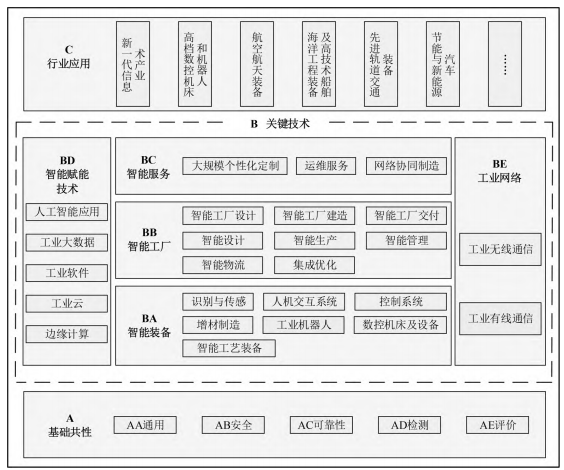
目前,《国家智能制造标准体系建设指南》(2018版,简称《指南》)已经发布,框架体系结构如图1所示。正如《指南》中的“智能制造、标准先行”,动力电池大规模制造需要采用标准化的手段,需要标准体系的支撑。动力电池技术起步较晚,其设计、制造、检验、应用缺少完整的标准,尤其针对锂电池行业的互联互通准则、集成接口、集成功能、集成能力标准,现场装备与系统集成、系统之间集成、系统互操作等集成标准严重缺少。面对动力电池智能制造发展的新形势、新机遇和新挑战,有必要系统梳理现有的相关标准,明确动力电池制造、集成的需求。从基础共性、关键技术以及行业应用等方面,建立一整套标准体系来支撑动力电池产业有序健康发展。
首先要实现电池规格的标准化,目前国内80多家动力电池企业有150多种电池规格型号,意味着需要有150多种不同的生产工艺和生产线,这严重限制了动力电池大规模制造能力的提升。应该总结分析过去的经验及给产业造成的损失教训,尽快制定出动力电池尺寸规格标准,将电池规格型号限制在10种左右。其次,元数据是动力电池设计、制造、应用的基础,要实现动力电池设计及基础标准化,需要建立动力电池领域元数据标准。 数字化转型网www.szhzxw.cn
SDS/T2111-2004《元数据标准化原则与方法》中规定了领域元数据制定时的选取原则,可以参照此原则制定动力电池领域元数据标准。最后要实现动力电池制造的标准化,需要解决一系列问题。动力电池制造过程复杂、工艺流程长、生产产线设备众多,而且同一条产线的生产设备往往来自不同的厂家,采用不同的通信接口和协议,导致设备之间缺乏互联互通互操作的基础。为了解决这个问题,需要建立电池制造过程数据字典标准,统一设备模型,制定设备通信接口规范,进行数据治理,实现产线设备和企业信息化系统的集成,实现运营技术与信息技术深度融合。同时,利用工业互联网平台,实现企业内部和外部信息集成,优化电池制造资源的配置及过程管控。
2. 模型化
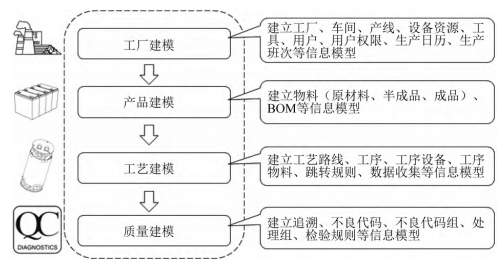
模型化是智能化的基础,它是将工厂、物料、机器和过程转化为计算机可以识别、优化和提升的基本手段。在动力电池制造中,需要建立电池模型、工厂模型、设备模型、工艺模型以及质量模型等,如图2所示。
模型要能够准确完整地描述对象的真实属性。模型的建立是一个不断调整和优化的过程。模型化和数字化是互相促进的过程,对于有理论模型的物理量或过程,可以使用现有模型将其数字化;对于没有模型或难以用理论模型准确描述的物理量或过程,可以先采集数据,通过数字分析建立数字化模型。这种方法可以很好地解决制造过程中的质量优化问题,也是数字化和智能化给制造业带来的红利。
3. 数字化
数字化研制体系包括数字化设计、数字化制造及数字化应用等方面。数字化设计包括材料设计、结构设计及工艺设计等方面。在电池设计过程中,需要使用专业的产品设计工具和结构设计工具,并建立电化学仿真模型和电池寿命模型等。 数字化转型网www.szhzxw.cn
数字化制造包括工艺规划、设备研制、系统集成等。通过运用工厂仿真、过程仿真、虚拟调试等技术手段,建立实际生产过程与虚拟生产过程的数字孪生系统。设计人员利用软件提供的仿真环境对产品及生产过程进行设计及优化,从而缩短产品从构思到投产的周期,减少失误并降低成本。
数字化应用包括电池质量控制、电池追溯系统的建立以及产品大数据分析等。为了实现数字化应用,需要建立动力电池设计、制造、质量追溯及梯次利用等全生命周期数据管理应用平台。
通过动力电池数字化设计、制造、应用全流程系统的建立,可以实现电池的高效设计、高质量制造、低成本生产及可靠的安全管控。 数字化转型网www.szhzxw.cn
4. 智能化
智能化指的是基于数据分析结果,挖掘隐形问题,并生成描述、诊断、预测、决策、控制等不同应用,从而形成优化决策建议或直接控制指令,实现个性化定制、智能化生产、协同化组织和服务化制造等创新模式,并将结果以数据化形式存储下来,最终构成从数据采集到设备、生产现场及企业运营管理的持续优化闭环,以提高电池制造的合格率、一致性和安全性。总的来说,动力电池智能制造的目标是实现基于模型的数字化和基于数据的智能化,从而提升制造的安全性、质量,并降低制造成本。
三、动力电池智能制造的思路
动力电池智能制造的核心是基于模型的数字化和基于大数据的智能化。首先,建立动力电池制造系统的信息模型,将设备、物料、信息系统模型化,建立基于模型定义的企业(MBE),实现模型的数字化,为基于大数据的智能化提供基础。
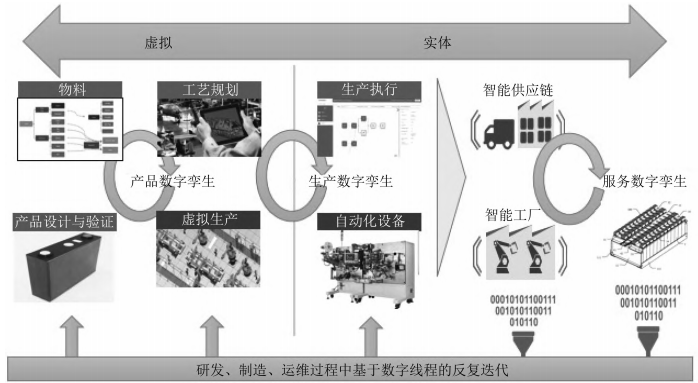
有了数字化模型,通过数字连接,将实体模型和虚拟模型相互关联,形成数字孪生,如图3所示。通过数字孪生,可以对系统进行优化,实现虚拟调试。
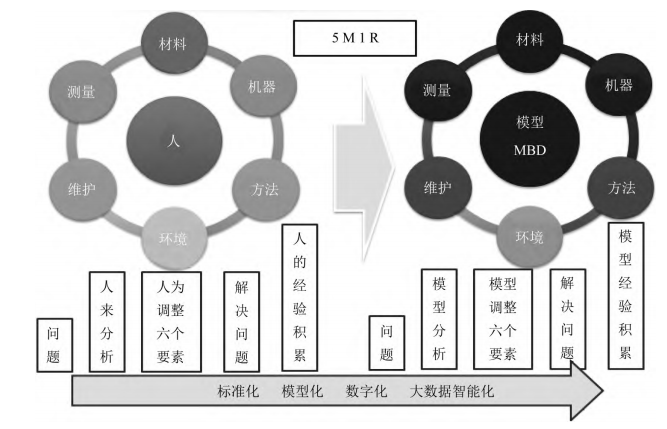
在没有模型的情况下,制造优化方式是通过人为认识问题、调整影响要素并解决问题,最后实现的是人的经验积累。基于模型的优化方式则不同,制造优化积累的结果是模型的迭代和进化,实现了数字化的积累,使计算机能够自主进行优化和深度学习,这就是基于模型优化的魅力所在。基于模型的数字化智能制造路径的演绎如图4所示。 数字化转型网www.szhzxw.cn
通过模型和数据,可以基于模型寻找影响质量的关键因素和关键质量控制点,并控制这些关键因素,以获得最佳质量,从而解决显性问题。同时,利用数据进行数字特征分析提取关键特征,实现预测性维护和健康管理,大大提升生产线制造的合格率。此外,还可以优化设计模型,实现反向升级,进一步优化制造过程,这正是智能制造的本质。
四、动力电池智能制造质量闭环
1. 纵向数据闭环
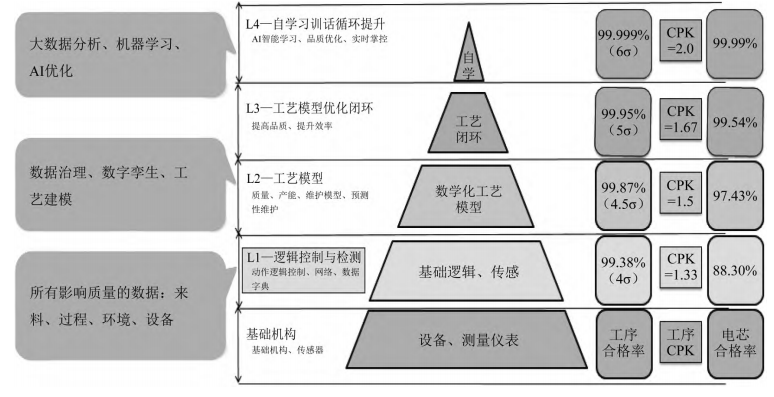
设备的智能制造水平可以分成4个层级:L1为逻辑控制与检测级,设备具备基本结构,能够满足控制检测和逻辑控制的需求,这个级别的制造合格率只有88%左右;L2为工艺模型级,这个级别的设备通过导入工艺模型实现制造合格率的提升,这级的合格率可达97%左右,相当于4.5σ的水平;L3为工艺模型优化闭环级,这个级别的装备实现了制造工艺的闭环,能够修正设备的加工参数,从而保证制造合格率达到99.9%以上,相当于5σ的水平;L4为自学习循环提升级,此时的设备通过工艺积累判断来料和工艺过程的变化,自动修正参数,实现更高质量的加工,可以保证99.99%以上的制造合格率,相当于6σ以上的水平。装备智能化的总体要求如图5所示。 数字化转型网www.szhzxw.cn
装备是产业的核心,也是实现智能制造的基础。首先,需要解决制造装备本身的智能化问题。装备实现智能制造的基本思路是应用闭环控制原理,并设置优化算法,以实现最优的控制目标。同时,需要应用闭环方法解决装备制造产品过程中不同层级的优化问题。装备控制闭环优化架构如图6所示。
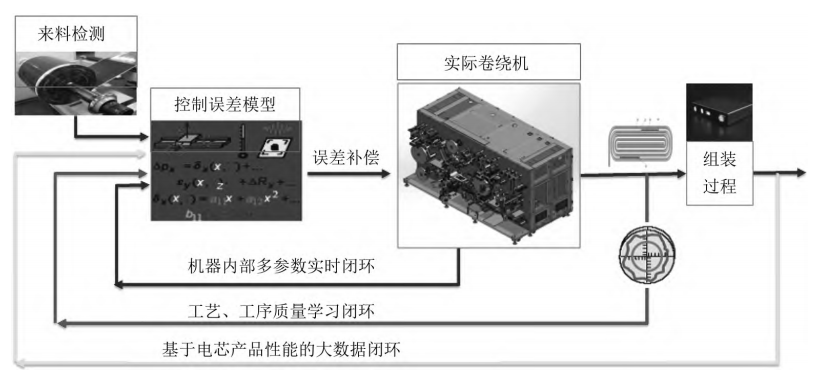
首先,是装备底层的控制。这一层主要基于传感器和逻辑控制,解决装备本身的定位精度、效率及稳定性等问题。例如,卷绕机主轴和涂布箔材驱动轴的控制等。每台设备都有很多这样的控制环,这些控制环通常要求具有实时性。随着制造精度和效率的不断提高,对底层控制的闭环周期时间要求也越来越高,一般在毫秒级,有些甚至要达到微秒级。这一层对于设备的控制性能和产品制造质量而言是开环的。
其次,是工艺闭环层。在这一层,通过对设备材料来料参数、过程参数、环境参数和加工产品质量参数进行工艺闭环,可以保证该工序的质量闭环。工艺闭环的闭环周期一般在毫秒到几十个毫秒。同时,工艺闭环也通过整体模型优化选择实现整体制造过程的大数据闭环,也就是第三层闭环。
2. 横向过程闭环
从来料到极片制造,再到电芯制造、化成分容和模组,通过互联互通的方式,实现对大约3000个数据点的监测,这样可以进行电芯和电池包的失效模式分析。动力电池制造质量闭环优化如图7所示。
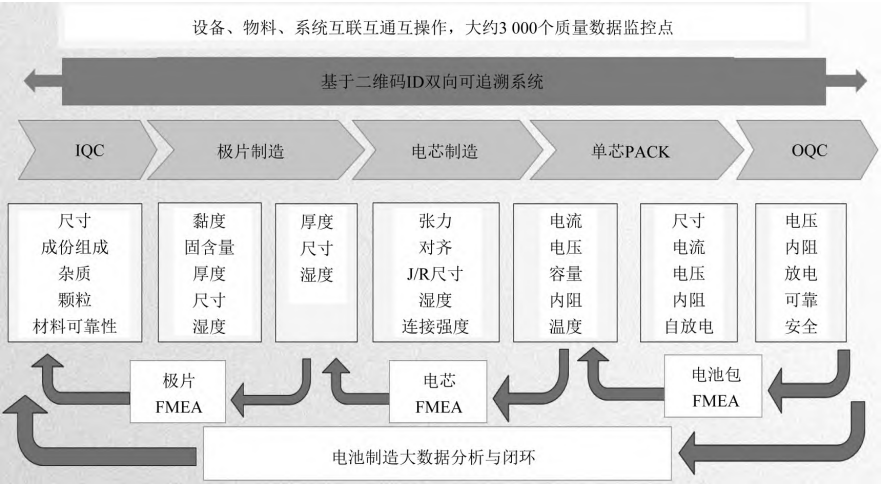
动力电池制造过程复杂、工艺流程长。主要分为极片制造单元、电芯制造单元和电池包制造单元,全流程影响电池质量的关键控制点超过2000个,包括来料尺寸、黏度、固含量、张力、对齐度、温度、湿度等。为了有效控制电池的生产质量,需要建立电池从原材料、电芯到电池包的全流程追溯体系,构造大数据质量闭环优化系统。首先,需要按生产工段分别建立极片制造、电芯制造及电池包制造的质量数据闭环系统,实现产线数据的闭环控制。在此基础上,完成全流程数据的集成,实现完整的电池制造大数据分析与闭环系统。通过闭环反馈,持续优化,不断提高电池制造从材料投入到电池包整体质量的横向优化。
五、动力电池智能制造系统成熟度实现的层级
动力电池制造系统从制造维度和智能维度两个方面进行分类。制造维度体现了面向产品的全生命周期的智能化提升,包括了设计、生产、物流、销售和服务五类,涵盖了从接收客户需求到提供产品及服务的整个过程。与传统的制造过程相比,智能制造更加侧重于各业务环节的智能化应用和智能水平的提升。智能维度是智能技术、智能化基础建设和智能化结果的综合体现,是对信息物理融合的诠释,完成了感知、通信、执行和决策的全过程,包括了全资源要素、互联互通、系统集成、信息融合和新兴业态五类,引导企业利用数字化、网络化和智能化技术进行模式创新。根据动力电池企业客户的需求,以及技术发展的状态、技术能力、技术手段和企业自身的目标定位,动力电池智能制造按成熟度分为五个级别,如表1所示。 数字化转型网www.szhzxw.cn
表1 动力电池智能制造各级成熟度的功能
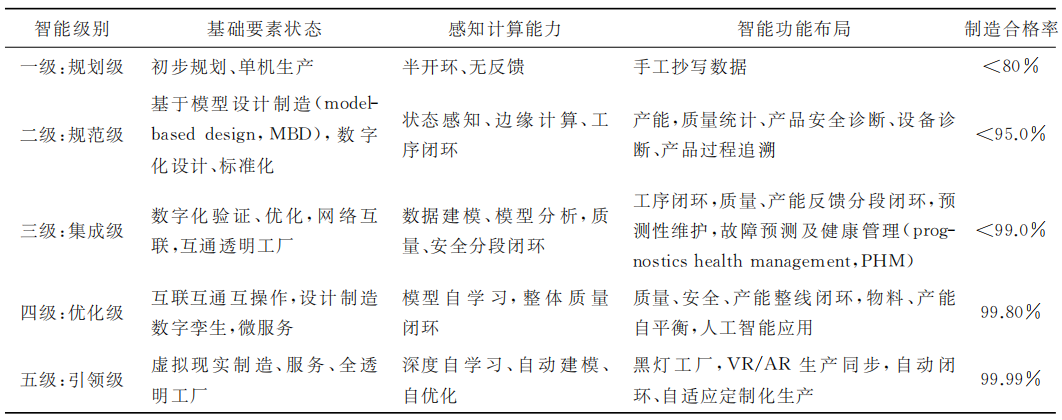
一级(规划级):电池生产企业应开始对实施智能制造的基础和条件进行规划,能够对核心业务(设计、资源供给、生产、销售、服务)进行流程化管理。
二级(规范级):电池生产企业应采用数字化设计、自动化技术、信息化手段对核心装备与核心业务进行改造和规范,实现单一业务活动的数据共享。
三级(集成级):电池生产企业应采取数字化手段对产品进行设计、制造验证,对装备、系统等开展集成,实现跨业务活动的数据共享,实现互联互通。 数字化转型网www.szhzxw.cn
四级(优化级):电池生产企业应利用数据挖掘技术对资源、制造过程等进行分析,实现对电池质量和安全性能的精准预测、闭环控制和优化,并实现生产的互操作。
五级(引领级):电池生产企业应基于模型持续驱动业务活动的优化和创新,以实现黑灯工厂生产和产品自适应定制化生产。
原文刊载于《电池工业》2023年8月 作者:阳如坤 柯奥

翻译:
Intelligent manufacturing practice of power battery factory
The background of intelligent manufacturing of power batteries
As the core parts of new energy vehicles, power batteries are the basic units for energy storage and conversion of new energy vehicles, and their technical development level will become the key support for the electric transformation of the global automotive industry. In recent years, the world has reached a consensus on the development of new energy vehicles, and major economies have formulated development plans for power batteries. From the current point of view, the international power battery market demand is strong, and China has more than half of the production capacity in many links of the entire industrial chain, and it is expected that the next decade will be a critical period of industrial development. 数字化转型网www.szhzxw.cn
Under the existing concept of low-carbon and environmentally friendly travel, governments of many countries have actively introduced corresponding policies (such as “limiting the sale of fuel vehicles” and “planning the proportion of new energy vehicles”, etc.) to promote the rapid development of electric vehicles, thus driving the good development of the power battery industry. According to the data released by SNEResearch, the global power battery construction capacity in 2022 has been close to 1TWh; In the same year, the global power battery installed capacity was 517.9 GWh, an increase of 75%. These data reflect that the power battery market still has a huge demand.
Figure 1 Intelligent Manufacturing Standard Framework Architecture (2018 edition)
In the field of high-end power battery products, there is little gap between China and foreign leading technologies. China is in a leading position in lithium iron phosphate power battery technology, which not only has significant technical advantages in large-scale industrial stable production, low cost and high safety of automotive power batteries, but also has accumulated rich application experience. Overall, in terms of advanced materials, new battery systems and recycling technology, China still needs to further improve; However, in terms of battery systems and bulk material technology, China has basically kept pace with foreign advanced levels.
Intelligent manufacturing refers to the use of advanced information technology, intelligent equipment and cloud computing and other technical means to achieve intelligent, automated, flexible and efficient manufacturing processes. It is the core and important part of Industry 4.0, and is one of the important means to promote the upgrading of the manufacturing industry and economic transformation.
With the rapid development of information, robotics and automation, big data and other technologies, industrial production methods are undergoing fundamental changes. Traditional manufacturing methods have been unable to meet the market and consumers on product quality, flexibility, delivery, personalized requirements, while the global economic competition is becoming increasingly fierce, the manufacturing industry needs to continuously improve production efficiency, reduce costs, in order to achieve an advantage in the market competition. Therefore, intelligent manufacturing has become a key path for the transformation and upgrading of manufacturing. 数字化转型网www.szhzxw.cn
The design and manufacturing of power batteries must first consider battery performance, including safety, qualification rate, consistency, manufacturing efficiency, etc. Among them, security includes equipment safety, manufacturing process safety, application safety and so on. At present, new energy vehicle safety accidents occur frequently, a considerable part of which is caused by the safety of the battery itself, therefore, improving the safety of the power battery is imminent. The current battery manufacturing pass rate (also known as straight-through rate) is about 90%, and the goal is to increase to more than 95% in 2025. The improvement of the pass rate can directly reduce the cost of battery manufacturing and bring considerable economic benefits to battery manufacturing enterprises. The consistency mainly includes capacity consistency, internal resistance consistency, self-discharge consistency and so on. Improving consistency can reduce product testing in the battery production process, simplify some manufacturing processes, and effectively improve production efficiency. At present, the single-line production capacity of domestic energy storage battery enterprises is generally low, which cannot meet the urgent demand for energy storage batteries, especially high-end battery capacity, in the market of new energy vehicles and energy storage power stations.
Improving the safety, pass rate, consistency and manufacturing efficiency of power battery manufacturing indicators are the goal of power battery manufacturers constantly strive to achieve this goal, must be in coating, winding, lamination, assembly and formation of core manufacturing capabilities have been greatly improved, and must achieve material technology, battery technology, equipment technology and intelligent control technology and other aspects of a comprehensive breakthrough. The adoption of standardization, digitalization, intelligence and other technical means is the inevitable way to achieve large-scale, high-quality manufacturing of power batteries.
Second, the path of intelligent manufacturing of power batteries
The realization of intelligent manufacturing of power batteries is an inevitable choice for scale manufacturing, and the path of standardization, modeling, digitalization and intelligence should be adopted. 数字化转型网www.szhzxw.cn
Standardization
At present, the “National Intelligent Manufacturing Standard System Construction Guide” (2018 edition, referred to as the “Guide”) has been released, and the framework architecture is shown in Figure 1. As the “intelligent manufacturing, standards first” in the “Guide”, large-scale manufacturing of power batteries needs to adopt standardized means, and needs the support of the standard system. Power battery technology started late, its design, manufacturing, inspection, application lack of complete standards, especially for the lithium battery industry interconnection criteria, integration interface, integration function, integration capability standards, field equipment and system integration, integration between systems integration, system interoperability and other integration standards are seriously lacking. In the face of the new situation, new opportunities and new challenges in the development of power battery intelligent manufacturing, it is necessary to systematically comb the existing relevant standards and clarify the needs of power battery manufacturing and integration. From the aspects of basic commonalities, key technologies and industry applications, a set of standard systems has been established to support the orderly and healthy development of the power battery industry.
At present, more than 80 domestic power battery companies have more than 150 kinds of battery specifications, which means that there are more than 150 different production processes and production lines, which seriously limits the promotion of large-scale manufacturing capacity of power batteries. Should summarize and analyze the past experience and the loss lessons caused to the industry, as soon as possible to develop a power battery size specification standard, the battery specification model is limited to about 10 kinds. Secondly, metadata is the basis of power battery design, manufacturing, application, to achieve power battery design and basic standardization, it is necessary to establish metadata standards in the field of power batteries. 数字化转型网www.szhzxw.cn
SDS/T2111-2004 “Metadata Standardization Principles and methods” provides the selection principles for the development of domain metadata, and can refer to this principle to develop metadata standards in the field of power batteries. Finally, to achieve the standardization of power battery manufacturing, a series of problems need to be solved. The power battery manufacturing process is complex, the process is long, the production line equipment is numerous, and the production equipment of the same production line often comes from different manufacturers, using different communication interfaces and protocols, resulting in the lack of interconnection and interoperability between the equipment. In order to solve this problem, it is necessary to establish the data dictionary standard of the battery manufacturing process, unify the equipment model, formulate the equipment communication interface specification, carry out data governance, realize the integration of production line equipment and enterprise information system, and realize the deep integration of operation technology and information technology. At the same time, the industrial Internet platform is used to realize the integration of internal and external information of the enterprise, and optimize the allocation of battery manufacturing resources and process control.
Model
Modeling is the basis of intelligence, it is the basic means of transforming factories, materials, machines and processes into a computer that can identify, optimize and improve. In power battery manufacturing, battery model, factory model, equipment model, process model and quality model need to be established, as shown in Figure 2.
FIG. 2 Power battery manufacturing model system
The model should be able to accurately and completely describe the real properties of the object. The establishment of the model is a process of constant adjustment and optimization. Modeling and digitalization are mutually promoting processes. For physical quantities or processes with theoretical models, existing models can be used to digitize them. For physical quantities or processes that do not have models or are difficult to describe accurately with theoretical models, data can be collected first and digital models can be established through digital analysis. This method can well solve the quality optimization problem in the manufacturing process, and is also the dividend brought by digitalization and intelligence to the manufacturing industry. 数字化转型网www.szhzxw.cn
Go digital
Digital development system includes digital design, digital manufacturing and digital application. Digital design includes material design, structure design and process design. In the battery design process, it is necessary to use professional product design tools and structural design tools, and establish electrochemical simulation models and battery life models.
Digital manufacturing includes process planning, equipment development, system integration, etc. By using factory simulation, process simulation, virtual debugging and other technical means, the digital twin system of actual production process and virtual production process is established. Designers use the simulation environment provided by the software to design and optimize products and production processes, thereby reducing the cycle time from idea to production, reducing errors and reducing costs.
Digital applications include battery quality control, the establishment of battery traceability systems, and product big data analysis. In order to realize digital applications, it is necessary to establish a full life cycle data management application platform such as power battery design, manufacturing, quality traceability and cascade utilization.
Through the establishment of the whole process system of digital design, manufacturing and application of power batteries, efficient design, high-quality manufacturing, low-cost production and reliable safety control of batteries can be realized. 数字化转型网www.szhzxw.cn
Intelligence
Intelligence refers to the mining of hidden problems based on data analysis results, and the generation of different applications such as description, diagnosis, prediction, decision and control, so as to form optimal decision suggestions or direct control instructions, realize personalized customization, intelligent production, collaborative organization and service manufacturing and other innovative models, and store the results in the form of data. Ultimately, it constitutes a continuous optimization loop from data acquisition to equipment, production site and enterprise operations management to improve the qualification rate, consistency and safety of battery manufacturing. In general, the goal of intelligent manufacturing of power batteries is to achieve model-based digitalization and data-based intelligence, so as to improve the safety and quality of manufacturing, and reduce manufacturing costs.
Third, the idea of intelligent manufacturing of power batteries
The core of intelligent manufacturing of power battery is digitalization based on model and intelligence based on big data. First of all, establish the information model of the power battery manufacturing system, model the equipment, materials, and information system, establish the enterprise (MBE) based on the model definition, realize the digitalization of the model, and provide the basis for the intelligence based on big data. 数字化转型网www.szhzxw.cn
With the digital model, the physical model and the virtual model are related to each other through the digital connection, forming a digital twin, as shown in Figure 3. Through the digital twin, the system can be optimized and virtual debugging can be realized.
Figure 3 Model-based digital twins
In the absence of a model, the manufacturing optimization method is to recognize the problem, adjust the influencing factors and solve the problem, and finally realize the accumulation of human experience. Model-based optimization method is different, the result of manufacturing optimization accumulation is the iteration and evolution of the model, the realization of digital accumulation, so that the computer can independently optimize and deep learning, which is the charm of model-based optimization. The deduction of the model-based digital intelligent manufacturing path is shown in Figure 4.
FIG. 4 Deduction of digital intelligent manufacturing path based on model
Through the model and data, it is possible to find the key factors that affect the quality and the key quality control points based on the model, and control these key factors to obtain the best quality, so as to solve the dominance problem. At the same time, the data is used for digital feature analysis to extract key features, achieve predictive maintenance and health management, and greatly improve the pass rate of production line manufacturing. In addition, it is possible to optimize the design model, achieve reverse upgrades, and further optimize the manufacturing process, which is the essence of intelligent manufacturing. 数字化转型网www.szhzxw.cn
Fourth, power battery intelligent manufacturing quality closed loop
Vertical data closed loop
The intelligent manufacturing level of the equipment can be divided into four levels: L1 is the logic control and detection level, the equipment has the basic structure to meet the needs of control detection and logic control, and the manufacturing pass rate of this level is only about 88%; L2 is the process model level, this level of equipment through the introduction of the process model to achieve the improvement of the manufacturing pass rate, the pass rate of this level can reach about 97%, equivalent to 4.5σ level; L3 optimizes the closed-loop level of the process model. This level of equipment realizes the closed-loop of the manufacturing process and can correct the processing parameters of the equipment, so as to ensure that the manufacturing pass rate reaches more than 99.9%, which is equivalent to the level of 5σ. L4 is a self-learning cycle upgrade, at this time, the equipment through the process accumulation to judge incoming materials and process changes, automatically correct parameters, to achieve higher quality processing, can ensure more than 99.99% of the manufacturing pass rate, equivalent to more than six sigma level. The overall requirements for equipment intelligence are shown in Figure 5.
Figure 5 Overall requirements for equipment intelligence
Equipment is the core of the industry and the basis for intelligent manufacturing. First of all, it is necessary to solve the intelligent problem of manufacturing equipment itself. The basic idea of equipment to realize intelligent manufacturing is to apply the closed-loop control principle and set the optimization algorithm to achieve the optimal control goal. At the same time, it is necessary to apply the closed-loop method to solve the optimization problems of different levels in the process of equipment manufacturing products. The closed-loop optimization architecture of equipment control is shown in Figure 6.
Figure 6 Hierarchical structure of equipment closed-loop control optimization
First, there is the control at the bottom of the equipment. This layer is mainly based on sensors and logic control to solve the positioning accuracy, efficiency and stability of the equipment itself. For example, the control of the winding machine spindle and the coated foil drive shaft. Each device has many of these control rings, which are usually required to have real-time performance. With the continuous improvement of manufacturing accuracy and efficiency, the closed-loop cycle time requirements for the underlying control are also getting higher and higher, generally at the millisecond level, and some even reach the microsecond level. This layer is open loop for the control performance of the equipment and the quality of the product manufacturing. 数字化转型网www.szhzxw.cn
Second, the process closed loop layer. In this layer, the quality closed loop of the process can be ensured by the process closed loop of the equipment material incoming parameters, process parameters, environmental parameters and the quality parameters of the processed products. The closed-loop cycle of the process closed loop is generally in milliseconds to tens of milliseconds. At the same time, the process closed loop also realizes the big data closed loop of the overall manufacturing process through the overall model optimization selection, that is, the third layer closed loop.
Horizontal process closed loop
From electrode manufacturing to cell manufacturing, chemical components and modules, the monitoring of about 3,000 data points is achieved through interconnection, so that failure mode analysis of cells and battery packs can be carried out. The closed-loop optimization of power battery manufacturing quality is shown in Figure 7.
Figure 7. Closed-loop optimization of power battery manufacturing quality
The manufacturing process of power battery is complicated and the technological flow is long. It is mainly divided into pole sheet manufacturing unit, cell manufacturing unit and battery pack manufacturing unit. There are more than 2000 key control points affecting battery quality in the whole process, including incoming material size, viscosity, solid content, tension, alignment, temperature, humidity and so on. In order to effectively control the production quality of the battery, it is necessary to establish the whole process traceability system of the battery from raw materials, cells to battery packs, and construct a closed-loop optimization system of big data quality. First of all, it is necessary to establish the quality data closed-loop system of pole plate manufacturing, cell manufacturing and battery pack manufacturing respectively according to the production section, so as to realize the closed-loop control of production line data. On this basis, complete the integration of the whole process data, to achieve a complete battery manufacturing big data analysis and closed-loop system. Through closed-loop feedback, continuous optimization, and continuously improve the horizontal optimization of battery manufacturing from material input to the overall quality of the battery pack. 数字化转型网www.szhzxw.cn
Fifth, the level of maturity of power battery intelligent manufacturing system
The power battery manufacturing system is classified from two aspects: manufacturing dimension and intelligence dimension. The manufacturing dimension reflects the intelligent improvement of the whole life cycle of products, including design, production, logistics, sales and service five categories, covering the entire process from receiving customer needs to providing products and services. Compared with the traditional manufacturing process, intelligent manufacturing focuses more on the intelligent application of each business link and the improvement of the intelligent level. The intelligent dimension is the comprehensive embodiment of intelligent technology, intelligent infrastructure and intelligent results, and the interpretation of the physical integration of information. It completes the whole process of perception, communication, implementation and decision-making, including the five categories of all-resource elements, interconnection, system integration, information fusion and emerging business forms, and guides enterprises to use digital, networking and intelligent technologies to carry out model innovation. According to the needs of power battery enterprise customers, as well as the state of technological development, technical capabilities, technical means and the enterprise’s own goal positioning, power battery intelligent manufacturing is divided into five levels according to maturity, as shown in Table 1. 数字化转型网www.szhzxw.cn
Table 1 Functions of intelligent manufacturing of power batteries at all levels of maturity
Level 1 (planning level) : Battery manufacturers should begin to plan the basis and conditions for the implementation of intelligent manufacturing, and be able to process management of the core business (design, resource supply, production, sales, and service).
Level 2 (standard level) : Battery manufacturers should use digital design, automation technology, information means to transform and standardize core equipment and core business, to achieve data sharing of a single business activity. 数字化转型网www.szhzxw.cn
Level 3 (integration level) : Battery manufacturers should adopt digital means for product design, manufacturing verification, integration of equipment, systems, etc., to achieve data sharing across business activities, to achieve interconnection.
Level 4 (optimization level) : Battery manufacturers should use data mining technology to analyze resources, manufacturing processes, etc., to achieve accurate prediction, closed-loop control and optimization of battery quality and safety performance, and to achieve production interoperability.
Level 5 (leading level) : Battery manufacturers should continue to drive the optimization and innovation of business activities based on models to achieve black light factory production and product adaptive customized production. 数字化转型网www.szhzxw.cn
The original article was published in “Battery Industry” August 2023 Author: Yang Rukun Ke ‘ao
本文由数字化转型网(www.szhzxw.cn)转载而成,来源于《电池工业》;编辑/翻译:数字化转型网宁檬树。
免责声明: 本网站(https://www.szhzxw.cn/)内容主要来自原创、合作媒体供稿和第三方投稿,凡在本网站出现的信息,均仅供参考。本网站将尽力确保所提供信息的准确性及可靠性,但不保证有关资料的准确性及可靠性,读者在使用前请进一步核实,并对任何自主决定的行为负责。本网站对有关资料所引致的错误、不确或遗漏,概不负任何法律责任。
本网站刊载的所有内容(包括但不仅限文字、图片、LOGO、音频、视频、软件、程序等) 版权归原作者所有。任何单位或个人认为本网站中的内容可能涉嫌侵犯其知识产权或存在不实内容时,请及时通知本站,予以删除。