
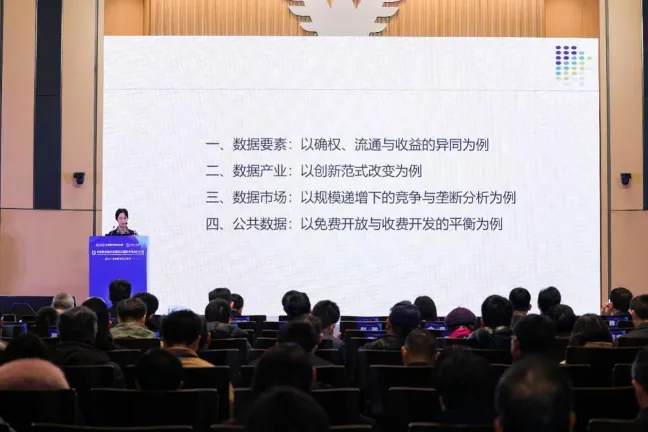
中国社会科学院大学教授、年会主席团主席江小涓教授以《数据的经济学分析:要素、产业和市场》为题进行了主旨演讲。本文根据江小涓教授现场发言内容整理。

去年以来,数据是一个很热的热点,从经济学的角度需要一个很好的分析框架,因为经济学中的生产要素分析是一个非常成熟的体系。我们现在把数据当成生产要素,这对经济学界的理论提出了很大的挑战,我们来探讨研究什么问题,才能称之为学术研究。
中国是首个把数据作为生产要素的国家,这在国际上是没有先例的。作为一种生产要素,确权、交易、收益等概念需要纳入分析框架中;作为一个产业,产业组织、生产消费、价格形成等概念需要纳入分析框架中;作为一个市场,创新、竞争、公共品等概念需要纳入分析框架中。考虑到数据的特点,还需要在分析中扩展框架和增加维度。并且,研究方向要呼应经济学的宗旨:研究社会资源配置的总体效率并尽可能合理分配。总之学术研究应该致力于知识体系的构建和完善。当下关于数据要素市场的研究,比较集中在数据确权、定价、交易等领域,希望学术界整体在数据研究方面继续加强学术含量高的研究,来促进理论发展,服务实践,促进国际交流,这是过去一年多我在参与数据问题时非常深切的体会。
从经济学视角思考,数据研究涉及非常多的学术问题。数据作为要素,配置效率怎么样,比如确权、交易和收益的制度安排,最终希望配置的效率最高;数据作为产业,需要研究具体经济主体的行为及其市场影响,例如消费者和生产者行为、均衡价格、创新行为等;数据作为市场,要研究数据市场的规则、行为和结构,特别是AI出现以后的巨型企业,对竞争规则、垄断的判定,政府的规制该怎么做,是非常具有挑战的问题;数据作为半公共品,公共利益和市场效益如何权衡,政府供给和市场供给的组合怎么判断。接下来举例来讲,数据要素我以确权、流通和收益为例,数据产业我用创新范式的改变作为例子,数据市场我们用规模递增下的竞争和垄断作为例子,公共数据以免费开发和收费开发的平衡作例子。
一、关于数据要素
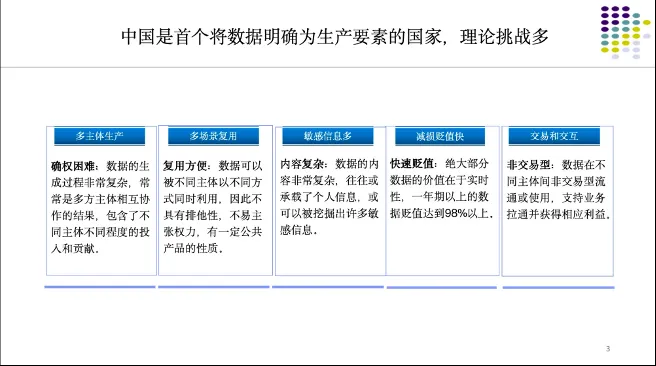
数据是一个生产要素,又是一个非常特别的要素,面临的理论挑战非常多。数据的独特性质主要体现在以下几个方面。首先是多主体生产因而确权困难,数据的生成过程错综复杂,常常是多方主体相互协作的结果,包含了不同主体不同程度的投入和贡献,因此确权困难。其次是多场景复用方便,一组数据可以被不同主体以不同方式重复利用,在使用上不具有竞争性和排他性,不易清晰明确主张权力。第三是数据中的敏感信息多,许多数据的内容多层次多元化,可能承载了需要保护的个人信息和商业机密,即使匿名化和去标识化,也有可能被挖掘出来。第四是减损贬值快,绝大部分数据的价值在于实时性,有研究表明一年期以上的数据贬值达到98%以上,保值增值十分困难。各位想想,你经常点什么外卖,搜索过什么类型的服务、APP就会推荐推送给你相关的内容,这都是从即时数据中挖掘到的,几个月后可能你的口味发生了变化,按照现在数据推送就没有意义。第五是具有交易和交互两类流通方式,特别是交互型流动即数据在不同主体间的非交易型流通使用,与其他生产要素流通使用的形态相比有显著不同。这个是我们后面要分析的重点问题。 数字化转型网(www.szhzxw.cn)
考虑到上述问题,在“数据二十条”的起草制定中,针对数据要素这些与其他生产要素不同的特点,文件的重点是构建起主要架构,即所谓的“四梁八柱”,许多更具体的内容都需要不断探索发展,并从社会有较多共识、实践有迫切需求、符合数据要素特征、与理论体系有较好契合性这些角度排出工作的重点。例如在起步阶段不回避“所有权”但更强调持有权、使用权、经营权,让数据先动起来用起来,就是现阶段中国特色数据产权制度的一个鲜明特点。再如处理好场内交易和场外交易的关系也是现实针对性很强的问题。从实践看,数据流通使用既有通过数据交易所完成的“场内交易”,也有企业与企业之间直接发生“场外交易”,更有规模巨大的非交易型的数据交互。因此“数据二十条”并未强调以哪种流通方式为主,而是提出场内交易与场外交易相结合,不断探索创新。在公共数据开放共享和开发利用、构建安全贯穿数据治理全过程的安全治理模式等方面,也都从理论与实践的结合出发,既提出长远发展方向,也明确当下工作重点。
理解了数据要素的特点,就能理解一年多来数据要素市场发展中的困难与问题。数据要素交易所在“数据二十条”出台前后特别是以后快速增长,但大体上是一个有市无价,或者有市有价无交易的情况,这在其他要素市场上很难看到。各地数据交易所发展很快,到2023年10月已经超过48家。每个交易所都有成千上万家的数据服务商,也有些入场准备参与确权交易的数据供应方。但一年多下来(有些起步早的交易所尝试时间更长,有些已有十年之久)数据交易量非常少,整体上仍在尝试性起步阶段。其实许多数据持有者都明白,数据交易很不容易,那他们为什么积极“入场”呢?企业期待数据入表,将数据资产化,进而能够去做金融创新、融资担保或资产证券化等。 数字化转型网(www.szhzxw.cn)
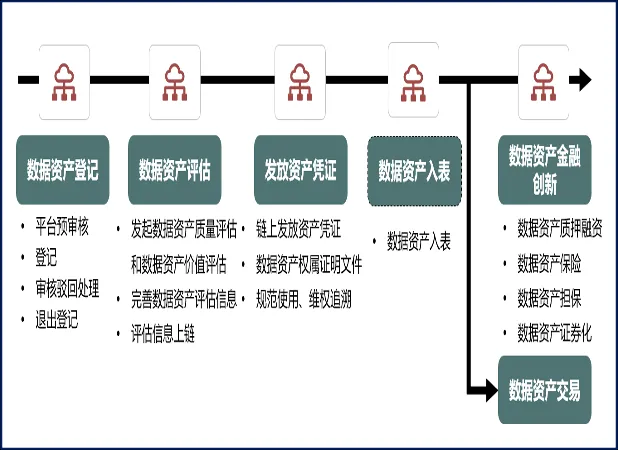
下图是各个数据交易所表达自己平台能够做什么的逻辑:做数据资产登记、数据资产评估;然后发放数据资产凭证,进而入表;入表后的主线是去做金融创新、融资贷款等,其次是进行数据资产的交易。我和银行开玩笑,说“数据要素市场建设发展的接力棒交到了金融领域,你们迟迟不接棒”。金融业为什么不敢往下做的原因之一,就是认为数据资产定价、交易方式特别是易贬损特点带来的挑战和风险都是新问题,需要积极而谨慎,发展与安全并重。不过,虽然我们将数据纳入传统生产要素分析框架中有困难,但这是一个新事物,需要留给创新足够的时间和空间。而且我们不一定要将其“装”进我们熟悉的体系构建中间去,要允许试允许探索。但从学术理论角度看,总要构建一个学术体系出来,这是一个非常有创新意义也有挑战的领域。
二、关于数据产业
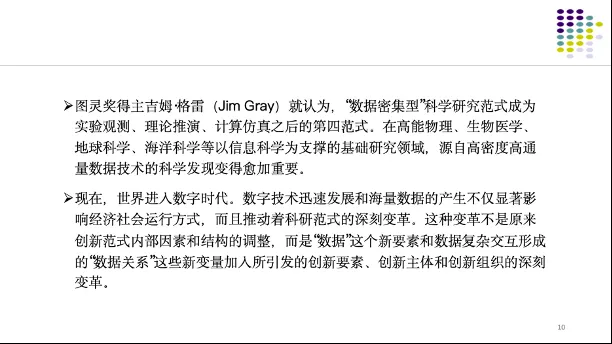
数据产业链条中,各环节参与方的行为和以往不一样,这个方面要研究的新问题很多。因为最近我在做一项数字时代创新问题研究,就拿它举例。现在数据创新范式按照国内外的很多学者来说,进入了“数据密集型”的科研创新范式。我们能看到除了数字行业自身以外,生物医学、高能物理、地球科学、海洋科学很多都是以信息科学为支撑的基础研究领域,如果数据观测处理能力不高,它们的进展是非常困难的。生命科学中,蛋白质怎么预测出来,不是生命科学自身的原创性发现,而是数字技术应用带来的结果,其中的原理早就知道,但就是算不出来。现在,世界进入数字时代。数字技术迅速发展和海量数据的产生不仅显著影响经济社会运行方式,而且推动着科研范式的深刻变革。这种变革不是原来创新范式内部因素和结构的调整,而是“数据”这个新要素和数据复杂交互形成的“数据关系”这些新变量加入所引发的创新要素、创新主体和创新组织的深刻变革。 数字化转型网(www.szhzxw.cn)
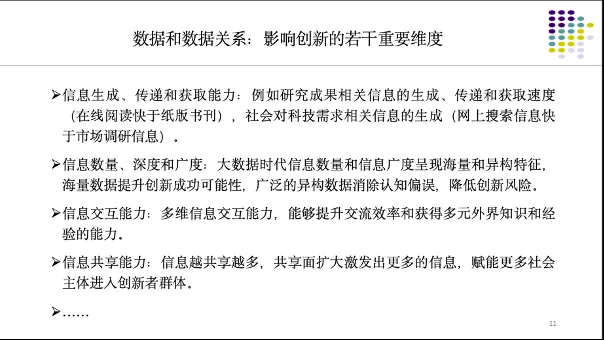
我们现在讲到数据和数据关系,不光是数据量多少,主要是数据关系影响了创新的重要维度。我们现在AI发展相对滞后有很多原因,能够共享的信息的数量和质量比较差,是影响下一步人工智能非常重要的因素。数据和算力决定谁来创新,包括很重要的原始创新。大模型的训练和调整需要极其巨大的数据、算力和算法的投入,Transformer架构进入主流以后,AI算力每两年增长275倍,在计算机本身有革命性的变革之前,只能靠扩量来增强算法的能力,所以目前只有大科技企业有雄厚的财力足以吸引大批顶尖的AI人才,从而以算力、算法和数据的最佳结合来推动人工智能前沿的突破,这就是最领先的AI大模型的变化。
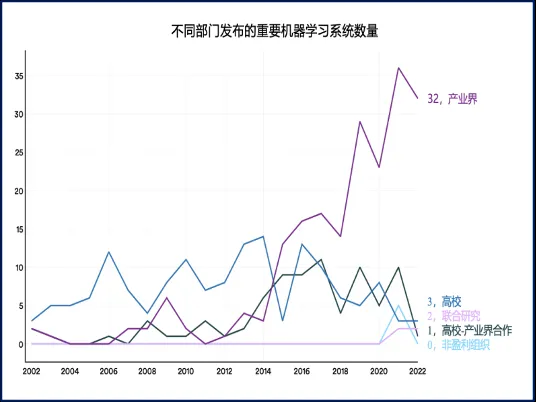
如下图,2014年是一个转折点,AI系统不是高校研发后的产业转化,而是从最基本的数学算法开始,都由产业界来做,2023年32个重要的机器学习模型都诞生在产业界。我们现在也经常讲国家创新体系,集中力量办大事,这方面也要考虑到数字时代的这种产业创新范式变革。这种海量的算力、数据以及人才迅速决策的能力、技术迭代的速度,完全是另外一种创新的组织架构,其中的变化是非常重要的。
三、关于数据市场
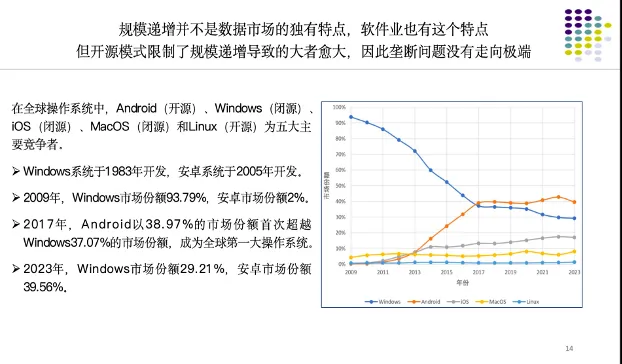
看待数据市场,需要研究市场的规则、行为和结构,特别是AI出现以后的“小规模企业+巨大市场”是非常具有挑战的问题,对规模递增下的竞争和垄断的分析也是我们的一个困惑。我们不能简单地认为市场从长期看会解决这个问题的,然后完全交给市场去处理。规模递增并不是数据市场的独有特点,软件业也有这个特点,但开源模式限制了规模递增导致的大者愈大,因此垄断问题没有走向极端。虽然领先者有规模递增的能力,但是开源之后,更多的开发者和应用市场出现,目前没有导致规模递增一定会致使大者越大、强者越强的局面出现。 数字化转型网(www.szhzxw.cn)
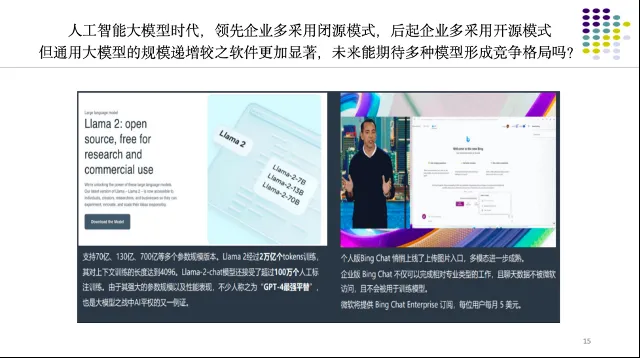
对于大模型,我们能期待这个趋势出现吗?仍是未知。如果理论不能有预测性的话,就没有价值。现在我们的知识能够想到OpenAI在AI时代,其产业组织、竞争垄断的格局最后会不会避免走向极端?也是未知。所以这个问题对我们是一个很大的新挑战。
四、关于公共数据
公共数据的性质有很多讨论,有观点认为数据本身具有公共品性质,公共数据又是政府掌握的数据,应该对社会开放。公共数据对公众开放是国际共识。开放数据的定义是“公众可获取的、能够被用户完整观测和使用的数据”。2009年,美国的奥巴马政府颁布了《开放政府指令》(US Open Government Directive);2018年12月24日,美国国会通过《开放政府数据法案》,要求联邦机构必须以“机器可读”格式,即以方便公众在智能手机或电脑上阅读的数据格式,发布任何不涉及公众隐私或国家安全的“非敏感”信息。例如,纽约市的政府及分支机构所拥有的数据必须对公众实施开放,市民们使用这些信息不需要经过任何注册、审批的繁琐程序,使用数据也不受限制。2011年,巴西、印尼、墨西哥、挪威、南非、菲律宾、英国和美国签署了《开放数据声明》,公共数据开放也是2011年成立的“开放政府合作伙伴”。迄今为止,全球已经有75个国家加入这一计划。 数字化转型网(www.szhzxw.cn)
国内政府数据开放发展至今,发展和应用最好的主要还是地理位置信息的开放、公共设施的数据开放(图书馆、教育机构、公共wifi等)、涉及健康安全的数据开放(比如河流洪水水位、交通拥堵状况、空气指数等)、市场监管数据开放(企业信息查询、行政处罚查询等)。这些信息现已可以通过多种途径获得。
政府数据开放意义重大,但多年下来动力不够是普遍问题。作为数据提供者的政府机构并不能从中直接得到经济回报,相反承担着泄露商业秘密和个人隐私的巨大风险,即便对数据采取“脱敏”处理也无法完全消除隐患。从道理上看,允许对数据开放并有一些收费也有合理性,例如有些原始数据不能直接开放共享,要做成数据产品;再如有些公共数据并不被广大公民和市场主体所需要,是某些企业的运营需要。公共品是为广大公民和市场主体服务的,对少数人服务“用者付费”这是公共品的基本原则。
今后,要寻求免费开放(开放共享)与收费开放(开发利用)的平衡。“数据二十条”里的提法是:“推动用于公共治理、公益事业的公共数据有条件无偿使用,探索用于产业发展、行业发展的公共数据有条件有偿使用”。目前看,对公共数据有偿开发开了一个口子以后,政府和相关公共企事业单位动力更强劲,行动更迅速。各地政府纷纷成立国有数据运营公司开展政府数据的授权运营,还可以搞二级合作商,获取合理的收入,这是一个非常普遍的趋势。政府大规模出售公共数据,公共品性质的数据转化为商业化数据,需要学术理论给予分析和解释,至少对公共品理论的发展提出了要求。
总的来讲,中国是一个数据生产大国和使用大国,我们是首先提出数据要素概念的国家,其中的实践探索多元而丰富,期待学术界同仁共同努力,构建符合学术理论规范、包含数据实践主要问题、体现中国数据发展特色的学术体系。谢谢大家! 数字化转型网(www.szhzxw.cn)

翻译:
Prof. Jiang Xiaojuan | Economic analysis of data: Factors, Industries and markets
Professor Jiang Xiaojuan, Professor of the University of Chinese Academy of Social Sciences and chairman of the presidium of the annual meeting, delivered a keynote speech on the topic of “Economic Analysis of Data: Factors, Industries and Markets”. This article is organized according to Professor Jiang Xiaojuan’s speech on the spot.
Professor Jiang Xiaojuan delivered the keynote speech
Since last year, data has been a very hot topic, and a good analytical framework is needed from the perspective of economics, because the analysis of production factors in economics is a very mature system. We now regard data as a factor of production, which poses a great challenge to the theory of the economic community, and let’s explore what problems can be called academic research.
China is the first country to use data as a factor of production, which is unprecedented in the world. As a factor of production, the concepts of ownership, transaction and income need to be included in the analytical framework. As an industry, industrial organization, production and consumption, price formation and other concepts need to be included in the analysis framework; As a market, concepts such as innovation, competition and public goods need to be incorporated into the analytical framework. Considering the characteristics of the data, it is also necessary to extend the framework and add dimensions to the analysis. Moreover, the research direction should echo the purpose of economics: to study the overall efficiency of the allocation of social resources and to allocate them as reasonably as possible. In short, academic research should be devoted to the construction and perfection of knowledge system. At present, the research on data element market is more concentrated in the fields of data ownership, pricing, trading, etc. It is hoped that the academic community as a whole will continue to strengthen research with high academic content in data research, so as to promote theoretical development, serve practice, and promote international exchanges. This is my deep experience when I participated in data issues over the past year. 数字化转型网(www.szhzxw.cn)
From the perspective of economics, data research involves a lot of academic problems. How about the allocation efficiency of data as a factor, such as the institutional arrangement of rights confirmation, trading and income, the ultimate hope is that the allocation efficiency is the highest; As an industry, data needs to study the behavior of specific economic entities and their market impact, such as consumer and producer behavior, equilibrium price, innovation behavior, etc. As a data market, it is very challenging to study the rules, behavior and structure of the data market, especially for giant enterprises after the emergence of AI, how to determine competition rules, monopoly, and government regulations; Data as a semi-public good, how to balance public interests and market benefits, how to judge the combination of government supply and market supply. Next, for example, I will take the data elements as an example of ownership, circulation and revenue; the data industry as an example of the change of innovation paradigm; the data market as an example of competition and monopoly under increasing scale; and the public data as an example of the balance between free development and paid development.
1. About data elements
Data is a factor of production, but also a very special factor, facing a lot of theoretical challenges. The unique nature of data is mainly reflected in the following aspects. First of all, it is difficult to confirm rights because of multi-subject production. The data generation process is complicated, often the result of the cooperation of multiple subjects, including different levels of input and contribution of different subjects, so it is difficult to confirm rights. Secondly, multi-scene reuse is convenient, and a set of data can be reused by different subjects in different ways, which is not competitive and exclusive in use, and it is not easy to clearly assert power. Third, there is a lot of sensitive information in the data, and the content of many data is multi-level and diversified, which may carry personal information and business secrets that need to be protected, even if it is anonymized and de-identified, it is possible to be excavated. The value of most data lies in real-time. Some studies have shown that the value of data over one year has reached more than 98%, so it is very difficult to maintain and increase value. Think about it, what takeout you often order, what type of service you have searched, the APP will recommend and push to you the relevant content, which is mined from the instant data, a few months later, your taste may have changed, according to the current data push is meaningless. Fifth, there are two types of circulation modes: transaction and interaction, especially interactive flow, that is, non-transactional circulation and use of data among different subjects, which is significantly different from the form of circulation and use of other production factors. This is the key problem we will analyze later.
In view of the above problems, in the drafting and formulation of “Data Article 20”, in view of the characteristics of data elements that are different from other production factors, the focus of the document is to build the main framework, that is, the so-called “four beams and eight pillars”, and many more specific contents need to be continuously explored and developed. And from the social consensus, practice has urgent needs, in line with the characteristics of data elements, with the theoretical system has a good fit of these points of work. For example, in the initial stage, we do not avoid “ownership” but emphasize the right to hold, the right to use, and the right to operate, so that the data can be used first, which is a distinctive feature of the data property rights system with Chinese characteristics at this stage. Another example is to deal with the relationship between the exchange trading and the over-the-counter trading is also a very targeted problem in reality. From a practical point of view, data circulation uses both “on-exchange trading” completed through data exchanges, and “off-exchange trading” directly between enterprises, and there is a huge scale of non-transactional data interaction. Therefore, the “Data 20” does not emphasize which kind of circulation mode is the main, but proposes the combination of exchange trading and over-the-counter trading, and constantly explore innovation. In terms of the open sharing and development of public data, and the construction of a security governance model that runs through the whole process of data governance, the company also starts from the combination of theory and practice, proposing the long-term development direction and clarifying the current work priorities.
Understanding the characteristics of data factors, we can understand the difficulties and problems in the development of data factors market in more than a year. Data element exchanges have grown rapidly before and after the introduction of the “Data Twenty”, especially after the introduction of the “data twenty”, but it is generally a situation where there is a market and it is priceless, or there is a market and there is a price without trading, which is difficult to see in other element markets. Local data exchanges are growing rapidly, with more than 48 by October 2023. Each exchange has tens of thousands of data providers, and there are also data providers who are ready to participate in the confirmation trade. But after more than a year (some early exchanges have been trying for longer, some for a decade), the volume of data trading is very small, and overall it is still a tentative start. In fact, many data holders understand that data trading is not easy, so why do they actively “enter”? Enterprises expect data to enter the table, the data will be capitalized, and then can do financial innovation, financing guarantee or asset securitization. 数字化转型网(www.szhzxw.cn)
The following is the logic of each data exchange to express what its platform can do: data asset registration, data asset evaluation; Then issue the data asset certificate, and then enter the table; After entering the table, the main line is to do financial innovation, financing loans, etc., followed by the transaction of data assets. I joked with the bank, saying, “The baton of data factor market construction and development has been handed over to the financial sector, and you have been slow to pick up the baton.” One of the reasons why the financial industry is afraid to move forward is that it believes that the challenges and risks posed by the pricing and trading of data assets, especially the debasement characteristics, are new issues that require active and cautious development and security. However, while we have difficulties incorporating data into traditional factor analysis frameworks, this is a new thing and needs to leave enough time and space for innovation. And we don’t necessarily have to “fit” it into our familiar system construction, to allow for trial-and-allow exploration. However, from the perspective of academic theory, it is always necessary to build an academic system, which is a very innovative and challenging field. 数字化转型网(www.szhzxw.cn)
2. About the Data Industry
In the data industry chain, the behavior of participants in each link is different from the past, and there are many new problems to be studied in this area. Because recently I was doing a research on innovation in the digital age, so let’s take this as an example. At present, according to many scholars at home and abroad, the data innovation paradigm has entered the “data-intensive” scientific research innovation paradigm. We can see that in addition to the digital industry itself, biomedicine, high-energy physics, earth science, Marine science are many basic research fields supported by information science, if the data observation and processing ability is not high, their progress is very difficult. In life science, how to predict the protein is not the original discovery of life science itself, but the result of the application of digital technology, the principle of which has been known for a long time, but it is not calculated. Now, the world has entered the digital age. The rapid development of digital technology and the generation of massive data not only significantly affect the way of economic and social operation, but also promote the profound change of scientific research paradigm. This change is not the adjustment of internal factors and structure of the original innovation paradigm, but the profound change of innovation elements, innovation subjects and innovation organizations caused by the addition of new variables such as “data”, which is a new element and the “data relationship” formed by the complex interaction of data.
We are now talking about data and data relationships, not just the amount of data, but the important dimensions of innovation that data relationships affect. There are many reasons why the development of AI is relatively lagging behind, and the quantity and quality of information that can be shared are relatively poor, which is a very important factor affecting the next step of artificial intelligence. Data and computing power determine who innovates, including the very important original innovation. The training and adjustment of large models require extremely huge investment in data, computing power and algorithms. After Transformer architecture enters the mainstream, AI computing power will grow 275 times every two years. Before the revolutionary change of the computer itself, the algorithm can only be enhanced by expanding the capacity. Therefore, at present, only big technology companies have strong financial resources enough to attract a large number of top AI talents, so as to promote the breakthrough of the frontier of artificial intelligence with the best combination of computing power, algorithms and data, which is the change of the most leading AI big model.
As shown below, 2014 is a turning point, AI systems are not industrial transformation after research and development in universities, but from the most basic mathematical algorithms, are done by the industry, and 32 important machine learning models in 2023 were born in the industry. Now we often talk about the national innovation system and concentrate on doing big things, and in this regard, we must also take into account this industrial innovation paradigm change in the digital age. This massive amount of computing power, data and talent’s ability to make quick decisions, the speed of technology iteration, is completely another kind of innovative organizational structure, in which change is very important.
3. About Data Market
Looking at the data market, we need to study the rules, behavior and structure of the market, especially the “small enterprises + huge market” after the emergence of AI is a very challenging problem, and the analysis of competition and monopoly under the increasing scale is also a puzzle for us. We cannot simply assume that the market will solve this problem in the long run and leave it to the market to deal with. Increasing scale is not a unique feature of data markets, as is the software industry, but the open source model limits the size of the biggest players resulting from increasing scale, so the monopoly problem is not extreme. Although the leaders have the ability to increase in scale, after open source, more developers and application markets appear, and the current situation does not lead to the increase in scale will inevitably lead to the bigger and stronger situation.
For large models, can we expect this trend to emerge? It’s still unknown. If a theory is not predictive, it has no value. Now our knowledge can think of OpenAI in the era of AI, will its industrial organization, competition and monopoly pattern eventually avoid going to extremes? Also unknown. So this is a big new challenge for us. 数字化转型网(www.szhzxw.cn)
4. About Public Data
There is a lot of discussion about the nature of public data, and some people think that data itself is a public good, and public data is government data, which should be open to society. It is an international consensus that public data should be open to the public. Open data is defined as “data that is publicly available and can be fully observed and used by users.” In 2009, the Obama administration issued the US Open Government Directive; On December 24, 2018, the U.S. Congress passed the Open Government Data Act, which requires federal agencies to release any “non-sensitive” information that does not concern the public’s privacy or national security in a “machine readable” format, that is, in a data format that the public can easily read on a smartphone or computer. For example, the data held by the government and branches of New York City must be open to the public, and citizens can use this information without any registration, approval procedures, and use of data is not restricted. In 2011, Brazil, Indonesia, Mexico, Norway, South Africa, the Philippines, the United Kingdom and the United States signed the Open Data Statement, and Open Data is also an “Open Government Partnership” established in 2011. To date, 75 countries around the world have joined the program.
Since the development of domestic government data opening, The best development and application is mainly the opening of geographical location information, the data opening of public facilities (libraries, educational institutions, public wifi, etc.), the data opening involving health and safety (such as river flood level, traffic congestion, air index, etc.), and the market supervision data opening (enterprise information inquiry, administrative punishment inquiry, etc.). This information is now available in a variety of ways.
Open government data is important, but lack of momentum has been a common problem for years. Government agencies as data providers can not directly get economic returns from it, on the contrary, bear the huge risk of revealing business secrets and personal privacy, even if the data to take “desensitization” processing can not completely eliminate hidden dangers. From a reasonable point of view, it is also reasonable to allow data opening and some charges, for example, some raw data can not be directly open and shared, but should be made into data products; Another example is that some public data is not needed by the majority of citizens and market players, and it is the operational needs of some enterprises. Public goods serve the majority of citizens and market subjects, and the basic principle of public goods is to “pay the user” for the services of a few people.
In the future, we should seek a balance between free opening (open sharing) and charging opening (development and utilization). The “twenty data Articles” in the formulation is: “promote the conditional free use of public data for public governance and public welfare undertakings, and explore the conditional paid use of public data for industrial development and industry development.” At present, after the paid development of public data has opened a gap, the government and relevant public enterprises and institutions are more powerful and act more quickly. Local governments have set up state-owned data operation companies to carry out the authorized operation of government data, and can also engage in secondary partners to obtain reasonable income, which is a very common trend. The government sells public data on a large scale, and the data of the nature of public goods is transformed into commercial data, which needs to be analyzed and explained by academic theories, at least the development of the theory of public goods is required.
In general, China is a big country of data production and use, and we are the first country to put forward the concept of data elements, in which the practical exploration is diversified and rich. We look forward to the joint efforts of academic colleagues to build an academic system that conforms to the academic theory norms, includes the main issues of data practice, and reflects the characteristics of Chinese data development. Thank you all! 数字化转型网(www.szhzxw.cn)
本文由数字化转型网(www.szhzxw.cn)转载而成,来源于清华服务经济与数字治理研究院;编辑/翻译:数字化转型网宁檬树。
免责声明: 本网站(https://www.szhzxw.cn/)内容主要来自原创、合作媒体供稿和第三方投稿,凡在本网站出现的信息,均仅供参考。本网站将尽力确保所提供信息的准确性及可靠性,但不保证有关资料的准确性及可靠性,读者在使用前请进一步核实,并对任何自主决定的行为负责。本网站对有关资料所引致的错误、不确或遗漏,概不负任何法律责任。
本网站刊载的所有内容(包括但不仅限文字、图片、LOGO、音频、视频、软件、程序等) 版权归原作者所有。任何单位或个人认为本网站中的内容可能涉嫌侵犯其知识产权或存在不实内容时,请及时通知本站,予以删除。