今天聊一个轻松点的话题。
作为一个从事了十几年信息化工作的IT人,多年来在大家的眼中,信息化几乎就是先进生产力的代名词,信息化建设几乎等同于提高生产力。
近几年来,不知道从何时开始,数字化的概念在社会上广泛流行,网络舆论也几乎一夜之间把信息化定为“过时”的理念,信息化从“小甜甜”变成了“牛夫人”。这些大家应该都深有体会。
对于信息化与数字化的关系,国内各路专家、学者的解读也是不尽相同,大体上认为数字化相比信息化处于更高的发展阶段,但由于对数字化和数字化转型的概念认识并未形成共识,这“数字化热”就更加莫名其妙了。
今天我主要是和大家一起对信息化、数字化、数字化转型的概念来源和在中西方的发展历史做一个回顾。相信看过之后,大家自然心里清楚。 数字化转型网www.szhzxw.cn
一、你所说的数字化——数字化转型的由来和历史
在很多时候,大家在把信息化和数字化放在一起比较的时候,讨论的数字化,其实是指数字化转型。对于数字化转型的由来和历史,要从“数字经济”这个词说起:
上世纪 80、90年代互联网技术日趋成熟,随着互联网的广泛接入,信息技术与网络技术相融合,从信息产业外溢,在加快企业管理和生产自动化的同时,不断产生新生产要素,形成电子商务等新商业模式。
1995年美国学者塔帕斯科特在《数字经济——联网智力时代的承诺和风险》中正式提出数字经济概念,认为信息技术的数字革命,使数字经济成了基于人类智力联网的新经济。1998年、1999年、2000年美国商务部先后出版了名为《浮现中的数字经济》(I,II)和《数字经济》的研究报告。这些报告均以分析信息产业、电子商务、网络经济等有关信息经济的发展为内容。数字经济的概念被越来越多的人士所接受。
世纪之交数字经济概念的出现、传播,并被广泛接受,是数字经济快速发展与广泛应用的背景下,数字技术经济范式朝着更广泛、更深入、更高级发展的表现,将带来经济社会面貌更为深刻的巨变。
中国国家统计局在《数字经济及其核心产业统计分类(2021)》中将数字经济分为“数字产业化”和“产业数字化”。 数字化转型网www.szhzxw.cn
“数字产业化”即数字经济核心产业,是指为产业数字化发展提供数字技术、产品、服务、基础设施和解决方案,以及完全依赖于数字技术、数据要素的各类经济活动。
对于“产业数字化”,2020年6月,国家信息中心信息化和产业发展部与京东数字科技研究院在京联袂发布《携手跨越重塑增长——中国产业数字化报告2020》首次专业阐释了“产业数字化”:产业数字化是指通过运用数字技术,对企业生产、经营、管理等各个环节进行改造和优化,以实现企业“降本增效”,提升竞争力。产业数字化的核心是数据,通过对企业内部和外部数据的收集、整合、分析和应用,实现企业决策的科学化、精细化和智能化。
而企业数字化转型就是企业开展“产业数字化”转型。
通过回顾数字化转型的由来和历史,我们可以看出,这个概念原本是相当清晰的,我们称之为狭义的数字化转型。然而在实践中,我们体会到,我国各类学者、专家、企业高层对于数字化转型的理解偏差极大,概念非常模糊。就像有的学者所说,它“已经成为一个过度使用和滥用的包罗万象的术语,用来描述与数字技术有关的一切事物” 。
为什么会这样?为了回答这个问题,我们来回顾一下中国企业和西方企业在面对数字化转型时,企业经营管理基础的不同。 数字化转型网www.szhzxw.cn
二、信息化和数字化之争——谈中西企业开展数字化转型时,不同的经营管理基础
对于数字化转型这个概念在中国企业界和学术界的模糊化,笔者认为是由中西企业在面对数字化转型时,企业经营管理基础的不同造成的。
为了阐释这个“不同”,我们回到“数字化”这个词。“数字化”的本源来自信号处理从模拟信号到数字信号转变的过程。从模拟信号到数字信号,要经历“抽样”、“量化”、“编码”三个阶段。20世纪30年代,奈奎斯特采样定理明确说明了抽样频率与信号频谱之间的关系,即当抽样频率大于信号中最高频率的2倍时,抽样后的数字信号能够完整保留原始信号中的所有信息。采样定理为数字化技术奠定了重要基础。
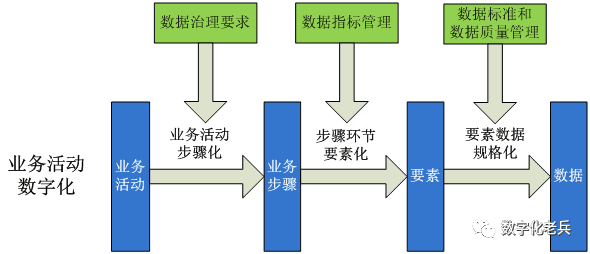
按照《从信号处理到数字化和数字化转型》和《数字化转型“降本增效”的底层逻辑是什么》中的观点,我们把业务从数字化到数字化转型,合并为“业务活动步骤化”、“步骤环节要素化”、“要素数据规格化”、“以数据为中心的业务变革”四个阶段。其中“以数据为中心的业务变革”就是本文第一章提到的狭义数字化转型。而“步骤化”、“要素化”、“数据规格化”这三步,分别对应模拟信号“数字化”中“抽样”、“量化”、“编码”这三步。我们称之为业务“数字化”。 数字化转型网www.szhzxw.cn
正如我们在《数字化转型“降本增效”的底层逻辑是什么》中提到的,近代以来企业管理先后经历了“科学管理”、“精益管理”和“管理自动化”三个阶段,分别对应了“业务活动步骤化”、“步骤环节要素化”、“要素数据规格化”这业务数字化的三步。西方企业在工业化进程中,完整经历了上述三个阶段,流程管理、精益管理、标准化管理的理念根植于企业文化当中。可以说,西方企业是在完成了“数字化”的基础上,再开展“数字化转型”的。
而中国的大规模工业化,是从新中国成立之后学习苏联经验基础上集中开展的计划性工业建设开始的,而接触并学习西方企业先进的生产、管理和经营理念,更是在改革开放以后。中国企业的管理理念并未完整经历“科学管理”、“精益管理”这两个阶段,而改革开放后的80年代和90年代初,正是西方企业管理经历以PC的普及、无纸化办公、计算机控制下自动化生产线为标志的“管理自动化”变革的阶段。大量的中国企业接触了信息技术,引进了西方生产线、使用了PC机办公,直接跳过“科学管理”、“精益管理”阶段,也使用了一个颇具中国特色的名词—“信息化”。百度百科将信息化定义为“信息化是指培育、发展以智能化工具为代表的新的生产力并使之造福于社会的历史过程。”这一定义,笔者认为本身就很符合中国企业当时的经济和社会现状,以及实际需求。而“信息化”这个词在西方国家就几乎没有流行过。对于这一阶段西方企业和中国企业管理的差别,用一句也许略显夸张的话,就是“中国企业用微信群搞语音和文字管理,西方企业在线下搞流程和精益管理”。 数字化转型网www.szhzxw.cn
随着云计算、大数据和人工智能等新兴IT技术的飞速发展,数据的重要作用越来越凸显,通过对企业内部和外部数据的收集、整合、分析和应用,实现企业决策的科学化、精细化和智能化这一理念在西方企业界逐渐形成共识。而对于原本就拥有良好“数字化”基础的西方企业,其利用大数据和人工智能技术,把企业手中掌握的大量涉及生产、经营、管理的数据利用起来,实现“以数据为中心的业务变革”,是顺理成章的事。对于西方企业而言,数字化转型的重点就是对大数据、人工智能技术的有效运用。
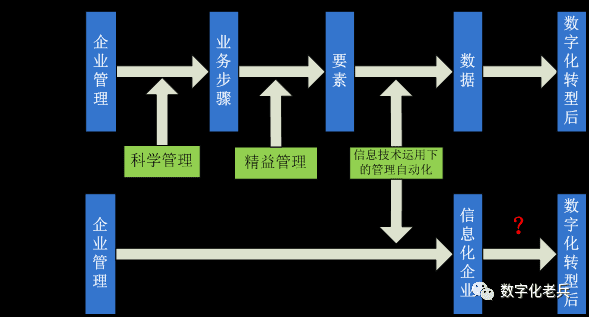
而中国企业在没有经历“科学管理”和“精益管理”变革的情况下,长期处于粗放式经营管理状态,在尝到了单纯采用信息技术这一“信息化”短暂的红利后,企业经营效率的提高很快遇到瓶颈。在21世纪初十几年人口红利的支持下,并未明显察觉到在“数字化”方面与西方企业的差距。而近年来,由于众所周知的因素,企业“降本增效”的压力越来越大,正逢西方企业开展“数字化转型”,于是信息化的落寞和数字化(实为数字化转型)的兴起就可以理解了。 数字化转型网www.szhzxw.cn
而在实践中,由于大多数中国企业未经历“科学管理”和“精益管理”变革,企业在管理中缺乏积累和使用数据的流程、标准、要素、人力、架构等各类基础,在引进西方企业理念,开展数字化转型建设过程中,缺数据、数据假、数据质量差等问题成为各类企业的通病。数据是数据、管理是管理、决策是决策,数据、管理、决策三张皮的现象也是普遍存在。以上体现出的数据问题和管理意识的差距,如果不解决,想通过单纯使用大数据和人工智能等技术措施,实现“降本增效”的想法,无异于“水中捞月”。
而对于中国企业,在整体管理理念落后的情况下,各类企业管理经营水平不平衡的现象也广泛存在。在这种情况下,对于数字化转型这个词的含义,在中国被泛化、模糊化,笔者理解这其实是基于现实的无奈之举。例如想要利用大数据和人工智能,就要做好数据治理和流程管理,而这又需要精益管理和科学管理……
三、透过现象看本质——重要的是知道想要什么,该怎么干
笔者一直以来其实都在回避数字化转型的准确概念,以及信息化与数字化概念之争的问题。本来只想讲讲数字化的干货,讲讲方法论。但是如果大家纠结于这个问题,往往会被一些专家的宣讲或企业的宣传所引导,偏离了本企业的发展方向,迷失了道路、忘记了初心,这也是很多企业数字化转型失败的重要原因之一。 数字化转型网www.szhzxw.cn
客观的说,大部分专家或IT企业对数字化和数字化转型的宣讲和理解并没有错,但就像上一章所讲,中国企业在面对数字化转型这个课题时,一百个人眼中有一百个哈姆雷特,每个企业所处的数字化发展阶段是不同的,所需要补的短板和选择的数字化转型路线是不同的。最重要的是,企业在了解了这些概念的由来和历史之后,不再被这样或那样的宣传误导,知道自己想要什么,该怎么干,这是最重要的。
2023年10月9日,希望看过本文的作者不会再纠结于这几个概念。

翻译:
Is it information or digital?
Let’s talk about a lighter topic today. 数字化转型网www.szhzxw.cn
As an IT person who has been engaged in information work for more than ten years. In everyone’s eyes for many years, information is almost synonymous with advanced productivity. And information construction is almost equivalent to improving productivity.
In recent years, I do not know when the concept of digitization has been widely popular in society, and network public opinion has almost overnight classified informatization as an “outdated” concept, and informatization has become a “cow lady” from “Little Sweets”. I think you all know that.
For the relationship between informatization and digitalization, the interpretation of various domestic experts and scholars is also different, generally believe that digitalization is at a higher stage of development than informatization. But because of the concept of digitalization and digital transformation has not reached a consensus. This “digitalization fever” is more inexplicable.
Today, I would like to review with you the concept sources of informatization, digitalization and digital transformation and their development history in China and the West. I believe that after reading, you will naturally know.
First, what you call digitalization – the origin and history of digital transformation
In many cases, when we compare informatization and digitalization together, the digitalization we discuss actually refers to digital transformation. For the origin and history of digital transformation, we should start with the term “digital economy” :
In the 1980s and 1990s, the Internet technology became more and more mature. With the extensive access of the Internet. The integration of information technology and network technology spilled over from the information industry. While accelerating the automation of enterprise management and production, new production factors continued to be generated and new business models such as e-commerce were formed. 数字化转型网www.szhzxw.cn
In 1995, Tapascott, an American scholar, formally put forward the concept of digital economy in Digital Economy – Promise and Risk in the Era of Networked Intelligence, believing that the digital revolution of information technology has made digital economy a new economy based on human intelligence networking. In 1998, 1999, and 2000, the U.S. Department of Commerce published research reports entitled “The Emerging Digital Economy” (I, II) and “The Digital Economy.” These reports are aimed at analyzing the development of information economy such as information industry, e-commerce and network economy. The concept of digital economy has been accepted by more and more people.
The emergence, dissemination and wide acceptance of the concept of digital economy at the turn of the century is a manifestation of the broader, deeper and more advanced development of the digital technological economic paradigm under the background of the rapid development and wide application of the digital economy, which will bring more profound changes in the economic and social landscape.
The National Bureau of Statistics of China classifies the digital economy into “digital industrialization” and “industrial digitalization” in its Statistical Classification of Digital Economy and its Core Industries (2021).
“Digital industrialization”, the core industry of the digital economy, refers to the provision of digital technologies, products, services, infrastructure and solutions for the digital development of the industry, as well as all kinds of economic activities that are completely dependent on digital technologies and data elements.
For “industrial digitalization”, in June 2020, the Information and Industrial Development Department of the State Information Center and Jingdong Digital Technology Research Institute jointly released the “Work together to reshape growth – China’s Industrial Digitalization Report 2020” in Beijing for the first time to professionally explain the “industrial digitalization” : Industrial digitalization refers to the transformation and optimization of production, operation, management and other aspects of enterprises through the use of digital technology. So as to achieve “cost reduction and efficiency increase” and enhance competitiveness. The core of industrial digitalization is data. Through the collection, integration, analysis and application of internal and external data, enterprise decision-making can be scientific, refined and intelligent. 数字化转型网www.szhzxw.cn
The enterprise digital transformation is the enterprise to carry out the “industrial digital” transformation.
By reviewing the origin and history of digital transformation. We can see that the concept was originally quite clear, we call it narrow digital transformation. However, in practice, we realize that all kinds of scholars, experts, and enterprise executives in our country have a great misunderstanding of digital transformation, and the concept is very vague. As one scholar put it, it “has become an overused and overused catch-all term to describe everything related to digital technology.”
Why is that? In order to answer this question, let’s review the differences between Chinese enterprises and Western enterprises in the face of digital transformation.
Second, the dispute between informatization and digitalization — discussing the different operation and management bases of Chinese and Western enterprises when they carry out digital transformation
As for the ambiguity of the concept of digital transformation in the Chinese business and academic circles. The author believes that it is caused by the difference between Chinese and Western enterprises in the face of digital transformation. 数字化转型网www.szhzxw.cn
To illustrate this “difference,” we return to the word “digital.” The source of “digitalization” comes from the process of signal processing from analog signals to digital signals. From analog signal to digital signal, it must go through three stages of “sampling”, “quantization” and “coding”. In the 1930s, the Nyquist sampling theorem clearly stated the relationship between sampling frequency and signal spectrum. That is, when the sampling frequency is more than twice the highest frequency in the signal. The sampled digital signal can completely retain all the information in the original signal. Sampling theorem lays an important foundation for digital technology.
According to the viewpoints of “From Signal Processing to Digitalization and Digital Transformation” and “What is the underlying logic of Digital Transformation”
According to the viewpoints of “From Signal Processing to Digitalization and Digital Transformation” and “What is the underlying logic of Digital Transformation”, we combine the business from digitalization to digital transformation into four stages of “business activity step”, “step link factor”, “factor data normalization” and “data-centric business transformation”. Among them, “data-centric business change” is the narrow sense of digital transformation mentioned in the first chapter of this paper. The three steps of “step”, “factor” and “data normalization” respectively correspond to the three steps of “sampling”, “quantization” and “coding” in the “digitalization” of analog signals. We call this the “digitization” of our business.
As we mentioned in “What is the underlying logic of Digital transformation”, since modern times, enterprise management has experienced three stages of “scientific management”, “lean management” and “management automation”, which respectively correspond to the three steps of business digitization: “business activity step”, “step element” and “factor data normalization”. In the process of industrialization, Western enterprises have completely experienced the above three stages. And the concepts of process management, lean management and standardized management are rooted in the corporate culture. It can be said that Western enterprises carry out “digital transformation” on the basis of completing “digitalization”. 数字化转型网www.szhzxw.cn
China’s large-scale industrialization began from the planned industrial construction carried out on the basis of learning the experience of the Soviet Union after the founding of the People’s Republic of China,
China’s large-scale industrialization began from the planned industrial construction carried out on the basis of learning the experience of the Soviet Union after the founding of the People’s Republic of China, and contact with and learn the advanced production, management and operation concepts of Western enterprises, especially after the reform and opening up.
The management concept of Chinese enterprises has not fully experienced the two stages of “scientific management” and “lean management”, while the 1980s and early 1990s after the reform and opening up, it is the Western enterprise management experienced the “management automation” reform stage marked by the popularization of PC, paperless office and automatic production line under computer control.
A large number of Chinese enterprises are exposed to information technology, the introduction of Western production lines. The use of PC office, directly skip the “scientific management”, “lean management” stage. But also use a quite Chinese characteristics of the term – “information”. Baidu Encyclopedia defines informatization as “the historical process of cultivating and developing new productive forces represented by intelligent tools and bringing them to the benefit of society.”
This definition, the author believes that itself is very consistent with the economic and social status quo of Chinese enterprises at that time, as well as the actual needs. The word “informationization” is hardly popular in Western countries. For the difference between the management of Western enterprises and Chinese enterprises at this stage. It may be slightly exaggerated to say that “Chinese enterprises use wechat groups to engage in voice and text management. And Western enterprises engage in process and lean management offline.” 数字化转型网www.szhzxw.cn
With the rapid development of emerging IT technologies such as cloud computing, big data and artificial intelligence, the important role of data is becoming more and more prominent.
Through the collection, integration, analysis and application of internal and external data of enterprises, the concept of scientific, refined and intelligent corporate decision-making has gradually formed a consensus in the western business community. For Western enterprises that already have a good “digital” foundation. It is natural for them to use big data and artificial intelligence technology to make use of a large amount of data involving production, operation and management in the hands of enterprises to achieve “data-centric business change”. For Western enterprises, the focus of digital transformation is the effective use of big data and artificial intelligence technology.
Different operation and management bases of Chinese and Western enterprises when they carry out digital transformation 数字化转型网www.szhzxw.cn
However, Chinese enterprises in the absence of “scientific management” and “lean management” change, long-term in the extensive management state, after tasting the simple use of information technology, the “information” of the short-term dividend, the improvement of enterprise operation efficiency soon encountered a bottleneck. Supported by the demographic dividend in the early 2000s, the gap with Western companies in terms of “digitalization” was not clearly perceived. In recent years, due to well-known factors, the pressure of enterprises to “reduce costs and increase efficiency” is increasing, just as Western enterprises carry out “digital transformation”. So the loneliness of information technology and the rise of digital (actually digital transformation) can be understood.
In practice, since most Chinese enterprises have not experienced the “scientific management” and “lean management” reform, they lack the process, standards, elements, manpower, structure and other foundations for the accumulation and use of data in management.
、In the process of introducing western enterprise concepts and carrying out digital transformation construction, problems such as lack of data, false data and poor data quality have become common problems of all kinds of enterprises. Data is data, management is management, decision-making is decision-making, and the phenomenon of data, management, and decision-making is also universal. If the gap between data problems and management awareness reflected above is not solved. The idea of “reducing costs and increasing efficiency” through the simple use of big data and artificial intelligence and other technical measures is tantamount to “finding a month in the water.”
As for Chinese enterprises, in the case of backward overall management concept. The phenomenon of unbalanced management and operation level of various enterprises also exists widely. In this case, the meaning of the word digital transformation has been generalized and blurred in China. And the author understands that this is actually a helpless move based on reality. For example, if you want to use big data and artificial intelligence. You must do a good job in data governance and process management, which in turn requires lean management and scientific management……
Third, see the essence through the phenomenon – the important thing is to know what you want, how to do
In fact, the author has been avoiding the accurate concept of digital transformation. As well as the issue of the dispute between informatization and digital concepts. I was just going to talk about digital dry goods, about methodology. However, if you are obsessed with this problem, you will often be guided by the propaganda of some experts or the propaganda of the enterprise, deviate from the development direction of the enterprise, lose the road, forget the original intention, which is also one of the important reasons for the failure of many enterprises digital transformation.
Objectively speaking, most experts or IT enterprises are not wrong in their preaching and understanding of digitalization and digital transformation. But as mentioned in the previous chapter, when Chinese enterprises face the topic of digital transformation. There are 100 Hamlets in the eyes of 100 people. Each enterprise is in different stages of digital development. And the shortcomings it needs to make up and the digital transformation route it chooses are different. The most important thing is that after enterprises understand the origin and history of these concepts. They are no longer misled by this or that propaganda. And they know what they want and how to do it.
On October 9, 2023, hopefully the authors who read this article will not struggle with these concepts.
本文由数字化转型网(www.szhzxw.cn)转载而成,来源于数字化老兵 ,作者数字化老兵aloha;编辑/翻译:数字化转型网宁檬树。
免责声明: 本网站(https://www.szhzxw.cn/)内容主要来自原创、合作媒体供稿和第三方投稿,凡在本网站出现的信息,均仅供参考。本网站将尽力确保所提供信息的准确性及可靠性,但不保证有关资料的准确性及可靠性,读者在使用前请进一步核实,并对任何自主决定的行为负责。本网站对有关资料所引致的错误、不确或遗漏,概不负任何法律责任。
本网站刊载的所有内容(包括但不仅限文字、图片、LOGO、音频、视频、软件、程序等) 版权归原作者所有。任何单位或个人认为本网站中的内容可能涉嫌侵犯其知识产权或存在不实内容时,请及时通知本站,予以删除。