一个时代有一个时代的明星,既要与时俱进,也不能忘了历史,不然就会迷失于当下。忘了信息化的实质,也会迷惑于数字化的本质。
“数字化”一词提出后,很长时间波澜不惊。
很多人认为“数字化”是“信息化”换了个名字,是新瓶装旧酒,或者是下一代信息化技术;有人认为是软件一词的泛化,制造业数字化被认为是工业软件一词的泛化。
直到最近几年,“数字化转型”的出现,才让“数字化”一词火热起来,被人们重新思考和讨论。
自从“数字化”热起来后,似乎把在中国大地驰骋了三十年的“信息化”都融化了,气化了,蒸发了。人们不再提信息化,有人羞于提它,甚至有意无意地贬低它。
有人把过去的信息化方案穿了件数字化外衣行走天下,如果把其中“数字化”三个字替换成“信息化”,里面90%的内容都似曾相识。
其实,信息化和数字化是既有区别有紧密联系的两个概念和词汇。懒于区别,会让数字化成为信息化的翻版,缺乏进步和创新;相互割裂,会让数字化转型既失去基础,又缺乏目标。
的确,“数字化转型”还有很多未确定的含义和不统一的概念,让人们莫衷一是,无所适从。人们看到各种数字化做法,也看到很多转型现象,褒贬不一,众说纷纭。
之所以如此,我认为是因为“数字化”一词的本质和底层逻辑没有识别出来,所以只能头痛医头,脚痛医脚,就事论事,感觉数字化转型有很多事要做,也有很多种做法,但又不知道哪些事是自己该做的事,哪些做法适合自己,更不知从何做起。
本文就“数字化”和“数字化转型”提出自己的理解,和读者一起体悟数字化转型的底层逻辑。
一、司左与行右
一个时代有一个时代的明星,既要与时俱进,也不能忘了历史,不然就会迷失于当下。忘了信息化的实质,也会迷惑于数字化的本质。在信息化大潮中冲浪过的人,面对数字化浪潮,会充满疑惑,似乎难以区别过去的信息化和现在的数字化。
没有在信息化中冲过浪的人,面对纷繁复杂的数字化局面,眉毛胡子一把抓,总是缺乏章法,不得要领。
人的大脑分两部分:左脑和右脑。左脑是理性之脑,主管逻辑和推理;右脑是感性之脑,主管直觉和艺术。左脑的理性决定了它是现实派、事实派、控制派、质量派;右脑的感性决定了它是未来派、幻想派、冲动派、创新派。
信息化和数字化就像人的左右脑,信息化司左脑之职,数字化行右脑之事。当我们掌握了明确的机理、完备的初始条件(初态)和边界条件(环境)时,用信息化帮我们提高效率和质量。
当我们的研究对象超越了我们理解,机理、初态和环境不完备时,则需要用数字化来突破我们局限,实现创新。“逻辑会让你从A点到B点,想象力会让你到任何地方。”爱因斯坦的这句话,说的就是这个意思。
二、信息化司左
我们所在的世界是三类系统的混构体系:第一类是自然物(如星系、生物等),第二类是人造物(如机器、生产线等),第三类是组织体(如企业、联盟等)。
人类始终致力于对这三类系统的运行规律进行研究,以期获得明确的机理。具有清晰初始条件和完备边界条件时,用明确机理来运算就能获得确定性的结论,人们靠这个运算结果可以预测时空运转(未来和远方)。
过去,人们所掌握了类似F=ma、E=MC²、工程经验公式、机器工作原理、生产执行策略、政治经济学、企业管理学等运行规律。
基于这些机理,计算机一出世,人们就迫不及待地开发了相应软件,于是科学计算、工程验算、MES、ERP、PLM、PM、MRO等软件相继涌现。
这些软件的出现,大幅度提升了人类的工作和生活的效率和质量。1990年代开始,这股浪潮变得尤为迅猛。那个年代,我们称为“信息时代”,很具中国特色的“信息化”一词也是从那时开始的。
之所以用“信息”一词,是因为我们掌握了机理之后,只需要少量的数据喂给软件,就可以获得足够好的反馈。这些少量的数据就是初始条件和边界条件。大量复杂的计算工作和数据流传,在软件内部就全部完美无误地完成了。
信息是控制论中大行其道的概念,该词的本意就包含对大量数据进行提炼总结而形成的最有价值的少量“数据”。
信息不仅包含了明确的运行机理,还包含了清晰的初始条件和完整的边界条件,即信息包含机理、初态和环境。当这些要素完备后,你便可以开发一个自动化系统,机器就可以完成过去由人来做的工作。
三、数字化行右
不幸的是,人类对自然物、人造物和组织体这三类系统的运行规律研究都还很不完善,对这个世界99%以上的运行机理、边界条件和初始条件的掌握都不完备。人们现已掌握的机理,只是这个世界规律中非常少的一部分。
一台机器的工作原理看似明确了,其实同一机器中还有很多其他机理不明确。企业运行的规律更是如此,不然就不存在“管理不仅是科学,更是一门艺术”这一模棱两可的说法了。
而且,即便是掌握了事物的运行机理,对边界条件和初始条件的确定也有很多挑战。
机理、初态和环境三个中有一个不清晰,运算结果就基本靠感觉了。在信息化时代,遇到这种情况都绕着走。但人类现已掌握的信息终有一天会被信息化用尽。
那些信息化资深人士都会发现,信息化带来的边际效益越来越低,就是因为能明确的机理、初态和环境都已经进入信息化系统了,但仍然还有很多问题没有解决,还有很多时空亟待预测。
此时,信息化遇到了瓶颈,上升通道被堵住了,价值曲线无限接近一条水平渐近线。
当然,人类从来都不会坐以待毙。信息(包含机理、初态和环境)都是从大量数据中总结提炼而成,不管这种数据完整还是不完整。其实,信息的提取恰恰就是人类中的聪明人通过并不完备的数据抽象提炼总结而成的。
过去信息化时代,普罗大众几乎忘了这一事实,直接使用既有的信息来完成工作。
但那些聪明的少数人始终是清醒的,科学技术也在不断发展,他们发现新科技(特别是大数据与AI技术)可以在海量数据中总结出具有一定明确程度的机理、初态和环境(姑且称为“准信息”),而且随着数据量的增加和进一步分析学习,“准信息”可以越来越明确。
准信息更接近纯数学的表达,未必像人类总结的信息那样具有显而易见的物理意义和业务含义。但在一定范围和条件下,准信息反映的规律确实接近真实世界的规律。
也就是说,新科技让人们可以回归到信息的本源——数据层面,发现靠人脑不曾发现的机理,总结机理需要的初态和环境。
于是,数字化的大幕被拉开。如果说信息化以明确信息为前提,那数字化则以海量数据为基石。数字化看似绕开了明确信息,但却走通了信息化曾绕开的路。
数字化的前提,是尽量完整地将研究对象从实物转换为数字化模型。当然这里指的是广义数字化模型,不仅仅指形体的数字化,我们把能反映实物特征和属性的所有时空关系的数字化表达都称为“数字化模型”。
当物理世界数字化之后,就可直接从大千世界的数据出发,来获得我们需要的机理、初态和环境,哪怕是准信息也好。
只要新的机理在手,初态和环境收入囊中,那对时空的预测又可以上一个台阶。因此,数字化是在信息化走到天涯海角时又搭建的桥梁、船舶或飞行器。
CAE是首先走上数字化道路的技术,其次是CAD,两者均通过建立全息模型的方式实现了对产品数据的充分利用,并通过分析和计算的方法扩展获得隐含和潜在的数据。
最近出现的大量的数字化应用是在生产制造过程、运行维护、企业管理、数字经济中,利用完整的生产数据、供应链数据、运维数据、企业数据、经济数据来预测以前MES、ERP、MOR、CRM、SCM等信息化软件只能绕开的场景,深挖数据中的信息,实现业务和管理的突破。耳熟能详的预测性维护便是典型实例。
凡此种种应用都显示,当物理世界能全面数字化表达的时候,人类的所有工业及经济的梦想——工业4.0、工业互联、智能制造、数字孪生、元宇宙、数字经济和智能商业等,都似乎近在眼前,触手可及。
四、“信”、“数”相较
显然,我们不能左右不分。没有信息化为基础的数字化是无本之木,就像大楼缺少了地基,终将倾倒坍塌,落得个白茫茫大地真干净。搞数字化,信息化的欠账迟早是要还的。
以工匠精神先把企业已经明确的工业机理和业务模型梳理清楚,在信息化系统中得到优良运行,然后再利用数字化进行创新发展,这才是数字化转型的正确姿势。
“转型”二字,不仅代表了物理向数字的转变,同时代表了信息化向数字化的转变。因此,奉劝那些试图跳过信息化阶段直接进入数字化的人,通过数字化来补救一切是痴心妄想,很可能因弯道超车而翻车。
如此看来,先有信息化,后有数字化,那是不是意味着数字化就比信息化高级一些?非也!数字化其实是一种递归,是信息化遇到发展瓶颈之后的回归本源,但又不是简单的返璞归真,而是事物螺旋发展的一次高层次的回归。
信息来源于数据,那是不是意味着信息比数据高级一些?非也!信息最终会转化为常识,没人认为只掌握常识的人是高人。信息也终会转化为流程和规则,只知按章办事的人,在组织中称为普通工作人员。高瞻远瞩的人,也就是那些企业领袖、行业翘楚、社会贤达及科技怪才,都往往是那些跳出现有信息框架,直接到高纬度和宽视野的数据中用敏锐直觉感知未来的人。
其实,一个组织中,任何一个层级的正职都应该具有这种直觉,因为感性和直觉才是创新的通路,而拓新是正职最重要的职责。
五、左右相成
人的左右大脑是相伴相生、相辅相成的。理性善于提升质量,但不善创新,但没有质量和效率的创新发展是不可靠、没前途的。艺术和创新是人类的生活梦想,但质量和效率是生存之本。
无论人的个体还是人类社会,都是在感性和理性的交替运行、直觉和推理共同作用下成长和进化的。
没人愿意为了理性和质量而去掉右脑,也没人为了艺术和创新而去掉左脑。个体人和人类社会都是先从朴素的感性和直觉发展上升到理性和理论的高度,然后又升华到优秀的直觉。优秀的直觉源于对丰富经历和有效经验的高度总结,还需要经常性的深度思考和远期瞭望。
我们的社会中确有一类具有这种优秀和敏锐直觉的人,是他们引导着你的企业、机构甚至人类的发展方向。正是这种优秀的直觉推动了人类新理论的产生和新科技的发展。
组织的决策都是用两个脑配合来做的。我们固然不能唯感性和直觉,但也不能唯理性和逻辑,更不能依赖理性。理性只能在已知的范畴内、舒适区内做事,而未知领域、无人区、焦虑区只能靠感性和直觉去探索和开拓。决策还是要追求均衡,方能权衡利弊,让收益最大和损害最小。
因此,在已知的范畴,我们恰恰追求感性和直觉,以促进创新,这是在充分理性的基础上用直觉来开拓新天地。
在未知的范畴,我们恰恰要追求理性和逻辑,收集更多的数据,用数据来说话,来巩固创新的成果和质量,完全靠感性和直觉一定会吃亏的。
因此,我们这里谈左右,并不是要把信息化和数字化对立。恰恰相反,从数据中识别总结确定性信息(机理、初态和环境)是数字化的使命,人类终究还是要像牛顿、爱因斯坦那样取得真正的具有物理含义和业务意义的终极模型,才能获得实质性的进步。
数字化识别出来的信息需要进行另一次递归,最终还要回归到信息化中来。有人说数据可以帮助人们消除不确定性,其实数据本身并不是不确定性的终结者,从数据中获得的信息才是。
所以,我们不能因为有数字化手段就选择“躺平”,完全依赖数据做任何业务,而是应千方百计地从数据中获得确定性的规律,尽量放大我们业务中信息化的比重而不是相反。
数字化是我们梦寐以求的创新和发展,但信息化是我们赖以生存的质量和效率。
也许,考核数字化团队的指标,不仅看其数字化工作拓展的广度和深度,更要看其将数字化成果转化为信息化的比重。质量与创新的交替进步和螺旋上升,是人类和工业的进化与发展的基本模式。
不妨把信息化和数字化看成是智慧工业DNA的两条链,就像生物DNA由两条链构成,缺一不可。
六、转型之本
此处,我们把数据与数字化紧密关联在一起,因为数字化转型业界确实普遍把“数据”奉为神明,认为数据是制造业数字化转型的驱动力,“数据工程”是其核心工程。
在这里,你对数据的利用方式做了何种转变,决定了你做了何种类型的数字化转型,就像人类对能源利用方式做了何种转变,决定了工业发生了何种革命,因为能源是原子工业的动力,而数据则是比特工业的动力。
人类有多次工业革命,都是因为能源利用方式的变化导致,这也预示着,数字化转型也将不止一次,人类利用数据的方式将会不断进化。
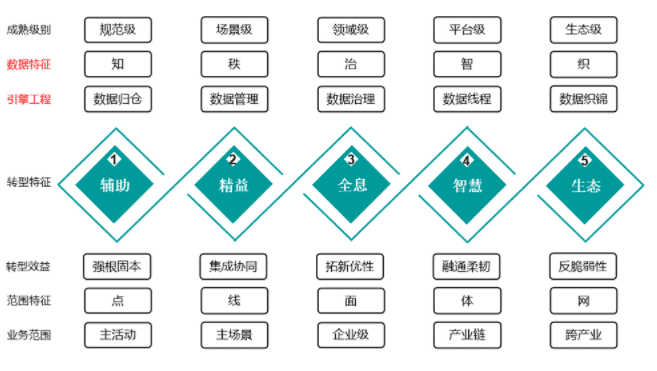
依我来看,新工业社会利用数据的方式也有多次转型:知化、秩化、治化、智化和织化,并由此引发多次数据工程。
作为数字化转型的五个引擎工程:数据归仓、数据管理、数据治理、数据线程、数据织锦,最终促成工业数字化的五次转型。
这一观点符合在中国国资委推行的国企制造业数字化转型采用的标准。该标准是由中关村信息技术和实体经济融合发展联盟(简称中信联)发布的团体标准(T/AIITRE 10004-2021)《数字化转型 成熟度模型》,该标准的成熟度级别包括规范级、场景级、领域级、平台级和生态级五级。本文也采纳这一标准。
在数据利用方式的五次转型中,中间的“三化”,即秩化、治化和智化,是当今制造业数字化中最轰轰烈烈的转型。
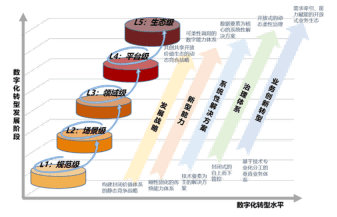
数据的“秩化”。在这个过程中,通过类似PDM、PLM、MES、ERP、MRO等传统信息化系统,将企业原本无序的数据有序化,并且同一系统之内的数据可以高度结构化。
每个系统具有界限分明的明确使命,所以数据也具有明显的边界。因此,需要通过流程协同和数据集成手段,来实现企业内关键业务之间的整合。
通过企业级业务智能(BI)手段实现全局精益。在这个阶段,针对数据的改造往往被称为“数据管理”。
数据的“治化”。在这个过程中,通过产业互联网平台的横向、纵向和端到端的互联互通,将各信息系统、各企业、全产业链内进行高度集成和融合,系统间、企业间、全链内的数据边界被打破。
通过建立全息化的数据模型来支持链内的融通化的业务模式,通过全局商业智能(BI)技术进行链内全局优化。在这个阶段,针对数据的改造被称为“数据治理”。
数据的“智化”。世间产业本无限,天下数据本无界,只要跨越甚至无视边界的技术出现,便能正本清源。大数据和机器学习就是这样的技术,在无差别的海量数据中,充分挖掘其深层智慧。
在“智化”过程中,利用人工智能系统,即兴化和自主化地跨链建立模糊化、水样化和用后即逝的业务生态和数据生态,恢复本无界限的产业生态的真面目。
也许,机会云卷云舒,价值潮起潮落,组织聚聚散散,才是人类美好生活本来的样子。在这个阶段,针对数据的改造称为“数据智能”。
现在数字工业利用数据的方式三次转型,决定了工业数字化将会有三次转型:数据的“秩化”将带来“精益转型”,数据的“治化”将带来“全息变革”,数据的“智化”将带来“智慧革命”。
最后需要说明一点,不论如何强调数据的重要性,数字化转型终究还是要以人为本。信息化以员工的职业素养和契约精神为前提,数字化以员工的学习能力和创新精神为目标。从这个角度,“一把手”工程才讲得通。
过去常说信息化和数字化是“一把手”工程,要求一把手关注一个信息化或数字化项目,要求一把手要亲自使用信息化软件或数字化平台,这其实都是与一把手的特质、定位和职责相违背的。
翻译:
Each era has its own era of stars. They should not only keep pace with The Times, but also not forget the history, or they will be lost in the present. Forget the nature of information, will also be confused by the nature of digital.
For a long time after the word “digital” was coined, there was no fuss.
Many people think that “digitalization” is “information” changed a name, is a new bottle of old wine, or the next generation of information technology; Some people think it is a generalization of the word software, and the digitalization of manufacturing industry is a generalization of the word industrial software.
Only in recent years, the emergence of “digital transformation” has made the word “digital” hot, rethought and discussed.
Since the “digital” heat up, it seems that the “information” galloping in China for three decades has melted, vaporized and evaporated. People no longer mention information, some people are ashamed to mention it, even intentionally or unintentionally belittle it.
Some people put the past information scheme to wear a digital coat to walk around the world, if the three words “digital” replaced by “information”, inside 90% of the content is deja vu.
In fact, informatization and digitization are two different and closely related concepts and words. Lazy distinction will make digitization become a copy of information, lack of progress and innovation; Fragmentation leaves digital transformation both groundless and aimless.
Indeed, “digital transformation” still has a lot of undefined meaning and inconsistent concepts, so that people do not know what to do. People look at all kinds of digital practices, and they see a lot of transformation, and there are different opinions.
I think this is because the essence and underlying logic of the word “digital” have not been identified, so I can only take a step-by-step approach. I feel that there are many things to be done in digital transformation and there are many ways to do them, but I don’t know which things I should do, which ways are suitable for me, let alone where to start.
This paper puts forward its own understanding of “digitization” and “digital transformation”, and understands the underlying logic of digital transformation together with readers.
The left and the right
Each era has its own era of stars. They should not only keep pace with The Times, but also not forget the history, or they will be lost in the present. Forget the nature of information, will also be confused by the nature of digital. People who have surfed in the tide of informatization will be full of doubts in the face of the tide of digitalization, and it seems difficult to distinguish the past informatization from the present digitalization.
People who have not washed the waves in information technology, face the complicated digital situation, eyebrows and beard all at once, always lack of rules, no essentials.
The human brain has two parts: the left brain and the right brain. The left side of the brain is the rational brain, responsible for logic and reasoning; The right side of the brain is the perceptual brain, which is responsible for intuition and art. The rationality of the left brain determines that it is realistic, factual, control and quality. The sensibility of the right brain determines that it is futurist, visionary, impulsive and innovative.
Informationization and digitalization are like the left and right brains of people. Informationization is the job of the left brain, while digitalization is the job of the right brain. When we have a clear mechanism, complete initial conditions (initial state) and boundary conditions (environment), informatization can help us improve efficiency and quality.
When our research object is beyond our understanding and the mechanism, initial state and environment are not complete, we need to use digitalization to break through our limitations and realize innovation. “Logic will get you from point A to point B. Imagination will get you everywhere.” This is what Einstein said.
The information department left
The world we live in is a mixed system of three kinds of systems: the first is natural things (such as galaxies, organisms, etc.), the second is artificial things (such as machines, production lines, etc.), and the third is organizations (such as enterprises, alliances, etc.).
Human beings are always committed to studying the operation rules of these three types of systems in order to get a clear mechanism. With clear initial conditions and complete boundary conditions, deterministic conclusions can be obtained by operation with clear mechanism, and one can predict the operation of space-time (future and distant) by the results of this operation.
In the past, people have learned operating rules such as F=ma, E=MC², engineering empirical formulas, machine principles, production execution strategies, political economy, and business management.
Based on these mechanisms, as soon as the computer was born, people could not wait to develop corresponding software, so scientific calculation, engineering checking calculation, MES, ERP, PLM, PM, MRO and other software emerged one after another.
The emergence of these software has greatly improved the efficiency and quality of human’s work and life.
Since the 1990s, the tide has grown even faster. At that time, we called it the “information age”, and the word “informationization” with Chinese characteristics began at that time.
We use the word “information” because once we understand the mechanism, we only need to feed a small amount of data to the software to get good enough feedback. These little bits of data are the initial conditions and the boundary conditions. A lot of complex computation work and data flow, inside the software is all perfectly done.
Information is a popular concept in cybernetics, and the word is meant to include the most valuable bits of “data” that can be distilled and summarized from a large amount of data.
Information contains not only clear operating mechanism, but also clear initial conditions and complete boundary conditions, that is, information contains mechanism, initial state and environment. When these elements are in place, you can develop an automated system where machines can do the work that people used to do.
Digital line right
Unfortunately, human beings are still far from perfect in the study of the operation laws of the three types of systems: natural objects, artifacts and organizations, and their grasp of more than 99% of the operating mechanisms, boundary conditions and initial conditions of the world is incomplete. The mechanisms now understood are only a very small part of the laws of the world.
The working principle of one machine seems clear, but there are many other mechanisms in the same machine that are not clear. This is especially true of the laws of business operation, otherwise there would be no “management is not only a science, but also an art” ambiguous.
Moreover, even after understanding how things work, there are many challenges in determining the boundary conditions and initial conditions.
If one of the three is unclear, the mechanism, the initial state, and the environment, the result of the calculation is basically by feeling. In the information age, we all go around it. But the information we have now will one day be used up by information technology.
Those who are experienced in information technology will find that the marginal benefits brought by information technology are getting lower and lower, because the clear mechanism, initial state and environment have entered the information system, but there are still many problems to be solved, and there are still a lot of time and space to predict.
At this time, informatization encountered a bottleneck, the ascending channel was blocked, the value curve is infinitely close to a horizontal asymptote.
Of course, humans never sit still. Information (including mechanism, initial state, and environment) is distilled from large amounts of data, complete or incomplete. In fact, the extraction of information is exactly what intelligent people do by abstracting and summarizing incomplete data.
In the past information age, the general public almost forgot this fact and went straight to the existing information to get things done.
But those smart few people are always sober, science and technology is also constantly developing, they find that new technologies (especially big data and AI technology) can summarize the mechanism, initial state and environment with a certain degree of clarity in the mass data (let’s call it “quasi-information”), and with the increase of data volume and further analysis and learning, the “quasi-information” can become more and more clear.
Quasi-information is closer to a pure mathematical expression and does not necessarily have the obvious physical and business implications of information summarized by humans. But in a certain range and under certain conditions, the law reflected by quasi-information is indeed close to the law of the real world.
In other words, new technology allows people to return to the source of information — the level of data, discover mechanisms that have not been discovered by human brain, and summarize the initial state and environment required by the mechanism.
Digitisation seems to have bypassed explicit information, but it has gone the way that informatization did.
So the digital curtain is being pulled back. If informatization is premised on clear information, digitalization is based on massive data. Digitisation seems to have bypassed explicit information, but it has gone the way that informatization did.
The premise of digitization is to completely transform the research object from the real object to the digital model. Of course, here refers to the generalized digital model, not only refers to the digitization of the body, we can reflect the characteristics and attributes of the physical object of all the digital expression of space-time relations are called “digital model”.
When the physical world is digitized, we can get the mechanism, the initial state and the environment we need, even if it is quasi-information, directly from the data of the big world.
As long as the new mechanism is in hand, the initial state and the environment are in the bag, the prediction of space-time can be a step up. Therefore, digitization is a bridge, ship or aircraft built when information goes to the ends of the earth.
CAE is the first technology to step on the road of digitization, followed by CAD.
CAE is the first technology to step on the road of digitization, followed by CAD. Both of them realize the full utilization of product data by the way of establishing holographic models, and obtain the implied and potential data by means of analysis and calculation.
Recently, a large number of digital applications are in the production and manufacturing process, operation and maintenance, enterprise management, digital economy, using complete production data, supply chain data, operation and maintenance data, enterprise data, economic data to predict the previous MES, ERP, MOR, CRM, SCM and other information software can only bypass the scene, digging the information in the data. Achieve business and management breakthroughs. The familiar predictive maintenance is a typical example.
All these applications show that when the physical world can be fully expressed digitally, all the industrial and economic dreams of mankind — Industry 4.0, industrial interconnection, intelligent manufacturing, digital twinning, metacomes, digital economy and smart business, etc. — seem to be at hand and within reach.
Comparison between “letter” and “number”
Obviously, we can’t be left and right. Digitalization without information is a tree without roots, just like a building without a foundation, will eventually collapse, leaving a vast white earth really clean. Engage in digital, information debt sooner or later is to return.
The correct posture of digital transformation is to first sort out the clear industrial mechanism and business model of the enterprise with the spirit of craftsman, get excellent operation in the information system, and then make use of digitalization for innovative development.
The word “transformation” not only represents the transformation from physical to digital, but also represents the transformation from information to digital. Therefore, advising those who try to skip the information phase and go straight to digital to fix everything through digital is wishful thinking and likely to flip over due to overtaking on a corner.
In this way, informatization comes before digitization.
Does that mean digitization is more advanced than informatization? No! Digitization is actually a recursion, a return to the source after the development bottleneck of informatization, but it is not a simple return to simplicity, but a high-level return to the spiral development of things.
Information comes from data. Does that mean information is higher than data? No! Information will eventually be translated into common sense, and no one thinks that people who only have common sense are superior. Information will eventually be translated into procedures and rules. People who only know how to follow the rules are called ordinary workers in the organization. Visionaries — business leaders, industry leaders, social visionaries, and tech geeks — tend to be those who jump out of the current information frame and intuit the future directly into the high latitude and wide range of data.
In fact, a job at any level of an organization should have this kind of intuition, because sensibility and intuition are the pathways to innovation, and innovation is the most important responsibility of the job.
Left and right complement each other
The left and right sides of the brain go hand in hand and complement each other. Rationality is good at improving quality, but not good at innovation. But without quality and efficiency, innovation and development are unreliable and have no future. Art and innovation are the dream of human life, but quality and efficiency are the foundation of survival.
Both human individual and human society grow and evolve under the joint action of sensibility and reason, intuition and reasoning.
No one wants to remove the right brain for reason and quality, and no one wants to remove the left brain for art and innovation. Both individuals and human society have first developed from simple sensibility and intuition to the height of rationality and theory, and then sublimated to excellent intuition. Good intuition is the result of a high level of experience and effective experience. It also requires frequent deep thinking and long-term observation.
There is a class of people in our society who have this kind of good and keen intuition. And they are the ones who guide the direction of your business, organization and even human beings. It is this excellent intuition that drives the development of new human theories and new technologies.
All organizational decisions are made with two brains working together. Although we cannot be sentient and intuitive, we cannot be rational and logical, let alone rely on reason. Reason can only work within the known category and comfort zone, while the unknown domain, no man’s land and anxiety zone can only be explored and explored by sensibility and intuition. The decision should be balanced, in order to balance the advantages and disadvantages. So as to maximize the benefits and minimize the damage.
Therefore, in the known category, we seek precisely sensibility and intuition to promote innovation, which is to break new ground with intuition on the basis of sufficient reason.
In the unknown field, we need to pursue rationality and logic, collect more data, use data to speak, and consolidate the results and quality of innovation. We will suffer losses if we rely entirely on emotion and intuition.
Therefore, when we talk about left and right, we do not mean to put it and digital opposite.
On the contrary, it is the mission of digitization to identify and summarize deterministic information (mechanism, initial state and environment) from data. After all, human beings still need to obtain the ultimate model with real physical and business significance like Newton and Einstein. So as to achieve substantial progress.
The information identified by digitization needs to be recursed again and finally returned to informatization. Some people say that data can help people eliminate uncertainty. In fact, data itself is not the terminator of uncertainty, but the information obtained from data is.
Therefore, we should not choose to “lie flat” because of digital means. And completely rely on data to do any business, but should do everything possible to obtain definite rules from the data. And try to enlarge the proportion of information in our business rather than the opposite.
Digitization is the innovation and development we dream of, but informatization is the quality and efficiency we live by.
Perhaps, the evaluation index of the digital team should not only look at the breadth and depth of their digital work expansion. But also look at the proportion of their digital achievements into informatization. The alternating progress and spiral rise of quality and innovation is the basic pattern of human and industrial evolution and development.
It may be considered that informatization and digitization are two strands of the DNA of intelligent industry. Just as biological DNA is composed of two strands, one of which is indispensable.
The Foundation of transformation
Here, we associate data and digitalization closely, because the digital transformation industry generally regards “data” as the god. And believes that data is the driving force of the digital transformation of manufacturing industry, and “data engineering” is its core project.
Here, what kind of digital transformation you make depends on how you use data. Just as what kind of revolution you make in industry depends on how you use energy. Because energy is what powers the atomic industry, and data is what powers the bit industry.
There have been many industrial revolutions, all driven by changes in the way we use energy. And this suggests that there will be more than one digital transition. And that the way we use data will continue to evolve.
In my opinion, the way of data utilization in the new industrial society has been transformed many times:. Knowledge, rank, management, intelligence and organization, which has led to multiple data engineering.
As the five engine projects of digital transformation:. Data warehousing, data management, data governance, data threading, data tapestry, ultimately contribute to the five transformation of industrial digitalization.
This view is in line with the criteria adopted by China’s state-owned Assets Supervision and Administration Commission for the digital transformation of state-owned manufacturing.
This standard is a group standard (T/AIITRE 10004-2021) “Digital Transformation Maturity Model” issued by Zhongguancun Information Technology and real Economy Integration Development Alliance (referred to as CITIC United). The maturity level of this standard includes specification level, scene level, domain level, platform level and ecological level. This article also adopts this standard.
Among the five transformations of data utilization mode, the middle “three transformations”, namely rank, management and intelligence, are the most vigorous transformation in the digitization of manufacturing industry today.
The “rank” of data. In this process, traditional information systems such as PDM, PLM, MES, ERP and MRO are used to order the original disordered data of the enterprise. And the data within the same system can be highly structured.
Each system has a well-defined mission, so data has clear boundaries. Therefore, it is necessary to integrate key businesses within an enterprise by means of process collaboration and data integration.
Global Lean through enterprise business intelligence (BI) approach. At this stage, the transformation of data is often referred to as “data management”.
The “cure” of data. In this process, through the horizontal, vertical and end-to-end connectivity of the industrial Internet platform, various information systems, enterprises and the whole industrial chain are highly integrated and integrated, and the data boundary between systems, enterprises and the whole chain is broken.
Holographic data model is established to support the integrated business model within the chain. And global optimization within the chain is carried out by global business intelligence (BI) technology. At this stage, the transformation of data is referred to as “data governance.”
The “intellectualization” of data. The world’s industry is infinite, the world’s data is boundless. As long as the emergence of technology that crosses or even ignores boundaries, can be the original source. Big data and machine learning are technologies that tap into the deep wisdom of undifferentiated masses of data.
In the process of “intellectualization”, the artificial intelligence system is used to establish the fuzzy, watery and vanishad-after business ecology and data ecology across the chain, restoring the true face of the boundless industrial ecology.
At this stage, the transformation of data is called “data intelligence”.
Perhaps, the opportunity cloud rolls Yun Shu, the value of the ebb and flow. The organization of the gathering and scattering, is the good life of human beings. At this stage, the transformation of data is called “data intelligence”.
At present, there are three transformations in the way of data utilization in digital industry. Which determines that there will be three transformations in industrial digitalization: the “rank” of data will bring about the “lean transformation”, the “governance” of data will bring about the “holographic revolution”, and the “intellectualization” of data will bring about the “intelligent revolution”.
Finally, no matter how much you emphasize the importance of data, digital transformation is still about people. Informatization is based on employees’ professional quality and spirit of contract. While digitization is based on employees’ learning ability and spirit of innovation. From this perspective, the “No. 1” project makes sense.
In the past, it was often said that informatization and digitization were “top” projects, requiring the top leader to pay attention to an informatization or digitization project. And requiring the top leader to personally use the informatization software or digital platform. Which actually goes against the characteristics, positioning and responsibilities of the top leader.
本文由数字化转型网(www.szhzxw.cn)转载而成,来源:踏雪当歌,作者:田锋;编辑/翻译:数字化转型网宁檬树。

免责声明: 本网站(https://www.szhzxw.cn/)内容主要来自原创、合作媒体供稿和第三方投稿,凡在本网站出现的信息,均仅供参考。本网站将尽力确保所提供信息的准确性及可靠性,但不保证有关资料的准确性及可靠性,读者在使用前请进一步核实,并对任何自主决定的行为负责。本网站对有关资料所引致的错误、不确或遗漏,概不负任何法律责任。
本网站刊载的所有内容(包括但不仅限文字、图片、LOGO、音频、视频、软件、程序等) 版权归原作者所有。任何单位或个人认为本网站中的内容可能涉嫌侵犯其知识产权或存在不实内容时,请及时通知本站,予以删除。